© 2019, IRJET | Impact Factor value: 7.211 | ISO 9001:2008 Certified Journal
| Page 241
Improving Productivity in a Mechanical Industry using Industrial
Engineering Tools and Techniques
Sumit Salunke
1, Sujeet Sirame
2, Madhura Mali
3, Sandesha Rathod
4, Prof.V.P. Kulkarni
5(1,2,3,4)
Students of School of Mechanical and Civil Engineering, MIT Academy of Engineering, Alandi (D).
SPPU University
5
Assistant Professor of school of Mechanical and Civil Engineering, MIT Academy of Engineering, Alandi(D).
SPPU University
---***---Abstract -
Productivity improvement is to do the right things better and make it a part of continuous process. Therefore, it is important to adopt efficient productivity improvement technique so as to ensure individuals and organization’s growth in productivity. The aim of this paper is to study the implementation of industrial engineering tools in a paint industry. This study started with observing the standard operation procedures and understanding the existing process flow. At the same time, observations at the production line were made to identify problems and areas of possible improvements. Time study, method study and layout study techniques formed an integrated platform to help identify and rectify the time lost in unnecessary movements of labour and tools which resulted in long machine idle time.Key Words: Work Study, Time Study, Layout Study, Productivity, Material Handling Improvement.
1. INTRODUCTION
Productivity is the ratio between output and input. It is quantitative relationship between what we produce and what we have spent to produce. Productivity is nothing but reduction in wastage of resources like men, material, machine, time, space, capital etc. It can be expressed as human efforts to produce more and more with less and less inputs of resources so that there will be maximum distribution of benefits among maximum number of people. Productivity denotes relationship between output and one or all associated inputs. European Productivity Council states that ‘Productivity is an attitude of mind’. It is a mentality of progress of the constant improvement of that which exists. It is certainty of being able to do better than yesterday and continuously. It is constant adoption of economic and social life to changing conditions. It is continual effort to apply new techniques and methods. It is faith in human progress. In the words of ‘Peter Drucker’ productivity means a balance between all factors of production that will give the maximum output with the smallest effort. On the other hand, according to International Labour Organisation productivity is the ratio between the volume of output as measured by production indicates and the corresponding volume of labour input' as measured by production indices and the corresponding volume of labour input as measured by employment indices. This definition applies to an enterprise, industry or an economy as a whole.
This project was taken up in the Sant Engineering pvt. Ltd. Company, mainly manufactures precision machined components which fit into various Front Axle Assemblies, Transmission Assemblies, Engines, Gearboxes Chassis & various other sub-assemblies of commercial vehicles and farming equipment’s such as tractors & combines. And also specialized in manufacturing of cold bend high tensile U Bolts for suspension assembly of medium & heavy duty trucks. With the development of components for the joint venture of Ashok Leyland & John Deere based in Chennai, we will now be catering to the construction equipment industry also. Time study is a structured process of directly observing and measuring human work using a timing device to establish the time required for completion of the work by a qualified worker when working at a defined level of performance. The main objective of this project was to achieve efficient production by comprehensive approach to minimize wastes by eliminating redundant movement of material, waiting and delays, over processing, excess worker motion and the need of rework and corrections. Each step of the manufacturing process was weighed against what value did it add to the whole process flow and was eliminated, combined, rearranged or simplified accordingly like unnecessary movements of operator and material. Working on improved material handling could act as catalyst in reducing the total time considerably. It also helped to provide ergonomic benefits by reducing human effort and thereby fatigue. Applying Layout study concepts, it helped in identifying unsystematic placement of materials which was shifted to new locations for better and faster accessibility.
2. LITERATURE REVIEW
© 2019, IRJET | Impact Factor value: 7.211 | ISO 9001:2008 Certified Journal
| Page 242
Pulkurte expressed their thoughts as,
Effective planning and designing of manufacturing processes and
equipment helps in achieving optimum productivity through maximum utilization of the resources available
leading to least possible industrial wastage thus resulting in low production cost. The aim of this paper is to
study the implementation of industrial engineering tools in a paint industry. This study started with observing
the standard operation procedures and understanding the existing process flow. At the same time, observations
at the production line were made to identify problems and areas of possible improvements. Time study, method
study and layout study techniques formed an integrated platform to help identify and rectify the time lost in
unnecessary movements of labour and tools which resulted in long machine idle time. The packaging method
used was conventional and time consuming which was simplified. There were suggestions proposed how
redesigning of the process flow and efficient material handling could save idle time for machines, how replacing
the old packaging method with use of zip ties would require less manpower and could help mitigate the
non-value added activities, thereby resulting in improved productivity of the industry.
2.2 The research paper titled as ‘Productivity Improvement Using Time Study Analysis In A Small Scale
Industry’ [2] whose authors, Sai Nishanth Reddy, P. Srinath Rao expressed their thoughts as,
The pattern
of economic competitiveness has changed globally now days. Many countries have joined the global economic
competition to capture global market in order to remain profitable and competitive by increasing its
productivity. There are many factors that influence the productivity of a manufacturing organization. The most
widely tackled issue is how to improve efficiency and productivity. Motion and time study technique is one of
the productivity improvement techniques used in many manufacturing companies. Motion and time study is
defined as a scientific analysis method designed to determine the best way to execute the repetitive task and to
measure the time spent by an average worker to complete a given task in a fixed workplace. In manufacturing
industries, assembly line is also another major area to be taken into consideration for increasing productivity.
Throughout the study, the aim is to propose a new system to the related company to increase their productivity.
The purpose of this paper is to discuss related issues of motion and time study implementation and assembly
line balancing and its influence toward productivity improvement. Data from a study carried out on a sample of
manufacturing industry small scale solar appliances shows that motion and time study implementation and
assembly line balancing contributes positively towards achieving productivity.
2.3 The research paper titled as ‘Set-up time Reduction of a Manufacturing Line using SMED Technique’ [3]
whose authors, Shashikant Shinde, Satyasheel Jahagirdar, Shriram Sane, Varsha Karandikar expressed
their thoughts as,
Nowadays, forging industries are adopting new tools and techniques to increase
productivity, operational availability and better overall efficiency of the production line. This research describes
the improvement in the set-up time process of a straightening cell on Axle Beam line. SMED is one of the many
lean production techniques for reducing waste in a manufacturing process. The Single-Minute Exchange of Die
(SMED) methodology and other Lean Production tools (5S, Visual Management, Kaizen and Standard Work)
were applied to reduce the setup time. As a result, the process setup time was significantly lowered (from 52 to
24 minutes). The percentage reduction in the set-up time 53.85%.
3. METHODOLOGY
To have a first-hand knowledge of the production flow and to be familiar with the activities being performed at the floor shop, the researcher went through the facility and identified each operation process involved from raw materials to finished goods, identified all the places where inventory is stored between the processes, and observed how the material flowed from one operation to another. There are a number of techniques in Industrial Engineering which are suitable for eliminating wastes. Amongst these techniques the researcher opted for Work Study techniques which are Method Study and Work Measurement. Following the basic procedure of Method Study, the first challenge was to select the product to be studied.
3.1 Selection of Product
© 2019, IRJET | Impact Factor value: 7.211 | ISO 9001:2008 Certified Journal
| Page 243
pulley was selected as it would become easier for the researcher to proceed with the next step that was to collect data and the other relevant facts.3.2 Recording Facts
[image:3.595.56.543.288.521.2]Data recording was the most crucial step as the success of the whole procedure depended entirely on the accuracy with which the facts were recorded, the basis of which would provide critical examination and the development of the improved method. Recording was done with the help of Flow Process Chart- Man Type and String diagram. But before any of these charts could be constituted it was required for the researcher to do the time study. The first step of time study involved a detailed analysis of the operation flow by direct observation. The entire process was broken down into elements. This was required to identify the non-productive activities and separate them from the productive ones. However, it was not possible to segregate the process into elements at once so it took many attempts to successfully separate out all the elements. Time study was done for whole processing of product i.e. machining process, chemical process, packaging process, inspection, delay and storage.
Table -1: Time Study Sheet with Respect to Worker
Sr.no. Elements Distance Time
1 Removing and fixing of a job 0.5m 20 sec
2 Walk from the storage to the CNCs machines 32.16 40.2sec
3 Walk to the next CNC machine 1.24m 1.55sec
4 Walk from CNCs to the VMCs machine 55.73m 69.66sec
5 Delay - 5sec
6 From VMCs to the drilling machine 49.4m 61.75sec
7 Changing of inserts and cutting tool 18m 180sec
8 Cleaning the machine 0.5m 5sec
9 Walk from drilling machine to the CNCs 41.55m 51.93sec
10 Delay - 5sec
11 Moving till the Chemical process plant 28.75m 35.9sec
12 Quality test for the job(pulley)(2guages are required) 1m 120sec 13 Job (pulley) taken from the chemical treatment plant to the
inspection 17.36m 21.7sec
14 Packaging of pulley
(8 quantity in a box) 2m 180sec
15 Disposal 5m 600sec
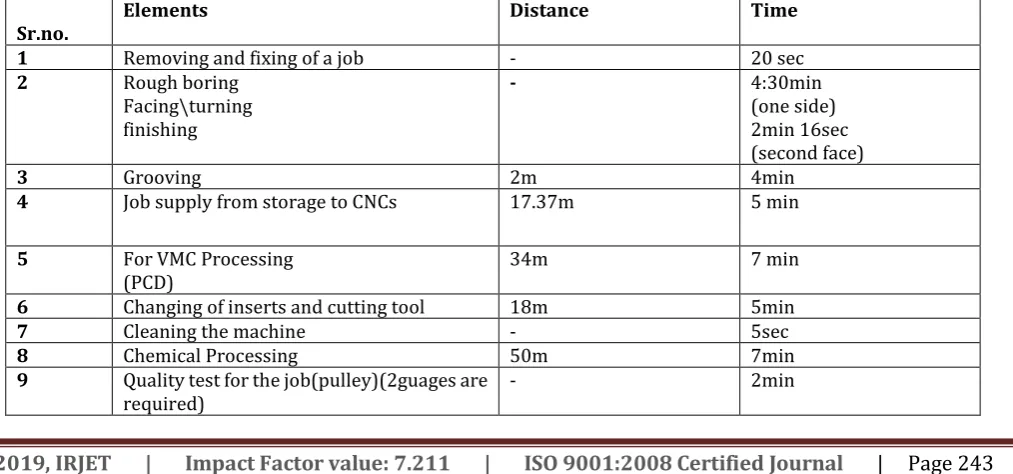
Table -2: Time Study for Pulley Manufacturing
Sr.no. Elements Distance Time
1 Removing and fixing of a job - 20 sec
2 Rough boring
Facing\turning finishing
- 4:30min
(one side) 2min 16sec (second face)
3 Grooving 2m 4min
4 Job supply from storage to CNCs 17.37m 5 min
5 For VMC Processing
(PCD) 34m 7 min
6 Changing of inserts and cutting tool 18m 5min
7 Cleaning the machine - 5sec
8 Chemical Processing 50m 7min
9 Quality test for the job(pulley)(2guages are
[image:3.595.51.558.555.792.2]© 2019, IRJET | Impact Factor value: 7.211 | ISO 9001:2008 Certified Journal
| Page 244
10 Packaging of pulley(8 quantity in a box) - 3min
11 Disposal
(loading and unloading of jobs) 5m 10mins
12 Total time required - 50min 11sec
Sr.no. Elements Distance Time
1 Removing and fixing of a job 0.5m 20 sec
2 Walk from the storage to the
CNCs machines 32.16 40.2sec
3 Walk to the next CNC machine 1.24m 1.55sec
4 Walk from CNCs to the VMCs
machine 55.73m 69.66sec
5 Delay - 5sec
6 From VMCs to the drilling
machine 49.4m 61.75sec
7 Changing of inserts and
cutting tool 18m 180sec
8 Cleaning the machine 0.5m 5sec
9 Walk from drilling machine to
the CNCs 41.55m 51.93sec
10 Delay - 5sec
11 Moving till the Chemical
process plant 28.75m 35.9sec
12 Quality test for the job(pulley)(2guages are required)
1m 120sec
13 Job (pulley) taken from the chemical treatment plant to the inspection
17.36m 21.7sec
14 Packaging of pulley
(8 quantity in a box) 2m 180sec
15 Disposal 5m 600sec
© 2019, IRJET | Impact Factor value: 7.211 | ISO 9001:2008 Certified Journal
| Page 245
3.3 Examining the facts Problems identified
Improper Layout leading to excessive movements Improper placement of tools
Non-productive activities adding no end value Improper Material handling
Traditional and time consuming methods of packaging Traditional methods and equipment of manufacturing Poor ergonomics
3.4 Developing the Improved Method
This stage of method study is about establishing the most practical, economic and effective method by taking into accounts all the circumstances. Categorizing the identified problems, the proposed solution are as follows.
3.4.1 Developing of Improved Layout
[image:5.595.134.458.361.745.2]The way of arrangement of material and machinery define the layout in that area. A careful analysis of the flow was done before concluding to changes in the present layout since changing the layout is a costly process as it involves movement of heavy duty machineries and stoppage of production.
© 2019, IRJET | Impact Factor value: 7.211 | ISO 9001:2008 Certified Journal
| Page 246
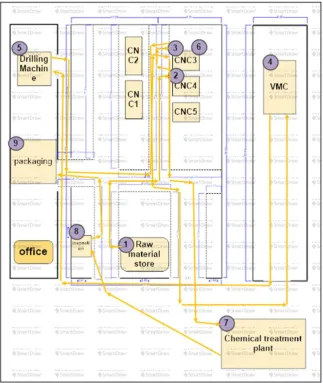
Following observations were made in original layout (Refer to fig-1), [image:6.595.65.521.148.696.2] Total distance travelled =337.19m Average speed of the worker=0.8m/s Time required=337.19/0.8=7.9 min
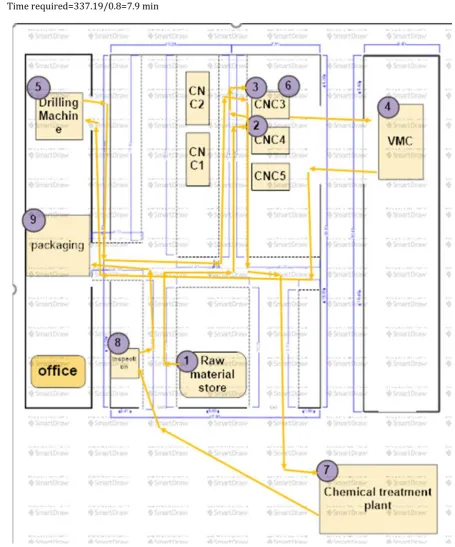
Fig -2: Proposed Layout
© 2019, IRJET | Impact Factor value: 7.211 | ISO 9001:2008 Certified Journal
| Page 247
Time required=176.1/0.8=3.6 min Time saved=7.9-3.6= 4.3 min
Following problems were identified with the help of string diagram (Refer Fig-1):
The VMC machine kept away from processes.
While reaching the VMC machine we have to carry heavy load of pulleys which require efforts and time.
To increase free space and improve worker’s and material’s safety, following suggestions were made (Refer to Fig-2):
Between VMC machine and CNC machine, we will plant a conveyor belt which carry pulleys from CNC
machine to VMC machine and vice versa. Which will reduce worker’s efforts and time.
Also the after VMC processing we have to send pulleys to drilling machine and because of the improved
layout this time will also be saved.
Improvement in Material handling
3.4.2
Improvement in Material Handling
Movement and handling of materials from one point to another in the course of processing involves significant time
and effort. Although it is costly and adds no end value to the product, it cannot be eliminated completely but can be
reduced substantially if appropriate methods and equipment’s at lowest possible cost are implemented with regard
to safety. To eliminate supererogatory worker’s motion and redundant movement of material the following changes
the researcher proposed:
I.
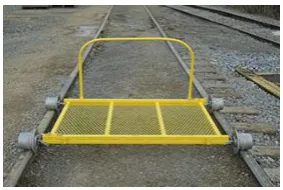
Motorized rail carrier
In present condition workers use hand cart to shift the heavy parts which take efforts and time. To solve the above
problem, we suggest to use a motorized rail carrier which is easy to use, easy to handle and saves time. [image:7.595.356.498.454.549.2]Fig -3: Existing Method Fig -4: Proposed Method
II.
Automatic Packing Machine
In present condition workers pack the boxes with hand which take a lot of time for packaging. To overcome this, we suggest to use an automatic packing machine which packs the boxes 10 times faster than worker.
© 2019, IRJET | Impact Factor value: 7.211 | ISO 9001:2008 Certified Journal
| Page 248
[image:8.595.140.455.142.356.2]3.4.3
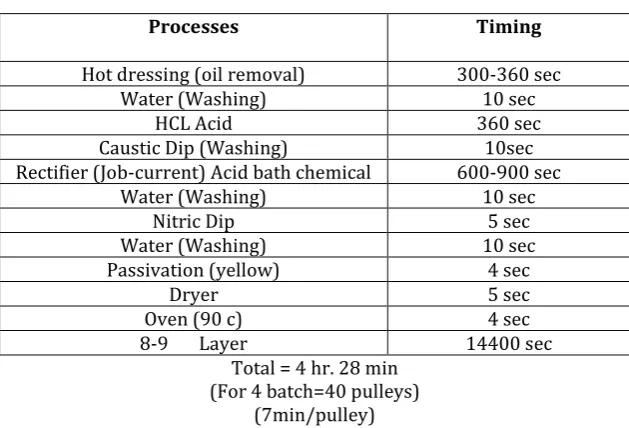
Improvement in Chemical Treatment
Table -3: Chemical treatment processes
Processes Timing
Hot dressing (oil removal) 300-360 sec
Water (Washing) 10 sec
HCL Acid 360 sec
Caustic Dip (Washing) 10sec
Rectifier (Job-current) Acid bath chemical 600-900 sec
Water (Washing) 10 sec
Nitric Dip 5 sec
Water (Washing) 10 sec
Passivation (yellow) 4 sec
Dryer 5 sec
Oven (90 c) 4 sec
8-9 Layer 14400 sec
Total = 4 hr. 28 min (For 4 batch=40 pulleys)
(7min/pulley)
In present chemical treatment process the time required for rectifier acid bath can be reduce by following methods-
Current Density can be increase to increase the plating rate. However, there is a maximum point where too high current density will create another set of problems such as burning and poor quality work.
Increasing the metal concentration in the process solution will increase the plating rate.
Bath pH concentration will impact plating rate. At lower pH concentration, hydrogen will plate out like a metal; thus, competing and lower the plating rate of the desired metal.
The concentration of the organic package such as wetter’s or brighteners will affect plating rate depending on the situation. For example, too much organic additives may reduce the plating rate, or wetter’s may be required so the part to have a good cathode film which may increase the plating rate.
Unwanted organic or metallic contamination will negative impact on the plating rate.
Temperature: most chemical processes increasing temperature can increase the rate of reaction such as increasing the plating rate, but it may also have a negative impact on the plating rate as well depending on the situation.
Solution agitation will affect plating rate. Increase the solution agitation will increase plating rate.
In a barrel plating operation, slower barrels’ speeds will increase the plating rate by increasing your coefficient of electrical contact within the barrel.
Thus by using above method we can save 3 min./pulley.
Table -4: Chemical treatment processes
Sr.
No. Manufacturing with: Packaging time Handling (layout time) Chemical Treatment time
On CNC time Total time
(min) Time saved
01 Present Method 4min 7.9min 7min 31.1min 50.18min
9.3min
[image:8.595.38.571.630.707.2]© 2019, IRJET | Impact Factor value: 7.211 | ISO 9001:2008 Certified Journal
| Page 249
3.5 Evaluation of developed methods Time saved after improvement in layout = 4.3 min. Time saved after improvement in chemical treatment=3min Time saved after improvement in packaging =2min
Therefore, total time saved in 1 batch (10 pulleys) = 9.3min
Shift Timings 22hrs including lunch break, tea break, morning meeting. Total Available time = 1320 minutes
Number of pulleys manufactured and packed per batch= 10 Number of working days in a month= 26
3.5.1 With Present Method
Number of batches that can be performed is 1320 ÷ 50.18 = 26.3 batches
Number of pulleys that can be manufactured and packed in 26.3 batches is 26.3 × 10 = 263 pulleys
Number of pulleys that can be manufactured per month is 263 26 = 6838 pulleys
3.5.2 With proposed Method
Number of batches that can be performed 1320 ÷ 40.88 = 32.28 batches
Number of pulleys that can be manufactured and packed in 32.8 batches 32.8 × 10 = 328 pulleys
Number of pulleys that can be produced per month 328 × 26 = 8528 pulleys
Increment in production of pulleys is 8525 - 6836 = 1690 pulleys
Therefore, increment in productivity is (1690/ 6836) × 100 = 24.8 %
4. CONCLUSION
This study analyzed the existing state of manufacturing and proposed improved methods, the implementation of which resulted in increased production capacity, improved productivity and reduced human efforts. With the implementation of work study principles, the results of the study were a success. Production operators were instrumental to the success of each improved method. By applying their knowledge to the processes allowed the researcher to provide the best solutions to the issues within the process. With the increase in productivity by approximately 19% shows 24.8% the correct application of industrial engineering techniques can have a positive impact within any company.
5. REFERANCES
Varsha Karandikar, Shriram Sane, Rahul Pulkurte, Improvement in Line Feeding System in Assembly Plant using Lean Manufacturing Technique, International Journal of Current Engineering and Technology, E-ISSN 2277 – 4106, P-ISSN 2347 – 5161.
Aakash Jaiswal, Shriram Madhukar Sane, Improving Productivity in a Paint Industry International Journal of Advance Industrial Engineering, E-ISSN 2320 –5539 http://inpressco.com/category/ijaie/