http://www.scirp.org/journal/ajcc ISSN Online: 2167-9509
ISSN Print: 2167-9495
DOI: 10.4236/ajcc.2018.71006 Mar. 28, 2018 54 American Journal of Climate Change
Disaster-Related Resilience as Ability and
Process: A Concept Guiding the Analysis of
Response Behavior before, during and after
Extreme Events
Janos J. Bogardi
1, Alexander Fekete
21Stellenbosch Institute of Advanced Study (STIAS), Wallenberg Research Centre at Stellenbosch University, Stellenbosch,
South Africa
2Institute of Rescue Engineering and Civil Protection, TH Köln (University of Applied Science Germany), Köln, Germany
Abstract
Extreme weather and climate events research needs concepts to analytically capture processes that describe how extreme they are: depth of impact but mainly also temporal aspects such as length, speed and quality of recovery. This paper analyses resilience as a concept to provide these dimensions. The use of the term resilience proliferates in many contexts and disciplines. Inter-pretations may overlap or even contradict each other. This paper seeks to make a case for a more nuanced understanding of resilience, including the use of “qualifier adjectives” to emphasize differences. Starting from the original etymological meaning of resilience as “bouncing back” the paper aims an in-novative (re)conceptualization to facilitate the practical use of resilience in disaster risk management. It is recommended to distinguish between resi-lience as ability, being a hazard independent pre-disposition for recovery, and resilience as a process, describing different bouncing back and bouncing for-ward mechanisms inherent in the different recovery phases. This proposed distinction would enable the assessment of recovery abilities before calamities occur and hence could serve as guide to disaster preparedness programmes. The suggested analysis of resilience as a process would open opportunities to use the concept describing preemptive resilience response (presilience), re-covery as bouncing back towards a state preceding the hazard event, as well as progressive resilience (prosilience) as bouncing forward and transition of the disaster recovery phase into adaptation and further development.
Keywords
Resilience Definition, Resilience as Ability and Process, Preemptive How to cite this paper: Bogardi, J.J. and
Fekete, A. (2018) Disaster-Related Resi-lience as Ability and Process: A Concept Guiding the Analysis of Response Behavior before, during and after Extreme Events. American Journal of Climate Change, 7, 54-78.
https://doi.org/10.4236/ajcc.2018.71006
Received: December 19, 2017 Accepted: March 25, 2018 Published: March 28, 2018
Copyright © 2018 by authors and Scientific Research Publishing Inc. This work is licensed under the Creative Commons Attribution International License (CC BY 4.0).
http://creativecommons.org/licenses/by/4.0/
DOI: 10.4236/ajcc.2018.71006 55 American Journal of Climate Change Resilience, Bouncing Back, Progressive Resilience
1. Introduction: What Is Resilience?
Extreme events research on weather and climate needs concepts to analytically capture processes that describe how extreme they are: depth of impact but mainly also temporal aspects such as length, speed and quality of recovery. This paper analyses resilience as a concept to provide these aspects and investigates components of resilience as well as clarifying overlapping definitions. Interdis-ciplinarity is key in extreme events research, and building bridges between ex-treme events and societal impacts and the disciplines and concepts attached to both, is important. Since, in addition to the aspects of the extreme event itself, it is also the social response to extremes, which at least determines whether ex-treme events lead to disasters, or not. This conjunction may become a more pressing topic as climate change extreme events continue to impact societies.
Resilience is a term that has gained cross-disciplinary attention in recent years. It already flourishes in certain disciplines while ever more other discip-lines are beginning to discover it [1] [2] [3]. Increasingly the adjective “resilient” can be found in many conference titles, irrespective of the subject of the event. In some fields such as Disaster Risk Reduction (DRR) or Climate Change Adap-tation (CCA), its overuse is already debated. This paper aims at analyzing traces of a possible “hiatus” and for signs of a “requiescence” of the term. While the scrutiny of resilience by its terminological fuzziness is not novel, this paper seeks to make a case for a nuanced understanding of resilience, very much in the sense of its original etymological meaning of “bouncing back”, or “bouncing forward” [4] in order to facilitate its practical applicability at least in the area of disaster risk preparedness and research. This paper aims at analyzing resilience both as (inherent) ability of potentially hazard impacted referent(s) and as a process dominating the recovery phase once a hazard event hits.
Alexander [5] describes a two millennia long evolution and usage of the term “resilience” across different disciplines and epochs. It also analyzes its rather chaotic contemporary utilization. His paper shows that resilience has risen in a number of disciplines and that its use dates back way beyond often cited “ances-tor” lines that start, for instance in the field of DRR, in the 1970s. Earlier usages of the term are not necessarily within strict scientific contexts or within the same disciplines. There is a growing number of papers critical on fuzzy terminology and apparent overuse of the term “resilience”. It could have been expected that after the publication of Alexander’s paper a certain scientific rigor in the resi-lience-related terminology and restrain in its indiscriminate use would occur. However, this expectation did not materialize.
relin-DOI: 10.4236/ajcc.2018.71006 56 American Journal of Climate Change quish its appeal. Irrespective of the multitude of (sometimes even contradictory) definitions and concepts [6] [7] and others which should be counterproductive to its popularity, the term “resilience” is still widely used. The original meaning of the word was changed and the term “has frequently been appropriated” without much thought.
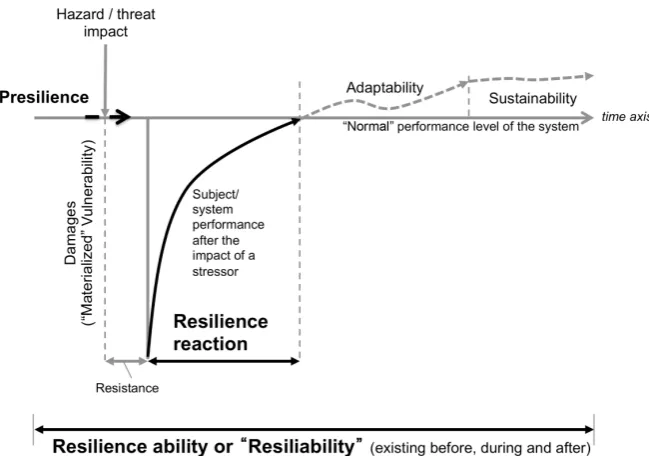
Definitional laxity, which increasingly characterizes resilience, may be helpful to adapt it into new contexts, or, to stimulate interdisciplinary dialogue [8], p. 14. But especially in research aiming to apply the concept of resilience, be it qua-litative or quantitative assessments such as risk indices or damage functions, more scientific rigor for narrowing down resilience should be observed. For example, new, aggregated resilience metrics have been developed and are pro-posed as replacements for risk-based performance assessment [9] [10]. While the proposed metric enables the dynamic change of “resilience” to be monitored and hence contributes to the comprehensive assessment of how a disaster and the recovery unfold, it is different from the resilience metric (time elapsed between the disaster and the achievement of pre-disaster performance level, see also
Fig-ure 1) as proposed by Hashimoto et al. [11] and Duckstein et al. [12] for water
resources systems. Other well-known resilience definitions like Holling [13] [14] [15] [16] are also different as they emphasize the stability of the system, whereas the Hashimoto et al. concept focuses on the rapidity of the recovery without considering whether the system left temporarily its original state (what is ex-pected to occur as consequence of a massive hazard revealing the vulnerability of the referent) or not.
Replacements of risk as an overall term in exchange for resilience have been documented at EU and international level in a variety of fields related to disaster risk [8], for instance, in spatial risk assessments or threat and consequence as-sessments of risks to critical infrastructures [17]. Béné et al. [1] discuss the ad-vantages and drawbacks of the resilience concept for vulnerability reduction and poverty alleviation programs.
2. The Appeal of Resilience and the Cacophony It Has Led to
While some publications underline the appeal of resilience for its positive con-notation and suggest a broadening of the use of resilience in an encompassing way covering aspects not limited to “bouncing back” only [4] [5] [18] [19] [20] [21], at the same time also appeals for more operationalization of resilience can be observed [7]. For those following an analytic approach and especially within a more quantitative or engineering approach, the existence of resilience as an “umbrella term” meaning several aspects, overlapping with vulnerability or sus-tainability or with other frequently used and sometimes rather ill-defined terms, can be frustrating. The prevailing “cacophony” in the definition of resilience is counterproductive to operational use.DOI: 10.4236/ajcc.2018.71006 57 American Journal of Climate Change while vulnerability seems increasingly being used for applications only [8]. Resi-lience, in the context of its original etymological meaning “to bounce back” might be interpreted as one of the abilities (or capacities as termed by other au-thors, for example, Turner et al., [22] p. 8075) enabling reduction in vulnerabili-ty, but certainly does not substitute for resistance, robustness, risk sharing, knowledge and other aspects that may also reduce vulnerability to disasters [18] [20] [21]. By aggregating too many features under the term “resilience” concep-tual clarity is lost. Resilience is an important, but by no means unique, ability of the affected system to absorb shocks, resist, buffer, and adapt amongst others. It should rather characterize, with well-chosen and measurable parameters, the ability to bounce back to the pre-disturbance state or to bounce forward and achieve a new, but desirable state [4].
Resilience, if interpreted very strictly in the sense of Hashimoto et al. [11] and Duckstein et al. [12] (see Figure 1), may not even be a factor mitigating vulnera-bility. Resilience is conceived simply to be measured as the time needed for a recovery. As Figure 1 depicts, resilience is seen as a process occurring after the exposure of vulnerable referents to the hazard, which is manifested in disaster losses. It is noteworthy that Manyena et al. [4] also note that “the resilience and vulnerability paradigms are still locked together and increasingly being treated as if they are one and the same” and argue that this should not be the case. Of course, the general assumption that lower vulnerability is usually followed by a quicker recovery is most likely valid.
[image:4.595.211.536.448.676.2]The reactive nature of resilience implies that this “response” to a disturbance should be triggered from within the affected system, preferably as self-reaction.
DOI: 10.4236/ajcc.2018.71006 58 American Journal of Climate Change This makes the application of the idea of resilience for ecosystems [13], or to so-cial-ecological systems [23] appealing. For technical systems as long as the me-chanical elasticity of the materials involved suffice to compensate the impact, re-silience takes place automatically. This can be well observed for example in the case of elasticity during regular operation of railway lines and bridges. Once these material properties are insufficient to trigger automatic resilience, post impact external intervention will be needed to initiate resilience (bouncing back to normal (pre-impact) state. After all, no collapsed bridge can rebuild itself.
3. Resilience and Its Definitions: A Review of the State
of the Art
The Publication of the Stockholm Resilience Center [23] “What is resilience? An introduction to social-ecological research” subscribes already in the title to a broad interpretation of resilience.
Shocks and disasters certainly open “windows of opportunity”. But can this process be equated with resilience? Isn’t it the chance to bounce, or rather jump forward? However, resilience is seen here as an adaptive process, hence cannot be really defined in advance as it reveals itself as a process whereby resilience gets into motion and evolves.
The term resilience is suffering from the relentless efforts of scientists to rede-fine and to overload it. The “purist” definition of resilience as bouncing back [11] what was called by Holling [15] as “engineering resilience”, refers simply to the ability of the system to recover after a disturbance (virtually without extra external help and investment). It could be measured as the time needed to ac-complish this bouncing back process based on the inherent elasticity and sup-pleness of the system. These inherent features or abilities are being exposed to and impacted by the occurrence of hazard event(s).
There are many more different interpretations of resilience exist. In one of the most comprehensive studies Bruneau et al. [6] claim that a resilient system shows the following abilities (Page 4 of the Bruneau et al. paper):
• Reduced failure probabilities.
• Reduced consequences from failures (expressed in terms of lives lost, damage etc.).
DOI: 10.4236/ajcc.2018.71006 59 American Journal of Climate Change is neither very logical, nor easy to be interpreted. Furthermore, it certainly makes much more difficult to derive a single, physically and monetarily inter-pretable index for this aggregated three features in one measure called (by Bru-neau et al. [6]) resilience. The same paper also introduced four “properties” representing resilience:
“Resilience for both physical and social systems can be further defined as con-sisting of the following properties:
Robustness: strength, or the ability of elements, systems, and other units of analysis to withstand a given level of stress or demand without suffering degra-dation or loss of function.
Redundancy: the extent to which elements, systems, or other units of analysis exist that are substitutable, i.e., capable of satisfying functional requirements in the event of disruption, degradation, or loss of functionality.
Resourcefulness: the capacity to identify problems, establish priorities, and mobilize resources when conditions exist that threaten to disrupt some element, system, or other unit of analysis; resourcefulness can be further conceptualized as consisting of the ability to apply material (i.e., monetary, physical, technolo-gical, and informational) and human resources to meet established priorities and achieve goals.
Rapidity: the capacity to meet priorities and achieve goals in a timely manner in order to contain losses and avoid future disruption”(Bruneau et al. [6], page 738).
These “properties” further overload resilience as an “umbrella concept”. Ro-bustness and redundancy are eminent features (abilities) of any technical or so-cioecological system. They enhance safety and security of the system perfor-mance, but they rather mitigate the extent of the impact of a stressor than di-rectly contributing to the speed of recovery (which was seen as resilience by Ha-shimoto et al. and Duckstein et al.). As redundancy and robustness mitigate the manifested vulnerability the subsequent recovery can of course be shorter due to the reduced amplitude of the perturbation of the system (see Figure 1). Re-sourcefulness and rapidity, as defined by Bruneau et al. [6] are clearly virtues (personal abilities) of the managers entrusted to operate the respective systems including the recovery after disturbances and rectifying their consequences. All four “properties” as called by Bruneau et al. “help” or serve as basis for resilience but it is claimed here that they are not directly part of it as a process. These four properties: robustness, redundancy, resourcefulness and rapidity, introduced by Bruneau et al. [6] resurface, among others, in the publication of Simonovic and Arunkumar [10], however with a somehow different interpretation.
Further in their study Bruneau et al. [6] stated that resilience has four dimen-sions:
“… resilience can also be conceptualized as encompassing four interrelated dimensions: technical, organizational, social, and economic”.
meas-DOI: 10.4236/ajcc.2018.71006 60 American Journal of Climate Change
ure of performance. Instead, different performance measures are required for different systems under analysis. Research is required to address the quantifica-tion and measurement of resilience in all its interrelated dimensions”…
These four “dimensions” can be seen as an earlier formulation of what is termed in this paper as “qualifier” adjectives of resilience. Bruneau et al. are ab-solutely right in their warning that these “dimensions” cannot be captured by one single aggregate measure (indicator).
Holling [13] [15], made a clear distinction between ecological resilience and engineering resilience, not to be mixed with yet another term “resilience engi-neering” [24]. The use of the term ecological resilience is justified to measure the stability of an ecosystem that returns to its original equilibrium state after the impacts of a disturbance. In fact, if an ecosystem cannot recover and flips into a new equilibrium state, it proves its non-resilience; in most cases it still remains an, albeit different, ecosystem. These multiple states of a technical system are usually not foreseen. Once a tipping point is passed the system’s functionality might be irrevocably lost. Its engineering resilience can then be characterized by an indefinitely long bouncing back timespan. For example, a reservoir built for storing water for water supply, flood control and energy generation may lose all these functions if the reservoir is completely filled by sediments or debris flow from an upstream landslide.
DOI: 10.4236/ajcc.2018.71006 61 American Journal of Climate Change another, widened meaning.
The paper of Kelman et al. [25] does not define either vulnerability or resi-lience. They rather lament about the overemphasis on quantitative approaches of vulnerability and resilience (V + R). It is however doubtful that this is really the observable trend. Many features of even a very carefully and simply defined ‘re-silience’ are neither adequately nor sufficiently quantified. At least comparisons between different spaces and affected societal groups should be made. The ex-clusive use of qualitative approaches would jeopardize V + R based prioritization of actions and investments. The big value of V + R would be if they were known-preferably quantitatively-before an extreme event’s impact (disaster) oc-curs. Otherwise the value(s) of V + R if estimated after the events struck would “degrade” from being a diagnosis to a post mortem report on the “pathology” of the disaster. In the section “Conceptual differentiation between resilience as ability and as process” of this paper similarities between vulnerability and resi-lience (as ability) will be highlighted whereas resiresi-lience as process is orthogonal to vulnerability as shown also in Figure 1.
Weichselgartner and Kelman’s paper [18] provides an excellent summary seen through geographers’ eyes. One can agree with most of their statements warning that risk reduction and sustainability frameworks should be used as overarching models rather than using an untested, ill-defined resilience framework. “Quan-titative” resilience is not absolute. First and foremost, there is the question to be answered: resilient to what? Their comments resonate well with the key sugges-tion of this paper, namely that resilience, like vulnerability should be split into a hazard independent core summarizing the resilience abilities and to a hazard dependent resilience process activated (switched on) through exposure of the referent to the hazard impacts.
Excellent short descriptions of emerging resilience frameworks in the UK, USA, OECD and COAG (Council of Australian Governments) and UN-ISDR are presented by Weichselgartner and Kelman [18]. Basically all frameworks are formulated without rigorous definition of the term and without conceptual clar-ity what is meant by and how to measure resilience. Hence there is no real objec-tive metric to estimate the success of the respecobjec-tive initiaobjec-tive(s). In the UK ap-proach resilience is featured as focusing on 4 components: resistance, reliability, redundancy and response/recovery. Again four “features”, but different ones than the proposed ones in Bruneau et al. [6]. But why should resilience sum-marize all four? Can these be measured by an aggregate index? Is it desirable and can it serve as a basis for real world decisions that may focus on any of the above listed components rather than addressing them all simultaneously? For practical use of the concept of resilience the answer is likely to be no, particularly if quan-tification is attempted.
4. Differentiation of Resilience According to Phases in the
Disaster Cycle
in-DOI: 10.4236/ajcc.2018.71006 62 American Journal of Climate Change creasing overuse of the term “resilience” does not augur well for its “operationa-lization”. As the first step towards more clarity, the term “resilience” should not be used without certain “resilience qualifiers”:
• Scale qualifiers: personal, human, community, urban, rural, national etc.- resilience.
• Context qualifiers: ecological, engineering, place-based, psychological, sys-tem-theoretical, disaster etc.-resilience.
• Hazard qualifiers: earthquake resilience, flood resilience, or multi-hazard re-silience.
Using such qualifiers in terminology could help avoiding misunderstandings. The use of very generic slogans like “resilient city”, which is used more and more even as conference titles are not only incomplete but also misleading. A seismi-cally resilient city could be very non-resilient to flash floods and vice versa. Be-ing more precise in describBe-ing the kind of resilience meant and analyzed, for example as a “multi-hazard, urban, engineering resilience approach”, could very much facilitate identification and clarity of the discourse. These specifications would help also to counteract what could be called the “dark side of resilience”: Corrupt socioeconomic systems have proved to be fairly resilient, irrespective of which definition of resilience is used. Hence any claim of improving resilience should be based on a crisp definition and be cautious of what exactly is made more resilient in the end.
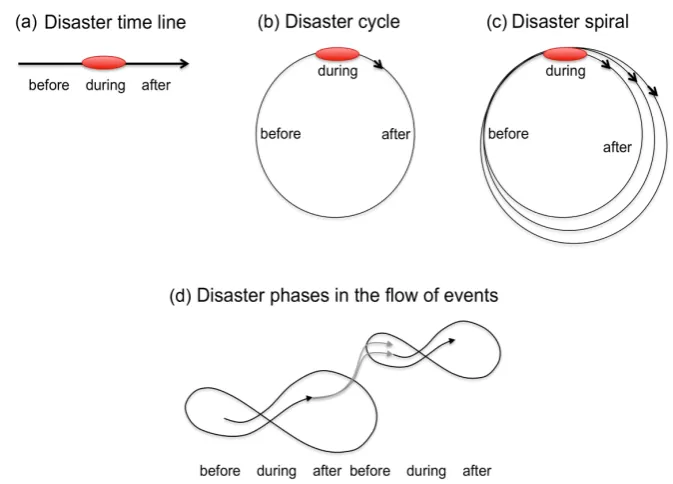
DOI: 10.4236/ajcc.2018.71006 63 American Journal of Climate Change Figure 2. Display of different conceptualizations of disaster phases according to linear time line (a), disaster cycle (b), disaster cycle extended to an evolving spiral (c) and mod-ified to match with adaptive cycle and flow of events (d).
The disaster time line ((a) in Figure 2) is a commonly found visualization of disaster phases before, during (red oval) and after a damaging hazard event. The disaster cycle (b) is also commonly used in variations of the terms of prevention, preparation, recovery and mitigation, for instance. These idealized visualizations have received critique on pointing towards a simplified linear (a) or cyclical (b) comprehension of disaster events that, in reality, are much more complex and therefore rather undulating or, not returning to exactly the previous state as be-fore. The spiral representation (c) has therefore been suggested to emphasize a cyclical yet developing model, avoiding an exact “return to the state before”. One disaster is unlike the other, with different dimensions and uneven lengths of each phase. The Holling model (d) expresses that also, but adding a continuous stability dynamic to it that might flip from one state of stability to another. This backdrop of awareness of existing models is important to outline for the equally simplified model used later in this paper (Figure 1).
Tables 1-3 summarize an attempt to collect, if not all, but at least the most frequently promoted definitions of resilience. Admittedly most of the definitions listed are coming from, or at least related to the disaster resilience literature. This constraint, however, is not counterproductive as this paper focuses on the possible operationalization of resilience in context of hazard-induced disasters. Tables 1-3 contain an illustrative list of published resilience definitions (em-phases in bold by the authors. Sources as provided and taken from resilience de-finition collections in: [6] [7] [18] [28].
[image:10.595.202.539.68.310.2]DOI: 10.4236/ajcc.2018.71006 64 American Journal of Climate Change Table 1. Abilities for one phase in the disaster cycle.
Phase of disaster cycle: Resilience as coping, withstanding
“the capacity to cope with unanticipated dangers after they have become manifest, learning to bounce back”
Wildavsky 1991, p. 77
“It is the buffer capacity or the ability of a system to absorb perturbation, or the magnitude of disturbance that can be absorbed before a system changes its structure by changing the variables.”
Holling et al., 1995
“Local resiliency with regard to disasters means that a locale is able to withstand an extreme natural event without suffering devastating losses, damage, diminished productivity, or quality of life without a large amount of assistance from outside the community.” Miletti, 1999
‘‘the ability of a system to withstand stresses of environmental loading” Bruneau et al., 2003
“Pliability, flexibility, or elasticity to absorb the event. Resiliency is offered by types of construction, barriers, composition of the land (geological base), geography, bomb shelters, location of dwelling, etc. As resiliency increases, so does the absorbing capacity of the society and/or the environment. Resiliency is the inverse of vulnerability.”
Journ. of Prehospital and Disaster Medicine, 2004
Phase of disaster cycle: Resilience as responding
“Resilience is a fundamental quality of individuals, groups and organisations, and systems as a whole to respond productively to significant change that disrupts the expected pattern of events without engaging in an extended period of regressive behaviour.”
Horne and Orr 1998, p. 31
“The ability to respond to singular or unique events.” Kendra and Wachtendorf, 2003
Phase of disaster cycle: Resilience as adapting/changing “Resilience is a measure of the recovery time of a system.”
Correira et al., 1987
“Resilience is the ability of an individual or organisation to expeditiously design and implement positive adaptive behaviours matched to the immediate situation, while enduring minimal stress.”
Mallak, 1998
“the capacity to adapt existing resources and skills to new situations and operating conditions.” Comfort 1999, p. 21
“Resilience is the flip side of vulnerability—a resilient system or population is not sensitive to climate variability and change and has the capacity to adapt.”
IPCC, 2001
“Resiliency is thought of as a characteristic of systems that offers flexibility and scope for adaptation whilst maintaining certain core functions (for example, access to basic needs and social stability).”
Pelling, 2003
“The term implies both the ability to adjust to normal or anticipated levels of stress and to adapt to sudden shocks and extraordinary demands.”
Bruneau et al., 2003
“The capacity of a system to absorb disturbance and reorganize while undergoing change so as to still retain essentially the same function, structure and feedbacks, and therefore identity, that is, the capacity to change in order to maintain the same identity.”
DOI: 10.4236/ajcc.2018.71006 65 American Journal of Climate Change Table 2. Abilities for two phases in the disaster cycle (bold highlighting inserted).
Phase of disaster cycle: Before and during
“Resiliency to disasters means a locale can withstand an extreme natural event with a tolerable level of losses. It takes mitigation actions consistent with achieving that level of protection.” Mileti, 1999
Phase of disaster cycle: During and after
“The capacity that people or groups may possess to withstand or recover from emergencies and which can stand as a counterbalance to vulnerability.”
Buckle, 1998
“The ability to resist downward pressures and to recover from a shock. From the ecology literature: property that allows a system to absorb and use (even benefit from) change. Where resilience is high, it requires a major disturbance to overcome the limits to qualitative change in a system and allow it to be transformed rapidly into another condition. From the sociology literature: ability to exploit opportunities, and resist and recover from negative shocks.” Alwang et al., 2001
“The capacity of the damaged ecosystem or community to absorb negative impacts and recover from these.”
Cardona, 2003
“The ability of an actor to cope with or adapt to hazard stress.” Pelling, 2003
“The ability of an organization to absorb the impact of a business interruption, and continue to provide a minimum acceptable level of service.”
Disaster Recov. Journal, 2005
“The capacity of a system—be it a forest, city or economy—to deal with change and continue to develop; withstanding shocks and disturbances (such as climate change or financial crises) and using such events to catalyze renewal and innovation.”
Stockholm Resilience Center: Sustainability Science for Biosphere Stewardship: What is Resilience? 2014
is that the definitions can be grouped into those mainly capturing, what is de-fined as resilience within one, two or more phases of the disaster cycle. This is not a very rigorous assignment and subject to the perspective chosen. However, the definitions found have been grouped whether related to one phase, such as either “stay and endure” (coping, withstanding) during the (immediate) disaster impact or, to the following phase where the system reacts and starts to recover from the impact (adapting, changing). These appear to be the most vital con-ceptual distinctions. In Figure 1 the first phase is identified as “resistance”, which can be related to “coping” and withstanding while already under hazard stress. The second phase is named “resilience” in Figure 1 and relates to the re-covery phase after the hazard stress decreases. Resilience is thus preceding the (usually slower) process of adaptation. The use of “adapting” in definitions of resi-lience as well as using multiple abilities and capacities reflect the usage of resiresi-lience as a general feature or, encompassing an even broader transformation ability.
5. Conceptual Differentiation between Resilience as Ability
and as Process
DOI: 10.4236/ajcc.2018.71006 66 American Journal of Climate Change Table 3. Abilities for multiple phases in the disaster cycle (bold highlighting inserted).
Phase of disaster cycle: Multiple
“Resilience describes an active process of self-righting, learned resourcefulness and growth—the abilityto function psychologically at a level far greater than expected given the individual’s capabilities and previous experiences.”
Paton, Smith and Violanti, 2000
“Qualities of people, communities, agencies, infrastructure that reduce vulnerability. Not just the absence of vulnerability rather the capacity to 1) prevent, mitigate losses and then if damage occurs 2) to maintain normal living conditions and to 3) manage recovery from the impact.” Buckle et al., 2000
“The concept [of resilience] has been used to characterize a system’s ability to bounce back to a reference state after a disturbance and the capacity of a system to maintain certain structures and functions despite disturbance. […] resilience of the system is often evaluated in terms of the amount of change a given system can undergo (e.g., how much disturbance or stress it can handle) and still remain within the set of natural or desirable states (i.e., remain within the same ‘configuration’ of states, rather than maintain a single state).”
Turner et al., 2003
“The capacity of a system, community or society potentially exposed to hazards to adapt by resisting or changing in order to reach and maintain an acceptable level of functioning and structure. This is determined by the degree to which the social system is capable of organizing itself to increase its capacity for learning from past disasters for better future protection and to improve risk reduction measures.”
UN/ISDR, 2004
“Ecosystem resilience is the capacity of an ecosystem to tolerate disturbance without collapsing into a qualitatively different state that is controlled by a different set of processes. A resilient ecosystem can withstand shocks and rebuild itself when necessary. Resilience in social systems has the added capacity of humans to anticipate and plan for the future.” Resilience Alliance, 2005
“The capacity of a system, community or society potentially exposed to hazards to adapt, by resisting or changing in order to reach and maintain an acceptable level of functioning and structure. This is determined by the degree to which the social system is capable of organising itself to increase this capacityfor learning from past disasters for better future protection and to improve risk reduction measures.”
UNISDR, 2005
“The ability of a system, community or society exposed to hazards to resist, absorb, accommodate to and recover from the effects of a hazard in a timely and efficient manner, including through the preservation and restoration of its essential basic structures and functions.”
UNISDR 2009, p. 24
“The ability of assets, networks and systems to anticipate, absorb, adapt to and/or rapidly recover from a disruptive event.”
Cabinet Office, 2011 p. 14
“The ability of countries, communities and house-holds to manage change, by maintaining or transforming living standards in the face of shocks or stresses—such as earthquakes, drought or violent conflict—without compromising their long-term prospects.”
DFID, 2011 p. 6
“The ability of a system and its component parts to anticipate, absorb, accommodate, or recover from the effects of a hazardous event in a timely and efficient manner, including through ensuring the preservation, restoration, or improvement of its essential basic structures and functions.”
IPCC, 2012 p. 563
“Resilience is the ability to prepare and plan for, absorb, recover from, and more successfully adapt to adverse events.”
DOI: 10.4236/ajcc.2018.71006 67 American Journal of Climate Change some important characteristics. Neither of them is absolute. Rather, a referent (human being/s/, infrastructure, economy, etc.) is vulnerable to a certain hazard (in case of disasters) or other type of impacts. Likewise, resilience can only be visualized if the trigger is taken into context. Thus a system is not resilient per se, but resilient to something [29]. Both vulnerability and resilience became “ac-tivated” once the referent is exposed to the particular hazard (trigger or impact). This duality of vulnerability, namely to be composed of a kind of hazard (or im-pact) independent predisposition which is termed “susceptibility” (for example, [30], see also [31] [32] which through exposure manifests itself as hazard specific vulnerability may be extended also for resilience. It is argued that resilience should, at least predominantly, and certainly in context with disasters, charac-terize reactive behavior (bouncing back to resume the pre-hazard state again, or bouncing forward into a different, potentially “better”, but at least “desirable” state).
Thus it is proposed, in context of disaster and disaster risk management, to identify resilience as the process of bouncing back, jumping forward or in cer-tain cases even to jump aside. Resilience is visualized as the first phase of a (pre-sumably swift) recovery just after the hazard event subsided. (See Figure 1). During the process of resilience, the referent(s) display resilient behavior. The success (or failure) of resilience is partially dependent upon the underlying abili-ties of the referent(s) which may be activated and relied on during the process of resilience. It is useful to define abilities in a very general context of a dynamic recovery potential, independent of whatever type of extreme event(s) might trigger resilience as a process to take place. By conceptualizing these resilience abilities to be de facto independent of the type and magnitude of potential ha-zards enables their assessment well in advance of any event, which may trigger a resilience process. The quantitative measure of resilience ability and that of resi-lience processes are scientific challenges on their own. This paper focuses on the theoretical/conceptual distinction between the two and hence prepares the ground for further advances towards respective quantifications.
By splitting, as suggested here, the hitherto ill-defined amorphous term “resi-lience” into two components:
1) A hazard independent resilience ability; and 2) A hazard dependent resilience process
The use of different names to distinguish them would be warranted. Other-wise the aim of this paper to clarify aspects of resilience and to contribute to its operationalization in disaster risk management would be corrupted. It is sug-gested that that the resilience process retains the term “resilience” or “resiliency”
[5], whereas the resilience abilities may be abbreviated by the name resiliabilities.
Examples of resiliabilities:
• Mobility (the availability of vehicles and the skill to drive them), • The availability of easily mobilized monetary assets,
DOI: 10.4236/ajcc.2018.71006 68 American Journal of Climate Change
• Well-organized and competent municipal administration, etc.
• Insurance coverage providing protection against a gamut of potential hazards These examples and similar abilities can be assessed well in advance of the occurrence of whatever calamities the referent(s) may face. No doubt that several other features and abilities that lower susceptibility of socioecological systems would simultaneously also enhance resiliability. Given the relatively short time span of the occurrence of a disaster triggering hazard event and the subsequent resilience process resiliability might be considered constant during this se-quence.
However, as part of social development or specific disaster preparedness measures resiliability might be enhanced. However, through social decline or neglect resiliability can decrease with time as well. Vulnerability and resilience are treated as orthogonal, meaning that they compose two axes of a graph.
[image:15.595.78.532.371.671.2]As far as resilience (the process) is concerned it is worth to distinguish differ-ent types of it, thus contributing to the more refined characterization of precau-tionary or recovery aspects of resilience. As Figure 1 and Figure 3 display, the resilience process may be triggered upon the realization of a disaster risk, thus prior to the occurrence of a hazard impact. This phenomenon to be distin-guished as presilience could be visualized for an individual as avoiding to be hit
DOI: 10.4236/ajcc.2018.71006 69 American Journal of Climate Change by a car by jumping aside before the collision happened. Ordering and imple-menting rapid evacuation by following early warning could also be seen as presi-lience for an entire community. By removing the vulnerable referents from harm’s way, through the reduced exposure of vulnerability, losses could be re-duced significantly. Thus capacities can be saved for the post trauma resilience process.
Disasters, even devastating ones offer a certain “window of opportunity”. Consequently, during the resilience/recovery period the social and political rea-diness to capitalize on the hazard-triggered social awareness and improve the potential preparedness of the impacted referent (to face the next occurrence of a hazard better equipped) can be possible. This could imply that the process does not finish with the completion of the resilience phase (reaching the pre-disaster “performance” level, but continues with progress in socioeconomic development and preparedness. Thus the continuing improvement associated with the pro-gressive part of resilience can be identified as prosilience. It can be expected that the process of prosilience coincides with an increase of resiliability. Thus resi-lience processes and abilities are sequentially intertwined within the so-called disaster cycle. Figure 1 and Figure 3 depict the different resilience phases, in-cluding the undesirable option of resilience failure leading to permanent de-struction, collapse or/and abandonment the hazard impacted area, or/and the death (or complete destruction) of the referent(s).
6. Discussion of the Proposed Phases of Resilience
6.1. Presilience
While theoretically a reaction before disaster strikes is plausible, or even en-couraged by programs such as disaster risk prevention, can it be observed in real cases? Pedestrians jumping back before overrun by a car, truck, train or else are certainly evocative examples. But what about other fields—can whole communi-ties perform “leaps” like this? Would rapid evacuation in face of an approaching flood wave or other hazards classify as presilience? Communities that sharply and significantly change course so as to avoid disaster impacts are harder to capture in such quick and uniform processes. Taking down buildings before they can collapse as a joint community effort could be such a theoretical example. When a virus compromises a computer system, a system shutdown is a step back in functionality that may help to save the whole system from full destruction.
DOI: 10.4236/ajcc.2018.71006 70 American Journal of Climate Change to distinguish between inherent preparation (which de facto helps enhancing re-siliability) and presilience which is conceptualized here as a pre-ignited response process. As shown in Figure 3, presilience is defined as a very specific phase just before the hazard impact, when the resiliability is activated by the perception of the immediate realization of risk. Such pre-event resilience relies on those parts of resiliability in triggering the process that can help to avoid hazard and hence, disaster impact by swift actions. Evacuation, or moving high value assets to higher level in case of floods can be classified as this type of actions.
The order in the example curves i), ii), and iii) does not imply a logical or process order, but is to display three general possible ways how presilience can manifest itself as a process.
i) the “bounce” takes place before hazard or threat impact the referent under investigation. In i) the bounce itself first occurs in the negative system state di-rection, to the damage side, downwards. Later on, the system stabilizes and manages to redirect towards an upward movement. While the system manages to re-stabilize, it has overall experienced a strain on its resources and process path, displayed by this, initially downward curve.
An example might be a ship avoiding hitting another ship by using additional energy and efforts, straining structure and personnel thus having less energy and awareness for dealing with other processes for a certain time until the collision is avoided. In case of avoiding to be hit by a car, the presilient reaction of a person could be to suddenly interrupt crossing the street, by recognizing almost too late the rapidly approaching car. While quickly jumping back, the collision might be avoided, but breaking an ankle in the process. Communities, which evacuate in face of imminent hazard events may save themselves from the worst, but can still suffer physically and mentally and have to absorb losses on property left behind. In an overall assessment presilient behavior will be regarded as a success, but occasionally with a negative touch, a broken ankle, stress, or resource and prop-erty losses.
DOI: 10.4236/ajcc.2018.71006 71 American Journal of Climate Change Curve iii) resembles the simple bouncing movement that helps avoiding the hazard and its impact without utilizing extra resources and skills. Opening the dyke to cap the flood peak by storing water in emergency flood storage space, thus allowing more time for an orderly evacuation of a menaced community downstream could be an example of presilience at societal scale.
All displayed arrows in Figure 3 are idealized models with significant simpli-fications. For example, in reality no such movement would be a straight line or a smooth curve. The movement would include many irregular ups and downs.
6.2. Resilience Immediately after Hazard Impact
(Reactive Resilience)
This is the phase typically identified with resilience by most who work with this term in the disaster management context. However, there is considerable confu-sion over distinguishing resilience phase and resiliabilities that can be activated before, during or after a hazard impact. The present conceptualization of lience as a process adheres to the fundamentally “bounce back” notion of resi-lience. Therefore it is important to differentiate and explain this phase in more detail.
In Figure 3 the first type of reaction in mind is either a quick bounce back (a) or a slow gradual return (b). Both are common in natural hazard contexts as well as in man-made or technical contexts. There is no straight-forward relationship between sudden hazards and sudden reaction, to pick out one combination ex-ample; a sudden earthquake can lead to slow gradual recovery over years, for example. Resilience may be triggered not immediately after the hazard impact (destroyed infrastructure, fear of further tremors etc.) However, there are even more forms of resilience (or the lack of it) reactions, such as collapse and/or death (trajectory d in Figure 3). The noteworthy aspect about this, possibly overlooked so far, is the variety in reaction types that can be related to the ha-zard, the context but also to the set of abilities of the system or person(s) af-fected. For example, it might not have been analyzed yet, whether and how the structure and relative strength of resiliability components influence the course and results of the resilience process.
DOI: 10.4236/ajcc.2018.71006 72 American Journal of Climate Change or steel. However, humans (both as individuals and social groups) may decide how and when start the resilience process based on the assessment of losses, op-tions and resiliabilities to act. Thus the magnitude of the hazard and its conse-quences, as pointed out by Beer [33], can have a considerable influence on how resilience unfolds.
So while resilience can conceptually be seen as a process in a specific time phase when the stressor is about to hit or, already has hit, the resiliability in context to a real disaster event has to be created before the event, but will also develop during and after the event. It could help to resolve the debates as to whether resilience is “just” bouncing back or bouncing forward, whether it has preparedness character (resiliabilities) or is just the reactive process. These di-lemmas were also often the subject of disputes between social and technically oriented scientists [8]. It is strongly believed that the proposed dual concept of resiliabilities and resilience as a process contributes substantially to clarify these issues. However, by observing the nature of the ongoing resilience discourse it is expected that this proposal would also trigger discussions. Such discussion will be in line with current approaches seeking to conceptually deepen the under-standing of resilience by introducing more nuanced conceptual structure [33], [34]. But it will also help approaches trying to measure or apply resilience by clarifying the oftentimes overlapping usages of similar terms such as resilience and degree of loss [35].
6.3. Prosilience
Prosilience or progress-related resilience, is the part conceptually separated from and following the immediate reaction phase of resilience so as to denote its for-ward looking characteristics. A prosilience trajectory is shown as curve c in Fig-ure 3. “Prosilient” interpretation of resilience is often demanded by those ab-horring a mere reactive interpretation of resilience. It seems plausible, that a system that has been impacted, be it a human individual being affected physical-ly or psychologicalphysical-ly, or be it a stressed beam in a building or any other example, it is likely that quite a number of such affected persons or objects need time to recover their full functionality. This can either take seconds or years, but there is a need to separate a “return to normal” functionality from any progress or evo-lution the referent can experience (usually afterwards, at least in measurable form). As soon as this progress starts, it is suggested to differentiate between this phase and the preceding resilience reaction phase. Hence it is termed as the pro-silience phase. This propro-silience phase can then evolve into adaptation or sustai-nability, or normality, whatever term may be used for this new state of the sys-tem. While this distinction works conceptually, in reality it is a great challenge to determine when recovery resilience reaction and then prosilience processes may finally transit the referent system into a new state virtually independent of the magnitude of the preceding hazard impact.
DOI: 10.4236/ajcc.2018.71006 73 American Journal of Climate Change are ups and downs, and after several years it is hard to estimate, which level the city would have achieved in terms of population without the hazard impact.
7. Demand for a Scientific, Not Normative Conceptualization
of Resilience
As the juxtaposition of the presented conceptualization of resilience, some au-thors consider resilience to be more than a scientific model; rather a concept or paradigm to be used to enable citizens to enact change, push governance, utilize power or guide transformation [20] [36]. In this context resilience is on its way towards an ideological concept, which can only capture half of the truth. Then there exist also problems that are willingly glossed over. Why should normative-ly, a bounce back or leap forward always be positive for the outside observer or people affected? As an example, ubiquitous and affordable, controllable robotics could be a major leap forward for human evolution and well-being. However, a sizeable portion of the present population fears losing identity when experienc-ing this (most likely unavoidable) leap. Whether fast technological development without adequate built-in redundancy and safety protocols would not increase susceptibility and vulnerability is a more than justified question. Would the in-crease of development-associated vulnerability undermine both resiliability and ultimately resilience?
What is the benefit of vulnerability over resilience? It directly and openly ad-dresses the weaknesses. While there have been many arguments against this “negative narrative”; should not there be a research line dealing with disasters that is ideologically free of mindcuffs?
In disaster risk research the pendulum of fashionable terms has a long tradi-tion in swinging back and forth. It might be time to take courage and questradi-tion the existing normative ideology and paradigms just as much as it has been ex-pressed for decades by those who have overturned previous paradigms. As an early example, White [37] had shown that hazards and disasters such as floods have a significant human component. However, it took decades to overturn the then prevailing research (and especially, policy) stream that put the focus solely on natural hazards and processes unfolding from it. The International Decade for Natural Disaster Reduction (1990-1999, in [38]) is often used as a reference datum, almost 50 years past Gilbert White’s first publication. It is therefore no surprise that the “achievements” of the “new paradigm” focusing on the human side (disasters and risks are considered as social constructs, see also [39], the vulnerability side [40], and more recently the resilience side are being developed amid vivid debates. This trend led to the multitude of resilience definitions seen in Tables 1-3).
DOI: 10.4236/ajcc.2018.71006 74 American Journal of Climate Change time phase and the characteristics of a resilient reaction were made in this paper. However, it can well be that the suggested terminology would need further re-finement. It is however a contribution towards a more open debate over resi-lience. The concept and terminology suggested in this paper may serve as a bridge between those who reject resilience as primarily a bouncing-back process and rather talk about a forward-looking, transformative, all-encompassing fea-ture they summarize also under the same term “resilience”, and those who would rather see resilience as ability and process, well defined and in the future preferably quantifiable towards practical applications, at least within the disaster management context.
8. Potential Critical Opinions on the Suggested
Differentiation of Resilience
Since this is a conceptual paper and contains new ideas at an initial stage, it is difficult to foresee the range of implications and critique it may provoke. One critique might be on the limitation of transfer of the dual interpretation of resi-lience as ability and process to social or community resiresi-lience approaches or to contexts, wherein society is targeted. Some authors have criticized already the ‘bounce back’ understanding of resilience in being not appropriate to use in bringing back societies to the previous state before disaster struck [18]. The Sendai Framework for DRR [41] contains a similar warning in its priority 4 to “build back better”; therefore, it is not just social systems, but also buildings and other structural as well as nonstructural areas where a “bounce back” might not be the best of possible solutions and therefore, resilience must be more than that. The idea presented in this paper is outlined with the help of simplified graphs. Critics may claim that no real event follows such “idealized” recovery and time lines. Resilience as bounce back is too limited for many participants of the resi-lience discourse. In Figure 3 this is addressed, however, since there is not just a bounce back, but also a prosilience phase included. Yet, it is admittedly still an idealized conceptual model. While all models are simplifications, some are still useful. However, here the main focus is on the real meaning of resilience. Resi-lience includes the notion of “springing back”. Therefore, this is still its core meaning. Resilience is revealed when it manifests itself in actions, and can be observed as a process. While in the resilience discourse most actors rather mean the normative idea of what resilience should all cover. This “ability” side of resi-lience is encapsulated here in the term “resiliability”.
DOI: 10.4236/ajcc.2018.71006 75 American Journal of Climate Change positive outcome. The (social) resilience target of wealthy home-owners might be just to build back (or bounce back). Restoring the status quo could also be the target even for poor people or other social groups. There is also a danger of ste-reotyping poor people as the sole victims of disasters. Consequently, the con-ceptual models presented here avoid any such normative implications and pro-vide for all possible outcomes of the resilience process. The bounce forward no-tions, the transformation etc. are either future phases of recovery or develop-ment once the immediate impacts of hazards or stressors have been compen-sated for. In terms of the resilience ability these phases can be interpreted as the realization of normative wishes and ideals (like achieving a sustainable, or cli-mate proof city). They may coincide with the development and innovative com-binations of resiliabilities of the referent.
9. Conclusions
No doubt that irrespective of critical warning words [5] [18], the metamorphosis of the original Latin expression for “bouncing back” towards an all-encompassing umbrella term for many positive features and processes counteracting system collapse and disturbances is still going strong. Intergovernmentally acknowl-edged and internationally used, the term “resilience” is likely to gain further momentum. Regretfully, the more it is used, the less it might be understood. Thus ringing the bells for the requiem of an interdisciplinary buzzword could be as of 2018 a premature gesture. As of a quantitative, practically useful and crisply defined resilience is concerned mourning cannot be ruled out [42] unless much intellectual effort and consensus thinking is invested towards its resurrection. With its focus on the recovery process resilience studies could provide the much-needed contributions and extensions to the trigger and disturbance (collapse) oriented hazard, vulnerability and risk studies. Towards this renais-sance this paper proposes to explore the dual nature of resilience; the ha-zard-independent resiliability and resilience as a potentially multiple phased process in the context of the hazard affected system (referent). By considering a hazard-independent core part (resiliability), general features of resilience could be assessed for different systems. It is argued that the use of the term resilience should be confined to “bouncing and jumping” processes within the broader context of recovery phases. Resilience of course may occur simultaneously at different time scales (fast and long-term recoveries etc.) and in different fields (dimensions by the terminology of Bruneau et al. [6]). This paper introduces the pre-emptive form of resilience, avoiding an impact by “bouncing forward” be-fore it hits, as “presilience”. The suggested process prosilience extends the re-covery phase towards development and evolution of the (once impacted) refe-rent. During and after the prosilience phase resiliabilities may be enhanced. Thus the experience gained with the preceding hazard event may be translated into better preparedness for the future.
DOI: 10.4236/ajcc.2018.71006 76 American Journal of Climate Change one on these different resilience trajectories than amalgamating them in an amorphous (and ill-defined) all-encompassing resilience measure. Hence it is likely that several resiliencies have to be acknowledged and need to be moni-tored parallel to each other. These distinct resiliencies may be set into motion by the exposure of the referent to certain sort and level of hazard impacts. By look-ing at resilience through this lens then the need for focused research is obvious. It seems however, that serious resilience research should urgently emancipate it-self from the ongoing “buzzword generation”.
Acknowledgements
Both STIAS (Stellenbosch Institute of Advanced Study, South Africa) and iASK, (Institute of Advanced Studies Köszeg, Hungary) supported the research leading to this publication. We would like to thank Prof Derek Attridge from University of York for the linguistic advice on the term “resiliability” and the anonymous reviewers for the intellectual debate and proposals towards the improvement of this paper.
References
[1] Béné, C., Godfrey Wood, R., Newsham, A. and Davies, M. (2012) Resilience: New Utopia or New Tyranny? Reflection about the Potentials and Limits of the Concept of Resilience in Relation to Vulnerability Reduction Programmes. IDS Working Paper No. 405, CSP Working Paper No. 006, 61.
[2] Chandler, D. (2014) Beyond Neoliberalism: Resilience, the New Art of Governing Complexity. Resilience, 2, 47-63.https://doi.org/10.1080/21693293.2013.878544
[3] Wink, R. (2016) Multidisziplinäre Perspektiven der Resilienzforschung. Studien zur Resilienzforschung. Springer, Wiesbaden. 215-232.
https://doi.org/10.1007/978-3-658-09623-6
[4] Manyena, S.B., O’Brien, G., O’Keefe, P. and Rose, J. (2011) Disaster Resilience: A bounce Back or Bounce forward Ability. Local Environment, 5, 417-424.
[5] Alexander, D. (2013) Resilience and Disaster Risk Reduction: An Etymological Journey. Natural Hazards and Earth System Sciences, 13, 2707-2716.
https://doi.org/10.5194/nhess-13-2707-2013
[6] Bruneau, M., Chang, S.E., Eguchi, R.T., Lee, G.C., O’Rourke, T.D., Reinhorn, A.M.,
et al. (2003) A Framework to Quantitatively Assess and Enhance the Seismic Resi-lience of Communities. Earthquake Spectra, 19, 733-752.
https://doi.org/10.1193/1.1623497
[7] Manyena, S.B. (2006) The Concept of Resilience Revisited. Disasters, 30, 434-450.
https://doi.org/10.1111/j.0361-3666.2006.00331.x
[8] Fekete, A., Hufschmidt, G. and Kruse, S. (2014) Benefits and Challenges of Resi-lience and Vulnerability for Disaster Risk Management. International Journal of Disaster Risk Science, 5, 3-20.https://doi.org/10.1007/s13753-014-0008-3
[9] Simonovic, S.P. and Peck, A. (2013) Dynamic Resilience to Climate Change Caused Natural Disasters in Coastal Megacities Quantification Framework. British Journal of Environment and Climate Change, 3, 378-401.
https://doi.org/10.9734/BJECC/2013/2504
Re-DOI: 10.4236/ajcc.2018.71006 77 American Journal of Climate Change silience for a Multipurpose Reservoir Operation. Water Resources Research, 52, 8630-8649.https://doi.org/10.1002/2016WR019551
[11] Hashimoto, T., Stedinger, J.R. and Loucks, D.P. (1982) Reliability, Resiliency, and Vulnerability Criteria for Water Resource System Performance Evaluation. Water Resources Research, 18, 14-20.https://doi.org/10.1029/WR018i001p00014
[12] Duckstein, L., Plate, E.J. and Benedini, M. (1987) Water Engineering Reliability and Risk: A System Framework. In: Duckstein, L. and Plate, E.J., Eds., Engineering Re-liability and Risk in Water Resources, Martinus Nijhoff Publishers, Dordrecht, 1-20.
https://doi.org/10.1007/978-94-009-3577-8_1
[13] Holling, C.S. (1973) Resilience and Stability of Ecological Systems. Annual Review of Ecology and Systematics, 4, 1-23.
https://doi.org/10.1146/annurev.es.04.110173.000245
[14] Holling, C.S. (1986) Resilience of Ecosystems: Local Surprise and Global Change. In: Clark, W.C. and Munn, R.E., Eds., Sustainable Development and the Biosphere, Cambridge University Press, Cambridge, 292-317.
[15] Holling, C.S. (1996) Engineering Resilience versus Ecological Resilience. In: Schulze, P., Ed., Engineering within Ecological Constraints, National Academy Press, Washington D.C., 31-44.
[16] Holling, C.S. (2004) From Complex Regions to Complex Worlds. Ecology and So-ciety, 9, 1-10.https://doi.org/10.5751/ES-00612-090111
[17] Homeland Security Studies and Analysis Institute (2010) Risk and Resilience. Ex-ploring the Relationship. Homeland Security Studies and Analysis Institute, Ar-lington.
[18] Weichselgartner, J. and Kelman, I. (2014) Geographies of Resilience: Challenges and Opportunities of a Descriptive Concept. Progress in Human Geography, 39, 249-267.https://doi.org/10.1177/0309132513518834
[19] Folke, C., Carpenter, S.R., Walker, B., Scheffer, M., Chapin, T. and Rockström, J. (2010) Resilience Thinking: Integrating Resilience, Adaptability and Transformabil-ity. Ecology and Society, 15, 20.https://doi.org/10.5751/ES-03610-150420
[20] Kuhlicke, C. (2013) Resilience: A Capacity and a Myth. Findings from an In-Depth Case Study in Disaster Management Research. Natural Hazards, 67, 61-76.
https://doi.org/10.1007/s11069-010-9646-y
[21] MacAskill, K. and Guthrie, P. (2014) Multiple Interpretations of Resilience in Dis-aster Risk Management. Procedia Economics and Finance, 18, 667-674.
https://doi.org/10.1016/S2212-5671(14)00989-7
[22] Turner, B.L., Kasperson, R.E., Matson, P.A., McCarthy, J.J., Corell, R.W., Christen-sen, L., et al. (2003) A Framework for Vulnerability Analysis in Sustainability Science. Proceedings of the National Academy of Sciences of the United States of America, 100, 8074-8079.https://doi.org/10.1073/pnas.1231335100
[23] Moberg, F. and Simonsen, S.H. (2012) What Is Resilience? An Introduction to So-cial-Ecological Research. Stockholm Resilience Centre, Stockholm, 19.
[24] Hollnagel, E. (2017) Resilience Engineering and the Future of Safety Management. In: Moller, N., et al., Eds., Handbook of Safety Principles, John Wiley & Sons, Inc., Hoboken, NJ.https://doi.org/10.1002/9781119443070.ch3
[25] Kelman, I., Gaillard, J.C. and Mercer, J. (2015) Climate Change’s Role in Disaster Risk Reduction’s Future: Beyond Vulnerability and Resilience. International Journal of Disaster Risk Science, 6, 21-27.https://doi.org/10.1007/s13753-015-0038-5
DOI: 10.4236/ajcc.2018.71006 78 American Journal of Climate Change Management Cycle: A General System Theory Approach. Jàmbá: Journal of Disaster Risk Studies, 4, 9.https://doi.org/10.4102/jamba.v4i1.54
[27] Gunderson, L.H. and Holling, C.S. (2002) Panarchy: Understanding Transforma-tions in Human and Natural Systems. Island Press, Washington.
[28] Thywissen, K. (2006) Components of Risk: A Comparative Glossary. SOURCE No. 2/2006. UNU-EHS, Bonn, 52.
[29] Carpenter, S., Walker, B., Anderies, J.M. and Abel, N. (2001) From Metaphor to Measurement: Resilience of What to What? Ecosystems, 4, 765-781.
https://doi.org/10.1007/s10021-001-0045-9
[30] Davidson, R.A. and Shah, H.C. An Urban Earthquake Disaster Risk Index, in Stan-ford Digital Repository. John A. Blume Earthquake Engineering Center Technical Report 121.
https://stacks.stanford.edu/file/druid:zy159jm6182/TR121_Davidson.pdf
[31] Fekete, A. (2010) Assessment of Social Vulnerability to River-Floods in Germany, in Graduate Series 2010. United Nations University—Institute for Environment and Human Security (UNU-EHS), Bonn.
[32] Bogardi, J.J., Damm, M. and Fekete, A. (2011) Multidimensional Indices to Cap-ture Vulnerability to River Floods. In: Eulisse, E., Ed., Challenges in Water Re-sources Management Vulnerability, Risk and Water Resources Preservation, Civiltá dell’Acqua International Centre, Università Ca’Foscari Venezia, 49-63.
[33] Beer, T. (2004) Geophysical Risk, Vulnerability, and Sustainability. In: Sparks, R.S.J. and Hawkesworth, C.J., Eds., The State of the Planet: Frontiers and Challenges in Geophysics, International Union of Geodesy and Geophysics, American Geophysi-cal Union, (GeophysiGeophysi-cal Monograph; 150, IUGG; 19) Washington D.C., 375-385. [34] Amir, S. and Kant, V. (2018) Sociotechnical Resilience: A Preliminary Concept. Risk
Analysis, 38, 8-16.https://doi.org/10.1111/risa.12816
[35] Zhang, N. and Huang, H. (2018) Resilience Analysis of Countries under Disasters Based on Multisource Data. Risk Analysis, 38, 31-42.
https://doi.org/10.1111/risa.12807
[36] Pelling, M. (2011) Adaptation to Climate Change: From Resilience to Transforma-tion. Routledge, Oxon.
[37] White, G.F. (1945) Human Adjustment to Floods. A Geographical Approach to the Flood Problem in the United States. In: Chicago, T.U.O., Ed., Research Paper No. 29, The University of Chicago, Chicago.
[38] UN (1987) International Decade for Natural Disaster Reduction. [39] Luhmann, N. (1993) Risk: A Sociological Theory. de Gruyter, Berlin.
[40] Bogardi, J.J. and Birkmann, J. (2004) Vulnerability Assessment: The First Step to-wards Sustainable Risk Reduction. In: Disasters and Society—From Hazard As-sessment to Risk Reduction, Universität Karlsruhe, Logos, Berlin.
[41] United Nations (2015) Sendai Framework for Disaster Risk Reduction 2015-2030. United Nations Office for Disaster Risk Reduction, Geneva.