http://www.scirp.org/journal/ojbm ISSN Online: 2329-3292
ISSN Print: 2329-3284
DOI: 10.4236/ojbm.2018.62023 Apr. 20, 2018 318 Open Journal of Business and Management
Study on Joint Dispatching of Bulk Carriers
Berth and Ship Unloader
Guangzhong Hu
Management School of Jinan University, Guangzhou, China
Abstract
The bulk terminals such as coal and iron ore play an important role in ensur-ing the effective energy supply and resource import in our country. It is ne-cessary and instructive to study the optimization of the dispatching of bulk terminals. Berths are the most important docking facilities for bulk terminals. Ship unloaders are the most important loading and unloading equipment for bulk terminals. The joint scheduling of berths and ship unloaders can shorten the working time and waiting time of ships. This paper builds a model based on mixed integer optimization to calculate the total ship time in port. Using genetic algorithm to solve the example, the result proves that the model is practical and the algorithm is effective.
Keywords
Joint Dispatching, Mixed Integer Programming, Genetic Algorithm
1. Introduction and Motivation
Coal resources are the most important part of China’s energy supply. Coal ter-minals play an important role in the port cargo transportation in some areas in China. Iron ore resources are the raw materials for industrial steel. The low self-sufficiency rate of iron ore in our country requires a large amount of im-ports from Australia and other countries. Shipping is the main mode of trans-portation for iron ore. Under the excess shipping capacity and fierce competi-tion in the shipping industry, enhancing the efficiency of bulk terminals, short-ening the time for shipping in port and enhancing the competitiveness of bulk terminals will directly affect customer experience and satisfaction. Berths are the most important docking facilities for bulk terminals. The unloader is the most important loading and unloading equipment for bulk terminals. Under the con-ditions of the number of berths, the berth depth, the length of shoreline, the
How to cite this paper: Hu, G.Z. (2018) Study on Joint Dispatching of Bulk Carriers Berth and Ship Unloader. Open Journal of Business and Management, 6, 318-332. https://doi.org/10.4236/ojbm.2018.62023
Received: March 7, 2018 Accepted: April 17, 2018 Published: April 20, 2018
Copyright © 2018 by author and Scientific Research Publishing Inc. This work is licensed under the Creative Commons Attribution International License (CC BY 4.0).
http://creativecommons.org/licenses/by/4.0/
DOI: 10.4236/ojbm.2018.62023 319 Open Journal of Business and Management
number of unloaders and the efficiency of ship unloaders, the rational allocation of berths and ship unloaders directly affect the operational efficiency of the en-tire terminal.
In this paper, berths and ship unloaders are considered as scarce resources for bulk terminals. The dynamic allocation problem of berths and unloaders is stu-died. Aiming at reducing the total port time in ships, a feasible way to rationally allocate terminal resources is explored. Explore the way to allocate the wharf re-sources rationally, establish the operational research optimization model, design the algorithm, and evaluate the validity of the algorithm through concrete exam-ples. The main contribution of this paper is to establish a mixed integer optimi-zation model, design heuristic algorithms, adjust algorithm parameters, and provide methods for solving similar problems. The limitation is that only the impact of the two resource scarcity factors of the ship unloader and the berth is considered, and other factors that may affect the scheduling are ignored, and the actual problems are slightly different. In addition, the algorithm innovation is not sufficient.
2. Literature Review
In view of the optimization problems related to port scheduling, scholars at home and abroad have conducted in-depth discussions and researches. Bier-wirth and Meisel (2009) [1] summarized the academic researches on port opera-tions in three parts according to berth allocation, ship unloader allocation and ship unloader scheduling. The existing research results have been systematically divided and described. Bierwirth and Meise (2015) [2] also point out that the in-tegrated research of berth and ship unloader scheduling. The inin-tegrated optimi-zation research that considers actual production factors is more realistic Situa-tion, more practical guidance. Imai et al. (2001) [3] proposed a dynamic alloca-tion model for discrete berths. The objective was to minimize the total service time and solve the problem by Lagrange relaxation heuristic. A large number of computational experiments were carried out to prove the feasibility of the algo-rithm. Based on the Imai (2001) dynamic programming model, Nishimura et al.
(2001) [4] further extended the genetic algorithm to obtain the approximate op-timal solution, and the calculation results were more effective, indicating that the genetic algorithm is suitable for practical problems. Park and Kim (2003) [5]
DOI: 10.4236/ojbm.2018.62023 320 Open Journal of Business and Management
fitness function values are calculated by joint scheduling of berths and ship un-loaders. Han Xiaolu et al. (2009) [8] studied the dynamic berth allocation with priority of ships, and solved the problem by genetic algorithm, tabu search and simulated annealing hybrid algorithm respectively. Golias et al. (2010) [9] pro-posed a 2-opt neighborhood search algorithm to solve the small-scale problem based on the research status of the discrete berth allocation problem. In addi-tion, a genetic algorithm for solving large-scale problems is also proposed. Lee et al. (2010) [10] established a hybrid integer programming model for the distribu-tion of discrete berths and ship unloader, and designed a genetic algorithm to solve the problem. Experiments on the examples demonstrate the effectiveness of the algorithm. Raa and Dullaert (2011) [11] also studied the issue of the joint distribution of berths and ship unloaders. The author used the MILP model to solve the factors, such as ship characteristics, preferred berths and processing time. Junliang He (2015) [12] studied the distribution of berth and ship unload-er, introduced the energy consumption of ship unloader equipment into the model, and built a mixed integer programming model with the objective of mi-nimizing the energy consumption and the delay time of the ship. The model was evaluated by using Genetic algorithm to solve, verify the “save time and energy” model validity. Karam and Eltawil (2016) [13] constructed a distribution model for berth and ship unloader, in which the berth allocation sub-model aiming at the lowest operating cost and the unloader allocation problem aiming at mini-mizing the average working time per ship.
From the content point of view, the research on port dispatching gradually turns from the independent study of berth allocation and ship unloader sche-duling to the integrative research on the joint dispatch of berth and ship un-loader. Research on port dispatching is often linked with facilities and physical factors of wharf operations such as berth length, wharf depth, yard space and tide height, and is closer to the reality of production. The natural factors such as weather and water flow affect the homework are also researched by some scho-lars to make them more appropriate to actual production.
From the perspective of research methods, operations research is the main method to solve the scheduling problem of berths and ship unloaders. The ma-thematical models are developed from linear programming to integer program-ming, target programming and nonlinear programming. In the model solving, often combined with the idea of genetic evolution, developed a variety of heuris-tic algorithms, or combined with simulation techniques to simulate the problem. Looking at the research results of berth dispatching, ship unloader distribution, ship unloader scheduling and integration optimization of domestic and foreign scholars in recent years, the dispatch of forward-looking service facilities for containers and bulk terminals can be solved to a large extent.
3. Problem Description and Model Establishment
3.1. Problem Description
DOI: 10.4236/ojbm.2018.62023 321 Open Journal of Business and Management
bulk cargo handling and distribution functions. A typical bulk terminal is mainly composed of berthing shoreline and cargo yard, equipped with unloader to un-load the cargo from the ship and equipped with conveyor belt network to deliver goods to the designated stack yard; stack yard with the stacker reclaimer in ac-cordance with the instructions of the cargo pile pickup operation, and with the conveyor belt network, and loading machine to complete the goods transport function. The above core equipment and other auxiliary equipment are coordi-nated to operate the production operation system that constitutes the bulk ter-minal.
In this paper, we study the joint scheduling problem of discrete berths and ship unloader, consider the distribution of berths and the scheduling of ship un-loader, set up the objective function with the goal of minimizing the total port time of the ship, establish mathematical optimization model, finally determine the time of entry, parking location, the number of ship unloaders assigned to each ship in operation.
3.1.1. Berth Allocation Problem
The main factors that determine the distribution of berths are berth-related in-formation such as the number of berths, berth length, berth depth, etc., as well as relevant information of the ship, such as the schedule of the ship, the load of the ship, draft of the ship, etc. The distribution standard of berths is to minimize the waiting time of the ship, Maximize the utilization of berths. In this paper, the object of study is discrete berths. The rational allocation of berths is the key fac-tor that affects the total time of a ship in port.
3.1.2. Ship Unloader Scheduling Problem
After determining the berth assigned by the ship, the unloader combination is determined according to the unloader allocation rules and the unloader usage, and a reasonable unloader unit is assigned to the berth. Dynamically allocating the number of ship unloaders served by each berth at each moment can over-come the limitations of static dispatching of ship unloaders and reduce the idle-ness of ship unloaders and make full use of ship unloader resources so as to ef-fectively reduce the working hours of ships in port, Reasonable arrangements for the scheduling of ship unloaders are another key factor affecting the total time of a ship in port.
3.2. Model Establishment
3.2.1. Model Assumptions1) Berth type is discrete berth, all berths are distributed on the same shoreline; 2) The ship’s planned arrival time is known, the length of the ship, draft and load are known;
3) Unloader on the same track, can be moved between different berths, ship unloader dispatching time between different bets neglected;
DOI: 10.4236/ojbm.2018.62023 322 Open Journal of Business and Management 3.2.2. Parameter Setting
1) B is the berth number of sets, i∈ =B
{
1, 2,,m}
, i is an integer.2) V is the Collection of ships, j∈ =V
{
1, 2,,n}
, j is an integer.3) Q is the Collection of unloaders, q∈ =Q
{
1, 2,,l}
, q is an integer. qminjis the minimum number of ship unloaders that can simultaneously operating in ship j per hour, and max
j
q is the maximum number of ship unloaders that can
simultaneously operating in ship j per hour.
4) One research period are L days, t is the moment in the research cycle,
[
0,1, , 24]
t∈ =T L .
5) aj is the time ship j arrived at the port.
6) wj is the load of the ship j.
7) vq is the working efficiency of ship unloader q.
8) M is an infinite positive number.
3.2.3. Decision Variables
9) xij: When the ship j enter the berth i, xij =1, otherwise xij =0.
10) yjj′: When the ship j before j' entering the berth, yjj′=1, otherwise 0
jj
y ′= .
11) zjq: Unloader q assigned to the ship j, zjq=1, otherwise zjq=0. 3.2.4. Auxiliary Decision Variables
12) sij is the time for the ship i to enter the berth j;
13) tzjq is the time for ship unloader q to start working for the ship j;
14) dj is the departure time of ship j; 3.2.5. Objective Functions and Constraints
The objective function: The ship has the least total time in port:
(
)
1 min j j
j V
f d a
∈
=
∑
− (3-1)Restrictions:
1, ij i B
x j V
∈
= ∀ ∈
∑
(3-2)The ship j must enter the berth and can only enter a berth;
(
1)
, ,ij j ij
s ≥a + x − M ∀ ∈i B j∈V (3-3)
The time of arrival of a ship must be later than the time of arrival;
(
)
1
,
l
jq j jq q j
q
z d tz v w j V
=
∗ − ∗ ≥ ∀ ∈
∑
(3-4)Ships must be unloaded to leave the port;
(
)
0jj ij j
y ′∗ s′−d ≥ (3-5)
When the berths i provide service to the ship j and j' in succession, the service for the ship j' must be after the service of j has been completed;
max 1 1 , l jq j q
z q j V
=
DOI: 10.4236/ojbm.2018.62023 323 Open Journal of Business and Management
At least one ship unloader serves the ship j, but does not exceed the maximum number of ship unloaders that are capable of simultaneously working on the ship;
(
tzj q′ ∗zj q′ −dj∗zjq)
∗yjj′≥ ∀ ∈0, q Q (3-7)When ship unloader q continue to serve ship j and ship j', ship unloader q
need to be able to participate in the unloading of ship j' after ship j leave port.
( )1 ( 1)
1 1 1
1, 1, , 1 ,
n n n
jq
j q j q
j j j
z − z + z q q q Q j V
= = =
+ − ≤ ∀ − + ∈ ∀ ∈
∑
∑
∑
(3-8)Bridge unloader with orbital constraints, can not cross each other;
4. Solution
4.1. Overview of Genetic Algorithms
The genetic algorithm was developed and established by Professor J. Holland
[14]. The main theories originated from Darwin’s theory of evolution and Men-del’s theory of inheritance. They gradually evolve to the optimal solution through the iterative process. Finally, the approximate optimal solution of the problem was converged. Belong to Evolutionary Algorithms [15]. Genetic algo-rithm has the process of coding, selecting, crossing, mutation, decoding and so on. It constructs the optimization-oriented iterative process with parameters space of encoding space representation, setting parameters of intersection and mutation rate, and uses fitness function as evaluation basis.
4.1.1. Genetic Algorithm Elements
Genetic algorithm has five basic components: the solution of the coding scheme, the initial population settings, fitness function design, genetic operator design and genetic parameters set.
1) Coding and decoding
The solution of practical problems needs to be expressed as chromosomes. The actual problem of generating chromosomes is called coding, which trans-forms the feasible solution of a problem from its solution space (phenotype space) to the search space that genetic algorithm can handled.
2) The initial population settings
The initial population is a set of solutions. Each individual represents a solu-tion to the problem. The initial populasolu-tion is set to ensure the solusolu-tion of the problem. When the optimal solution is slowed down, the size of the population is moderately increased. However, if the population size is too large, the calcula-tion will be affected speed, populacalcula-tion size calculacalcula-tion can be based on data from repeated tests.
3) Fitness function design
DOI: 10.4236/ojbm.2018.62023 324 Open Journal of Business and Management
behavior of the population. Therefore, the selection of the fitness function is very important.
4) Select, cross, mutation operator
Genetic operators include three basic forms: selection, crossover and muta-tion, which constitute the core of search capability of genetic algorithms. They are the main carriers of the phenomenon of reproduction, hybridization and mutation in natural selection and evolution. The choice is to select good indi-viduals in the initial population based on individual fitness values, and by choosing to give outstanding individuals more opportunities to breed the next generation, essentially Darwin’s natural selection theory. The crossover is a cer-tain probability exchange of the gene sequences corresponding to the two chro-mosomes. The purpose of the crossover is to pass on the original good gene pat-terns to the next generation and hope that the next generation will become a better new individual after being reorganized. Variation is the random change of the value of one or more genes on a chromosome with a certain probability in order to form a new individual, usually with a lower probability of mutation. Mutation is to change the random direction of individuals, which is good for population updating genes, increasing population diversity and avoiding the al-gorithm’s precocious jump out of local optimum, which determines the local search ability of the algorithm and helps to find the global optimal solution.
5) Genetic parameters set
Control parameters in genetic algorithm include population size, crossover probability, mutation probability, evolution termination condition and so on. These parameters have a very important effect on the performance of the genetic algorithm. The size of the population affects the speed and quality of the solu-tion. When the size of the population is small, the diversity of the population is small, the computation is small and the computing speed is faster, which may lead to premature phenomenon. When the population size is too large, the pop-ulation diversity is more sufficient, the calcpop-ulation is large and the operation ef-ficiency will be reduced. The crossover probability controls the execution fre-quency of crossover operator. As the main genetic operator, the crossover prob-ability generally takes a larger value in order to obtain a new gene pattern quick-ly. The range of the crossover probability is about 0.4 - 0.99. The mutation probability must be weighed against the protection of good individual genes and to prevent the problem of premature convergence. If the mutation probability is too large, the high individual gene damage rate in the population makes the search tend to be random, convergent slowly or not converge; if the mutation probability too small to produce new individuals with poor ability, prone to premature phenomenon. The general recommended value range between 0.0001 - 0.1. The number of iterations sets an iteration number, which is generally recommended to be 100 - 1000 as the termination condition.
4.1.2. Genetic Algorithm Standard Process
DOI: 10.4236/ojbm.2018.62023 325 Open Journal of Business and Management
adaptive search algorithms based on natural selection and population genetics proposed by Holland. The two main ideas are the survival of the fittest selection mechanism and self-learning information exchange principle.
Step 1: The solution of the problem model is coded into chromosome genes according to certain rules, and randomly generated initial population with the specified population size as the basis of evolution;
Step 2: Calculate the fitness value of each individual in the population as the basis for evaluation of the genetic operation;
Step 3: Judge whether the optimization of the termination conditions, if the output is the best solution, and the end of the calculation; Otherwise, go to Step 4, to continue iteration;
Step 4: Carry out the survival of the fittest according to the fitness value, retain or copy the individuals with high fitness value according to certain rules, and eliminate the individuals with low fitness value;
Step 5: Generate a new individual by performing gene crossover with the set probability and certain rules;
Step 6: Execute the gene mutation operation with the set probability and cer-tain rules to generate a new individual;
Step 7: the population change, return to Step 2;
The advantage of standard genetic algorithm is that it has strong robustness, parallelism and directionality. However, compared with the adaptability of evo-lutionary process, the fixed parameter setting actually limits the performance of genetic algorithm, and the adaptive parameter setting is closer the rules of natu-ral evolution, thereby enhancing the efficiency and effectiveness of genetic algo-rithms. Based on this consideration, the improved genetic algorithm will be adopted for solving the model in this paper.
4.2. Genetic Algorithm to Solve
4.2.1. Genetic Algorithm CodingIn the berth allocation model, the key decision is to determine berthing berths and berthing time. In this paper, the algorithm of ship unloader distribution is not written as a chromosome encoding, but the ship unloader assignment in the solution by the fitness function to be limited. The ship unloader distribution in the algorithm needs to assign constraints according to the unloader, and the un-loader combination that does not satisfy the allocation constraints sets its fitness function to zero. Considering the content and model of this paper, the integer coding rule [7] is adopted to solve this problem. The length of chromosome is the number of arriving ships plus the number of berths minus 1 [16]. Taking one of the six arriving ships and three berths during the study period, the chromo-some coding methods are shown in Tables 1-3.
DOI: 10.4236/ojbm.2018.62023 326 Open Journal of Business and Management
Table 1. Chromosome initial coding.
Ship S1 S2 S3 S4 S5 S6
Berth #i #i #i #i #i #i
Table 2. Chromosome coding format.
Berth #1 #2 #3
Ship S1 S4 S2 S5 S3 S6
Table 3. Berth allocation results.
Ship S1 S4 0 S2 S5 0 S3 S6
Berth #1 #1 0 #2 #2 0 #3 #3
and # = i means that the numbering ship is assigned to the berth number. Ac-cording to the above genetic algorithm berth allocation corresponds to the chromosome encoding form as follows in Table 2.
The first line, whose value is expressed as [1 4 0 2 5 0 3 6], is the form of the chromosome in the genetic algorithm. The first line indicates that there are 6 ships in a schedule and the second line indicates that there are 3 berths at the wharf, of which 0 is used in the genetic algorithm to distinguish the berths of each berth. This chromosome means that No. 1 and No. 4 ships are assigned to berth No. 1, No. 2 and No. 5 berths to berth No. 3, and numbers 3 and 6 to berth No. 3. After finishing, the distribution of berths can be decoded. The ships on each berth are shown in Table 3.
This integer coding design takes into account not only the berths of arriving vessels but also the order in which the berths are serviced at that berth as well as the practical constraints that the same berth can serve only one ship at the same time, the coding of the chromosomes did not duplicate the description of the study.
4.2.2. Algorithm Parameter Settings
Population size: According to the coding rules, for m berths and n ships, chro-mosome codes are generated by arranging natural numbers from 0 to m, and a berth allocation plan is obtained. In order to improve the adaptability of initial population and the diversity of population, we first generate N times population size individuals, and then select the non-repetitive individuals with higher fitness as the initial population according to the set population size.
The maximum number of iterations: In this paper, the number of iterations to achieve the maximum termination conditions for the algorithm, based on the actual case analysis needs, combined with the test results to be adjusted.
DOI: 10.4236/ojbm.2018.62023 327 Open Journal of Business and Management
The second way is transposition variation, the probability of this mutation is set to 45%.
4.2.3. Fitness Function Settings
The design of fitness function is the key to the algorithm. In this paper, the algo-rithm solves the constraint problem after the initial solution is generated, and rejects the solutions that do not meet the constraint. In addition to the berth length and water depth constraint, this paper is mostly a logic constraint, with berth length and water depth as hard constraints. When the length and water depth are not satisfied, the fitness value is zero. In other constraints, berth allo-cation and ship unloader distribution are the main targets, taking the ship’s total port time as the main consideration. When the berth is available, the ship can enter the port, when the unloader is available, the unloader can be added to the ship unloader unit for operation. After processing the constraints, the objective function of total time in port is calculated, and its function value is used as the only criterion for evaluating the individual’s merits.
Fitness function: 1 min
(
j j)
j Vf d a
∈
=
∑
−4.2.4. Algorithm to Solve the Process
The joint distribution problem studied in this paper consists of two levels: dis-tribution of berths for ships and disdis-tribution of unloading units for anchored ships. Among them, the distribution of berths mainly considers the order of berths assigned to each ship and the order of each berthing ship. The distribu-tion of ship unloader mainly considers the real-time status of ship unloaders near berths and the distribution rules of ship unloaders. The algorithm design mainly considers the berth scheduling problem, and adds the unloader con-straint when calculating the fitness function to form the optimal unloader com-bination.
1) Berth scheduling strategy
Step 1: At the moment t the ship j arrives,to see if there are any berths
available. If there is currently a berth available, the ship is allowed to enter the berth i smoothly and the registered berths i are recorded. The vessel entering the berth is included in the work ship collection WS (work ship) and the berths i
occupied are marked as occupied and iteratively entered into Step 3. Otherwise, the vessel is included in the NWS (not work ship), iteration Go to Step 2.
Step 2: After arriving in port, vessels that have not successfully entered the berth are checked to see if any qualified berths can be parked after the ship has completed the work to leave the berth, if the conditions for entering the port are satisfied, the ship enters the operation, iterating to Step 3; if all The berth will not be able to serve, and the ship will continue to wait and continue looping with Step 2.
Step 3: According to the berthing dock arrival time aj, loading capacity wj
and ship unloader operating efficiency vq, in accordance with the ship unloader
DOI: 10.4236/ojbm.2018.62023 328 Open Journal of Business and Management
of the ship j, the unloader occupied by the vessel j is marked as occupied. 2) Unloader allocation strategy
Step 1: Ships moored at time t, The ship unloader is assigned according to the information of ship’s weight and the unloader use situation, and obey the rules that unloader can not be crossed. Then the ship unloader in working status is marked as occupied. According to the number of ship unloader and its efficiency to calculate and update the ship’s departure time, go to Step 2.
Step 2: When the ship completes the unloading operation, it releases its occu-pied berth and ship unloader, respectively marks the released berth and ship unloader as idle, and adds the ship which has completed the unloader to the shipwreck WFS ( work finished ship).
3) Joint distribution process
Step 1: Through the judgment of the physical conditions such as the time of arrival of the ship, the length of the ship, the draft of the ship, the carrying ca-pacity of the ship, the length of the berth and the depth of the berth, the berth scheduling strategy is adopted to arrange the ship to berth.
Step 2: If the berth has an idle tag, the arriving ship enter the berth according to the berth scheduling strategy, and implement Step 1 of berth scheduling strategy. If berths are all marked as occupied, execute Step 2 of berth scheduling policy.
Step 3: In WS, select the earliest departure vessel j and release the berth and unloader occupied by the vessel j at the end time dj of the vessel’s operation,
and go to Step 4.
Step 4: For ships that have arrived in port but have not been able to enter in time, select the ship j' from the NWS collection and adopt the berth scheduling strategy to enter the port and go to Step 5.
Step 5: Determine whether all the ships arriving at the port have finished their work. If all the unloading operations are completed, stop calculating the output. Otherwise, go back to Step 3.
Step 6: After the completion of berth allocation and ship unloader, according to the ship load and ship unloader efficiency, to calculate ship work time, plus the ship’s waiting time is the ship’s port time;
5. Numerical Analysis
5.1. B Terminal Profile
DOI: 10.4236/ojbm.2018.62023 329 Open Journal of Business and Management
advanced equipment, with water supply, drainage, control, power supply, wa-tering and dust removal, sewage treatment, communications and other facilities, the implementation of computer management, formed a coal loading and un-loading ships, automobiles and electronic weighing, stacking conveyor system of the professional production line a total of 1344 processes. B pier ship unloader efficiency and energy consumption information is as follows Table 4.
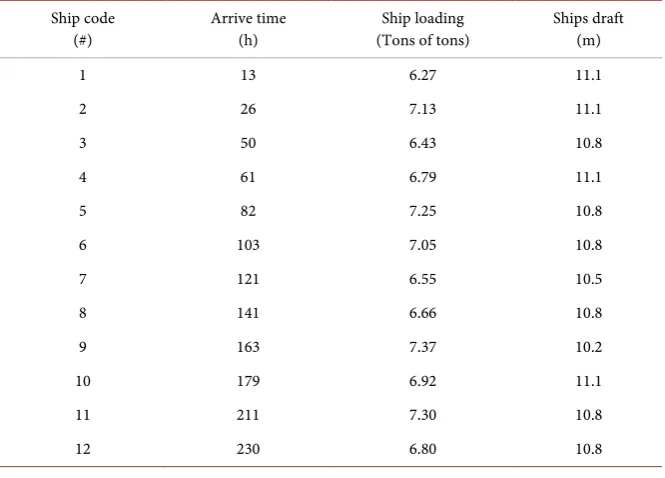
In this paper, we collect the relevant data of ship dispatching in terminal B, and through the analysis and arrangement of the data, we determine the density of ships arriving at port each month, the carrying capacity of ships and the draft range of ships. Within 10 days of the formation, 12 ships the data collected in port are as follows Table 5.
5.2. Calculation Results
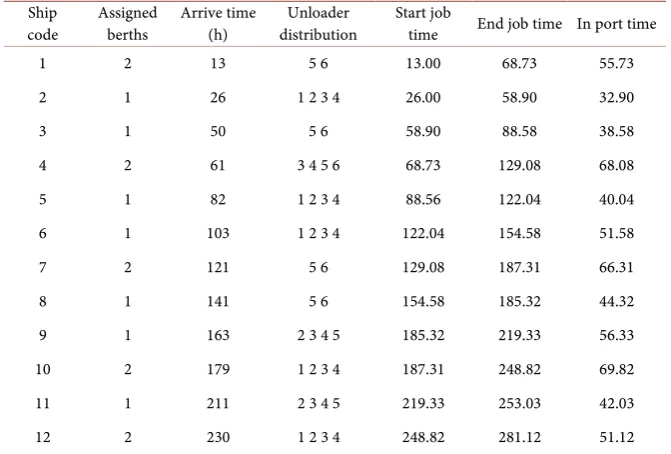
The number of berths is 2, the number of ships is 12, the number of ship un-loaders is 6, the maximum number of ship unun-loaders can be operated at the same time for each ship is 3, and the operating efficiency of ship unloader is 50%. Set the population size to 50 and the number of iterations to 100 using the matlab R2014a software running on Intel (R) Core (TM) i7-4600U mainframe with Windows 7 operating system. The calculation results and scheduling scheme are as follows Table 6 and Figure 1.
[image:12.595.204.542.420.454.2]The algorithm iterates to the 18th generation when the fitness function is the
Table 4. B Special Terminal Unloader Information.
Ship unloader #1 #2 #3 #4 #5 #6
Efficiency (t/h) 1000 1000 1000 1000 1250 1250
Table 5. Terminal B Arrival Ship Data.
Ship code
(#) Arrive time (h) (Tons of tons) Ship loading Ships draft (m)
1 13 6.27 11.1
2 26 7.13 11.1
3 50 6.43 10.8
4 61 6.79 11.1
5 82 7.25 10.8
6 103 7.05 10.8
7 121 6.55 10.5
8 141 6.66 10.8
9 163 7.37 10.2
10 179 6.92 11.1
11 211 7.30 10.8
[image:12.595.207.540.485.724.2]DOI: 10.4236/ojbm.2018.62023 330 Open Journal of Business and Management
Figure 1. B Pier Genetic Algorithm Fitness iteration diagram.
Table 6. Genetically calculated results of Coal Terminal B Dispatch. Ship
code Assigned berths Arrive time (h) distribution Unloader Start job time End job time In port time
1 2 13 5 6 13.00 68.73 55.73
2 1 26 1 2 3 4 26.00 58.90 32.90
3 1 50 5 6 58.90 88.58 38.58
4 2 61 3 4 5 6 68.73 129.08 68.08
5 1 82 1 2 3 4 88.56 122.04 40.04
6 1 103 1 2 3 4 122.04 154.58 51.58
7 2 121 5 6 129.08 187.31 66.31
8 1 141 5 6 154.58 185.32 44.32
9 1 163 2 3 4 5 185.32 219.33 56.33
10 2 179 1 2 3 4 187.31 248.82 69.82
11 1 211 2 3 4 5 219.33 253.03 42.03
12 2 230 1 2 3 4 248.82 281.12 51.12
smallest. At this moment, the last vessel of the ship departs for 281.12 hours and the total time in port are 616.84 hours.
6. Conclusions
practic-DOI: 10.4236/ojbm.2018.62023 331 Open Journal of Business and Management
al significance.
The problem of bulk cargo terminal dispatching is a complicated issue with many factors affecting: the factors of ship, unloader, yard and water depth, as well as uncontrollable factors such as tide, water flow and weather. The author’s research ability is limited and it is impossible to conduct a comprehensive study, can only focus on some of the factors, other factors are not considered, reducing the difficulty of solving the model.
In view of the limitations of this paper, the following perspectives are made: 1) To study the optimal scheduling problem from different perspectives of different terminals, for example, cost considerations, ship unloader constraints and time window constraints are still the focus of further research. 2) The influence of real-time dynamic factors such as available space and tide on the quay opera-tions needs to be further explored. 3) The development and innovation of algo-rithms, various research practices show that no algorithm is superior to another algorithm absolutely, and that different algorithms may solve different problems with better results. Therefore, it is an important direction for algorithm research and innovation in solving such problems.
References
[1] Bierwirth, C. and Meisel, F. (2009) A Fast Heuristic for Quay Crane Scheduling with Interference Constraints. Journal of Scheduling, 12, 345-360.
https://doi.org/10.1007/s10951-009-0105-0
[2] Bierwirth, C. and Meisel, F. (2015) A Follow-Up Survey of Berth Allocation and Quay Crane Scheduling Problems in Container Terminals. European Journal of Operational Research, 244, 675-689. https://doi.org/10.1016/j.ejor.2014.12.030 [3] Imai, A., Nishimura, E. and Papadimitriou, S. (2001) The Dynamic Berth Allocation
Problem for a Container Port. Transportation Research Part B: Methodological, 35, 401-417. https://doi.org/10.1016/S0191-2615(99)00057-0
[4] Nishimura, E., Imai, A. and Papadimitriou, S. (2001) Berth Allocation Planning in the Public Berth System by Genetic Algorithms. European Journal of Operational Research, 131, 282-292. https://doi.org/10.1016/S0377-2217(00)00128-4
[5] Park, Y. and Kim, K.H. (2003) A Scheduling Method for Berth and Quay Cranes.
OR Spectrum, 25, 1-23. https://doi.org/10.1007/s00291-002-0109-z
[6] Kim, K.H. and Park, Y. (2004) A Crane Scheduling Method for Port Container Terminals. European Journal of Operational Research, 156, 752-768.
https://doi.org/10.1016/S0377-2217(03)00133-4
[7] Imai, A., Chen, H.C., Nishimura, E., et al. (2008) The Simultaneous Berth and Quay Crane Allocation Problem. Transportation Research Part E: Logistics and Trans-portation Review, 44, 900-920. https://doi.org/10.1016/j.tre.2007.03.003
[8] Han, X.-L., Lu, Z.-Q. and Xi, L.-F. (2009) Optimization of Dynamic Discrete Berth Scheduling with Service Priority. Journal of Shanghai Jiaotong University, No. 06, 902-905.
[9] Golias, M.M., Boile, M. and Theofanis, S. (2010) A Lamda-Optimal Based Heuristic for the Berth Scheduling Problem. Transportation Research Part C: Emerging Technologies, 18, 794-806. https://doi.org/10.1016/j.trc.2009.07.001
DOI: 10.4236/ojbm.2018.62023 332 Open Journal of Business and Management Scheduling in Port Container Terminals. Engineering Optimization, 42, 747-761. https://doi.org/10.1080/03052150903406571
[11] Raa, B., Dullaert, W. and Schaeren, R.V. (2011) An Enriched Model for the Inte-grated Berth Allocation and Quay Crane Assignment Problem. Expert Systems with Applications, 38, 14136-14147.
[12] He, J., Huang, Y., Yan, W., et al. (2015) Integrated Internal Truck, Yard Crane and Quay Crane Scheduling in a Container Terminal Considering Energy Consump-tion, 42, 2464-2487.
[13] Karam, A. and Eltawil, A. (2016) Functional Integration Approach for the Berth Allocation, Quay Crane Assignment and Specific Quay Crane Assignment Prob-lems. Computers & Industrial Engineering.
[14] Holland, J.H. (1962) Outline for a Logical Theory of Adaptive Systems. Journal of the ACM, 9, 297-314. https://doi.org/10.1145/321127.321128
[15] Tang, K.Z. (2011) Improvement and Application of Genetic Algorithm and Particle Swarm Optimization. Pattern Recognition and Intelligent Systems, Nanjing Univer-sity of Science and Technology, Nanjing.