Colophon
University
University
University of Twente
Education
MSc. Business Administration
Track
Entrepreneurship, Innovation and Strategy
Project
reference
Master Thesis
Address
Drienerlolaan 5
7522 NB Enschede
Phone number
+31 (0) 53 489 91 11
University
supervisors
Dr. S.J.A. (Sandor) Löwik
Drs. P (Patrick) Bliek
Student
Name
T.B. (Twan) van Essen
Address
Stationsplein 33
7551 CN Hengelo
Phone number
+31 (0) 6 111 148 48
[email protected]
Preface
During the past year, I have written this Master Thesis obtain my degree in Business Administration at the University of Twente. The goal of this study was to find out what the most important selection criteria are in the partner selection process for businesses and if these criteria are influenced by certain factors. The purpose of this research is to investigate the potential a Business Partnering Application. The Business Partnering Application is an idea for an application much like Tinder, but its purpose is for organisations to easily find business partners. The results of this research should help surface the most important criteria for enhancing opportunity recognition. This thesis is interesting for everyone who has interest in partnerships, opportunity recognition, and the relationship between both concepts.
I would like to thank a few people for their help during this research, starting with Sandor Löwik and Patrick Bliek for their support and useful feedback. Also, I would like to thank them for giving me the opportunity to conduct this study, since the Business Partnering Application is their idea. Furthermore, I want to thank my father, Henk Jan van Essen for his great help and support during my study and my brother Luke van Essen for the final check.
Abstract
Partnerships have become a more and more important way of doing business and creating value. However, establishing proper partnerships often costs a lot of money and effort. To enhance this process and also overcome other problems at the University of Twente the idea exists of a Business Partnering Application, which is a Tinder-like application that enables organisations to find suitable partners. This study determines which partner selection criteria are the most important and therewith also influence the content that needs to be shown within the BPA to stimulate opportunity recognition. Besides that, this study also shows why these criteria are the most important and the influence of the external factors alertness and cognitive and personality traits. The subjects of this study were manager and executives that have experience in selecting partners. Data in this study was collected using two consecutive methods. At first ten questionnaires were sent to managers and respondents, which in a later stadium were interviewed for a more in-depth view.
Table of contents
PREFACE ... 3
ABSTRACT ... 4
TABLE OF CONTENTS ... 5
1 INTRODUCTION ... 7
2 THEORY ... 9
2.1 PARTNERSHIPS ... 9
2.2 PARTNER SELECTION ... 10
2.3 OPPORTUNITY RECOGNITION ... 12
2.4 OPPORTUNITY RECOGNITION WITHIN THE BUSINESS PARTNERING APPLICATION (BPA) ... 13
3 METHODOLOGY ... 15
3.1 RESEARCH DESIGN ... 15
3.2 SAMPLE ... 16
3.3 DATA COLLECTION ... 16
3.4 INTERVIEW GUIDE ... 16
3.5 DATA ANALYSIS ... 17
3.5.1 WITHIN-CASE ANALYSIS ... 17
3.5.2 CROSS-CASE ANALYSIS ... 18
3.6 VALIDITY AND RELIABILITY ... 18
3.6.1 RELIABILITY ... 18
3.6.2 VALIDITY ... 18
3.7 OPERATIONALISATION ... 21
3.8 CHANGES INTERVIEW/QUESTIONNAIRE ... 23
4 RESULTS ... 24
4.1 CONTEXTUAL FACTORS ... 24
4.2 COGNITIVE / PERSONALITY TREATS ... 26
4.3 EXPERIENCE WITH PARTNERSHIPS... 27
4.4 PARTNER SELECTION CRITERIA ... 28
4.5 ENTREPRENEURIAL ALERTNESS ... 29
4.6 INTERVIEW RESULTS ... 30
4.6.1 WITHIN CASE ANALYSIS ... 30
4.6.2 CROSS-CASE ANALYSIS ... 41
5 CONCLUSION ... 45
5.1 CONCLUSION ... 45
5.2 CONTRIBUTIONS TO SCIENCE AND PRACTICE ... 47
5.3 LIMITATIONS AND FUTURE RESEARCH ... 47
REFERENCE LIST ... 49
APPENDIX 1: QUESTIONNAIRE ... 56
APPENDIX 3: INTERVIEW GUIDE... 70
APPENDIX 4: LETTER OF INFORMED CONSENT (DUTCH) ... 72
1
Introduction
The expansion of the internet has reconstructed the way relationships are initiated and maintained (James, 2015). In recent years, online dating has become a common and popular form of searching for potential partnerships (Gatter & Hodkinson, 2016; Ellison, Heino & Gibbs, 2006). In 2012, the Tinder dating application was released, which allows users to set filters such as distance and gender. The user can then swipe through different profiles based on these parameters. When two users swipe right (towards the heart icon) at each other’s profiles, they receive the notification “it’s a match” (Duguay, 2017). Tinder is currently used in over 190 countries and generates 1.6 billion swipes and 26 million matches every day (Tinder, 2017). With 1.5 million dates per week there is no doubt Tinder has become a significant way of finding a partner. Considering Tinder’s global success, Löwik started to wonder if a Tinder-like application could be a way for organisations to find suitable business partners; A Business Partnering Application (hereafter BPA).
A BPA can best be described as a multi-sided platform. A multi-sided platform enables direct interactions between two or more distinct groups of customers (Haglu & Wright, 2015; Evans, 2003). The idea of a BPA is that organisations could either offer partnership possibilities, or search for organisations that are open to establishing partnerships. This enables organisations to not only be found by organisations searching for partnerships, but also “swipe” through organisations with set parameters as well. The organisations could be searching for a specific partner or reviewing opportunities. This concept can be compared to LinkedIn, a multi-sided platform that helps organisations finds suitable employees and vice versa. For a BPA to be a proper way of finding partners, the application needs to enable users to recognise opportunities in the form of potential partnerships as easy as possible. Opportunity recognition is described as someone perceiving a possibility to create a new and profitable business, service or product (Barringer & Ireland in Ramon-Rodríguez, Medina-Garrido, Lorenzo-Gómez, & Ruiz-Navarro 2010). In the context of a BPA, the opportunity recognition is seeing a potential partner with whom a business, service, or product opportunity can be exploited, or to presenting a partnership opportunity that is easily recognisable.
Establishing the right partnerships often costs a lot of money and effort (Kanter, 1994; Lane & Beamish, 1990; Cummings & Holmberg, 2012). Furthermore, organisations frequently select a partner from within their own network (Beckman, Haunschild & Phillips, 2004; Street & Cameron, 2007). Additionally, according to BarNir and Smith (2002), the existing personal network of an entrepreneur or executive can influence the number and type of business relationships an organisation could potentially access. Gulati (1995) showed that organisations with established alliances have the tendency, when establishing new alliances, to again collaborate with the same partner. Literature suggests that a possible reason for this phenomenon is the fact that new partners represent weaker ties for an organisation (Beckman et al., 2004). The strength of a tie is defined by Granovetter (1973) as “a combination of the amount of time, the emotional intensity, the intimacy (mutual confiding), and the reciprocal services which characterise the tie” (p. 1361). Having weak ties with partners also has its benefits. Levin & Cross (2004) suggest that weak ties provide access to non-redundant information. Ganovetter (1973) and Hansen (1999) state that weak ties have the benefit of obtaining unique and new information. Also, Baum and Ingram (2002) found that organisations gather new information and alternatives through new partners. Obtaining new knowledge could be important for organisations, because it can enhance its innovative capabilities and performance (Tsai, 2001; Grant, 1996; Wang & Wang, 2012).
All together a BPA could be a solution for several potential problems that organisations experience regarding partnerships. If within the application partnership opportunities or partners are presented in such a way that opportunities are recognised faster than other ways of finding suitable partners, it can potentially be a solution for organisations that have time and/or effort constraints. For entrepreneurs and executives that lack a broad network, a BPA could provide opportunities that they otherwise might not have found. Organisations that do have a broad network a BPA could be an easy way to search beyond that network for weakly tied partnerships and exploit the benefits of those partnerships, such as obtaining new
infor
mation. Opportunities in this perspective are either organisations that present a partnership proposal or organisations open to partnership proposals that are displayed.A BPA is an application and therewith also has the potential to utilise the value propositions of the mobile medium. Varnali and Toker (2010) summarised several unique value propositions of the mobile medium, namely: ubiquity, immediacy, accessibility, time-criticality, and instant connectivity.
organisations currently searching for partner, could be investing a lot of time and effort in finding a suitable partner, however these organisations might have zero interest in forming a partnership. Contacting a willing organisation in a BPA does not mean that it is 100% sure that a partnership will be established, but at least the organisations know that both parties are open to or even offering partnership opportunities.
Even though the BPA idea could be a solution to several problems and generate value for organisations, there are currently no theories or ideas regarding this particular method of establishing partnerships, since this is a new and different approach to the search process of finding suitable partners. This means that along with the potential benefits of a BPA, there are boundaries such as the gap in literature. While several authors such as Hitt et al., (2000) & Emden et al, (2006) present partner selection criteria, the most prominent selection criteria are not specified or ordered.There are authors such as Hitt et al., (2000) that present a theory about this, though in a different context, namely international partner selection for joint ventures. This however does not apply to a BPA since it does not focus on enabling international partnerships for “just” joint ventures. Hiit et al.,(2000) suggests in het future research proposals that partner selection criteria might vary with different types of partnerships.
The BPA is an application on a mobile of tablet screen and does not have the possibility to process and show all partner selection criteria, so research must address a ranking in importance. I do not want to focus on just presenting “what” the most important criteria are, but also “why” the persons who select partners finds these criteria the most important, since these results could contribute to and/or strengthen literature.
Regarding the BPA, the results of this research are important since a BPA can create value when opportunities in the form of a partnership are recognised faster, due the right content being displayed. In example, the BPA shows the partner selection criteria, financial assets, previous alliance experience, and industry attractiveness (Hitt et al., 2000). If these are not the aspects organisations are searching for, recognising organisation within a short timeframe gets more difficult, since users of a BPA have to obtain the information they search for elsewhere. Therefore, the first research question is:
“What are the most important partner selection criteria and why?”
By answering the first research question, some information becomes available. This however is still incomplete. In research, there are often control and moderating factors that influence the results. Therefore, the second research question will address if there is an interaction.
“Do factors influence the relationship between opportunity recognition and partner selection criteria, and if so, which and how?”
All together the following conceptual model is proposed:
2
Theory
In the following chapter the relevant key concepts of this study are examined. Summed up these are
Partnerships and Opportunity recognition. This chapter ends with the proposed conceptual model. During the exploration of the key concept I will also focus on finding possible influential factors.
2.1
Partnerships
Due to the wide range of types of partnerships that literature distinguishes, this research will focus on the concept of strategic partnerships/alliances. The concept is defined as an ongoing relationship between two independent organisations/parties, and includes a mutual sharing of information, risks and rewards (Roodhooft & Van den Abbeele, 2006; Tsang, 1999; Teece, 1992; Cheng, Love & Irani, 2004). According to Teng and Das (2008) there are eight common types of strategic alliances, namely: joint ventures, equity alliances, joint production, joint marketing and promotion, joint R&D, enhanced supplier partnership, sponsored R&D, and licencing agreements. This list almost matches the partnership categories presented by Isoraite (2009). The difference is that she adds franchising and outsourcing as possible types of alliances, and breaks licensing up into technology and product licensing. Her definitions are also more specific, with for example her definition of a licencing agreement.
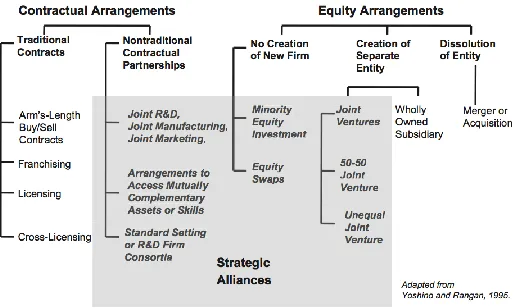
Kale and Singh (2009) provide an even more specific scope of interfirm relationships, derived from Yoshino and Rangen (1995). This scope is displayed in figure 2: Interfirm relationships
Figure 2: I nt erf irm relat ions h ips
This figure is very useful because of the categorisation of different types of alliances and will be used during this study. The categories presented in figure 2 will also be used to determine types of strategic partnerships or alliances (SPOA) respondents entered in the past. The purpose of including this in the theoretical exploration is that firms that have more experience with strategic alliances should learn the desirable characteristics of partnerships (Hitt et al., 2000). Also, through experience organisations may develop an expertise in several aspects of alliance management, for example identifying good partners (McCutchen, Swamidass & Teng, 2008).
[image:9.612.100.360.319.473.2]2.2
Partner selection
To assess potential partners, the exploring manager/organisation needs to determine the variables used for its assessment. Besides the available network, time, and effort, discussed in the introduction, literature provides a broad range of other partner selection criteria, which will be discussed in the following sections. Hagedoorn (2006) implies that a partnership relationship becomes embedded at a certain point. This means that repeating a collaboration with a known partner firm is preferred over starting new collaborations with strangers. The reason for this is an increased familiarity and trust with known partners (Dekker, Gulati and Gargiulo in Dekker & Van den Abbeele, 2010). This matches the hypothesis that experienced organisations invest less time in its quest of finding a partner. Furthermore, these past experiences with partnerships may reduce the need for new information during this process (Goerzen and Dekker in Dekker & Van den Abbeele, 2010).
Besides familiarity, trust, network, time, and effort available there are several other aspects that influence the partner search process. Emden, Calontone and Droge (2006) showed that when organisations want to develop a new product together, they search for technological, strategic, and relational alignment. The technological alignment is characterised by technical capabilities, resource complementarities, and overlapping knowledge bases. A firm can become aware of these through an existing network, or publicised details. Strategic alliances are more likely to succeed when partners have complementary resources. The last characteristic of technological alignment is overlapping knowledge bases, in example educational background, and previous or similar technologies/industries.
Strategic alignment can be divided into motivation and goal correspondence. The question if organisations want to process this aspect arises. If for example an organisation has a new product idea and needs a partner to exploit that idea, it might not be willing to share this idea instantly. The last type of alignment according to Emden et al., (2006) is relational alignment, with subcategories compatible cultures, propensity to change, and long-term orientation.
Figure 3: E m ergent Theor y o f P art ner S elec t ion f o r Cr eat ing P rod uc t A dvant a ge t hr ou gh Coll abo rat io n
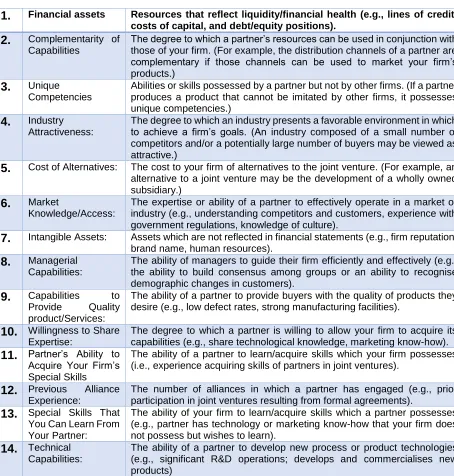
[image:10.612.66.432.357.575.2]1.
Financial assets Resources that reflect liquidity/financial health (e.g., lines of credit, costs of capital, and debt/equity positions).2.
Complementarity of CapabilitiesThe degree to which a partner’s resources can be used in conjunction with those of your firm. (For example, the distribution channels of a partner are complementary if those channels can be used to market your firm’s products.)
3.
Unique CompetenciesAbilities or skills possessed by a partner but not by other firms. (If a partner produces a product that cannot be imitated by other firms, it possesses unique competencies.)
4.
Industry Attractiveness:The degree to which an industry presents a favorable environment in which to achieve a firm’s goals. (An industry composed of a small number of competitors and/or a potentially large number of buyers may be viewed as attractive.)
5.
Cost of Alternatives: The cost to your firm of alternatives to the joint venture. (For example, an alternative to a joint venture may be the development of a wholly owned subsidiary.)6.
MarketKnowledge/Access:
The expertise or ability of a partner to effectively operate in a market or industry (e.g., understanding competitors and customers, experience with government regulations, knowledge of culture).
7.
Intangible Assets: Assets which are not reflected in financial statements (e.g., firm reputation, brand name, human resources).8.
Managerial Capabilities:The ability of managers to guide their firm efficiently and effectively (e.g., the ability to build consensus among groups or an ability to recognise demographic changes in customers).
9.
Capabilities to Provide Quality product/Services:The ability of a partner to provide buyers with the quality of products they desire (e.g., low defect rates, strong manufacturing facilities).
10.
Willingness to Share Expertise:The degree to which a partner is willing to allow your firm to acquire its capabilities (e.g., share technological knowledge, marketing know-how).
11.
Partner’s Ability toAcquire Your Firm’s Special Skills
The ability of a partner to learn/acquire skills which your firm possesses (i.e., experience acquiring skills of partners in joint ventures).
12.
Previous Alliance Experience:The number of alliances in which a partner has engaged (e.g., prior participation in joint ventures resulting from formal agreements).
13.
Special Skills That You Can Learn From Your Partner:The ability of your firm to learn/acquire skills which a partner possesses (e.g., partner has technology or marketing know-how that your firm does not possess but wishes to learn).
14.
Technical Capabilities:The ability of a partner to develop new process or product technologies (e.g., significant R&D operations; develops and commercialises new products)
Table 1: Ov er vie w part ner s elec t ion c rit eri a wit h def i nit ion
[image:11.612.77.531.64.540.2]All other criteria provided by both authors will be included in the research.
Emden et al., (2006)
Hitt et al., (2000)
Technical ability
Technical capabilities
Resource complementarity
(resource and market
knowledge)
Complementary capabilities/Market
knowledge/access
Table 2: S im ilar c rit eria
This means that all the criteria of Hitt et al., (2000) will be included in this study together with the non-overlapping criteria of Emden et al.,(2006). An overview of all the criteria can be found in paragraph 3.7 where earch criterion is also operationalized.
These two papers provide criteria for two different contexts, namely new product development and international joint ventures. Since there is a lot of overlap between these papers, literature was reviewed once again to check if I did not miss any important criteria. This did not result in criteria that could not be categorised in addition to the existing ones. Among others the main articles reviewed were Glaister & Buckley (1997) and Moen, Bakås, Bolstad and Pedersen (2010). The only criteria found of significant difference, was “foreign government negotiation ability”. This criterion however is of less relevance within this research since it does not just solely focus on international partnerships. This could result in a bias since the sample need to have experience with partnerships. If they do not have experience with international partnerships the chance exists that do not know the value of this criterion and therewith rate them not properly.
To conclude this paragraph the concept of trust will be discussed since it often came forward in papers as an important criterion. According to Inkpen and Curall (2004) trust should be viewed as an evolving concept rather than static. The level of trust is influenced as the relationship between partners ages, previous successes, failures, and interactions. Even though this concept is an important criterion between partners, it is not something the BPA could easily implement within the application because of its evolutionary characteristics.
2.3
Opportunity recognition
Opportunity recognition is defined as the match between an unfulfilled need in the market and a solution that will satisfy this need (Bhave, 1994; Shane, 2003). Another perspective is presented by Barringer and Ireland (in Ramos-Rodríguez et al., 2010). They describe opportunity recognition as someone perceiving a possibility to create a new and profitable business, service, or product. This definition suits the BPA best, since the goal of the BPA is to let organisations recognise a business, service, or product opportunity which can be utilised together with a partner. Though there are several other definitions reviewed such the ones provided by Christensen and Peterson (1990) or Keh, Foo and Lim, (2002) but these where less suitable in the context of a BPA.
An influential factor for recognising new business opportunities would be the individuals’ access to external knowledge through the social networks in which they participate. This was shown in the same research of Ramos-Rodríguez et al., (2010). Other factors are of great influence as well. Shane (2001) found that prior knowledge/experience of a field or industry influences opportunity recognition, while Shane (2003) and Krueger (in Barons & Ensley, 2006) found that a wide range of cognitive factors/capacities such as attributions and intentions are related to opportunity recognition. According to Ardichvili, Cardozo, and Ray (2003) several cognitive studies have shown that two personality traits are associated to opportunity recognition, namely: optimism and creativity. The same authors stated that entrepreneurial alertness is also of influence.
Besides these personality characteristics, several environmental trends can influence opportunity recognition. According to Barringer and Ireland (in Shrader & Finkle, 2015) economic and social factors, technological advances, and political and regulatory changes are environmental trends that influence opportunity recognition.
namely: prior knowledge, social capital, cognition/personality traits, environmental conditions, alertness, and systematic search.
2.4
Opportunity recognition within the Business Partnering Application (BPA)
Cognitive and personality traits are important to the BPA. It could be that a person open to experience prefers different content within the application, compared to someone who is not that open to experience. It is important to include these differences, since they possibly influence the results. This research will therefore use the Ten Item Personality Measure (TIPI) of the Big Five to list the personality traits of the respondents. The Big Five is a commonly acknowledged as a measurement instrument of the five main dimensions of personality. TIPI is a brief instrument that can stand as reasonable proxies for longer Big Five instruments, and will be used in this research (Gosling, Rentfrow & Swann, 2003).
The factors environmental trends and systematic research are less relevant. The BPA, in theory, could be a way to systematically search for partners, meaning this factor would already be included. Systematically is in this matter searching with a plan/system. In a BPA would this mean for example searching in a specific industry, place, criteria and so on. Environmental factors encompass economic growth, social and political context, geographic location, and cultural values (George et al., 2016). This is less relevant for the BPA since changes in the environment create opportunities. When someone wants to exploit these opportunities with a partner, the BPA becomes of relevance to find a right partner to exploit the opportunities with if necessary. The environment though is included in this research since it will mainly take place in the east part of the Netherlands. The conclusions must therefor explain whether the results are applicable to other parts of the Netherlands / the world.
Furthermore, the concept alertness could have an influence on opportunity recognition and this needs to be measured as well. It might be that alert entrepreneurs or executives select partners based on different criteria. To measure this concept Tang, Kacmar and Businitz (2012) developed a 13-item alertness scale. Even though George et al., (2016) stated that measuring this construct is empirically too complex to be quantified the results of the 13-item alertness scale showed to be valid. Therefore, this scale will be used in this research, see paragraph 3.6: Operationalisation.
At last social capital and prior knowledge need to be addressed. Social capital is less important since it is a source of opportunity recognition, as well as a BPA. Someone’s network could have an influence on recognising opportunities, but this does not have an influence on which aspects in a partner search are the most important. For example, when an opportunity is recognised due to social capital, the BPA could assist in finding/recognising the suitable partner, if that would be necessary to utilise the opportunity. However, recognising a business opportunity resulting from social capital as source is separate from the BPA. If they need a partner to utilise that opportunity a new recognition is necessary, namely the recognition of the suited partner and social capital does not have a direct influence within the BPA on the recognition of the suitable partner. To continue, prior knowledge is less important for the BPA as well. Prior knowledge can be categorised into the dimensions: prior knowledge of markets, ways to serve markets and customer problems. Some people can recognise opportunities because of prior information they possess. But this does not influence the search aspects that need to be shown in the BPA. When a person “swipes” through the BPA it is highly unlikely they possess prior information of every organisation and industry they swipe past. It could be the case that an entrepreneur with prior industry knowledge of the automotive industry is not interested or not able in seeing the industry attractiveness in a BPA. On the other hand, it might be of interest if the branch was not automotive, but wholesale and/or retail.
point of view. This research will therefore include contextual factors as control variables to get a broader view of prior knowledge, and not just on the knowledge of markets and customers.
Figure 4: Theoretical conceptual Model
The following proposed conceptual model is based on the findings in the theoretical exploration.
The review of the concepts partnerships and opportunity recognition led to this extended conceptual model. Included in this model are the influences of alertness, contextual factors, cognitive and personality traits, and experience with partnerships as they could have an influence on priorities in partner selection criteria as shown in the BPA which are necessary to recognise an opportunity
3
Methodology
In the following chapter the methodology for this study is described, which consists of – Research design, Sample, Data collection, Interview Guide, Data analysis, and validity and reliability.
3.1 Research design
This research aims to answer two research questions, namely: “What are the most important partner selection criteria and why?” and “Do certain factors influence the relationship between opportunity recognition and partner selection criteria, and if so, which and how?”. Since the BPA provided a new way of establishing partnerships and a telephone or tablet screen can only show limited content, this research must distinguish which criteria of partner selection are the most important and if the outcome is influenced by other factors. Of course, there are also other aspects that differ between digital and offline communication, for example the fact that is easier to hide certain aspects such as facial expressions (Bülow & Felix, 2016), but that is not the focus of this research. This regards also digital literacy, which is defined as the ability to use ICT, information, and communication technology (Bowles, 2013). This would be relevant for this research if the main question was, for example, to research potential usage or attitude towards the BPA. Reason for this is that it is possible that a developer, who in general has a high digital literacy, would have a more positive attitude towards the BPA than a manager of a construction organisation due to his digital literacy that is expected to be lower. Even though I ask respondents if they would use the application with a direct question, this is not the main topic of this research, since it is only briefly mentioned and because just an answer to that question would not show valid results.
Researching what the most important aspects could be done via quantitative method, but qualitative research methods are useful for researching unexplored topics (Britten, Jones, Murphy & Stacy, 1995). Qualitative methods provide more in-depth information which is important since the goal is not to only find out “what” prioritisation exist, but also “why”. As stated in the introduction, no theories or ideas exist about these exact topics in this concext. Therefore, a new conceptual model was designed as shown in figure 4. This means that this research is of an explanatory nature, since it represents a topic where little scientific knowledge is available about the process that will be examined (Stebbins, 2001). Qualitative research methods are most often (not exclusively) appropriate to explore a conceptual model, while quantitative research is most often used to test a conceptual model (Verschuren & Doorewaard, 1995). According to Draper (2004) qualitative research is characterised by the process of analytical induction, in which specific observations are used to construct a theory or hypothesis. One of the most commonly used qualitative methods are interviews.
Harrel and Bradley (2009) stated that researchers can use interviews for a variety of purposes, such as collecting information from individuals about their own practices, perception, attitudes, beliefs, or opinions. They can also be used to gather information about past or present behaviours or experiences. Theory distinguished three different types of interview structures based on “control”, namely unstructured, semi-structured and structured. This research will gather information, using semi-structured interviews. Harrel and Bradley (2009) stated that semi-structured interviews are often used when the researcher wants to delve deeply into a topic and to thoroughly understand the answers provided (p. 27). An interview guide is used with a list of questions and topics that must be covered (Harrel & Bradley, 2009; Verschuren & Doorewaard, 2007). The interview guide is based on thorough literature research and can be found in appendix 3: Interview guide.This structure suits this research in the appropriate manner, since there are several topics that need to be covered to answer the research question. Therefore, an unstructured interview would not be suitable. A structured interview would also be less appropriate since this research is searching for in depth information about the prioritisation of partner selection criteria.
3.2 Sample
The interviews will be conducted with entrepreneurs and executives of organisations. I chose to interview these occupations because they are most often involved or influential in the decision-making process of partnerships and are potential users (Eisenhardt, 1999; BarNIr & Smith, 2002; Hitt et al., 2000; Seitanidi & Crane, 2009). Apart from the occupations of a respondent within the study, it important that they have experience with partner search/selection, because through experience organisations may develop expertise in several aspects of alliance management; for example, identifying good partners (McCutchen et al., 2008). Besides that, Hitt et al., (2000) stated in his paper that organisations that gained experience with strategic alliances should have a better understanding on the characteristics they desire.
I will interview entrepreneurs and executives based on convenience sampling. In most qualitative researches representativeness play no role due to time, money and labour intensity (Doorewaard, Kil & Ven, 2015). The most important criterion in selecting respondents in this research is based on whether they can provide “rich” information about the subject of this research. The theory discussed in the first paragraph sets this expectation.
To conclude, there will also not be a segmentation between industries managers/executives work in. The goal of the BPA is to not only focus on enabling SPOA’s within specific industries, but also across industries. This means that the aspects shown within the BPA should not just meet the requirements of one specific industry. The sample size will be determined by the saturation point and therefore not beforehand. Saturation is defined by Morse (1995) as: “data adequacy and operationalised as collecting data until no new information is obtained” (p.147).
Since there are human subjects in my research I will submit this proposal for ethical assessment to determine if this research conforms to ethical standards. My research has been approved by the Ethics Committee of the University of Twente. This committee has assessed whether my proposed research conforms to ethical standards. The approval can be found under the application number 18055. Furthermore, interviewees will be informed beforehand that the report will contain a summary of the results, whilst individual data will not be reported.
3.3
Data collection
To capture data there are several sources from the research interview according to Harrel and Bradley (2009). First there will be description that includes all information about the sample of the people selected for the study, such as demographic information and occupation, see chapter 4 results. Secondly the interviews are conducted in Dutch and recorded. This is also one of the criteria. The persons that are interviewed are to give permission beforehand to record the interviews. These interviews will then be transcribed afterwards.
Finally, there will be notes that are taken during the interviews. This is because tapes and transcripts do not capture all data. In order to structure the concepts of this research an interview guide has been put together, see appendix 3: Interview guide. The questionnaire will provide information on several concepts of this research that are operationalised to collect data properly in paragraph 3.6: operationalisation. It will determine contextual factors, entrepreneurial alertness, cognitive and personality traits, experience with partnerships, and which partner selection criteria the respondent find most important and which ones the least. Why the respondents find specific partner selection criteria the most important will be mapped via the interview.
3.4
Interview Guide
The interview guide directs the interviewer during the interview to obtain the necessary information for answering the research question. The interview guide may be modified through use according to King, Cassell & Symon (1994). Adding factors that emerged spontaneously in the interviews or dropping / reformulating those that are incomprehensible to the participants are possibilities. To avoid bias the interview questions are phrased in such way that:
Multiple questions are avoided;
Leading questions which impose the research questions are not included (neutral and non-suggestive); Interviewees are not told what his/her answer means;
Important to mention is that interviewing includes more than “just” asking questions (Emans, 1985). The questionnaire obtains information about contextual factors, personal characteristics, alertness and cognitive & personality traits. Furthermore, the questionnaire provides me with information about their experience with partnerships overall and during the past three years, and “what” partners selection criteria the respondents find the most important. These two topics (number 3 and 4) will be discussed more in-depth during the interviews.
Before the interview takes place, the interviewees have to choose two partnerships cases in which they were involved in the partner selection process during the past three years. If they where only involved in one partnership selection process in the past three years, that case will be the one that is discussed, but preferably two partnerships will be discussed during the interview. Since partnerships do not occur weekly I expect that not all interviewees of my convenience sample have been involved in selecting more than one partner during the past three years. If they have been involved in over two partnership I will ask them to choose the partnerships in which the selection process was most intense. Also there is a preference to discuss a successful and non successful partnership during the interview.
The interview starts with an evaluation of the questionnaire and research. The purpose of the research and the BPA will again be explained to refresh the memories of the interviewees. The main questions are based on the questionnaire and literature review. Answers of topic two and three of the questionnaire serve as a guide.
At first the case partner selection process and partner is discussed. Next their evaluation of partnership criteria is discussed and we will reflect on their partner selection case. The last part consists of a few common questions about partnerships and an evaluation if the interviewees would be potential users of the BPA.
3.5 Data analysis
After data is collected the interviews are transcribed and will be coded using the qualitative data analysis software ATLAS, which is a crucial aspect of the analysis (Basit, 2003). Codes are determined based on the theoretical operationalisation of the concepts of this research. An example is codes for financial assets as an important selection criterion in partnerships. When an interviewee expresses that he or she finds it most important that the alliance partner does not have a high debt in comparison with its equity because he/she can’t afford a failure. This can be viewed as an indicator that expresses the importance of financial assets.
3.5.1 Within-Case analysis
Within-case analysis is defined as the intimate exploration of a single case as a stand-alone entity. The subject of study, the case, is in this research the individual respondent that was interviewed and filled in the questionnaire. This type of analysis involves an in-depth familiarity with a specific respondent to distinguish how processes or patterns revealed in the case support, refute, or expand the propositions/code words that the research derived from a literature study. In this research, there are two parts of analysis. The first part is the process of partner selection, specifically the process of how partners are recognised and which criteria have an influence on that and why they have an influence. The second part of analysis is the potential user of the BPA, in which factors that potentially influence the order of selection criteria are analysed.
This results in the emerge of the case’s unique attributes and patterns, before general attributes and patterns across the cases are located. Within case analysis starts with a rich and thick description of the data. This overview should reveal the contextual nature and richness of the case. This is necessary in order to reduce the amount of data which helps the researcher deal with the daunting amount of data and focus on the most important parts for the analytical framework (Mills, Durepos & Wiebe, 2010).
3.5.2 Cross-case analysis
Initially I will use within-case analysis to develop a stand-alone description of each case followed by a cross-case comparison to identify what each cross-case has in common, as well as what attributes are unique. In reality both types of analysis often occur synergistically and interactively. Cross-case analysis allows for the data to be compared both with the literature, as well as mutually (Mills, Durepos & Wiebe, 2010).
3.6 Validity and reliability
The quality of this paper depends on its attention to validity and reliability. In the paragraph data analysis, there are some ways to avoid bias that are of influence. Though, to give a full view, the paragraph will provide insight on how this research deals with the aspects of validity and reliability. Theory provided in this paragraph is obtained from the book “Wat is onderzoek?” (Verhoeven, 2011).
3.6.1 Reliability
Reliability indicates to what extent measurement in this study is free of influence of random errors. In other words, will the techniques used result in consistent findings in repeated measurements with different researchers, respondents, and conditions (Verhoeven, 2011)? Therefore, at first the interview questions are phrased in such a way that bias is avoided. Also, interviews will be transcribed and codes are developed. The codes are based on literature research to make sure it covers all aspects of the concepts of this research. Further, a test interview will be conducted to test the reliability of the topic list.
3.6.2 Validity
Aside from obtaining reliable results, this research aims to achieve valid results as well. Validity comprehends to what extent the conclusions are meaningful (valid) based on the measuring instruments. In this case, the subject is not the instrument but the fit between the measurement and its label. Validity focusses on whether the research is free of systematic errors. Two important factors that influence validity are the measurement instrument and the research subjects (Verhoeven, 2011).
Internal validity
Internal validity refers to the claim of finding, giving, and testing the right explanation, and answers the question if the independent variable causes the dependent variable? Several situations that could endanger the internal validity of the results are listed below (Verhoeven, 2011).
Selection of research subjects (Verhoeven, 2011). Solely the opinion of a select group is researched. Therefore, I have executed thorough literature research in order to select the right research subjects. Since decisions regarding SPOA’s are most often made by executives and entrepreneurs they will be the research subjects. This makes the threat of the selection of research subjects to internal validity less relevant. It is also important have knowledgeable subjects. This will be determined in the selection process, in which only subjects are selected that are experienced with and have knowledge about selecting partners. Answers during the interviews will provide a definitive conclusion with the determination of knowledgeability. When is seems that respondents are not knowledgeable follow up and knowledge questions will be asked during the interview to check this. Furthermore, when the respondents provide highly unlikely answers I will invest more time in triangulating these answers to determine if the situation is not outlined different that the real situation.
Not only interviewing the same type of executives and entrepreneurs. If for example only marketing managers are interviewed, the result could get biased. Therefore, I will interview different types of executives (marketing manager, CRM manager, after sales manager etc.) and the executives and entrepreneurs also need to operate in different sectors.
Maturation. The natural development of a situation / subject. This is a threat when a research takes a long time such as methods to learn children words. Eventually they will learn it (Verhoeven, 2011). Since the aim of this research is to finish it within three months this will not be a significant threat. Instrumentation. During the research, if the results are measured in a different way, different results
could be observed. This can be caused by, for example, changing topics or questions during the interview (Verhoeven, 2011). For this reason, the results are only measured by methodical. Though, there are different results that require different methods (interviews and questionnaires), but each result will be measured with the only one method that is fitting. The interviews and questionnaires are tested to check the reliability and make additions when necessary. The respondents will also be asked additional questions regarding insight that came forward from later interviews if necessary. If aquestion is dropped for a proper reason, the answers of previous interviews will also not be used in the conclusions, besides the conclusion that it was not relevant for this research. When a question is reformulated, the original answer will be excluded from the results and the reformulated question will be sent to the respondents to get similar answers.
Internal validity can be enhanced by triangulation (Meijer, Verloop & Bijaard, 2002). The concept triangulation is defined as “a validity procedure where researchers search for convergence among multiple and different sources of information to form themes or categories in a study” (Creswell & Miller, 2000, p. 126). This study applies triangulation in several ways. Data will be collected from several sources, namely scientific articles, books, questionnaires and interviews.
Topic
Variable
Possible triangulation
source
Contextual factors Size of the organisation Reach, website, LinkedIn
Contextual factors Legal Form Chamber of Commerce
Contextual factors Family owned business Website / Reach
Contextual factors Industry Chamber of Commerce / Reach
Contextual factors Tenure of office Website
Contextual factors Educational level LinkedIn
Contextual factors Past functional experience LinkedIn
Contextual factors Age Social media
Contextual factors Function Website / LinkedIn
Contextual factors Responsibilities
-Experience with partnerships
All variables Website, Reach, Google
Cognitive/personality traits
Ten Item Personality Measure (TIPI)
-Order partner selection criteria
All variables Interviews
Alertness 13-item alertness scale
-Table 3: Tri angu lat ion of var iables
Construct validity
If a relation if found, is this a causal one? The difference with construct validity and internal validity is that construct validity does not focus on whether the relationship that is found is the proper one, but on the way the concepts A and B are measured (Verhoeven, 2011).
Mills, Durepos and Wiebe (2010) define construct validity as a test’s “degree to which it measures the behavioural domains or traits that it was designed to measure. More specifically, construct validity can be understood as the extent to which the behavioural domains or constructs of theoretical interest have been successfully operationalised” (p. 380). Is the test measuring what it wants to measure? Measuring constructs could be quite difficult, especially when concepts are subjective or unclear. Therefore, the concepts in this research are properly described before converting them to questions. Several questions will be used to answer the research question. When asking the research question directly to the research subjects, the proper results would not be obtained. Another important factor that influences the construct validity is the way questions are formulated. Badly formulated questions have a negative effect on the results. Therefore, to avoid bias the interview questions are phrased as mentioned in the paragraph data analysis.
Further factors influencing the concepts are kept apart from each other in the topics/questions. Asking the research subjects what they find to be the most important factor in partner selection will result in different answers, because every respondent will think about different factors. Therefore, I will present them the criteria that is based on literature research.
External validity
3.7
Operationalisation
In this paragraph the partner selection criteria, contextual factors, experience with partnerships cognitive / personality traits, and entrepreneurial alertness are operationalised.
Most important partner search criteria:
Partner selection criteria (Hitt et al., 2000)
Concept (Hitt et al., 2000)
Financial assets Resources that reflect liquidity/financial health (e.g., lines of credit, costs of capital, and debt/equity positions).
Complementarity of Capabilities
The degree to which a partner’s resources can be used in conjunction with those of your firm? (Tangible resources are for example distribution channels and intangible resources could be a patent)
Unique Competencies Abilities or skills possessed by a partner but not by other firms. (If the partner produces a product that cannot be imitated it has to possession of a unique skill)
Industry Attractiveness The degree to which an industry presents a favourable environment in which to achieve a firm’s goals
Cost of Alternatives The cost to your firm of alternatives to the partnership.
Market
Knowledge/Access
The expertise or ability of a partner to effectively operate in a market or industry (e.g., understanding competitors and customers, experience with government regulations, knowledge of culture).
Intangible Assets Assets which are not reflected in financial statements (e.g., firm reputation, brand name, human resources).
Managerial Capabilities The expertise or ability of a partner to effectively operate in a market or industry (e.g., understanding competitors and customers, experience with government regulations, knowledge of culture).
Capabilities to Provide Quality Product/Service:
The ability of a partner to provide buyers with the quality of products they desire (e.g., low defect rates, strong manufacturing facilities).
Willingness to Share Expertise
The degree to which a partner is willing to allow your firm to acquire its capabilities (e.g., share technological knowledge, marketing know-how).
Partner’s Ability to Acquire Your Firm’s Special Skills
The ability of a partner to learn/acquire skills which your firm possesses (i.e., experience acquiring skills of partners in joint ventures).
Previous Alliance Experience
The number of alliances in which a partner has engaged (e.g., prior participation in joint ventures resulting from formal agreements).
Special Skills That You Can Learn From Your Partner
The ability of your firm to learn/acquire skills which a partner possesses (e.g., partner has technology or marketing know-how that your firm does not possess but wishes to learn).
Partner selection criteria (Emden et al., 2006)
Concept (Emden et al., 2006)
Overlapping knowledge bases
Same educational background; previous work done on the same subject working with similar technologies or in the same industry
Strategic alignment: Motivational
correspondence
Having mutually beneficial intentions; determine likelihood of opportunistic behaviour; reasons for entering alliances e.g. internalise unavailable knowledge;
Strategic alignment: Goal correspondence
Not “exactly” the same goals; good balance of two organisations seeking a common objective; goals not conflicting
Relational alignment: Compatible cultures
Collection of cognitions, expectations, mind-sets, norms, values within an organisation
Relational alignment: propensity to adapt
Willingness of partners to adapt as requirements of collaboration change
Relational alignment: Long term orientation
Willingness to make short-term sacrifices for the long-term results; willing to contribute without knowing the exact outcome
Contextual factors (control variables)
Contextual information is anything that is useful to characterise the situation of an entity, in which the entity is a person, place, or object (Dey, 2001). This research addresses the following characteristics:
Company characteristics
This research will adopt the company / firm-specific variables displayed in Pansiri (2007). The variables are adopted are: size, and whether the company is a family owned business. Size will be categorised based on the SME’s categories of the European commission, head staff count. Also, an industry variable will be included. The list of different industries’ will be adapted from CBS (CBS, 2017)
Executive / entrepreneur characteristics
Pansiri (2007) also provides a list with several respondent characteristics which this research will adopt. These are age, tenure of office, educational level, past functional experience, current function, management layer and responsibilities. Questions and categories regarding these respondent characteristics are adapted from Löwik (2013). This research also addresses the department the executive / entrepreneur works and the total years of experience the respondents has. These questions will also be included.
Experience with partnerships
To construct a partnering experience, this research will adapt the measure used by Gulati, Lavie & Sing (2009). These authors measure the experience by accumulating the number of all prior partnerships/alliances. A partnership/alliance only counts if it can be categorised within the table of Kale and Singh (2009): scope of interfirm relationships. In the questionnaire respondents are asked what their overall experience is and their experience of the past three years. The past three years are of importance because these will be discussed during the interview. More information about this can be found in the interview guide, appendix 3.
Cognitive/personality traits
On a webpage of the University of Texas website1 Gosling refers to a Dutch version of TIPI,
which was developed by Sander Koole. Since the questionnaires will be conducted in Dutch, this version it most suitable. Furthermore, Gosling provided on the same page a way to compute and display the TIPI scores via an excel spreadsheet developed by Daniel DeNeui. Outcomes of this part of the interview will be processed using this spreadsheet.
Entrepreneurial alertness
To measure alertness, this research will adopt the 13-item alertness scale developed by Tang et al., (2012). According to these authors alertness consists out of three elements that led to the development of the scale. All items are measured using the 7-point Likert scale ranging from 1 strongly disagree to 7 strongly agree.
Scanning & search
This dimension refers to the constant scanning of the environment and search for new information, changes and shifts unnoticed by others. It includes pre-existing knowledge, readiness and sensitivity to new opportunities.
1. I have frequent interactions with others to acquire new information.
2. I always keep an eye out for new business ideas when looking for information. 3. I read news, magazines, or trade publications regularly to acquire new information. 4. I browse the Internet every day.
5. I am an avid information seeker.
6. I am always actively looking for new information.
Association and connection
Putting together dissimilar pieces of information and building them into coherent alternatives. This element addresses how persons cognitively respond to and process new information clues.
7. I see links between seemingly unrelated pieces of information. 8. I am good at “connecting dots.”
9. I often see connections between previously unconnected domains of information. Scale mean 6
Evaluation and judgment
The last and third element regards evaluations and judging new changes, shirts or information. Also, it reflects the decisions if they would see a business opportunity with profit potential.
10. I have a gut feeling for potential opportunities.
11. I can distinguish between profitable opportunities and not-so-profitable opportunities. 12. I have a knack for telling high-value opportunities apart from low-value opportunities. 13. When facing multiple opportunities, I am able to select the good ones.
Scale mean 5.5
3.8
Changes interview/questionnaire
Several changes have taken place during the interview/questionnaire in order to obtain more reliable and valid results. The first became apparent after the first questionnaire. The respondent filled in that he/she had been involved in six different types of partnerships. It was not clear if these were with the same partner or six different partners. Therefore, a new question was introduced for the following questionnaires which measured that. Also, a change was made in the interview questions after the first interview. I asked the respondent if they knew an organisation which he/she would evaluate as an interesting partner. He answered that he could not instantly think of one and to prevent that I have prepared four new questions for each interview. The new questions regarding organisations from which they have to choose the most interesting partner and also explain why. The respondents had to choose from two similar organisations which he/she would prefer to start a partnership with.
4
Results
This chapter will display the collected data form the interviews and questionnaires. The results will be described per topic to structure this chapter. Afterwards the results are analysed and triangulated. I will use alphabet codes to keep the respondents anonymous.
4.1
Contextual factors
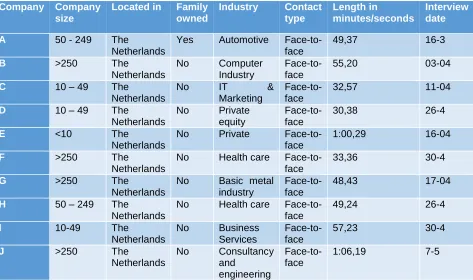
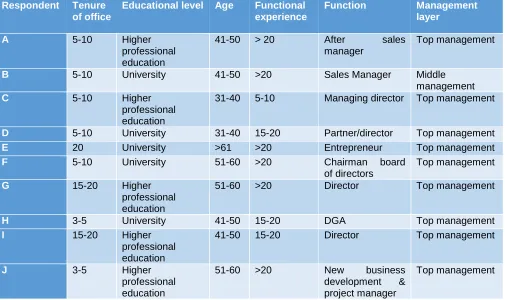
Several control variables are included in this research to characterise the situation of the respondent and organisations they are working for. Table 4 illustrates the interviewed organisations and table 5 the interviewed persons in detail, but anonymously.
Company Company size
Located in Family owned
Industry Contact
type
Length in
minutes/seconds
Interview date
A 50 - 249 The
Netherlands
Yes Automotive Face-to-face
49,37 16-3
B >250 The
Netherlands
No Computer Industry
Face-to-face
55,20 03-04
C 10 – 49 The
Netherlands
No IT & Marketing
Face-to-face
32,57 11-04
D 10 – 49 The
Netherlands
No Private equity
Face-to-face
30,38 26-4
E <10 The
Netherlands
No Private Face-to-face
1:00,29 16-04
F >250 The
Netherlands
No Health care Face-to-face
33,36 30-4
G >250 The
Netherlands
No Basic metal industry
Face-to-face
48,43 17-04
H 50 – 249 The
Netherlands
No Health care Face-to-face
49,24 26-4
I 10-49 The
Netherlands
No Business Services
Face-to-face
57,23 30-4
J >250 The
Netherlands
No Consultancy and
engineering
Face-to-face
1:06,19 7-5
[image:24.612.79.552.200.480.2]Respondent Tenure of office
Educational level Age Functional
experience
Function Management
layer
A 5-10 Higher professional education
41-50 > 20 After sales manager
Top management
B 5-10 University 41-50 >20 Sales Manager Middle management
C 5-10 Higher professional education
31-40 5-10 Managing director Top management
D 5-10 University 31-40 15-20 Partner/director Top management
E 20 University >61 >20 Entrepreneur Top management
F 5-10 University 51-60 >20 Chairman board of directors
Top management
G 15-20 Higher professional education
51-60 >20 Director Top management
H 3-5 University 41-50 15-20 DGA Top management
I 15-20 Higher professional education
41-50 15-20 Director Top management
J 3-5 Higher
professional education
51-60 >20 New business development & project manager
Top management
[image:25.612.76.581.73.373.2]4.2
Cognitive / personality treats
This research uses the Ten Item Personality Measure (TIPI) of the Ocean Big Five, which is explained in the operationalization in paragraph 3.7. The Dutch Version translated by Sander Koole23 was used in the
questionnaires. The creator of this scale, Gosling et al., (2003) , provides an excel spreadsheet which computes the scores alongside the norms. This spreadsheet was created by Daniel DeNeui and provided the following results:
Respondent Extroversion Agreeableness Conscientiousness Emotional Stability
Openness
A 6,5
High 4,5 Medium Low 4 Low 4 Medium low 6 Medium high
B 4
Medium Low 5 Medium Low 3 Low 7 High 6,5 High
C 4,5
Medium high 4 Low 6,5 Medium high 7 High 6,5 High
D 4,5
Medium high 3,5 Low
5,5
Medium high
6 Medium high
4 Low
E 4,5
Medium high 4,5 Medium low 6,5 Medium high 7 High 5,5 Medium high
F 4,5
Medium high 3,5 Low 6,5 Medium high 7 High 6 Medium high
G 7
High 6,5 High 6,5 Medium high 6,5 High 7 High
H 6,5
High 4 Low 4 Low 5,5 Medium high 6,5 High
I 6,5
High 5,5 Medium high 5 Medium low 4,5 Medium low 6,5 High
J 6,5
High 5 Medium Low 6,5 Medium high 7 High 7 High
Norms 4,44 5,23 5,4 4,83 5,38
Table 6: B ig Fiv e P ers onal it y Trait s
The norms of these results are adapted from the study of Gosling et al., (2003) which are based on 1.813 respondents. The main reason to adapt these and no other existing norms is that these norms are based on the results that were used to design this measurement of the OCEAN Big Five.
4.3
Experience with partnerships
Following the experience with partnerships is mapped of the respondents. At first the total experience is displayed in table 7 and the experience in the past three years in displayed in table 8. Arrangement to access mutually complementary assets or skills is abbreviated as ATAMCAOS in the table.
Amount of time per type of partnerships in total
A B C D E F G H I J
Type
Joint R&D - - 3 - 5 1 50 - - 2
Joint Manufacturing -- - 50 - 5 2 100 - - 5
Joint Marketing 2 20 3 - 5 - - 1 - 1
ATAMCAOS 2 - 2 - 5 2 - - - 2
R&D Consortia - - 1 - 2 - - - - 1
Minority Equity Investment
- - 3 - 3 - - - ? -
Equity Swaps - - 1 - - - ? -
50-50 Joint venture 2 - 5 1 4 - - 1 ? -
Unequal joint venture
- - 3 2 - - - 1 ? 1
Total 6 20 71 3 29 5 150 3 ? 12
Total unique 2 20 ? 3 ? 4 150 2 ? 10
Table 7: Tot al e xp erie nc e in s elec t ing part n ers pe r t ype
Amount of times in type of partnerships in the past three years
A B C D E F G H I J
Type
Joint R&D - - 3 0 0 1 9 - - 2
Joint Manufacturing - - 20 0 0 2 20 - - 5
Joint Marketing 1 10 3 0 0 - - 1 - 1
ATAMCAOS 1 - 2 0 0 2 - - - 2
R&D Consortia - - 1 0 0 - - - - 1
Minority Equity Investment
- - 3 0 0 - - - 2 -
Equity Swaps - - 0 0 0 - - - 1 -
50-50 Joint venture 1 - 0 1 1 - - 1 1 -
Unequal joint venture - - 3 2 0 - - 1 1 1
Total 2 10 36 3 1 5 29 3 5 12
Total unique 1 10 ? 3 1 4 29 2 ? 10
4.4
Partner selection criteria
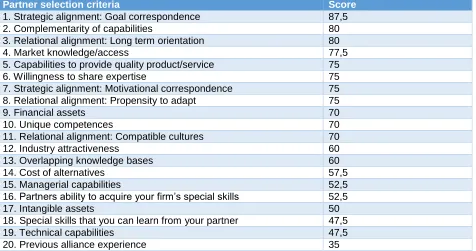
In this paragraph, the existing prioritization in selecting alliance partners will be discussed based on the operationalised partner selection criteria. Table 9 provided an overview of the scores. To obtain a clear overview, the scoresheet options will have scores varying from 0 to 100. The higher the average score, the more important the criterion was for the respondents. Every respondent has the option to evaluate each criterion as low, moderately low, average, moderately high, and high, as adapted from Hitt et al., (2000).
This results in the following scoresheet:
Low : 0
Moderately low : 25 Average : 50 Moderately high : 75
[image:28.612.75.551.274.525.2]High : 100
Table 9 summarises the results of all respondents.
Partner selection criteria Score
1. Strategic alignment: Goal correspondence 87,5 2. Complementarity of capabilities 80 3. Relational alignment: Long term orientation 80
4. Market knowledge/access 77,5
5. Capabilities to provide quality product/service 75 6. Willingness to share expertise 75 7. Strategic alignment: Motivational correspondence 75 8. Relational alignment: Propensity to adapt 75
9. Financial assets 70
10. Unique competences 70
11. Relational alignment: Compatible cultures 70
12. Industry attractiveness 60
13. Overlapping knowledge bases 60
14. Cost of alternatives 57,5
15. Managerial capabilities 52,5
16. Partners ability to acquire your firm’s special skills 52,5
17. Intangible assets 50
18. Special skills that you can learn from your partner 47,5
19. Technical capabilities 47,5
20. Previous alliance experience 35