Chapter 1
Multipurpose optimization with and without Uncertainties for Deformed Bodies and
Structural Elements
Sinitsin A.V., Ivanova S.Yu., Makeev E.V., and Banichuk N.V.
Abstract The problems of multipurpose analysis and optimization of deformed structures and thin - walled structural elements are studied under some constraints concerning incomplete data. Different approaches and their applications are pre- sented: Guaranteed Approach; Probabilistic Approach; Mixed Guaranteed - Prob- abilistic Approach; Pareto - multidisciplinary and Nash - stationary Approaches.
Multipurpose optimization of layered plate made from given set of materials in con- text of optimization of ballistic limit velocity is presented with some other examples of application of Pareto and Nash approaches for solving of multipurpose problems.
Shape optimization problems in contact mechanics are also considered with incom- plete data taking into account.
Multipurpose optimization in mechanics and optimal design of structures and struc- tural elements plays an important role in modern problems of engineering. There are two basic approaches for solving of multipurpose problems: the Pareto-approach and the Nash-approach. Each of them has as some preferences as some disadvan- tages and the investigators must take into account many different factors choosing the appropriate approach for the treated problems.
According to Pareto-approach the minimization (or maximization) of vector func- tional
J(h) = J1(h), . . . , J1(h), . . . , JN(h)T → min
h∈Λh (1.1)
must be performed on the set of Λhadmissible design variables h ∈ Λh. The components of this vector functional are the treated optimization criteria J1(h), . . . , J1(h), . . . , JN(h). Minimum in (1.1) is considered in Pareto-sense, i.e.
Sinitsin A.V.
Institute for Problems in mechanics, Russian Academy of Sciences, pr.Vernadskogo 101, 117526 Moscow, Russia, e-mail: [email protected]
Ivanova S.Yu.
Institute for Problems in mechanics, Russian Academy of Sciences, pr.Vernadskogo 101, 117526 Moscow, Russia, e-mail: [email protected]
Makeev E.V.
Institute for Problems in mechanics, Russian Academy of Sciences, pr.Vernadskogo 101, 117526 Moscow, Russia, e-mail: [email protected]
Banichuk N.V.
Institute for Problems in mechanics, Russian Academy of Sciences, pr.Vernadskogo 101, 117526 Moscow, Russia e-mail: [email protected]
1
h∗= arg min
h∈Λh
is the solution of the problem (1.1) and does not exist any other solution h ∈ Λhfor which
Ji(h) ≤ Ji(h∗) and at least for one component Jsthe strong inequality
Js(h) < Js(h∗)
is valid. For finding of the optimal solution h∗the minimization of objective weight- ing functional or preference functional
JC(h) =
N
∑
i=1
CjJj(h) → min
h∈Λh
can be realized where Ci≥ 0, ∑Ni=1Ci= 1, i = 1, . . . , N. For any set of coefficients (factors) Cithere is one optimal solution h∗, i.e. one point in the space of functionals J,. . . , JN. All such points create the Pareto-front.
The other approach, so-called Nash-approach has a game character. According to this approach there are two optimality criteria
J1(h1, h2), J2(h1, h2), h1∈ Λh1, h2∈ Λh2
and two ”gamers” - two design variables h1 and h2 . The sequence of Nash- minimization may be described as follows. Step 1: Suppose that the first approx- imation of optimal solution h∗2is given. Step 2: The first criterion is minimized by the first ”gamer” with given h∗2
J1(h1, h∗2) → min
h1∈Λh1
and the first approximation of optimal solution h∗1is found:
h∗1= arg min
h1∈Λh1J1(h1, h∗2)
Step 3: The second criterion is minimized by the second ”gamer” with given h∗1 J2(h∗1, h2) → min
h2∈Λh2
and the second approximation of optimal solution h∗2is found:
h∗2= arg min
h2∈Λh2J2(h∗1, h2)
Then we can return to the Step 2 or stop the process of optimization. The solution h∗1, h∗2 of the Nash-optimization problem defines in the space of functionals J1, J2
some equilibrium point.
Uncertainties or incomplete data concerning external loading or internal defects are taken into account in multipurpose optimization problems by using of sev- eral approaches. The first guaranteed (minimax) approach realizes ”the worst case scenario”. The second probability (stochastic) approach is used where the neces- sary statistic data describing the problem characteristics are known. Also mixed guaranteed-probability approach can be used.
Two optimality criteria have been considered for Pareto-optimization (against high- speed penetration) of layered plate structure made from finite set of given materials (1-aluminum, 2-soft steel, 3-copper, 4-duraluminum): the total mass of the plate must be minimal and the ballistic limit velocity of strikers must be maximal [4].
The total thickness of the plate was given, but thicknesses of separate layers were unknown as well as their positions (order) in the structure. For solving this optimiza- tion problem with incomplete data described above the evolutionary computational method known as genetic algorithm (GA) was applied. In Fig.1 the optimal distribu- tion of materials (red - copper, blue - steel) within layered structure and the striker velocity decreasing are shown for arbitrary mass of the structure (CM= 0). The ma- terial distributions for different values of objective weighing factor CM of the mass criterion are given in Fig.2. Dark regions in Fig.4 denote cooper layers and gray regions - steel layers. The factor CM has the following values: 1) 0-0.02; 2) 0.3; 3) 0.4; 4) 0.5; 5) 0.55. In the Fig.3 the monotonic dependence of objective weighting functional JC on the weighting factor CM is presented. Convergence of the genetic algorithm is illustrated in Fig.4 by the dependence of the preference functional value on the number of generation.
Fig. 1.1 Optimal layered plate with
CM= 0 Fig. 1.2 Optimal distributions of mate-
rials
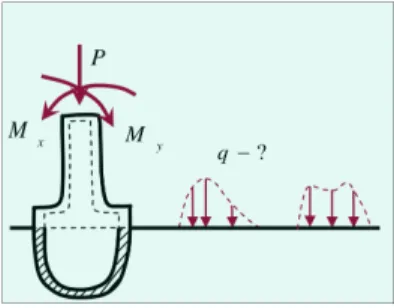
Rigid punch shape optimization in contact problems of theory of elasticity was in- vestigated taking into account incomplete data about external loading [1]. It was supposed that the punch is under action of given forces and moments (acting in the
Fig. 1.3 Dependence of the preference functional on CM
Fig. 1.4 Convergence of GA-method
contact region) and also under action of external forces (acting beyond the contact region) as it is shown in Fig.5. Information about the value and coordinates of ap- plication of such external forces might be incomplete. Guaranteed approach based on worst case scenario is applied as for formulation as for solution of the considered optimization problems with incomplete data on external forces. As a result, the op- timal designs obtained are insensitive to load variations within a given admissible set. Optimal shape of the rigid punch circular in-plane is presented in Fig.6.
Fig. 1.5 Statement of the contact prob- lem
Fig. 1.6 Optimal punch shape
Multipurpose optimization problem for the rigid shell moving on the surface of the elastic half-space has been investigated analytically [2-3] under constraints on the total force and moments acting on the punch (Fig.7).
The shape of the punch has played the role of unknown design variable. The dis- crepancy functional between the actual pressure distribution under the punch and some given pressure distribution was considered as the first optimality criterion.
The second one was the friction dissipation power functional. For minimization of these functionals the Pareto approach has been used and preference functional has been optimized. The specific shape for rectangular in-plane rigid punch is presented in Fig. 8.
Fig. 1.7 Interaction of rigid punch and elastic media
Fig. 1.8 Specific optimal punch shape
The research was performed under financial support of RFBR (grant 14-08-00016- a), RAS Program 12, Program of Support of Leading Scientific Schools (grant 2954.2014.1).
References
1. Banichuk N.V., Ivanova S.Yu. Optimization problems of contact mechanics. Mechanics Based Design of Structures and Machines. Vol. 37, No 2, 2009, p. 144-156.
2. N.V. Banichuk, S.Yu. Ivanova, E.V. Makeev. Finding of rigid punch shape and optimal contact pressure distribution. Mechanics Based Design of Structures and Machines, 38(4), 2010, p.
417-429.
3. Banichuk N.V., Ivanova S.Yu., Makeev E.V., Sinitsin A.V. New approach for contact optimiza- tion problems with friction and wear. Proceedings of the XXXIX Summer School-Conference APM (2011) (Advanced Problems in Mechanics), St.Petersburg, 2011, p. 80-86.
4. N.V. Banichuk, S.Y. Ivanova, F. Ragnedda and M. Serra. Multiobjective Approach for Op- timal Design of Layered Plates Against Penetration of Strikers. Mechanics Based Design of Structures and Machines, 41(2), 2013, p.189-201.