
Master Thesis
Estimating Creditworthiness using
Uncertain Online Data
Author:
MauriceBolhuis
Committee: Dr. ir. Maurice van Keulen
Dr. ir. DjoerdHiemstra
MSc. Ruben Bos
MSc. Luuk Peters
Database Group
Faculty of Electrical Engineering, Mathematics and Computer Science
October 13, 2015
Topicus FORCE Framework
The rules for credit lenders have become stricter since the financial crisis of 2007-2008.
As a consequence, it has become more difficult for companies to obtain a loan. Many
people and companies leave a trail of information about themselves on the Internet.
Searching and extracting this information is accompanied with uncertainty. In this
re-search, we study whether this uncertain online information can be used as an alternative
or extra indicator for estimating a company’s creditworthiness and how accounting for
information uncertainty impacts the prediction performance.
A data set consisting 3579 corporate ratings has been constructed using the data
of an external data provider. Based on the results of a survey, a literature study and
information availability tests, LinkedIn accounts of company owners, corporate Twitter
accounts and corporate Facebook accounts were chosen as an information source for
ex-tracting indicators. In total, the Twitter and Facebook accounts of 387 companies and
436 corresponding LinkedIn owner accounts of this data set were manually searched.
Information was harvested from these sources and several indicators have been derived
from the harvested information.
Two experiments were performed with this data. In the first experiment, a Naive
Bayes, J48, Random Forest and Support Vector Machine classifier was trained and tested
using solely these Internet features. A comparison of their accuracy to the 31% accuracy
of the ZeroR classifier, which as a rule always predicts the most occurring target class,
showed that none of the models performed statistically better. In a second experiment,
it was tested whether combining Internet features with financial data increases the
ac-curacy. A financial data mining model was created that approximates the rating model
of the ratings in our data set and that uses the same financial data as the rating model.
The two best performing financial models were built using the Random Forest and J48
classifiers with an accuracy of 68% and 63% respectively. Adding Internet features to
these models gave mixed results with a significant decrease and an insignificant increase
respectively.
An experimental setup for testing how incorporating uncertainty affects the
pre-diction accuracy of our model is explained. As part of this setup, a search system is
described to find candidate results of online information related to a subject and to
clas-sify the degree of uncertainty of this online information. It is illustrated how uncertainty
This master thesis is the result of the graduation of the study Computer Science at the
University of Twente and was completed as part of an internship at Topicus Finance. I
would like to thank Maurice for his guidance and continuous feedback. I would like to
thank Djoerd for reviewing my thesis. Furthermore, I would like to thank everyone at
Topicus Finance who supported me during this research. In particular, I would like to
thank my supervisors at Topicus Finance, Ruben and Luuk, for their continuing support
and valuable feedback.
Maurice Bolhuis
Enschede, October 2015
Abstract i
Acknowledgements ii
1 Introduction 1
1.1 Motivation . . . 1
1.2 Problem statement . . . 2
1.3 Research questions . . . 3
1.4 Research method . . . 4
1.5 Contributions . . . 5
1.6 Report outline . . . 5
2 Research Domain 7 2.1 Credit application process . . . 7
2.1.1 Acquaintance . . . 8
2.1.2 Financial requirements. . . 8
2.1.3 Financial analysis . . . 8
2.1.4 Non-financial analysis . . . 9
2.1.5 Credit structure . . . 9
2.1.6 Sign off . . . 9
2.2 Credit rating . . . 9
3 Related Work 13 3.1 Online entity resolution . . . 13
3.2 Microcredit risk assessment using crowdsourcing and social networks . . . 14
3.3 Credit scoring with social network data . . . 15
3.4 Probabilistic databases . . . 16
4 Financial Data 20 4.1 Creditworthiness indicator . . . 20
4.1.1 Bankruptcy . . . 20
4.1.2 Rating . . . 22
4.2 Data provider . . . 23
4.3 Collecting data . . . 23
4.3.1 Setup . . . 24
4.4 Result . . . 29
4.5 Conclusion . . . 30
5 Online Data 32 5.1 Survey . . . 32
5.2 Literature . . . 34
5.2.1 The added value of external data sources in the credit application process . . . 34
5.2.2 Online credit score calculating companies . . . 35
5.2.3 Social media as information source . . . 36
5.3 Information uncertainty . . . 42
5.4 Information subjects . . . 43
5.5 Information sources. . . 43
5.5.1 Social Media . . . 44
5.5.2 Company Website . . . 44
5.5.3 Statistics Bureau . . . 46
5.5.4 News Items . . . 46
5.5.5 Google Reviews. . . 47
5.5.6 Google Trends . . . 47
5.5.7 Job Vacancy Website. . . 48
5.6 Information availability and usability . . . 48
5.6.1 Social Media . . . 48
5.6.2 Google Reviews. . . 52
5.6.3 Google Trends . . . 52
5.6.4 Job Vacancy Website. . . 52
5.6.5 Others . . . 52
5.7 Collecting data . . . 53
5.7.1 LinkedIn user profile . . . 54
5.7.2 Twitter corporate profile. . . 55
5.7.3 Facebook corporate profile. . . 55
5.8 Result . . . 56
5.9 Conclusion . . . 57
6 Indicator performance as creditworthiness predictor 59 6.1 Experiment 1: Accuracy of a model using Internet features only. . . 59
6.1.1 Preprocessing data . . . 60
6.1.2 Results . . . 63
6.2 Experiment 2: Accuracy of a model which combines Internet features with financial data. . . 64
6.2.1 Preprocessing data . . . 65
6.2.2 Results . . . 65
6.3 Conclusion . . . 66
7 Including uncertainty of online data 68 7.1 Setup . . . 68
7.2 Search system . . . 69
7.2.1 Search strategy . . . 70
7.3 Uncertainty in data mining . . . 71
7.3.1 Approaches for handling uncertainty . . . 72
7.3.2 Related work on resolving uncertainty in classifiers . . . 73
7.4 Conclusion . . . 76
8 Ethical Considerations 77 8.1 Discrimination . . . 77
8.2 Privacy . . . 79
9 Conclusions 83 9.1 Main research findings . . . 83
9.2 Discussion and Future work . . . 85
A Similarity Functions 89 A.1 N-grams . . . 89
A.2 Levenshtein distance . . . 90
A.3 Jaro–Winkler distance . . . 90
A.4 Term frequency–inverse document frequency. . . 91
B Named Entity Recognition and Disambiguation 94 C Data Mining Classifiers 96 C.1 Rule-based classifier . . . 96
C.2 Decision tree classifier . . . 96
C.3 Naive Bayes classifier. . . 97
C.4 Support Vector Machine . . . 98
D Survey Questions 100 E Survey Results 106 F Correlation between Internet features and PD 110 F.1 Twitter features . . . 110
F.2 Facebook features. . . 111
F.3 LinkedIn features . . . 112
Introduction
1.1
Motivation
Since the financial crisis of 2007-2008, rules for credit lenders have become stricter.
Banks are required to maintain larger capital buffers and reduce the capital leverage.
As a result, it has become more difficult for companies to obtain credit.
Currently, when a company owner applies for a business loan, the decision by the lender
of whether or not to grant the loan is based on two main factors. The first factor is
based on the company figures the credit applicant supplies. These figures are supplied
in the form of a balance of payments and income statement. However, figures do not
paint a complete image of the company. The second factor that influences the decision
whether or not a loan is granted, and which maybe even more important is qualitative
data. When the Bank and Currency Committee asked J.P. Morgan in 1912 if a man’s
money and property was the most important factor in lending money, he responded
by saying: ”No, sir; the first thing is character.” [1,2]. What this example illustrates is that, although a credit applicant might be financially healthy, a credit lender is not
likely to lend its money if it does not know if it can trust the applicant. Credit lenders
obtain this qualitative data via a conversation with the owner of the company about the
financing requirement. This is intended to obtain a better insight in who manages the
company and how the company is managed. During this meeting issues like management
structure, management capacities and business planning are discussed.
A credit rating score can be calculated over both these quantitative and qualitative
factors. A credit rating expresses the probability of default (PD) of a company within
a certain period, usually one year. This rating can either be expressed as a percentage
indicating the probability of default, or as a rating class which is a combination of
numbers and/or letters. A credit score can influence a lender’s decision to grant the
credit, but also the terms of the credit, such as the percentage rate, repayment period
and additional fees [3]. An increased accuracy of credit scores might broaden the amount of companies that successfully obtain a credit, because it reduces the uncertainty for the
lender which is therefore more likely to lend money.
1.2
Problem statement
Many people and companies leave a trail of information about themselves on the
In-ternet. Social media is becoming an increasingly important channel to gather insights
on company performance [4]. Data generated from online communication acts as ”po-tential gold mines for discovering knowledge”, according to Dey and Hague [5]. As the statement of J.P. Morgan in 1912 already showed, especially qualitative data about a
person is of interest to a lender. This information might be found on social media and
other websites on the Internet. The financial crisis showed the importance of being able
to make an accurate prediction of the creditworthiness of credit applicants.
Search-ing and extractSearch-ing this information is accompanied with uncertainty. For example, it
might be uncertain if the information found is actually related to the person or company
that was searched for. Topicus Finance is interested in whether this online information
can be used as an alternative or extra indicator for whether or not to grant a loan to
a company and how accounting for information uncertainty impacts the performance
of this indicator. Figure 1.1 illustrates this problem in which online information, for which it is uncertain that it belongs to the company of interest, is used as input for a
creditworthiness prediction model.
Internet
?
Company A Company B
Rating Risk level (probability of default)
In recent years, multiple companies started using information of the Internet for
cal-culating credit scores, such as Lenddo Inc.1, Neo Finance Inc.2, Friendly Score Ltd.3,
Affirm Inc.4 and Kabbage Inc.5. Websites used by these companies are mostly social
media and include Facebook, Twitter and LinkedIn [6]. Although there are existing solutions, the precise working of their algorithms remains unknown, because it is part of
their business model. Most of these existing solutions focus on consumer credit scores,
while in this research, we are interested in corporate credit scores. In addition, these
existing solutions have in common that they explicitly ask access to a person’s social
media account. This has several disadvantages. First, it might not always be a viable
option to explicitly ask access to a person’s social media account, e.g., when information
on all the employees of a company would be used for making a creditworthiness
predic-tion. Second, by explicitly asking access to the account, it is more likely that the profile
is first fine-tuned before applying for a loan. As a result, the profile data might give an
incorrect image of the creditworthiness.
1.3
Research questions
The following main research question is defined based on the problem statement above:
RQ Given a limited and uncertain set of online data about a real world person or
company, can a prediction of their creditworthiness be made using this data?
This main research question is divided into the following subquestions:
Q1 Which financial data related to creditworthiness is available to test the performance
of online information as predictor for a company’s creditworthiness?
Q2 Which online available information can be used as a predictor for the
creditwor-thiness of these companies?
Q3 What is the performance of these indicators as a predictor for creditworthiness?
Q4 How does incorporating the uncertainty of online data affect the prediction
accu-racy?
1
https://www.lenddo.com/ 2
https://www.neoverify.com/ 3http://www.friendlyscore.com/ 4
The goal is to build a data mining model that makes creditworthiness predictions based
on uncertain online information. Training and testing such a prediction model requires
a data set consisting of both financial and online data. Answering the first subquestion
helps to acquire the necessary financial data for relating online information to
creditwor-thiness. The second subquestion helps to identify which uncertain online information
can be used for predicting the creditworthiness of a company. Answering the third
sub-question helps to determine how this online information performs as a predictor of a
company’s creditworthiness. The fourth subquestion helps to determine whether taking
uncertainty into account has a positive effect on prediction accuracy or not.
1.4
Research method
The first research question will be answered by first holding interviews with employees of
Topicus Finance about which data related to creditworthiness is available within Topicus
Finance or Topicus Finance has/can get access to. The goal of these interviews is to
also get clear which steps are required to obtain this data. It might be necessary to
create a program to collect the data and construct the financial data set, depending on
the availability and completeness of this data.
The second research question will be answered by holding a survey and consulting
litera-ture on online information sources that possibly are relevant to creditworthiness
predic-tions of companies. The survey will be held among employees of Topicus Finance. The
literature study will help to identify whether there are existing solutions and what kind
of information is used within these existing solutions. In order to construct a model, it
is required that a significant amount of companies from the financial data set can be
found in an information source. Hence, a test will be performed using a sample from
this data set to determine the availability of information on the companies within the
information sources. Because the model will be trained on data for which uncertainty
is not modeled, the accounts of companies and persons related to the company will be
manually searched once suitable information sources are found. The eligible information
will be harvested from these accounts.
The third research question will be answered by doing two experiments. First, we will
test whether solely Internet features can be used for making creditworthiness predictions.
Second, we will test whether Internet features can be used for making creditworthiness
predictions when used in combination with financial data. For both experiments, data
mining models will be constructed using several classifiers. The prediction models will
be trained and tested using the financial and online data collected while answering
Web Harvesting
Data Mining Search
Information
Figure 1.2: Steps involved in answering the 4th subquestion.
The research method to answer the fourth subquestion is to perform an experiment in
which the model of the third subquestion is reused and in which its accuracy is tested
both using data for which uncertainty is and is not modeled. In this research, we focus
on uncertainty that arises when searching for online information. Figure1.2 shows the steps required to answer the fourth subquestion. Literature will be studied on methods
of finding online manifestations of persons and companies, such that a search system
can be built that can find candidate results. Information of interest will be harvested for
these results and will be used for making a creditworthiness prediction using the data
mining model. In the certain case, only the information of the best matching search
result will be harvested and used. In the uncertain case, the alternative search results
are each taken into consideration with their probability. Literature will be studied for
methods of incorporating uncertainty into data mining models.
Answering these four subquestion allows to answer the main research question.
1.5
Contributions
The contributions of this research are threefold. First, this research shows online
infor-mation that is possibly useful for predicting a company’s creditworthiness and which is
not used in common corporate ratings. Second, it shows how well this information
per-forms as creditworthiness indicator. Third, this research discusses how the uncertainty
of online data can be included into the prediction model.
1.6
Report outline
The remainder of this report is organized as follows: Chapter 2 describes the research
domain by explaining the typical structure of a credit application process and how risks
are estimated within this process. Chapter 3 describes related work. Chapter 4 answers
the first research question by explaining how a data set was created that consists of
financial data related to creditworthiness. In chapter 5 we answer the second research
question by discussing several possible online information sources. Chapter 6 answers the
third research question by explaining the experiments performed to test the performance
7 discusses the experiment for testing how including uncertainty affects the prediction
accuracy of the model. Chapter 8 discusses ethical concerns of using online information.
Research Domain
In order to understand how online information can be applied in the credit application
process, we explain the steps involved in obtaining a credit and the methods used by
credit lenders to estimate the risks. These topics are considered background information
for the rest of this report.
2.1
Credit application process
A large fraction of starting entrepreneurs and existing companies that want to invest
need to find sources of finance. This financial requirement can be fulfilled using owners’
equity or loans. Loans are obtained by consulting a credit lender, often a bank. Before
a loan is granted, the credit lender first requires some information about the credit
applicant in order to make a deliberate decision. This information is obtained within
the credit application process. This is the process in which the credit applicant and
credit lender exchange information necessary for the credit lender to make a decision on
whether the credit is granted and to determine the amount of credit, the interest rate
and the duration of the repayment period. The steps involved within this process are
illustrated in Figure2.1.
Financial Analysis
Non-Financial Analysis Financial
Requirements
Acquintance Credit
Structure Sign Off
Figure 2.1: Steps involved within the credit application process.
The results of the process are written down in a credit proposal. The goal of drafting a
credit proposal is to give both the credit applicant and the lender insight into the risks
of providing a credit and allowing them to make a deliberate decision. Banks, such as
of obtaining the necessary information. Although there is no standardized plan, the
essence of these steps is roughly the same for different credit lenders.
2.1.1 Acquaintance
The first step is to gather some basic information about the applicant. This includes
information such as the type of company of the applicant; whether the applicant is an
existing or a new customer; and the reason of his or her visit, i.e., whether the applicant
requests a new loan or wants to revise an existing loan. Whenever the applicant is already
a customer, it has established a reputation which will be taken into consideration when
determining the terms of the credit.
2.1.2 Financial requirements
In this step the credit applicant underpins its financial requirements and the credit lender
analyses these requirements. The applicant explains for what it intends to use the credit
and motivates the amount of money required, how the credit influences the company,
and explains how it intends to repay the loan. The credit lender estimates whether the
requested amount of credit is enough for the different business scenarios. It determines
which part of the finance can be provided using a credit and which part using equity or
third-party resources. Furthermore, they discuss issues like which income sources will
be used to repay the loan.
2.1.3 Financial analysis
Within this step the credit lender analyses credit risks by analyzing the cash flows that
are expected based on the future prospects of the company. This gives it the credit
lender insight into the ability of the company to meet the repayment obligations. The
credit lender analyses the financial impact on the company of several future prospects.
Most important figures needed for an analysis by the credit lender are supplied using a
financial account. A financial account of a company gives a numerical overview of the
revenues and costs; assets and liabilities; and income and expenditure of a company.
Credit lenders calculate some formulas over these figures to classify and compare credit
2.1.4 Non-financial analysis
The financial figures of a company do not paint a complete image of the credit applicant.
Despite having good financial figures, a company still can go bankrupt, for example, due
to poor management. As explained in Section 1.1, qualitative data, such as the char-acter of an entrepreneur, can be at least as important. This is why credit lenders also
analyze non-financial issues. The credit lender considers the management structure of
the company, the role of the credit applicant within the management, whether
manage-ment has ownership interests in the company. They determine whether the company
has well-skilled managers that, for example, are capable of dealing with a company crisis
situation. Furthermore, it is important that someone within management has
experi-ence with financial administration. Besides information about management, the credit
lender also requests more general information about the company, such as its
activi-ties, the products and services it delivers and the customers it has. They discuss the
company’s strategic and financial plan.
2.1.5 Credit structure
In this step the credit lender analyses possible structures that impact their risk.
Struc-tural risk is the risk that the credit lender has no grip on cash flows [7]. This can arise when other stakeholders come first in line to claim money when the company goes
bankrupt. The credit lender analyses which other stakeholders exist and determines its
debt position. Furthermore, credit lenders also take into consideration the securities
of-fered by the credit applicant in case the company would default, for example, inventories
or sureties.
2.1.6 Sign off
Within this last step the credit lender evaluates the results of all previous performed
analyses. It estimates the total risk and underpins why it is justified to accept these
risks or not. The lender will determine the interest rate of the loan. It will then consult
with the credit applicant and depending on the decision of both a contract is signed to
confirm the deal.
2.2
Credit rating
is a combination of numbers and/or letters. A debtor is said to default when “it fails
to meet the payment obligations within a specific period” [9]. The period considered is usually one year. A credit rating basically expresses how likely it is that the debtor will
repay the debt [10].
Entities for which credit ratings can be calculated vary from entire countries to
compa-nies and individual consumers, however, this research only focuses on company ratings.
In a guide by the European Commission about ratings [10] a distinction is made between two types of ratings:
• External ratings: these are issued by rating agencies for only countries and
rela-tively large companies.
• Internal ratings: these are assigned by banks to their borrowers.
A rating is calculated using the quantitative and qualitative information acquired during
the credit application process. Figure2.2illustrates how corporate borrowers are rated.
Customer
Information provider*
Quantitative factors •Debt ratio •Liquidity •Profitability •…
Qualitative factors •Management quality •Market situation •Legal form •…
Rating statistical algorithm
Risk level (probability of default) Internal rating model
Rating
[image:16.596.116.517.375.551.2]*External providers collecting financial data, only used by somebanks
Figure 2.2: How borrowers are rated [10].
As explained in Section2.1, the quantitative data is gathered from financial statements or annual reports. In addition, sometimes the company is also asked for tax returns and
business plan figures. Certain ratios are calculated over these figures. Most commonly,
this includes ratios that express the indebtedness, liquidity and profitability of the
com-pany [10]. Based on the judgment of the bank, values are assigned to the qualitative factors, such as quality of management and market situation. The weight banks assign
to these qualitative factors in their rating algorithm often depends on the size of the
An example of a credit rating score that is considered throughout this thesis is the URA
Solvency Check [11]. Although the ratios calculated differ per specific credit rating, Henking et al. [9] show some example ratios that can be used in calculating a credit rating score:
• Share of ordinary results. This ratio takes the income resulting from day-to-day
operations of the company as a fraction of the liabilities.
• Liability ratio. This ratio measures the amount due to banks and suppliers as a
fraction of the liabilities.
• Interest rate on borrowings. This ratio is calculated by taking the amount of
interest expenses as a fraction of the debts. It expresses the estimated level of risk
by lenders to the company.
• Share of short-term liabilities. This ratio is calculated by dividing the short-term
liabilities by the sales value. A liability is often short-term if it is due within 1
year. This ratio expresses how well the company is able to repay its short-term
debts.
• Share of own funds. This ratio measures the fraction of the assets that is financed
by owners’ equity. A larger ratio shows that shareholders are more willing to invest
in the company, therefore making it less risky for potential lenders to invest their
money into the company.
Discriminational Financial Ratios
= 19,75% = 49,43% = 4,52% =34,45% Ordinary Result
Liability Ratio
Interest rate on borrowings Share of short-term liabilities
Equity Ratio =14,71%
Balance Sheet Rating
Z=a+b1*k1+b2*k2+…+bn*kn Z-Factor = 3.98 Probability of Default
= 0,42%
Apriory = 1.8
Rating Categories
Standard and Poor‘s = BB+
Moody‘s = Baa2
IFD = 2
KSV = 3
[image:17.596.131.497.486.733.2]DSGV = 6
Figure2.3illustrates the process of calculating a credit rating based on the balance sheet figures. The values of these ratios are inserted into a regression function which transforms
them into a single number. This value is normalized using a logistic function into a
number between 0% and 100% which indicates the probability that the company goes
bankrupt. The company is assigned a particular rating class based on these normalized
[image:18.596.140.494.233.587.2]values. Table 2.1 shows to which rating class a company with a certain probability of default is assigned according to the URA rating.
Table 2.1: URA Rating Scale (one-year probability of default) [11].
PD-Rating PD% Description
AAA 0.001% The company has a very strong financial standing. The ability
to meet its payment obligations is excellent.
AA+ 0.002%
AA 0.004%
The company’s solvency is satisfactory. Fundamental strength
is not as good as in AAA/ AA+.
AA- 0.008%
A+ 0.01%
A 0.02%
A- 0.04% The company’s solvency is adequate. However, negative
changes in the economic conditions may have considerable
effects on the company’s ability to meet its payment
obligations.
BBB+ 0.09%
BBB 0.17%
BBB- 0.42%
BB+ 0.87% The financial standing of the company is characterized by
considerable, continuous uncertainty. Distinct speculative
elements. Presently the company is still able to fulfill all
payment obligations.
BB 1.56%
BB- 2.81%
B+ 4.68%
B 7.16%
There is presently a high risk for the company not being able
to meet its payment obligations on time.
B- 11.62%
CCC+ 15.40%
CCC 17.38%
CCC- 21.50% Due to its financial situation the company could not meet its
financial obligations on time. Selective default in payment,
insolvency. Failure to pay, insolvency.
CC 26.00%
Related Work
Uncertainty can arise when searching for online data. Section3.1discusses related work on searching online manifestations of persons. The use of online information for
pre-dicting creditworthiness has been studied by related work. Section3.2discusses related work in which social media information is used for predicting the creditworthiness of
per-sons. Section 3.3 discusses related work that analyzes the impact of using information of social media connections on customer rating accuracy. Related work on probabilistic
databases, the concept of which is applied within this research, is discussed in Section
3.4.
3.1
Online entity resolution
As explained in Section1.2, searching and extracting online information can be accompa-nied with uncertainty. For example, uncertainty can arise when resolving online entities.
H. Been built a prototype of a system that uses data about a real world person to
au-tomatically find online manifestations of that person [13]. The prototype allows finding online manifestations by searching on several characteristics of a person, for example,
first name, last name and email address. Possible results are crawled and match scores
are calculated for these results using the information known about the person that is
searched for. A probabilistic view is applied to derive conclusions from the evidence
that is found and calculated over the collected data. Experiments performed with the
prototype in which Twitter was used as an online source show that the prototype is able
to reliably and automatically find persons on the Internet.
The metrics described by H. Been to determine the level of confidence that a correct
search result is found are relevant for this research because they can be used as a
discussed in the work of H. Been. It allows determining the best match that can be
used for testing the prediction performance when uncertainty is not modeled. When
uncertainty is modeled, the metrics can be used to attach a level of uncertainty to the
data that is extracted.
In addition to searching information, uncertainty from entity resolution can also arise
within data. Related work exists that study entity resolution within informal texts, such
as Twitter tweets [14,15]. AppendixBexplains the subtasks of information extraction used by related work. This can be used to determine the level of uncertainty when
informal texts are used as an information source for predicting creditworthiness.
3.2
Microcredit risk assessment using crowdsourcing and
social networks
Related work has studied the use of online information for predicting creditworthiness.
In [16], Hasanov et al. explain a system that performs credit risk assessment using crowdsourcing and social networks. Figure 3.1illustrates the proposed system.
User permission
Information retrieval
Evaluation
Decision
USER
[image:20.596.148.483.401.606.2]CROWDSOURCING
Figure 3.1: Risk assessment approach using crowdsourcing and social networks [16].
Their system retrieves information of credit applicants from their Facebook and LinkedIn
social media accounts. Information that potentially influences the creditworthiness of
a person is extracted from these accounts (e.g., skills, interests, work experience and
recommendations). This information is evaluated using a crowdsourcing approach. In
this approach, real-world persons are consulted via messages posted automatically on
social media asking them how they think that a certain information value (e.g., the
post these messages. Persons could respond by ‘liking’ the message when they think the
information contributes to entitling someone to receive a loan. The persons consulted
consisted of people interested in banking and financial institutions. A single numerical
value is computed using the results of this crowdsourcing evaluation approach by
calcu-lating a factor for each category based on the number of ‘likes’ and then combining these
factors using linear regression. A decision is made whether or not the loan should be
granted based on this number. Data of a financial institution in Azerbaijan containing
credit history of clients who have previously received a loan and have agreed to share
their social media data is used to train and test the system. Their system achieved a
92.5% true positive rate and has a false positive and false negative rate of 6.45% and
11.11% respectively.
There are two main differences between the work of Hasanov et al. and out work.
Hasanov et al. focus on predicting creditworthiness of persons. However, in this research
we focus on predicting creditworthiness of companies. Furthermore, Hasanov et al. first
explicitly ask a credit applicant permission to access the data on their social media
accounts and hence knows for certain that the information relates to the credit applicant.
In this research, we study creditworthiness prediction using data for which it is uncertain
whether the information relates to the person or company of interest.
3.3
Credit scoring with social network data
Besides information directly related to a person for whom the credit score is calculated,
also the information of social media connections can act as information source. Y. Wei
et al. performed an economic study in which they analyze the use of social network
data on the accuracy of consumer credit scores [3]. The results of their study show that, under the assumption that people are more likely to connect with people that
are similar to them, social network data provides extra information that can improve
the accuracy of creditworthiness prediction. Social network connections of a person can
be used as additional information for predicting creditworthiness by not purely looking
at who those friends are, but by analyzing how those persons are connected. It is
reasonable to assume that there has to be some kind of link or similarity between two
persons connected on social media (e.g., traits, work or study). This similarity can be
used to clarify beliefs about the person and verify its information. Whenever companies
start using this social network data for estimating creditworthiness, people might start
limiting their number of connections and only connect to more similar people to try
to improve their credit score. This can result in network fragmentation in which good
only being able to connect with other bad financial types. If people getting rid of
bad connections, the system is getting information from less connections, resulting in
less information to improve the creditworthiness prediction accuracy. However, when
the system can get information and knows that you are trying to game the system by
disconnecting bad friends, and it knows that you are a good type, it also knows that
your connections are more likely to be also good types. When a group of good types is
in your network, the system could have more confidence that you are also a good type.
The results suggest that whenever a prediction of creditworthiness can be made using
the social media account of a person, the information of connections of this person might
also be an indicator of the creditworthiness of the person.
3.4
Probabilistic databases
In this research, we study whether creditworthiness predictions can be made using
un-certain data. A lot of research has been done on dealing with unun-certainty in databases.
These so-called probabilistic databases are database management systems which can
store uncertain data [17]. The value of some attributes or the presence of some records within these databases can be uncertain and are only known with some probability [18]. Traditional database management systems store all values as facts. However, there are
many sources of uncertainty. Suciu et al. [18] distinguish between two types of uncer-tainty: tuple-level uncertainty and attribute-level uncertainty. Whether a tuple belongs
to a database instance or not, i.e., whether the tuple exists, is unknown in situations
of the first type of uncertainty. Each tuple is a random variable which can take two
values: true when the tuple is present and false when it is absent. Hence, it is called a
maybe tuple. In situations of the second type of uncertainty the value of an attribute
A is uncertain. The value of this attribute A is a random variable whose domain is
the set of values the attribute might take for that tuple. These forms of uncertainty
can come from missing data, non-specific data, vague data, inconsistent data and errors
[17,19,20]:
• In information extraction systems uncertainty comes from the ambiguity in
natural-language.
• In data integration and cleaning uncertainty comes from comparing data sources
and identifying matching entities.
• In data collection uncertainty comes from the limited accuracy of measurement
• In some privacy important applications uncertainty is purposely inserted to hide
sensitive attributes.
Examples of probabilistic database systems are MayBMS [21], Trio [22], MystiQ [23] and Orion [24]. The first two only support discrete uncertainty while the last two also support continuous uncertainty. These are all relational probabilistic database systems.
However, also research is done to build a probabilistic XML database system [25,26]. An important concept within the probabilistic databases field is the concept of possible
worlds. Because the value of attributes and the existence of tuples are uncertain, the
database can be in one of several possible states each of which has a certain probability.
These possible database instances are called possible worlds. Table3.1shows an example illustrating the possible worlds concept. This example shows a database consisting
of a table with the attributes name and gender. For some tuples in this example,
there is attribute-level uncertainty for the name attribute, for example, the name of
the first person is ‘Jan’ with a probability of 0.7 or ‘Janssen’ with a probability of 0.3.
Furthermore, in this example the existence of some tuples is uncertain, for example,
‘Marieke’ might only belong to the table with a probability of 0.6 (and not belong to the
table with a probability of 0.4). Given these possible tuples, the database can be in four
states. The probability that the database is in state 3.1a equals 0.7×0.6 = 0.42. The probabilities for the other possible worlds were calculated similarly. This is a relatively
simple example with a limited amount of possible worlds, but in more realistic cases the
amount of possible worlds can get huge. It is often impossible to return all possible sets
of answers. Therefore, the probabilistic database often ranks tuples and aggregates over
uncertain values to present the possible query answers to the user [19]. For example, query performance can be speeded up by returning only the k highest ranked tuples
(top-k query answering).
Table 3.1: Possible worlds example
(a)
Probability: 0.42
Name Gender
Jan male
Marieke female
(b)
Probability: 0.28
Name Gender
Jan male
(c)
Probability: 0.18
Name Gender
Janssen male
Marieke female
(d)
Probability: 0.12
Name Gender
Janssen male
Possible worlds can be defined more formally as follows: let DB be set of all possible
databases. Let D be an instance of a database: D ∈ DB. Furthermore, let De be a
probabilistic database instance. A probabilistic database is a set of database instances,
each associated with a certain probability: De ∈ DB ×[0..1]. The sum of the probabilities
of all possible states of this uncertain database should equal one: P
called a possible world of the probabilistic database. The set of all probabilistic databases
can then be defined as follows: PDB={De ∈ DB ×[0..1]| P
(D,p)p= 1}
Probabilistic database systems can support two types of uncertainty: discrete and
con-tinuous. A finite number of values can be distinguished with discrete uncertainty while
in continuous database systems attributes can take an infinite number of values. Besides
this classification of uncertainty, it can also be classified as dependent or independent.
Whenever the attribute values are independent, the value of one attribute does not
in-fluence the probability of the value of the other attributes. For example, whether the
name is Jan or Janssen in the example of3.1does not influence the fact whether Marieke is an entry within this table. The data of a probabilistic database is usually stored in
normal relational database tables, supplemented with extra attributed and tables that
store probabilities, alternatives and dependencies [17].
Queries sent to a probabilistic database are to a large extent the same as standard SQL
queries. Most probabilistic databases use an extended SQL version [17]. This extended version of SQL supports some special constructs that allow dealing with uncertainty,
for example, for calculating the expected value. However, these constructs are not
standardized and differ per probabilistic database system. Instead of only returning
the results, a probabilistic database also returns the probabilities of each result. A
SQL query on a probabilistic database is computed by fetching and transforming the
data; and performing probabilistic inference [19]. One of the advantages of probabilistic databases is that it integrates the probabilistic inference and query computation steps.
By doing so, the probabilistic inference can be speeded up by using standard database
management techniques such as materialized views and schema information.
Another advantage of probabilistic databases is that it often does not require tuples and
attributes to be independent and allow dependencies in the uncertainties to be specified.
For example, a tuple can only exist if another tuple exists, or two tuples cannot coexist.
Similarly for attribute uncertainty, you can specify, for example, that an attribute has
a particular value only if another attribute has a particular value. The advantage for
application developers is that they do not have to be concerned with the details
proba-bility theory, because the uncertainty is dealt within the database management system.
Developers can simply query the database with the slightly different version of SQL.
Queries are evaluated according to an execution plan. Query optimization is concerned
with finding more efficient execution plans while preserving the semantics. A query
result of a probabilistic database is correct only if both assertions and their probability
are correct [27]. A safe execution plan is a query execution plan that returns correct results. Once a plan has proven to be safe it can be executed on any database instance.
be dependent, and hence cannot be manipulated independently. Therefore, a query
plan that is correct for regular database systems might not be correct for probabilistic
databases.
In [15], Van Keulen et al. claim that dealing with alternatives (i.e. possible worlds) along with their confidences might yield better results. In this work, we study whether
this claim of achieving better results by applying the possible worlds concept of
proba-bilistic databases holds in a real-world case within the financial domain. We study how
incorporating multiple candidate results instead of incorporating only the most likely
Financial Data
Constructing a data mining model for subquestions three and four, that can make
cred-itworthiness predictions based on online information, requires both financial and online
data to train and test the model. Since in this research we study the prediction of a
company’s creditworthiness, the financial data should be related to the
creditworthi-ness of companies. In this chapter, we discuss two possible creditworthicreditworthi-ness indicators.
We discuss the data provider that is used for constructing a data set consisting of this
selected creditworthiness indicator. Furthermore, we explain the setup that was used
to collect the data from this data provider. The resulting data set is discussed. This
allows us to answer the first subquestion on the available financial data related to
cred-itworthiness to test the performance of online information as predictor for a company’s
creditworthiness.
4.1
Creditworthiness indicator
There are multiple creditworthiness indicators that could be used for training and testing
a model that uses online information for predicting a company’s creditworthiness. In
this section we discuss bankruptcies and credit ratings as creditworthiness indicators.
4.1.1 Bankruptcy
Bankruptcy is the ultimate proof that a company was not creditworthy, because a
com-pany that went bankrupt cannot repay its loan. Figure 4.1 shows how a test setup might look like when using bankruptcy as creditworthiness indicator for testing the
per-formance of online information as predictor of creditworthiness. Although this setup also
includes a rating, it is not used for determining the accuracy of the prediction. In this
test setup the accuracy of the original rating model is determined using the bankruptcy
information of companies. This accuracy is used as a baseline. A new rating model that
incorporates online information into the original rating model can be constructed. Some
basic information about the company, that is available through a data provider, can
be used for searching more elaborate information about them in an online information
source. This information is transformed into an indicator score, which can be added
to the original model. The accuracy of this new rating model can again be determined
using bankruptcy information. The accuracy of both the model excluding and including
the online information can be compared to determine whether the online information
improves the creditworthiness prediction.
Information
Extraction Analysis Calculate
Rating
Calculate accuracy
Financial Statement
Basic company related information
provided by the data provider
Online Information
Source
Calculate score
Accuracy
Bankruptcy (Yes/No)
Rating Combine
scores
Score
New Rating
Figure 4.1: Test setup when using bankruptcy as creditworthiness indicator.
Several problems were discovered when attempting to create a data set in which bankruptcy
is used as creditworthiness indicator. The results of a manual verification of the
avail-ability of online information about several companies that went bankrupt and persons
that are related to these companies suggest that:
• In general, companies that went bankrupt do not seem to be very active on the
Internet. Many of these companies do not have a website and could not be found
on several popular online platforms such as Twitter, LinkedIn and Facebook. In
addition, persons related to these companies seem to be harder to find on the
Internet.
• Even if the companies were active on the Internet, their data often is limited,
The presence of companies on the Internet might by itself be predictors of
creditwor-thiness. However, when no account can be found for a company and hence no extra
information can be extracted from it, the presence on the Internet would be the only
indicator that could be used for making predictions. The performance of other online
information as predictor of creditworthiness cannot be tested in these cases. In addition,
often the amount of information available for these defaulted companies or persons that
are related to it is too limited to determine irrefutably whether the account belongs
to the company / person and hence whether it present on the Internet. Since in these
cases it is uncertain whether the company / person had an account, it cannot be used
for training and testing the model. Because of these issues it was decided not to use
bankruptcy as creditworthiness indicator.
4.1.2 Rating
A rating expresses the probability of default and indicates how likely it is that someone is
able to repay its loan within a certain period. As discussed in Section2.2a rating can be calculated based on the figures of the financial statement and profit & loss account. Using
ratings as creditworthiness indicator does not necessarily suffer from the same problems
as when using bankruptcy as creditworthiness indicator. First, it might be easier to
find a set of companies that are relatively less creditworthy, but still can be found on
the Internet. Most bankruptcies occur among smaller companies because they are more
volatile and more often operate in small markets [28]. These smaller companies are relatively harder to find on the Internet. The amount of companies that went bankrupt
is a subset of the amount of companies that would have had a bad rating. Hence, there
might be more relatively larger companies with a bad rating for which information can be
found compared to the amount of companies that went bankrupt for which information
can be found. Second, most companies for which a rating can be calculated are still
active. Therefore, it is more likely to be able to find up to date information for these
companies.
Using ratings as a creditworthiness indicator requires a slightly different test setup
com-pared to the one discussed in Section 4.1.1. In general, testing cannot be done with data that is also used to construct a model. Hence, when the calculated score would
be combined with the rating as in Figure 4.1, the rating cannot also be used for testing the accuracy of the score because it partly already consists of this rating. However,
another possibility is to use the rating as a reference and try to approximate this rating
by calculating a score over the online information. Figure 4.2 shows how a test setup might look like when using the rating for testing the performance of online information
Information
Extraction Analysis Calculate
Rating
Financial Statement
Basic company related information
provided by the data provider
Online Information
Source
Calculate score
Accuracy
Rating Compare
scores
Score
Figure 4.2: Test setup when using ratings as creditworthiness indicator.
4.2
Data provider
A data provider needed to be found that could provide ratings or the financial data
necessary to calculate ratings, such that ratings can be used for training and testing
our prediction model. Interviews with several employees of Topicus Finance revealed
an external data provider that could supply the information necessary to create a data
set. This data provider offers company information on millions of listed and private
industrial companies around the globe. It cannot provide company ratings off the shelf.
However, Topicus Finance has access to a rating formula that uses the figures of the
financial statement of a company to calculate a credit rating. Since the data provider
can provide key financial data for the companies, such as balance sheet and profit & loss
account figures, it is possible to compute a rating for them. In addition, if listed, the
data provider also offers other relevant non-financial information such as the company’s
contact information, the legal status (e.g., active, default on payment or bankrupt), the
sector it belongs to; and names of current directors and managers. This additional data
allows online information related to these companies to be searched.
4.3
Collecting data
To construct a data set consisting of ratings that could be used for training the prediction
model and testing its performance, it was necessary to build a system that could import
and extract the data from the data provider. As explained in the previous section, the
data provider does not provide ratings itself. However, ratings could be calculated over
the data of this data provider using the rating model available within Topicus Finance.
4.3.1 Setup
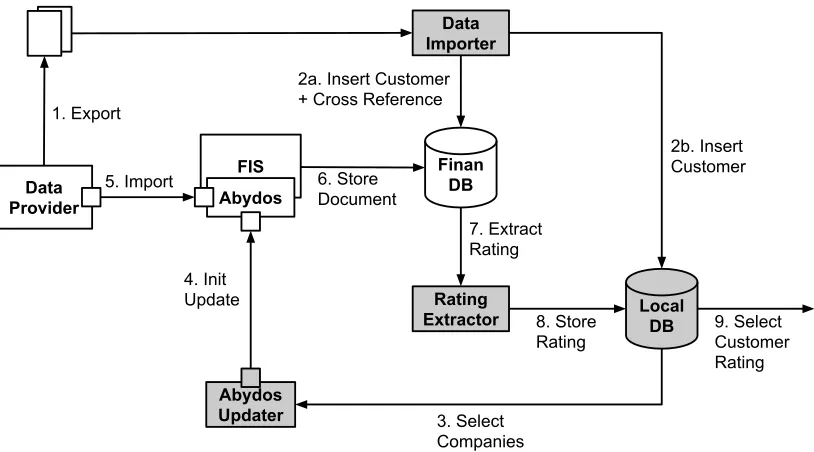
Figure4.3illustrates the setup that was used to create a data set using the data provided by the data provider. Non-shaded components were already in place within Topicus
Fi-nance while the shaded components were specially created for this system. The different
components within this setup are discussed together with the flow of information.
Finan DB Local DB Rating Extractor Data Importer Abydos Updater 4. Init Update Data Provider 5. Import 3. Select Companies 2b. Insert Customer 1. Export 7. Extract Rating 6. Store Document 2a. Insert Customer + Cross Reference
[image:30.596.115.522.194.420.2]8. Store Rating FIS Abydos 9. Select Customer Rating
Figure 4.3: Setup for creating data set.
• Data Provider. As discussed before, the data provider provides financial
infor-mation together with some basic inforinfor-mation about the companies. The financial
information is accessible through a web service while the basic information can
be exported (1) though the data provider’s web interface. This basic information
consists (if available for the company) of:
– Company name
– Company managers / directors / contacts
– Address: street, zip code, city, country
– Website
– Statistical Classification of Economic Activities in the European Community
(NACE)
– Chamber of commerce registration number
• Data Importer. The Data Importer is designed to read files that are exported
by the data provider and storing the exported information in the Finan and Local
DB. A customer entry and cross reference are created and stored in the Finan DB
(2a). The customer details are stored in the Local DB (2b).
• Finan Database. The three elements stored within the Finan DB for this setup
are customers, cross references and documents. Customers consist of a name and
reference identifier which is used to access and store information of the customer
within the Finan system. Cross references belong to a certain customer and contain
the identifier used by the external data provider. This identifier is used to retrieve
financial data of a specific customer. Documents are stored in XML format and
also belong to a certain customer.
• Local Database. The Local DB stores both customer details and ratings that
are extracted from the imported XML documents.
• Abydos Updater. The Abydos Updater initiates the retrieval of financial
docu-ments. It selects customers that have been added to the Local DB (3) and initiates
updates by calling theInitUpdate method of the Abydos web service (4).
• Abydos Web Service. The Abydos web service can be used to initiate updating
financial data stored within the Finan DB. Abydos also has a web interface which
allows running update batches. However, updates initiated through this web
in-terface will only update documents for which the data provider’s data has changed
in the last year. In contrast, updates initiated through the web service are not
only limited to documents updated in the last year and will update all documents
for which there is a newer document available.
• Financial Import Service (FIS). The FIS is a component used within Topicus
Finance to import financial data. The Abydos web service uses this service for
importing the updated financial data. The FIS first retrieves the financial XML
data from an external source (5). Then it transforms this data using a defined
mapping into a format that is understood by the Finan model. In this case,
it transforms the data into International Financial Reporting Standards (IFRS)
format which is an accountancy standard. The Finan model was modified for this
setup such that ratings are added to the XML documents stored in the database.
Finally, it stores this document into the Finan DB (6).
• Rating Extractor. The Rating Extractor extracts ratings from XML documents
stored in the Finan DB (7). This is done using SQL/XML queries. SQL/XML is
an extension to the SQL language which allows to store and query XML data in a
these financial documents. The relevant nodes are: column definitions, timelines
and financial nodes. These are contained within thecolumnDefinitions,timeLines
and ROOT nodes respectively. Column definitions define a period to which the
financial figures relate. The XML document has a separate timeline for every
information source. In most cases, there is only a single timeline since there is
only one source of information. Each timeline consists of a number of columns for
each year for which there is financial data available. The financial nodes (in this
case krPD and krUraRatingKlasse) consist of column nodes, which relate to the
columns defined within the columnDefinitions and contain the specific financial
value.
finanDocument
columnDefinitions
columnDefinition
columnId startDate endDate
timeLines
timeLine
timeLineId columnIds
columnId
ROOT
krPD
columns
column
columnId value
krUraRatingKlasse
columns
column
columnId value
Figure 4.4: XML tree of the financial documents.
4.3.2 Data filtering
The data provider offers company information for a large variety of companies. However,
the data provided is not always sufficient for a rating to be calculated. Furthermore,
not all companies are within the scope of this research. Therefore, some selection filters
were applied before importing the data to increase the quality of the data set. These
filters were chosen with care to not unnecessarily limit ourselves, but whenever it turns
out that some of these filters are too strict they can easily be loosened. The data filters
applied initially when selecting data from the data provider are:
• Incomplete data. The financial data of many companies provided by the data
provider is incomplete and therefore insufficient for a rating to be calculated.
Hence, filters were added to select only companies for which the balance sheet
contains at least the amount of total assets and shareholders’ funds & liabilities;
and for which the profit & loss account contains at least an operating revenue
• Country. Importing and extracting the necessary data to create a data set is
time consuming. Because of time constraints, the first step was to create a data
set consisting of only Dutch companies. This country is from the point of view of
Topicus Finance most interesting.
• Latest year of account. Only companies for which the financial figures are at
least available for one of the five most recent years (2010-2014) are selected. This
filter is essential, because it excludes companies for which only data is available
when social media did not yet exist or the usage was still limited. In addition,
it limits the number of ratings which are not related to information that can be
found today.
• Financial companies. The mappings created by Topicus Finance are not
in-tended for financial companies. These types of companies have an accounting
template which deviates from the industrial accounting template. Therefore, these
companies are excluded (NACE Rev. 2 nr. 64-66 and 69).
• Other irrelevant sectors. Public administration and defense; and
extraterrito-rial organizations and bodies are also excluded, because these companies do not
follow the credit application process.
• Exclude holdings. Because holdings do not produce any goods or services, they
are excluded. In addition to the financial holding which already is excluded, this
also concerns non-financial holdings (NACE Rev. 2 nr. 70). Companies with the
word ‘Holding’ in their name were later removed, because it turned out that the
sector filter did not filter out all holdings.
• Legal form. Companies with a sole proprietorship, private limited liability and
general partnership legal form are selected. Public limited liability companies are
excluded from the data set. Often, much information is available for these types
of companies to make already a good prediction of their creditworthiness. The
potential added value of online information is larger for smaller companies for
which there is relatively less other information available.
• Turnover. A limit of 50 million euro was set on the turnover for the same reason
as why the legal form filter is added. This amount was chosen in consultation with
the Topicus Finance economist.
After running the program, the information of 10907 companies was imported. In total,
26703 ratings related to the period 2010-2014 were calculated and extracted for these
companies. However, it turned out that this initial data set still had some
deficien-cies. Therefore, some additional filters were applied after importing the data to further
• Unbalanced balance sheets. When studying the imported financial data, we
found that for many ratings the corresponding balance sheet is unbalanced after
importing the data. An inspection of these balance sheets revealed that the
map-ping would not map certain figures to the Finan system when it lacks a level of
detail, i.e., no subfigures are defined for these main category figures. We found
that this mapping could be improved by additionally mapping the main category
of these subfigures. Ratings calculated over unbalanced balance sheets are likely
to be incorrect. Therefore, an additional filter was applied to the already collected
data that checks whether the balance sheet is balanced. When this is not the case,
the rating is left out of the data set.
• Director / manager / contact information available. Because we are
specif-ically interested in whether online information about a person related to the
com-pany can be used as a predictor of creditworthiness, it is necessary that some basic
information about these persons is known. Therefore, only companies for which
this information was available were selected.
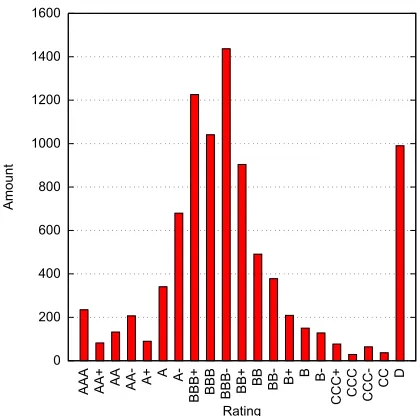
• Extreme ratings. Figure4.5shows the distribution of 7703 ratings for which the balance sheet is balanced and for which information about the company directors
/ managers / contacts is known. The ratings seem to be normally distributed.
However, as can be seen in the figure, the AAA and especially the D ratings seem
to be outliers to this distribution. Despite being interested in the difference in
ratings, the Topicus Finance economist advised to filter out these extreme ratings.
A common reason for companies to obtain an AAA rating is that the company
has a high amount of equity. According to the economist, many of the smaller
companies with a high amount of equity are investment companies. Although on
paper these companies might not be classified as holdings, in practice they do not
produce any goods or services and therefore are out of scope for this research.
A company receiving a D rating is an indication that it is quite certain that the
company will go bankrupt within a year. If the rating concerns a period more
than one year ago and the company is still active, the rating has a high likelihood
of being incorrect. For example, 4% of the companies had a probability of default
of 100% in one year and still existed in a later year. This means that at least 20%
of the D ratings in this set were incorrect. If these ratings are kept included, the
system would be trained and tested on erroneous data and as a consequence will
produce inaccurate results.
• Most recent ratings vs. all available ratings. When the company ratings of
all available years are used to determine how a change in information influences
0 200 400 600 800 1000 1200 1400 1600
AAA AA+ AA AA- A+ A A-BBB+ BBB BBB- BB+
BB BB- B+ B B-CCC+ CCC CCC- CC
D
Amount
[image:35.596.206.415.83.291.2]Rating
Figure 4.5: Rating distribution including multiple ratings per company.
at the time of the rating and which was placed online later. Often, the creation
or modification date of information on the Internet is unknown. Whenever only
the most recent ratings are used, we limit the number of cases for which the
information that is now available was unavailable at the time of the rating. Hence,
it was decided to only use most recent ratings.
4.4
Result
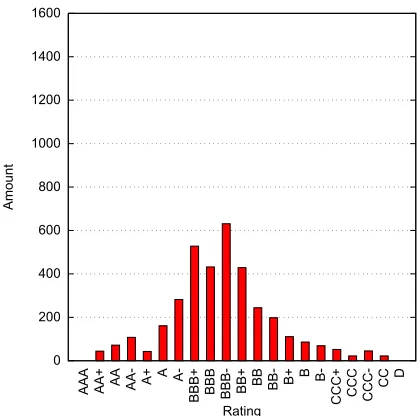
After filtering the data set, the ratings of 3579 distinct companies remained. Figure
4.6 shows the distribution of most recent ratings available per company for which the corresponding balance sheet is balanced and for which information about the company
directors / managers / contacts is known. For training and testing our prediction model,
the data set should consist both of companies that are creditworthy and those that are
not such that the difference in information can be related to the difference in
creditwor-thiness. The figure shows that the ratings of this data set are indeed well-distributed.
In general, having a bigger data set is better for data mining. However, the costs in
time, money and effort should we weighted against the benefit of extending the data set.
The models that will be constructed are trained on data for which uncertainty is not
modeled, i.e., the information is actually related to the company belonging to a rating.
To be certain that harvested information is related to a company, it is necessary to do
a manual search for the correct pages / accounts within online information sources. In
0 200 400 600 800 1000 1200 1400 1600
AAA AA+ AA AA- A+ A A-BBB+ BBB BBB- BB+
BB BB- B+ B B-CCC+ CCC CCC- CC
D
Amount
[image:36.596.206.415.83.291.2]Rating
Figure 4.6: Rating distribution after refining the data set.
Because of time constraints, we might not be able to search in all considered online
information sources for the pages / accounts of all 3579 companies. No specific criterion
was found for the minimum size of a data set in data mining, because it strongly depends
on the experiment that is performed, and the data and classifier that is used. However,
related work [16] suggests that 400 is a reasonable amount. And although in this research we do not take a statistical approach, a sample size of 385 seems to be required for an
unknown population and confidence level of 95% [30]. The final data set amply met this criterion. This suggests that this data set can be used for the experiments.
The figure shows that fewer samples are available for the outer rating classes. Whenever
only a subset of these companies is manually searched, it might turn out that there
are too few samples for some rating classes to train the classifiers. However, given the
large number of rating classes, we can reduce the number of classes, such that more
samples per class are available whenever the amount of samples per class turns out to
be a problem.
4.5
Conclusion
In this chapter, we discussed which financial data is available for training and
test-ing a model that uses online information for predicttest-ing a company’s creditworthiness.
Bankruptcies and ratings were discussed as possible creditworthiness indicators for
training and testing a creditworthiness prediction model. Several problems of using
bankruptcy as creditworthiness indicator were discussed. It was explained that using
![Figure 2.2: How borrowers are rated [10].](https://thumb-us.123doks.com/thumbv2/123dok_us/9813834.482618/16.596.116.517.375.551/figure-how-borrowers-are-rated.webp)
![Figure 2.3: Example procedure of a rating [12].](https://thumb-us.123doks.com/thumbv2/123dok_us/9813834.482618/17.596.131.497.486.733/figure-example-procedure-of-a-rating.webp)
![Table 2.1: URA Rating Scale (one-year probability of default) [11].](https://thumb-us.123doks.com/thumbv2/123dok_us/9813834.482618/18.596.140.494.233.587/table-ura-rating-scale-year-probability-default.webp)
![Figure 3.1: Risk assessment approach using crowdsourcing and social networks [16].](https://thumb-us.123doks.com/thumbv2/123dok_us/9813834.482618/20.596.148.483.401.606/figure-risk-assessment-approach-using-crowdsourcing-social-networks.webp)
![Figure 5.1: Average daily mentions of firms [4].](https://thumb-us.123doks.com/thumbv2/123dok_us/9813834.482618/44.596.112.536.246.464/figure-average-daily-mentions-of-rms.webp)
![Figure 5.2: Social media posts related to performance indicator categories per indus-try [4, 33].](https://thumb-us.123doks.com/thumbv2/123dok_us/9813834.482618/46.596.112.523.79.327/figure-social-media-posts-related-performance-indicator-categories.webp)

