http://wrap.warwick.ac.uk/
Original citation:Giridhar, P., Kumar, V. and Joseph, M. (1997) The mine pump problem. University of Warwick. Department of Computer Science. (Department of Computer Science Research Report). (Unpublished) CS-RR-332
Permanent WRAP url:
http://wrap.warwick.ac.uk/61019 Copyright and reuse:
The Warwick Research Archive Portal (WRAP) makes this work by researchers of the University of Warwick available open access under the following conditions. Copyright © and all moral rights to the version of the paper presented here belong to the individual author(s) and/or other copyright owners. To the extent reasonable and practicable the material made available in WRAP has been checked for eligibility before being made available.
Copies of full items can be used for personal research or study, educational, or not-for-profit purposes without prior permission or charge. Provided that the authors, title and full bibliographic details are credited, a hyperlink and/or URL is given for the original metadata page and the content is not changed in any way.
A note on versions:
The Mine Pump Problem
(This description is taken from Real-time Systems: Specification,
Verifica-tion and Analysis, (Joseph, 1996).)
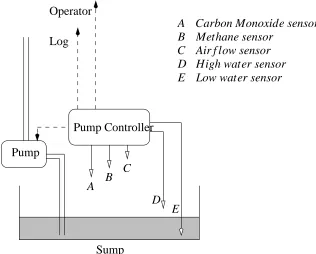
Water percolating into a mine is collected in a sump to be pumped out of the mine (see Figure 1). The water level sensors D and E detect when water is above a high and a low level respectively. A pump controller switches the pump on when the water reaches the high water level and off when it goes below the low water level. If, due to a failure of the pump, the water cannot be pumped out, the mine must be evacuated within one hour.
The mine has other sensors (A, B, C) to monitor the carbon monoxide, methane and airflow levels. An alarm must be raised and the operator informed within one second of any of these levels becoming critical so that the mine can be evacuated within one hour. To avoid the risk of explosion, the pump must be operated only when the methane level is below a critical level.
Human operators can also control the operation of the pump, but within limits. An operator can switch the pump on or off if the water is between the low and high water levels. A special operator, the supervisor, can switch the pump on or off without this restriction. In all cases, the methane level must be below its critical level if the pump is to be operated.
Readings from all sensors, and a record of the operation of the pump, must be logged for later analysis.
Safety requirements
From the informal description of the mine pump and its operations we obtain the fol-lowing safety requirements:
1. The pump must not be operated if the methane level is critical. 2. The mine must be evacuated within one hour of the pump failing.
3. Alarms must be raised if the methane level, the carbon monoxide level or the airflow level is critical.
0 1 000 111 0 0 0 0 0 0 1 1 1 1 1 1 0 0 0 0 0 1 1 1 1 1 0 0 0 1 1 1 0 0 0 0 0 0 0 0 0 0 0 1 1 1 1 1 1 1 1 1 1 1 A B C E D Pump Controller Pump Sump Log Operator
High water sensor Air f low sensor Methane sensor
Low water sensor
Carbon Monoxide sensor A
[image:3.595.197.513.85.339.2]B C D E
Figure 1 Mine pump and control system (adapted from Burns and Lister, 1991)
Operational requirement
The mine is normally operated for three shifts a day, and the objective is for no more than one shift in 1000 to be lost due to high water levels.
The following pages describe the development of a mine pump program in Esterel. This account complements the other versions given in the book
Real-time Systems: Specification, Verification and Analysis, (Joseph, 1996).
Chapter 1
Synchronous Programming
P. Giridhar, Vinod Kumar and Mathai Joseph
Introduction
A reactive system maintains continuous interaction with its environment by sending outputs in response to inputs from devices like sensors and process controllers. The
behaviour of such a system is the relationship between inputs and outputs. Inputs may
come also from timers, allowing the system to align its actions with external clocks and provide real-time responses. The class of reactive systems includes communication pro-tocols, user interfaces and real-time systems in process control, avionics and bio-medical instrumentation.
In this chapter, we introduce the synchronous programming language Esterel for the specification and verification of behaviour of reactive systems. An Esterel program re-acts to an input event(s) by performing computations (e.g. updating local variables, in-voking procedures or functions etc.) and emitting local and external output signals. It is assumed that this reaction is instantaneous, i.e. s are synchronous with inputs and they occur in the same instant as inputs. A consequence of this assumption is that reactions are expected to take ‘no time’ with respect to the rate of change of the environment, i.e. the reaction to an input event should be completed before next input event arrives. This requirement poses no problems for specification and verification, but the implementa-tion that guarantees this requirement may not always be efficient. However, synchronous programs have the following advantages where this requirement can be satisfied:
it is easy to write such programs and verify them, they can be compiled into very efficient automata, and they are independent of implementation details.
The synchrony assumption is realized by the instantaneous broadcasting of signals and translation of Esterel programs to efficient finite automata.
1.1
Esterel Language
The basic unit of an Esterel program is a module. It consists of declarations of the objects (signals, variables etc.) used in the module and the body, containing Esterel statements. The language has imperative statements such as assignment, loops and statement com-position operators, and temporal statements such as triggers, watchdogs and temporal loops. In the rest of this section, the basic constructs of Esterel are presented. A com-prehensive list of the constructs and their semantics can be found in [1] and in the Esterel language reference manual.
Esterel supports modular development and, to some extent, successive refinement of programs. Problem can be decomposed into various components, each of which can be specified in a module. These modules can be composed in sequence, or in parallel using the keywordrun.
1.1.1 Imperative Statements
The imperative statements of Esterel are similar to those of other languages: there is a null statement (nothing), a halting statement (halt) and assignment (:=), conditional (if...
then... else) and iteration (loop,repeat) statements. Other statements for signal emission (emit), testing the presence of a signal (present ... then ... else), procedure invocation (call), function invocation. With the exception of halt, the other statements are treated as though they terminate instantaneously. Procedures and functions are assumed to be implemented in a host language; care must be taken to ensure that their execution time is small enough for them to be treated as if they terminate instantaneously.
The parallel operator (||) terminates when all its branches have terminated. Thus if there are temporal statements in a branch, it may not terminate instantaneously. The sequencing operator has precedence over the parallel operator. The trap statement (trap
Tin...exitT ...end) terminates either when its body terminates or when an exit statement is executed in the body. A handler can optionally be specified for a trap. If a trap is exited through an exit statement, the corresponding handler, if present, is executed. When more than one trap is exited in the same instant (in parallel branches), the outermost trap only is exited; the others are discarded.
1.1.2 Temporal Statements
A temporal statement in Esterel is used to specify an action which depends on the oc-currence of an input event in the environment. Unlike imperative statements, temporal statements may take one or more instants to finish.
There are three kinds of basic temporal statements: triggers (await), watchdogs (do
Esterel Language 5
Trigger
A trigger has the form: await event. It halts the execution until the specified event occurs. In this basic form, execution will wait for the next occurrence of an input event: e.g. await Second will halt the execution until the next occurrence of the event Second. To test for the presence of an event in the current instant, the qualifier immediate must be used: e.g.await immediate RejectSamplewill terminate instantaneously ifRejectSample
event is already present and will wait for its next occurrence if it is not present. An event can also have an occurrence count: e.g.await1000 Secondwill halt the execution until the Secondevent occurs 1000 times. The immediate qualifier and the occurrence count can be used in any temporal statement. In addition, events can be combined with the logical operatorsand,orandnotusing an expression in square brackets.
The trigger can also be written asawait eventdo statend to emphasize the depen-dency ofstaton the occurrence ofevent. This is equivalent toawaitevent;stat.
The most general form of trigger is a multiple await. This is used to specify triggers for more than one event. If any of the events occurs, the corresponding trigger is exe-cuted. If more than one input event occurs simultaneously, only the first trigger for these events is executed. Thus Esterel guarantees that the reactions are always deterministic – for the same inputs, an Esterel program will always produce the same outputs. For example, a vending machine that serves tea and coffee can be programmed as follows:
loop
await Coin ;
await
case Tea do
emit ServeTea ;
case Coffee do
emit ServeCoffee ;
end await ;
end loop ;
If the customer presses the tea and coffee buttons simultaneously, only tea is served.
Watchdog
A watchdog specifies an upper time limit for the execution of a body of statements. If the body does not finish before the time limit, its execution is terminated and the timeout trigger for the time limit is executed, if there is one.
await TrainArrived ;
do
emit CloseGate ;
await GateClosed ;
watching 2 minute timeout
emit StopTrain ;
end timeout ;
A similar statement,dostatupto event, can be used to give an exact time limit for the execution of the body. It terminates only when the specified event occurs; it does not terminate when the bodystatterminates. This is equivalent todostat; halt watching
event.
Temporal Loop
There are two types of temporal loops. The statement,everyeventdostatend, executes stateach time that specified event occurs. If the event occurs before execution of the statement is completed, the current execution is terminated and a new execution is started in the same instant. The other temporal loop has the form,loopstateachevent. This is similar to theeverystatement, except that in this case the first execution of the loop starts without waiting foreventto occur.
A signal (either an input signal set by the environment or a local or output signal emitted by the Esterel program) is present for only one instant. An exception to this rule is the special signaltickwhich is present at all instants. If it is necessary for an output signal to be present at all instants, a temporal loop usingtickcan be used:
loop
emit event ;
each tick;
This construct is so useful that a special keyword, sustain, is available for this pur-pose; it should be clear from the semantics of the loop construct thatsustainwill never terminate.
1.1.3 Semantics
Esterel Language 7
Consider the following non-reactive program.
module Nonreactive:
output S;
present S else emit S end;
end module;
If it is assumed that S is present when the test is performed, theemitS command will not be executed and S will not be present. On the other hand, if S is assumed to be absent then S will be emitted and hence will be present.
An Esterel program is logically reactive if the assumed presence of each signal cor-responds to execution of an emitof the corresponding signal; a signal is absent if there is no execution of an emit of that signal. Further, a program is logically deterministic if only one set of signals is present. By contrast, the following is a non-deterministic program as S could be present or absent.
module Nondeterministic:
output S;
present S then emit S end;
end module
An Esterel program is logically correct if it is logically reactive and logically deter-ministic with respect to all possible input events. However, logical correctness has to be strengthened to take account of cause and effect. Otherwise, a logically correct program could be written where signals are present or absent, satisfying the logical dependencies of the program, but which cannot be explained in terms of cause and effect. The signals in Esterel program must not only satisfy a set of equations but they should characterize the intentions of the system designer about how the system should react to inputs.
A closer look at the nonreactive and non-deterministic programs shows that the as-sumption of instantaneous feedback is at the root of the problem. Earlier versions of the Esterel (v4) compiler prevented instantaneous feedback altogether by first doing a static analysis of the program. This had also the effect of preventing Esterel users from writing programs with natural cyclic dependencies. The next version of the Esterel com-piler (v5) used a dynamic analysis to permit constructive, reactive and deterministic to be compiled. The analysis is constructive as no self-justifying assumptions are made. Instead facts are propagated from known signal statuses to progressively and recursively determine all signal states depending on what the program must do and what it cannot do. Non-reactive and non-deterministic programs are rejected by this analysis. If the analysis reaches a dead end when no further signal states can be inferred, the program is considered to be non-constructive (Berry, 1996).
Accepting and rejecting programs based on the must and cannot predicates is the basis for the constructive behavioral semantics of Esterel. Another method uses constructive
operational semantics where signal statuses are given values and the program code is emulated through a series of micro steps. Clearly, each signal is ternary valued during
1.2
The Mine Pump
The mine pump has been described in the introductory part of this report. Here the mine pump is programmed in Esterel and the program is shown to meet its requirements. In addition, some fault-tolerance is included in the system, so that it continues to perform in spite of the occurrence of certain failures.
There are four major components in the system:
the pump controller,
the environment monitor subsystem consisting of monitors for carbon monoxide,
methane, airflow and the water level,
the data-logging subsystem, and the operator subsystem.
For simplicity, the data-logging subsystem is ignored. The other three subsystems run concurrently forever, monitoring various sensors and reacting to new events in the environment. The basic structure of the mine pump system in Esterel is:
module MinePump :
::: declarations ::: run PumpController
jj
run EnvMonitor
jj
run Operator
end module
We start with a version of the program in which some of the details are ignored.
1.2.1 Version 1
Pump Controller
The Mine Pump 9
module PumpController :
::: declarations ::: loop
await
case StopPump do
emit SwitchOffPump ;
case StartPump do
emit SwitchOnPump ;
end await ;
end loop ;
end module
Note that sinceStopPump is listed before StartPump in the multiple await, even if these events occur at the same time (perhaps being issued by different subsystems), the pump is always switched off. This will ensure that when StopPump is issued by the methane monitor, a StartPumpsignal issued at the same instant by the water level monitor has no effect.
Environment Monitor
The environment monitor can be decomposed into four subsystems:
the carbon monoxide monitor, the airflow monitor,
the methane monitor, and the water level monitor.
The behaviour of carbon monoxide monitor and that of airflow monitor are similar; hence they are combined into one module. The composite behaviour of the environment monitor is the parallel composition, or concurrent execution of all these subsystems.
module EnvMonitor :
::: declarations ::: run COAirFlowMonitor
jj
run MethaneMonitor
jj
run WaterMonitor
The carbon monoxide monitor and airflow monitor are relatively simple. Whenever the level becomes critical, an alarm has to be raised and the operator informed.
module COAirFlowMonitor :
::: declarations :::
every [ COAboveCritical or AirflowAboveCritical ] do emit RaiseAlarm ;
emit AlertOperator ;
end every ;
end module
The pump must not be operated when the methane level is critical. But the pump must be run whenever necessary to keep the water level in the sump between low and high levels. These requirements can be met by the following strategy:
the pump is stopped whenever the methane level becomes critical,
the pump is started when the water level reachesHighWaterand the methane level
is not critical, and
the pump is stopped when the water level reachesLowWater.
When the methane level becomes critical, the pump must be stopped, an alarm raised and the operator alerted. If the methane level is known at all instants, when the water level reachesHighWater a safe decision can be taken about whether or not to start the pump. The methane level is critical from the time theMethaneAboveCriticalsignal is received until the methane level falls below critical level, i.e. when theMethaneBelowCritical signal is received.
Thus the methane monitor is:
module MethaneMonitor :
::: declarations :::
every MethaneAboveCritical do emit RaiseAlarm ;
emit AlertOperator ;
emit StopPump ;
do
sustain MethaneCritical ;
watching MethaneBelowCritical ;
end every ;
The Mine Pump 11
and the water level monitor is:
module WaterMonitor :
::: declarations ::: loop
await
case LWOff do
emit StopPump ;
case HWOn do
present MethaneCritical else emit StartPump ;
end present ;
end await ;
end loop ;
end module
This version of the mine pump does not indicate what is to be done when the methane level falls below its critical value after water reachesHighWater. This is considered in the next version of the mine pump.
Operator Interface
An operator can switch the pump on or off if the water level is betweenHighWaterand LowWater, while the supervisor can operate the pump at any time. In both cases, the methane level should be below its critical value for the pump to be operated.
Signals from the high water sensor (HW) and the low water sensor (LW) will be used to keep track of the current water level. The water level is between HighWater and LowWaterifHWis ‘off’ andLWis ‘on’; i.e. from the time when HWbecomes ‘off’ (water falls belowHighWater) orLWbecomes ‘on’ (water raises aboveLowWater) until any of them changes its state. This can be specified as follows:
loop
await [ LWOn or HWOff ] ;
do
sustain WaterLevelMid ;
watching [ LWOff or HWOn ] ;
Adding this fragment to the water level monitor gives the following program:
module WaterMonitor :
::: declarations ::: loop
await
case LWOff do
emit StopPump ;
case HWOn do
present MethaneCritical else emit StartPump ;
end present ;
end await ;
end loop ;
jj loop
await [ LWOn or HWOff ] ;
do
sustain WaterLevelMid ;
watching [ LWOff or HWOn ] ;
end loop ;
end module
The operator is alerted whenever the carbon monoxide or the airflow reach their crit-ical levels. This is indicated by theAlertOperatorsignal emitted by the environment monitor. Further, the operator can turn the pump on or off only when the water level is betweenHighWaterandLowWaterand the methane level is not critical.
module Operator :
::: declarations ::: loop
await
case SupervisorStartPump do
present MethaneCritical else emit StartPump ;
end present ;
case SupervisorStopPump do emit StopPump ;
case OperatorStartPump do present [ WaterLevelMid and
not MethaneCritical ] then emit StartPump ;
end present ;
case OperatorStopPump do
present WaterLevelMid then emit StopPump ;
end present ;
end await ;
end loop ;
jj
every AlertOperator do emit Beep ;
end every ;
The Mine Pump 13
1.2.2 Version 2
The basic mine pump program consists of a number of components executing in parallel. In this section further details are added as refinements to the program. Since the basic structure of the program is modular, the refinements to the pump controller, environment monitor and operator interface can be considered independently provided they do not change the interface between the modules. Where the changes do affect the interface, e.g. among some sub-modules within environment monitor, it must be ensured that the changes do not affect the overall behaviour of the program.
Pump Controller
The previous version of pump controller did not record the status of the pump, i.e. whether it was running or not. Hence if a StartPumpsignal is given by a subsystem, the controller will issue theSwitchOnPumpto the pump even if it is already running. To avoid this, the current status of the pump should be recorded and the pump started only if it is not already running and stopped only if it is running.
Since the pump alternates between running and not running the state at any time can be easily recorded.
Assuming that the pump is initially not running, the firstStartPumpsignal received by the pump controller should cause it to start the pump ifStopPumpis not present, i.e. if the methane level is safe. Any subsequent start signals should be ignored. While in this state if aStopPumpis received, the pump should be stopped. Any furtherStopPump should be ignored.
module PumpController :
input StopPump, StartPump ;
output SwitchOffPump, SwitchOnPump, PumpStopped, PumpStarted, PumpRunning ;
loop
await StartPump ;
present StopPump else
emit SwitchOnPump ; emit PumpStarted ;
await StopPump ;
emit SwitchOffPump ; emit PumpStopped ;
end present ;
end loop ;
jj loop
await StartPump ;
do
sustain PumpRunning ;
watching StopPump ;
end loop;
Environment Monitor
The first version of the environment monitor made no provision for the controller to start the pump if the methane level fell from a critical to a safe level and the water level is at or aboveHighWater. To rectify this problem, the pump should be started not only when the water level reaches HighWaterand methane level is not critical, but also when the methane level falls below its critical value and the water level is at or aboveHighWater. The previous version of the water level monitor keeps track of the water level when it is betweenHighWaterandLowWaterbut not when it crosses HighWater. So a simple extension of the water level monitor is to record when water is at or aboveHighWater:
every HWOn do do
sustain WaterlLevelHigh ;
watching HWOff ;
end every
A similar extension would record when water is belowLowWater. This will be used later in the fault-tolerant version of the mine pump.
every LWOn do do
sustain WaterLevelLow
watching LWOff ;
end every
The new version of the methane and water level monitors are given below. The oper-ator interface remains unchanged.
module MethaneMonitor :
input MethaneAboveCritical, MethaneBelowCritical, WaterLevelHigh ;
output RaiseAlarm, AlertOperator, StopPump, MethaneCritical, StartPump ;
every MethaneAboveCritical do emit RaiseAlarm ;
emit AlertOperator ;
emit StopPump ;
do
sustain MethaneCritical ;
watching MethaneBelowCritical ;
present WaterLevelHigh then emit StartPump ;
end present ;
end every ;
Fault Tolerance 15
module WaterMonitor :
input LWOn, LWOff, MethaneCritical, PumpStarted, HWOn, HWOff ;
output StopPump, StartPump, WaterLevelMid, WaterLevelLow, WaterLevelHigh ;
loop await
case LWOff do
emit StopPump ;
case HWOn do
present MethaneCritical else emit StartPump ;
end present ;
end await ;
end loop ;
jj loop
await [ LWOn or HWOff ] ;
do
sustain WaterLevelMid ;
watching [ LWOff or HWOn ] ;
end loop ;
jj
every HWOn do do
sustain WaterLevelHigh ;
watching HWOff ;
end every ;
jj
every LWOff do do
sustain WaterLevelLow ;
watching LWOn ;
end every ;
end module
1.3
Fault Tolerance
The mine pump system specified so far will work as intended if the environment behaves as expected and the system consisting of the various sensors and the pump functions without faults at any time. However, in the real world, faults can occur at any time. In this section, the mine pump program is altered to detect and tolerate some specific faults.
1.3.1 Faulty Water Sensors
There are two water sensors in the system: the high water sensor and the low water sensor. If the sensors are faultless, then since HighWater> LowWater,HWOn) LWOn
(i.e. if the water is above HighWaterit is also above LowWater) andLWOff ) HWOff
(i.e. if the water is belowLowWaterit is also belowHighWater). If this is not true, then it can be assumed that one of the sensors is faulty.
First, consider the low water sensor: this should go off when the water falls below the low level and remain off until water rises to that level, at which time it should go on. Typically, a faulty sensor does not change its state when it should (i.e. it gets stuck at its current position). If the low water sensor is stuck at the off position, when the water reachesHighWaterthe high water sensor will go on. This can be detected and reported to the operator so that appropriate action can be taken.
module FTLWStuckAtOff :
input HWOn, WaterLevelLow ;
output LWOn, LWFaulty ;
every HWOn do
present WaterLevelLow then
emit LWOn ; emit LWFaulty ;
end present ;
end every ;
end module
Fault Tolerance 17
module FTHWStuckAtOffLWStuckAtOn :
input second, WaterLevelLow, WaterLevelHigh ;
output LWOn, LWFaulty, HWOn, HWFaulty ;
sensor WaterIn : integer, WaterOut : integer ;
constant LowWater, HighWater : integer ;
function VolToLevel(integer) : integer ;
var SumWaterIn := 0, SumWaterOut := 0, WaterLevel : integer in
every second do
SumWaterIn := SumWaterIn + ?WaterIn ; SumWaterOut := SumWaterOut + ?WaterOut ;
WaterLevel := VolToLevel(SumWaterOut - SumWaterIn) ;
if (WaterLevel <= LowWater) then present WaterLevelLow else
emit LWOff ;
emit LWFaulty ;
end present ;
elsif (WaterLevel >= HighWater) then present WaterLevelHigh else
emit HWOn ;
emit HWFaulty ;
end present ;
end if ;
end every ;
end var ;
end module
The fault-tolerant behaviour for the high water sensor is similar. If it is stuck at on position, this can be detected when the low water sensor goes to the off position.
module FTHWStuckAtOff :
input LWOff, WaterLevelHigh ;
output HWOff, HWFaulty ;
every LWOff do
present WaterLevelHigh then
emit HWOff ; emit HWFaulty ;
end present ;
end every ;
end module
The case of high water sensor getting stuck at the off position has already been con-sidered.
1.3.2 Faulty Pump
the outflow sensor is at least equal to the minimum pump rating while pumping is going on and that the reading is zero when pumping has stopped. Assume that the safety of the mine requires this check to be done once every second.
module FTPump :
input PumpStarted, second, PumpStopped ;
output FaultyPump ;
sensor WaterOut : integer ;
constant PumpRating : integer ;
loop
await PumpStarted ;
do
every second do
if (?WaterOut < PumpRating) then emit FaultyPump ;
end if ;
end every ;
watching PumpStopped ;
end loop ;
jj loop
await PumpStopped ;
do
every second do
if (?WaterOut > 0) then emit FaultyPump ;
end if ;
end every ;
watching PumpStarted ;
end loop ;
end module
The fault-tolerant mine pump is the parallel composition of the the mine pump de-veloped in Section 1.2.2 and the fault-tolerant water sensors and the pump controller developed in Section 1.3.
module FTMinePump :
::: declarations ::: run MinePump
jj
run FTHWLWStuckAtOff
jj
run FTHWLWStuckAtOn
jj
run FTPump
end module
Verification 19
1.4
Verification
Assume that the mine pump program must satisfy the following properties:
1. Safe Pump : the pump is off when the methane level is critical,
2. Fair Pump : if the water level is high and the methane is not critical, then the pump is on, and
3. Protective Pump : whenever carbon monoxide becomes critical, the alarm is raised.
The standard verification tool for Esterel is Auto/Mauto. It is used for analysis of finite automata produced by Esterel compiler. Its primary functionality is abstraction or reduction of automata using a process calculus model with bisimulation used to guaran-tee observational equivalence.
To prove that the system satisfies a given property in all states of the system, Auto/Mauto can be used in two ways: to reduce the automaton sufficiently for the property to be eas-ily interpreted from the resulting automata which can be displayed graphically, or to check that there is no path that leads to the negation of the property.
In this section, we outline how verification of Esterel programs is done using Mauto to show that the three properties stated above are not negated by any execution path of the program.
Safe Pump
This proof is divided into two parts. First, it must be shown that in any state of the system, it is not the case that if the pump is on andMethaneAboveCriticaloccurs, the SwitchOffPumpsignal is not emitted.
If the water level is high and the pump is running, it must be the case that
:(MethaneAboveCritical ^ :SwitchO f f Pump)
Second, in any state of the system, it must not be the case that if the methane level is critical, theSwitchOnPumpsignal is not emitted.
If the methane level is critical,
:SwitchOnPump
Fair Pump
This proof is also divided into two parts. First, if the pump is not running, then it should start pumping whenever water crossesHighWaterand the methane level is not critical. In other words, in no state of the system should the negation of this property be true; i.e.
:((HW On ^ :MethaneAboveCritical) ) SwitchOnPump)
This can be simplified to
HW On ^ :MethaneAboveCritical ^ :SwtichOnPump
Second, if the pump is running, it should stop pumping only if either the methane level becomes critical or the water level falls belowLowWateror the operator stops the pump or the supervisor stops the pump.
:(SwitchO f f Pump )(MethaneAboveCritical _ LW O f f _
OperatorStopPump _ SupervisorStopPump))
This can be simplified to
SwitchOffPump ^ :MethaneAboveCritical ^ :LW O f f ^
:OperatorStopPump ^ :SupervisorStopPump
and directly verified using Mauto.
Protective Pump
The pump is protective if it is not the case that whenCOCriticalis present,RaiseAlarm is not emitted.
:(COAboveCritical ^ :RaiseAlarm)
This property is in the form for verification using Mauto.
1.5
Historical Background
Berry et al (1983) introduced the synchronous model of programming and Esterel. The language constructs and mathematical semantics were presented in (Berry & Gonthier, 1992). Esterel and its toolset have been widely distributed and used as a design notation for many different applications.
Exercises 21
it takes to compute the response to an event. Instantaneous responses are an idealization and it is sufficient to ensure that the responses to one set of events are completed before the next event arrives. Giridhar et al (Giridhar et al, 1997) show how it can be checked that a system does not violate this assumption.
The verification tool Auto/Mauto (Vergamini & Einstein, 1992) implements the ab-straction of automata based on bisimulation and observation equivalence (Boudal et al, 1990). Autograph (Roy & Simone, 1990) is a graphical interface to Auto for visualiza-tion of automata. Jagadeesan et al (Jagadeesan et al, 1995) describe Tempest, another tool for verification of Esterel programs. Tempest translates linear-time temporal logic safety properties to Esterel programs which are compiled along with the program to be verified. Reachability analysis is then done to check that the safety properties are not violated.
The class of synchronous languages now includes Lustre, Signal, and Statecharts. Like Esterel, Statecharts(Harel, 1987) provide a state-transition-based notation but in this case with explicit representation of state transitions using diagrams. Lustre and Sig-nal are multiple-clocked data-flow languages. Lustre (Halbwachs et al, 1991) programs express the values taken by variables at various execution cycles of clocks. Signal(Le Guernic et al, 1991) is a block-diagram-based language used to express the dynamic re-lations on signal flows via constraints. Both Lustre and Signal allow program properties to be written as programs: thus verification reduces to checking for contradictions in the resulting program. Benveniste and Berry (1991) presents an excellent introduction to synchronous programming and its use for the development of reactive and real-time systems; it also compares the state-based synchronous approach with the dataflow-based synchronous approach.
1.6
Exercises
Exercise 1.1 In Section 1.3.1, it is assumed that the inflow and outflow sensors are faultless. Refine the Esterel program to tolerate faults in these sensors also.
Exercise 1.2 Timing requirements were ignored in the Esterel programs. Modify the Esterel mine-pump program to include the timing requirements presented in Chapter 1, e.g. to ensure that the pump is switched off within tM+tPunits of time after the methane
level becomes critical.
Exercise 1.3 The alarm is raised when the level of any of the gases becomes critical. However, the mine pump specifications do not specify what should be done when the level then falls below the critical level. Define a reasonable behaviour for this and in-clude it in the mine pump program.
The Mine Pump in Esterel
P. Giridhar, Vinod Kumar and Mathai Joseph
module FTMinePump :
input MethaneAboveCritical, MethaneBelowCritical, AirFlowAboveCritical, COAboveCritical,
SupervisorStartPump, SupervisorStopPump, OperatorStartPump, OperatorStopPump, LWOn, LWOff, HWOn,
HWOff, second ;
sensor WaterIn : integer, WaterOut : integer ;
relation MethaneAboveCritical # MethaneBelowCritical, SupervisorStartPump # SupervisorStopPump, OperatorStartPump # OperatorStopPump, LWOn # LWOff, HWOn # HWOff, LWOn # HWOn ;
output RaiseAlarm, Beep, SwitchOnPump, SwitchOffPump, HWFaulty, LWFaulty, FaultyPump ;
constant LowWater, HighWater, MinRating : integer ;
signal MethaneCritical, COCritical, AirFlowCritical,
AlertOperator, WaterLevelLow, WaterLevelHigh, WaterLevelMid, PumpStarted, PumpStopped, StartPump, StopPump in
run MinePump
jj
run FTHWLWStuckAtOff
jj
run FTHWLWStuckAtOn
jj
run FTPump
end signal ;
end module
The Mine Pump in Esterel 23
module MinePump :
input MethaneAboveCritical, MethaneBelowCritical, AirFlowAboveCritical, COAboveCritical,
SupervisorStartPump, SupervisorStopPump, OperatorStartPump, OperatorStopPump, LWOn, LWOff, HWOn, HWOff ;
relation MethaneAboveCritical # MethaneBelowCritical, SupervisorStartPump # SupervisorStopPump, OperatorStartPump # OperatorStopPump, LWOn # LWOff, HWOn # HWOff ;
output RaiseAlarm, Beep, SwitchOnPump, SwitchOffPump ;
signal COCritical, AirFlowCritical,
AlertOperator, WaterLevelLow, WaterLevelMid,
PumpStarted, PumpStopped, StartPump, StopPump, PumpRunning, MethaneCritical, WaterLevelHigh in
run PumpController
jj
run EnvMonitor
jj
run Operator
end signal ;
end module
module FTLWStuckAtOff :
input HWOn, WaterLevelLow ;
output LWOn, LWFaulty ;
every HWOn do
present WaterLevelLow then
emit LWOn ; emit LWFaulty ;
end present ;
end every ;
end module
module FTHWStuckAtOff :
input LWOff, WaterLevelHigh ;
output HWOff, HWFaulty ;
every LWOff do
present WaterLevelHigh then
emit HWOff ; emit HWFaulty ;
end present ;
end every ;
module FTHWStuckAtOffLWStuckAtOn :
input second, WaterLevelLow, WaterLevelHigh ;
output LWOn, LWFaulty, HWOn, HWFaulty ;
sensor WaterIn : integer, WaterOut : integer ;
constant LowWater, HighWater : integer ;
function VolToLevel(integer) : integer ;
var SumWaterIn := 0, SumWaterOut := 0, WaterLevel : integer in
every second do
SumWaterIn := SumWaterIn + ?WaterIn ; SumWaterOut := SumWaterOut + ?WaterOut ;
WaterLevel := VolToLevel(SumWaterOut - SumWaterIn) ;
if (WaterLevel <= LowWater) then present WaterLevelLow else
emit LWOff ;
emit LWFaulty ;
end present ;
elsif (WaterLevel >= HighWater) then present WaterLevelHigh else
emit HWOn ;
emit HWFaulty ;
end present ;
end if ;
end every ;
end var ;
end module
module FTPump :
input PumpStarted, second, PumpStopped ;
output FaultyPump ;
sensor WaterOut : integer ;
constant PumpRating : integer ;
loop
await PumpStarted ;
do
every second do
if (?WaterOut < PumpRating) then emit FaultyPump ;
end if ;
end every ;
watching PumpStopped ;
end loop ;
jj loop
await PumpStopped ;
do
every second do
if (?WaterOut > 0) then emit FaultyPump ;
end if ;
end every ;
watching PumpStarted ;
end loop ;
The Mine Pump in Esterel 25
module PumpController :
input StopPump, StartPump ;
output SwitchOffPump, SwitchOnPump, PumpStopped, PumpStarted, PumpRunning ;
loop
await StartPump ;
present StopPump else
emit SwitchOnPump ; emit PumpStarted ;
await StopPump ;
emit SwitchOffPump ; emit PumpStopped ;
end present ;
end loop ;
jj loop
await StartPump ;
do
sustain PumpRunning ;
watching StopPump ;
end loop;
end module
module EnvMonitor :
input MethaneAboveCritical, MethaneBelowCritical, AirFlowAboveCritical, COAboveCritical,
LWOn, HWOn, HWOff, LWOff ;
output RaiseAlarm, AlertOperator, StopPump, MethaneCritical, StartPump, Beep ;
signal WaterLevelHigh, WaterLevelLow, WaterLevelMid, PumpStarted, PumpStopped in
run COAirFlowMonitor
jj
run MethaneMonitor
jj
run WaterMonitor
end signal ;
module Operator :
input SupervisorStartPump, MethaneCritical,
SupervisorStopPump, OperatorStartPump, WaterLevelMid, OperatorStopPump, AlertOperator ;
output StartPump, StopPump, Beep ;
loop await
case SupervisorStartPump do present MethaneCritical else
emit StartPump ;
end present ;
case SupervisorStopPump do emit StopPump ;
case OperatorStartPump do present [ WaterLevelMid and
not MethaneCritical ] then emit StartPump ;
end present ;
case OperatorStopPump do present WaterLevelMid then
emit StopPump ;
end present ;
case AlertOperator do emit Beep ;
end await ;
end loop ;
end module
module COAirFlowMonitor :
input COAboveCritical, AirflowAboveCritical ;
output RaiseAlarm, AlertOperator ;
every [ COAboveCritical or AirflowAboveCritical ] do emit RaiseAlarm ;
emit AlertOperator ;
end every ;
end module
module MethaneMonitor :
input MethaneAboveCritical, MethaneBelowCritical, WaterLevelHigh ;
output RaiseAlarm, AlertOperator, StopPump, MethaneCritical, StartPump ;
every MethaneAboveCritical do emit RaiseAlarm ;
The Mine Pump in Esterel 27
emit StopPump ;
do
sustain MethaneCritical ;
watching MethaneBelowCritical ;
present WaterLevelHigh then emit StartPump ;
end present ;
end every ;
end module
module WaterMonitor :
input LWOn, LWOff, MethaneCritical, PumpStarted, HWOn, HWOff ;
output StopPump, StartPump, WaterLevelMid, WaterLevelLow, WaterLevelHigh ;
loop await
case LWOff do
emit StopPump ;
case HWOn do
present MethaneCritical else emit StartPump ;
end present ;
end await ;
end loop ;
jj loop
await [ LWOn or HWOff ] ;
do
sustain WaterLevelMid ;
watching [ LWOff or HWOn ] ;
end loop ;
jj
every HWOn do do
sustain WaterLevelHigh ;
watching HWOff ;
end every ;
jj
every LWOff do do
sustain WaterLevelLow ;
watching LWOn ;
end every ;
References
Benveniste, A., & Berry, G. 1991. The synchronous approach to reactive and real-time systems. Pages 1268–1336 of: Proc. of the IEEE. 79(9).
Berry, G. 1996. The Constructive Semantics of Pure ESTEREL. Draft Version 2.0 , Centre de Mathematiques Appliquees, Ecole des Mines de Paris.
Berry, G., Mosian, S., & Rigault J-P. 1983. Esterel: Towards a synchronous and seman-tically sound high level language for real-time applications. Proc. of IEEE Real
Time Systems Symp.
Berry, G., & Gonthier, G. 1992. The ESTEREL synchronous programming language, design, semantics, implementation. Pages 87–152 of: Sc. of Comp. Prog., 19(2). Boudal, G., Roy, V., de Simone, R., & Vergamini, D. 1990. Process algebras and systems
of communicating processes. Proc. of the Automatic Verification Mthods for Finite
State Systems. LNCS 407, Springer-Verlog.
Giridhar, P., Savita, F., & Swaminathan, N. 1997. How Long is an Instant? Techical Report, Tata Research Development and Design Centre, Pune, India.
Halbwachs, N., Caspi, P., Raymond, P., & Pilaud, D. 1991. The synchronous data-flow programming language LUSTRE. Pages 1305–1320 of: Proc. of the IEEE. 79(9). Harel, D. 1987. Statecharts: a visual formalism for complex systems. Pages 231–274
of: Sc. Comp. Prog., 8.
Jagadeesan, L. J., Puchol, C., & Von Olnhausen, J. E. 1995. Safety property verification of ESTEREL programs and applications to telecommunications software. Proc. 7th
Conf. on Comp. Aided Verification.
Joseph, M. (Ed.) 1996. Real-time Systems: Specification, Verification and Analysis. Prentice Hall International, ISBN 0-13-455297-0.
Le Guernic, P., Gautier, T., Le Borgne, M., & Le Marie, C. 1991. Programming real time applications with SIGNAL. Pages 1321–1336 of: Proc. of the IEEE. 79(9). Roy, V., & de Simone, R. 1990. Auto and Autograph. Proc. of Workshop on Comp.
Aided Verification.
Vergamini, D. & Einstein, A.A. 1992. Auto/Mauto User Manual. INRIA Report.