publisher policies. Please scroll down to view the document itself. Please refer to the repository record for this item and our policy information available from the repository home page for further information.
To see the final version of this paper please visit the publisher’s website. Access to the published version may require a subscription.
Author(s): Zachary Estes , Michelle Verges and Lawrence W. Barsalou Article Title: Head Up, Foot Down: Object Words Orient Attention to the Objects' Typical Location
Year of publication: 2008
Link to published version: http://dx.doi.org/ 10.1111/j.1467-9280.2008.02051.x
IN PRESS, Psychological Science
Head up, foot down: Object words orient attention to the object’s typical location
Zachary Estes
University of Warwick
Michelle Verges
Indiana University, South Bend
Lawrence W. Barsalou
Emory University
Word Count: 2500
Correspondence to:
Zachary Estes
Department of Psychology
University of Warwick
Coventry, CV4 7AL
United Kingdom
Abstract
Many objects typically occur in particular locations, and object words encode these spatial
associations. We tested whether such object words (e.g, “head”, “foot”) orient attention toward
the location where the denoted object typically occurs (i.e., up, down). Because object words
elicit a perceptual simulation of the denoted object (i.e., the representations acquired during
actual perception are reactivated), they were predicted to interfere with identification of an
unrelated visual target subsequently presented in the object’s typical location. Consistent with
this prediction, three experiments demonstrated that words denoting objects that typically occur
high in the visual field hindered identification of targets appearing at the top of the display,
whereas words denoting low objects hindered target identification at the bottom of the display.
Thus, object words oriented attention to and activated a perceptual simulation in the object’s
typical location. These results shed new light on how language affects perception.
KEYWORDS: language and perception; mental imagery; perceptual simulation; reflexive
orienting; spatial attention.
Attention is often guided by environmental cues (see Berger, Henik, & Rafal, 2005).
Here we focus on cues that orient attention away from themselves. For example, visual targets
are identified faster on the left when preceded by an arrow pointing leftward (Posner, Snyder, &
Davidson, 1980), the word “left” (Hommel, Pratt, Colzato, & Godijn, 2001), a head facing
leftward (Langton, Watt, & Bruce, 2000), or eyes gazing leftward (Kingstone, Smilek, Ristic,
Friesen, & Eastwood, 2003). These directional cues orient attention even when the target is no
more likely to occur at the cued location (i.e., left) than at an uncued location (e.g., right). Thus,
social and symbolic cues can reflexively orient attention to an implied location.
Do object words such as “head” and “foot” similarly direct attention to specific
locations? Words that denote objects are, after all, both symbolic and social. They are verbal
symbols for communicating with others about a given object. Some objects, such as apples and
books, occur in diverse locations and hence have no particular spatial connotation. Other objects,
however, typically occur in particular locations. For instance, branches and clouds are typically
overhead, whereas roots and puddles are typically underfoot. Indeed, object words are judged
faster when presented on a computer screen in the objects’ canonical positions (Zwaan &
Yaxley, 2003). For instance, “eagle” is judged faster when presented at the top of a display,
whereas “snake” is judged faster at the bottom (Šetić & Domijan, 2007). Given that many object
words encode spatial associations, we hypothesized that object words direct attention toward the
location where their referent typically occurs.
Whereas directional cues such as “left” simply point to a location, object words such as
“bird” also evoke a perceptual simulation of the denoted object. Perceptual simulation is the
activation of perceptual representations that were acquired during the actual perception of a
with perceiving a particular stimulus (see Barsalou, 1999, 2008; Martin, 2007). For example, the
word “bird” and an image of a bird activate highly overlapping cortical networks
(Vandenberghe, Price, Wise, Josephs, & Frackowiak, 1996; see Pulvermüller, 2001). Such
perceptual simulations emerge automatically during language comprehension, often without
conscious awareness. They may also be intentionally generated and consciously inspected, as in
the case of mental imagery.
Perceptual simulation of word meaning may have significant implications for attention
and perception. If the word “bird” activates the neural mechanisms involved in the perception of
a bird, then perception of another visual stimulus that requires these same mechanisms should be
delayed. Indeed, this may explain why mental imagery hinders visual perception (Craver-Lemley
& Reeves, 1992). Critically, however, perceptual interference only occurs when the mental
image and the physical stimulus overlap spatially (Craver-Lemley & Arterberry, 2001).
Generalizing to more implicit forms of perceptual simulation, then, object words might also
hinder visual perception. More specifically, if object words activate perceptual simulations in the
object’s typical location, then they should hinder perception of a visual target in that location.
Essentially, because the perceptual mechanisms required for identification of the target are
engaged in the simulation of the denoted object at its typical location, target identification should
be delayed at that location. In contrast, when the visual target and the perceptual simulation do
not overlap spatially, interference should not occur (cf. Craver-Lemley & Arterberry, 2001). The
present experiments assessed this hypothesis.
Experiment 1
Object words associated with an upper or lower location served as cues. To ensure that
context word. Thus, each trial consisted of a context word (e.g., “cowboy”) followed by an upper
(i.e., “hat”) or lower (i.e., “boot”) location cue, both presented centrally. A target letter (“X” or
“O”) then appeared at the top or bottom of the display, and participants identified the target as
quickly as possible. Targets were equally likely to appear at the top or bottom location,
regardless of the cue object’s typical location. Thus, the cue did not predict target location. If
object words activate a perceptual simulation in the object’s typical location, then target
identification should be hindered at that location.
Method
Experimental stimuli were 30 context words, each paired with one upper and one lower
cue word, thus yielding 60 spatial cues. Thirty yoked pairs of non-spatial filler cues (e.g.,
“chocolate powder”, “chocolate shavings”) were also included. Participants initiated each trial by
pressing the spacebar, which triggered a central fixation cross that appeared for 250 ms. The
context word then appeared centrally for 500 ms, replaced immediately by the cue word for 250
ms. After a 50 ms delay, a target letter subtending approximately 1° of visual angle appeared at
the top or bottom of the screen. The “top” and “bottom” locations were centered horizontally
approximately 8° vertically from the center of the display. Participants were instructed to identify
the target letter as quickly and accurately as possible by pressing the appropriate key. Location
Cue (upper, lower), Target Location (top, bottom), and Target Letter (X, O) were fully crossed
and balanced, such that each target letter was equiprobable at each target location, which was
equiprobable within each cue condition. Ten practice trials preceded the 120 experimental trials.
Eighteen undergraduates participated for course credit.
Data were coded according to whether the target letter appeared in the location associated
with the object word. The “Typical” condition included high cues followed by top targets and
low cues followed by bottom targets, whereas the “Atypical” condition included high cues
followed by bottom targets and low cues followed by top targets. Data from each of the
experiments reported herein were analyzed as follows. Response times on incorrect trials were
removed from all analyses. Response times greater than 1000 ms were also removed, resulting in
the exclusion of 1% to 4% of trials (across experiments). Data were analyzed using ANOVA
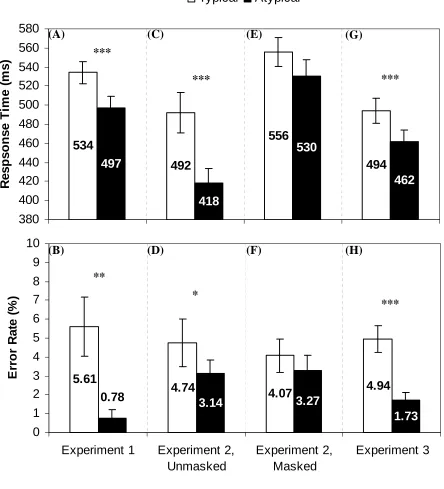
across participants (F1) and items (F2). Figure 1 illustrates the mean response times and error
rates for all experiments.
Targets were identified more slowly (Figure 1A) and less accurately (Figure 1B) when
appearing in the typical location of the preceding object word. In response times, this effect was
significant [F1(1, 17) = 40.19, prep ≈ 1.00; F2(1, 58) = 41.54, prep ≈ 1.00] and robust (37 ms, η2 =
.70). In error rates, this effect was also significant [F1(1, 17) = 9.33, prep = .97; F2(1, 58) = 18.96,
prep ≈ 1.00] and robust (4.83%, η2 = .35). As predicted, the cue word evoked a perceptual
simulation in the object’s typical location, thus hindering perception of a target letter at that
location.
Experiment 2
If the interference observed in Experiment 1 was due to perceptual simulation, then
disrupting that simulation should attenuate the interference. To test this prediction, Experiment 2
replicated the procedure of Experiment 1, but included a condition in which both target locations
were visually masked prior to target presentation. Another possibility is that interference could
reflect inhibition of return (IOR), whereby the perception of a stimulus at a recently attended
attentional shift to the implied location, thereby triggering IOR and inhibiting target
identification in that location. Indeed, in Experiment 1 the target appeared 300 ms after the
spatial cue. This is well within the timeframe of IOR, which has a typical onset around 225 ms
post-stimulus (see Klein, 2000). To test this explanation, the cue-target asynchrony was reduced
to 150 ms in Experiment 2. If interference occurs at this brief delay, it cannot be attributed to
IOR.
Method
Fifty-nine undergraduates were randomly assigned to an Unmasked or a Masked
condition. The stimuli and procedure of the Unmasked condition were identical to Experiment 1,
except that the context and cue words appeared for only 150 and 100 ms respectively. With the
50 ms delay preceding the target, the cue-target asynchrony was 150 ms. The Masked condition
was identical, except that a visual mask appeared during the 50 ms delay. The mask—three
contiguous rows of eight ampersands (approx. 3° × 5.25°)—appeared at both target locations
simultaneously on each trial.
Results and Discussion
Six participants (3 from each group) were excluded because of overall latencies or
accuracies more than 2.5 standard deviations from the group mean. Data were initially analyzed
via 2 (Target Location: typical, atypical) × 2 (Mask: unmasked, masked) mixed ANOVA.
As Figures 1C and 1D illustrate, the unmasked condition replicated the perceptual
interference effect in both response times and error rates. In the masked condition, however, this
effect was attenuated (Figures 1E and 1F). For response times, the main effect of Target
Location was significant [F1(1, 51) = 18.28, prep ≈ 1.00; F2(1, 58) = 155.18, prep ≈ 1.00]; target
effect of Mask was also significant [F1(1, 51) = 16.54, prep = .99; F2(1, 58) = 509.41, prep ≈ 1.00];
visual masking slowed target identification. Most importantly, however, Target Location and
Mask interacted, with a larger interference effect in the unmasked condition than in the masked
condition [F1(1, 51) = 4.31, prep = .89; F2(1, 58) = 32.70, prep ≈ 1.00]. For error rates, only the
main effect of Target Location was significant [F1(1, 51) = 8.01, prep = .96; F2(1, 58) = 13.21, prep
=.99]. The unmasked and masked conditions are analyzed separately below.
Unmasked. In response times, perceptual interference was significant [F1(1, 25) = 19.65,
prep = .99; F2(1, 58) = 176.11, prep ≈ 1.00] and robust (74 ms, η2 = .44). In error rates, interference
was also significant [F1(1, 25) = 7.24, prep = .94; F2(1, 58) = 11.49, prep = .98] and robust (1.60%,
η2 = .23).
Masked. Response times yielded only mixed evidence of perceptual interference [F1(1,
26) = 2.48, prep = .79 and F2(1, 58) = 27.90, prep ≈ 1.00]. In error rates the interference was
nonsignificant.
Summary. The perceptual interference observed in Experiment 1 was replicated in the
Unmasked condition but was attenuated in the Masked condition. Although the same qualitative
pattern was observed in both conditions, the significant interaction in response times indicates
that these patterns differed quantitatively. Furthermore, the interference effect was obtained for
errors in the Unmasked condition but not in the Masked condition. Given the brief cue-target
asynchrony (150 ms), perceptual interference cannot be explained as IOR, which occurs only at
longer delays (Klein, 2000). Thus, object words appear to elicit a perceptual simulation in the
object’s typical location. This perceptual simulation interferes with perceiving a target in that
location. A visual mask in that target location, however, disrupts the simulation and hence
Experiment 3
In the preceding experiments, the location cue (e.g., “hat”) was preceded by a context
word (e.g., “cowboy”). To ensure that interference is unrelated to the context words, in
Experiment 3 only the location cues were presented.
Method
The stimuli and procedure were identical to the unmasked condition of Experiment 2,
except that only cue words were presented. Thirty undergraduates participated.
Results and Discussion
Three outlying participants (2.5 standard deviations beyond the mean) were excluded. In
response times (Figure 1G), the interference effect was significant [F1(1, 26) = 22.59, prep ≈ 1.00;
F2(1, 58) = 25.15, prep ≈ 1.00] and robust (32 ms, η2 = .47). In error rates (Figure 1H),
interference was also significant [F1(1, 26) = 12.77, prep = .98; F2(1, 58) = 13.04, prep = .99] and
robust (3.21%, η2 = .33). Thus, individual object words orient attention to and evoke a perceptual
simulation in their typical location, thereby hindering perception in that location.
General Discussion
Words denoting objects that typically occur in high places (e.g., “hat”, “cloud”) hindered
identification of targets appearing at the top of the display, whereas words denoting low objects
(e.g., “boot”, “puddle”) hindered identification of targets at the bottom. This perceptual
interference is attributable to attentional orienting and perceptual simulation. First, object words
orient attention toward the object’s typical location. To illustrate, because birds typically are seen
in high places, they become associated with the upper visual field (cf. Richardson & Spivey,
orienting occurred in the present experiments even though the object words did not predict target
location. These results therefore suggest that orienting to object words is automatic, or reflexive.
Second, object words activate perceptual simulations. Much evidence indicates that
words automatically activate the neural systems associated with the perceptual features of their
referents (Barsalou, 2008; Martin, 2007). When a simulated object (e.g., a bird) and a perceptual
target (e.g., “X”) share few features, perception of the target requires inhibition of the neural
circuits activated during object simulation, thereby slowing target identification at the attended
location. At the unattended location, the perceptual mechanisms are not engaged in object
simulation, and hence target identification proceeds without interference. When a visual mask
appears at both target locations, the features of the mask must be inhibited, thus slowing target
identification at both locations.
Reflexive orienting and perceptual simulation together explain why some linguistic cues
hinder perception whereas others facilitate it. When the linguistic cue is infelicitous, perception
is delayed. In the present experiments, for example, the cue words were unrelated to the target
letters. Richardson, Spivey, Barsalou, and McRae (2003) presented sentences describing either a
vertically oriented event (e.g., X respected Y) or a horizontally oriented event (e.g., X argued
with Y), followed by an infelicitous visual target (i.e., a square or circle) on the vertical or the
horizontal axis. Targets were identified more slowly on the axis associated with the preceding
sentence. Kaschak and colleagues (2005) reported an analogous pattern of interference between
unrelated visual depictions and sentential descriptions of motion. The present results suggest that
participants in all these studies attended to the visual location, axis or direction of motion implied
by the sentence, and simulated the described activity. Interference occurred because the
In contrast, when a linguistic cue is felicitous (i.e., it accurately describes the visual
stimulus), perception is facilitated. Stanfield and Zwaan (2001) presented prime sentences that
described an object in one orientation or another (e.g., “He hammered the nail into the wall /
floor”), followed by an image of the target object in one of these orientations (i.e., a nail oriented
horizontally or vertically). Judgments of the target object were faster when it matched the
orientation implied by the sentence. Zwaan, Madden, Yaxley, and Aveyard (2004) similarly
found that a ball in motion was processed faster when preceded by a sentence describing a ball
moving in the same direction. In both cases, facilitation occurred because the simulation and the
visual stimulus activated similar perceptual representations. Thus, when attention is oriented to
the target location and the perceptual simulation resembles the visual target, perception is
facilitated. When either attentional orienting or perceptual simulation is inconsistent with the
References
Barsalou, L. W. (1999). Perceptual symbol systems. Behavioral and Brain Sciences, 22,
577-660.
Barsalou, L. W. (2008). Grounded cognition. Annual Review of Psychology, 59.
Berger, A., Henik, A., & Rafal, R. (2005). Competition between endogenous and exogenous
orienting of visual attention. Journal of Experimental Psychology: General, 134,
207-221.
Craver-Lemley, C., & Arterberry, M. E. (2001). Imagery-induced interference on a visual
detection task. Spatial Vision, 14, 101-119.
Craver-Lemley, C., & Reeves, A. (1992). How visual imagery interferes with vision.
Psychological Review, 99, 633-649.
Hommel, B., Pratt, J., Colzato, L., & Godijn, R. (2001). Symbolic control of visual attention.
Psychological Science, 12, 360-365.
Kaschak, M. P., Madden, C. J., Therriault, D. J., Yaxley, R. H., Aveyard, M., Blanchard, A. A.,
& Zwaan, R. A. (2005). Perception of motion affects language processing. Cognition, 94,
B79-B89.
Kingstone, A., Smilek, D., Ristic, J., Friesen, C. K., & Eastwood, J. D. (2003). Attention,
researchers! It is time to take a look at the real world. Current Directions in
Psychological Science, 12, 176-180.
Klein, R. M. (2000). Inhibition of return. Trends in Cognitive Sciences, 4, 138-147.
Langton, S. R. H., Watt, R. J., & Bruce, V. (2000). Do the eyes have it? Cues to the direction of
Martin, A. (2007). The representation of object concepts in the brain. Annual Review of
Psychology, 58, 25-45.
Posner, M. I., & Cohen, Y. (1984). Components of visual orienting. In H. Bouma & D. G.
Houwhuis (Eds.), Attention and Performance X: Control of Language Processes (pp.
531-556). Hillsdale, NJ: Erlbaum.
Posner, M. I., Snyder, C. R. R., & Davidson, B. (1980). Attention and the detection of signals.
Journal of Experimental Psychology: General, 109, 160-174.
Pulvermüller, F. (2001). Brain reflections of words and their meaning. Trends in Cognitive
Sciences, 5, 517-524.
Richardson, D. C., & Spivey, M. J. (2000). Representation, space, and Hollywood Squares:
Looking at things that aren’t there anymore. Cognition, 76, 269-295.
Richardson, D. C., Spivey, M. J., Barsalou, L. W., & McRae, K. (2003). Spatial representations
activated during real-time comprehension of verbs. Cognitive Science, 27, 767-780.
Šetić, M., & Domijan, D. (2007). The influence of vertical spatial orientation on property
verification. Language and Cognitive Processes, 22, 297-312.
Stanfield, R. A., & Zwaan, R. A. (2001). The effect of implied orientation derived from verbal
context on picture recognition. Psychological Science, 12, 153-156.
Vandenberghe, R., Price, C., Wise, R., Josephs, O., & Frackowiak, R. S. J. (1996). Functional
anatomy of a common semantic system for words and pictures. Nature, 383, 254-256.
Zwaan, R. A., Madden, C. J., Yaxley, R. H., & Aveyard, M. E. (2004). Moving words: Dynamic
representations in language comprehension. Cognitive Science, 28, 611-619.
Zwaan, R. A., & Yaxley, R. H. (2003). Spatial iconicity affects semantic relatedness judgments.
Figure 1. Response times and error rates (M ± SE) as a function of target location (typical,
atypical) in Experiment 1 (Panels A and B), Experiment 2 (Unmasked: Panels C and D; Masked:
Panels E and F), and Experiment 3 (Panels G and H). * p < .05, ** p < .01, *** p < .001
534 492 556 494 497 418 530 462 380 400 420 440 460 480 500 520 540 560 580 R esp so n s e T im e ( m s) Typical Atypical 5.61
4.74 4.07 4.94
3.14 3.27 1.73 0.78 0 1 2 3 4 5 6 7 8 9 10
Experiment 1 Experiment 2, Unmasked Experiment 2, Masked Experiment 3 E rro r R a te ( % )
(A) (C) (E) (G)
***
*** ***
(B) (D) (F) (H)
**
*