Westfälische Wilhelms-Universität Münster University of Twente
Institut für Politikwissenschaft School of Management and Governance 1st Supervisor: Dr. Matthias Freise 2nd Supervisor: Prof. Dr. Sawitri Saharso
Bachelor Thesis:
Fragmented civil society and its influence
on the development of democracy –
Implications for EU democracy promotion
in Pakistan
Name: Ronja Gottschling
1
Table of Content
1. Introduction 1
2. Theoretical background 4
2.1. Key definitions 4
2.2. Civil society in democratic transition and its contribution to democracy 5
2.3. EU external democracy promotion 8
2.4. EU concept of civil society within its democracy promotion 9 2.5. Theoretical preconditions and EU expectations regarding civil society 10
3. Methodological approach 11
4. Civil society in Pakistan 12
4.1. Introduction to Pakistan and its state of democracy 12
4.2. Fragmented civil society structures 14
4.2.1. Basic mapping of civil society actors 15
4.2.2. ‘Urban/modern’ vs.
‘traditional/religious/ethnic/sectarian/clan-based’ civil society 17
4.2.3. ‘Civil’ vs. ‘uncivil’ segments of society 20
4.3. Interim summary: conclusions on the potential of Pakistan’s civil society 22
5. Implications for EU democracy promotion in Pakistan 25
5.1. Assessing the EU concept of civil society in the context of Pakistan 26 5.2. Appropriate democracy promotion strategies and constraints in Pakistan 27
6. Conclusion 29
References 34
Annex: 38
1
1. Introduction
Democracy is one of the crucial basic principles that the European Union and most ‘Western’ political systems in general are based on. One can look back at a long history of political thought on the one hand and of political struggle on the other hand, where in the end a wide-shared consent on the desirability of democracy as basis pattern of a state system has emerged. This consent is so far-reaching that democracy promotion in third countries has become an important feature within development cooperation especially among various European countries, the EU as a political actor itself, the USA as well as several other international donor institutions and organisations.1 This shared consent on democracy as a preferred state principle however entails multiple different definitions of democracy itself and of the aspects being considered crucial for an established democracy, with different approaches and strategies to achieve or strengthen democracy and varying motives behind the promotion of it. Among all these aspects that can be taken into account examining democracy promotion this paper will focus on the role of civil society, the social realm where a civic identity and public civic engagement are said to be realised. A ‘vibrant’ civil society is often considered an important basis for democracy and especially as playing a decisive role for its consolidation, making it stable enough in a country even in the case of internal crises (Merkel 2003). Civil Society is said to control the state power and thereby reduce political corruption, to stimulate political participation and empower the people, to provide services, and to enable interest mediation, social integration and political socialisation (Forbrig 2002). Against this background the paper will furthermore focus on the EU as promoter of democracy, often putting a special emphasis on civil society, not only within the context of strengthening democracy within its own borders and coping with its institutional democratic and legitimation deficit, but also in terms of its external democracy promotion. This approach however includes certain assumptions and preconditions about existing structures of civil society and the potential that those entail for democracy. Forbrig (2002) in this context argues that ‘civil’ society can also foster obscured decision-making, biased interest representation, social segregation and non-democratic procedures, goals and strategies.
1 “The European Union (…) is founded on the principles of liberty, democracy, respect for human
2
Pakistan is certainly an interesting country case in this regard. It is often considered a state of low stability, with a very strong military that has ruled the country for several decades, high corruption, high levels of (especially sectarian) conflict and violence and beyond various other challenges faced with problems of rising (religious) extremism and radicalisation among the population. At a first glance, one might be able to identify the social sphere of civil society in Pakistan – a realm distinguished from government and business – but will have difficulties to find this specific type of social action often ascribed to civil society: oriented towards compromise and understanding in public, stressing individual independence and social self-organisation, recognising plurality and proceeding non-violently and peacefully (Kocka 2004). Shah (2004) for example mentions ‘antidemocratic’ tendencies of Pakistan’s civil society that is in the service of an authoritarian state and Mustafa (2005) refers to ‘uncivil’ society in Pakistan. One of the main interests of this paper is to examine exactly this concomitance of different segments that make up Pakistan’s civil society, which raises questions of how to define civil society in this context and to which extent it can be considered conducive to democracy.
EU-Pakistan relations trace back to 1962, when diplomatic relations between Pakistan and the Community were established, and have their roots in a Commercial Cooperation Agreement signed in 1976. Since then the Commission has committed more than €500 million to projects and programmes, earlier focusing on infrastructure and social development projects, in the 1990s rather oriented towards social sector investment programmes, with an emphasis on human development and environmental management (European Commission 2013). After the World Bank, the Asian Development Bank, the US, the UK and Japan, the European Commission is one of the biggest grant donors in Pakistan. For the period from 2002 to 2006, €75 million were allocated for development and economic cooperation and under the recent Development Cooperation Instrument (DCI), an indicative allocation of €398 million has been stated for the period of 2007 to 2013. The general framework for the Commission’s cooperation with Pakistan is currently the 3rd
3
allocating funds to state institutions and – in terms of promoting democratisation – addressing the need to strengthen democratic structures and processes at the institutional level, engaging civil society within development cooperation in Pakistan has received increasing funding and consideration in EU programmes. The European Commission acknowledges the positive impact of projects in cooperation with NGOs, civil society and non-state actors, defined for example in its thematic programme “Non-state actors and local authorities in development” (2011-2013 Strategy Paper). Especially in terms of sustainable development and the promotion of democracy, the EU “gives value to a dynamic, pluralistic and competent civil society and recognizes the importance of constructive relations between states and CSOs” (European Commission 2012, 4). Civil society is furthermore considered an important actor in fostering peace and in conflict resolution as well as in articulating citizens' concerns and thereby in strengthening participatory democracy (EC 2012).
The question that arises here is whether civil society in Pakistan is actually taking this role or if it is too fractured along different segments that act more or less against each other, which makes the efforts of those committed to democracy and human rights hardly visible or even ineffective. Thereby it is crucial not only to look at the comparably well-organised NGO-sector with rather ‘liberal’/secular organisations oriented towards ‘Western’ values, which international funding often concentrates on, but to take civil society structures as a whole into consideration. Hence, the central research question of this paper is: How are different segments of Pakistan’s civil society to be evaluated with regard to their potential to strengthen democracy in
the country? Six basic conditions for a civil society to be conducive to democracy as
well as distinctions such as ‘urban/modern’ vs. ‘traditional/religious/ethnic/clan-based’ and ‘civil’ vs. ‘uncivil’ spaces of society with regard to active organisations and their influence and support in Pakistan will provide the general framework for analysis. On this basis, implications for EU democracy promotion will be pointed out, assessing the EU concept of civil society in the context of Pakistan and making suggestions for appropriate democracy promoting approaches taking into account possible constraints.
4
theoretical framework, the concept of civil society and its (overall positive) perception that underlie the democracy promotion approach of the EU, as well as the role and potential that the EU ascribes to civil society will be examined. After stating the methodological approach in chapter 3, which will also clarify how the research question will be answered along six preconditions, the following chapter will then focus on civil society structures in Pakistan, as mentioned above, taking into account different actors and organisations, their position within society and their possible outreach. Chapter 5 will finally discuss some implications for the EU’s democracy promotion in Pakistan with regard to the findings of the previous chapter. This should lead to a (certainly limited) answer to the question which preconditions for democracy promotion can be found on the non-state level in Pakistan and how useful an approach focused on civil society and aimed at strengthening democracy will therefore be.
2. Theoretical background
The following sections first state key definitions and then specify civil society’s role with regard to democracy from a theoretical perspective as well as within the EU’s external democracy promotion.
2.1. Key definitions
Examining the role of (Pakistan’s) civil society for the strengthening of democracy and the resulting implications for EU democracy promotion, first the terms ‘democracy’ and ‘civil society’ shortly need to be clarified.
5
ones) and associational autonomy (ibid.). Principles of modern democratic rule/governance and other underlying (normative) concepts within the EU’s promotion of democracy in third countries will further be mentioned in 2.3. and 2.4.
‘Civil society’ – the second central term – is often considered a Western European concept rooted in the ideas of Enlightenment and furthermore associated with the names and thoughts of Hegel, Marx, Tocqueville, Habermas and Putnam, to mention just a few. In line with this rather historical perspective, it is still difficult to capture the actual meaning of the term ‘Civil Society’ since it entails various dimensions and can be explained from different perspectives. In this paper, Jürgen Kocka’s (2004) concept will be adopted, defining civil society in three ways, namely as a specific type of social action, as a social sphere and as a utopia underlying a democratic ideal. As a specific type of action, civil society is oriented towards non-conflict, compromise, and understanding in public as well as towards common goods, stressing individual independence and social self-organisation, recognising plurality, difference and tensions and proceeding non-violently and peacefully. This goes along with the notion of ‘civility/civil action’. As a social sphere, civil society constitutes a social space “related to, but distinguished from government, business, and the private sector” (Kocka 2004), comprised of (but not limited to) organisations, associations and social movements active in diverse fields of public interest. Finally, as a utopia, civil society constitutes a key feature of liberal democracies, which stresses individual rights and democratic values, links the individual to the political system and which is a condition for (political) public discourse (ibid.). On the individual level, this also assumes a certain ideal type of citizen who supports basic democratic values, participates in the political process, and promotes the above mentioned specific type of social action. Civil society defined in this last way certainly entails a normative dimension, which is generally difficult to distinguish from empirical evidence. However, as chapter 2.4. will show, the promotion of democracy is to a great extent based on the assumption of the positive potential of civil society for democracy.
2.2. Civil society in democratic transition and its contribution to democracy
6
of the autocratic regime, institutionalisation of democracy and consolidation of democracy. The downfall of an autocratic regime, which can take place in different ways, is often the result of a legitimacy crisis due to economic, political or military reasons. The next stage would then be the institutionalisation of democratic structures and processes, which will be completed by the adoption of a constitution (Merkel 2003). In the context of the third phase, the consolidation of democracy, Merkel mentions several levels where democracy needs to stabilised, namely on the constitutional (political system), representative (e.g. political parties), behavioural (informal political actors) and on the civil society level. Merkel in the first place broaches the role of civil society in the phase of democratic consolidation, but since a detailed elaboration of the democratic conditions in Pakistan is beyond the extent of this paper, in the following, civil society’s general contributions to democracy and its role in the strengthening of democracy will be expounded.
7
finally provide an ‘arena’ for the expression of diverse interests and help to mediate and resolve conflicts (ibid.).
On the other hand one must not forget that civil society should also be considered against the background of certain caveats, depending on the country context and existing state and civil society structures. If civil society loses its necessary autonomy from the state, it risks getting co-opted by state actors and will no longer constitute an independent social realm. On the other hand, a rent-seeking civil society which undermines the state authority is also a risk for democracy. In this context, the notion of ‘civil’ vs. ‘uncivil’ society is often mentioned, which will be elaborated more in detail in the context of Pakistan below. Other problems especially when it comes to civil society organisations are those of representation and legitimation – the question of who they actually represent – as well as of dependency on (foreign) funding (Diamond 1997).
Catherine Götze (2005) in her study on civil society structures of the Balkans and preconditions and possibilities for external influence, develops a typology of civil societies in terms of three levels – individual, associational and state level – along which one can categorise civil society between an ideal type of civil society, which can strengthen democracy, and a negative type, the absence of civil society. In between Götze situates different types of what she calls ‘rudimental’ civil societies. She concludes in the context of her country cases that the individual level is central to a civil society conducive to democracy: Even when on the associational and the state level, civil society tends towards the ideal type (associations as ‘schools of democracy’ and trustworthy political institutions), a universal and open civic identity as a result of social differentiation and individualisation that is missing always leads to the ‘failure’ of civil society.2
Derived from this theoretical background of locating civil society in the process of democratic transition and elaborating its role with regard to democracy, chapter 2.5. will state six basic preconditions for a civil society conducive to democracy. Those preconditions will be examined in chapter 4, analysing civil society structures in
2 „Universelle Identitäten sind die erste Voraussetzung für Zivilgesellschaft; partikulare
8
Pakistan with a focus on how ‘modern’ and ‘traditional’ tracks of society translate into ‘civil’ and ‘uncivil’ segments.
2.3. EU external democracy promotion
External democracy promotion refers to “all strategies and instruments which are intended to contribute to a democratization or democratic consolidation of a third country, regardless of whether the strategies or instruments are carried out by a single state, a supranational/international organization, or a private actor” (Knodt/Jünemann 2007a, 9). The EU as democracy promoter can be categorised as “value-driven community” which represents concepts of democracy, human rights, the rule of law and good governance and “exports its view of legitimate democratic governance of nation-states to third countries”, namely a “Western-style liberal” concept of democracy (Knodt/Jünemann 2007a). Hence, it is obvious that the EU in this context appears as a normative power, considering the exportation or at least promotion of a certain type of governance as legitimate. Democracy, human rights, the rule of law and good governance are also central aspects of the EU’s accession policy, making it a requirement to adopt and respect this normative consensus on common values within the community. However, the promotion of democracy should also be considered against the background of the EU’s (foreign policy) interests. In its direct neighbourhood one of the EU’s primary goals is to be surrounded by democracies, assuming that democratic countries tend to resolve their conflicts peacefully (ibid.). Security concerns furthermore play a decisive role in the EU’s promotion of democracy in third countries, especially in weak or failed states, states such as Pakistan that are in the focus in terms of threats of international terrorism, and in order to manage international migration (to the EU).
9
Assembly’s definition of democracy as reference point for EU action (EP – OPPD 2010). This definition goes beyond Dahl’s concept of polyarchy, also emphasising respect for human rights, a pluralistic system of political parties and organisations, respect for the rule of law and the separation of powers.
2.4. EU concept of civil society within its democracy promotion
Within its external democracy promotion and in line with the idea that democracy – in the case of EU policies defined in terms of a wide range of requirements – entails the most desirable basic principles for a state system, the EU promotes another basic idea: the central role of civil society for the strengthening and consolidation of democracy. As elaborated above civil society is said to play a crucial role for (the development of) any democracy, depending however on certain preconditions within a country and characteristics of civil society itself. The EU emphasises in the central document on its engagement with civil society in external relations that civil society is “a crucial component of any democratic system” and an “asset in itself”, fostering pluralism, peace and conflict resolution, contributing to effective policies and strengthen participatory democracy (European Commission 2012, 3). While the term ‘civil society’ remains rather broadly defined, the document focuses on the definition of Civil Society Organisation (CSOs), including
“all non-State, not-for-profit structures3
, non-partisan and non-violent, through which people organise to pursue shared objectives and ideals, whether political, cultural, social or
economic. (…) The EU values CSOs' diversity and specificities; it engages with accountable and transparent CSOs which share its commitment to social progress and to the fundamental values of peace, freedom, equal rights and human dignity” (ibid.).
Besides the positive role that the EU ascribes to CSOs, another central aspect is the emphasis of state-CSO-partnership. While the European Commission mentions that it can suspend cooperation with national governments in case of the non-recognition of civil society and also stresses CSOs’ independence, it ideally seeks for CSOs’ participation in domestic policies and strong cooperation between the state and CSOs.
3 Including community-based organisations, non-governmental organisations, faith-based
10
2.5. Theoretical preconditions and EU expectations regarding civil society
The theoretical background on civil society in democratic consolidation suggests on the one hand a positive and contributing role, but also several caveats that among others depend on the general environment within a country, the political, societal and associational structures and the degree of civic engagement and support for democracy among the citizens. Following the methodological approach in chapter 3, the analytical and main part of the thesis will examine civil society structures in Pakistan and whether those meet the elaborated theoretical preconditions for being conducive to democracy. Hence, conditions being examined in chapter 4 in order to assess civil society’s potential to strengthen democracy are:
1. established (stable) structures of basic democratic institutions
2. political leadership that acknowledges civil society and its potential to fulfil various functions in cooperation but also independently of the state, and therefore also recognises civil society’s necessary autonomy
3. civil society organisations active in advocacy, civic education and human rights that have support among the population
4. a tolerant societal environment that acknowledges pluralism and enables the peaceful coexistence of modern and traditional segments
5. strong ‘civil’ segments within society that outweigh ‘uncivil’ segments, also with regard to their support among the population
6. democracy-supporting attitudes among the population and a civic identity
11
3. Methodological approach
Starting from scientific literature review as well as review of EU policy documents as a basis for the above elaborated theoretical framework, the analysis part will furthermore be based on review of scientific literature as well as empirical studies (some based on survey data) in order to examine Pakistan’s civil society structures. Central empirical studies on the composition of Pakistan’s civil society considered here are first of all the reports of Ghaus-Pasha/Jamal/Iqbal (2002 and 2003) in the context of the Johns Hopkins Comparative Nonprofit Sector Project4. As mentioned further below, the non-profit sector in Pakistan does not represent civil society as a whole, but provides a basic overview of organisations active in Pakistan. Secondly, results of the CIVICUS Index on Civil Society Project and the report on Pakistan by Baig (2001) will be considered, analysing civil society with regard to space, structure, values and impact. Furthermore, the CSO Sustainability Index for Pakistan by USAID (2011) based on the assessment of local civil society representatives and experts will be taken into account. Especially with regard to the role of Islam, religious organisations, militancy and madrasas in Pakistan, findings of the ‘Religions and Development Research Programme’5
as well as of the research conducted by the International Crisis Group6 will be considered.
Data analysis will then focus on how empirical findings about the composition and structure of Pakistan’s civil society match to the theoretical assumptions about the role of civil society for democracy. By discussing whether the above elaborated conditions are met in Pakistan, one will be able to argue whether Pakistan’s civil society can contribute to the strengthening of democracy in the country. Furthermore, on this basis the EU concept of civil society (within its democracy promotion) will be assessed in the context of Pakistan in order to draw some conclusions for the EU’s democracy promotion approach and its efforts focusing on civil society in Pakistan.
4 The Johns Hopkins Comparative Nonprofit Sector Project (CNP) constitutes a collaborative effort by
scholars worldwide to understand the scope, structure and the role of the non-profit sector in various countries, using a common framework and approach.
5 The ‘Religions and Development Research Programme’ is an international research partnership that
explores the relationships between several major world religions, development in low-income countries and poverty reduction.
6 The International Crisis Group is a private, multinational organisation that seeks to strengthen “the
12
4. Civil society in Pakistan
Since the theoretical framework indicates that a country’s general environment and its state of democratic institutionalisation can either enable or disable a vibrant civil society, before analysing civil society structures in detail, a first look at the general political situation in Pakistan, its state of democracy and challenges as well as deficits in this regard is important.
4.1. Introduction to Pakistan and its state of democracy
Pakistan – the country with the sixth largest population in the world, an HDI of 0.5157 and according to World Bank categories a lower middle-income country – in the past often gained international attention due to the ongoing dispute with its neighbour country India over the region Kashmir, but recently (especially after the terrorist attacks of the 11th September 2001) primarily due to its links with international terrorism, sometimes even described as “most dangerous place in the world” and “breeding ground for global jihadists” (Bokhari 2011, 82). Pakistan was founded as a Muslim state in 1947 when British India gained independence, separated from its (mainly Hindu8) neighbour country India9, and ever since its foundation there seems to be an ongoing process of trying to define and redefine a Pakistani national identity and what this is supposed to be based on. While the vision of the founder of the nation, Quaid-e-Azam Muhammed Ali Jinnah, entailed a certain secular state idea, periods of political Islamisation, especially under General Zia-ul-Haq (1977-1988), shaped political institutions and the society in the following decades, placing the question of the role of Islam and the relationship between the state and religion at the core of continuous tension within the country. Present challenges include increasing intolerance, waves of (political) violence often based on sectarian, ethnic and tribal identities, as well as hatred especially directed towards minorities, holy places and ‘liberal’ thinkers and activists (Bokhari 2011). One should also take into account that Pakistan has a very large youth population.
7
“The HDI is a summary measure for assessing long-term progress in three basic dimensions of human development: a long and healthy life, access to knowledge and a decent standard of living”, ranging from 0 to 1 (1 indicating highest human development). See:
http://hdr.undp.org/sites/default/files/Country-Profiles/PAK.pdf
8However, India is home to a variety of religions, Muslims being the second largest group after
Hindus (Adeney/Wyatt 2010).
9 The partition led to mass migration of around ten million people between the newly created
13
Currently 54.8% of Pakistan’s population are under the age of 2510, which constitutes a high potential for the development of the country, but also raises fundamental challenges when those young people lack opportunities in the country and in the ‘worst case’ sympathise with or join radical and militant movements.
Can Pakistan be considered a democracy? While this question can be discussed at length from different perspectives (see e.g. Romberg 2010), here just a basic overview will be given. Pakistan is officially a democratic parliamentary federal republic with Islam as the state religion. However, it has been ruled by presidents brought to power by military coups in the periods of 1958 to 1971, 1977 to 1988 and 1999 to 2008 (either direct military rule or direct/indirect military involvement in government), leaving relatively weak and non-reliable political institutions and processes (Hasan A. Rizvi). With the last general elections in May 2013 for the first time in the history of the Pakistani state a democratically elected government completed its tenure and voter turnout raised from 44% to 55%11. However, as Hasan A. Rizvi notes, while the rulers, political parties and leaders, and the civil society groups seem to support democracy at the normative or conceptual level, there are still large deficits at the operational level. One problem in this regard is the prevalence of nepotism among many people in political institutions, which is one of the reasons for very high levels of corruption12. Political parties have largely failed to play an integrative role, primarily representing regional, ethnic and other parochial interests (Rizvi 2009). The judicial system can generally be considered weak and the human rights situation is certainly problematic, especially with regard to the existing blasphemy laws. Press freedom is also very low.13 Major challenges can furthermore be considered the poor performance of the elected assemblies, failure to build consensus on the operational norms of the political system, as well as a drift towards confrontation, religious and cultural intolerance and extremism, and the failure or even unwillingness of the state to tackle extremism (Hasan A. Rizvi).
Summing up and with regard to condition 1 mentioned in 2.5., the institutionalisation of basic democratic institutions has to some extent taken place in Pakistan, but
10 http://www.cia.gov/library/publications/the-world-factbook/geos/pk.html 11 http://cerp.org.pk/elections-2013/
12
In 2013, Pakistan scored 28 on Transparency International’s perceived corruption index (range from 0 – very corrupt – to 100 – very clean), and thereby ranks 127 out of 175 countries (rank 1 being the least corrupt country): http://www.transparency.org/cpi2013/results
13 The World Press Freedom Index 2014 by Reporters Without Borders ranks Pakistan 158 out of 180
14
continues to show considerable deficits on many levels. While this condition does not preclude the development of a civil society conducive to democracy, it is still not very enabling and constitutes a rather ‘unsettled’ democratic environment.
4.2. Fragmented civil society structures
15
extremists to support his government’s agenda and to neutralise his secular political opposition. Even after the 11th September 2001 and the increased pressure by the US government on Pakistan to cooperate in the ‘fight against international terrorism’, Musharraf’s actions – while in public statements emphasising his will to stop the activities of jihadists, militant organisations and to introduce a madrassa (religious school) reform – were reluctant or secretly even following an opposite agenda focusing on regime survival (ICG 2002). In sum, this reveals a very ambivalent and often opportunistic relation between the state and civil society actors, and especially a government not able or willing to create an appropriate environment for a vibrant and active civil society. Even though the situation under civilian rule from 2008 on might have improved, the longstanding unfavourable position of the Pakistani state has certainly shaped civil society in Pakistan. Condition 2 for a civil society conducive to democracy can therefore be considered as hardly met.
Starting from Schedler’s (1996) remark that looking at ‘civil’ society does not necessarily mean finding a ‘civilised’ society, in the following – after a basic mapping of civil society actors – characteristics of Pakistani civil society and relevant actors will be analysed from two perspectives: first differentiating between ‘modern/urban’ and ‘traditional/religious/ethnic/clan-based’ tracks of society and secondly between ‘civil’ and ‘uncivil’ segments of the society.
4.2.1. Basic mapping of civil society actors
Within the Johns Hopkins Comparative Nonprofit Sector Project, with their two publications in 2002 and 2003, Aisha Ghaus-Pasha, Muhammad A. Iqbal and Haroon Jamal present some basic mapping of the non-profit sector in Pakistan, in the first place focusing on the right (“organised”) part of the following chart14:
14 Source: Ghaus-Pasha/Iqbal 2003 p. 8; as five crucial characteristics of the organised section they
16
The legal framework for non-profit organisations is considered “both archaic and confusing” (Ghaus-Pasha/Iqbal 2003, 12) since there are more than ten laws under which non-profit organisations can be registered or recognised, all of them entailing different regulations.15
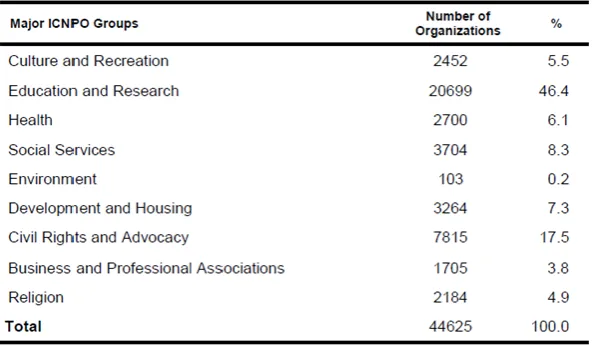
[image:18.595.72.369.274.447.2]While the notion of ‘civil society’ is certainly broader than what is defined as ‘non-profit sector’ in this study, and the authors emphasise that religious worship organisations, political parties and trade unions are not included16, it can still provide an important basic overview of active organisations and their activities.
Table 1: Estimated Composition of Nonprofit Sector in Pakistan17
Table 1 shows that nearly half of all organisations are active in the field of education
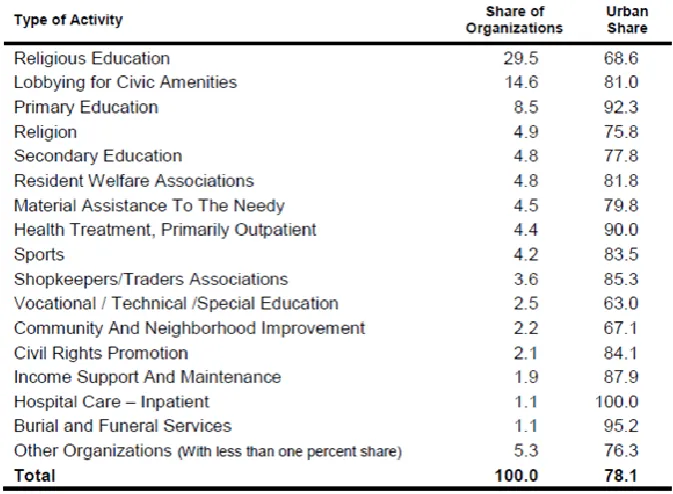
and research, while with 17.5% the second largest group are civil rights and advocacy groups. Interestingly, this distribution is relatively equal in the provinces of Punjab, Sindh and Baluchistan, however in former NWFP18 50.3% of all organisations are active in the field of civil rights and advocacy and only 24.8% in education and research.19 Looking at the organisations’ activities, one can furthermore state that the most prevalent activity is religious education (29.5%), followed by lobbying for civic amenities (14.6%). Organisations primarily active in civil rights promotion only make up 2.1% of all organisations included in the study.20
15
The majority of organisations is registered under the following laws: the Societies Registration Act of 1860, the Trust Act of 1882, the Companies Ordinance of 1984, and the Voluntary Social Welfare Agencies (Registration and Control) Ordinance of 1961 (Ghaus-Pasha/Iqbal 2003).
16 On the other hand, political parties are often considered part of ‘political’ and not ‘civil’ society
since they are seeking to obtain political power. See for example Diamond 1997.
17 Source: Ghaus-Pasha at al. 2002 p. 12
18 North-West Frontier Province bordering Afghanistan; since 2010 called Khyber-Pakhtunkhwa 19 For the provincial composition of non-profit organisations see Table 2 in the appendix. 20
17
Another common project analysing civil society across countries worldwide is the CIVICUS index on civil society, which does so along the four dimensions ‘space, structure, values and impact’ and which assesses a certain score for each of these dimensions, thereby determining the ‘health’ of the examined country’s civil society. Looking at the dimension ‘structure’ in Pakistan, the study reveals shortcomings in areas such as membership base, regional distribution, building alliances and coalitions, and co-operation with the private sector. Analysing the space/realm that civil society is active in, the study also shows that civil society in Pakistan is constrained by legal, political and socio-cultural pressures (Baig 2001). A more recent study by USAID (2011) on CSO sustainability in Pakistan considers the legal framework slightly more favourable and acknowledges the existing (yet to be improved) consultation of CSOs by the government on policy formulation, but also emphasises the mixed public image of CSOs.
With regard to condition 3, one can conclude that there are various organisations active in advocacy, civic education and human rights, however, they are relatively small in number, do not get considerable support or recognition from the state and the population in Pakistan is rather sceptical towards those organisations. This will be further elaborated in 4.2.3. and 4.3.
4.2.2. ‘Urban/modern’ vs. ‘traditional/religious/sectarian/ethnic/clan-based’
civil society
As mentioned earlier, civil society can be considered a broader concept going beyond the sector of non-profit organisations. In Pakistan civil society is certainly shaped by religion as well as ethnic and clan-based identities: “Fracture, on sectarian, ethnic, regional, and class lines, remains the dominant characteristic of civil society in Pakistan” (Pasha 2010, 134). Qadeer (1996) emphasises that Pakistan’s civil society is divided into traditional and modern tracks, fractured along ethnic and sectarian lines and increasingly dominated by sectarian interests, whose instruments include public meetings, demonstrations and (threatened or real) violence. He furthermore categorises Pakistan’s civil society into two ‘tracks’: On the one hand formal/modern institutions such as political parties21, labour unions, (the English) media and press, chambers of commerce, citizen clubs and community organisations, which represent modern ‘liberal’ values such as human rights, freedom of expression, and an
21
18
independent judiciary, and which “expect the public authority to enforce their demands” (Qadeer 1997, 754). One the other hand there are traditional structures often based on local level and on local networks and shaped by social class structures and/or religion, such as clans, village and neighbourhood organisations, ethno-religious communities, ethno-religious orders and seminaries (madrasas) (Qadeer 1997).
Problematic in the Pakistani context has certainly been the instrumental use of religion by civilian as well as military rulers whenever it suited their interests (see 4.2. for the example of Musharraf). It can be argued that not merely a personal strong feeling of religious identity among the population but this instrumental use of religion led to enforced ideologies and constitutes a main reason for increased sectarian violence, extremism and terrorism. Saigol (2009) emphasises that rather Pakistan’s rulers from the privileged classes enforced (radical) religious doctrine in contrast to the more tolerant, peaceful but dispossessed classes. One must therefore take into account that Pakistan’s main problems to some extent also arise from fundamental socio-economic and class inequalities.
19
While the study within the ‘Religions and Development Research Programme’ counts madrasas as part of religious/faith-based organisations, a separate look at religious school enrolment is useful since madrasas are commonly considered as central institutions for the recruitment of jihadists and as fostering religious extremism. Reliable data on religious school enrolment in Pakistan are hardly available and vary highly. For example, a study by Andrabi at al. (2005) states that there are 475,000 children enrolled in madrassas while the ICG concludes that there are 1.5-1.7 million, a figure provided by senior government officials and madrasa administrators (ICG 2002). Most madrasas can be found in the ‘Pashtun belt’ at the Pakistani-Afghan border, whose number increased during the (considerably foreign-funded) resistance to the invasion of Afghanistan by the Soviet Union starting in 1979, and had its largest ‘boom’ at the time of the withdrawal of the Soviet Union and the rise of the Taliban (Andrabi at al. 2005). Another interesting finding in this context is that – as the data show – parents apparently do not send their children to madrasas whenever there are no other schooling options (no other school nearby or budgetary constraints of the household), nor because they are particularly religious-minded. Often madrasa education does not replace other schooling options but is rather complementary. While madrasas certainly play an important role in addressing the needs of their communities, (admittedly only) speculations by ministry officials suggest that 10 to 15 per cent of madrasas might have links to sectarian militancy or international terrorism (ICG 2002).
20
The lack of trust and cooperation between rather secular/modern and traditional civil society actors and again the ambiguous position of the state in this context reveals serious challenges with regard to condition 4 and the peaceful coexistence of modern and traditional segments of society, especially considering the position and outreach of madrasas, which is generally difficult to assess due to the lack of official registration and therefore the lack of reliable data.
4.2.3. ‘Civil’ vs. ‘uncivil’ segments of society
After examining the interplay between rather ‘modern’ and ‘traditional’ civil society organisations and actors and taking into account the special role that religion holds in Pakistan’s society, the remaining question is whether those existing civil society organisations and actors form a largely ‘civil’, non-violent and peaceful realm or whether ‘uncivil’ segments capture the society in a way that makes the prospects of a civil society able to strengthen democracy rather unlikely. The decisive differentiation between ‘civil’ and ‘uncivil’ segments of society is in the first place their position towards violence: Organisations and movements that employ violence against civilians are hardly compatible with the notion of ‘civility’ that characterises the specific type of social action ascribed to civil society (Mustafa 2005). Another characteristic of a rather ‘uncivil’ society is a rent-seeking tendency that eventually weakens the state.
21
and rallies, which was also covered by a very active media. It can finally be considered successful with the restoration of the judiciary in March 2009 and the emergence of a more independent position of the judiciary (Abbas/Jasam 2009).
Although the lawyers’ movement can be considered an important sign for the development of a democratically active society, organised civil society groups advocating the rule of law and respect for human rights and freedoms in general seem to be rather reluctant in leading the movement for the ‘restoration’ of democracy, which can be explained by their lack of trust in the political system as such (Taimur-ul-Hassan 2011). Furthermore one must note that the state mostly holds an unfavourable attitude towards advocacy and human rights organisations, rather favouring (religious) organisations active in welfare work and other service delivery. A similar attitude can be found among the population in general who tends to be critical of advocacy and human rights organisations, especially when they receive considerable foreign funding and are therefore considered as representing Western interests. Condition 3 is therefore only partly met, not only because of the small number of organisations in the field but also due to the limited support they get. Many citizens rather donate to religious organisations. In fact, while there is no large support for the politics of religious parties, most Pakistanis apparently find “Islamic education and preservation of Islam the most worthy choice for charity” (ICG 2002, 14). As the ICG (ibid.) states, “94 per cent of charitable donations made by Pakistani individuals and corporations goes to religious institutions and causes, and 98 per cent of donors cite religion as their main motivation.” This importance that people attach to religion leads Qadeer (1997, 758) to the conclusion that “the only funded non-governmental, non-profit organisations which exercise considerable control over peoples’ behaviour and mobilise communities for their causes are (seminaries) Madarissas”. Against the background that – as stated above – some madrasas foster extremism, their favourable position among the population challenges the civility of Pakistan’s civil society.
22
fight against Soviet troops in Afghanistan left them with considerable influence in Pakistan, especially in the border region to Afghanistan where the Pakistani government has hardly any control. The other main conflict where the Pakistani state has systematically supported militant organisations as instruments of its foreign policy is in the ongoing dispute with India over Kashmir. While officially announcing and joining the fight against international terrorism especially by Musharraf, at the same time, militant organisations active in ‘liberating’ Kashmir from Indian ‘occupation’ were usually excluded from this particular Pakistani understanding of tackling extremism (Kukreja 2003).
Although a more detailed analysis of militant organisations is beyond the scope of this paper, one cannot deny that they have a certain influence, outreach and also support in Pakistan, which can to a large extent be attributed to the ambiguous position of the government. Looking at the attitudes of the population, Fair at al. (2012) with their large-scale public opinion survey show that again neither personal religious practice nor support for political Islam (and the belief that Islam should play a greater role in Pakistani government) is related to support for militant groups. Further considering condition 5, while Pakistan’s society certainly has strong civil segments, one must note that the organised part active in advocacy work and the promotion of human rights constitutes a very small sector that is primarily found in urban regions and often does not receive large-scale support neither from the state nor among the population. It seems that many Pakistani citizens – when willing to publicly stand for democracy – rather join social (protest) movements (such as the lawyers’ movement) for achieving democracy-related aims than putting their trust in the work of NGOs and other organisations active in the field. Peaceful social (protest) movements certainly form an important part of civil society, but cannot compensate for the needed stable associational civil society structures in Pakistan.
4.3. Interim Summary: conclusions on the potential of Pakistan’s civil society
23
military still has a considerable positive reputation especially in terms of ensuring Pakistan’s stability and security – and whether a democracy-oriented civil society will further emerge.
The above analysis was supposed to show how Pakistan’s civil society is shaped by modern and traditional tracks that translate into ‘civil’ as well as ‘uncivil’ segments of society and how these findings can be evaluated with regard to the above mentioned preconditions for a civil society conducive to democracy. It has so far been shown that the first five preconditions are not fully met in Pakistan. While this does not mean that there is no civil society that can strengthen democracy or no prospects of it, the development of a truly civil society is still an ongoing challenge in Pakistan and will most probably not be a linear and clear-directed process.
Condition 1, basic democratic structures, is generally given but those function only
to a limited extent and are characterised by low levels of transparency and accountability. Condition 2, a political leadership creating an environment that enables civil society, has (especially up to 2008) hardly been given since the relationship between the state and civil society actors has mostly been shaped by co-optation and rent-seeking.
24
25
precondition for a ‘vibrant’ civil society conducive to democracy that has not yet fully developed in Pakistan.
5. Implications for EU democracy promotion in Pakistan
Returning to the EU efforts to promote democracy in Pakistan, the central question is – given the above analysed fragmented civil society – whether the EU concept of civil society fits the Pakistani context and which approach will be most appropriate and hence effective. As mentioned above the EU within its democracy promotion has several instruments at hand addressing the state level of a third country such as technical and financial assistance, trade and investment instruments as well as diplomatic strategies that can also be linked to conditionalities and sanctions. However, the focus on civil society here rather relates to the question whether it is possible to build up a civil society through external support or whether this is a far too ambitious aim (Lovell 2007). The theory suggests (as an ideal type) a linear process of political transformation from an authoritarian regime to a democracy, from the downfall of the old regime over the institutionalisation of democratic structures and processes to the consolidation of democracy. Pakistan has not experienced such a linear process, rather facing altering civilian and military rule with different but always very limited implementation of democratic principles, often also misused for the consolidation of power, and leaving the population with an ambiguous attitude towards democracy. Assuming however a certain democratic institutionalisation (especially after return to civilian rule in 2008) one can now make some limited suggestions about what to expect from an EU bottom-up, civil-society-strengthening democracy approach. Of course the EU has – also within its democracy promotion in Pakistan – in the past rather focused on the cooperation with the state. Therefore, the importance that the state and its efforts have as well as a state-level democracy promoting approach will be shortly discussed in 5.2.
26
active in civic education, even when small in number, and support them in reaching the Pakistani population. But whether this will be effective enough to achieve a considerable positive change towards a more stable democracy remains an open question. Furthermore, the example of Pakistan might show the need to rethink the normative basis inherent in the EU’s democracy promotion approach – especially with regard to its understanding of civil society and the potential ascribed to it (Zinecker 2011).
5.1. Assessing the EU concept of civil society in the context of Pakistan
As elaborated earlier, according to the EU civil society is a “crucial component of any democratic system, fostering pluralism, peace and conflict resolution, contributing to effective policies and strengthen participatory democracy” (EC 2012, 3). However, as the example of Pakistan clearly showed, in the social space distinguished from government, business, and the private sector a broad range of actors and organisations can be found, which do not all act upon the specific type of social action based on civility. As Zinecker (2011) notes, civil society is only one part of society. Lovell (2007) further in this regard emphasises that obstacles to building up a civil society do not only arise from an ‘overweening’ state but also from traditional loyalties, customs and rituals in the private sphere. Applying the EU concept of civil society in Pakistan therefore means looking for specific segments of society that are able to strengthen democracy and contribute to the development of a peaceful and tolerant society.
Although the EU defines civil society organisations in a very broad way (explicitly comprising faith-based organisations)22, as many other donor organisations within their external democracy promotion the EU tends to focus on a rather narrow set of organisations, which seem best to promote the values that the EU stands for: “professionalised NGOs dedicated to advocacy or civic education work on public interest issues directly relating to democratisation, such as election monitoring, voter education, governmental transparency, and political and civil rights generally” (Carothers/Ottaway 2000, 11). However, as mentioned before, those organisations do not represent civil society in Pakistan as a whole. While the EU obviously seeks to only support civil segments of Pakistan’s society, it would be oversimplified to assume that the above described traditional tracks of society always translate into
22
27
uncivil segments of society or that faith-based organisations are never conducive to democracy. The lack of dialogue, trust and cooperation between religious and secular organisations should therefore be addressed, which might not directly encourage people’s political participation, but it would address the need to find ways to conciliate people’s religious identity and a civic identity inherent in the concept of civil society. At the same time one must take into account that in this regard external influence is possible and also desirable only to a limited extent. Development partners however should not generally prefer secular over religiously-inspired organisations, but try to decide on a case-by-case basis, “based on an understanding of individual organizations and their context” (Kirmani 2011, 5).
A last aspect considers the EU’s ideal of strong cooperation between CSOs and the state and CSOs’ participation in domestic policies. Besides the tendency of the Pakistani state to co-opt civil society actors for its own interests and the (occasional) acceptance of it by those actors in order to seek their own benefits, the recent lawyers’ movement revealed civil society’s willingness to protest against the government to safeguard a cornerstone of democracy, namely an independent judiciary. While Zaidi (2011, 216) comments that the movement was “led by lawyers protecting their own particular institutional interests”, others emphasise its wide-spread support and ability to mobilise all sorts of civil society actors. In any case it raises questions about the appropriateness of the EU’s focus on CSO-state partnership and whether it is not more important to strengthen civil society’s independence in Pakistan.
5.2. Appropriate democracy promotion strategies and constraints in Pakistan
28
human rights and fundamental freedoms; the strengthening of civil society as stated aim within those projects.23 CSOs in Pakistan have been engaged in a number of such activities (not only funded by the EU), ranging from election observation, orientation and briefing sessions for members of parliament, monitoring the performance of the parliament and the provincial assemblies, over legislative watch programmes, reports about the state of implementation of various international treaties and conventions, to the spreading of awareness about democracy among young students in schools (Mehboob 2010). However, the CIVICUS index on civil society in Pakistan in this regard states that CSOs’ impact – its ability to influence public policy making and monitoring – remains relatively low (Baig 2001)24.
Organisations engaged in the just listed activities are mostly those ones categorised as active in civil rights and advocacy, which constitute only a relatively small percentage of all CSOs in Pakistan. At the same time one could however argue that for an external democracy promoter such as the EU this is the most effective way to address issues of democracy: on the institutional level, trying to engage the local population and its organisations. To illustrate why this might still be a limited approach, one should get back to the question of why it is important to support basic civil society structures and to follow a bottom-up democracy approach in Pakistan. Zinecker (2011, 6) explains this from a theoretical perspective in a very comprehensive way:
“Political liberties – freedom of speech and association – materialise only in civil society. Even elections will fail to work if civil society does not make use of them. Rule of law is not of itself in force if civil society has no access. Other regime segments are directly rooted in civil society: the civil nature of a political regime requires that of civil society. Without political inclusion that goes beyond the electoral regime, a politically active civil society is unthinkable.”
Hence, institutional reforms are important for the strengthening of democracy in Pakistan, but a truly civil society still needs to develop and the suggestion here is that this does not necessarily succeed or requires ‘complete’ democratic institutionalisation, especially in a country like Pakistan where democratisation has been far from a clear-directed process. Top-down democracy approaches are therefore one way of addressing certain aspects of Pakistan’s deficient democracy,
23 See e.g. project list of the European Delegation to Pakistan:
http://eeas.europa.eu/delegations/pakistan/projects/list_of_projects/projects_en.htm
In 2013 within its engagement in Pakistan the EU allocated a budget of 2,350,000 Euro to ‘Non-State Actors and Local Authorities’, however still comprising only a very small amount of the total budget allocated to Pakistan.
24
29
which at the same time needs an active civil society as a basis that enables the functioning and acceptance of democratic structures and processes. However, as mentioned earlier, possibilities for external influence are and should be limited in this regard. So while it would be problematic to disconnect (external) aid from an understanding of the society in which the institutions are rooted (Lovell 2007), the creation of a civil society can hardly be directed from outside.
With regard to Pakistan’s civil society, there are (among others) two central challenges: the ambiguous relationship with the state and the fact that civil society is fragmented along modern and traditional tracks as well as civil and uncivil segments. In the first case it has already been mentioned that the EU tends to support cooperation and projects in partnership between the state and civil society, especially in rather insecure countries to avoid reform impulse from below which might destabilise the third country (Jünemann/Knodt 2007b). However, it has also been shown that Pakistan needs a stronger independent civil society that does not inevitably need to be in opposition to state but constitute an autonomous realm distinguished from the government. Who should or can be part of this civil society? – Certainly not the identified ‘uncivil’ segments of society. While the Pakistani state has the central responsibility to address militant organisations and those madrasas spreading extremist ideas among the population, external actors such as the EU can – besides exerting pressure on the Pakistani government to combat extremist groupings – support CSOs active in combating radicalisation and extremism, spreading tolerance as well as interfaith and inter-sectarian harmony and civic education. Such an approach can be effective when it does not only focus on well-organised, professional and secular organisations, but also seeks the cooperation with (smaller) local organisations as well as religious organisations that can reach the population and that are sensitive to local structures of society. This can also reduce the bad reputation that is often attached to foreign funding of organisations among the population. While this demands more effort in differentiating and deciding upon cooperation partners, it might be more conducive to create a civic identity sensitive to the central role of religion in Pakistan’s society.
6. Conclusion
30
namely whether it is “appropriate to interfere – and how far – in the affairs of other states in the name of ‘democracy’ ” (Lovell 2007, 130). Lovell (ibid.) furthermore notes that democracy promotion can “appear to be a continuation of the West’s attempts to dominate and exploit other societies”. While this ‘appearance’ might be a bit undifferentiated here to be applied directly, there can hardly be a doubt that the European Union is following its interests when promoting democracy externally. On the one hand, the EU is concerned with (global) security. While this can be observed particularly in its direct neighbourhood where the EU – besides its accession policy – tries to establish close links and cooperation and promotes its values towards those countries that are not eligible for joining the EU but bordering EU member states, security is also central to its general foreign policy, identifying international terrorism, the proliferation of weapons of mass destruction and failing states as main threats. In contrast to the USA, the EU relies exclusively on economic and diplomatic instruments, military means only to be used in self-defence and humanitarian interventions (Jünemann/Knodt 2007a). The other ‘interest’ or rather idea underlying EU democracy promotion is its understanding as value-driven community and normative power, based on democracy, human rights, rule of law and good governance – principles that are regarded as legitimate to ‘export’ and also reach back to security concerns since democracies in this context are considered to settle disputes peacefully. Pakistan is somehow a special case for its central position regarding international terrorism and the therefore (strategic) interest and influence that the USA seek in the country25. The international community furthermore seeks to ensure Pakistan’s stability (e.g. through the insistence on democracy) because of its status as nuclear power. The EU – apart from the fact that it does not apply military means – tends to an approach of ‘positive’ (cooperative) instruments in rather unstable countries (ibid.), which Pakistan in many regards can be counted to. This ‘cooperative’ approach – while here not largely elaborated on the state level – can also be observed on the level of civil society where the EU emphasises CSO-state-partnership. The above mentioned normative dimension includes the EU’s understanding of the role of civil society for the development of democracy, considering it a crucial component of any democratic system. The foundations of democracy certainly lie in social relationships that allow conflict to be publicly formulated, expressed and managed, namely in an extended public sphere (Lovell
25 US-Pakistan relations have arguably not been further elaborated in this paper, although they
31
2007). However, as Lovell (2007, 131) furthermore notes, “the promotion of democracy in non-Atlantic societies must consequently confront traditional conceptions of the division between private and public spheres of life”, which shifted in its very own way in the history of European countries. Hence, a central challenge for (the promotion of) democracy is – besides an understanding of traditional mechanisms of decision making – the need for traditional ruling groups to give considerable parts of their own power to the state authority (Lovell 2007), a very crucial aspect in the context of Pakistan that especially lacks in the tribal areas bordering Afghanistan26.
The central research question examined in this thesis was how different segments of Pakistan’s civil society can be evaluated with regard to their potential to strengthen democracy in the country. This has been examined along six basic conditions and a basic categorisation of Pakistan’s civil society. Furthermore, the research question asked for implications that can be drawn for the EU concept of civil society in the Pakistani context and appropriate democracy promoting approaches.
It has been shown that Pakistan’s civil society is in many regards deeply divided and shaped by traditional and modern tracks that can translate into civil as well as uncivil segments of society. Zaidi (2011) in this regard argues that civil society actors and constituents are moving in and out of the realm of civil society over a period of time. Modern segments of society should not automatically be equated with civil segments and neither should traditional/religious and uncivil segments. Zaidi (2011) points out that the modern ‘elite’ of Pakistan often prioritises lifestyle liberalism over political liberalism and democracy. Problematic is furthermore CSOs’ little resistance to co-optation by the state. On the traditional/religious track, Saigol (2009) acknowledges the more tolerant and peaceful versions of South Asian religions that unfortunately have been increasingly replaced by harsh versions of Arabian Islam, through conservative religious-oriented rulers as well as militant organisations. It has become clear that one of the most serious challenges arises from the religious tracks of Pakistan’s society: extremist militant organisations (and certain madrasas) fostering radicalisation among the population27. One must however bear in mind that the Pakistani state has frequently used religion and religious doctrine to achieve their
26 The Federally Administered Tribal Areas (FATA) constitute a semi-autonomous region with limited
official, but more importantly, limited actual state control.
27 This is obviously not supposed to mean that militant organisations and madrasas represent the
32
own power interests and often did not take a clear stance against extremism, sometimes even supporting militant movements, which also changed and developed over time with regard to their strategies and instruments.
33
Finally, a number of aspects relevant in this context should be mentioned that have not been elaborated in this paper and therefore constitute limits to the above analysis. First, the description of madrasas (especially their curricula) and of militant organisations has been relatively broad and not very precise in terms of different militant groupings, their influence and support among the Pakistani population.28 Several large-scale public opinion surveys among the Pakistani population are available to illustrate for example attitudes towards democracy, which was beyond the scope of this paper29. The question of compatibility of Islam (and e.g. Sharia law) with democracy has admittedly been excluded here but is certainly crucial when looking closer at the Pakistani jurisdiction. Further relevant actors that shape the political situation and public in Pakistan are political parties and the media which found only limited consideration here.30 Furthermore, regional differences as well as the urban-rural-bias in Pakistan need to be considered in more extensive research. The regional context constitutes another important factor when examining the political situation in Pakistan. This includes especially the tensed relations with neighbour countries such as Afghanistan and India, which shape Pakistan’s security policy to a great extent.31 Lastly, in the context of EU democracy promotion one should take into account that the EU acts parallel to individual EU member states. While the EU tries to coordinate the activities of its member states, they also have their own agendas and programmes in Pakistan. This aspect – apart from many others, ranging from the use of military means over the size of budget to the reputation within the country32 – distinguishes the EU from the USA as external donor in Pakistan.
28 For that, see for example the already mentioned as well as further reports by the International Crisis
Group.
29
See for example: “Views on State of Democracy in South Asia: 2013 – Pakistan Report: 2013“ published by the Pakistan Institute of Legislative Development and Transparency (PILDAT):
http://www.pildat.org/publications/publication/SDR/ViewsonStateofDemocracyinSouthAsia_Pakistan Report2013.pdf
30
See for example Rizvi 2009 and Taimur-ul-Hassan 2011.
31 For the importance of peace with India, see for example Rashid 2009 and Saigol 2009.
32 The USA do apply military means and have a far greater budget, but also a much more negative