INTERNAL DOCUMENT
Preliminary report on currents in the N. Rockall Trough.
¥.J. Gould & D.J. Webb.
Institute of Oceanographic Sciences,
Wormley.
I N S T I T U T E OF OCEAIMOGRAPHIC S C I E N C E S
INSTITUTE OF OCEANOGRAPHIC SCIENCES
Worm ley, Godalming, Surrey, GU8 SUB.
(042-879-4141)
(Director: Professor H. Charnock)
Bidston Observatory, Birkenhead,
Merseyside, L43 7RA. (051-652-2396)
(Assistant Director: Dr. D. E. Cartwright)
Crossway, Taunton,
Somerset, T A l 2DW. (0823-86211)
(Assistant Director: M J . Tucker)
Marine Scientific Equipment Service Research Vessel Base,
No. 1 Dock, Barry,
South Glamorgan, CF6 6UZ. (04462-77451)
(Officer-in-Charge: Dr. L.M. Skinner)
Preliminary report on currents in
tlie N. Rockall Trough.
¥.J. Gould & D.J. ¥ebb.
Currents in the N. Rockall Trough
Preliminary Report
Introduction
This is a preliminary report of some current meter
measure-ments imade by the Institute of Oceanographic Sciences in the
Northern Rockall trough during the Joint Air-Sea Interaction
Experiment (JASIN) in the summer of 197W. The work was sponsored
by the Department of Energy. The current measurements which are
the subject of this report formed part of a project to study the
deep circulation of the Rockall Trough and its response to
atmos-pheric forcing. The scientific development of the programme is
outlined in Appendix 1 .
The moorings.
Five subsurface current meter moorings carrying a total of
19 Aanderaa recording current meters were set at the positions
II to 15 shown in fig. 1 . The buoys were in place from mid-July
to early September. The details of mooring positions, times of
deployment and recovery and. water depths are contained in Table 1.
Figure 2 is a schematic diagram of the deepest of the five moorings.
All except II carried four current meters which were intended to
settle at depths close to 200, 6OO, 1000 and 1500m. Where the
depths were shallower than this (II and 12} the lowest current
meter was omitted or moved to about 20m above the sea bed.
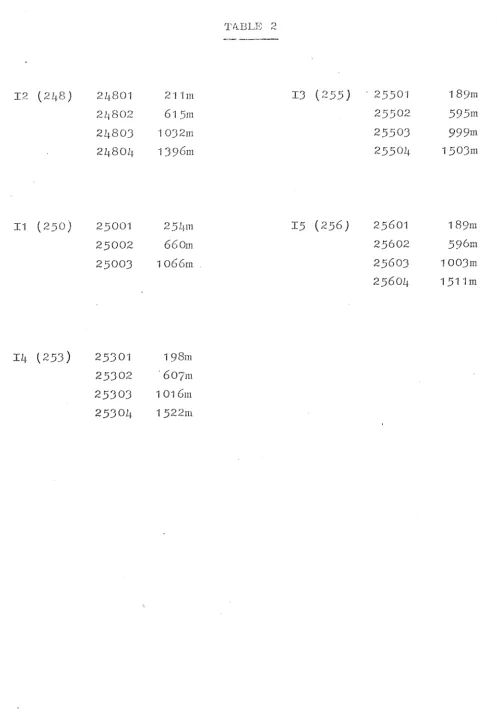
The actual depths attained by the instruments are shown in
table 2 . , The variations from the nominal values are due to
inaccuracies in the precut wire lengths and in departures of the
actual water depths from those shown on the bathymetry r charts.
Pressure transducers on the uppermost instrument of some of the
2.
due to current drag were typically less than - 10m during the 2
month record and tlm^ depth variations of the deeper instruments
were proportionately less.
Individual current meter records are referred to by a number
consisting of the lOS mooring number combined with the sequence
number of the instrument measured from the top of the mooring.
Thus 25601 is the uppermost current meter on mooring 256 (15) and
25604 would be the deepest on that mooring.
current meter data.
The Aanderaa recording current meters used in this experiment
recorded data internally on magnetic tape at 10 minute intervals
throughout the record. The sampling is controlled by an internal
crystal clock and timing errors were in all cases less than two
minutes b y the end of the experiment. Each instrument recorded
current speed as a n integrated value over the 10 minute sample
period, current direction as a single value every 10 minutes of
the orientation of the current meter value relative to magnetic
north and water temperature from an externally mounted thermistor.
All the current meters had been individually calibrated prior
to the experiment and it can be expected that the 10 minute current
values should be accurate to within - 1 cm/sec for speed and - 1"
in direction (50 cm/sec is approximately 1 kt).
At this stage no editing has been performed on the data
series and as a consequence the plots show some "spikes" (bad
data points}, but the general interpretation of the data will not
be affected. The data "spikes" have, of course, been ignored in
Data Presentation.
Each current meter record is displayed as a time series
of the 10 minute values of speedy east a^d north component and
water temperature (figs. 3 to 21). Also plotted on the east and
north components tim^ series of low-pass filtered data. (The
filter cutoff is such that 24 br period oscillations should be
reduced to 3^ of their original amplitude). These filtered values
allow a better assessment of the relative contributions of high
frequency (semidiurnal tidal) and low frequency (periods of
several days) motions.
The plots of individual current components do not allow
the direction of current flow to be easily recognised and so a
series of "stick plots" (one for each mooring) are shown if figs.
22 - 26. These are shown as a series of vectors drawn at 12 hr
intervals each representing the speed and direction of the low
frequency current at that time. The combination of all the records
from a mooring on one page allows a rough estimate of the vertical
coherence to be made together with the amplitude and direction of
the low frequency oscillations and of the mean flow.
A l l the time series plots are drawn on a common time axis
from day 190 (July 9th) to day 255 (September 12th). August
1st is day 213 and September 1st day 2^4.
Description of the data.
All of the current records (figs. 3 - 2 1 ) show tidal
oscillations which are present in both velocity components and
in the current speed and whose amplitude varies throughout the
record. The variations are not regular (i.e. i;hey differ from
current records on the continental shelf in whici^ a regular
5.
motions and of their vertical coherence. Moorings 13 and X5
(255 256) show predominantly northward flow throughout the
experiment. "Events" in the record Hoem to occur simultaneously
throughout the water coluam aad are in the same sense. e.g.
around day 228 on mooring 256 the northward flow is stopped and
turned towards the west at all depths. The periodicity of the
low frequency fluctuations in these as in all the other records
is close to 10 days. Mooring lij (253) also shows coherent
fluctu-ations but the northward mean flow is less well defined.
The influence of local bottom topography is seen in the
deepest record on mooring 250 (II). The strong oscillations are
aligned parallel to the local depth contours and are rather
dissimilar to the records at the two upper layers.
The lower part of mooring 12 (248) is influenced by the
overflow from the Norwegian Sea and thus the 1000m record is
strongly to the south compared to the records above it which are
for the most part towards the east. The most striking feature of
the three records on this mooring are the vertically coherent
events near day 202 and 232 when the deep overflow is reversed.
At all levels the change in current is of the order of 30 cm/sec.
These two times approximately coincide with the only two periods
during the JASIN experiment in which strong winds associated with
the passage of depressions were experienced in the N. Rockall
Trough. The later event is also seen in the records of mooring
256 (15). In such short records it is possible that the coincidence
of the meteorological and oceanographic events is fortuitous but
if the summertime atmospheric disturbances can perturb the
currents throughout the water column by as uuch as 30 cm/sec the
typical winter storms in the area may in fac^ produce much larger
k.
table 3 an attempt has been made to characterise ea^b record by
giving the typical and maximum observed values of tidal current
amplitude.
The largest tidal signals are seen at the 1000m level on
moorings 2^6 and 2^^. Both of these moorings are on the eastern
side of the trough and the high tidal energy may be a result of
their proximity to the Hebrides Shelf and the Wyville-Thomson
ridge. The mechanism of the transfer of this tidal energy from
the shelf to the deeper levels of the trough is not clear. The
maximum tidal signals seen are of the order of - 40 cm/sec (almost
1 ktj. The values on other moorings are in the range - 8 to - 2?
cm/sec. There is some evidence that the deepest records, from
the 1000 and 1500m levels contain energy in the internal wave
band - periods between 30 mins and 10 hrs - this shows as "noise"
on the records and may not always be adequately resolved by the
10 minute sample period.
The highest 10 minute values are again on moorings 2^8 and
256 at the 1000m level, 68 and 55 cm/sec respectively. Mooring 2^8
is influenced b y the overflow of water from the Norwegian Sea as
it spills over the ¥yville-Thomson Ridge. This accounts for the
correlation of h i g h currents with low temperatures on record 2^803.
The deepest current meter had a damaged rotor (perhaps by the high
currents). This will have reduced its sensitivity but the speed
channel shows that the currents were strong enough during overflow
events (marked b y low temperatures) to register values of up to
1 knot. It is reasonable to suppose that the true values greatly
exceeded this.
Figs. 22 - 26 dvaw attention to the low frequency currents
which remain after the tides and higher frequency m- M e n s have
been filtered out and discarded. The plots give a good impression
. Engineering significance of preliminary results.
It is possible to see in the records described here several of
the factors known to influence the currents in areas of the deep
ocean adjacent to large topographic features. The dominant effects
in these records are due to tides and to meteorological disturbances
and in this particu^^r area the energetic overflows of dense, cold
water from the Norwegian Sea are an obv±ous feature of some
of the deep records.
The relative importance of inertial oscillations, internal
waves and mesoscale eddies will not become clear until more detailed
analysis of the records has been performed. The full effects of the
overflows from the Norwegian Sea have not been monitored due to
damage to the current meter (perhaps caused by the high currents).
The importance of episodes of extreme current, which will be
of interest in the design of engineering structures, is difficult
to assess from such short records from the summer season. One
crude estimate of possible maxima is made by combining the maximum
tidal amplitude observed with the maximum low frequency signal and
assuming that the two are coincident. This operation results in
extremes of 77 and 59 cm/sec on moorings 2^8 and 256 respectively,
of the order of I4O cm/sec on moorings 25O and 255 and 29 cm/sec on
253. These results show clearly that the strongest currents may
be encountered close to topography and on the eastern side of the
basin. Longer observations can only serve to increase these
extreme values.
The magnitude of vertical shear both at tidal and lower
frequencies cannot yet be assessed from the preliminary analysis
but is certain to be of importance in the design of structures.
The measurements made in this experiment do not consider the upper
20C^ of the water column where both shear and extreme values of
7
-Appendix.
Scientific development of the experiment
The measurements reported here were designed to study the
circulation of the Northern Rockall Trough and to learn something
of the physical processes responsible. Previous current
measure-ments in the area had shown oscillations with periods of 5 to 10
days and it was thought that they might be driven by atmospheric
pressure and surface winds acting on the ocean. Because of the
meteorological measurements being made, the JASIN experiment
presented a good opportunity to study this connection.
Most of what is known of the long term water flow through
the region has been inferred from studies of the different types
of water, within and around the Rockall Though. This suggested
that at the surface there is a northward flow along the eastern
side of the Trough. Near the bottom the cold water which spills
over the ¥yville-Thornson ridge is thought to run as a current
along the northern and western sides of the Trough.
The Trough is large enough to contain mesoscale eddies which
are a feature of other parts of the N. Atlantic. These are
circulation features equivalent to the cyclones and anticyclones
of the atmosphere, but with diameters of only 100km or so. They
take 100 days or more to pass a point.
Some previous current measurements m^le ±n t]^ Trough showed
current oscillations with periods of 5 to 10 days. Such
oscilla-tions are not normally very noticeable ±n current records from
the deep ocean despite the fact that this is the frequency range
in which one would expect atmospheric forcing to be greatest. Piv^
to ten days is the period of the main internal seiche of the Trough
and the oscillations could therefore be the response of this seiche
wave in which, th^ surface water level remains roughly constant
but the internal density surfaces are displaced accompanied by
current shear across the density surface).
Continental shelf Avaves with periods of a few days are waveo
which are trapped against the continental shelf by the Coriolis
force. The associated currents are greatest on the shelf and at
the shelf edge and decay as one moves into deeper water. Such
continental shelf waves in the Rockall Trough would move
anti-clockwise around the basin.
At periods of a day or less, there are a number of wave
motions which occur in current measurements, Tidal currents are
usually the most important in the eastern Atlantic. There are
also inertial oscillations (natural horizontal oscillations of
the ocean Associated with the earth's rotation), and internal
waves associated with oscillations of the density surfaces.
Selection of mooring positions.
The initial plan was to form, together with the moorings
E3 and Ei|, a hexagonal array of moorings with one central mooring.
This would give good geographical coverage of the northern Rockall
Trough. During the planning of JASIN, 13 was moved away from the
shelf so that density measurements could be made around it. Also
we learned that the Marine Laboratory, Aberdeen of DAPS were
planning to place a mooring (D2) near the original position of 15.
The modified positions of 13 and 15 and the positions of the other
deep current meter moorings are shown in fig. 1.
This array of widely spaced moorings should enable us to map
the mean flow through the area. Mooring 12 was positioned to
monitor any water flowing over the Wyville-Thomson ridge.
The moorings are too far apart to map the mesoscale eddies
— ^ —
measurements with the density observations.
The array should be suited for studying oscillations with
periods of 5 to 10 days because both the surface and internal
waves of this period are expected to have waveleng&G larger than
the separation of the moorings. This is also true for the main
surface tide. However, the other high frequency oscillations
mentioned have much shorter wavelengths. For these oscillations
the horizontal and vertical spacing of the current meters is too
great to define their detailed structure and thus they will only
be studied in a statistical sense.
Finally in positioning the moorings the continental slopes
were avoided, partly due to the difficulty of setting moorings
on steep slopes but also so that these initial measurements are
not too confused b y the complexities of a full spectrum of shelf
i..v I'
St. Kilclo
Rcckau /i ^
Pig. 2
189m
596m
1003m
1511m
[ h
0
-I -L_
-T
4' buoyancy sphere
- 20m X 8mm wire
Command Beacon 2101
Aanderaa current meter 3342
406m X 8mm
AA 3341
407m X 8mm
Aa 2450
507m X 8mm
Aa 3450
446m X 8mm
Co^zand release 2151
2m X trawl warp
T A B L E 1
M o o r i n g n u m b e r P o s i t i o n W a t e r depth. Date set R e c o v e r e d (M)
J A S I M / J O S
1 2 / 2 4 8 6 0 ° 1 1 ' , 7 N 0 9 ° 1 5 ' 1 4 4 4 i 4 - v % l 6 - D l
1 1 / 2 5 0 5 9 ° 5 9 ' . 2 N 1 2 ° 0 9 ' . 1 W 1 1 1 7 1 5 - v i l 4 - ] Z
1 4 / 2 5 3 5 8 ° 4 9 ' . 8 N 1 1 ° 3 9 ' . 8 W 1 8 2 1 1 7 - V % I 2 7 - V I % I
1 3 / 2 5 5 5 8 ° 3 0 t . O N 1 2 ° 4 0 ' .2W 1 5 9 1 1 8 - V I I 1 - I X
TABLE
12 (248) 2 4 8 0 1
24802 24803 2 4 8 0 4
2 1 1 m
615m 1032m
1396m
Z3 (255; 25501
2 5 5 0 2
25503 25504
I89m 595m 999m
1503m
I I ( 2 5 0 ) 25001
25002 2 5 0 0 3
2 5 4 m
660m
1 0 6 6 m
1 5 ( 2 5 6 ; 2 5 6 0 1
2 5 6 0 2
25603 2 5 6 0 4
I 8 9 m
596m 1 0 0 3 m
1511m
14 1253) 25301
25302 25303 25304
198m 607m 1016m
[image:16.595.44.542.56.782.2]TABLE 3
All speeds In cm/sei
Tidal TO minute Max low freq,
amplitude average speed speed
Typical Max
250 10 13 33 27
248 20 25 46 37
200m 255 10 15 35 17
253 6 8 25 16
256 6 10 31 23
250 10 13 30 22
248 20 27 40 33
600m 255 12 15 30 21
253 6 10 26 16
256 7 15 35 26
250 12 18 34 22
248 25 40 68 37
1000m 255 15 22 28 17
253 7 12 23 11
256 15 4 0 55 19
1500m
248 No Data No Data No Data
255 6 10 25 15
253 10 15 23 14
CAS
T
CM/SE
C
'.Q
O
-gj
M
^0
0
ge.
i
.
M
:
M O C3
-a
NORT
H
CM/SE
L
-^a.
w
g.fi
^
#
%
!>
1
:
-TCr
r
OE
G
C
SPEE
D
CM/SE
C
2j
^ r K
I
feW."
->3 3 EAS T CM/SE C -^a. i
o CD l\3
za. m R.Q O "jO'C o -9"
-%
#
NORT H CM/SE C -K.D O O.O C 15.C O —:L6 : TEM P DE G C I.D Q b.C O 5.0 3 SPEE D CM/SE C f ' f 4 . I4
f
f_3
r -ERS T CM/SE C O. M ya.q o ( r - g ? r NORT H CM/SE C p,G a 0 0 0 t^.Q O TEM P DE O C
%
SPEE D CM/GE C 1,K % 8 D O *f.0 3 CO.O O Scji o C3 u:
m _f
CM/SE
C
O.C
O
W.
M
1
-L
%
ft.NORT
H
CM/SE
C
TEM
P
DE#
C
5FCE
D
CM/SE
C
?.
*
#;0
5
ow
c^
:
:
v
-•>
f
1
&
f
f
OM
M.
EAS
T
CM/SE
C
-M.O
O
0;[|
3
f^.O
O
IS
CO o ret
:
"
k
-•
NORT
H
CM/SE
C
X.
W
0
M
TEM
r
DE
O
C
a.o
:
d
^
r
\
I
f i i|
I
SPEE
D
CM
/SE
C
f
f
Lg 3
33
.p
EAS T CM/SE C 0 o d w -3 CO .
o W '
ERS T CM/SE C i.o c 0.0 0
3 o o -a 3
ERS
T
CM/SE
C
-W.C
Q
-M.Q
O
0.0
3
O) o
H 8
$
#
iBQ.
M
-Rl.o
q
;RT
H
CH/SE
C
TEMPDEG
C
SPEE
D
CH/SE
i
1
'
-f
f\
/
0
3
3
K.
W
EO.
EAS
T
CM/5E
C
jl.O
O
DO
T
BO.0
3
-^0
3
NORT
H
CM/SE
C
-yi.i
o
3.C
T
g.
(
TEM
P
DE
C
C
SKEc
O
CM/OE
C
K
M
I^.
W
D
M
l&.
M
1
1
:.D
0
PO.C
rs ERS T CM/Si C NORT H CM/SE C -«.o o O. M ra.i % TEM P DE C C SPEE D CM/SC C _ n :| W «jK t C M g. i L. .
-[IK
w o Uge
n U) o •5^
EAS
T
CM/SE
G
d
r
j
f
I
-f-w
..
"
y^.a
,
t^.
w
,,
w
^
,,
M
m
r
&
-a s
!;
L
-1
C
^— a cn cn (Q
"6 B
-EAS
T
CM/oE
C
NORT
H
CM/SE
C
N.O
O
O.
M
**.G
]
TEMPOE
D
J^'O
S
B.o
a
"3=-/
IPEIZ
u
CI!
/
!?.c
:
r
-i
I
%
I
r
-0^
:
-RQ.c
n
I
5 01 I\)
Hi b.
EAS
T
CM/SH
C
I
f
.#
r
NORT
H
CM/SC
C
i
>
-.^TEMrOED
C
SrCEDCM/^F
C
#
&
za_
I
?.B
1
nq.0
-&1.0
Q
i
EAS
T
CM/SE
C
"
S s
0«3
3
23iC
9
1 l"
_3"
W
NORT
H
CM/SE
C
C
M '?
s
_g.e
c
k^
]
TEM
P
DE
O
C
SFCL
D
CM/SE
C
7^
:
o^
c
%
0
0.-/S
3
b
EAS
T
CM/SE
C
-a.ir
o
1:
-b -fi
J
E -H
k s
1 -8 -9 & -s & 1' -g & -a 1)NORT
H
CM/SE
C •
5^.C
O
ri 31s
.
TEM
P
OL
D
C
SPEE
D
CM/SE
C
•
W'
M
f'j
M
t|tO
a
^tl
3
0
H
5-,
!:nS
T
CM/SE
C
^0
0
3
z|.
w
NORT
H
CM/GE
C
0
C
3
Z^.I
M
W
gj
M
TEM
P
OE
O
C
SPEF
D
CM/SE
C
M
Z$.(
M
M.O
O
-M.
M
-g -8rr
o cn o o re
smy
f
GM/BE
d
b.c
U
-3 Is O
) o w
i 1-5
a
.
TEh
P
jOE
O
t
^ISPE&
D
_CM/SE
C
.,e=
^
T
V
JEt
.
,
CH/SE
C
^
,
OjO
d
g.b
o
^j.o
d
S 'N i c
n
O
) o .pk
LR
I
I
kjx'.ii
i
cH/SE
k
:
.b
)
6
w
/
'
t
i f
2 5 4 rn
08
•v,o
z (_)
6 6 0 m
o
W o CO^Z.
~s" 2Z U
1 0 6 6 m
•x^--5
^^.1.00 I3S.M nrn.M
Qj t J
... .^.^/,,%:% , A. I / 4^
% J
-;30(I1)
il
I ?
-s
2rkn
/
u
LU.,
CO 9 .
c u
615ni
"T
8
Bl
.-Al 1 /
l\ I / / /
u %G. \ =
1032 rn
1M.M
I K«.o: tio.M ei#.M
24G(I2)
/ f
I'/l'll'"
6)
UJ ,
u
1 9 8 r n
/n^M/zW^/iuw^ A K\
8
ET
S r
u
LU t_ tO". 3= u
6 0 7 m
. I ///x/\ f /////lU
M-u
LL!._ z: (_)
1016ni
M-S
Gl
t J
5=
CJ
1 5 2 2 m
yiii.LC :*I9.(U
cu(I3}
CM/SE C 6C.C 0 -SQ.Q O CM/SE C -IS.0 3 0.^. 0 se.s a LT I
to r-0
g cn
#
I 3^ 3 CT ;I
r1
\
/
I
I\
CM/SE C -2E.0 3 0.0 0 53.0 0 -53.0 9 CK/SE C -25.0 0 C.C O o C O C O 3
I
%
\
r
i
CJ
L)
189 m
g-(_)
LUf (O ^ c u
5 9 6 m Y
\tlll
*r 8
t3 lUr
to 9J 1 0 0 3 m I I .yYj^////y%,y, , , , / / / n / / / 1 / / l I
A\\
R 81
u iu„ oc u
1511m
» I f /// / / , \ ^ \ \ i I ^^^5*,—y / / » V"". , » /
*!|ig.oo 3^