Proceedings of the Tenth Workshop on Innovative Use of NLP for Building Educational Applications, 2015, pages 224–232,
Task-Independent Features for Automated Essay Grading
Torsten Zesch Michael Wojatzki
Language Technology Lab University of Duisburg-Essen
Dirk Scholten-Akoun Center of Teacher Education University of Duisburg-Essen
Abstract
Automated scoring of student essays is in-creasingly used to reduce manual grading ef-fort. State-of-the-art approaches use super-vised machine learning which makes it com-plicated to transfer a system trained on one task to another. We investigate which cur-rently used features are task-independent and evaluate their transferability on English and German datasets. We find that, by using our task-independent feature set, models transfer better between tasks. We also find that the transfer works even better between tasks of the same type.
1 Introduction
Having students write an essay is a widely used method for assessment, e.g. universities use essay writing skills as a proxy for the prospects of appli-cants. As manually grading essays is costly, auto-mated essay grading systems are increasingly used becasue they – once developed – do not introduce additional costs for grading new essays.
Automated essay grading systems usually follow a supervised approach and yield a quality of holistic grading comparable to human performance (Valenti et al., 2003; Dikli, 2006). These systems make use of certain properties of essays (called features) in order to estimate the essay quality. In the grading process, these features are extracted and ratings are assigned according to the manifestations of the fea-tures (Attali and Burstein, 2006). In order to auto-matically learn the association between feature val-ues and ratings a high amount of manually rated es-says is required for training. Hence, it seems desir-able to develop systems that work without this initial
input, which means – expressed in terms of machine learning – that features should not be defined by the present task but by general essay grading. A task is defined here as prompting a group of humans to solve a particular writing task. Tasks differ in at-tributes such as the grade-level of underlying sub-jects or characteristics of the prompt.
Many kinds of features have been proposed for essay grading (Valenti et al., 2003; Dikli, 2006). They differ in the degree of dependency to the task at hand. There are features that are strongly dependent on a task, e.g. when they detect important words or topics (Chen and He, 2013). Other features are less dependent, e.g. when they capture general character-istics of essays like the number of words in the essay (Östling, 2013; Lei et al., 2014), usage of connectors (Burstein and Chodorow, 1999; Lei et al., 2014), etc. We assume that a system which considers only task-independent features should perform well no matter what task it is trained on. However, it is un-clear how much explanatory power the model might lose in this step. In this paper, we test this hypothe-sis by performing experiments with a state-of-the-art essay grading system on English and German datasets. We categorize features into task-dependent and task-independent ones and evaluate the differ-ence in grading accuracy between the corresponding models. We find that the task-independent models show a better performance for both languages tested, but the resulting losses are relatively high in general. Moreover, we examine the tasks more closely and group them according to whether they offer a tex-tual source as a reference point. We show that the transfer works better if the model is derived from the same task type.
2 Features
In this section, we describe state-of-the-art features and how they relate to the quality of an essay. For each feature, we discuss whether it belongs to the strongly task-dependent or weakly task-dependent group.
2.1 Length Features
This very simple but quite valuable feature deals with the essay length (Mahana et al., 2012; Chen and He, 2013; Östling, 2013; Lei et al., 2014). The core idea is that essays are usually written under a time limit. So the amount of produced text can be a useful predictor of the productivity of the writer and thus the quality of the essay (Shermis and Burstein, 2002). Therefore, we measure the text length by counting all tokens and sentences in an essay. The degree of task-dependence of this feature is directly connected to the time limit.
The average sentence lengthin words andword lengthin characters can be an indicator for the de-gree of complexity a writer can master (Attali and Burstein, 2006; Mahana et al., 2012; Chen and He, 2013; Östling, 2013). As this is not particularly tied to a specific task, these features are weakly task-dependent.
2.2 Occurrence Features
According to Mahana et al. (2012) the occurrences of linguistic phenomena such as commas, quota-tions, orexclamation markscan serve as valuable features in a grade prediction. These features fo-cus more on the structuring of an essay and are thus weakly task-dependent.
For tasks that are source-based (i.e. a source text is provided on which the task is based), we augment this approach by also counting formal references
like citations and line references. Source-based fea-tures are obviously strongly task-dependent.
Using third party sources to support an argu-ment can be a valuable hint for evidence (Bergler, 2006). Therefore, we use the approach of Krestel et al. (2008) to detect direct, indirect, and reported speechin essays. The approach relies on set of re-porting verbs and rules to identify and distinguish these forms.
If a task is based on a certain text source, the oc-currence ofcore conceptsin the essay should be an indicator for high quality (Foltz et al., 1999). We de-termine core concepts from the source using words or phrases with a high tf.idf weight. Again these fea-tures are just meaningful if the related task offers a textual source.
2.3 Syntax Features
Variation in the syntactic structures used in an essay may indicate proficiency in writing (Burstein et al., 1998). Following Chen and He (2013), we opera-tionalize this by measuring the ratio of distinct parse trees to all the trees and the average depths of the trees to computesyntactic variationfeatures.
Further, the parsing trees are used to measure the proportion of subordinate, causal and temporal clauses. Causal and temporal clauses are detected by causal or temporal conjunctions that could be found in subordinate-clauses. For example, a sub-ordinate clause beginning with whenis considered as temporal. The detection of causal- and temporal clauses is used to enrich the syntactic variability by a discourse element (Burstein et al., 1998; Chen and He, 2013; Lei et al., 2014). As syntactic features are relatively independent of the task, we categorize them as weakly task-dependent.
2.4 Style Features
Another important aspect of essay quality is an appropriate style. Following Östling (2013), we use the relative ratio of POS-tags to detect style preferences of writers. We complemented this by a feature that measures the formality F of an essay (Heylighen and Dewaele, 2002) defined as:
F = P
i∈A
c(i)
n −
P
j∈B
c(j)
n + 100
2
where A = {N, ADJ, PP, DET}, B = {PR, V, ADV, UH}, and n is the number of tokens in the text. Theformality-feature should be strongly task-dependent, as the correct style depends on the task and the target audience.
type-token-ratioto estimate whether an essay has a relatively rich or rather poor vocabulary.
As noted by Breland et al. (1994), word knowl-edge of a writer is highly tied to the corpus fre-quency of the words used. The lower the frefre-quency the higher the writer’s language proficiency. We model this idea by calculating the average word frequencyin the Web1T-corpus (Brants and Franz, 2006). We expect this average frequency to be relatively stable and thus categorize the feature as weakly task-dependent.
2.5 Cohesion Features
The structure of an essay reflects the writer’s abil-ity to organize her ideas and compose a cohesive re-sponse to the task. Following Lei et al. (2014) the use of connectives (like therefore or accordingly) can be a hint for a cohesive essay. We count oc-currences of connectives (from a fixed list) and nor-malize by the total number of tokens. As cohesion is relatively independent from the topic of an essay, we categorize this feature as weakly task-dependent.
2.6 Coherence Features
In order to make an essay understandable, writers need to ensure that the whole text is coherent and the reader can follow the argumentation (Chen and He, 2013; Lei et al., 2014). Features based on Rhetori-cal Structure Theory (William and Thompson, 1988) could be used (Burstein et al., 2001), but there are no reliable parsers available for German and per-formance is also not yet robust enough for English. Instead, we operationalize coherence measuring the
topical overlapbetween adjacent sentences. We use similarity measures based on n-gram overlap and re-dundancy (e.g. of nouns). This operationalization of coherence is weakly task-dependent, as the degree of topical overlap is independent of the actual topic.
2.7 Error Features
Grammatical or spelling errors are one of the most obvious indicators of bad essays, but have been found to have only little impact on scoring quality (Chen and He, 2013; Östling, 2013). We add a sim-ple rule-basedgrammar errorfeature in our system based on LanguageTool.1 We do not expect
gram-1https://www.languagetool.org
mar errors to be bound to specific topics and catego-rize the feature as weakly task-dependent.
2.8 Readability Features
We use a set of established readability fea-tures (Flesch, Coleman-Liau, ARI, Kincaid, FOG, Lix, and SMOG), that rely on normalized counts of words, letters, syllables or other phenomena (like abbreviations) which affect the readability (McLaughlin, 1969; McCallum and Peterson, 1982; Smith and Taffler, 1992). Depending on which writ-ing style is considered as appropriate, high scorwrit-ing essays might be associated with different levels of readability. However, a certain level of formal writ-ing is required for most essays and very simple or very complex writing are both indicators for bad es-says. Thus, we categorize the features as weakly task-dependent.
2.9 Task-Similarity Features
For source-based essays, we can determine thetask similarity of an essay by computing the similarity between essay and the task specific source (Östling, 2013). There should be a certain degree of simi-larity between the source and the essay, but if the similarity is too high the essay might be plagia-rized. We use Kullback–Leibler divergence between source and essay.
A variant of this feature computes the corpus similarity to a neutral background corpus (Brown corpus (Marcus et al., 1993) in our case) in order to determine whether the essay was written specific enough.
While the corpus similarity should be weakly task-dependent, the task similarity is of course strongly dependent on the task.
2.10 Set-Dependent Features
So far, all features have only used the characteris-tics of a single essay, but it is also useful to take the whole set of essays into account. Instead of detect-ing characteristics of an individual essay the differ-ences between essays in the set is examined. Set-based features can be Set-based on topics (Burstein et al., 1998) or n-grams (Chen and He, 2013). We use
Chen and He (2013), we further use the same num-ber ofPOS n-gramsas features.
As a consequence of writing conventions, word-ing in an essay usually differs between regions in a text. For example, words that indicate a summary or a conclusion are indicators for a good essay only if they occur at the end, not at the beginning. Thus, we partition the essay innequally sized parts based on word counts (we found five parts to work well) and compute partition word n-grams using the same settings as described above.
As all features described in this section deal with frequent wording or essay topics, they are strongly task-dependent.
3 Experimental Setup
We now describe the experimental setup used to examine our research question regarding task-independent models.
3.1 Datasets
As we want to compare models across tasks, we need datasets that contain different tasks.
English A suitable English dataset is the ASAP essay grading challenge.2 The dataset contains eight
independent tasks of essay-writing with each about 1,800 graded essays (except the last one with only 723). The essays were written by students in grade levels between 7 and 10 of a US high-school. The tasks cover a wide range of different settings and can be grouped on whether they were source-based or not:
Thesource-based taskshave in common that the participants first received a text as input and then had to write an essay that refers to this source. The fol-lowing task belong to this group:
• Task 3: Given a source of someone who is trav-eling by bicycle, students should describe how the environment influences the narrator. • Task 4: On the basis of the text ‘winter
hibis-cus’ participants should explain why the text ends in a particular way.
• Task 5: Students were requested to describe the mood of a given memoir.
2https://www.kaggle.com/c/asap-aes
• Task 6: Based on an excerpt on the construction of the Empire State Building, participants had to describe the obstacles the builders faced. Theopinion tasksask for an opinion about a cer-tain topic, but without referring to a specific source text.
• Task 1: Students should convince readers of a local newspaper of their opinion on the effects computers have on people.
• Task 2: Participants were asked to write about their opinion on whether certain media should be banned from libraries. They were prompted to include own experiences.
• Task 7: Participants should freely write on ‘pa-tience’. They could either write entirely free or about a situation in which they or another per-son proved patience.
• Task 8: Participants were told to tell a true story in which laughter was a part.
As the different tasks use different scoring schemes, we use holistic scores and normalize to a scale from 0 to 9 in order to make the trained model exchange-able.
German The German dataset contains two inde-pendent tasks each with 197 and 196 annotated es-says. The essays were written by first-year univer-sity students of degree programs for future teachers. Both writing tasks had in common that the partici-pants first received a text as an input. After reading the given text they were supposed to write an essay by summarizing the argumentative structure of the text. However, students were also asked to include their own pro and contra arguments.
• T1: Students were requested to summarize and to discuss a newspaper article of a national German newspaper which deals with an edu-cational topic.
Group Feature
strongly task-dependent
essay length
partition word n-gram POS n-gram
word n-gram *core concepts
*formal references
*task similarity
weakly task-dependent
connectives
commas/quotations/exclamation corpus similarity
direct, indirect and reported speech formality
grammar error readability
subordinate, causal & temporal clauses syntactic variation
topical overlap type-token-ratio word frequency word/sentence length
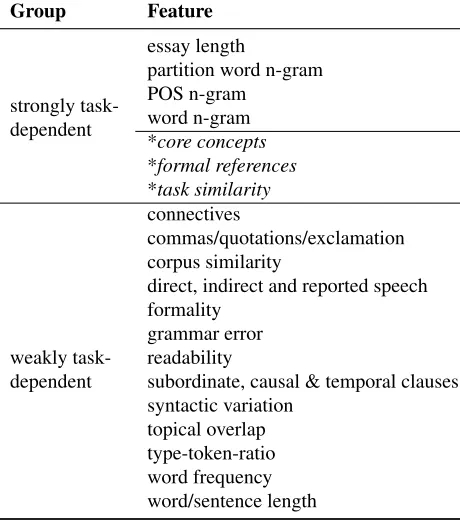
Table 1: List of features grouped into strongly and weakly task-dependent. Source-based features (marked with a *) are not used in our experiments.
3.2 Strongly vs. Weakly Dependent Features
[image:5.612.72.304.65.330.2]Our theoretic considerations on the commonly used features show that they differ in their degree of de-pendence on a specific essay writing task. As not all tasks refer to a source, we exclude – for the sake of comparability – features that rely heavily on the source text, i.e. features like core concepts. We ar-gue that set-dependent features are strongly task-dependent and most others are weakly task-dependent. Table 1 gives an overview of the two feature groups used in our experiments. Thefull feature set uses both strongly and weakly task-dependent features, while the reduced set only uses the weakly task-dependent ones.
3.3 Essay Grading System
In order to ensure a fair comparison, we re-implemented a state-of-the-art essay grading system based on DKPro TC (Daxenberger et al., 2014)3
which ensures easy reproducibility and replicability. Our system takes a set of graded essays and
3version: 0.7
performs preprocessing using tokenization, POS-tagging, stemming, and syntactic parsing.4 The
fea-ture extraction takes a list of feafea-tures (either thefull
orreduced set of features) and extracts the corre-sponding feature values from the instances. The ma-chine learning algorithm5then learns a model of
es-say quality from the extracted features.
In a second and independent step, the learned model is applied in order to grade essays. In the usual in-task setting (our baseline), we train on a part of the available data for a specific essay writing task and then evaluate on the held-out rest (10-fold cross validation). In our task-adaptation setting, we train the model on all the data for one task, but evaluate on another task.
For the German essays, we need to adapt some components of the system. For example, the lists of
connectives, causalandtemporalclause detection were replaced by German equivalents. The detection ofdirect, indirect, and reported speechwas done following Brunner (2013). Further,corpus similar-itywas computed based on the Tiger corpus (Brants et al., 2004) instead of the Brown corpus, and the
word frequencywas calculated using the German part of Web1T. In all other aspects, the English and German setups are equal.
3.4 Evaluation Metric
Following the recommendation of the ASAP chal-lenge, we use as evaluation metric quadratic weighted kappacomputed as:
κ= 1− P
i,jwi,jOi,j
P
i,jwi,jEi,j
with Oi,j as the number of times one annotator
graded j and the other i, with Ei,j as the expected
grades given a random distribution and with
wi,j = (i−j) 2
(N−1)2
as the weight of the grades. The metric produces a value for the agreement between the human gold standard and the machine grading.
4The preprocessing was realized with the DKPro Core 1.7.0
components used within DKPro TC: BreakIterator, TreeTagger, SnowballStemmer and StanfordParser.
[image:5.612.73.303.70.330.2]3 4 5 6 1 2 7 8 0
0.2 0.4 0.6 0.8 1
source-based opinion
Tasks
κ
[image:6.612.75.277.65.274.2]full reduced
Figure 1: ASAP dataset: Comparison of the full and reduced model.
4 Results
We now report and discuss the results of our task adaptation experiments. The difference in perfor-mance will be an indicator of how well the mod-els can be transferred from one essay set to another. We first establish the within-task results as a baseline and then compare them with the cross-task results.
4.1 Baseline: Within-Task Models
Figure 1 gives an overview of the results obtained when training a dedicated model for each task, either with the strongly task-dependent full model or the weakly task-dependent reduced model. Task8 shows very low performance due to the much smaller amount of available training data. We expected that the full model would always perform better than the reduced model, but we get a mixed picture instead. It seems that even within a task, the full feature set overfits on specific words used in the training data while they do not need to be necessarily mentioned in order to write a good essay.
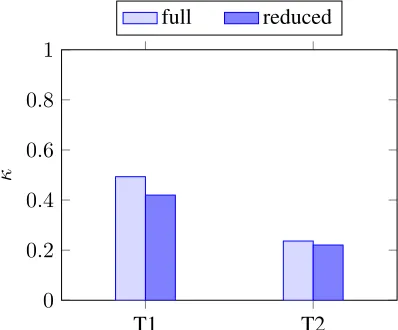
Figure 2 shows the results for the German essays. The kappa values are much lower than for the En-glish essays. This can be explained by the fact that the German tasks focus more on content issues than on language proficiency aspects, as the German es-says are targeted towards university students
com-T1 T2
0 0.2 0.4 0.6 0.8 1
κ
[image:6.612.316.515.66.231.2]full reduced
Figure 2: German dataset: Comparison of the full and reduced model
pared to school students for the English essays. As content issues are hardly covered by our features, the results could probably be improved by adding content features like the occurrence of core concepts (see 2.2). However, for both German tasks we see the expected drop in performance when going from the full to the reduced model although it is rather small.
After having calculated the baselines, we can now transfer the models and determine the loss associ-ated with the transfer.
4.2 Experiment: Cross-Task Models
We now examine the task-adaptivity of models by training on one task and testing on another, and then compare the result to the baseline established above. Table 2 shows the resulting loss in performance for the full model. The table rows represent the tasks on which the model has been trained and the columns the tasks on which the trained model was tested. The average loss over all model transfers is .42, which shows that the full models do not work very well when transferred to another task.6 For
most cases, the observed behavior is symmetric, i.e. we see a similar drop when training on task 5 and testing on 4 or training on 4 and testing on 5. Though there are some remarkable exceptions. The model
6Note that the average loss in terms of quadratic weighted
Opinion Source-based
3 4 5 6 1 2 7 8
Opinion
3 - -0.41 -0.24 -0.44 -0.42 -0.56 -0.34 -0.43
4 -0.35 - -0.48 -0.48 -0.35 -0.55 -0.38 -0.41
5 -0.41 -0.47 - -0.55 -0.13 -0.46 -0.25 -0.35
6 -0.46 -0.59 -0.61 - -0.43 -0.36 -0.45 -0.13
Source-based
1 -0.45 -0.60 -0.55 -0.65 - +0.01 -0.37 -0.12
2 -0.46 -0.60 -0.60 -0.63 -0.40 - -0.61 -0.10
7 -0.39 -0.49 -0.42 -0.53 -0.28 -0.19 - -0.19
8 -0.41 -0.53 -0.50 -0.60 -0.52 -0.24 -0.33
-Table 2: Loss of thefullmodels compared with using the tasks own model (loss >-0.3 highlighted)
Opinion Source-based
3 4 5 6 1 2 7 8
Opinion
3 - -0.11 -0.29 -0.25 -0.66 -0.61 -0.31 -0.46
4 -0.04 - -0.24 -0.24 -0.67 -0.60 -0.29 -0.46
5 -0.23 -0.18 - +0.03 -0.54 -0.60 -0.16 -0.44
6 -0.41 -0.34 -0.24 - -0.39 -0.57 -0.06 -0.40
Source-based
1 -0.54 -0.43 -0.45 -0.37 - -0.12 -0.07 -0.20
2 -0.48 -0.40 -0.48 -0.43 -0.35 - -0.36 -0.05
7 -0.54 -0.39 -0.39 -0.38 -0.09 -0.28 - -0.25
8 -0.56 -0.49 -0.57 -0.50 -0.49 -0.25 -0.31
-Table 3: Loss of thereducedmodels compared with using the tasks own model (loss >-0.3 highlighted)
trained on set 1 performs even better on set 2 than its own model, while training on set 2 and testing on set 1 results in a .4 drop. In addition, all source-based models (1, 2, and 7) work quite well as models for set 8 – the drop is only about .1 in all those cases. However, set 8 has relatively little training data so that this might be rather an effect of the other models being generally of higher quality than a task transfer effect.
The same procedure was carried out for the model with the reduced feature set that excludes task-dependent features. The results are shown in table 3. We see that the average loss is reduced (.36 com-pared to .42 for the full model) which is in line with our hypothesis that the reduced feature set should transfer better between tasks. However, the effect is not very strong when averaged over all tasks.
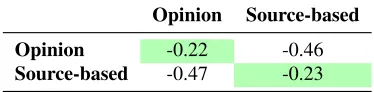
We also observe noticeable difference in the transferability between the groups (source-based vs. opinion tasks). Looking only within the source-based tasks the loss falls between +.03 and -.41, while for training on the opinion tasks and yields much higher losses (from -.37 to -.57 ). The same
Opinion Source-based Opinion -0.22 -0.46
[image:7.612.127.487.65.189.2]Source-based -0.47 -0.23
Table 4: Average loss of reduced model by task type
effect can be found for the opinion tasks (with the exceptions of set 7). In order to better see the dif-ference, we show the average loss for each group in table 4. It is obvious that a transfer within source-based or opinion tasks works much better than across the groups. Within a group, the loss is only half as big as between groups.
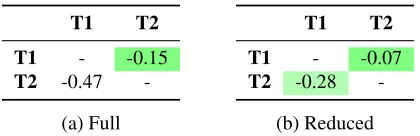
We perform the same set of experiments on the German data set. The results of the full model are shown in table 5a and the results of the reduced model are shown in figure 5b. Again the losses of the reduced model are much smaller than of the full model confirming our results on the English dataset.
5 Conclusion
[image:7.612.126.486.225.349.2] [image:7.612.333.520.394.440.2]T1 T2 T1 - -0.15
T2 -0.47 -(a) Full
T1 T2
T1 - -0.07
[image:8.612.85.295.64.132.2]T2 -0.28 -(b) Reduced
Table 5: Loss on the German dataset
grading can be transferred from one task to another. We discussed a wide range of features commonly used for essay grading regarding their task depen-dence and found that they can be categorized into strongly and weakly task-dependent. Our hypothe-sis was that the latter model should transfer better between tasks. In order to test that, we implemented a state-of-the-art essay grading system for English and German and examined the task transferability by comparing the baseline performance (training on the actual task) with the models trained on the other tasks. We found, consistent with our hypothesis, that the reduced models performed better on aver-age. The transfer worked even better if the underly-ing tasks are similar in terms of beunderly-ing source-based or opinionated. The fact that the losses on average are still quite high raises the question of whether a more fine-grained discrimination of features is nec-essary or whether models for essay grading can be transferred at all.
In future work we plan to further investigate the connection of task attributes to their task-transferability (e.g. the language proficiency level of participants or differences in the task description). In addition, we think that there are facets of quality that are independent of tasks, like the complexity of essays. Grading essays not only holistically, but ac-cording to facets is likely to transfer better between tasks and at the same time provides teachers with reliable sub-scores that may support their decisions without the demand of training data.
References
Yigal Attali and Jill Burstein. 2006. Automated essay scoring with e-raterR v. 2. The Journal of Technology, Learning and Assessment, 4(3).
Sabine Bergler. 2006. Conveying attitude with reported speech. InComputing attitude and affect in text: The-ory and applications, pages 11–22. Springer.
Thorsten Brants and Alex Franz. 2006. Web 1t 5-gram corpus version 1.1. Google Inc.
Sabine Brants, Stefanie Dipper, Peter Eisenberg, Sil-via Hansen-Schirra, Esther König, Wolfgang Lezius, Christian Rohrer, George Smith, and Hans Uszkor-eit. 2004. Tiger: Linguistic interpretation of a ger-man corpus. Research on Language and Computation, 2(4):597–620.
Hunter M Breland, Robert J Jones, Laura Jenkins, Marion Paynter, Judith Pollack, and Y Fai Fong. 1994. The college board vocabulary study. ETS Research Report Series, 1994(1):i–51.
Annelen Brunner. 2013. Automatic recognition of speech, thought, and writing representation in ger-man narrative texts. Literary and linguistic computing, 28(4):563–575.
Jill Burstein and Martin Chodorow. 1999. Automated essay scoring for nonnative english speakers. In Pro-ceedings of a Symposium on Computer Mediated guage Assessment and Evaluation in Natural Lan-guage Processing, pages 68–75. Association for Com-putational Linguistics.
Jill Burstein, Karen Kukich, Susanne Wolff, Chi Lu, Martin Chodorow, Lisa Braden-Harder, and Mary Dee Harris. 1998. Automated scoring using a hybrid feature identification technique. In Proceedings of the 17th international conference on Computational linguistics-Volume 1, pages 206–210. Association for Computational Linguistics.
Jill Burstein, Claudia Leacock, and Richard Swartz. 2001. Automated evaluation of essays and short an-swers. Loughborough University Press.
Hongbo Chen and Ben He. 2013. Automated essay scoring by maximizing human-machine agreement. In
EMNLP, pages 1741–1752.
Johannes Daxenberger, Oliver Ferschke, Iryna Gurevych, and Torsten Zesch. 2014. Dkpro tc: A java-based framework for supervised learning experiments on tex-tual data. InProceedings of 52nd Annual Meeting of the Association for Computational Linguistics: System Demonstrations, pages 61–66, Baltimore, Maryland, June. Association for Computational Linguistics. Semire Dikli. 2006. An overview of automated scoring
of essays. The Journal of Technology, Learning and Assessment, 5(1).
Ronald A Fisher. 1915. Frequency distribution of the values of the correlation coefficient in samples from an indefinitely large population. Biometrika, pages 507– 521.
Francis Heylighen and Jean-Marc Dewaele. 2002. Vari-ation in the contextuality of language: An empirical measure.Foundations of Science, 7(3):293–340. Ralf Krestel, Sabine Bergler, René Witte, et al. 2008.
Minding the source: Automatic tagging of reported speech in newspaper articles. Reporter, 1(5):4. Chi-Un Lei, Ka Lok Man, and TO Ting. 2014. Using
learning analytics to analyze writing skills of students: A case study in a technological common core curricu-lum course. IAENG International Journal of Com-puter Science, 41(3).
Manvi Mahana, Mishel Johns, and Ashwin Apte. 2012. Automated essay grading using machine learning.
Mach. Learn. Session, Stanford University.
Mitchell P Marcus, Mary Ann Marcinkiewicz, and Beat-rice Santorini. 1993. Building a large annotated cor-pus of english: The penn treebank. Computational lin-guistics, 19(2):313–330.
Douglas R McCallum and James L Peterson. 1982. Computer-based readability indexes. InProceedings of the ACM’82 Conference, pages 44–48. ACM. G Harry McLaughlin. 1969. Smog grading: A new
read-ability formula. Journal of reading, 12(8):639–646. Robert Östling. 2013. Automated essay scoring for
swedish. In Proceedings of the Eighth Workshop on Innovative Use of NLP for Building Educational Ap-plications, pages 42–47.
Mark D Shermis and Jill C Burstein. 2002. Automated essay scoring: A cross-disciplinary perspective. Rout-ledge.
Malcolm Smith and Richard Taffler. 1992. Readability and understandability: Different measures of the tex-tual complexity of accounting narrative. Accounting, Auditing & Accountability Journal, 5(4):0–0.
Salvatore Valenti, Francesca Neri, and Alessandro Cuc-chiarelli. 2003. An overview of current research on automated essay grading. Journal of Information Technology Education: Research, 2(1):319–330. Mann William and Sandra Thompson. 1988. Rhetorical