DeepNL: a Deep Learning NLP pipeline
Giuseppe Attardi Dipartimento di Informatica
Università di Pisa Pisa, Italy
Abstract
We present the architecture of a deep learn-ing pipeline for natural language pro-cessing. Based on this architecture we built a set of tools both for creating distributional vector representations and for performing specific NLP tasks. Three methods are available for creating embeddings: feed-forward neural network, sentiment specific embeddings and embeddings based on counts and Hellinger PCA. Two methods are provided for training a network to per-form sequence tagging, a window approach and a convolutional approach. The window approach is used for implementing a POS tagger and a NER tagger, the convolutional network is used for Semantic Role Label-ing. The library is implemented in Python with core numerical processing written in C++ using parallel linear algebra library for efficiency and scalability.
1 Introduction
Distributional Semantic Models (DSM) that rep-resent words as vectors of weights over a high dimensional feature space (Hinton et al., 1986), have proved very effective in representing se-mantic or syntactic aspects of lexicon. Incorpo-rating such representations has allowed improv-ing many natural language tasks. They also re-duce the burden of feature selection since these models can be learned through unsupervised techniques from text.
Deep learning algorithms for NLP tasks ex-ploit distributional representation of words. In tagging applications such as POS tagging, NER tagging and Semantic Role Labeling (SRL), this has proved quite effective in reaching state of art accuracy and reducing reliance on manually en-gineered feature selection (Collobert et al, 2011).
Word embeddings have been exploited also in constituency parsing (Collobert, 2011) and dependency parsing (Chen and Manning, 2014).
A further benefit of a deep learning approach is to allow performing multiple tasks jointly, and therefore reducing error propagation as well as improving efficiency.
This paper presents DeepNL, an NLP pipe-line based on a common Deep Learning architec-ture: it consists of tools for creating embeddings, and tools that exploit word embeddings as fea-tures. The current release includes a POS tagger, a NER, an SRL tagger and a dependency parser.
Two methods are supported for creating em-beddings: an approach that uses neural network and one using Hellinger PCA (Lebret and Col-lobert 2014).
2 NLP Toolkits
A short survey of NLP toolkits is presented by Krithika and Akondi (2014).
NLTK is among the most well-known and comprehensive NLP toolkits: it is written in Py-thon and provides a number of basic processing facilities (tokenization, splitting, statistical anal-ysis of corpora, etc.) as well as machine learning algorithms for classification and clustering. Cur-rently it does not provide any tool based on word embeddings, however it can be interfaced to SENNA1 or it can be used in conjunction with Gensim2 which provides several algorithms for performing unsupervised semantic modeling from plain text, including word embeddings, random indexing, LDA (Latent Dirichlet Alloca-tion).
The Stanford NLP Toolkit (Manning et al., 2014) is written in Java and provides tools for tokenization, sentence splitting, POS tagging, NER, parsing, sentiment analysis and temporal expression tagging. As a recent inclusion, it
1 http://ronan.collobert.com/senna/ 2
http://radimrehurek.com/gensim/
vides a dependency parser based on neural net-work and word embeddings (Chen et al., 2014).
OpenNLP3 is a machine learning library writ-ten in Java that supports the most common NLP tasks, such as tokenization, sentence segmenta-tion, POS tagging, named entity extracsegmenta-tion, chunking, parsing, and coreference resolution.
Typically each tool built with these libraries uses a different approach or an most suitable al-gorithm for the task: for example Sanford NLP uses Conditional Random Fields for NER while the POS tagger uses MaxEntropy and both re-quire a set of rich features that need to be manu-ally engineered.
DeepNL differs from these toolkits since it is based on a common deep learning architecture: all tools exploit the same core neural network and use mostly just word embeddings as fea-tures. For example the POS tagger and the NER tagger have an identical structure, and they differ only in the way they read/write documents and in the configuration of the discrete features used: the POS tagger uses word suffixes while the NER uses gazetteer dictionaries. Embeddings are used as features, providing a continuous rather than discrete representation of text.
The ability of creating suitable embeddings for various tasks is critical for the proper work-ing of the tools in DeepNL; hence the toolkit integrates algorithms for creating word embed-dings from text, either in unsupervised or super-vised fashion.
3 Building Word Embeddings
Word embeddings provide a low dimensional vector space representation for words, where values in each dimension may represent syntac-tic or semansyntac-tic properties.
DeepNL provides two methods for building embeddings, one is based on the use of a neural language model, as proposed by (Turian and Bengio; Collobert et al., 2011; Mikolov et al., 2010) and one based on spectral method as pro-posed by Lebret and Collobert (2013).
The neural language method can be hard to train and the process is often quite time consum-ing, since several iterations are required over the whole training set. Some researchers provide precomputed embeddings for English4. The
3
http://opennlp.apache.org/ 4 http://ronan.collobert.com/senna/ http://metaoptimize.com/projects/wordreprs/ http://www.fit.vutbr.cz/˜imikolov/rnnlm/ http://ai.stanford.edu/˜ehhuang/
yglot project (Al-Rafou et al., 2013) makes available embeddings for several languages, built from the plain text of Wikipedia in the re-spective language, and the Python code for com-puting them5, that supports GPU computations by means of Theano6.
Mikolov et al. (2013) developed an alterna-tive solution for computing word embeddings, which significantly reduces the computational costs. They propose two log-linear models, called bag of words and skip-gram model. The bag-of-word approach is similar to a feed-forward neural network language model and learns to classify the current word in a given context, except that instead of concatenating the vectors of the words in the context window of each token, it just averages them, eliminating a network layer and reducing the data dimensions. The skip-gram model tries instead to estimate context words based on the current word. Further speed up in the computation is obtained by ex-ploiting a mini-batch Asynchronous Stochastic Gradient Descent algorithm, splitting the training corpus into partitions and assigning them to mul-tiple threads. An optimistic approach is also ex-ploited to avoid synchronization costs: updates to the current weight matrix are performed con-currently, without any locking, assuming that updates to the same rows of the matrix will be infrequent and will not harm convergence.
The authors published single-machine multi-threaded C++ code for computing the word vec-tors7. A reimplementation of the algorithm in Python is included in the Genism library (Řehůřek and Petr Sojka, 2010). In order to ob-tain comparable speed to the C++ version, they use Cython for interfacing a coding in C of the core function for training the network on a single sentence, which in turn exploits the BLAS li-brary for algebraic computations.
The DeepNL implementation is written in Cython8 and uses C++ code which exploits the Eigen9 library for efficient parallel linear algebra computations. Data is exchanged between Numpy arrays in Python and Eigen matrices by means of Eigen Map types. On the Cython side, a pointer to the location where the data of a Numpy array is stored is obtained with a call like:
5
https://bitbucket.org/aboSamoor/word2embeddings 6 http://deeplearning.net/software/theano/
7 https://code.google.com/p/word2vec 8
http://docs.cython.org/ 9
<FLOAT_t*>np.PyArray_DATA(self.nn.hid den_weights)
and passed to a C++ method. On the C++ side this is turned into an Eigen matrix, with no com-putational costs due to conversion or allocation, with the code:
Map<Matrix> hidden_weights(
hidden_weights, numHidden, numInput)
which interprets the pointer to a double as a ma-trix with numHidden rows and numInput col-umns. Since Eigen by default uses column-major order while Numpy uses row-major order, the class Matrix above is declared as:
typedef Eigen::Matrix<double, en::Dynamic, Eigen::Dynamic, Eig-en::RowMajor> Matrix;
3.1 Word Embeddings through Hellinger PCA
Lebret and Collobert (2013) have shown that embeddings can be efficiently computed from word co-occurence counts, applying Principal Component Analysis (PCA) to reduce dimen-sionality while optimizing the Hellinger similari-ty distance.
Levy and Goldberg (2014) have shown simi-larly that the skip-gram model by Mikolov et al.(2013) can be interpreted as implicitly factor-izing a word-context matrix, whose values are the pointwise mutual information (PMI) of the respective word and context pairs, shifted by a global constant.
DeepNL provides an implementation of the Hellinger PCA algorithm using Cython and the LAPACK library SSYEVR from Scipy10.
Cooccurrence frequencies are computed by counting the number of times each context word w D occurs after a sequence of T words:
𝑝(𝑤|𝑇) =𝑝(𝑤, 𝑇) 𝑝(𝑇) =
𝑛(𝑤, 𝑇) ∑ 𝑛(𝑤, 𝑇)𝑛
where n(w, T) is the number of times word w occurs after a sequence of T words. The set D of context word is normally chosen as the the sub-set of the top most frequent words in the vocabu-lary V.
The word co-occurrence matrix C of size |V||D| is built. The coefficients of C are square rooted and then its transpose is multiplied by it to obtain a symmetric square matrix of size
10
https://docs.scipy.org/doc/scipy-0.15.1/reference/generated/scipy.linalg.lapack.ssyevr.html
|V||V|, to which PCA is applied to obtain the desired dimensionality reduction.
3.2 Sentiment Specific Word Embeddings
For the task of sentiment analysis, semantic similarity is not appropriate, since antonyms end up at close distance in the embeddings space. One needs to learn a vector representation where words of opposite polarity are further apart.
Tang et al. (2014) propose an approach for learning sentiment specific word embeddings, by incorporating supervised knowledge of polarity in the loss function of the learning algorithm. The original hinge loss function in the algorithm by Collobert et al. (2011) is:
LCW(x, xc) = max(0, 1 f(x) + f(xc))
where x is an ngram and xc is the same ngram corrupted by changing the target word with a randomly chosen one, f(·) is the feature function computed by the neural network with parameters θ. The sentiment specific network outputs a vec-tor of 2 dimensions, one for modeling the gener-ic syntactgener-ic/semantgener-ic aspects of words and the second for modeling polarity.
A second loss function is introduced as objec-tive for minimization:
LSS(x, xc) = max(0, 1 s(x) f(x)1 +
s(x) f(xc)1)
where s is an indicator function reflecting the sentiment polarity of a sentence,
𝛿𝑠(𝑥) = {1 𝑖𝑓 𝑓
𝑔(𝑥) = [1,0]
0 𝑖𝑓 𝑓𝑔(𝑥) = [0,1]
where fg(x) is the gold distribution for ngram x. The overall hinge loss is a linear combination of the two:
L(x, xc) = LCW(x, xc) + (1 – ) LSS(x, xc) The gradient for the output layer is given by the formula:
( 𝜕ℒ 𝜕𝑓𝜃(𝑥)
𝜕ℒ 𝛿𝑓𝜃(𝑥𝑐)
)
0 = {(
−1
1) 𝑖𝑓 ℒ𝐶𝑊(𝑥, 𝑥𝑐) > 0 (0
0) otherwise
( 𝜕ℒ 𝜕𝑓𝜃(𝑥)
𝜕ℒ 𝛿𝑓𝜃(𝑥𝑐)
)
1 = {(
1
−1) 𝑖𝑓 ℒ𝑆𝑆(𝑥, 𝑥𝑐) > 0 (0
0) otherwise
using an adaptive learning rate according to the AdaGrad method (Duchi et al, 2011). The algo-rithm requires a training set consisting of sen-tences annotated with their polarity, for example a corpus of tweets. The algorithm builds embed-dings for both unigrams and ngrams at the same time, by performing variations on a training sen-tence replacing not just a single word, but a se-quence of words with either another word or an-other ngram.
4 Deep Learning Architecture
DeepNL adopts a multi layer neural network architecture, as proposed in (Collobert et al., 2011):
1. Lookup layer. It maps word feature indi-ces to a feature vector, as described be-low.
2. Linear layer. Fully connected network layer, represented by matrix M1 and in-put bias b1.
3. Activation layer (e.g. hardtanh)
4. Linear layer. Fully connected network layer, represented by matrix M2 and in-put bias b2
5. Softmax layer. Computes the softmax of the output values, producing a probabil-ity distribution of the outputs.
Overall, the network computes the following function:
f(x) = softmax(M2 a(M1 x + b1) + b2)
where M1
R
hd, b1
R
d, M2
R
oh, b2
R
o, are the parameters, with d the dimension of the input, h the number of hidden units, o the num-ber of output classes, a() is the activation func-tion.
4.1 Lookup layer
The first layer of the network transforms the in-put into a feature vector representation. Individ-ual words are represented by a tuple of K dis-crete features, w D1Dk, where Dk is the dictionary for the k-th feature.
Each feature has its own lookup table 𝐿𝑇𝑊𝑘(∙), with a matrix of parameters to be learned 𝑊𝑘∈ ℝ𝑑𝑘×|𝒟𝑘|, where Dk is the dic-tionary for the k-th feature and dk is a user speci-fied vector size. The lookup table layer 𝐿𝑇𝑊𝑘(∙)
associates a vector of weights to each discrete feature fDk:
𝐿𝑇𝑊𝑘(𝑓) = 〈𝑊𝑘〉 𝑓 1
where 〈𝑊𝑘〉1𝑓∈ ℝ𝑑𝑘 is the fthcolumn of W and dk
is the word vector size (a hyper-parameter to be cho-sen by the user).
The feature vector for word w becomes the concatenation of the vectors for all features:
𝐿𝑇𝑊1(𝑤1)𝐿𝑇𝑊2(𝑤2) ⋯ 𝐿𝑇𝑊𝐾(𝑤𝑘)
This vector of features for word w, is passed as input to the network. Wk, M1, b1, M2 and b2 are the parameters to be learned by backpropagation.
4.2 Feature Extractors
The library has a modular architecture that al-lows customizing a network for specific tasks, in particular its first layer, by supplying extractors for various types of features.
An extractor is defined as a class that inherits from an abstract class with the following inter-face:
class Extractor(object): def extract(self, tokens) def lookup(self, feature) def save(self, file) def load(self, file)
Method extract, applied to a list of tokens, ex-tracts features from each token and returns a list of IDs for those features. The argument is a list of tokens rather than a single token, since fea-tures might depend on consecutive tokens. For instance a gazetteer extractor needs to look at a sequence of tokens to determine whether they are mentioned in its dictionary.
Method lookup returns the vector of weights for a given feature. Methods save/load allow saving and reloading the Extractor data to/from disk.
Extractors currently include an Embeddings
5 Sequence Taggers
For sequence tagging, two approaches were pro-posed in Collobert at al. (2011), a window ap-proach and a sentence apap-proach. The window approach assumes that the tag of a word depends mainly on the neighboring words, and is suitable for tasks like POS and NE tagging. The sentence approach assumes that the whole sentence must be taken into account by adding a convolution layer after the first lookup layer and is more suitable for tasks like SRL.
We can train a neural network to maximize the log-likelihood over the training data. Denot-ing by the trainable parameters, including the network and the transition scores, we want to maximize the following log-likelihood with re-spect to :
∑ log 𝑝(𝑡|𝑥, 𝜃) (𝑥,𝑡)∈𝑇
where x are all training sentences and t their cor-responding tag sequence.
The score s(x, t, ) of a sequence of tags t for a sentence x, with parameters , is given by the sum of the transition scores and the tag scores:
𝑠(𝑥, 𝑡, 𝜃) = ∑(𝑇(𝑡𝑖−1, 𝑡𝑖) + 𝑓𝜃(𝑥𝑖, 𝑡𝑖)) 𝑛
𝑖=1
where T(i, j) is the score for the transition from tag i to tag j, and f(ti, xi) is the output of the network at word xi for tag ti. The probability of a sequence y for sentence x can be expressed as:
𝑝(𝑦|𝑥, 𝜃) = 𝑒𝑠(𝑥,𝑦,𝜃) ∑ 𝑒𝑠(𝑥,𝑡,𝜃)
𝑡
If we define: logadd
𝑖 𝑥𝑖= log ∑ 𝑒 𝑥𝑖
𝑖
the log of the conditional probability of the cor-rect sequence y is given by:
log 𝑝(𝑦|𝑥, 𝜃) = 𝑠(𝑥, 𝑦, 𝜃) − logadd
𝑡 𝑠(𝑥, 𝑡, 𝜃)
The probability can be computed iteratively by defining:
𝜕𝑖(𝑎) = logadd 𝑡𝑖=𝑎 𝑠(𝑥1
𝑖, 𝑡 1𝑖, 𝜃)
= logadd
𝑏 (𝜕𝑖−1(𝑏) + 𝑇(𝑏, 𝑎)) + 𝑓𝜃(𝑎, 𝑖) ∀𝑎
and finally
logadd
𝑡 𝑠(𝑥, 𝑡, 𝜃) = logadd𝑎 𝛿|𝑥|(𝑎)
In order to avoid numeric overflows, the func-tion logadd must be computed carefully, i.e. by subtracting the maximum value to the coeffi-cients before performing exponentiation and then re-adding the maximum.
The computation of the gradients can be per-formed at once for the whole sequence exploit-ing matrix operations whose computation can be optimized and parallelized using suitable linear algebra libraries. We implemented two versions of the network trainer, one in Python using NumPy11 and one in C++ using Eigen12.
Here for example is the Python code for computing the in the above equation:
delta = scores
delta[0] += transitions[-1] tr = transitions[:-1].T
for i in xrange(1, len(delta)): # sum by rows
logadd = logsumexp(delta[i-1]+tr, 1)
delta[token] += logadd
The array scores[i, j] contains the output of the neural network for the i-th element of the sequence and for tag j, delta[i, j] represents the sum of all scores ending at the i-th token with tag j; transitions[i, j] contains the current estimate of the probability of a transition from tag i to tag j.
6 Experiments
We tested the DeepNL sequence tagger on the CoNLL 2003 challenge13, a NER benchmark based on Reuters data. The tagger was trained with three types of features: the word embed-dings from SENNA, a “caps” feature telling whether a word is in lowercase, uppercase, title case, or had at least one non-initial capital letter, and a gazetteer feature, based on the list provid-ed by the organizers. The window size was set to 5, 300 hidden variables were used and training was iterated for 40 epochs. In the following table we report the scores compared with the system by Ando et al. (2005) which uses a semi-supervised approach and with the results by the released version of SENNA14:
11 http://www.numpy.org/
12 http://eigen.tuxfamily.org/ 13
http://www.cnts.ua.ac.be/conll2003/ner/ 14
System F1 Ando et al. 2005 89.31
SENNA 89.51
[image:6.612.118.277.59.109.2]DeepNL 89.38
Table 1. Performance on the NER task, using the CoNLL 2003 benchmark.
The slight difference with SENNA might be ex-plained by the use of different gazetteers.
The same sequence tagger can be used for POS tagging. In this case the discrete features used are the same capitalization feature as for the NER and a suffix feature, which denotes whether a token ends with one of the 455 most frequent suffixes of length one or two characters in the training corpus.
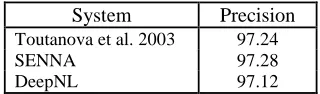
Table 2 presents the results achieved by the POS tagger trained on the Penn Treebank, com-pared with the results of the reference system by Tuotanova et al. (2003), which uses rich fea-tures, and with the original SENNA implementa-tion.
System Precision Toutanova et al. 2003 97.24
SENNA 97.28
DeepNL 97.12
Table 2. Performance on the POS task, using the Penn Treebank, sections 0-18 for training, sections 22-24
for testing.
Both these experiments confirm that word em-beddings can replace the use of complex manu-ally engineered features for typical natural lan-guage processing tasks.
7 Dependency Parsing
We have adapted to the use of embeddings our original transition based dependency parser DeSR (Attardi et al., 2009), that was already based on a neural network. The parser uses the neural network to decide which action to per-form at each step in the analysis of a sentence. Looking at a short context of past analyzed to-kens and next input toto-kens, it must decide whether the two current focus tokens can be connected by a dependency relation. In this case it performs a reduction, creating the dependency, otherwise it advances on the input. The original implementation used a large set of discrete fea-tures to represent the current context.
The deep learning version of the parser ex-ploits word embedding as features and also
cre-ates a dense vector representation for the remain-ing discrete features. A specific extractor ( At-tributeExtractor) was built for this purpose.
8 Conclusions
We have presented the architecture of DeepNL, a library for building NLP applications based on a deep learning architecture. The implementation is written in Python/Cython and uses C++ linear algebra libraries for efficiency and scalability, exploiting multithreading or GPUs where avail-able.
The implementation of DeepNL is available on GitHub15.
The availability of a library that allows creat-ing embeddcreat-ings and traincreat-ing a deep learncreat-ing ar-chitecture using them might contribute to the development of further tools for linguistic analy-sis.
For example we are planning to build a clas-sifier for performing identification of affirma-tive, negative or speculative contexts in sentenc-es.
We are also considering additional ways of creating embeddings, for example to generate context sensitive embeddings that could provide word representations that disambiguate among word senses.
Acknowledgements
Partial support for this work was provided by project RIS (POR RIS of the Regione Toscana, CUP n° 6408.30122011.026000160).
References
R. Al-Rfou, B. Perozzi, and S. Skiena. 2013. Poly-glot: Distributed Word Representations for Multi-lingual NLP. arXiv preprint arXiv:1307.1662. R. K. Ando, T. Zhang, and P. Bartlett. 2005. A
framework for learning predictive structures from multiple tasks and unlabeled data. Journal of Ma-chine Learning Research, 6:1817–1853.
G. Attardi, F. Dell'Orletta, M. Simi, J. Turian. 2009. Accurate Dependency Parsing with a Stacked Mul-tilayer Perceptron. In Proc. of Workshop Evalita 2009, ISBN 978-88-903581-1-1.
Danqi Chen and Christopher D. Manning. 2014. Fast and Accurate Dependency Parser using Neural Networks. In: Proc. of EMNLP 2014.
R. Collobert et al. 2011. Natural Language Processing (Almost) from Scratch. Journal of Machine Learn-ing Research, 12, 2461–2505.
15
[image:6.612.118.278.335.382.2]R. Collobert and J. Weston. 2008. A unified architec-ture for natural language processing: Deep neural networks with multitask learning. In ICML, 2008. R. Collobert. 2011. Deep Learning for Efficient
Dis-criminative Parsing. In AISTATS, 2011.
P. S. Dhillon, D. Foster, and L. Ungar. 2011. Mul-tiview learning of word embeddings via CCA. In Advances in Neural Information Processing Sys-tems (NIPS), volume 24.
John Duchi, Elad Hazan, and Yoram Singer. 2011. Adaptive subgradient methods for online learning and stochastic optimization. The Journal of Ma-chine Learning Research.
S. Hartmann, G. Szarvas, and I. Gurevych. 2011. Mining Multiword Terms from Wikipedia, in M.T. Pazienza & A. Stellato (Eds.): Semi-Automatic Ontology Development: Processes and Resources, pp. 226-258, Hershey, PA, USA: IGI Global. G.E. Hinton, J.L. McClelland, D.E. Rumelhart.
Dis-tributed representations. 1986. In: Parallel distrib-uted processing: Explorations in the microstructure of cognition. Volume 1: Foundations, MIT Press, 1986.
L.B. Krithika and Kalyana Vasanth Akondi. 2014. Survey on Various Natural Language Processing Toolkits. World Applied Sciences Journal 32 (3): 399-402.
Rémi Lebret and Ronan Collobert. 2013. Word Em-beddings through Hellinger PCA. Proc. of EACL 2013.
Omer Levy and Yoav Goldberg. 2014. Neural Word Embeddings as Implicit Matrix Factorization. In Advances in Neural Information Processing Sys-tems (NIPS), 2014.
Christopher D. Manning and Hinrich Schütze. 1999. Foundations of Statistical Natural Language Pro-cessing. The MIT Press. Cambridge, Massachu-setts.
Manning, Christopher D., Surdeanu, Mihai, Bauer, John, Finkel, Jenny, Bethard, Steven J., and McClosky, David. 2014. The Stanford CoreNLP Natural Language Processing Toolkit. In Proceed-ings of 52nd Annual Meeting of the Association for Computational Linguistics: System Demonstra-tions, pp. 55-60.
T. Mikolov, M. Karafiat, L. Burget, J. Cernocky, and Sanjeev Khudanpur. 2010. Recurrent neural net-work based language model.
Tomas Mikolov, Kai Chen, Greg Corrado, and Jef-frey Dean. 2013. Efficient Estimation of Word Representations in Vector Space. In Proceedings of Workshop at ICLR, 2013.
J. Nivre. 2007. Incremental non-projective dependen-cy parsing, Proceedings of Human LanguageTech-nologies: The Annual Conference of the North American Chapter of the Association for Computa-tional Linguistics (NAACL HLT), Rochester, NY, pp. 396–403.
Radim Řehůřek and Petr Sojka. 2010. Software Framework for Topic Modelling with Large Cor-pora. In Proceedings of the LREC 2010 Workshop on New Challenges for NLP Frameworks, ELRA, Valletta, Malta, pp. 45–50.