Prepositional Phrase Attachment Problem Revisited:
How
VERBNET
Can Help
Dan Bailey
University of Nebraska at Omaha
Yuliya Lierler
University of Nebraska at Omaha
Benjamin Susman
University of Nebraska at Omaha
Abstract
Resolving attachment ambiguities is a pervasive problem in syntactic analysis. We propose and investigate an approach to resolving prepositional phrase attachment that centers around the ways of incorporating semantic knowledge derived from the lexico-semantic ontologies such asVERBNET andWORDNET.
1 Introduction
Syntactic parsing is a process of uncovering the internal structure of sentences, in particular, articulating what the constituents of a given sentence are and what relationships are between them. Software systems that perform this task are called (syntactic) parsers. Parsing technology has seen striking advances. Wide-coverage off-the-shelf parsers are freely available and ready to use. Yet, modern parsers are not at the level of human-expert agreement. One of the notorious problems in parsing technology is determining prepositional phrase attachment. For example, the following phrase by Ray Mooney:
eat spaghetti with chopsticks. (1)
is syntactically ambiguous allowing for two syntactic structures: in one, the prepositional phrase with chopsticksmodifies (attaches to) the verbeat and in another, it modifies the nounspaghetti. The latter is erroneous as it suggests thatspaghetti with chopsticks constitutes a meal. The phrase
eat spaghetti with meatballs (2)
is syntactically ambiguous in a similar manner. Modern advanced parsers do not produce proper syntactic representations for these phrases: instead they favor the same structure for both statements (Lierler and Sch¨uller, 2013).
These “spaghetti” examples illustrate the necessity to incorporate semantic knowledge into the pars-ing process, in particular, one has to take into accountselectional restrictions(Katz and Fodor, 1963) — the semantic, common-sense restrictions that a word imposes on the environment in which it occurs. For instance, the fact that chopsticks are an instrument suggests thatwith chopsticksmodifieseat spaghetti
in phrase (1) as a tool for eating. Current statistical methods, dominant in the field of syntactic analysis, take into account selectional restrictions implicitly by assigning the most probable syntactic structure based on observed co-occurrences of words and structures in training corpora. As mentioned, this is often not sufficient. In this work we propose and investigate an approach to the prepositional phrase at-tachment problem that incorporates explicit semantic knowledge available in the lexico-semantic dataset VERBNET into the decision process for resolving the ambiguity of prepositional statements. Machine learning forms a backbone of the decision procedure that we investigate.
This work targets to bring knowledge representation techniques into syntactic parsing. Indeed, lexical ontologiesVERBNETandWORDNETare at heart of this project. Lierler and Sch¨uller (2013) advocated a framework for parsing that results in what they call semantically-coherent syntactic parses. These parses account for selectional restrictions. On the one hand, that work suggests a promising direction. On the other hand, it outlines the need for automatic methods for acquiring lexico-semantic information that relates to parsing a sentence. Present work takes a step in the direction of establishing principles to mine existing lexico-semantic resources and incorporate found information into parsing process.
The importance of taking semantic information, including selectional restrictions, into account dur-ing parsdur-ing has long been recognized. Ford (1982), Jensen and Binot (1987), Hirst (1988), Dahlgren (1988), and Allen (1995) devised methods for parsing that performed selectional restrictions analysis. These methods assume that a systematic word taxonomy as well as a database of selectional restric-tions is available. Developments in the field of Lexical semantics have made such systematic large scale datasets, including WORDNET (Miller et al., 1990) and VERBNET (Kipper et al., 2000), a reality. The WORDNETproject provides a taxonomy that organizes words into a coherent representation that reflects some lexical relationships between them. TheVERBNETproject provides a domain-independent, broad-coverage verb lexicon that includes selectional restriction information. Also recent research illustrates the benefits of lexico-semantic information in tasks closely related to parsing. Zhou et al. (2011) illustrate how web-derived selectional preferences improve dependency parsing. Zapirain et al. (2013) show that selectional preferences obtained by means ofWORDNET-based similarity metrics improve semantic role labeling. Srikumar and Roth (2013) illustrate how selectional restrictions posed by prepositions improve relation prediction performance. Agirre et al. (2008, 2011) also suggest the necessity of incorporating semantic information into parsing by providing evidence that word sense information stemming from WORDNETimproves parsing and prepositional phrase attachment.
These findings support the importance of developing parsing algorithms that can handle semantic information effectively. We view the decision procedure for resolving prepositional phrase attachment developed in this paper as complementary to above mentioned methods. The main driving vehicle of this work is theVERBNET ontology. To the best of our knowledge no current approach relies on the use of VERBNETin compiling selectional preferences information.
The prepositional phrase attachment problem has received a lot of attention as a stand alone task. Lapata and Keller (2005) provide a summary of systems attempting to solve this problem. All of the re-ported systems have centered on machine learning approaches such as a maximum entropy model (Ratna-parkhi et al., 1994), a back-off model (Collins and Brooks, 1995), a transformation based approach (Brill and Resnik, 1994), a memory-based learning approach (Zavrel et al., 1997), and unsupervised ap-proaches (Ratnaparkhi, 1998) or (Pantel and Lin, 2000). The reported accuracy of the systems ranged from 81.60% to 88.10%. The average human precision on the task is reported to be 88.20%.
The outline of the paper follows. We begin by introducing the relevant resources and concepts, in particular,VERBNETandWORDNETalong with the concept of selectional restriction. Following that, we introduce the problem of prepositional phrase attachment. Once these foundations have been laid, we provide the details of a machine-learning based algorithm that makes use of theVERBNETandWORDNET resources in a systematic way. We then evaluate a system that implements the outlined algorithm and discuss our plans for its future.
2 The
VERBNET,
WORDNETLexicons and Selectional Restrictions
these classes share.
The VERBNETdataset is composed of basic structures, called frame syntax. For example, a frame syntax for ahit-verb class follows:
A G E N TintControl V P A T I E N T {with} I N S T R U M E N Tconcrete (3)
This frame syntax suggests that one possible structure for the use of a verb in the hit-class is to have an AGENTfollowed by the verb itself, then aPATIENT, the prepositionwith and anINSTRUMENT. The AGENT,PATIENTandINSTRUMENTare calledthematic roles. VERBNETallows 23 such roles including THEME, RECIPIENT,SOURCE.1 The thematic roles inVERBNETare augmented further byrestrictions. VERBNETmaintains a hierarchy of restrictions based on the top-level entries in EuroWordNet (Kipper-Schuler, 2005, Section 3.1.2) consisting of 37 entries. This hierarchy allows VERBNET to specify that the AGENTthematic role for the verbs in class hit is of the type intelligent control(intControl) and theINSTRUMENTrole inhit isconcrete. In other words, an entity that serves anINSTRUMENTrole of
hit possesses a property of beingconcrete– some concrete physical object.
TheWORDNETsystem is a comprehensive manually developed lexical database from Princeton Uni-versity (Miller et al., 1990). InWORDNET, nouns, verbs, and adjectives are organized into synonym sets each representing one underlying lexical concept. Several semantic relations among words are incorpo-rated into WORDNETas links between the synonym sets. These semantic relations include super/sub-ordinate relations —hypernymy, hyponymy or ISA relation; and part-whole relation —meronymy. Thus we can investigate relationships between various concepts by following links within WORDNET. For instance, by following the ISA links, one may easily establish that synonym set containing a nounboy is in ISA relation with a synonym set for theintelligent controlconcept. TheWORDNETlexicon has been extensively used for developing metrics and procedures for determining the relatedness/similarity of lex-ical concepts. The task of identifying whether and how given words are related has many applications in natural language processing (NLP) (e.g., word sense disambiguation, information extraction). Budanit-sky and Hirst (2006) present a comprehensive study that compares five different measures of relatedness based onWORDNET including a measure by Leacock and Chodorow (1998). In this work we also use WORDNETfor similar purposes. For example, with the help ofWORDNETwe define what it means that a noun “matches” a restriction or a thematic role. Section 4 presents the definition of matching.
Selectional restrictions (Katz and Fodor, 1963) are the semantic, common-sense restrictions that a word imposes on the environment in which it occurs. Aselectional constructis a tuple[w, t, r, p]where (i)wis a word, (ii)tis a thematic role that the wordwallows, (iii)ris a restriction on the thematic rolet
with respect to the word w(by the empty set we denote no restrictions), (iv)pis a set of prepositions that can be used to realize the thematic role t of the word w (this set may be empty suggesting that no preposition is necessary to realize this thematic role). Selectional construct is meant to capture the selectional restrictions (sometimes we use these terms interchangeably). The VERBNETlexicon can be viewed as a systematic, wide-coverage knowledge base about selectional restrictions of verbs. Recall a frame syntax (3) for the verbhit. We now present three selectional constructs that follow from the frame:
(hit,AGENT,intControl,∅), (hit,PATIENT,∅,∅), (hit,INSTRUMENT,concrete,{with}).
3 Prepositional Phrase Attachment
should be parsed into dependency structure of the form:
verb noun1 with noun2 DOBJ
PREP-POBJ
(4) This parse structure reveals the prepositional phrase attachment describes the action being undertaken.
“Comitative” use ofwithsuch as in phrase (2) leads to a structure of the form
verb noun1 with noun2 DOBJ
PREP-POBJ
(5) We call (4) and (5)P-parse structures. We call a phrase,P-phrase, when it has the form
verb noun-phrase preposition noun-phrase.
In the introduction, we argued that selectional restrictions provide sufficient information to disam-biguate many PP attachments. We now incorporate selectional restrictions into syntactic parsing of
P-phrases. We say that a selectional constructjustifiesan edge annotated by PREP-POBJ fromwton
if it has the form (w,t,r,p),where thematic role t and restrictionr ont are “matched” by word n. Section 4 presents the definition of matching for different thematic roles and restrictions. A P-parse structure issemantically coherent if its edge annotated by PREP-POBJ is justified by some selectional construct triggered by the words occurring in aP-parse structure.
For example,P-phrase (1) triggers the selectional construct
(eat,INSTRUMENT,concrete,{with}). (6) Intuitively, this construct justifies the PREP-POBJ edge betweenspaghetti andchopsticks. P-parse of the form (4) is thus semantically coherent.
We can view selectional restrictions as conditions that must be satisfied in the process of parsing. In other words, semantically coherent parse structures are the ones that satisfy these conditions. It is clear that at times more than one parse structure is semantically coherent for a phrase. Similarly, more than one selectional construct may justify a PREP-POBJ edge.
4 PP-attachment Selection Algorithm
The dataset by Ratnaparkhi et al. (1994) is often used to devise and evaluate PP-attachment resolution systems. We use it in this work also. For the rest of the paper we refer to the Ratnaparkhi et al. dataset asR. TheRdataset is a collection ofP-phrases stemming from Penn Treebank. Each data entry inR
is a tuple of the form
(verb, noun1, prep, noun2). (7) Intuitively, each tuple corresponds to aP-phrase. Figure 1 presents the basic statistics on ten most occur-ring prepositions in the dataset. The second row titledTotalgives the number of tuples contained inR
that mention the respective preposition. The third row presents the ratio of the number of occurrences of a preposition (the second row) over the size of the Rdataset. OverallRcontains23898P-phrases. The last row represents the frequencies of the verb attachment for the respective prepositions. We note how by far the most frequent prepositionof is also very bias in a sense that99%of the time it triggers the attachment to a noun. This is why we present the column namedAll-of that gives the statistics for all tuples that do not contain the prepositionof.
Preposition All All - of of in to for on from with at as by Total 23898 17395 6503 3973 3005 2522 1421 1059 1049 780 564 526
% ofR 100 72.8 27.2 16.6 12.6 10.6 5.9 4.4 4.4 3.3 2.4 2.2
% Verb Attachment 46.9 64.2 0.9 54.6 80.1 51.2 53.8 68.6 64.4 80.4 81.2 72.2
Figure 1: Basic statistics on the Ratnaparkhi et al. (1994) dataset.
input objects and a desired output. An input object is often summarized by so called feature vector. A classifier of choice analyzes the training data and produces a model that can be used to evaluate unlabeled input objects. In this work we rely on Logistic Regression classification algorithm as the vehicle for implementing the decision procedure for the PP-attachment selection problem. To imple-ment this procedure we used the Logistic Regression classifier with a ridge estimator of 10−7 avail-able in Weka2 (Hall et al., 2009) – software by University of Waikato which contains tools for data preprocessing, classification, and clustering. We call our system PPATTACH, which is available at
http://www.unomaha.edu/nlpkr/software/ppattach/.
In our settings we used theRdataset to produce training data. EachP-phrase (7) inRis mapped to a feature vector composed of five elements:
• the prepositionprepof the tuple (7);
• the VERBNET verb class of the verb in (7). If the verb class is unavailable in VERBNET then lemmatizedverbserves the role of a feature itself. We call this featureVerbclass;
• Features namedVERBNET[noun1,noun2],VERBNET[noun2], andNominalization, which encode information that some selectional constructs stemming from VERBNET are “applicable” to the tuple (7).
We now speak about the rationale behind choosing these features. Figure 1 clearly indicates that prepo-sitions are bias to one or another attachment decision. Lapata and Keller (2005) present a generic base-line for the prepositional phrase attachment decision by choosing noun attachment in all cases, which achieves correct attachment 56.9% of the time. They further present that this baseline can be improved simply by choosing the most likely attachment decision for each preposition reaching 72.2% accuracy. These observations provide strong evidence for the necessity of the first feature. As discussed verbs impose selectional restrictions. The second feature in combination with the first one allows us to use the R dataset to collect the statistical information about verb classes and their usage. The last three features are based on the information stemming from VERBNET. These features allow us to incorpo-rate explicit information on selectional restrictions available in VERBNET into the decision procedure for the PP-attachment selection problem. We now proceed towards the description of how these three VERBNET-based features are computed.
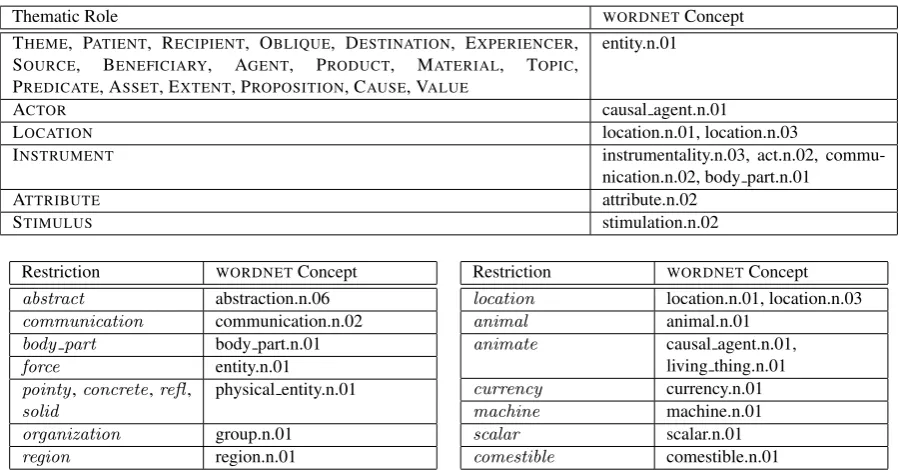
To describe the computation of theVERBNET-based features precisely, we define a concept of match-ing. We say that a nounmatchesa thematic role (a restriction) listed in Figure 2 if one of itsWORDNET senses has a path in WORDNET justified by the ISA links to a corresponding lexical concept depicted in Figure 2. We also say that a noun matchesthe thematic role INSTRUMENTif the definition (gloss) of one of the noun’s WORDNET senses contains a string “used”. Likewise, we establish amatch with the restrictionpointy by finding the string, “sharp” within the definition for one of the noun’s senses. Accounting for parts of word’s definition stems from the work by Jensen and Binot (1987). Figure 2 contains all 23 thematic roles of theVERBNETdataset.
Descriptions of the computation procedures ofVERBNET-based features follow. Each procedure is given a tuple of the form (7) as its input. These features are binary, their default values are0.
Feature VERBNET[noun1,noun2]: We start by searching for all verb-classes that include verb from tuple (7). Frame syntax structures of the form
Thematic Role WORDNETConcept THEME, PATIENT, RECIPIENT, OBLIQUE, DESTINATION, EXPERIENCER,
SOURCE, BENEFICIARY, AGENT, PRODUCT, MATERIAL, TOPIC, PREDICATE, ASSET, EXTENT, PROPOSITION, CAUSE, VALUE
entity.n.01
ACTOR causal agent.n.01
LOCATION location.n.01, location.n.03
INSTRUMENT instrumentality.n.03, act.n.02,
commu-nication.n.02, body part.n.01
ATTRIBUTE attribute.n.02
STIMULUS stimulation.n.02
Restriction WORDNETConcept
abstract abstraction.n.06
communication communication.n.02
body part body part.n.01
force entity.n.01
pointy,concrete,refl,
solid physical entity.n.01
organization group.n.01
region region.n.01
Restriction WORDNETConcept
location location.n.01, location.n.03
animal animal.n.01
animate causal agent.n.01,
living thing.n.01
currency currency.n.01
machine machine.n.01
scalar scalar.n.01
[image:6.595.73.523.68.303.2]comestible comestible.n.01
Figure 2:WORDNETISA-Parent
are extracted from these classes. Frame syntax (8) translates into selectional constructs that include
(verb,TH E MRO L E1,restriction1,∅) (9)
(verb,TH E MRO L E2,restriction2,{prep}) (10)
For each frame syntax, we (i) verify whether noun1 matches the thematic role THEMROLE1 as well as the restriction restriction1, which suggests that selectional construct (9) justifies an edge between
verb andnoun1, and (ii) verify whethernoun2 matches THEMROLE2 as well asrestriction2, which suggests that selectional construct (10) justifies a PREP-POBJ edge betweenverbandnoun2. If this test is positive for at least one frame syntax we assign valueVERBto the featureVERBNET[noun1,noun2].
FeatureVERBNET[noun2]: This procedure is similar to the previous method. Frame syntax structures of the form
TH E MRO L E v {prep} TH E MRO L E2restriction2 (11) are extracted from the verb-classes inVERBNETthat includeverbfrom tuple (7). The frame syntax (11) translates into selectional constructs that include restriction (10). We then verify whethernoun2matches THEMROLE2 as well asrestriction2, which suggests that selectional construct (10) justifies an edge betweenverbandnoun2. Subsequently we assign valueVERBto the featureVERBNET[noun2].
FeatureNominalization:Nominalizationis the use of a verb, an adjective, or an adverb as a noun, with or without morphological transformation. In this work, we are especially interested in nouns derived from verbs. Such nouns typically behave as nouns grammatically, yet semantically they carry information of a respective verb. For example, a noun “conversation” is derived from a verb “to converse”, which infor-mally suggests at least two participants in the event of conversation. Given tuple (7), theNominalization
method starts by identifying whether noun1 is derived from a verb. The WORDNET lexicon contains edges between nouns and verbs that are called derivationally related forms. We searchWORDNET for connections via these edges betweennoun1and some verb. We require that the root word remains the same betweennoun1and a found verb. If such verb exists we considernoun1to be a nominalization. If
5 Evaluation
We use various metrics to gauge the overall performance of the PPATTACH system. First we consider a baseline which consists of the most likely attachment on a per preposition basis. We also construct a PPATTACH- system by dropping theVerbclassfeature from PPATTACH. We construct aGENERICsystem by dropping theVERBNET-based features from the PPATTACHsystem.
We train and test each system on the wholeRdataset and subsets ofRon a preposition-by-preposition basis. Given that each resultant dataset is of limited size (see the second row in Figure 1), we use 10-fold cross-validation to evaluate the methods. The cross-validation was done in Weka. The main idea is to randomly select instances that constitute the test set. Subsequently we train a classifier on the remaining instances and evaluate the model on the selected test set. This is conducted ten times (with different test-training set pairs). Figure 3 summarizes the classification accuracy (the number of correct classifications over the number of classifications) of the system using Logistic Regression classifier.
Preposition All All - of of in to for on from with at as by Baseline 74.6 65.4 99.1 54.6 80.1 51.2 53.8 68.6 64.4 80.4 81.2 72.2 PPATTACH- 79.3 72.7 99.0 64.6 87.8 66.6 68.5 75.5 70.9 81.8 79.8 80.0 GENERIC 79.0 72.3 99.0 64.7 87.8 67.0 68.2 76.3 69.7 82.9 79.8 82.3 PPATTACH 79.3 72.5 99.0 64.7 88.0 66.9 69.6 75.4 70.7 81.9 78.5 81.7
Figure 3: Evaluation Data on PPATTACHusing Logistic Regression.
We see substantial improvements from Baseline across most prepositions. Figure 4 presents data that can be used to explain this. For each VERBNET-based feature, this figure presents two rows. The row named Recall gives a percentage that describes the frequency at which the feature is assigned a value different from default; the row namedPrecisiongives a percentage of relevant instances such that the feature assignment agrees with the correct attachment decision. For six out of ten prepositions the precision for theVERBNET[noun1,noun2]feature is at least 83.6%. For five out of these prepositions the recall ranges from 10.3% to 37.6%. There are two prepositionsat andas that have high precision, yet the performance of PPATTACHis comparable to that of Baseline. We also find that in this case the verb class does not play a role in improving the classification accuracy (Baseline andGENERICbehave practically identical). Figure 1 illustrates that the prepositions at and as have strong attachment bias for verb. Most of the features in PPATTACHalso favor such attachment. Gaining evidence for the other decision shall improve the situation.
VERBNET-based features of in to for on from with at as by
VERBNET[noun1,noun2] Recall 4.1 12.9 37.6 25.5 9.4 25.3 15.7 10.3 22.3 0.8 Precision 6.0 66.0 91.5 59.6 71.6 83.6 92.7 93.8 98.4 100.0 VERBNET[noun2] Recall 1.2 7.5 27.5 3.8 10.6 7.0 9.2 1.7 0.0 5.5
Precision 0.0 59.8 89.7 60.4 85.3 82.4 88.5 100 N/A 96.6
Nominalization Recall 1.5 12.8 9.8 3.9 3.7 2.8 10.3 0.3 0.0 1.0 Precision 100.0 70.2 27.8 66.3 64.2 56.7 66.7 50.0 N/A 60.0
Figure 4: Features Evaluation for PPATTACH.
We now note on the difference that changing the classification algorithm can make to PPATTACH performance. Figure 5 summarizes the classification accuracy of PPATTACH using the Na¨ıve Bayes classifier of Weka. In this case, PPATTACH- markedly lags behindGENERICand PPATTACH, indicating the importance of the classification algorithm selection.
They were annotated in Penn Treebank as having verb attachment suggesting errors in this corpus3.
[image:8.595.94.499.96.147.2]Preposition All All - of of in to for on from with at as by PPATTACH- 74.5 67.7 99.1 59.8 80.1 54.5 57.0 69.2 67.9 80.3 81.2 71.9 GENERIC 79.0 71.3 99.1 64.5 86.2 66.5 68.3 76.1 69.9 80.4 81.0 80.0 PPATTACH 78.9 71.2 99.1 65.3 87.9 66.5 68.5 76.5 72.8 80.5 81.0 80.0
Figure 5: Evaluation Data on PPATTACHusing Na¨ıve Bayes.
6 Beyond
VERBNET: Preposition
with
Case-Study
This section focuses on a specific preposition, with. We investigate whether and how with-specific features improve classification accuracy. We start by noting that VERBNET often omits information. Consider sentence (1). There is nothing in VERBNET that suggests the selectional construct (6). This construct is intuitively triggered by the preposition with itself. Indeed, there are three main uses of
with: instrumental,adverbial, andcomitative. The instrumental use ofwithindicates that the preposi-tional phrase conveys details in which the object serves the role of an instrument while executing the action suggested by the verb. Phrase (1) illustrates the instrumental use ofwith. In contrast, the phrase
eat spaghetti with enthusiasmillustrates an adverbial use ofwith. Here, the prepositional phrase answers the question ofhowthe action was undertaken. To accommodate for common instrumental and adverbial uses ofwithwe propose the following generic selectional constructs
(v,INSTRUMENT,concrete,{with}) (12)
(v,MANNER,∅,{with}), (13)
wherev is a variable that can be substituted byanyverb includingeat orhit.
The grammatical casecomitativedenotes accompaniment. In English this case is often realized by
withand captures the sense oftogether withorin company with. Expressionsspaghetti with meatballs
and boat with an engine illustrate the comitative case. In the former example, words spaghetti and
meatballs are closelyrelatedto each other as they both denote food entities. In the later example,boat
andengine are in lexical relation meronymy. We propose two selectional constructs that account for such examples
(w,COMPANION,related(w),{with}) (14)
(w,COMPANION,meronym(w),{with}) (15) wherew is a variable that can be substituted byanyword, e.g.,spaghetti orboat;related(w)stands for any wordw0such thatwandw0are related (according to a certain metric);meronym(w)stands for any
wordw0 such thatw0is a meronym ofw.
In describing selectional constructs (14) and (15) we identified the need not only for a metric to estab-lish relatedness between words, but also for a wide-coverage meronym relation database. TheWORDNET lexicon records meronymy relations between synonym sets. However, it is not flawless and questions arise when attempting automatic methods for identifying meronymy. For example, inWORDNETarmis listed as a direct meronym ofhuman, butleg is not. Thus to identify thatleg is a meronym ofhuman, deeper mining ofWORDNETbecomes a necessity. Later in this section we describe an algorithm that we devised for this purpose. To establish relatedness between words we rely onWORDNET and the metric developed by Leacock and Chodorow (1998).
Below we present features that capture the aforementioned reasoning as well as several other obser-vations. We use these features to augment the PPATTACHsystem to construct the system PPATTACH+.
FeatureInstrumentality: This method accounts for “instrument” selectional construct (12). We verify whethernoun2matches the thematic roleINSTRUMENT, which suggests that selectional construct (12) justifies an edge betweenverbandnoun2. We assignVERBto the feature.
Feature Adverbial Use: We proposed to characterize an adverbial use of with by selectional con-struct (13). We say that a nounmatchesthe thematic roleMANNERif there exists an adverbial derivation from a noun to some verb inWORDNET. The “derivationally related forms” edges ofWORDNETare used to establish an adverbial derivation. Ifnoun2 in the given tuple (7) matches the thematic roleMANNER then selectional construct (13) justifies an edge betweenverbandnoun2. We assignVERBto the feature.
FeatureSimilarity: This procedure accounts for “related” selectional construct (14). We verify whether
noun1andnoun2of the given tuple (7) are related using the Leacock-Chodorow algorithm (1998).If the value produced by the Leacock-Chodorow procedure exceeds2, we assume that the nouns are related. This translates into the fact that selectional construct (12) justifies an edge betweennoun1 andnoun2. We assign a valueNOUNto the feature.
FeatureMeronymy: This procedure accounts for “meronymy” selectional construct (15). For a given tuple (7), we verify whether noun2 is a meronym ofnoun1 using aWORDNET-based method that we propose. First, we take thenoun1and construct a set containing its full hypernymy and hyponymy tree for all of its WORDNETsynsets. Second, we construct a set consisting of the full hyponymy fornoun2 for all of its WORDNET synsets. If an element from the set for noun2 is a meronym, as defined by WORDNET, of an element in the set fornoun1, then we conclude thatnoun2is a meronym ofnoun1. If the meronymy selectional construct justifies an edge betweennoun1andnoun2, the feature is assigned NOUN.
FeatureRelational Noun: Phrases such asdeveloped a relationship with people contain a relational nounrelationship. Relational nouns suggest that there is a possessive relation between “individuals” participating in an utterance. To accommodate for relational nouns we propose the following generic selectional construct(n,POSSESSOR,∅,{with}),wherenis a relational noun. Given tuple (7), the
Re-lational Nounmethod identifies whethernoun1is a relational noun by observing if one of itsWORDNET senses has a path justified by the ISA links inWORDNETto a lexical conceptrelation. Currently, we as-sume that any noun matches the thematic rolePOSSESSOR. We assign the featureNOUNif we establish thatnoun1is relational.
Feature Idiom: Some verb/noun combinations represent an idiomatic use, such as “make hay”. The WORDNETlexicon contains entries representing idioms. We verify whetherverbandnoun1of the given tuple (7) form an idiom by means ofWORDNET. If this is the case, we assignVERBto the feature.
We analyzed performance of each described feature. Figure 6 presents the data in a similar fashion as Figure 4. On the left, we list higher precision features. We note the high recall ofInstrumentalityand rather reliable precision. This is a positive indication that we may address the limitations encountered forVERBNETand to generally improve classification. On the right, we list the lower precision features. The “right” results suggest that the ways to refine algorithms for implementing low-precision features should be sought out. Also, it is possible that the semantic information carried by the verb outweighs the information available from Similarity and Meronymy. In the future we plan to investigate these possibilities. The classification accuracy of the PPATTACH+ system is 71.2% for with. Due to the
Instrumentality Recall 48.0 Precision 70.6
Relational Noun Recall 5.8 Precision 75.4
Adverbial Use Recall 2.3 Precision 75.0
Similarity Recall 15.7 Precision 38.8
Meronymy Recall 3.1 Precision 48.5
Idiom Recall 1.6 Precision 35.3
poor precision we witnessed for the “right” features, we retested the PPATTACH+ after removing these features. We subsequently achieve a classification accuracy of 72.0%, outperforming the PPATTACH accuracy of 70.7%. Overall, the results appear to be promising, suggesting that preposition-specific selectional constructs will lead to better classification as a whole.
7 Discussion and Future Work
In this work we proposed a principled method for incorporating wide-coverage lexical resources VERB-NETandWORDNETinto decision making for the task of resolving prepositional phrase attachment. Our preliminary system PPATTACHillustrates the feasibility and promise of the approach.
The proposed method relies on a number of features that are suggestive of why a particular attach-ment is reasonable. For instance, consider the featureInstrumentality. In cases when the value of this feature isVERB, we are urged to believe that the second noun of a givenP-phrase tuple can be labeled as an instrument of the action indicated by the verb of the tuple (following from the fact that the “instru-ment” selectional construct is applicable to thisP-phrase tuple). A long-term goal of this project is to incorporate elements of the proposed decision procedure into modern parsing technology and, in partic-ular, into semantic role labeling methods. Work by Zhou et al. (2011), Srikumar and Roth (2013), Agirre et al. (2008, 2011), and Belinkov et al. (2014) encourages research in this direction.
As we continue development of this project, we hope to improve the presented method in several ways. We will use WORDNET to a greater extent to determine selectional restrictions on nouns. For example, the current method does not draw any distinction between AGENTand ASSET. We also intend to incorporate a semantic ontology calledNOMLEX(Macleod et al., 1998) that incorporated noun-based selectional restrictions. Figure 1 illustrates that all but one prepositionof prefer verb attachment. Most of the features we investigated also favor such attachment. Gaining evidence for the other decision will be helpful. We illustrated how we improve on preposition with by augmenting available lexico-semantic ontologies with knowledge specific to this preposition. We will pursue similar effort for other prepositions in the future. We also intend to go beyond the development and evaluation geared by theR
dataset. Our discussion in the Evaluation section suggests such necessity.
Acknowledgments
Thanks to A. Artsymenia, J. Beavers, C. Bonial, M. Chernyshevich, S. Erdogan, A. Harrison, V. Lif-schitz, J. Michael, M. Palmer, D. Postanogov, P. Sch¨uller, Q. Zhu, and the anonymous reviewers for useful discussions and comments. Daniel Bailey was supported by a FIRE-2013: Fund for Investing in the Research Enterprise Grant of the University of Nebraska. Ben Susman was partially supported by FIRE-2013.
References
Agirre, E., T. Baldwin, and D. Mart´ınez (2008). Improving parsing and pp attachment performance with sense information. In46th Annual Meeting of the Association for Computational Linguistics (ACL), pp. 317–325.
Agirre, E., K. Bengoetxea, K. Gojenola, and J. Nivre (2011). Improving dependency parsing with se-mantic classes. In49th Annual Meeting of the Association for Computational Linguistics (ACL, Short Papers), pp. 699–703.
Allen, J. (1995). Natural Language Understanding (2Nd Ed.). Redwood City, CA, USA: Benjamin-Cummings Publishing Co., Inc.
Brill, E. and P. Resnik (1994). A rule-based approach to prepositional phrase attachment disambiguation. In15th conference on Computational linguistics-Volume 2, pp. 1198–1204.
Budanitsky, A. and G. Hirst (2006, March). Evaluating wordnet-based measures of lexical semantic relatedness.Computional Linguistics 32(1), 13–47.
Collins, M. and J. Brooks (1995). Prepositional phrase attachment through a backed-off model. In
Proceedings of the Third Workshop on Very Large Corpora, pp. 27–38.
Dahlgren, K. (1988). Naive Semantics for Natural Language Understanding. Norwell, MA, USA: Kluwer Academic Publishers.
Ford, Bresnan, K. (1982). A competence-based theory of syntatic closure. In Bresnan (Ed.),The Mental Representation of Grammatical Relations, pp. 727–796. The MIT Press.
Hall, M., E. Frank, G. Holmes, B. Pfahringer, P. Reutemann, and I. H. Witten (2009, November). The weka data mining software: An update. SIGKDD Explor. Newsl. 11(1), 10–18.
Hirst, G. (1988, March). Semantic interpretation and ambiguity. Artificial intelligence 34(2), 131–177. Jensen, K. and J.-L. Binot (1987). Disambiguating prepositional phrase attachments by using on-line
dictionary definitions.Computational Linguistics 13(3-4), 251–260.
Katz, J. J. and J. A. Fodor (1963). The structure of a semantic theory. Language 39(2), pp. 170–210. Kipper, K., H. T. Dang, and M. Palmer (2000). Class-based construction of a verb lexicon. In 7th
National Conference on Artificial Intelligence and Twelfth Conference on Innovative Applications of Artificial Intelligence, pp. 691–696. AAAI Press / The MIT Press.
Kipper-Schuler, K. (2005). VerbNet: A Broad-Coverage, Comprehensive Verb Lexicon. Ph. D. thesis, University of Pennsylvania.
Lapata, M. and F. Keller (2005). Web-based models for natural language processing.ACM Transactions on Speech and Language Processing (TSLP) 2(1), 3.
Leacock, C. and M. Chodorow (1998). Combining local context and wordnet similarity for word sense identification. In C. Fellbaum (Ed.), WordNet: An Electronic Lexical Database, Cambridge, MA, USA, pp. 265–283. The MIT Press.
Levin, B. (1993). English verb classes and alternations : a preliminary investigation. University Of Chicago Press.
Lierler, Y. and P. Sch¨uller (2013). Towards a tight integration of syntactic parsing with semantic disam-biguation by means of declarative programming. In10th International Conference on Computational Semantics (IWCS).
Macleod, C., R. Grishman, A. Meyers, L. Barrett, and R. Reeves (1998). Nomlex: A lexicon of nomi-nalizations. Proceedings og EURALEX 98, 187–193.
Miller, G. A., R. Beckwith, C. Fellbaum, D. Gross, and K. Miller (1990). Wordnet: An on-line lexical database. International Journal of Lexicography 3, 235–244.
Pantel, P. and D. Lin (2000). An unsupervised approach to prepositional phrase attachment using con-textually similar words. In38th Annual Meeting on Association for Computational Linguistics (ACL), Stroudsburg, PA, USA, pp. 101–108.
Ratnaparkhi, A. (1998). Statistical models for unsupervised prepositional phrase attachment. In 36th Annual Meeting of the Association for Computational Linguistics and 17th International Conference on Computational Linguistics - Volume 2 (ACL), Stroudsburg, PA, USA, pp. 1079–1085.
Ratnaparkhi, A., J. Reynar, and S. Roukos (1994). A maximum entropy model for prepositional phrase attachment. InWorkshop on Human Language Technology, pp. 250–255.
Srikumar, V. and D. Roth (2013). Modeling semantic relations expressed by prepositions. TACL 1, 231–242.
Stetina, J. and M. Nagao (1997). Corpus based pp attachment ambiguity resolution with a semantic dictionary. In5th Workshop pn Very Large Corpora, pp. 66–80.
Zapirain, B., E. Agirre, L. M`arquez, and M. Surdeanu (2013). Selectional preferences for semantic role classification.Computational Linguistics 39(3), 631–663.
Zavrel, J., W. Daelemans, J. Veenstra, et al. (1997). Resolving PP attachment ambiguities with memory-based learning. InWorkshop on Computational Language Learning (CoNLL’97), ACL, Madrid. Zhou, G., J. Zhao, K. Liu, and L. Cai (2011). Exploiting web-derived selectional preference to