Beyond LDA: Exploring Supervised Topic Modeling for
Depression-Related Language in Twitter
Philip Resnik2,4, William Armstrong1,4, Leonardo Claudino1,4,
Thang Nguyen3, Viet-An Nguyen1,4, and Jordan Boyd-Graber3,5
1Computer Science,2Linguistics,3iSchool, and4UMIACS, University of Maryland 5Computer Science, University of Colorado Boulder
{resnik,armstrow}@umd.edu
{claudino,daithang,vietan}@cs.umd.edu
{daithang,jbg}@umiacs.umd.edu
Abstract
Topic models can yield insight into how de-pressed and non-dede-pressed individuals use language differently. In this paper, we explore the use of supervised topic models in the anal-ysis of linguistic signal for detecting depres-sion, providing promising results using several models.
1 Introduction
Depression is one of the most prevalent forms of mental illness: in the U.S. alone, 25 million adults per year suffer a major depressive episode (NAMI, 2013), and Katzman et al. (2014) observe that “[by] 2020, depression is projected to be among the most important contributors to the global burden of dis-ease”. Unfortunately, there are significant barriers to obtaining help for depression and mental disor-ders in general, including potential stigma associ-ated with actively seeking treatment (Rodrigues et al., 2014) and lack of access to qualified diagnosti-cians (Sibelius, 2013; APA, 2013). When patients suffering from depression see a primary care physi-cian, the rates of misdiagnosis are staggering (Ver-mani et al., 2011).
These considerations have helped to motivate a recent surge of interest in finding accessible, cost effective, non-intrusive methods to detect depres-sion and other mental disorders. Continuing a line of thought pioneered by Pennebaker and colleagues (Pennebaker and King, 1999; Rude et al., 2004, and others), researchers have been developing methods for identifying relevant signal in people’s language
use, which could potentially provide inexpensive early detection of individuals who might require a specialist’s evaluation, on the basis of their naturally occurring linguistic behavior, e.g. (Neuman et al., 2012; De Choudhury et al., 2013; Coppersmith et al., 2014). Critical mass for a community of interest on these topics has been building within the compu-tational linguistics research community (Resnik et al., 2014).
To date, however, the language analysis methods used in this domain have tended to be fairly simple, typically including words orn-grams, manually de-fined word categories (e.g., Pennebaker’s LIWC lex-icon, Pennebaker and King (1999)), and “vanilla” topic models (Blei et al., 2003, latent Dirichlet al-location (LDA)). This stands in contrast to other domains of computational social science in which more sophisticated models have been developed for some time, including opinion analysis (Titov and McDonald, 2008), analysis of the scientific literature (Blei and Lafferty, 2007), and computational politi-cal science (Grimmer, 2010).
In this paper, we take steps toward employing more sophisticated models in the analysis of lin-guistic signal for detecting depression, providing promising results using supervised LDA (Blei and McAuliffe, 2007) and supervised anchor topic mod-els (Nguyen et al., 2015), and beginning some initial exploration of a new supervised nested LDA model
(SNLDA).
2 Data
Our primary experimental dataset is the Twitter collection created by Coppersmith et al. (2014)
and used in the CLPsych Hackathon (Coppersmith, 2015). The raw set contains roughly 3 million tweets from about 2,000 twitter users, of which roughly 600 self-identify as having been clinically diag-nosed with depression (by virtue of having publicly tweeted “I was diagnosed with depression today” or similar, with manual validation by the individuals preparing the data). We grouped all tweets by an in-dividual user into a single document, and a base vo-cabulary was created by pre-processing documents using standard NLP tools, specifically: (1) keeping alphanumeric words and word-encoded emoticons, (2) removing stopwords using the MALLET stop-word list, and (3) lemmatizing using NLTK’s Word-NetLemmatizer. We then filtered out words that peared in fewer than 20 documents, words only ap-pearing in documents of fewer than 50 words (fewer than 10 users), and URLs. The resulting set of 1,809 documents was randomly divided into train/dev/test subsets to create a 60-20-20% split. We model doc-uments from the Twitter datasets depression subset as having a regression value of 1 and those from the control subset as having a regression value of -1.
In building some of our models, we also use a lection of 6,459 stream-of-consciousness essays col-lected between 1997 and 2008 by Pennebaker and King (1999), who asked students to think about their thoughts, sensations, and feelings in the moment and “write your thoughts as they come to you”. As dis-cussed in Section 3.1, running LDA on this dataset provides informative priors for SLDA’s learning
process on the Twitter training data. The student essays average approximately 780 words each, and Resnik et al. (2013) showed that unsupervised topic models based on this dataset can produce very clean, interpretable topical categories, a number of which were viewed by a clinician as relevant in the assess-ment of depression, including, for example, “vege-tative” symptoms (particularly related to sleep and energy level), somatic symptoms (physical discom-fort, e.g. headache, itching, digestive problems), and situational factors such as homesickness.
For uniformity, we preprocessed the stream-of-consciousness dataset with the same tools as the Twitter set.1 We created a shared vocabulary for our models by taking the union of the vocabularies from
1With the exception of the document count filters, due to the different number and sizse of documents; instead, we allowed
the two datasets, leading to a roughly 6% increase in vocabulary size over the Twitter dataset alone.
3 Models
3.1 LDA
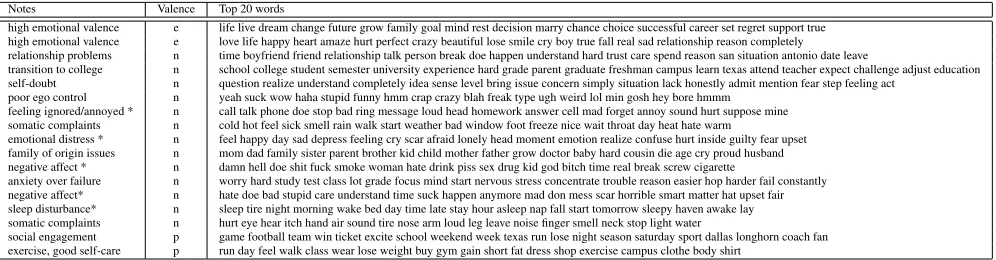
LDA (Blei et al., 2003) uncovers underlying struc-ture in collections of documents by treating each document as if it was generated as a “mixture” of different topics. As a useful illustration, repli-cating Resnik et al. (2013), we find that using LDA with 50 topics on the Pennebaker stream-of-consciousness essays produces many topics that are coherent and meaningful. We had a licensed clinical psychologist review these to identify the topics most likely to be relevant in assessing depression, shown in Table 1.2 This step exploiting domain expertise can be viewed as a poor-man’s version of interactive topic modeling (Hu et al., 2014), which we intend to explore in future work.
3.2 Supervised LDA
Basic (sometimes referred to as “vanilla”) LDA is just the entry point when it comes to characterizing latent topical structure in collections of documents, and extensions to LDA have proven valuable in other areas of computational social science. Super-visedtopic models (SLDA, introduced by Blei and
McAuliffe (2007)), extend LDA in settings where the documents are accompanied by labels or values of interest, e.g. opinion analysis (reviews accompa-nied byk-star ratings) or political analysis (politi-cal speeches accompanied by the author’s politi(politi-cal party). The advantage of supervised topic modeling is that the language in the documents and the accom-panying values are modeled jointly — this means that the unsupervised topic discovery process seeks to optimize not just the coherence of the topics un-derlying the discourse, but the model’s ability to pre-dict the associated values. So, for example, in mod-eling Amazon reviews, vanilla LDA might discover a topic containing opinion words (great,enjoy, dis-like, etc.) but SLDA would be more likely to
sep-arate these out into a positive opinion-word topic
Notes Valence Top 20 words
high emotional valence e life live dream change future grow family goal mind rest decision marry chance choice successful career set regret support true high emotional valence e love life happy heart amaze hurt perfect crazy beautiful lose smile cry boy true fall real sad relationship reason completely relationship problems n time boyfriend friend relationship talk person break doe happen understand hard trust care spend reason san situation antonio date leave
transition to college n school college student semester university experience hard grade parent graduate freshman campus learn texas attend teacher expect challenge adjust education self-doubt n question realize understand completely idea sense level bring issue concern simply situation lack honestly admit mention fear step feeling act
poor ego control n yeah suck wow haha stupid funny hmm crap crazy blah freak type ugh weird lol min gosh hey bore hmmm feeling ignored/annoyed * n call talk phone doe stop bad ring message loud head homework answer cell mad forget annoy sound hurt suppose mine somatic complaints n cold hot feel sick smell rain walk start weather bad window foot freeze nice wait throat day heat hate warm
emotional distress * n feel happy day sad depress feeling cry scar afraid lonely head moment emotion realize confuse hurt inside guilty fear upset family of origin issues n mom dad family sister parent brother kid child mother father grow doctor baby hard cousin die age cry proud husband negative affect * n damn hell doe shit fuck smoke woman hate drink piss sex drug kid god bitch time real break screw cigarette
anxiety over failure n worry hard study test class lot grade focus mind start nervous stress concentrate trouble reason easier hop harder fail constantly negative affect* n hate doe bad stupid care understand time suck happen anymore mad don mess scar horrible smart matter hat upset fair sleep disturbance* n sleep tire night morning wake bed day time late stay hour asleep nap fall start tomorrow sleepy haven awake lay somatic complaints n hurt eye hear itch hand air sound tire nose arm loud leg leave noise finger smell neck stop light water
[image:3.612.74.572.55.185.2]social engagement p game football team win ticket excite school weekend week texas run lose night season saturday sport dallas longhorn coach fan exercise, good self-care p run day feel walk class wear lose weight buy gym gain short fat dress shop exercise campus clothe body shirt
Table 1: LDA topics from Pennebaker stream-of-consciousness essays identified by a clinician as most relevant for assessing depression. Topics with negative valence (n) were judged likely to be indicators for depression, those with positive valence (p) were judged likely to indicate absence of depression, and those labeled (e) have strong emotional valence without clearly indicating likely assessment. Asterisked topics were viewed as the strongest indicators.
(great,enjoy, etc.) predicting higher star ratings and a negative opinion-word topic (dislike, sucks, etc.) predicting lower ratings.
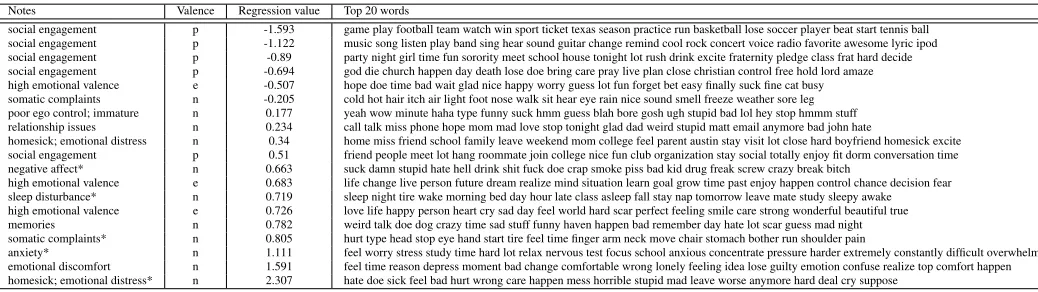
Table 2 illustrates topics we obtained by run-ning 50-topic SLDA on the Pennebaker
stream-of-consciousness dataset, using, as each essay’s regres-sion variable, the student’s degree of neuroticism — a personality trait that can be a risk factor for in-ternalizing disorders such as depression and anxi-ety — as assessed using the Big-5 personality in-ventory (John and Srivastava, 1999). The neuroti-cism scores are Z-score normalized, so the more positive (negative) a topic’s regression value, the more (less) the supervised model associates the topic with neuroticism. As was done for Table 1, we had a clinician identify the most relevant topics; these were presented in random order without the neu-roticism regression values in order to avoid biasing the judgments. The SLDA neuroticism values for
topics in Table 2 pattern nicely with the clinician judgments: negative neuroticism scores are associ-ated with clinician-judged positive valence topics, and positive neuroticism scores with negative va-lence. Scores for the p and n valence items differ significantly according to a Mann-Whitney U test (p < .005).
Table 3 shows topics derived using SLDA on the
Twitter training data; owing to space limitations, we show the topics with the 5 highest and 5 lowest Z-normalized regression scores.
We also derive topics on Twitter training data using a “seeded” version of SLDA in which the
50 topics in Section 3.1 provide informative pri-ors; recall that these came from the Pennebaker stream-of-consciousness data. We were motivated by the hypothesis that many of the topics emerg-ing cleanly in Pennebaker’s population of college students would be relevant for the Twitter dataset, which also skews toward a younger population but is significantly messier. Although theSLDA runs with
and without informative priors produce many simi-lar topics, Table 4 shows a number of topics identi-fied bySLDA with informative priors, that were not
among the topics found without them.
3.3 Supervised Anchor Model
As another extension to LDA-based modeling, we explore the use of the the anchor algorithm (Arora et al., 2013, henceANCHOR), which provides a fast
way to learn topic models and also enhances inter-pretability by identifying a single “anchor” word as-sociated with each topic. UnlikeSLDA, which
ex-amines every document in a dataset, ANCHOR
re-quires only a V by V matrix Q of word cooccur-rences, where V is the size of the vocabulary, to discover topics. Nguyen et al. (2015) introduces a supervised anchor algorithm (hence SANCHOR),
which, like SLDA, takes advantage of joint
Notes Valence Regression value Top 20 words
social engagement p -1.593 game play football team watch win sport ticket texas season practice run basketball lose soccer player beat start tennis ball social engagement p -1.122 music song listen play band sing hear sound guitar change remind cool rock concert voice radio favorite awesome lyric ipod social engagement p -0.89 party night girl time fun sorority meet school house tonight lot rush drink excite fraternity pledge class frat hard decide social engagement p -0.694 god die church happen day death lose doe bring care pray live plan close christian control free hold lord amaze high emotional valence e -0.507 hope doe time bad wait glad nice happy worry guess lot fun forget bet easy finally suck fine cat busy somatic complaints n -0.205 cold hot hair itch air light foot nose walk sit hear eye rain nice sound smell freeze weather sore leg poor ego control; immature n 0.177 yeah wow minute haha type funny suck hmm guess blah bore gosh ugh stupid bad lol hey stop hmmm stuff relationship issues n 0.234 call talk miss phone hope mom mad love stop tonight glad dad weird stupid matt email anymore bad john hate
homesick; emotional distress n 0.34 home miss friend school family leave weekend mom college feel parent austin stay visit lot close hard boyfriend homesick excite social engagement p 0.51 friend people meet lot hang roommate join college nice fun club organization stay social totally enjoy fit dorm conversation time negative affect* n 0.663 suck damn stupid hate hell drink shit fuck doe crap smoke piss bad kid drug freak screw crazy break bitch
high emotional valence e 0.683 life change live person future dream realize mind situation learn goal grow time past enjoy happen control chance decision fear sleep disturbance* n 0.719 sleep night tire wake morning bed day hour late class asleep fall stay nap tomorrow leave mate study sleepy awake high emotional valence e 0.726 love life happy person heart cry sad day feel world hard scar perfect feeling smile care strong wonderful beautiful true memories n 0.782 weird talk doe dog crazy time sad stuff funny haven happen bad remember day hate lot scar guess mad night somatic complaints* n 0.805 hurt type head stop eye hand start tire feel time finger arm neck move chair stomach bother run shoulder pain
[image:4.612.74.593.70.216.2]anxiety* n 1.111 feel worry stress study time hard lot relax nervous test focus school anxious concentrate pressure harder extremely constantly difficult overwhelm emotional discomfort n 1.591 feel time reason depress moment bad change comfortable wrong lonely feeling idea lose guilty emotion confuse realize top comfort happen homesick; emotional distress* n 2.307 hate doe sick feel bad hurt wrong care happen mess horrible stupid mad leave worse anymore hard deal cry suppose
Table 2: SLDA topics from Pennebaker stream-of-consciousness essays identified by a clinician as most
relevant for assessing depression. Supervision (regression) is based on Z-scored Big-5 neuroticism scores.
Regression value Top 20 words
2.923 eat fat cut hate fuck weight cross line body sleep scar die food cry fast ugh gym skinny boyfriend week 1.956 omg cry school god cute literally hair gonna hate mom ugh idk wow sleep omfg laugh wear picture tbh sad
1.703 book write read episode twitter story tweet fan cover movie awesome win doctor alex season character yeah film happen week 1.676 fuck shit bitch gonna wanna hate damn man dick wtf suck dude smoke god drink gay sex girl hell piss
1.602 pls depression donate kindly film support mental word ocd health package producer hour anxiety mind tomorrow hun teamfollowback disorder visit
-1.067 game win team play coach season run player state tonight fan football baseball lead brown dodger ohio score red week -1.078 game man win play team damn fan lebron tonight dude gonna football heat ball bro nba hell boy basketball bull
-1.354 man goal fan win unite game arsenal play team player league score season madrid football match manchester cup sign chelsea
-1.584 EMOJI EMOJI EMOJI EMOJI EMOJI EMOJI EMOJI EMOJI EMOJI EMOJI EMOJI EMOJI EMOJI EMOJI birthday EMOJI bae EMOJI lmao EMOJI -2.197 birthday class tonight week literally hour tomorrow weekend summer college home break party favorite excite game die beach drive study
Table 3: Most extremeSLDA topics from Twitter training data
Regression value Top 20 words
4.119 happiness cut line depression post cross anxiety mental read view eat suicide scar die ago family connect month account hospital 1.68 brain episode doctor fan season week movie link tumblr comment finally read story ago scene buy gaga write order hey 0.054 eat sleep morning hour home food bed drink week run dinner tomorrow wake dog fat coffee tire buy tonight lunch 0.039 girl baby boy hot beautiful kiss date heart sexy dance babe week sweet hair marry birthday lady retweet nice miley -0.641 tonight dress beautiful fashion style cute party beauty hair nail black shop lady free beach vip bottle outfit buy ticket -1.199 wanna baby sleep phone hate home mad bore tire bitch text morning hurt play man ready tomorrow leo stay ima
Table 4: SelectedSLDA topics from Twitter training data with informative priors
Anchor Top 20 words
business business market plan lead build birmingham car city support social pay company system legal financial deal service design creative control college college school class girl week student study hour test learn summer parent high hate sit tomorrow senior mom wear teacher
dance dance girl school amaze tonight wear song funny movie picture beautiful pretty fun sing omg hot high drink hair boy fat fat eat hate body sleep weight girl bed skinny cry fast beautiful die perfect cross hair ugh week sick care
friday friday tonight weekend week tomorrow party monday saturday morning thursday tuesday sunday club meet drink hour wednesday queen card movie fuck fuck shit hate bitch girl wanna gonna sleep care school drink damn die suck yeah break kill text stupid phone
god god heart man jesus lord bless pray person men mind church trust woman care truth girl walk hear matter true haha haha yeah tomorrow gonna bed pretty omg xx nice sleep excite tweet fun week hour yay mum amaze hate tonight music music song album awesome single grey rock hear justin meet band gonna light sound tour grab concert artist tonight amaze play play game tonight man fan team radio hey season sound hour yeah episode nice buy hear football ball beat player win win game team fan tonight vote season player goal football man chance final card coach score week luck usa top
topic has at least one anchor word that unambigu-ously identifies that topic — when you see an an-chor in a document, you know for sure that that topic is relevant somewhere in it.3 For instance, fifa might be an anchor word for the soccer topic. Words such as ball, net, or player are related to the soccer topic, but they cannot be anchor words because they are also mentioned in topics such as baseball or networking. The supervised anchor algo-rithm (SANCHOR) extends ANCHOR by expanding
the word co-occurrence data to include word-level conditional probabilities for the regression variable of interest (Nguyen et al., 2015). Table 5 illustrates a number of the topics discovered bySANCHORin the
Twitter training data.4 See the Appendix for more details.
3.4 Supervised Nested Latent Dirichlet Allocation
Like all topic models, SNLDA is based on a
gener-ative model in which each document is created by selecting a probability distribution over topics it will contain, and then selecting words based on that topic distribution; that is, every document can be viewed as coming from a mixture of topics. Like SLDA
(Section 3.2),SNLDAallows us to connect each topic
with a regression variable of interest; however, in
SNLDA we additionally assume that the underlying
topics are organized into a tree. The additional hier-archy is intended to improve our ability to represent more complicated text and account for the fact that a single topic can contribute to either side of the re-gression parameter depending on its subcontext.
The input ofSNLDAis identical to that ofSLDA,
namely a collection of D documents, each associ-ated with a response variable. The output is a tree T, with fixed heightLand a pre-defined number of childrenKlfor each levellof the tree. At each node,
we have a process similar toSLDA: we draw (a) a
topic φk specifying what this node k is about and
(b) a regression parameterηkspecifying the weight
of k in capturing the response variable. A child node is connected with its parent node, topically, by drawing its topic distribution from a Dirichlet prior
3This assumption can be violated, but the truer it is, the bet-ter the model.
4Note thatSANCHORdoes not produce regression values for each topic in the way thatSLDA does.
Features P, R=0.5 P, R=0.75 P, R=1
(A) Unigrams 0.607 0.483 0.342
(B) LIWC 0.571 0.479 0.344
(C) LDA-50 (Mallet) 0.447 0.402 0.349
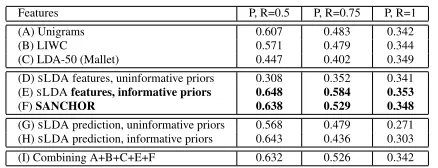
(D)SLDA features, uninformative priors 0.308 0.352 0.341 (E)SLDAfeatures, informative priors 0.648 0.584 0.353
(F)SANCHOR 0.638 0.529 0.348
(G)SLDA prediction, uninformative priors 0.568 0.479 0.271 (H)SLDA prediction, informative priors 0.643 0.436 0.303
[image:5.612.318.537.52.136.2](I) Combining A+B+C+E+F 0.632 0.526 0.342
Table 7: Evaluation on Twitter test set, showing pre-cision at three levels of recall.
Dir(βlkφpk) whose mean vector φpk is the topic of the parent nodepk. See the Apendix for more
de-tails.
The structure of this model is similar in spirit to SHLDA (Nguyen et al., 2013), and it is intended to serve a similar purpose, namely inducing struc-ture in such a way that sub-topics meaningfully spe-cialize their parent nodes. Nguyen et al. illustrate how this can be useful in the political domain — for example, in an analysis of Congressional floor de-bates, the model identifies taxation as a first-level topic, with one child node that captures Democrats’ framing of the subject (with terms likechild support,
education, students, andhealth care, i.e. the social services that taxes pay for) and another child node capturing Republican framing (with terms likedeath tax,jobs, family businesses, andequipment, related to the implications of taxation for businesses). Here our goal is to use a similarly structured model, but jointly modeling authors’ language with their de-pression status as the regression variable rather than their political affiliation.
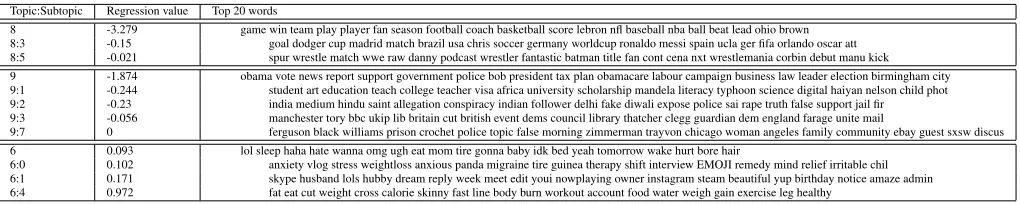
Tables 6 provide some illustrative examples of
SNLDA topics induced from the Twitter training
Topic:Subtopic Regression value Top 20 words
8 -3.279 game win team play player fan season football coach basketball score lebron nfl baseball nba ball beat lead ohio brown 8:3 -0.15 goal dodger cup madrid match brazil usa chris soccer germany worldcup ronaldo messi spain ucla ger fifa orlando oscar att 8:5 -0.021 spur wrestle match wwe raw danny podcast wrestler fantastic batman title fan cont cena nxt wrestlemania corbin debut manu kick 9 -1.874 obama vote news report support government police bob president tax plan obamacare labour campaign business law leader election birmingham city 9:1 -0.244 student art education teach college teacher visa africa university scholarship mandela literacy typhoon science digital haiyan nelson child phot 9:2 -0.23 india medium hindu saint allegation conspiracy indian follower delhi fake diwali expose police sai rape truth false support jail fir 9:3 -0.056 manchester tory bbc ukip lib britain cut british event dems council library thatcher clegg guardian dem england farage unite mail
9:7 0 ferguson black williams prison crochet police topic false morning zimmerman trayvon chicago woman angeles family community ebay guest sxsw discus 6 0.093 lol sleep haha hate wanna omg ugh eat mom tire gonna baby idk bed yeah tomorrow wake hurt bore hair
[image:6.612.73.583.53.155.2]6:0 0.102 anxiety vlog stress weightloss anxious panda migraine tire guinea therapy shift interview EMOJI remedy mind relief irritable chil 6:1 0.171 skype husband lols hubby dream reply week meet edit youi nowplaying owner instagram steam beautiful yup birthday notice amaze admin 6:4 0.972 fat eat cut weight cross calorie skinny fast line body burn workout account food water weigh gain exercise leg healthy
Table 6: SelectedSNLDAtopics
4 Quantitative results
An established use of topic models in predictive modeling is to create aK-topic model using some relevant document collection (which might or might not include the training set), and then, for training and test documents, to use the posterior topic dis-tributionPr(zk|d), k = 1..K as a set ofKfeatures
(Resnik et al., 2013; Schwartz et al., 2014). These features can be useful because the automatically dis-covered topics sometimes capture higher-level prop-erties or “themes” in authors’ language that have predictive value beyond individual words or phrases. Our experimentation used these features from LDA,
SLDA, and sANCHOR; using topic posteriors from
SNLDAis left for future work.
To assess the ability of the models/features and how they compare to baseline methods, we trained a linear support vector regression (SVR) model on the union of the Twitter train and dev sets, evaluated on the test set. We chose regression over classifica-tion despite having binary labels in our data in order to more easily evaluate precision at various levels of recall, which can be done simply by threshold-ing the predicted value at different points in order to obtain different recall levels. In addition, SVR has been shown to be an adequate choice to other sim-ilar text regression problems (Kogan et al., 2009), and in future analyses the use of the linear kernel will allow us to further see the contributions of each feature from the weights assigned by the regression model. We follow standard practice in using uni-gram features and LIWC categories as baseline fea-ture sets, and we also use topic posteriors from a 50-topic LDA model built on the Twitter training data.5
5Not to be confused with the LDA model built using the
stream-of-consciousness dataset in Section 3.1, which was used
As shown in Table 7, we evaluated alternative models/feature sets by fixing the percentage of re-called (correctly classified) depression subjects at levels R=1, 0.75, and 0.5 and looking at preci-sion, or, equivalently, the rate of misdiagnosed con-trol subjects.6 When R=1, it means the classifica-tion threshold was set to the smallest value such that all depressed subjects were correctly classified. The results show that all methods perform similarly badly at 100% recall: when required to identify all depressed individuals, two thirds or so of the flagged individuals are false positives. When allowed to trade off recall for improved precision, SLDA
per-forms wellif provided with informative priors, and the supervised anchor method (without informative priors) is not far behind.
For completeness, we also used theSLDA
mod-els directly for prediction, i.e. computing the ex-pected response value for a test document fromη>z¯
wherez¯is the document’s posterior topic distribu-tion and theηs are the per-topic regression parame-ters. These results are shown as “SLDA prediction”
(lines G and H) in the table. The utility of this tech-nique is illustrated on the model without informative priors (G), where it yielded a substantial improve-ment over the use of the posterior topics as features for both LDA (line C) andSLDA with
uninforma-tive priors (line D). This suggests thatSLDA-based
features (D) may have performed so poorly because they failed to sufficiently leverage the added value of the regression parameter, making them no bet-ter than vanilla LDA (C). SNLDA models can
sim-ilarly be used to predict a test document’s expected
to provide informative priors forSLDA.
6Owing to an error discovered late in the writing process, 4 out of 396 test items were excluded from theSANCHOR
response value; we will explore this in future work. To the extent that this test set is representative of the real world, the results here seem promising: with R=0.75, 3 of 4 depressed individuals are detected at the cost of roughly 1 false positive per 3 individu-als predicted. The representativeness of the exper-iment, however, depends heavily on the true lence of depression. On the one hand, the preva-lence in the Coppersmith (2015) dataset — in the vicinity of 30% — is consistent with Vermani et al. (2011), who cite four prior studies when stating that “major depressive disorder has been shown to be one of the most common mental disorders seen in primary care patients, with prevalence rates ranging from 23% to 35%”. In their own study of 840 pri-mary care patients in Canada, they found that 27.2% met criteria for major depressive disorder. On the other hand, those numbers seem quite high: Vermani et al. also cite a WHO study finding that 10.4% of screened patients met criteria for current depression, and that number is more in line with NIMH’s 12-month prevalence figures.7
Although it introduces a mismatch between train-ing and test data prevalence, therefore, we experi-mented with randomly down-sampling the number of positive examples in the test data (but not the training set) to get a test-set prevalence of 10%. Ta-ble 8 shows the mean±standard deviation results.8 The absolute numbers are significantly lower, but the same trend persists in the comparison across mod-els/features.
Elsewhere in this volume, a companion paper describes our participation in the CLPsych 2015 Shared Task (Coppersmith et al., 2015), providing experimentation on shared task datasets and further discussion and analysis (Resnik et al., 2015). 5 Conclusions
Our goal in this paper has been to go beyond sim-ple, “vanilla” topic models to explore the poten-tial utility of more sophisticated topic modeling in the automatic identification of depression. Qualita-tive examples have confirmed that LDA, and now
7http://www.nimh.nih.gov/
health/statistics/prevalence/
major-depression-among-adults.shtml
8To obtain means and standard deviations we down-sampled 100 times.
Features P, R=0.5 P, R=0.75 P, R=1
Uni 0.239±0.047 0.165±0.042 0.108±0.010
SANCHOR 0.271±0.045 0.189±0.033 0.126±0.015
SLDA-inf 0.267±0.042 0.216±0.035 0.119±0.022
Table 8: Mean±stdev precision (P) and recall (R) scores of linear SVR for the3 best-performing mod-els/features in Table 7 (SLDA with informative
pri-ors,SANCHORand unigrams) on test sets where the
prevalence of depression was randomly downsam-pled to 10%.
additional LDA-like models, can uncover mean-ingful and potentially useful latent structure, and our quantitative experimentation using the CLPsych Hackathon dataset has shown more sophisticated topic models exploiting supervision, such asSLDA
andSANCHOR, can improve on LDA alone.
One of the additional take-aways here is that in-formative priors can make a meaningful difference in performance; we plan to pursue this further us-ing interactive topic modelus-ing (Hu et al., 2014) with our domain expert, and also by providing informa-tive priors for anchor methods.
Another important observation is that prevalence matters, and therefore further work is needed explor-ing the sensivity of early screenexplor-ing approaches to changes in the proportion of the target signal rep-resented in the data.
Finally, a third interesting observation coming out of our experimentation was that aggregation might matter a great deal. Rather than aggregating by au-thor, we defined asetof documents for each author as their tweets aggregated on a weekly basis, i.e. one document per author per week. Although just a pre-liminary experiment with one model, we found with
SANCHOR that the weekly grouping improved
Acknowledgments
We appreciate the helpful comments of the anony-mous reviewers, we are grateful to Rebecca Resnik for contributing her comments and clinical exper-tise, and we thank Glen Coppersmith, Mark Dredze, Jamie Pennebaker, and their colleagues for kindly sharing data and resources. This work was sup-ported in part by NSF awards 1320538, 1018625, and 1211153. Any opinions, findings, conclusions, or recommendations expressed here are those of the authors and do not necessarily reflect the view of the sponsor.
Appendix
The Appendix is available online at http: //www.umiacs.umd.edu/˜resnik/pubs/ clpsych2_appendix.pdf.
References
APA. 2013. The critical need
for psychologists in rural America.
http://www.apa.org/about/gr/education/rural-need.aspx, Downloaded September 16, 2013.
Sanjeev Arora, Rong Ge, Yoni Halpern, David M. Mimno, Ankur Moitra, David Sontag, Yichen Wu, and Michael Zhu. 2013. A practical algorithm for topic modeling with provable guarantees.
David M Blei and John D Lafferty. 2007. A correlated topic model of science. The Annals of Applied Statis-tics, pages 17–35.
David M Blei and Jon D McAuliffe. 2007. Supervised topic models. InAdvances in Neural Information Pro-cessing Systems, pages 121–128.
David M Blei, Andrew Y Ng, and Michael I Jordan. 2003. Latent Dirichlet allocation. The Journal of Ma-chine Learning Research, 3:993–1022.
Glen Coppersmith, Mark Dredze, and Craig Harman. 2014. Quantifying mental health signals in Twitter. In
Proceedings of the Workshop on Computational Lin-guistics and Clinical Psychology: From Linguistic Sig-nal to Clinical Reality, pages 51–60, Baltimore, Mary-land, USA, June. Association for Computational Lin-guistics.
Glen Coppersmith, Mark Dredze, Craig Harman, Kristy Hollingshead, and Margaret Mitchell. 2015. CLPsych 2015 shared task: Depression and PTSD on Twitter. In
Proceedings of the Workshop on Computational Lin-guistics and Clinical Psychology: From Linguistic Sig-nal to Clinical Reality, Denver, Colorado, USA, June.
North American Chapter of the Association for Com-putational Linguistics.
Glen Coppersmith. 2015. [Un]Shared task: Com-putational linguistics and clinical psychology.
http://glencoppersmith.com/papers/ CLPsych2015_hackathon_shared_task. pdf.
Munmun De Choudhury, Scott Counts, and Eric Horvitz. 2013. Predicting postpartum changes in emotion and behavior via social media. InProceedings of the 2013 ACM annual conference on Human factors in comput-ing systems, pages 3267–3276. ACM.
Justin Grimmer. 2010. A Bayesian hierarchical topic model for political texts: Measuring expressed agen-das in Senate press releases. Political Analysis, 18(1):1–35.
Yuening Hu, Jordan Boyd-Graber, Brianna Satinoff, and Alison Smith. 2014. Interactive topic modeling. Ma-chine Learning, 95(3):423–469.
Oliver P John and Sanjay Srivastava. 1999. The big five trait taxonomy: History, measurement, and theoretical perspectives. Handbook of personality: Theory and research, 2:102–138.
Martin A Katzman, Leena Anand, Melissa Furtado, and Pratap Chokka. 2014. Food for thought: understand-ing the value, variety and usage of management algo-rithms for major depressive disorder. Psychiatry re-search, 220:S3–S14.
Shimon Kogan, Dimitry Levin, R. Bryan Routledge, S. Jacob Sagi, and A. Noah Smith. 2009. Predict-ing risk from financial reports with regression. In Pro-ceedings of Human Language Technologies: The 2009 Annual Conference of the North American Chapter of the Association for Computational Linguistics, pages 272–280. Association for Computational Linguistics. NAMI. 2013. Major depression fact sheet, April.
http://www.nami.org/Template.cfm?Section=depression. Yair Neuman, Yohai Cohen, Dan Assaf, and Gabbi
Kedma. 2012. Proactive screening for depression through metaphorical and automatic text analysis. Ar-tif. Intell. Med., 56(1):19–25, September.
Viet-An Nguyen, Jordan Boyd-Graber, and Philip Resnik. 2013. Lexical and hierarchical topic regres-sion. InProceedings of Advances in Neural Informa-tion Processing Systems, pages 1106–1114.
Thang Nguyen, Jordan Boyd-Graber, Jeffrey Lund, Kevin Seppi, and Eric Ringger. 2015. Is your anchor going up or down? Fast and accurate supervised topic models. InNorth American Chapter of the Association for Computational Linguistics.
Philip Resnik, Anderson Garron, and Rebecca Resnik. 2013. Using topic modeling to improve prediction of neuroticism and depression in college students. In Proceedings of the 2013 Conference on Empiri-cal Methods in Natural Language Processing, pages 1348–1353, Seattle, Washington, USA, October. As-sociation for Computational Linguistics.
Philip Resnik, Rebecca Resnik, and Margaret Mitchell, editors. 2014. Proceedings of the Workshop on Com-putational Linguistics and Clinical Psychology: From Linguistic Signal to Clinical Reality. Association for Computational Linguistics, Baltimore, Maryland, USA, June.
Philip Resnik, William Armstrong, Leonardo Claudino, and Thang Nguyen. 2015. The University of Mary-land CLPsych 2015 shared task system. In Proceed-ings of the Workshop on Computational Linguistics and Clinical Psychology: From Linguistic Signal to Clinical Reality, Denver, Colorado, USA, June. North American Chapter of the Association for Computa-tional Linguistics.
Stephanie Rodrigues, Barbara Bokhour, Nora Mueller, Natalie Dell, Princess E Osei-Bonsu, Shibei Zhao, Mark Glickman, Susan V Eisen, and A Rani Elwy. 2014. Impact of stigma on veteran treatment seeking for depression. American Journal of Psychiatric Re-habilitation, 17(2):128–146.
Stephanie Rude, Eva-Maria Gortner, and James Pen-nebaker. 2004. Language use of depressed and depression-vulnerable college students. Cognition & Emotion, 18(8):1121–1133.
H. Andrew Schwartz, Johannes Eichstaedt, Margaret L. Kern, Gregory Park, Maarten Sap, David Stillwell, Michal Kosinski, and Lyle Ungar. 2014. Towards as-sessing changes in degree of depression through face-book. InProceedings of the Workshop on Computa-tional Linguistics and Clinical Psychology: From Lin-guistic Signal to Clinical Reality, pages 118–125, Bal-timore, Maryland, USA, June. Association for Com-putational Linguistics.
Kathleen Sibelius. 2013. Increasing ac-cess to mental health services, April. http://www.whitehouse.gov/blog/2013/04/10/increasing-access-mental-health-services.
Ivan Titov and Ryan McDonald. 2008. Modeling on-line reviews with multi-grain topic models. In Pro-ceedings of the 17th international conference on World Wide Web, pages 111–120. ACM.