Discontinuous Constituents: a Problematic Case for Parallel Corpora
Annotation and Querying
Marilisa Amoia, Kerstin Kunz, Ekaterina Lapshinova-Koltunski Department of Applied Linguistics, Saarland University
{m.amoia,k.kunz,e.lapshinova}@mx.uni-saarland.de
Abstract
In this paper, we discuss some linguistic phenomena that pose potential problems for multilevel linguistic annotation of par-allel corpora in general and specifically for data encoding with state-of-art multilevel corpus querying tools such as CQP. We de-scribe the strategy we use for integrating the standard hierarchical XML represen-tation used to annotate such phenomena in our aligned bilingual corpus GECCo into a timeline-based format as used in CQP. Thus, our framework supports effi-cient multilevel representation as well as corpus exploitation and querying of lin-guistic data of arbitrary complexity.
1 Introduction
Gathering and providing a natural language cor-pus of good quality requires the definition of data models that mirror the complexity of natural lan-guage data from written as well as spoken dis-course. In recent years, much work has been done to develop standards for annotations, anno-tation schemes and coding practice guidelines (c.f. (McKelvie et al., 2001), (Blache et al., 2010)) with the aim of allowing data exchange between differ-ent annotations tools and portability of corpora to other platforms as well as the integration of cor-pora. Yet, relative little attention has been devoted to interfacing annotation schemes with the encod-ing formats required by corpus query engines.
Although several efficient automatic systems for parallel corpus exploitation have been devel-oped, these systems are generally specialized for the storage and retrieval of a very limited number of annotation levels. For instance, UNITEX (Pau-mier, 2000) only allows alignment on sentence level, and although EMDROS (Petersen, 2004) is a system for storing and retrieving annotated texts
that is very generic and applicable to almost any kind of linguistic annotation, it does not allow alignment.
In fact, very few corpus query tools such as CQP (Christ, 1994), ANNIS2 (Zeldes et al., 2009) or MATE (McKelvie et al., 2001) exist that can handle multilevel annotated corpora. To our knowledge, ANNIS2 is still in the development phase, at the moment of writing, and MATE (McKelvie et al., 2001) does not easily support alignment of parallel corpora.
In this paper, we present our experience with the multilevel query engine CQP developed within the CWB Open Corpus Workbench (Christ, 1994), a collection of open-source tools for managing and querying large text corpora (ranging from 10 mil-lion to 2 bilmil-lion words).
Our focus will be on some problematic issues that have been raised by our attempt to auto-matically encode our multilevel-annotated bilin-gual parallel corpus into CQP. The GECCo cor-pus, which was developed in our research group for the contrastive study of cohesion in English and German combines automatic and manual an-notation on different layers of linguistic knowl-edge ranging from pos-tagging, syntax chunking to semantic information such as linguistic chains and coreference. We noticed that certain annota-tions were difficult to encode employing state-of-art query tools, namely those representing discon-tinuous segments.
The paper is structured as follows: Section 2 gives an overview of linguistic phenomena that might lead to discontinuous segments. Section 3 describes the XML-based data format on which multi-layer annotations in the corpus are based. Section 4 deals with the strategy we adopted to encode corpus annotations into CQP and in partic-ular describes the strategy for encoding problem-atic constituents such as discontinuous segments into a timeline-based data format, as the one used
by CQP, so as to allow corpus querying and ex-ploitation. Section 5 concludes with pointers for future research.
2 Differences in Information Distribution between English and German
This section is concerned with differences in in-formation distribution between English and Ger-man as these complicate annotation and exploita-tion of parallel corpora. Here, structural shifts be-tween originals and translations have turned out to be particularly problematic in view of semi-automatic annotation and querying of translational equivalents or extraction for further processing. They cause discontinuity in cases where the trans-lational equivalents are aligned on the basis of se-mantic criteria1.
2.1 Contrasts between English and German
General differences between English and Ger-man such as case marking and word order (see e.g. (Hawkins, 1986), (Koenig and Gast, 2007), (Steiner, 2001) and (Teich, 2003)) are believed to have implications with respect to the positional options for the integration of information into sen-tences. For instance, (Doherty, 2004) but also (Te-ich, 2003) and (Steiner and Te(Te-ich, 2004) note that the order of information is more flexible in En-glish at the beginning of declarative main clauses where more than one constituent may occur be-fore the verb complex. In contrast, German of-fers more structuring options after the finite verb (in the Mittelfeld) and an additional option be-hind the non-finite verb (Nachfeld). This is due to the topological peculiarity of the German ver-bal bracket. Fabricius-Hansen (1999) highlights the tendency of German to structure experien-tial meaning more vertically and metaphorically in contrast to a more horizontal and congruent distribution of information in English. She in-dicates ”recursive compounding, repeated nomi-nalization, heavy prenuclear and postnuclear noun phrase modification, and accumulation of adver-bial adjuncts” (Fabricius-Hansen, 1999) as gram-matical features that enhance hierarchical infor-mation packaging. In summary, the differences between English and German described above
1We opted for a semantic alignment as we assume that only this kind of annotation provides the information nec-essary for studying English-German contrasts in information distribution and further phenomena of cohesion.
may provoke the following relevant shifts be-tween originals and translation: Meaning that is expressed inside phrases in German may be ex-pressed by a subordinate or main clause or may appear in a separate sentence in English. Meaning that is expressed in a medium sentence position in German may be shifted to the beginning or end of a sentence or be incorporated in a separate sen-tence in English. As a consequence of these shifts we assume that meaning may be conveyed in En-glish by a contiguous element at one particular po-sition, while corresponding meaning may be real-ized in German by separate elements in different syntactic positions. We thus expect a higher num-ber of discontinuous segments in German, both at phrase and at clause level. In the following sec-tion of this paper some examples of discontinuous segments will be discussed.
2.2 Some examples for discontinuous segments
We now go on to examine some stretches of text from the GECCo corpus in which discontinuous segments are encoded in case of semantic align-ment. In German, discontinous segments at sen-tence level may be caused by a tendency to encode relevant information in the form of complex appo-sitions in a middle position of the sentence:
(1) a. Dieser L¨osung - und das ist f¨ur mich das Wunder - haben zum Schluss alle zuges-timmt:
b. The miraculous thing for me was that in the end everyone agreed to this solution:
In the German original (1a), relevant and focused information is inserted as a clausal apposition into another sentence, without being related to one spe-cific constituent. The same meaning is expressed in the English translation (1b) by the subject and predicate of the main clause turning the predicate plus arguments of the German main clause in a subordinate clause. The alignment of translational equivalents therefore requires the annotation of a discontinuous segment. Below is an example of a discontinuous segment in German that is not only annotated for alignment of translational equiva-lents but also for the annotation of coreference.
b. The InnoRegio funding programme has been very successful – something local politicians, and not just Social Democrats, have confirmed.
In the German original (2a), a clausal apposition is again inserted into another main clause. How-ever, the anaphoric pronoundasin the apposition refers to the whole main clause. Thus, the latter has to be annotated as discontinuous segment in order to mark it as the antecedent of the pronoun. In the English translation (2b), the apposition is retained but appears after the main clause, with-out splitting it into two linear parts. Thus only one continuous element needs to be segmented in the translation for the annotation and alignment of the antecedent. Another cause of discontinuous seg-ments on sentence level are prepositional phrases which, are again distributed more freely in Ger-man than in English.
(3) a. Dieser Konsens ist trotz aller m¨oglichen Vorbehalte ein hohes politisches Gut.
b. Despite all possible reservations, this con-sensus is a key political asset.
A prepositional phrase functioning as an adver-bial occurs after the predicate (in the Mittelfeld) in German (3a) but is moved to the beginning of the sentence in the English translation (3b). Conse-quently, alignment of the main clause according to semantic criteria would result in a discontinuous segment in German but not in English.
(4) a. Dieser Konsens ist, trotz aller m¨oglichen Vorbehalte, ein hohes politisches Gut, das die Stiftung ”Erinnerung, Verant-wortung und Zukunft” im Kuratorium unter Leitung von Botschafter Kastrup und durch den Vorstand aus Dr. Jansen, Dr. Br¨autigam und Botschafter Primor er-halten muß.
b. Despite all possible reservations, this con-sensus is a key political asset which the Foundation ”Remembrance, Responsibil-ity and the Future” must preserve on its Board of Trustees. The latter is chaired by Ambassador Dieter Kastrup. Board of Trustees members Michael Jansen, Hans-Otto Br¨autigam, and Ambassador Avi Pri-mor were elected the foundation’s execu-tive officers.
In the German excerpt, a prepositional phrase functioning as an adverbial occurs in the Mit-telfeld (4a) before the right verbal bracket. The meaning of this PP is realized in a separate sen-tence in the English translation (4b). A meaning-based alignment of the first English sentence therefore includes a discontinuous element in the German original.
Discontinuous segments on phrase level in Ger-man may be due to distinct NP pre-modification conventions (see (Koenig and Gast, 2007), (Do-herty, 2004), (Fabricius-Hansen, 1999) and (Te-ich, 2003)). In contrast to English, merely preposi-tional phrases and finite relative clauses follow the head noun in German. Constructions of medium complexity are usually placed before the head noun. These contrasts may complicate corefer-ence chaining, on the one hand, and alignment of elements of these chains in the parallel corpora, on the other hand.
(5) a. ¨uber zwei Zeilen Lagerh¨auser blicken wir auf [das str¨omungslose Grau des Hafenbeckens und auf die Landzunge, die sich zwischen ihm und dem Fluss erstreckt] A1. Seit Menschengedenken geh¨ort [dieses auf drei Seiten von Wasser umgebene Gel¨ande] B1 der chemischen Industrie.
b. We look across two rows of warehouses at [the motionless grey surface of the harbor basin and the tongue of land that extends between it and the river] A2. Enclosed on three sides by water, [this area] B2 has been a preserve of the chemical industry for as long as anyone can remember.
and transformed it into an adverbial clause func-tioning as a clausal adverbial at sentence level. Hence, semantic alignment of the English subject ”this area” results in the annotation of a discon-tinuous segment in German, consisting of ”diese” and ”Gel¨ande”. Flexible positioning of complex NP postmodifiers in German may also yield dis-continuous segments:
(6) a. This occurred just after I took a turn-ing and found myself on a road curvturn-ing around the edge of a hill.
b. Dies geschah kurz nach einer Abzwei-gung, als ich mich pl¨otzlich auf einer Straße befand, die in Kurven an einem Hang entlangf¨uhrte.
The relative clause occurs after the nominal head in both the English original and its German translation. However, the heavy NP shift enables the German relative clause to be postponed after the predicate. The alignment of the corresponding relative clauses entails annotating a discontinuous element in German.
(7) a. Aber wenn die Notwendigkeit von Re-formen besser verstanden wird, als die Bereitschaft verbreitet ist, diese zu un-terst¨utzen (...)
b. However, if the awareness of necessary reforms is greater than the willingness to support these reforms (...)
In the example above, the infinitive plus argu-ment postmodifying the NP head ”Bereitschaft” occurs after the predicate, while the correspond-ing infinitive construction appears directly after the NP head ”willingness” in English. The align-ment of both noun phrases requires the creation of a discontinuous segment in German.
Although we assume that the number of discon-tinuous segments may be higher in the German than in the English corpus, for the reasons high-lighted above, note should be made of the fact that English-German contrasts may also trigger dis-continuous elements in the English corpus as il-lustrated by the following example:
(8) a. What is now clear from the historical idence of the last century is that in ev-ery case where a poor nation has signifi-cantly overcome its poverty, this has been
achieved while engaging in production for export markets and opening itself to the influx of foreign goods, investment and technology; that is, by participating in globalization.”
b. Anhand der historischen Beweise des letzten Jahrhunderts ist jetzt klar, da in jedem Fall, in dem eine arme Na-tion ihre Armut in betr¨achtlichem Maße ¨uberwunden hat, dies durch die Produk-tion f¨ur Exportm¨arkte und die eigene
¨
Offnung f¨ur ausl¨andische Waren, Investi-tionen und Technologie geschah - das heißt, durch die Beteiligung an der Glob-alisierung.”
Pseudo-cleft constructions as employed in the example above are a rather frequent strategy in English for realizing clauses as subjects in Theme position (see (Teich, 2003)). Equivalent construc-tions are relatively rare in German, and indeed, the meaning of the English pseudo-cleft clause is realized as a main clause in the German transla-tion. As a consequence, the complex prepositional phrase of the English pseudo-cleft is moved to the beginning of the sentence in German. An align-ment of these two PPs therefore entails the cre-ation of other discontinuous segments in the En-glish original.
Other differences between English and German causing discontinuous segments especially in En-glish may result from the greater availability of non-finite verb constructions or a more verbal re-alization of meaning in general.
3 Annotation of Parallel Corpora
3.1 GECCo: A Multilingual Parallel Corpus
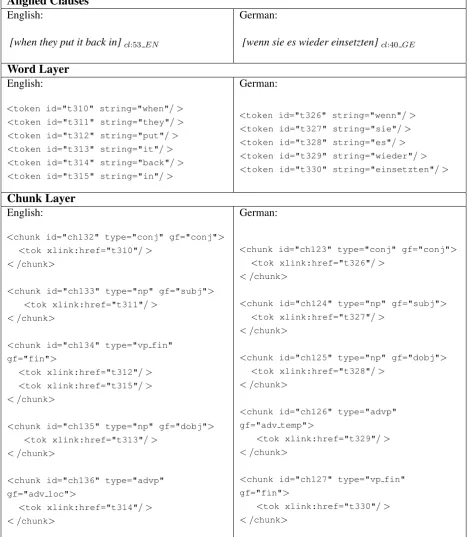
Aligned Clauses
English: German:
[when they put it back in]cl:53 EN [wenn sie es wieder einsetzten]cl:40 GE
Word Layer
English: German:
<token id="t310" string="when"/ > <token id="t311" string="they"/ > <token id="t312" string="put"/ >
<token id="t313" string="it"/ > <token id="t314" string="back"/ > <token id="t315" string="in"/ >
<token id="t326" string="wenn"/ > <token id="t327" string="sie"/ > <token id="t328" string="es"/ >
<token id="t329" string="wieder"/ > <token id="t330" string="einsetzten"/ >
Chunk Layer
English: German:
<chunk id="ch132" type="conj" gf="conj"> <tok xlink:href="t310"/ >
< /chunk>
<chunk id="ch133" type="np" gf="subj"> <tok xlink:href="t311"/ >
< /chunk>
<chunk id="ch134" type="vp fin"
gf="fin">
<tok xlink:href="t312"/ > <tok xlink:href="t315"/ >
< /chunk>
<chunk id="ch135" type="np" gf="dobj"> <tok xlink:href="t313"/ >
< /chunk>
<chunk id="ch136" type="advp"
gf="adv loc">
<tok xlink:href="t314"/ > < /chunk>
<chunk id="ch123" type="conj" gf="conj">
<tok xlink:href="t326"/ > < /chunk>
<chunk id="ch124" type="np" gf="subj"> <tok xlink:href="t327"/ >
< /chunk>
<chunk id="ch125" type="np" gf="dobj"> <tok xlink:href="t328"/ >
< /chunk>
<chunk id="ch126" type="advp" gf="adv temp">
<tok xlink:href="t329"/ > < /chunk>
<chunk id="ch127" type="vp fin" gf="fin">
<tok xlink:href="t330"/ >
[image:5.595.71.541.134.672.2]< /chunk>
For the time being, GECCo contains 10 differ-ent registers, i.e. the eight registers of written lan-guage of the CroCo corpus and two new regis-ters (interviews and academic discourse) of spo-ken language (see (Kunz and Koltunski, 2011) for a more detailed description of the GECCo corpus architecture). We are currently trying to enhance the automatic annotation of the new registers by means of manual annotation. Encoding the differ-ent layers of manual annotation into CQP, we are faced with the difficulty of encoding discontinuous constituents as illustrated in section 2.
In conclusion we can say that the complexity of linguistic annotations required for studying con-trasts in English-German cohesive devices neces-sitates both
(i) an annotation scheme capable of coping with multilevel annotations, i.e. graph structures and
(ii) a multilevel corpus query engine that can cope with the complexity of our annotation layers and data model.
3.2 Annotation data model
XML is generally considered to be a useful tool for encoding complex structured language data. In-deed, XML is a widely used standard for encod-ing annotations of natural language corpora. Al-though the base formalism cannot describe over-lapping structures since it was originally designed to represent tree structures only, its extension (Is-ard and Thompson, 1998) with hyperlinks (href) enables the representation of crossing and overlap-ping structures.
In our corpus annotation framework we have adopted a modular strategy. Each annotation layer is represented as a different XML file generated by MMAX2 (M¨uller and Strube, 2006) that supports the manual annotation. The mapping of different representation layers (the graph structure) is guar-anteed by the (href) hyperlinks between the dif-ferent XML files. Figure 1 shows some example annotations from the corpus.
In order to allow further corpus query and ex-ploitation, the linguistic information contained in the XML files needs to be merged into a format readable by a corpus query engine. As this oper-ation is not straightforward in the case of discon-tinuous segments, an overview of the potential dif-ficulties will be provided in the following section. .
4 Interfacing XML Annotations of Discontinuous Segments in CQP
4.1 CQP data model
CQP is based on an XML-like corpus encoding language that is compatible with the data model we use for corpus annotation.
The primary data used in CQP are tokens. The CQP language is a rigid positional system on the token positions, i.e. the tokens are totally ordered, providing a timeline for the incremental encoding of structural attributes. CQP provides annotations of two types of attributes:
• positional attributes: describe features related to the tokens or token position such as part-of-speech, morphological features, etc.
• structural attributes: describe features related to ordered sets of tokens, such as syntactic chunks, clauses, sentences, etc.
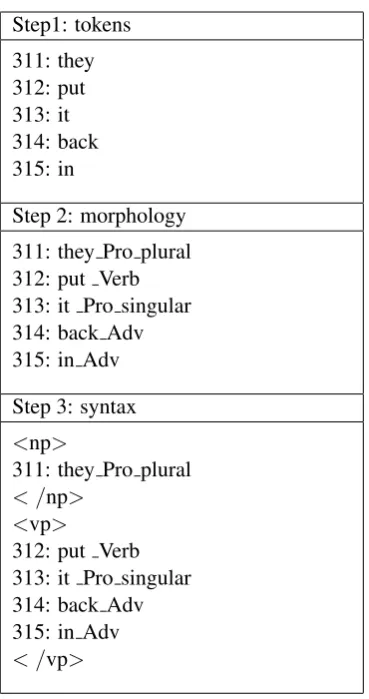
CQP allows for incremental information merg-ing, i.e. structural attributes can be sequentially integrated with the positional attributes so as to re-fine the linguistic information present in the cor-pus. Figure 2 displays an example of incremental annotation encoding in CQP.
Further, CQP enables the representation of overlapping structures, which is not allowed in standard XML. However, as CQP uses the posi-tions of tokens for storage and retrieval, discontin-uous segments cannot be directly represented.
In conclusion we can say that, in order to en-code the GECCo corpus annotation data into CQP, the hierarchical XML representation used for en-coding multi-layer annotations needs to be trans-lated into the CQP timeline-based corpus repre-sentation on the basis of the position of tokens. The next section describes the strategy we employ for encoding discontinuous constituents into CQP.
4.2 Representing discontinuous segments in CQP
As we have seen previously, structural attributes are encoded in CQP as ordered sets of token posi-tions. Thus, a structural attributeT AGdescribing an XML tag (e.g. tokenorchunk) can be defined as the following sequence of token positions:
T AG= [t1, t2, ...., tn],
Step1: tokens
311: they 312: put 313: it 314: back 315: in
Step 2: morphology
311: they Pro plural 312: put Verb 313: it Pro singular 314: back Adv 315: in Adv
Step 3: syntax
<np>
311: they Pro plural
< /np> <vp>
312: put Verb 313: it Pro singular 314: back Adv 315: in Adv
[image:7.595.90.275.57.407.2]< /vp>
Figure 2: Merging multi-layer XML annotations into CQP.
In order to describe the strategy used to encode discontinuous segments into CQP, we first give the formal definition of a discontinuous structural at-tribute.
LetT AGbe a sequence of tokens describing the structural attribute represented by an XML tag
T AG= [t1, ..., tj, ..., tj+n, ..., tk]
andGAP Sa set of integer pairs such that
(xi, yi)∈GAP Siff
[xi, xi+1, ..., yi]is a sequence of integer numbers without gaps
Then, the definition of a discontinuous se-quence is as follows:
T AGis discontinuous iff |GAP S|>1
As CQP does not support the representation of such discontinuous segments we adopt the fol-lowing strategy: First, we split a T AG contain-ing gaps into the set of its continuous subsets (∪T AGi), i.e. sequences of tokens without gaps
<chunk id="ch133" gf=subj>
<token id="t311" string="they"/ > < /chunk>
<chunk id=”ch134” gap id=”ch134-gap” gf=fiv> <token id=”t312” string= ”put”/ >
< /chunk>
<chunk id="ch135" gf=dobj>
<token id="t313" string="it"/ > < /chunk>
<chunk id="ch136" gf=adv loc>
<token id="t314" string="back"/ > < /chunk>
<chunk id=”ch134” gap id=”ch134-gap” gf=fiv> <token id=”t315” string=”in”/ >
< /chunk>
Figure 3: CQP XML-like representation of dis-continuous segments.
T AG=∪T AGi, e.i.
=∪[xi, ..., yi],∀(xi, yi)∈GAP S
Then, after having assigned an identical coin-dex gap id to all the subsets of a discontinuous
T AG, we represent each of them as a standard CQP structural attribute. At the query stage, the segments that have been split are linked together into a unique segment by a query macro that se-lects structural attributes with the samegap id.
Summing up, the strategy we adopt consists of three steps:
• partitioning the discontinuous segment into a set of continuous subsets,
• representation of the continuous partitions of the original set as standard CQP structural at-tributes,
• reconstruction of the original discontinuous segment at the query stage.
An example of a structure that cannot be di-rectly encoded in CQP was given in Figure 1. The English aligned clause contains a discontinuos
T AG segment representing a finite verb vp f in
(put in).
vp f in= [t312,t315],
Gapvp f in=[(312,312),(315,315)]
Figure 3 shows the CQP encoding of the contin-uous subsets ofvp f indefined byGapvp f in for this example.
199090: <clause id=”GO SPEECH 009-cl67” align=”G2E SPEECH 009-cl67-cl93”>
Dieser L¨osung
</clause>
→etrans:<clause id=”ETRANS SPEECH 009-cl93” align=”G2E SPEECH 009-cl67-cl93”>
that in the end everyone agreed to this solution
</clause>
199093: <clause id=”GO SPEECH 009-cl68” align=”G2E SPEECH 009-cl68-cl92”>
und das ist f¨ur mich das Wunder
</clause>
→etrans:<clause id=”ETRANS SPEECH 009-cl92” align=”G2E SPEECH 009-cl68-cl92>
The miraculous thing for me was
</clause>
199101: <clause id=”GO SPEECH 009-cl67” align=”G2E SPEECH 009-cl67-cl93”>
haben zum Schluss alle zugestimmt
</clause>
→etrans:<clause id=”ETRANS SPEECH 009-cl93” align=”G2E SPEECH 009-cl67-cl93”>
that in the end everyone agreed to this solution
</clause>
Figure 4: CQP representation of alignment in GECCo.
vp f inEN =[put in]
vp f inGE =[einsetzen]
Figure 4 represents the output obtained by querying the GECCo corpus with CQP. In par-ticular, it shows how the framework described in this paper permits both an efficient encoding and querying of linguistic annotations (e.g. the align-ment of linguistic discontinuous constituents such as (1) with (2)) in CQP.
5 Conclusion
In this paper, we have discussed problematic is-sues that may arise in connection with the auto-matic encoding of a manually annotated corpus into the multilevel corpus query engine CQP. Man-ual corpus annotation often produces complexly structured representations of the linguistic infor-mation displayed in the corpus that are difficult to encode using general state-of-art corpus query tools.
While much research has addressed the issue of providing annotation standards for linguistic cor-pora, only a few resources (e.g. ANNIS2 and MATE) exist that provide efficient interfacing of those multi-layer annotations standards with
cor-pus query engines. However, MATE (McKelvie et al., 2001) does not support parallel corpora encod-ing. ANNIS 2 (Zeldes et al., 2009) for instance provides translation utilities from arbitrary XML data structures to the ANNIS format. The An-nis2 representation format allows the representa-tion and graphs and discontinuous constituents of arbitrary complexity. However, the corpus query language provided by this system is highly com-plex and requires a high level of expertise on the part of the user.
In this paper we proposed a CQP-based alterna-tive to ANNIS2. We described the strategy we im-plemented that allows the encoding and querying in CQP of multi-layer parallel corpora that include linguistic phenomena of arbitrary complexity.
Acknowledgments
The authors thank the DFG (Deutsche Forschungsgemeinschaft) for supporting this project.
References
Philippe Blache, Brigitte Bigi, Laurent Pr´evot, St´ephane Rauzy, and Julien Seinturier. 2010. A general scheme for broad-coverage multimodal an-notation. InProceedings of ICGL-10.
Oli Christ. 1994. A modular and flexible architecture for an integrated corpus query system. In
COM-PLEX’94.
M. Doherty. 2004. Strategy of incremental parsimony.
SPRIKreports, No 25.
C. Fabricius-Hansen. 1999. Information packaging and translation: Aspects of translational sentence splitting (german/english/norwegian). Studia
Gram-matica, 47:175–214.
J. A. Hawkins. 1986. A Comparative Typology of
En-glish and German: Unifying the Contrasts. Croom
Helm, London.
McKelvie D. Isard, A. and H.S. Thompson. 1998. Di-alogue transcripts: A new sgml architecture for the hcrc map task corpus. In Proceedings of the 5th International Conference on Spoken Language Pro-cessing, ICSLP98, Sydney.
E. Koenig and V. Gast. 2007. Understanding English-German Contrasts. Grundlagen der Anglistik und Amerikanistik. Schmidt (revised 2nd edition: 2009), Berlin.
Kerstin Kunz and Ekaterina Lapshinova Koltunski. 2011. Tools to analyse german-english contrasts in cohesion. InHamburg Working Papers in Multilin-gualism.
David McKelvie, Amy Isard, Andreas Mengel, Morten Baun Mller, Michael Grosse, and Marion Klein. 2001. The mate workbench - an annotation tool for xml coded speech corpora. Speech Commu-nication, pages 97–112.
Christoph M¨uller and Michael Strube. 2006. Multi-level annotation of linguistic data with MMAX2. In Sabine Braun, Kurt Kohn, and Joybrato Mukher-jee, editors,Corpus Technology and Language
Ped-agogy: New Resources, New Tools, New Methods,
pages 197–214. Peter Lang, Frankfurt a.M., Ger-many.
S. Neumann. 2005. Corpus design. Deliverable of the CroCo Project, No 1.
S´ebastien Paumier. 2000. Nouvelles m´ethodes pour la recherche d’expressions dans de grands corpus. In A. Dister, editor,Actes des 3`emes Journ´ees INTEX. Revue Informatique et Statistique dans les Sciences Humaines, 36´eme ann`ee, n 1 `a 4.
Ulrik Petersen. 2004. Emdros: a text database en-gine for analyzed or annotated text. InCOLING ’04: Proceedings of the 20th international conference on
Computational Linguistics. Association for
Compu-tational Linguistics.
Erich Steiner and Elke Teich. 2004. Metafunctional
profile of the grammar of German. In: Caffarel,
A., J.R. Martin and C.M.I.M. Matthiessen (eds). Language Typology. A Functional Perspective. Ben-jamins, Amsterdam.
Erich Steiner. 2001. Translations englishgerman: in-vestigating the relative importance of systemic con-trasts and of the text type translation.SPRIKreports, No 7:1–49.
E. Teich. 2003. Cross-linguistic variation in sys-tem and text. A methodology for the investigation
of translations and comparable texts. De Gruyter,
Berlin and New York.