Deriving rhetorical relationships from semantic content
Richard Power
Department of Computing Open University, UK
Abstract
This paper investigates to what extent rhetori-cal relations can be assigned purely on the ba-sis of propositional content, without any ref-erence to speaker goals or other pragmatic in-formation. This task confronts any NLG sys-tem designed to generate coherent text from a set of formally represented statements; we consider it here in the context of an ontology verbaliser, for which the input is a set of ax-ioms encoded in the web ontology language OWL. A simple set-theoretical model of the possible semantic relationships between two statements is proposed; this model allows 46 logically consistent relationships, of which we hypothesise that 11 are rhetorically coherent. This hypothesis is tested through an empirical survey which also provides evidence on how the coherent patterns are expressed linguisti-cally.
1 Introduction
Perhaps the murkiest area in the language sciences is the issue of how statements are combined in a discourse. Much research has been based (more or less strictly) on Rhetorical Structure Theory (RST), (Mann and Thompson, 1987), a theory grounded in intuitions about naturally occurring texts and more concerned with comprehensive coverage than for-mal adequacy. Categories like ‘concession’ and ‘elaboration’ have to be assigned through human judgement, and remain somewhat subjective despite efforts to refine them and clarify their definitions (Carlson and Marcu, 2001). Other researchers have
looked more deeply into the meaning of the re-lations, analysing them through rhetorical features (Hobbs, 1985; Sanders et al., 1992; Knott, 1996) with more emphasis on theory than on the require-ments of practical annotation.
In this paper we attack the problem from a new di-rection. Instead of starting from naturally occurring texts, and human judgements thereupon, we con-sider the far more restricted issue of how a rhetorical relationship could be assigned to two axioms drawn from an ontology, and hence to the sentences gener-ated from these axioms by an ontology verbaliser,1 using only information that is internal to the ontol-ogy. This means that we accept the strict limitations of the ontology formalism, assumed to be OWL-DL (Horrocks et al., 2003); statements that cannot be represented in this formalism are excluded. It also means that the ontology is the only source of knowledge about the domain, and that no pragmatic information is available at all, beyond the implicit fact that each axiom has been asserted. This is pre-cisely the situation that confronts an NLG (Natural Language Generation) system that aims to generate a coherent text from an OWL ontology, using only generic methods (i.e., methods that require no ad-ditional domain knowledge). How can such a sys-tem decide whether two stasys-tements from the ontol-ogy are related, and if so, classify the relationship in a way that guides their linguistic realisation?
An example will clarify both the exact task, and how it might be approached. Suppose that an
on-1Examples of ontology verbalisers are SWAT Tools (SWAT
Project, 2011), described by Williams et al. (2011), ACE (At-tempto Project, 2011), and OntoVerbal (Liang et al., 2011).
OWL statement Example of verbalisation
1 ClassAssertion(C,I) Butch is a dog 2 ObjectPropertyAssertion(P,I,J) Mary owns Butch 3 ClassAssertion(ObjectSomeValuesFrom(P,C),I) Butch lives in a kennel
4 SubClassOf(C,D) Every dog is a canine
5 SubClassOf(C,ObjectHasValue(P,I)) Every dog likes Mary 6 SubClassOf(C,ObjectSomeValuesFrom(P,D)) Every dog lives in a kennel 7 DisjointClasses(C,D) No dog is a cat
[image:2.612.135.481.59.161.2]8 EquivalentClasses(C,D) A dog is defined as a domestic canine
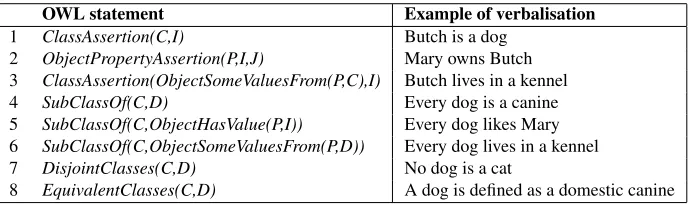
Table 1: Common axiom patterns in OWL. A study of over 200 ontologies indicated that these patterns comprise over 95% of all axioms (Power and Third, 2010). VariablesC,Ddenote classes,I,Jdenote individuals, andP denotes a property.
tology contains the axioms in table 1, and that we are interested in the relationship between the axioms numbered 6 and 3:
Every dog lives in a kennel. Butch lives in a kennel.
Even within our restricted formulation of the task, there are two sources of evidence that can be ex-ploited here. First, confining our attention to these two statements alone, we may note that they share the same predicate term ‘lives in a kennel’ (corre-sponding to a constructed class in OWL). On this basis we might presume that the statements are re-lated, and propose a neutral method of linking them such as ‘Every dog lives in a kennel; so does Butch’. However, we can go further if we exploit the sec-ond source of evidence,the other statements in the ontology— and in particular statement 1 which con-nects the terms ‘Butch’ and ‘dog’. Taking this into account, we could interpret the second statement in our pair (3) as an implication of the first statement (6), or perhaps as an example of it:
Every dog lives in a kennel; therefore so does Butch. Every dog, including Butch for example, lives in a kennel.
The purpose of this paper is to model systematically the patterns of relationship among the terms in two statements, and to show through an empirical study which pairs are judged to be rhetorically related, and which are not. For pairs judged to be related, we also present evidence on how the statements could be combined linguistically (e.g., using aggregation and/or discourse connectives).
2 Coherence model
We begin by constructing a simple model which covers OWL statements based on three axiom func-tors: ClassAssertion, ObjectPropertyAssertion, and
SubClassOf.2 The commonest patterns are shown in axioms 1-6 of table 1, along with sample English realisations conforming to most verbalisers (Kalju-rand and Fuchs., 2007; Hart et al., 2008; Schwitter and Meyer, 2007).
For the axioms considered, we can give a sim-ple uniform semantics in which each statement links two sets, one denoted by the subject, the other by the predicate; the meaning of the statement is that the predicate set contains the subject set. To accommo-date individuals within this scheme we can replace them by enumerated classes with only one member (in OWL these can be constructed using the functor
OneOf). Thus ‘Butch is a dog’ means that the set containing only Butch is a subset of the set of dogs; ‘Butch lives in a kennel’ means that the set contain-ing only Butch is a subset of the set of thcontain-ings that live in kennels, and so forth. Both statements in a pair can then be reduced to a pair of setsSP, whereSis the subject set andP is the predicate set, the
struc-ture of the pair beingS1P1+S2P2.3 With four sets
we now have six potential relationships to consider:
S1P1,S1S2,S1P2,P1S2,P1P2, andS2P2. Two of
these (S1P1,S2P2) correspond to the original
state-ments; the other four may be addressed elsewhere in
2Elsewhere (Power and Third, 2010) we have shown that
these functors cover around 80% of all axioms.
3Note that this semantics is derived from the underlying
Figure 1: Subject-Predicate relations for two statements
Figure 2: Relations among two sets
the ontology, thus providing additional information on whether and how the statements are rhetorically related. The six relationships are shown diagram-matically in figure 1 by the arrows labelled A–F.
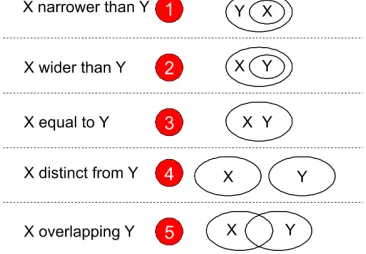
The next question is how these relationships among sets should be classified. Among various possibilities, a plausible method is shown in figure 2: given two sets X and Y, either X will be
nar-rower thanY, or wider, or equal, or distinct, or
over-lapping. These relations are represented in OWL as follows: (1) narrower by SubClassOf(X,Y); (2) wider bySubClassOf(Y,X); (3) equal by Equivalent-Classes(X,Y); (4) distinct by disjointClasses(X,Y); and (5) overlapping, implicitly, by absence of the above. A similar set of relations has been proposed by MacCartney and Manning (2009) for the textual entailment task.4
With this model, the rhetorical relationship be-tween two statements can be profiled by assigning an integer from 1–5 (figure 2) to each of the
relation-4MacCartney and Manning actually use seven relations,
be-cause they distinguish as a separate case disjoint and overlap relations in which the classesXandY cover all entities in the domain (i.e., every entity must belong either toX or toY or both). This refinement is not relevant for our purposes.
ships A–F (figure 1); to represent such assignments succinctly we will use a six-number code such as 131231 meaning A=1, B=3, C=1, D=2, E=3, F=1. If we assume that subjects are always narrower than predicates, two of these relations (A and F in figure 1) will always be 1. This leaves a potential54or 625
[image:3.612.94.277.195.322.2]combinations for the other four relations (B to E in figure 1). However, most of these combinations are contradictory; by writing a Prolog program5 which applies consistency constraints, we have shown that the consistent combinations number only 46 (Power, 2011a). These are presented with handcrafted exam-ples suggesting that some of the patterns are rhetori-cally coherent, while others, although logirhetori-cally con-sistent, are not. On the basis of these examples, the author judged that 11 pairs out of 46 were rhetori-cally related and 35/46 were not. The list was then given to two colleagues who picked out exactly the same eleven patterns, illustrated in table 2. In this table the patterns are also grouped, and given names which we hope are intuitively easier to grasp than their codes. On inspection, it turns out that a simple rule explains our selections: we judged a pattern co-herent either if the two statements had a set in com-mon (i.e., if the cross-statement relations B-E con-tained relation 3), or if all cross-statement relations were disjoint (i.e., 144441).
3 Empirical validation
The empirical study described in this section has two aims. First, we seek firmer evidence regard-ing the division of the 46 logically consistent pat-terns into coherent and incoherent (i.e., rhetorically related and unrelated). However intuitive this divi-sion, it is interesting not only to confirm it, but to see whether there are degrees of coherence both within the sheep (so to speak) and the goats. Secondly, where people judge that two statements have suffi-cient affinity to be presented together, we are inter-ested in how they combine them linguistically, and whether each pattern is associated with characteris-tic discourse connectives or syntaccharacteris-tic configurations. To generate examples for testing, it is convenient to construct an ontology that contains just enough material to produce at least one example for each
5The program can be downloaded from the website at Power
N Code Name Example
1 131211 Widening Elaboration Dogs are canines; dogs are vertebrates 2 131221 Narrowing Elaboration Dogs are vertebrates; dogs are canines 3 131251 Additive Elaboration Dogs are canines; dogs are domestic mammals 4 111231 Widening Comparison Dogs are vertebrates; canines are vertebrates 5 121231 Narrowing Comparison Canines are vertebrates; dogs are vertebrates 6 141231 Disjoint Comparison Dogs are vertebrates; cats are vertebrates
7 151231 Additive Comparison Canines are vertebrates; domestic mammals are vertebrates 8 111311 Forward Reasoning Dogs are canines; canines are vertebrates
[image:4.612.117.500.58.197.2]9 123221 Backward Reasoning Canines are vertebrates; dogs are canines 10 144441 Contrast Dogs are canines; cats are felines 11 131231 Restatement Dogs are canines; dogs are canines
Table 2: Classification of the coherent patterns
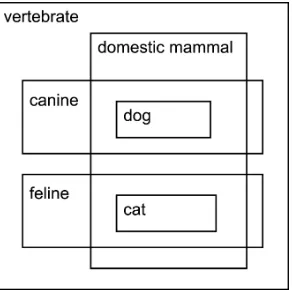
Figure 3: Minimal ontology for coherent patterns
pattern. For the eleven patterns hypothesised to be coherent, the minimalsuch ontology is shown dia-grammatically in figure 3. The important feature of this diagram is not the names of the classes, but their relationships; by varying the names it would be pos-sible to generate test examples in different domains. Note that to generate examples for all 46 consis-tent patterns, we would have to add more classes, the main reason being that incoherent patterns like 155551 require several classes that partially overlap one another (corresponding to weakly related con-cepts). However, using only the minimal ontology it is possible to generate 10 examples that werenot se-lected as coherent. It is therefore convenient to test the proposed coherence partition using only material generated from the minimal ontology: this ensures that the concepts used in all patterns are as similar as possible, and also yields two groups of roughly equal size. In fact, by eliminating the arguably triv-ial restatement pattern, in which the two statements
in the pair are exactly the same, we obtain exactly ten patterns in the group presumed coherent, and ten in the group presumed incoherent; all of these pat-terns are shown in table 3. To save space this ta-ble uses an abbreviated wording in the ‘Example’ column; the wording actually used is illustrated in figure 4, with ‘Dogs’ replaced by ‘A dog’, a formu-lation preferred by subjects in an evaluation of the SWAT verbaliser (Stevens et al., 2011).6
To present each participant with a conveniently brief task (in our experience, anything over five min-utes yields a high drop-out rate), two surveys were compiled from the patterns in table 3, each com-posed of five patterns from the coherent group and five from the incoherent group, arbitrarily selected and then arranged in a random order (the same for all subjects doing a given survey). Survey I was sent to the SIGDIAL mailing list, Survey II to the SIGGEN list. When uptake proved much greater for Survey II, we also sent Survey I to a local departmental list, and invited people on the SIGGEN list to do Survey I as well as (or instead of) II; since the questions were all different, no duplication resulted if a participant did both surveys. Overall 45 participants completed Survey I and 52 completed Survey II.7
A snapshot from Survey I is shown in figure 4.
6The issue of how best to word a universal statement
re-quires further research. ‘Every X is a Y’ is perhaps most pre-cise, but sometimes sounds unnatural; ‘Xs are Ys’ and ‘an X is a Y’ are more natural but more open to other interpretations. For the statements in the survey we assume it was obvious that a generic interpretation was intended, and no subjects commented that the sentences were ambiguous or in any way unclear.
7It can therefore be inferred from table 3 which questions
[image:4.612.114.260.241.386.2]N Code Freq % Example
1 WiEl 131211 25/45 56% Dogs are canines; dogs have backbones 2 NaEl 131221 37/52 71% Dogs have backbones; dogs are canines 3 AdEl 131251 30/45 67% Dogs are canines; dogs are domestic mammals 4 WiCp 111231 37/45 82% Dogs have backbones; canines have backbones 5 NaCp 121231 34/45 76% Canines have backbones; dogs have backbones 6 DiCp 141231 50/52 96% Canines have backbones; felines have backbones
7 AdCp 151231 24/52 46% Canines have backbones; domestic mammals have backbones 8 FwRe 111311 51/52 98% Dogs are canines; canines have backbones
9 BwRe 123221 42/52 81% Canines have backbones; dogs are canines 10 CoRe 144441 43/45 96% Dogs are canines; cats are felines
Total 373/485 77%
11 Incoh 111511 0/45 0% Dogs are canines; domestic mammals have backbones 12 Incoh 125221 9/52 17% Canines have backbones; dogs are domestic mammals 13 Incoh 141211 2/45 4% Dogs are domestic mammals; cats have backbones 14 Incoh 141221 4/52 8% Dogs have backbones; cats are domestic mammals 15 Incoh 141411 2/45 4% Dogs are canines; felines have backbones 16 Incoh 141451 12/52 23% Dogs are canines; cats are domestic mammals 17 Incoh 141511 0/45 0% Dogs are domestic mammals; felines have backbones 18 Incoh 144221 2/52 4% Dogs have backbones; cats are felines
19 Incoh 144251 2/45 4% Dogs are domestic mammals; cats are felines 20 Incoh 145221 3/52 6% Canines have backbones; cats are domestic mammals
[image:5.612.104.513.58.321.2]Total 36/485 7%
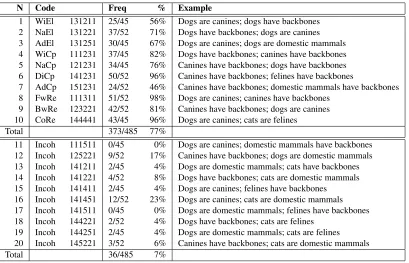
Table 3: Coherence judgements for each pattern. Subjects were asked to judge whether the statements in each pair could be appropriately presented together. The data are the number of ‘Yes’ responses to this question. Patterns 1–10 were hypothesised coherent, patterns 11–20 incoherent.
Figure 4: First question in Survey I
Participants were asked to judge whether it would be appropriate to link the two statements in a text (in the given order), by presenting them either in the same sentence or in consecutive sentences; if they answered this question in the affirmative, there was an optional follow-up question asking them to in-dicate, by typing freely into a text box, how they might combine them. To score these responses, we counted four features:
And: The statements were combined neutrally us-ing ‘and’, or a full stop or a semicolon, without any discourse connective.
Con: A discourse connective was employed (possi-bly in addition to ‘and’).
Agg: Either the subject or predicate terms of the statements were aggregated.
Rel: One statement was expressed as a relative clause inside the other.
Pattern Connectives
Widening Elaboration therefore (4), hence (1), so (1), which means that (1)
Narrowing Elaboration also (2), because (2), in addition (2), more specifically (2), furthermore (1), moreover (1)
Additive Elaboration however (1), therefore (1)
Widening Comparison because (6), in fact (5), like (5), as (4), as do (2), since (2), so (2), as does (1), for example (1), in general (1), as well as (1), more generally (1), therefore (1) Narrowing Comparison therefore (8), so (5), hence (4), for example (3), as (2), like (2), as does (1),
as well (1), in particular (1), including (1), ipso facto (1), such as (1) Disjoint Comparison also (6), too (6), as well as (2), so does (2), just like (1), similarly (1)
Additive Comparison as do (2), actually (1), also (1), for (1), in general (1), like (1), so do (1), too (1) Forward Reasoning also (1), therefore (1)
[image:6.612.109.505.59.223.2]Backward Reasoning for example (5), e.g. (2), example is (2), as (1), by the way (1), therefore (1) Contrast whereas (11), while (10), but (3), however (1), as (1)
Table 5: Connectives suggested for each pattern, with their frequencies
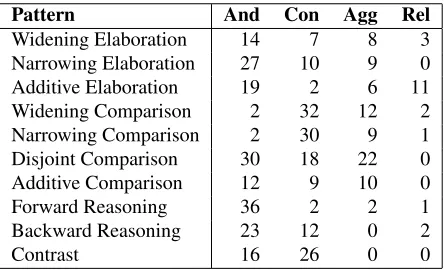
Pattern And Con Agg Rel
Widening Elaboration 14 7 8 3 Narrowing Elaboration 27 10 9 0 Additive Elaboration 19 2 6 11 Widening Comparison 2 32 12 2 Narrowing Comparison 2 30 9 1 Disjoint Comparison 30 18 22 0 Additive Comparison 12 9 10 0 Forward Reasoning 36 2 2 1 Backward Reasoning 23 12 0 2
Contrast 16 26 0 0
Table 4: Frequencies of various devices for combining the statements in the ten coherent patterns presented. ‘And’ = Linked only by ‘and’ or punctuation; ‘Con’ = Connective; ‘Agg’ = Aggregation; ‘Rel’ = Relative clause.
4 Analysis of results
4.1 Coherent and incoherent
The first question is whether the results confirm our intuitive classification of the patterns into coherent and incoherent. Table 3 demonstrates clearly that they do. Summing across all subjects, we obtained 373/485 (77%) positive responses for patterns that satisfied our coherence criterion (upper half of table 3), compared with 36/485 (7%) positive responses for patterns that did not satisfy this criterion (lower half) – obviously a highly significant association8. Overall, judgements were fairly evenly divided
be-8On a 2x2χ2test for association between pattern (coherent vs incoherent) and judgement (positive vs negative) we obtain χ2=480 withdf=1, two-tailedp <0.00001.
tween positive and negative, with 409 ‘Yes’ answers against 561 ‘No’ answers.
Looking in more detail at the coherent group, we found clear differences in degree, with several pat-terns obtaining positive responses of 95% and over, with others not far above the 50% level (and one just below). On a two-tailed binomial test assum-ing equala prioriprobabilities for ‘Yes’ and ‘No’, frequencies over 70% are significant at thep <0.01
level and frequencies over 75% at the p < 0.001
level; thus we have three patterns (widening elabora-tion, additive elaboraelabora-tion, additive comparison) for which there is not a clear consensus that the state-ments are related closely enough to be combined in a discourse.
4.2 Distinctive realisation
The second question is whether we find evidence that the coherent patterns are distinctive, as shown by the linguistic devices by which they are com-bined. Here table 4 shows that the realisation pro-files for the ten patterns differ sharply. With rel-atively few responses these results should be seen only as suggestive, but several trends are already ap-parent:
• For widening and narrowing comparison, a dis-course connective is almost always used; for the other patterns, combinations using only ‘and’ or a full stop are common.
[image:6.612.75.297.264.399.2]used; for the other patterns connectives other than ‘and’ are common.
• Aggregation is commonly used for comparisons, and especially for disjoint comparison (e.g., ‘Ca-nines and felines have backbones’).
• Relative clause combinations are commonly used only for one pattern, additive elaboration (e.g., ‘Dogs, which are domesticated mammals, belong to the canine family’).
4.3 Discourse connectives
The final question is whether the discourse connec-tives proposed for the coherent patterns are distinc-tive, and linked to familiar rhetorical relations such as EVIDENCE and EXAMPLE. Here again the re-sults are only suggestive, but consistent themes do emerge from the subjects’ choices. For widening and narrowing elaboration these choices signal the EVIDENCE relation (‘therefore’, ‘because’) as well asELABORATION(‘also’, ‘moreover’). For widen-ing and narrowwiden-ing comparison EVIDENCE is also common, with more signs of sensitivity to gener-alising or specifying (‘more generally’, ‘in particu-lar’), a rhetorical move somewhat neglected in RST and other theories. For all comparisons, but espe-cially disjoint comparison, the connectives often sig-nal SIMILARITY. Backward reasoning is the only pattern for which choices often signalledEXAMPLE. Finally, choices for our contrast pattern were dom-inated by ‘whereas’ and ‘while’, marking as one would expect theCONTRASTrelation.
5 Discussion
5.1 Comparison with other approaches
The most similar work, both in spirit and substance, is the taxonomy of coherence relations proposed by Sanders et al. (1992), who also aim to cover a re-stricted set of relations using relatively precise the-oretical concepts. Their fundamental distinction is betweencausalandadditiverelations, where ‘cause’ is defined (oddly) as animplicationbetween two dis-course segments: thus if one statement implies the other we have a causal relation; if not we have an additive one. Causal relationships are further distin-guished by order of presentation: if antecedent pre-cedes consequent the order isbasic, otherwise
non-basic. The theory also distinguishes whether the re-lation is semantic or pragmatic, and whether state-ments are presented in positive or negative polar-ity; these features are not distinguished in our model which is restricted to semantic relations and positive polarity. Combining the values of their four features, Sanders et al. list 12 patterns of which three are comparable with ours: (1) Causal-Semantic-Basic-Positive, (2) Causal-Semantic-Nonbasic-Causal-Semantic-Basic-Positive, and (3) Additive-Semantic-Positive; the first two are labelled ‘Cause-consequence’ and the third ‘List’.
In our model, the causal-additive distinction is easily made for the elaboration patterns (i.e., those with equivalent subject terms): if the predicate terms are widening or narrowing the relation is ‘causal’, if they overlap it is ‘additive’ (hence our choice of that word). The basic order for elaboration is widening elaboration (e.g., ‘dogs are canines’ im-plies ‘dogs are vertebrates’); narrowing elabora-tion is non-basic. For comparison patterns (those with equivalent predicate terms) the same distinc-tions hold, except that this time the basic order is narrowing comparison, and widening comparison is non-basic. Note however that we find no evidence that the basic order is preferred: on the contrary, positive coherence judgements were more common for the non-basic orders both for the elaboration and comparison patterns (although the differences are not large). We also find quite different realisa-tion profiles for widening elaborarealisa-tion and narrow-ing comparison (both Causal-Basic in Sanders et al.’s taxonomy), and for narrowing elaboration and widening comparison (both Causal-Nonbasic). In line with Sanders et al. we obtain discourse con-nectives signalling implication (‘therefore’, ‘since’ etc.) for all these ‘causal’ patterns, but we also ob-tain connectives signalling generalisation or specifi-cation (‘more generally’, ‘in particular’) and exem-plication (‘for example’) that depend on our more detailed classification.
Comparing our classification with RST is harder since the approaches are so different. Unlike Sanders et al., RST is not concerned with order of presentation, and has instead an asymmetry in the
Regard-ing coverage, we can informally link our patterns to the following RST relations (Carlson and Marcu, 2001): comparison, contrast, elaboration-additional, elaboration-general-specific, example, and restate-ment.9 On the other hand we cover some relations apparently missing from RST, which lacks any no-tion of co-premise (found in our forward and back-ward reasoning patterns), or of moving from spe-cific to general or vice-versa (our distinction be-tween widening and narrowing).
5.2 Limitations
As already mentioned, the methods proposed here are bounded by characteristics of the ontology ver-balisation task: since the OWL standard (Horrocks et al., 2003) lacks any representation of pragmat-ics, or time, or causal relations between events, or modality, or probability, many relations dependent on these concepts lie outside our compass. However, even within this restriction of coverage, the theory and evaluation described here are far from complete. Recall first of all that we have covered only those patterns in which the subject of each statement de-notes asubclassof the predicate (relation number 1 in our code). Thus we cover ‘every dog is a canine’ (dogs are a subclass of canines), but not the follow-ing sentence patterns:
(2) Only canines are dogs (subject is super-class of predicate)
(3) A dog is defined as a domestic canine (sub-ject and predicate are equivalent)
(4) No dog is a cat (subject and predicate are disjoint)
(5) Some pets are canines10(subject and
pred-icate overlap)
In verbalising ontologies it would be unnecessary to cover pattern (2), which is merely an awkward inversion of SubClassOf, or (5), which is repre-sented in OWL only indirectly. However, patterns (3) and (4) should be covered, since they correspond to the OWL functors DisjointClasses and Equiva-lentClasses, and their inclusion would raise the total 9The restatement pattern 131231 was deemed too trivial for
inclusion in the survey, but might plausibly occur either for em-phasis or to explain technical terms – for instance ‘Corgis are domestic canines, that is, they are dogs’.
10Actually this sentence is an oversimplified rendition of
overlap, which would also require that some pets are not ca-nines and some caca-nines are not pets.
number of patterns from 46 to 297, and the subset conforming to our coherence rule from 11 to 62.11
A second limitation concerns the empirical val-idation, which addresses only a single very small content domain. Looking at a wider set of examples, it might emerge that the fivefold classification of se-mantic relations used here is oversimple, and that the taxonomic information in ontologies can be put to better use. To take just one example, the coher-ence of the disjoint comparison pattern might plau-sibly depend on the subject terms being not only dis-joint, but alsosiblingsin the taxonomy (Milosavlje-vic, 1997) – i.e., concepts at the same level of gener-ality: subjects might be less inclined to judge the ex-ample coherent if canines were compared with tens rather than felines, even though canines and kit-tens are also disjoint.
Next, we could probably produce a more flexible and generally applicable model if the semantic rela-tions among sets were relaxed so that they allowed exceptions. In particular, by enforcing strict consis-tency we lose the pattern 131241, disjoint elabora-tion, in which a subject term is assigned to two in-compatible predicates (e.g., ‘Butch is a wolf; Butch is a pet’). If we defined relations 1-4 in a way that allowed a little leeway (e.g., X is nearly a subclass of Y; X and Y are nearly disjoint; etc.), the reper-toire of ‘consistent’ patterns could be expanded, and we would obtain a plausible context for the re-lations typically signalled by ‘but’ and ‘however’ (e.g., CONCESSION). Such a model would be use-ful for a system generating from data, which might find a few instances of wolf pets in a dataset where nearly all wolves are non-pets and nearly all pets are non-wolves, and thus generate ‘Butch is a pet even though he is a wolf’.
Finally, we have considered only how a rhetori-cal relationship could be assigned to apairof state-ments, ignoring the issue of how a globally coherent text could be planned from pairwise assignments. However, this topic is already addressed in the lit-erature, for instance by Marcu’s (1997) bottom-up planning algorithms.
11For details on how these numbers are computed see Power
6 Conclusion
We have sketched a model through which an NLG system could decide whether two formally encoded statements are rhetorically related, and if so how, by examining cross-statement semantic relations ev-idenced by other statements in the knowledge base. Although in its early stages, the work suggests that a formal basis for assigning rhetorical relations is possible, at least for some relations. As well as guiding NLG systems that generate from ontologies and/or data, our method might prove useful in auto-matically detecting rhetorical relations in naturally-occurring text; in fact it has already been applied successfully to the task of textual entailment (Mac-Cartney and Manning, 2009), which could be re-garded as a special case in which the only rhetorical relation of interest isCONSEQUENCE.
Acknowledgments
The SWAT project (Semantic Web Authoring Tool) is supported by the UK Engineering and Phys-ical Sciences Research Council (EPSRC) grants G033579/1 (Open University) and G032459/1 (Uni-versity of Manchester). Thanks are also due to col-leagues and reviewers for their comments and sug-gestions.
References
Attempto Project. 2011. ACE OWL Verbalizer. Web-site. http://attempto.ifi.uzh.ch/site/ tools/.
Lynn Carlson and Daniel Marcu. 2001. Discourse tag-ging manual. Technical report, ISI Tech Report ISI-TR-545.
Glen Hart, Martina Johnson, and Catherine Dolbear. 2008. Rabbit: Developing a control natural language for authoring ontologies. In Manfred Hauswirth, Manolis Koubarakis, and Sean Bechhofer, editors,
Proceedings of the 5th European Semantic Web Con-ference, pages 348–360.
Jerry Hobbs. 1985. On the coherence and structure of discourse. Technical report, Stanford University. Ian Horrocks, Peter F. Patel-Schneider, and Frank Van
Harmelen. 2003. From shiq and rdf to owl: The mak-ing of a web ontology language. Journal of Web Se-mantics, 1:2003.
Kaarel Kaljurand and Norbert Fuchs. 2007. Verbalizing OWL in Attempto Controlled English. In OWLED: OWL Experiences and Directions.
A. Knott. 1996. A data-driven methodology for moti-vating a set of coherence relations. Technical report, University of Edinburgh. Ph.D. thesis.
Shao Fen Liang, Donia Scott, Robert Stevens, and Alan Rector. 2011. Unlocking Medical Ontologies for Non-Ontology Experts. In Proceedings of the 49th Annual Meeting of the Association for Computational Linguistics: Human Language Technologies.
Bill MacCartney and Christopher D. Manning. 2009. An extended model of natural logic. In Proceed-ings of the Eighth International Conference on Com-putational Semantics, IWCS-8 ’09, pages 140–156, Stroudsburg, PA, USA. Association for Computational Linguistics.
W. Mann and S. Thompson. 1987. Rhetorical structure theory: a theory of text organization. In L. Polyani, ed-itor,The structure of discourse, Norwood, NJ. Ablex. Daniel Marcu. 1997. From Local to Global
Coher-ence: A Bottom-Up Approach to Text Planning. In
AAAI/IAAI, pages 629–635.
Maria Milosavljevic. 1997. Augmenting the user’s knowledge via comparison. In In Proceedings of the 6th International Conference on User Modelling, pages 119–130.
Richard Power and Allan Third. 2010. Expressing OWL axioms by English sentences: dubious in theory, fea-sible in practice. InProceedings of the 23rd Interna-tional Conference on ComputaInterna-tional Linguistics. Richard Power. 2011a. Coherence relations in
ontolo-gies. Technical Report Technical Report TR2011-01, ISSN 1744-1986, Department of Computing, Open University.
Richard Power. 2011b. Rhetorical Coherence Patterns. Website. http://mcs.open.ac.uk/rp3242/
rhetoric.html.
T. Sanders, W. Spooren, and L. Noordman. 1992. To-ward a taxonomy of coherence relations. Discourse Processes, (15):1–35.
Rolf Schwitter and Thomas Meyer. 2007. Sydney OWL Syntax - towards a Controlled Natural Language Syn-tax for OWL 1.1. InOWLED: OWL Experiences and Directions.
Robert Stevens, James Malone, Sandra Williams, Richard Power, and Allan Third. 2011. Automat-ing generation of textual class definitions from owl to english. Journal of Biomedical Semantics, 2(S 2:S5), May.
SWAT Project. 2011. SWAT Natural Language Tools. Website.http://swat.open.ac.uk/tools/. Sandra Williams, Allan Third, and Richard Power. 2011.
Levels of organisation in ontology verbalisation. In