Efficient Matrix-Encoded Grammars and Low Latency Parallelization
Strategies for CYK
Aaron Dunlop, Nathan Bodenstab and Brian Roark Center for Spoken Language Understanding
Oregon Health & Science University Portland, OR
[aaron.dunlop,bodenstab,roarkbr]@gmail.com
Abstract
We present a matrix encoding of context-free grammars, motivated by hardware-level efficiency considerations. We find effi-ciency gains of 2.5–9× for exhaustive in-ference and approximately 2× for pruned inference, resulting in high-accuracy pars-ing at over 20 sentences per second. Our grammar encoding allows fine-grained par-allelism during chart cell population; we present a controlled study of several meth-ods of parallel parsing, and find near-optimal latency reductions as core-count in-creases.
1 Introduction
Constituent parsers are important for a number of information extraction subtasks — e.g., anaphora and coreference resolution and semantic role la-beling — and parsing time is often a bottleneck for such applications (Bjrne et al., 2010; Banko, 1999). Most constituent parsers leverage the dy-namic programming “chart” structure of the CYK algorithm, even when performing approximate in-ference. The inner loop of the CYK algorithm computes an argmax for each constituent span by intersecting the set of observed child cate-gories spanning adjacent substrings with the set of rule productions in the grammar. This ‘gram-mar intersection’ operation is the most compu-tationally intensive component of the algorithm. Prior work has shown that the grammar encod-ing can greatly affect parsencod-ing efficiency (c.f Klein and Manning (2001), Moore (2004), Penn and Munteanu (2003)); in this paper we present a ma-trix encoding that can encode very large grammars to maximize inference efficiency.
This matrix grammar encoding allows a refac-toring of the CYK algorithm with two beneficial properties: 1) the number of expensive grammar intersection operations is reduced from O(n3) to
O(n2); and 2) since grammar intersection is re-duced to a set of matrix operations, the resulting algorithm is amenable to fine-grained paralleliza-tion.
Most discussion of parallel parsing concentrates onthroughput, the aggregate number of sentences parsed per second on a particular machine. In this study, we are also interested in applications for which response time is of interest (e.g., real-time speech recognition and machine translation), and thus consider latency, the time to parse a single sentence, as a primary objective. Given ideally efficient algorithms and hardware, there would be no tradeoff between the two — that is, we would be able to parallelize each sentence across an arbitrary number of processor cores, re-ducing latency and increasing throughput linearly with core-count. Unfortunately, hardware con-straints and Amdahl’s law ensure that we will never achieve that ideal speedup; in practice, we are likely to see some tradeoff. We will demon-strate interesting patterns of the tradeoff between throughput and latency with various paralleliza-tion methods, allowing consumers to tailor parsing strategies to particular application requirements.
Our grammar intersection method is amenable to graphics processors (GPUs) and similar massively-parallel architectures. In this work, we perform our analysis on a multicore CPU system. We demonstrate the utility of this approach using a number of different grammars, including the la-tent variable grammar used by the Berkeley parser (Petrov et al., 2006). We show large speedups compared to a traditional CYK implementation for serial inference, parsing over 20 sentences per sec-ond with the Berkeley grammar. Parallelizing this algorithm reduces average latency to .026 seconds. The remainder of this paper is organized as fol-lows: we begin in Section 2 with background on the CYK algorithm and various general and CYK-specific parallelization considerations. In
tion 3 we provide a detailed presentation of our grammar encoding, data structures, and intersec-tion method. In Secintersec-tion 4, we demonstrate their effectiveness on a single core and present con-trolled experiments comparing several paralleliza-tion strategies.
2 Background
2.1 CYK
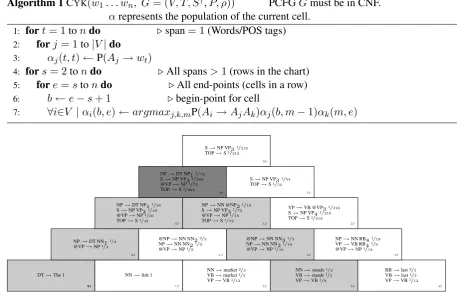
Algorithm 1 shows pseudocode of the widely used CYK algorithm. Briefly, constituents spanning longer substrings are built from shorter-span con-stituents via a chart structure, as shown in Figure 1. Span-1 cells (the bottom row of the chart) are initialized with all part-of-speech (POS) tags, and with unary productions spanning a single word. At higher span cells in the chart, such as the dark grey cell in Figure 1, new constituents are built by com-bining constituents spanning adjacent substrings, guided by the productions in the grammar. With a probabilistic context-free grammar (PCFG) the maximum likelihood solution is found by storing, in each cell in the chart, the highest probability for each category in the non-terminal setV along with a backpointer to where that solution came from. Dynamic programming reduces this poten-tially exponential search toO(n3)complexity.
2.2 Parallelism
Since smooth parallelization is one of the benefits of the algorithm we will present in Section 3.2, we begin with background on some of the barri-ers to efficient parallelism. The overhead of par-allelism takes many forms.1 The operating sys-tem consumes processor cycles in thread schedul-ing; coordination and synchronization of concur-rent tasks can leave processors idle; and (more im-portantly to memory-bound applications such as parsing) context switching between threads often requires flushing the CPU cache, resulting in more memory contention and stalls.
Further, some multi-core architectures share L2 or L3 caches between CPU cores, and nearly all share bandwidth to memory (the ‘front-side bus’, or FSB). Parallel execution threads compete for those resources, and may stall one another. Thus, parallelism can introduce considerable hardware
1
We are concerned primarily with parallelism within a single machine. Cluster-level parallelism incurs network la-tency, shared filesystem, and other forms of overhead that do not concern us here.
overhead, even if OS- and task-level overhead are minimal, but this impact can be minimized if con-current threads share common data structures.
2.3 Low-Latency Parallel CYK
We observe that CYK parsing can be parallelized in (at least) three distinct ways, each likely to have different advantages and disadvantages vis-`a-vis the bottlenecks just discussed:
Sentence-level: The simplest way to parallelize parsing is to parse sentences or documents inde-pendently on separate cores. This approach is well-understood, simple to implement, and quite effective. Total throughput should scale roughly linearly with the number of cores available, at least until we reach the limits of memory bandwidth, but latency is not improved — and may actually in-crease.
Cell-level: In most forms of CYK iteration, we populate each cell separately, leading to a straight-forward form of cell-level parallelism. For exam-ple, in bottom-up cell iteration order, we popu-late one chart row fully before proceeding to the next. The cells on each row are independent of one another, so we can process all cells of a row in parallel. Unfortunately, as we move higher in the chart, there are fewer cells per row, and we must leave CPU cores idle. The highest cells in the chart are often the most densely populated (and require the most processing), an inherent limitation of this form of parallelism.2
Ninomiya et al. (1997) explored cell-level par-allelization on a 256-processor machine. Their method incurred an overhead of 6–10×vs. their baseline serial algorithm (depending on sentence length). That is, their parallel algorithm ran 6– 10 times slower on a single core than a simpler serial implementation. So even if their approach scaled ideally, many cores would be required to match their serial baseline performance. In prac-tice, their algorithm did not scale linearly and required approximately 64 CPUs to equal their baseline single-CPU performance, and the total speedup observed on 256 CPUs was only 2–4×.
Grammar-level: Parallelization within a chart cell is more difficult to implement, but may avoid some of the weaknesses of the first two methods described. If we can fully parallelize cell popu-lation, we can make use of all available cores
Algorithm 1CYK(w1. . . wn, G= (V, T, S†, P, ρ)) PCFGGmust be in CNF. αrepresents the population of the current cell.
1: fort= 1tondo .span= 1(Words/POS tags) 2: forj= 1to|V|do
3: αj(t, t)←P(Aj →wt)
4: fors= 2tondo .All spans>1(rows in the chart) 5: fore=stondo .All end-points (cells in a row) 6: b←e−s+ 1 .begin-point for cell
7: ∀i∈V |αi(b, e)←argmaxj,k,mP(Ai→AjAk)αj(b, m−1)αk(m, e)
DT→The 1
0,1 0,1
NN→fish 1
1,2
NN→market2/3
VB→market1/3
VP→VB1/12 2,3
NN→stands1/2
VB→stands1/2
VP→VB1/8 3,4
RB→last2/3
VB→last1/3
VP→VB1/12 4,5
NP→DT NN11/4
@VP→NP1/4 0,2
@NP→NN NN22/3
NP→NN NN21/9
@VP→NP1/9 1,3
@NP→NN NN31/3
NP→NN NN31/18
@VP→NP1/18 2,4
NP→NN RB41/18
VP→VB RB41/6
@VP→NP1/18 3,5
NP→DT NP11/36
S→NP VP21/48
@VP→NP1/36
TOP→S1/48 0,3
NP→NN @NP21/18
S→NP VP31/72
@VP→NP1/18
TOP→S1/72 1,4
VP→VB @VP31/216
S→NP VP41/216
TOP→S1/216 2,5
NP→DT NP11/72
S→NP VP31/288
@VP→NP1/72
TOP→S1/288 0,4
S→NP VP31/54
TOP→S1/54 1,5
S→NP VP31/216
[image:3.595.65.523.69.366.2]TOP→S1/216 0,5
Figure 1: Example CYK chart, with target cell 0,4 highlighted in dark gray and the child cells involved in popu-lating it highlighted in light gray.
gardless of the cell iteration order or the current position in the chart.3 Because each thread is op-erating on the same cell, their working sets may align more closely than in other forms of paral-lelism, reducing context-switch overhead. How-ever, this method implies very fine-grained task di-visions and close coordination between threads — when we split a single grammar intersection oper-ation across many threads, each task is quite small. At this fine granularity, locking of shared data structures is impractical, so we must divide tasks such that they share immutable data (the grammar and current cell population) but do not simultane-ously mutate the same target data structures (e.g., individual threads may populate separate ranges of non-terminals in the target cell, but must not attempt to populate the same range). Even with careful task division, the task management may overwhelm the potential gains. Youngmin et al. (2011) presented one approach to this problem; we present another approach in Section 3.2.
3
Of course, we can utilize sentence-level and cell-level parallelism as well.
3 Methods
3.1 Matrix Grammar Encoding
Retrieval of valid grammar rules and their prob-abilities is an essential component of context-free parsing. High-accuracy grammars can exceed mil-lions of productions, so efficient model access is critical to parsing performance. Prior work on en-coding the grammar as a finite state automaton (Klein and Manning, 2001) and prefix compacted tries (Moore, 2004) demonstrated that model en-coding can lead to significant efficiency gains in parsing.4 Motivated to address hardware bottle-necks and constraints, we present a novel encod-ing in matrix form.
Given a binarized probabilistic context-free grammar (PCFG) defined as the tuple
(V, T, S†, P, ρ) where V is the set of non-terminals,T is the set of terminals,S†is a special start symbol,P is the set of grammar productions, and ρ is a mapping of grammar productions to probabilities, we subdivide P into binary rules,
Pb, and unary rules,Pu.
We encode Pb in matrix form, where the rows
of the matrix1..|V|represent a production’s
left-4
hand-side non-terminal, and the columns repre-sent a tuple of all possible right-hand-side non-terminals (pairs in a binarized grammar). This forms a matrix of|V|rows and|V|2columns. Fig-ure 2 shows a simple grammar represented in this format.
In theory, this matrix could contain |V|3 en-tries, but most grammars of interest are incred-ibly sparse, populating only a very small frac-tion of the possible matrix cells. For example, the Berkeley latent-variable grammar defines 1134 non-terminals, so a fully populated binary rule ma-trix would contain 1.49 billion rules, but the gram-mar only populates 1.73 million. Thus, we choose a ‘compressed sparse column’ sparse matrix repre-sentation (Tewarson, 1973). This storage structure is quite dense — we store the binary rules of the Berkeley grammar in approximately 10.5 MB of memory. Further, the rules are stored contiguously in memory and in order of access, so the gram-mar intersection operations should be very cache-efficient.
3.2 Matrix-Vector Grammar Intersection
We now present a novel intersection method, based on the grammar encoding from Section 3.1, which decouples midpoint iteration from gram-mar intersection, and can reduce the cell pop-ulation cost considerably. We begin by point-ing to Algorithm 1, the standard CYK algorithm. The argmax on line 7 intersects the set of ob-served child categories spanning adjacent sub-strings (stored in chart cells) with the set of rule productions found in the grammar. Algorithms 2 and 3 show two possible grammar intersection methods, one which loops over productions in the grammar (Alg. 2) and one which loops over left-children prior to looking for grammar productions (Alg. 3). Song et al. (2008) explored a num-ber of such grammar intersection methods, and found Algorithm 3 to be superior for right-factored grammars. We now present a novel intersection method based on the grammar encoding from Sec-tion 3.1. The descripSec-tion in this secSec-tion is infor-mal, with midpoints omitted for clarity. In Sec-tion 3.3, we will formalize the method as an appli-cation of a lexicographic semiring.
We represent the population of each chart cellα
as a vector inR|V|. Each dimension of this vector
represents the (log) probability of a non-terminal
Algorithm 2Grammar intersection via full gram-mar loop (backpointer storage omitted). α(b, e)
represents the population of the cell spanning wordsbtoe.
α(b, e)←0
form=b+ 1toe−1do forAi →AjAk∈P do
x←P(Ai→AjAk)αj(b, m−1)αk(m, e)
ifx > αi(b, e)then
αi(b, e)←x
Algorithm 3 Grammar intersection via left child grammar loop
α(b, e)←0
form=b+ 1toe−1do forj∈α(b, m−1)do
forAi→AjAk∈P do
x←P(Ai→AjAk)αj(b, m−1)αk(m, e)
ifx > αi(b, e)then
αi(b, e)←x
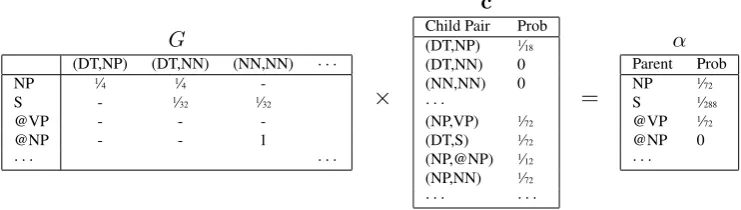
in that cell. To perform the argmax, we popu-late a temporary vectorcof|V|2dimensions with the cartesian product of all observed non-terminals from the left and right child cells over all mid-points. That is, each dimension of this vector rep-resents an ordered pair of non-terminals from the grammar, and its length (score) is the product of the inside probabilities of the respective children. For any child pairs which occur at multiple mid-points, we record only the most probable.
For example, when populating the highlighted cell (0,4) in Figure 1, the first midpoint (m=1) adds (DT,NP), (DT,S), and (DT,@VP) to c; the second midpoint (m=2) will add (NP,@NP), (NP,@VP), (@VP,@NP), and so on. If we ob-serve the same pair at multiple midpoints, we re-tain only the maximum score.
Given a matrix-encoded grammar, G, and the child-cell vector, c, we simply multiply G by c
num-G
(DT,NP) (DT,NN) (NN,NN) · · ·
NP 1⁄
4 1⁄4
-S - 1⁄32 1⁄32
@VP - -
-@NP - - 1
· · · ·
×
c Child Pair Prob (DT,NP) 1⁄
18
(DT,NN) 0 (NN,NN) 0
· · ·
(NP,VP) 1⁄72
(DT,S) 1⁄72
(NP,@NP) 1⁄ 12
(NP,NN) 1⁄ 72
· · · ·
=
α Parent Prob NP 1⁄
72
S 1⁄288
@VP 1⁄72
@NP 0
[image:5.595.108.479.68.173.2]· · ·
Figure 2:Example matrix-vector multiplication for cell 0,4 in Figure 1. The grammarGencodes binary rules as a|V| × |V|2matrix, with rows representing parents and columns representing child pairs. The vectorccontains
non-terminal child pairs observed across all possible midpoints. The matrix-vector product ofG×cproduces the target cell population,α. Factored categories are prefixed with ‘@’, and backpointers are omitted for clarity.
Algorithm 4Grammar intersection via Sparse Matrix×Vector Multiplication.
h(l, r)mapsl, r∈V to an index ofc c←0
form=b+ 1toe−1do forj = 1to|V|do
fork= 1to|V|do
i←h(αj(b, m−1), αk(m, e))
ifαj(b, m−1)αk(m, e)>ci then ci ←αj(b, m−1)αk(m, e)
α(b, e)←G·c
ber of expensive grammar operations fromO(n3)
toO(n2).
We note the similarity to the formalisms of Valiant (1975), which transforms parsing into boolean matrix multiplication, and Lee (1997), which inverts that transformation. However, the similarity is only superficial; Valient’s algorithm populates an upper-triangular matrix, the elements of which are equivalent to CYK chart cells. Each matrix element is a subset ofV, the observed pop-ulation of the analogous chart cell. The matrix is populated by a transitive closure operation, which takes the place of the CYK algorithm. Our matrix operation, on the other hand, is concerned with the population of individual chart cells, the operation accomplished by Valient’s∗operator.
Decoupling the midpoint iteration from gram-mar intersection is not contingent on our matrix-vector encoding. The optimization in Graham et al. (1980) also refactors the CYK algorithm to result in O(n2) grammar intersection operations by changing the dynamic programming to iterate through right (or left) child cells and build new (parent) categories in multiple chart cells at once.
Similarly, the grammar-loop intersection of Algo-rithm 2 could be modified to first maximize over all midpoints, then iterate over grammar produc-tions as is done in Algorithm 4. However, nei-ther variation lends itself to straightforward paral-lelization, and the required synchronization would severely impact parallel efficiency.
In contrast, the cartesian product and matrix-vector operations of our SpMV method parallelize easily across many cores. We subdivide V into segments, one for each thread. Each thread iterates over its own subset ofV in the left child cell and combines with all entries in the right child cell, populating an entry in c for each observed child pair.cis represented as independent segments safe for lock-free mutation by independent threads (see Section 3.4).
To perform the matrix-vector operation in paral-lel, we retain the same segments ofc, and segment
Gsimilarly. Each threadtmultiplies its segment
Gt·ct, producing a vectorαt. We then merge the
αtvectors into the finalα. Since|V|<<|c|, this
final merge is quite efficient.
3.3 Lexicographic Semiring
We now present Algorithm 4 more formally as an application of a lexicographic semiring (Golan, 1999). Roark et al. (2011) recently applied lexi-cographic semirings to language-model encoding. We will follow their notational conventions, and refer the interested reader to their detailed discus-sion.
A semiring is a ring, possibly lacking negation, defining two operations ⊕ and ⊗ and their re-spective identity elements¯0and¯1(Kuich and Sa-lomaa, 1985). One common example in speech and language applications is thetropical semiring
with identity∞, and+is the⊗, with identity0. This definition is often used for Viterbi search, us-ing negative log probabilities as costs.
A lexicographic semiring is defined over tu-ples of weights hW1, W2. . . Wni, with the con-dition that the tuples can be ordered first by W1, then by W2, and so on (similar to lexicographic string comparison, resulting in the name). We use the hT, Ti semiring, defined as a pair of tropical weights:
hw1, w2i ⊕ hw3, w4i=
hw1, w2i
ifw1< w3or (w1=w3&
w2< w4)
hw3, w4i otherwise
hw1, w2i ⊗ hw3, w4i=hw1+w3, w2+w4i
In our application,W1encodes the negative log probability of a production inGor of an observed non-terminal in the chart. W2 encodes the mid-point of the maximum-probability analysis.5 To perform grammar intersection using this semiring, we encode the grammar matrix as described in Section 3.2, and include 0asW2 for each gram-mar entry (since this weight is constant, it need not be encoded in the grammar representation).
We populate a vector of tuples ci for each possible midpoint of the cell, and c =
c1 ⊕ c2 ⊕ . . . cspan.⊕compares withmin, so
the entries inc will be from the maximum prob-ability midpoints and the first midpoint will ‘win’ in the case of a tie.
When we multiplyG·cin thehT, Tisemiring, we use the⊗multiplication operator on each indi-vidual element, and the⊕addition operator for the sum. SinceW2 is 0 for all entries inG, the mid-points are simply carried over fromc, andG·c
is the minimum-cost path to each observed non-terminal.
SpMV optimizations have been explored exten-sively in the high-performance computing litera-ture (c.f., for example, Williams et al. (2009), Bell and Garland (2009), Goumas et al. (2008)) Al-though the matrix-vector operations in thehT, Ti
semiring is quite distinct from SpMV in the real semiring, we anticipate that some of those algo-rithms will apply, and would be of particular
inter-5SinceW2represents a midpoint, we could alter the defi-nition to specify thatW2∈N, but the standard tropical semir-ing is adequate and slightly simpler.
est if parsing with grammars more densely popu-lated than those we explore in this study.
3.4 Vector Data Structure
We have already discussed a memory- and cache-efficient encoding of G. We must also represent
c efficiently. Although this data structure is not a primary contribution of this work, we do note that the choice of vector representation greatly im-pacts overall parsing efficiency, so we will briefly describe our choices.
We representc with a perfect hash of the form
h(l, r) → [m], mapping left and right children to a matrix column. Since a perfect hash function ensures no collisions, this function is reversible (h−1([m])→(l, r)), allowing recovery of the left and right children from their hashed representa-tion. We construct |V| different hash functions, mappinghi(r) → [mi]. We store the data struc-tures for these functions adjacently in memory, such that iterating over the entire range of c ac-cesses memory in roughly linear order.6 Global optimization of a perfect hash is an NP-complete problem. Even though we only create the hash once during initialization, we want to avoid ex-ponential effort and instead use a displacement heuristic (Tarjan and Yao, 1979) to pack the hash efficiently, achieving 50-80% occupancy for most grammars. We elected not to use a minimal perfect hash, since the decrease in storage space comes at the cost of increased memory access.
4 Evaluation
We compare exhaustive and pruned parsing effi-ciency with several other competitive parsing im-plementations. We performed all matrix-encoded parsing and parallelization experiments using the open-source BUBS parser (Bodenstab and Dun-lop, 2011). The parser framework is grammar agnostic, permitting experiments on grammars of various sizes, and it implements both exhaustive inference and ‘Adaptive Beam Pruning’, as de-scribed in Bodenstab et al. (2011). For exhaustive parsing, we use BUBS implementation of Algo-rithms 2 and 3 and Mark Johnson’s highly opti-mized C implementation,lncky(Johnson, 2006) as baselines; for pruned inference, we compare with the Charniak parser (Charniak, 2000), the
Markov-0 Markov-2 Parent Berkeley SM6
Categories 100 3092 6971 1134
Binarized Rules 3859 13649 25229 1,725,570
F-score 60.7 71.9 77.5 89.3
BUBS Grammar loop (Algorithm 2) 0.16 1.92 23.4 29.9 BUBS Left-child loop (Algorithm 3) 0.13 0.50 0.8 63.0
Johnson (2006) 0.10 0.22 0.3 36.0
[image:7.595.100.500.61.173.2]SpMV (this paper) 0.04 0.26 1.2 3.2
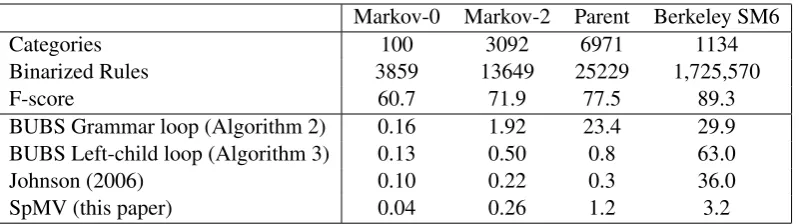
Table 1: Exhaustive Viterbi parse times (average seconds/sentence, lower is better) over WSJ Section 22 for various grammars. All parsers produce the same maximum-likelihood parse trees.
Berkeley parser (Petrov et al., 2006), and with the aforementioned ‘Adaptive Beam Search’ sys-tem implemented in BUBS. The Charniak parser is written in C and parses with a lexicalized gram-mar. The BUBS and Berkeley parsers are imple-mented in Java and parse with a latent-variable grammar.7
A brief note about implementation choices is appropriate here. Java has often been viewed as notoriously slow, a perception well-established when Java runtime environments were interpreted rather than compiled. Recent advances in virtual machine technology have largely eliminated the differential between Java and statically-compiled languages such as Fortran and C (c.f. Amedro et al. (2010), Kotzmann et al. (2008), Paleczny et al. (2001), Click et al. (2005), Click et al. (2007), Wrthinger et al. (2007), and Tene et al. (2009)).
We performed all trials on a 12-core Linux ma-chine (2×Intel®Xeon X5650 CPUs). Each core
can execute 2 simultaneous threads, for a total of 24 concurrent threads. For the parsers imple-mented in Java, we used the Oracle 1.6.0 26 Vir-tual Machine.
4.1 Exhaustive Serial Search
In Table 1, we present exhaustive search results with four grammars, each induced from the Penn Treebank Sections 2-21 (Marcus et al., 1999). The Markov-order-0 and Markov-order-2 gram-mars were markovized as described in Manning and Schuetze (1999). The parent-annotated gram-mar further splits the states of the Markov-order-2 grammar by annotating each non-terminal with its parent category, as described in Johnson (1998). This expands the vocabulary greatly, but the
rule-7
By default, the Berkeley parser marginalizes over the latent-variables in the grammar and retrieves the Max-Rule parse tree; for fair comparison with our approach, we report timings in its simpler Viterbi-search mode.
set somewhat less so. The Berkeley grammar (Petrov et al., 2006) is a high-accuracy unlexical-ized grammar, learned by iteratively splitting and merging non-terminals. Its vocabulary is relatively small (particularly in comparison with the parent-annotated grammar), but the ruleset is quite large. All grammars examined are right-factored, so we evaluate Algorithm 3, per the trials in Song et al. (2008).
Johnson’s C implementation outperforms the default BUBS exhaustive implementations, pri-marily (we believe) due to BUBS use of memory-inefficient Java objects. Our matrix grammar en-coding and SpMV grammar intersection algorithm perform very well in comparison to both base-line systems; for the Markov-order-2 and Parent-annotated grammars, which have large vocabular-ies and relatively small rulesets, our approach per-forms similarly to Johnson’s C implementation. For the grammars with large rulesets relative to their vocabularies (Markov-order-0 and Berkeley), our approach provides a dramatic speedup — over
9× vs. our fastest baseline using the Berkeley grammar. Other experiments not reported here in-dicate that the grammar representation accounts for the majority of this speedup, with the grammar intersection method accounting for an additional improvement of approximately 35%. We antic-ipate that potential users will primarily be inter-ested in high-accuracy grammars, particularly for non-exact inference, so we focus all other empiri-cal trials on the Berkeley grammar.
4.2 Pruned Serial Search
F-score Sent/sec Charniak (2000) 90.3 1.7 Berkeley (CTF Viterbi) 89.3 4.7 Adaptive Beam w/Alg. 3 89.0 10.2 Adaptive Beam w/Alg. 4 89.1 21.9
Table 2:Pruned parse times over WSJ Section 22 (av-erage sentences/sec, higher is better).
Sentences / Sec
F−Score
87.5 88.0 88.5 89.0 89.5 90.0
● ●
● ● ● ● ● ● ● ● ● ● ● ●
5 10 15 20 25
● Charniak Adaptive Beam Search
Adaptive Beam with SpMV (this paper)
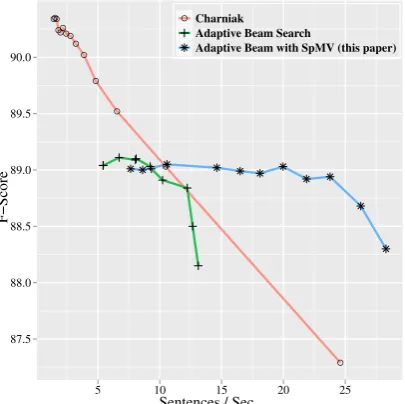
Figure 3: Comparison of F-score vs. speed over a variety of pruning parameterizations for adaptive cell pruning and for our algorithm.
search (Collins, 1999). These methods reduce the search space greatly, allowing effective search in reasonable time, although only A* guarantees finding the globally optimal solution. We take as our primary baseline, the ‘Adaptive Beam Search’ system implemented in BUBS. This technique predicts the appropriate population of each cell in-dividually, allowing heavier pruning in areas of the chart in which the model predicts less ambiguity. When the lexical context is sufficient to disam-biguate constituent structure, it prunes entire cells, and thus generalizes Roark and Hollingshead’s linear-time chart constraint algorithm (2009). Our grammar intersection method works well with Adaptive Beam Search. Table 2 shows a speedup of over 2×vs. the baseline implementation, and an even greater advantage vs. other competitive parsers. The Charniak and Adaptive Beam prun-ing systems both have tunable parameters, control-ling their accuracy vs. efficiency operating point. Figure 3 shows empirical results over a range of those tuning parameters for those two implemen-tations and for our approach. For a given
param-eterization, the search space explored by our ap-proach is identical to that explored by Bodenstab et al., (modulo minor differences in unary pro-cessing), so the efficiencies achieved are directly comparable. We find consistently improved speed across all pruning thresholds.
4.3 Exhaustive Parallel Search
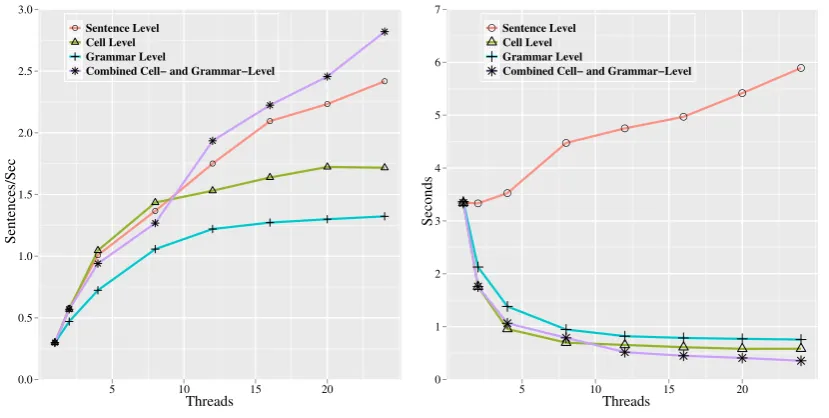
We now move to evaluating parallelization meth-ods. Our baseline parsers could be parallelized at a sentence-level, and possibly at a cell-level, but having already established dramatic gains vs. those approaches for serial parsing, we will fo-cus all these trials on our own SpMV algorithm — thus, the sentence-level results reported serve as a ‘baseline’ of sorts, albeit one already demon-strated to be a dramatic improvement on stan-dard baselines. We parallelize the SpMV imple-mentation using the three parallelization strategies discussed in Section 2.3., and compare through-put and latency. To explore potential additive effects, we include a system combining cell-level and grammar-cell-level parallelism, using several grammar-level threads for each cell-level thread, over the same range of total thread count. Note that some serial processing is required for each sentence (primarily initialization of the chart and extraction of the final parse tree), but these opera-tions consume only 1.5% of the total time.
Executed with a single thread, the cell-level and grammar-level parallel implementations incur an overhead of less than 1%, which compares very fa-vorably with the 500–900% overhead in Ninomiya et al. (1997). Figure 4 shows throughput and la-tency of each parallelization approach as thread count increases. All approaches show improved throughput with increased thread-count. Cell-level and grammar-Cell-level approaches begin to Cell-level off around 12 threads, when all physical cores are occupied; combining the two appears to benefit further from Hyper-threading, achieving through-put superior to sentence-level threading.
[image:8.595.78.281.165.367.2]Threads
Sentences/Sec
0.0 0.5 1.0 1.5 2.0 2.5 3.0
●
● ●
●
● ●
● ●
5 10 15 20
● Sentence Level Cell Level Grammar Level
Combined Cell− and Grammar−Level
(a) Throughput, in sentences per second.
Threads
Seconds
0 1 2 3 4 5 6 7
●
● ●
●
● ●
● ●
5 10 15 20
●Sentence Level Cell Level Grammar Level
Combined Cell− and Grammar−Level
[image:9.595.92.507.74.283.2](b) Latency, in seconds per sentence.
Figure 4:Exhaustive SpMV search throughput and latency vs. thread-count.
improvement of nearly 40% vs. cell-level thread-ing alone.
While an improvement of 9×is quite impres-sive, we anticipate that further gains might be pos-sible. We found that both cell-level and grammar-level methods often leave numerous threads idle, and CPU monitoring rarely shows all cores be-ing occupied. Our observations lead us to believe that much of the ‘lost’ processor time is going to the task handling and inter-thread communication, and we are optimistic that hardware threading will extend the gains observed for these methods.
4.4 Pruned Parallel Search
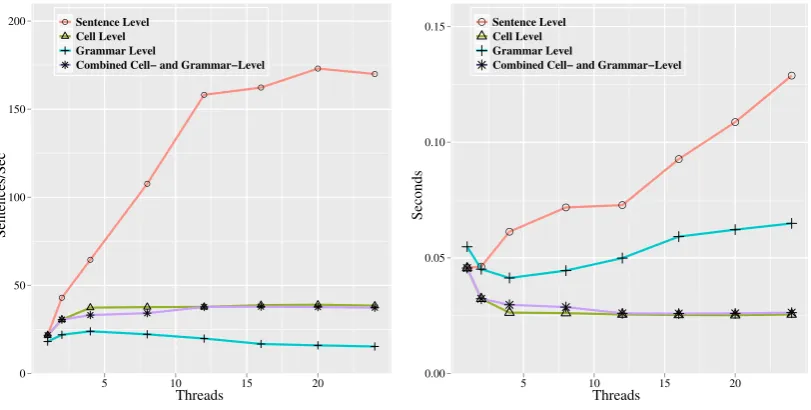
Figure 5 presents similar trials for pruned parallel search (once again, all trials use our grammar in-tersection method). In this case, we find that the cell-level and combined approaches perform quite strongly — nearly optimally, in fact. In contrast to the relatively small serial portions of exhaustive search, pruned search requires some fairly expen-sive serial operations. The adaptive cell pruning initialization is quite costly, consuming over 35% of the total time (c.f. Bodenstab et al., 2011). In total, the serial steps account for approximately 45% of the time, so the observed 44% increase in throughput and reduction in latency, although much smaller than that of sentence-level thread-ing, is nearly optimal. We anticipate that paral-lelizing the pruning initialization should further improve throughput and latency.
For grammar-level parallelism in Figure 5b,
however, we find a somewhat counterintuitive re-sult: increasing the thread-countincreaseslatency. This is due to the characteristics of the grammar and the severity of pruning during inference. The Berkeley grammar has a small non-terminal set
(|V| = 1134), but a large ruleset (|Pb| = 1.7
million). When performing exhaustive search, many cells are densely populated (average cell population is 450 of 1134). When performing pruned search, the cell populations are naturally much sparser (at most 30 entries, and often fewer). Thus, the grammar-level parallel tasks are much smaller. Task management overhead grows in im-portance as the task size shrinks, and quickly over-whelms the potential gains of additional execution threads. As already mentioned, hardware thread-management is likely to ameliorate this problem.
5 Discussion and Future Work
We have presented a novel matrix grammar encod-ing which has several beneficial properties. Ac-cess to grammar rules encoded in this manner is very cache-efficient, and it enables cell population using a Sparse Matrix×Vector grammar intersec-tion. As a well-understood matrix operation, this reduction allows very fine-grained parallelism.
Threads
Sentences/Sec
0 50 100 150 200
●
● ●
●
● ●
● ●
5 10 15 20
● Sentence Level Cell Level Grammar Level
Combined Cell− and Grammar−Level
(a) Throughput, in sentences per second.
Threads
Seconds
0.00 0.05 0.10 0.15
●
● ●
●
● ●
● ●
5 10 15 20
●Sentence Level Cell Level Grammar Level
Combined Cell− and Grammar−Level
[image:10.595.97.503.77.282.2](b) Latency, in seconds per sentence.
Figure 5:Pruned search throughput and latency vs. thread-count.
throughput and latency, which may be of interest to end-user applications and others with response-time constraints.
This work is available in the open-source BUBS parser for further research or practical application. In future work, we plan to extend our approach to more parallel architectures, including graphics processing units. We also plan to parallelize the adaptive beam width pruning, and we want to ex-plore the SpMV optimizations discussed in Sec-tion 3.3.
Acknowledgments
This research was supported in part by NSF Grant #IIS-0811745. Any opinions, findings, conclu-sions or recommendations expressed in this pub-lication are those of the authors and do not neces-sarily reflect the views of the NSF.
References
Brian Amedro, Denis Caromel, Fabrice Huet, Vladimir Bodnartchouk, Christian Delb, and Guillermo L. Taboada. 2010. HPC in java: experiences in implementing the NAS parallel benchmarks. In Proceedings of the 10th WSEAS international conference on ap-plied informatics and communications and 3rd WSEAS international conference on Biomedical electronics and biomedical informatics, page 221230.
Michele Banko. 1999. Open Information Extrac-tion for the Web. PhD dissertation, University of Washington, Seattle, Washington.
Nathan Bell and Michael Garland. 2009. Imple-menting sparse matrix-vector multiplication on throughput-oriented processors. InProceedings of the Conference on High Performance Com-puting Networking, Storage and Analysis, pages 1–11, Portland, Oregon. ACM.
Jari Bjrne, Filip Ginter, Sampo Pyysalo, Jun’ichi Tsujii, and Tapio Salakoski. 2010. Complex event extraction at PubMed scale. Bioinformat-ics, 26(12):382–390, June.
Nathan Bodenstab and Aaron Dunlop. 2011. BUBS parser. http://code.google.com/p/bubs-parser/.
Nathan Bodenstab, Aaron Dunlop, Brian Roark, and Keith Hall. 2011. Beam-Width prediction for efficient Context-Free parsing. In Proceed-ings of the 49th Annual Meeting of the Associa-tion for ComputaAssocia-tional Linguistics, pages 440– 449, Portland, Oregon, June.
Sharon A Caraballo and Eugene Charniak. 1998. New figures of merit for best-first probabilis-tic chart parsing. Computational Linguistics, 24:275298, June.
American chapter of the Association for Com-putational Linguistics conference, pages 132– 139, Seattle, Washington. Morgan Kaufmann Publishers Inc.
Cliff Click, Gil Tene, and Michael Wolf. 2005. The pauseless GC algorithm. Proceedings of the 1st ACM/USENIX international conference on Virtual execution environments, page 4656.
Clifford N. Click, Christopher A. Vick, and Michael H. Paleczny. 2007. System and method for range check elimination via itera-tion splitting in a dynamic compiler, May. US Patent 7,222,337.
Michael Collins. 1999. Head-Driven Statistical Models for Natural Language Parsing. PhD dissertation, University of Pennsylvania.
Jonathan Samuel Golan. 1999. Semirings and their Applications. Springer, July.
Georgios Goumas, Kornilios Kourtis, Nikos Anastopoulos, Vasileios Karakasis, and Nectar-ios Koziris. 2008. Understanding the perfor-mance of sparse matrix-vector multiplication. In PDP08: Proceedings of the 16th Euromi-cro International Conference on Parallel, Dis-tributed and Network-based Processing.
Susan L. Graham, Michael Harrison Ruzzo, and Walter L. 1980. An improved Context-Free recognizer. ACM Trans. Program. Lang. Syst., 2(3):415–462.
Mark Johnson. 1998. PCFG models of lin-guistic tree representations. Comput. Linguist., 24(4):613–632.
Mark Johnson. 2006. lncky.
http://www.cog.brown.edu/˜mj/Software.htm.
Dan Klein and Christopher D. Manning. 2001. Parsing with treebank grammars: Empirical bounds, theoretical models, and the structure of the penn treebank. In Proceedings of 39th Annual Meeting of the Association for Compu-tational Linguistics, pages 338–345, Toulouse, France, July.
Dan Klein and Christopher D. Manning. 2003. A* parsing. InProceedings of the 2003 Confer-ence of the North American Chapter of the As-sociation for Computational Linguistics on
Hu-man Language Technology (NAACL ’03), pages 40–47, Edmonton, Canada.
Thomas Kotzmann, Christian Wimmer, Hanspeter Mssenbck, Thomas Rodriguez, Kenneth Rus-sell, and David Cox. 2008. Design of the java HotSpot client compiler for java 6. ACM Trans-actions on Architecture and Code Optimization (TACO), 5:7:1–7:32, May.
Werner Kuich and Arto Salomaa. 1985. Semir-ings, Automata, Languages. EATCS Mono-graphs on Theoretical Computer Science, Num-ber 5. Springer-Verlag, Berlin, Germany.
Lillian Lee. 1997. Fast Context-Free parsing re-quires fast boolean matrix multiplication. In Proceedings of the 35th Annual Meeting of the Association for Computational Linguistics, pages 9–15, Madrid, Spain, July. ACL.
Christopher D. Manning and Hinrich Schuetze. 1999. Foundations of Statistical Natural Lan-guage Processing. The MIT Press, June.
Mitchell P Marcus, Beatrice Santorini, Mary Ann Marcinkiewicz, and Ann Taylor. 1999. Treebank-3. Linguistic Data Consortium, Philadelphia.
Robert C Moore. 2004. Improved left-corner chart parsing for large context-free grammars. New developments in parsing technology, page 185201.
Takashi Ninomiya, Kentaro Torisawa, Taura Kin-jiro, and Tsujii Jun’ichi. 1997. A parallel CKY parsing algorithm on Large-Scale Distributed-Memory parallel machines. In PACLING ’97, pages 223–231, Tokyo, Japan.
Michael Paleczny, Christopher Vick, and Cliff Click. 2001. The java hotspot server com-piler. Proceedings of the 2001 Symposium on Java Virtual Machine Research and Technology Symposium, pages 1–12.
Adam Pauls, Dan Klein, and Chris Quirk. 2010. Top-down k-best a* parsing. InProceedings of ACL 2010, page 200204, Morristown, NJ, USA.
Slav Petrov, Leon Barrett, Romain Thibaux, and Dan Klein. 2006. Learning accurate, compact, and interpretable tree annotation. In Proceed-ings of the 21st International Conference on Computational Linguistics and the 44th annual meeting of the Association for Computational Linguistics, pages 433–440, Sydney, Australia. ACL.
Brian Roark and Kristy Hollingshead. 2009. Lin-ear complexity Context-Free parsing pipelines via chart constraints. In Proceedings of Hu-man Language Technologies: The 2009 Annual Conference of the North American Chapter of the Association for Computational Linguistics, pages 647–655, Boulder, Colorado, June. ACL.
Brian Roark, Richard Sproat, and Izhak Shafran. 2011. Lexicographic semirings for exact au-tomata encoding of sequence models. In Pro-ceedings of the 49th Annual Meeting of the As-sociation for Computational Linguistics, Port-land, Oregon, June. ACL.
Xinying Song, Shilin Ding, and Chin-Yew Lin. 2008. Better binarization for the CKY parsing. InProceedings of the 2008 Conference on Em-pirical Methods in Natural Language Process-ing, pages 167–176, Honolulu, Hawaii, Octo-ber. ACL.
Robert Endre Tarjan and Andrew Chi-Chih Yao. 1979. Storing a sparse table. Commun. ACM, 22(11):606–611.
Gil Tene, Jack H. Choquette, Scott Sellers, and Clifford N. Click. 2009. Array access, August. US Patent 7,577,801.
Reginald P. Tewarson. 1973. Sparse Matrices. Mathematics in Science and Engineering Vol-ume 99. Academic Press, April.
Leslie G. Valiant. 1975. General context-free recognition in less than cubic time. Journal of Computer and System Sciences, 10(2):308–314, April.
Samuel Williams, Leonid Oliker, Richard Vuduc, John Shalf, Katherine Yelick, and James Dem-mel. 2009. Optimization of sparse matrix-vector multiplication on emerging multicore platforms. Parallel Computing, 35(3):178–194, March.
Thomas Wrthinger, Christian Wimmer, and Hanspeter Mssenbck. 2007. Array bounds check elimination for the java HotSpot\ client compiler. Proceedings of the 5th international symposium on Principles and practice of pro-gramming in Java, page 125133.