Dialect Translation:
Integrating Bayesian Co-segmentation Models with Pivot-based SMT
Michael Paul and Andrew Finch and Paul R. Dixon and Eiichiro Sumita National Institute of Information and Communications Technology
MASTAR Project Kyoto, Japan
Abstract
Recent research on multilingual statistical ma-chine translation (SMT) focuses on the usage of pivot languages in order to overcome re-source limitations for certain language pairs. This paper proposes a new method to translate a dialect language into a foreign language by integrating transliteration approaches based on Bayesian co-segmentation (BCS) models with pivot-based SMT approaches. The ad-vantages of the proposed method with respect to standard SMT approaches are three fold: (1) it uses a standard language as the pivot lan-guage and acquires knowledge about the re-lation between dialects and the standard lan-guage automatically, (2) it reduces the transla-tion task complexity by using monotone de-coding techniques, (3) it reduces the num-ber of features in the log-linear model that have to be estimated from bilingual data. Ex-perimental results translating four Japanese dialects (Kumamoto, Kyoto, Okinawa, Os-aka) into four Indo-European languages (En-glish, German, Russian, Hindi) and two Asian languages (Chinese, Korean) revealed that the proposed method improves the translation quality of dialect translation tasks and outper-forms standard pivot translation approaches concatenating SMT engines for the majority of the investigated language pairs.
1 Introduction
The translation quality of SMT approaches heavily depends on the amount and coverage of the bilin-gual language resources available to train the statis-tical models. There are several data collection
ini-tiatives1amassing and distributing large amounts of textual data. For frequently used language pairs like
French-English, large-sized text data sets are
read-ily available. However, for less frequently used lan-guage pairs, only a limited amount of bilingual re-sources are available, if any at all.
In order to overcome language resource limi-tations, recent research on multilingual SMT fo-cuses on the use of pivot languages (de Gispert and Marino, 2006; Utiyama and Isahara, 2007; Wu and Wang, 2007; Bertoldi et al., 2008; Koehn et al., 2009). Instead of a direct translation between two languages where only a limited amount of bilingual resources is available, the pivot translation approach makes use of a third language that is more appropri-ate due to the availability of more bilingual corpora and/or its relatedness to the source/target language. In most of the previous research, English has been the pivot language of choice due to the richness of available language resources. However, recent re-search on pivot translation has shown that the usage of non-English pivot languages can improve trans-lation quality of certain language pairs, especially when translating from or into Asian languages (Paul et al., 2009).
This paper focuses on the translation of dialects, i.e., a variety of a language that is characteristic of a particular group of the language’s speakers, into a foreign language. A standard dialect (or
stan-dard language) is a dialect that is recognized as
the ”correct” spoken and written form of the lan-guage. Dialects typically differ in terms of mor-phology, vocabulary and pronunciation. Various
1LDC: http://www.ldc.upenn.edu, ELRA: http://www.elra.info
methods have been proposed to measure relatedness between dialects using phonetic distance measures (Nerbonne and Heeringa, 1997), string distance al-gorithms (Heeringa et al., 2006; Scherrer, 2007), or statistical models (Chitturi and Hansen, 2008).
Concerning data-driven natural language process-ing (NLP) applications like machine translation (MT), however, linguistic resources and tools usu-ally are available for the standard language, but not for dialects. In order to create dialect language re-sources, previous research utilized explicit knowl-edge about the relation between the standard lan-guage and the dialect using rule-based and statistical models (Habash et al., 2005; Sawaf, 2010). In addi-tion, applying the linguistic tools for the standard language to dialect resources is often insufficient. For example, the task of word segmentation, i.e., the identification of word boundaries in continuous text, is one of the fundamental preprocessing steps of MT applications. In contrast to Indo-European languages like English, many Asian languages like Japanese do not use a whitespace character to sep-arate meaningful word units. However, the applica-tion of a linguistically motivated standard language word segmentation tool to a dialect corpus results in a poor segmentation quality due to morphological differences in verbs and adjectives, thus resulting in a lower translation quality for SMT systems that ac-quire the translation knowledge automatically from a parallel text corpus (Paul et al., 2011).
This paper differs from previous research in the following aspects:
• it reduces the data sparseness problem of di-rect translation approaches by translating a resource-limited dialect language into a foreign language by using the resource-rich standard language as the pivot language.
• it is language independent and acquires knowl-edge about the relation between the standard language and the dialect automatically.
• it avoids segmentation mismatches between the input and the translation model by mapping the characterized dialect language, i.e., each char-acter is treated as a single token, to the word segmentation of the standard language using a Bayesian co-segmentation model.
• it reduces the translation task complexity by us-ing monotone decodus-ing techniques.
• it reduces the number of features in the log-linear model that have to be estimated from bilingual data.
The details of the proposed dialect translation method are described in Section 2. Experiments were carried out for the translation of four Japanese dialects (Kumamoto, Kyoto, Okinawa, Osaka) into four Indo-European languages (English, German, Russian, Hindi) and two Asian languages (Chinese, Korean). The utilized language resources and the outline of the experiments are summarized in Sec-tion 3. The results reveal that the integration of Bayesian co-segmentation models with pivot-based SMT improves the translation quality of dialect to foreign language translation tasks and that the pro-posed system outperforms standard pivot translation approaches concatenating SMT engines that trans-late the dialect into the standard language and the standard language MT output into the foreign lan-guage for the majority of the investigated lanlan-guage pairs.
2 Dialect Translation
Spoken language translation technologies attempt to bridge the language barriers between people with different native languages who each want to engage in conversation by using their mother-tongue. For standard languages, multilingual speech translation services like the VoiceTra2system for travel conver-sations are readily available. However, such tech-nologies are not capable of dealing with dialect lan-guages due to the lack of language resources and the high development costs of building speech transla-tion components for a large number of dialect varia-tions.
In order to reduce such problems, the dialect translation method proposed in this paper integrates two different methods of transducing a given dialect input sentence into a foreign language. In the first step, the close relationship between the local and standard language is exploited to directly map char-acter sequences in the dialect input to word seg-ments in the standard language using a Bayesian
segmentation approach, details of which are given in Section 2.1. The proposed transliteration method is described in Section 2.2. The advantages of the pro-posed Bayesian co-segmentation approach are two fold: it reduces the translation complexity and it avoids segmentation inconsistencies between the in-put and the translation models. In the second step, a state-of-the-art phrase-based SMT system trained on a large amount of bilingual data is applied to ob-tain high-quality foreign language translations as de-scribed in Section 2.3.
2.1 Bayesian Co-segmentation
The method for mapping the dialect sentences into the standard language word segments is a direct character-to-character mapping between the lan-guages. This process is known as
translitera-tion. Many transliteration methods have previously
been proposed, including methods based on string-similarity measures between character sequences (Noeman and Madkour, 2010) or generation-based models (Lee and Chang, 2003; Tsuji and Kageura, 2006; Jiampojamarn et al., 2010).
In this paper, we use a generative Bayesian model similar to the one from (DeNero et al., 2008) which offers several benefits over standard transliteration techniques: (1) the technique has the ability to train models whilst avoiding over-fitting the data, (2) compact models that have only a small number of well-chosen parameters are constructed, (3) the un-derlying generative transliteration model is based on the joint source-channel model (Li et al., 2004), and (4) the model is symmetric with respect to source and target language. Intuitively, the model has two basic components: a model for generating an out-come that has already been generated at least once before, and a second model that assigns a probabil-ity to an outcome that has not yet been produced. Ideally, to encourage the re-use of model parame-ters, the probability of generating a novel bilingual sequence pair should be considerably lower then the probability of generating a previously observed se-quence pair. The probability distribution over these bilingual sequence pairs (including an infinite num-ber of unseen pairs) can be learned directly from un-labeled data by Bayesian inference of the hidden co-segmentation of the corpus.
The co-segmentation process is driven by a
Dirichlet process, which is a stochastic process de-fined over a set S (in our case, the set of all pos-sible bilingual sequence pairs) whose sample path is a probability distribution on S. The underlying stochastic process for the generation of a corpus composed of bilingual phrase pairs (sk,tk) can be written in the following form:
G|α,G0 ∼ DP(α, G0)
(sk,tk)|G ∼ G (1)
G is a discrete probability distribution over all the bilingual sequence pairs according to a Dirichlet
process prior with a base measureG0 and
concen-tration parameter α. The concentration parameter α > 0 controls the variance of G; intuitively, the largerαis, the more similarG0 will be toG.
For the base measure that controls the genera-tion of novel sequence pairs, we use a joint spelling model that assigns probability to new sequence pairs according to the following joint distribution:
G0((s,t)) = p(|s|)p(s||s|)×p(|t|)p(t||t|)
= λ |s| s |s|!e
−λsv−|s|
s ×
λ|tt| |t|!e
−λtv−|t|
t (2)
where |s|and |t|are the length in characters of the source and target sides of the bilingual sequence pair;vsandvtare the vocabulary sizes of the source
and target languages respectively; andλsandλtare
the expected lengths3of the source and target. According to this model, source and target se-quences are generated independently: in each case the sequence length is chosen from a Poisson dis-tribution, and then the sequence itself is generated given the length. Note that this model is able to assign a probability to arbitrary bilingual sequence pairs of any length in the source and target sequence, but favors shorter sequences in both.
The generative model is given in Equation 3. The equation assigns a probability to the kth bilingual sequence pair(sk,tk)in a derivation of the corpus, given all of the other sequence pairs in the history so far(s
−k,t−k). Here−kis read as: “up to but not
includingk”.
p((sk,tk))|(s−k,t−k))
= N((sk,tk)) +αG0((sk,tk))
N+α (3)
3
Following (Xu et al., 2008), we assign the parametersλs,
Input: Random initial corpus segmentation
Output: Unsupervised co-segmentation of the corpus according to the model
foreach iter=1 to NumIterations do
foreach bilingual word-pairw∈randperm(W)do foreach co-segmentationγiofwdo
Compute probabilityp(γi|h)
wherehis the set of data (excludingw) and its hidden co-segmentation
end
Sample a co-segmentationγifrom the distributionp(γi|h)
Update counts end
end
Algorithm 1: Blocked Gibbs Sampling
In this equation,Nis the total number of bilingual sequence pairs generated so far and N((sk,tk))is the number of times the sequence pair (sk,tk) has occurred in the history. G0 andαare the base
mea-sure and concentration parameter as before.
We used a blocked version of a Gibbs sampler for training, which is similar to that of (Mochihashi et al., 2009). We extended their forward filtering / backward sampling (FFBS) dynamic programing algorithm in order to deal with bilingual segmenta-tions (see Algorithm 1). We found our sampler con-verged rapidly without annealing. The number of iterations was set by hand after observing the con-vergence behavior of the algorithm in pilot experi-ments. We used a value of 75 iterations through the corpus in all experiments reported in this paper. For more details on the Bayesian co-segmentation pro-cess, please refer to (Finch and Sumita, 2010).
2.2 Dialect to Standard Language Transduction
A Bayesian segmentation model is utilized to trans-form unseen dialect sentences into the word seg-mentation of the standard language by using the joint-source channel framework proposed by (Li et al., 2004). The joint-source channel model, also called the n-gram transliteration model, is a joint probability model that captures information on how the source and target sentences can be generated simultaneously using transliteration pairs, i.e., the most likely sequence of source characters and tar-get words according to a joint language model built from the co-segmentation from the Bayesian model.
Suppose that we have a dialect sentence σ = l1l2. . . lL and a standard language sentence ω = s1s2. . . sS where li are dialect characters, sj are
word tokens of the standard language, and there exists an alignment γ =< l1. . . lq, s1 >, . . . , < lr. . . lL, sS >, 1 ≤ q < r ≤ L ofK
translitera-tion units. Then, an n-gram transliteratranslitera-tion model is defined as the transliteration probability of a translit-eration pair< l, s >kdepending on its immediaten
preceding transliteration pairs:
P(σ, ω, γ) = K
Y
k=1
P(< l, s >k|< l, s >k−k−n1+1) (4)
For the experiments reported in this paper, we im-plemented the joint-source channel model approach as a weighted finite state transducer (FST) using the OpenFst toolkit (Allauzen et al., 2007). The FST takes the sequence of dialect characters as its input and outputs the co-segmented bilingual seg-ments from which the standard language segseg-ments are extracted.
2.3 Pivot-based SMT
Recent research on speech translation focuses on corpus-based approaches, and in particular on statis-tical machine translation (SMT), which is a machine translation paradigm where translations are gener-ated on the basis of statistical models whose param-eters are derived from the analysis of bilingual text corpora. SMT formulates the problem of translat-ing a source language sentencesrcinto a target lan-guage sentencetrg as a maximization problem of the conditional probability:
argmaxtrgp(src|trg)∗p(trg) (5)
where p(src|trg) is called a translation model (T M) and represents the generation probability fromtrginto src, andp(trg) is called a language
model (LM) and represents the likelihood of the tar-get language (Brown et al., 1993). During the trans-lation process (decoding), a score based on the sta-tistical model probabilities is assigned to each trans-lation hypothesis and the one that gives the highest probability is selected as the best translation.
where only few bilingual language resources (if any at all) are available for the dialect and the foreign language, only a relatively low translation quality can be obtained. In order to obtain better transla-tions, we apply a pivot translation approach. Pivot
translation is the translation from a source language
(SRC) to a target language (TRG) through an inter-mediate pivot (or bridging) language (PVT). In this paper, we select the standard language as the pivot language.
Within the SMT framework, various coupling strategies like cascading, phrase-table composition, or pseudo-corpus generation have been proposed. For the experiments reported in this paper, we uti-lized the cascading approach because it is compu-tational less expensive, but still performs compara-bly well compared to the other pivot translation ap-proaches. In the first step, the dialect input is tran-scribed into the standard language as detran-scribed in Section 2.1. Next, the obtained standard language MT output is translated into the target language us-ing SMT models trained on the much larger lan-guage resources.
3 Experiments
The effects of integrating Bayesian co-segmentation models with pivot-based SMT are investigated using the Basic Travel Expressions Corpus (BTEC), which is a collection of sentences that bilingual travel ex-perts consider useful for people traveling abroad (Kikui et al., 2006). For the dialect translation ex-periments, we selected Japanese (ja), a language that does not naturally separate word units, and the di-alects from the Kumamoto (jaku), Kyoto (jaky),
Ok-inawa (jaok), and Osaka (jaos) areas. All dialects
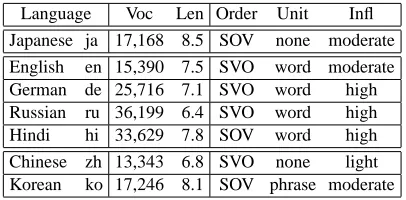
[image:5.612.334.537.70.170.2]share the same Japanese writing system that com-bines logographic Chinese characters and two syl-labic scripts, i.e., hiragana (used for native Japanese words) and katakana (used for foreign loanwords or onomatopoeia). For the target language, we in-vestigated four Indo-European languages, i.e., En-glish (en), German (de), Russian (ru), and Hindi (hi) and two Asian languages, i.e., Chinese (zh) and Korean (ko). The corpus statistics are summa-rized in Table 1, where Voc specifies the vocabulary size and Len the average sentence length of the re-spective data sets. These languages differ largely
Table 1: Language Resources
Language Voc Len Order Unit Infl
Japanese ja 17,168 8.5 SOV none moderate English en 15,390 7.5 SVO word moderate German de 25,716 7.1 SVO word high Russian ru 36,199 6.4 SVO word high
Hindi hi 33,629 7.8 SOV word high
Chinese zh 13,343 6.8 SVO none light Korean ko 17,246 8.1 SOV phrase moderate
in word order (Order: subject-object-verb (SOV), subject-verb-object (SVO)), segmentation unit (Unit: phrase, word, none), and degree of inflection (Infl: high, moderate, light). Concerning word segmenta-tion, the corpora were preprocessed using language-specific word segmentation tools that are widely-accepted within the MT community for languages that do not use white spaces to separate word/phrase tokens, i.e., CHASEN4for Japanese and ICTCLAS5 for Chinese. For all other languages, simple to-kenization tools were applied. All data sets were case-sensitive with punctuation marks preserved.
The language resources were randomly split into three subsets for the evaluation of translation quality (eval, 1k sentences), the tuning of theSMT model weights (dev, 1k sentences) and the training of the statistical models (train, 160k sentences). For the dialect languages, a subset of 20k sentences was used for the training of translation models for all of the resource-limited language pairs. In order to avoid word segmentation errors from the standard language segmentation tool beeing applied to dialect resources, these models are trained on bitext, where the local dialect source sentence is characterized and the target language is segmented using language-specific segmentation tools.
For the training of theSMTmodels, standard word alignment (Och and Ney, 2003) and language mod-eling (Stolcke, 2002) tools were used. Minimum error rate training (MERT) was used to tune the de-coder’s parameters on the dev set using the technique proposed in (Och and Ney, 2003). For the trans-lation, an inhouse multi-stack phrase-based decoder was used. For the evaluation of translation quality, we applied the standard automatic evaluation metric
4
http://chasen-legacy.sourceforge.jp
Table 2: SMT-based Direct Translation Quality
BLEU (%)
SRC ja jaku jaky jaok jaos
TRG (160k) (20k) (20k)
en 56.51 32.84 32.27 31.81 30.99 31.97 de 51.73 26.24 25.06 25.71 24.37 25.18 ru 50.34 23.67 23.12 23.19 22.30 22.07 hi 49.99 21.10 20.46 20.40 19.72 20.96 zh 48.59 33.80 32.72 33.15 32.66 32.96 ko 64.52 53.31 52.93 51.24 49.40 51.57
BLEU, which calculates the geometric mean of n-gram precision by the system output with respect to reference translations with the addition of a brevity penalty to punish short sentences. Scores range be-tween 0 (worst) and 1 (best) (Papineni et al., 2002). For the experiments reported here, single translation references were used.
3.1 Direct Translation
[image:6.612.347.524.80.179.2]Table 2 summarizes the translation performance of the SMT engines used to directly translate the source language dialects into the foreign language. For the large training data condition (160k), the high-est BLEU scores are obtained for the translation of Japanese into Korean followed by English, German, Russian, and Hindi with Chinese seeming to be the most difficult translation task out of the investigated target languages. For the standard language (ja), the translation quality for the small data condition (20k) that corresponds to the language resources used for the translation of the dialect languages is also given. For the Asian target languages, gains of 11%∼14% BLEU points are obtained when increasing the train-ing data size from 20k to 160k. However, an even larger increase (24%∼27% BLEU points) in trans-lation quality can be seen for all Indo-European tar-get languages. Therefore, larger gains are to be expected when the pivot translation framework is applied to the translation of dialect languages into Indo-European languages compared to Asian target languages. Comparing the evaluation results for the small training data condition, the highest scores are achieved for the standard language for all target lan-guages, indicating the difficulty in translating the di-alects. Moreover, the Kumamoto dialect seems to be the easiest task, followed by the Kyoto dialect and the Osaka dialect. The lowest BLEU scores were
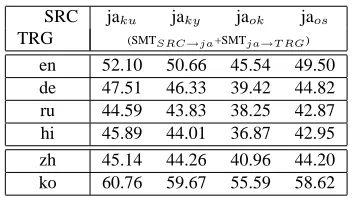
Table 3: SMT-based Pivot Translation Quality
BLEU (%)
SRC jaku jaky jaok jaos TRG (SMTSRC→ja+SMTja→T RG)
en 52.10 50.66 45.54 49.50
de 47.51 46.33 39.42 44.82
ru 44.59 43.83 38.25 42.87
hi 45.89 44.01 36.87 42.95
zh 45.14 44.26 40.96 44.20
ko 60.76 59.67 55.59 58.62
obtained for the translation of the Okinawa dialect.
3.2 SMT-based Pivot Translation
The SMT engines of Table 2 are then utilized within the framework of the SMT-based pivot translation by (1) translating the dialect input into the stan-dard language using the SMT engines trained on the 20k data sets and (2) translating the standard lan-guage MT output into the foreign lanlan-guage using the SMT engines trained on the 160k data sets. The translation quality of the SMT-based pivot transla-tion experiments are summarized in Table 3. Large gains of 6.2%∼25.4% BLEU points compared to the direct translation results are obtained for all in-vestigated language pairs, showing the effectiveness of pivot translation approaches for resource-limited language pairs. The largest gains are obtained for jaku, followed by jaos, jaky, and jaok. Therefore, the
easier the translation task, the larger the improve-ments of the pivot translation approach.
3.3 Bayesian Co-segmentation Model
(reorder-Table 4: Dialect to Standard Language Transduction
BLEU (%)
SRC jaku jaky jaok jaos
Engine (decoding) (SRC→ja)
BCS (monotone) 91.55 86.74 80.36 85.04 SMT (monotone) 88.39 84.87 74.27 82.86 (reordering) 88.39 84.73 74.26 82.66
ing) and without (monotone) distortion models to
the monotone Bayesian co-segmentation approach (BCS). Only minor differences between SMT decod-ing with and without reorderdecod-ing are obtained. This shows that the grammatical structure of the dialect sentences and the standard language sentences are very similar, thus justifying the usage of monotone decoding strategies for the given task. The compari-son of the SMT-based and the BCS-based transduc-tion of the dialect sentences into the standard lan-guage shows that the Bayesian co-segmentation ap-proach outperforms the SMT apap-proach significantly, gaining 1.9% / 2.2% / 3.2% / 6.1% BLEU points for jaky/ jaos/ jaku/ jaok, respectively.
3.4 BCS-based Pivot Translation
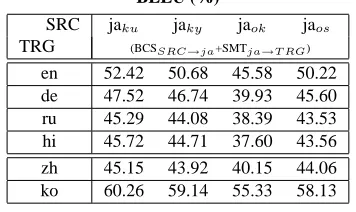
The translation quality of the proposed method, i.e. the integration of the Bayesian co-segmentation models into the pivot translation framework, are given in Table 5. The overall gains of the proposed method compared to (a) the direct translation ap-proach (see Table 2) and (b) the SMT-based pivot translation approach (see Table 3) are summarized in Table 6. The results show that the BCS-based pivot translation approach also largely outperforms the direct translation approach, gaining 5.9%∼25.3% BLEU points. Comparing the two pivot translation approaches, the proposed BCS-based pivot transla-tion method gains up to 0.8% BLEU points over the concatenation of SMT engines for the Indo-European target languages, but is not able to im-prove the translation quality for translating into Ko-rean and Chinese. Interestingly, the SMT-based pivot translation approach seems to be better for lan-guage pairs where only small relative gains from the pivot translation approach are achieved when trans-lating the dialect into a foreign language. For exam-ple, Korean is a language closely related to Japanese and the SMT models from the small data condition already seem to cover enough information to
suc-Table 5: BCS-based Pivot Translation Quality
BLEU (%)
SRC jaku jaky jaok jaos TRG (BCSSRC→ja+SMTja→T RG)
en 52.42 50.68 45.58 50.22
de 47.52 46.74 39.93 45.60
ru 45.29 44.08 38.39 43.53
hi 45.72 44.71 37.60 43.56
zh 45.15 43.92 40.15 44.06
[image:7.612.345.523.76.182.2]ko 60.26 59.14 55.33 58.13
Table 6: Gains of BCS-based Pivot Translation
BLEU (%)
SRC jaku jaky jaok jaos
TRG on SMT-based Pivot (Direct) Translation
en +0.32 +0.02 +0.04 +0.72
(+20.15) (+18.87) (+14.59) (+18.25)
de +0.01 +0.41 +0.51 +0.78
(+22.46) (+21.03) (+15.56) (+20.50)
ru +0.70 +0.25 +0.14 +0.66
(+22.17) (+20.89) (+16.09) (+21.46)
hi -0.17 +0.70 +0.73 +0.61
(+25.26) (+24.31) (+17.88) (+22.60)
zh +0.01 -0.34 -0.81 -0.14
(+12.43) (+10.77) (+7.49) (+11.10)
ko -0.50 -0.53 -0.26 -0.49
(+7.33) (+7.90) (+5.93) (+6.56)
cessfully translate the dialect languages into Korean. In the case of Chinese, the translation quality for even the large data condition SMT engines is rela-tively low. Therefore, improving the quality of the standard language input might have only a small im-pact on the overall pivot translation performance, if any at all. On the other hand, the proposed method can be successfully applied for the translation of lan-guage pairs where structural differences have a large impact on the translation quality. In such a transla-tion task, the more accurate transductransla-tion of the di-alect structure into the standard language can affect the overall translation performance positively.
4 Conclusion
[image:7.612.327.544.218.382.2]language. Next, an FST-based joint-source channel model is applied to unseen dialect input sentences to monotonically generate co-segmented bilingual seg-ments from which the standard language segseg-ments are extracted. The obtained pivot sentence is then translated into the foreign language using a state-of-the-art phrase-based SMT engine trained on a large corpus.
Experiments were carried out for the translation of four Japanese dialects into four Indo-European as well as into two Asian languages. The re-sults revealed that the Bayesian co-segmentation method largely improves the quality of the stan-dard language sentence generated from a dialect in-put compared to SMT-based translation approaches. Although significant improvements of up to 0.8% in BLEU points are achieved for certain target languages, such as all of the investigated Indo-European languages, it is difficult to transfer the gains obtained by the Bayesian co-segmentation model to the outcomes for the pivot translation method.
Further research will have to investigate features like language relatedness, structural differences, and translation model complexity to identify indica-tors of translation quality that could enable the selec-tion of BCS-based vs. SMT-based pivot translaselec-tion approaches for specific language pairs to improve the overall system performance further.
In addition we would like to investigate the ef-fects of using the proposed method for translating foreign languages into dialect languages. As the Bayesian co-segmentation model is symmetric with respect to source and target language, we plan to reuse the models learned for the experiments pre-sented in this paper and hope to obtain new insights into the robustness of the Bayesian co-segmentation method when dealing with noisy data sets like ma-chine translation outputs.
Acknowledgments
This work is partly supported by the Grant-in-Aid for Scientific Research (C) Number 19500137.
References
Cyril Allauzen, Michael Riley, Johan Schalkwyk, Wo-jciech Skut, and Mehryar Mohri. 2007.
Open-Fst: A General and Efficient Weighted Finite-State Transducer Library. In Proc. of the 9th Interna-tional Conference on Implementation and Application of Automata, (CIAA 2007), volume 4783 of Lecture Notes in Computer Science, pages 11–23. Springer.
http://www.openfst.org.
Nicola Bertoldi, Madalina Barbaiani, Marcello Federico, and Roldano Cattoni. 2008. Phrase-Based statistical machine translation with Pivot Languages. In Proc. of the 5th International Workshop on Spoken Language Translation (IWSLT), pages 143–149, Hawaii, USA. Peter Brown, Stephen Della Pietra, Vincent Della Pietra,
and Robert Mercer. 1993. The mathematics of statis-tical machine translation: Parameter estimation. Com-putational Linguistics, 19(2):263–311.
Ragul Chitturi and John Hansen. 2008. Dialect Clas-sification for online podcasts fusing Acoustic and Language-based Structural and Semantic Information. In Proc. of the 46th Annual Meeting of the Associa-tion for ComputaAssocia-tional Linguistics - Human Language Technologies (ACL-HLT), Companion Volume, pages 21–24, Columbus, USA.
Adria de Gispert and Jose B. Marino. 2006. Catalan-English statistical machine translation without paral-lel corpus: bridging through Spanish. In Proc. of 5th International Conference on Language Resources and Evaluation (LREC), pages 65–68, Genoa, Italy. John DeNero, Alex Bouchard-C ˆot´e, and Dan Klein.
2008. Sampling Alignment Structure under a Bayesian Translation Model. In Proc. of Conference on Empirical Methods on Natural Language Process-ing (EMNLP), Hawaii, USA.
Andrew Finch and Eiichiro Sumita. 2010. A Bayesian Model of Bilingual Segmentation for Transliteration. In Proc. of the 7th International Workshop on Spoken Language Translation (IWSLT), pages 259–266, Paris, France.
Nizar Habash, Owen Rambow, and George Kiraz. 2005. Morphological Analysis and Generation for Arabic Dialects. In Proc. of the ACL Workshop on Computa-tional Approaches to Semitic Languages, pages 17–24, Ann Arbor, USA.
Wilbert Heeringa, Peter Kleiweg, Charlotte Gosskens, and John Nerbonne. 2006. Evaluation of String Dis-tance Algorithms for Dialectology. In Proc. of the Workshop on Linguistic Distances, pages 51–62, Syd-ney, Australia.
Genichiro Kikui, Seiichi Yamamoto, Toshiyuki Takezawa, and Eiichiro Sumita. 2006. Compar-ative study on corpora for speech translation. IEEE Transactions on Audio, Speech and Language, 14(5):1674–1682.
Philipp Koehn, Alexandra Birch, and Ralf Steinberger. 2009. 462 Machine Translation Systems for Europe. In Proc. of the MT Summit XII, Ottawa, Canada. Chun-Jen Lee and Jason S. Chang. 2003.
Acqui-sition of English-Chinese transliterated word pairs from parallel-aligned texts using a statistical machine transliteration model. In Proc. of the HLT-NAACL 2003 Workshop on Building and using parallel texts, Volume 3, pages 96–103, Edmonton, Canada.
Haizhou Li, Min Zhang, and Jian Su. 2004. A joint source-channel model for machine transliteration. In Proc. of the 42nd ACL, pages 159–166, Barcelona, Spain.
Daichi Mochihashi, Takeshi Yamada, and Naonori Ueda. 2009. Bayesian unsupervised word segmentation with nested Pitman-Yor language modeling. In Proc of the Joint Conference of the 47th Annual Meeting of the ACL and the 4th International Joint Conference on Natural Language Processing of the AFNLP (ACL-IJCNLP), pages 100–108, Suntec, Singapore.
John Nerbonne and Wilbert Heeringa. 1997. Measur-ing Dialect Distance Phonetically. In Proc. of the ACL Special Interest Group in Computational Phonology, pages 11–18, Madrid, Spain.
Sara Noeman and Amgad Madkour. 2010. Language Independent Transliteration Mining System Using Fi-nite State Automata Framework. In Proc. of the 2010 Named Entities Workshop (NEWS), pages 57–61, Up-psala, Sweden.
Franz Josef Och and Hermann Ney. 2003. A Systematic Comparison of Various Statistical Alignment Models. Computational Linguistics, 29(1):19–51.
Kishore Papineni, Salim Roukos, Todd Ward, and Wei-Jing Zhu. 2002. BLEU: a method for automatic eval-uation of machine translation. In Proc. of the 40th An-nual Meeting on Association for Computational Lin-guistics (ACL), pages 311–318, Philadelphia, USA. Michael Paul, Hirofumi Yamamoto, Eiichiro Sumita, and
Satoshi Nakamura. 2009. On the Importance of Pivot Language Selection for Statistical Machine Transla-tion. In Proc. of the North American Chapter of the Association for Computational Linguistics - Human Language Technologies (NAACL HLT), pages 221– 224, Boulder, USA.
Michael Paul, Andrew Finch, and Eiichiro Sumita. 2011. Word Segmentation for Dialect Translation. LNCS Lectures Note in Computer Science, Springer, 6609:55–67.
Hassan Sawaf. 2010. Arabic Dialect Handling in Hybrid Machine Translation. In Proc. of the 9th Conference of the Association for Machine Translation in the Ameri-cas (AMTA), Denver, USA.
Yves Scherrer. 2007. Adaptive String Distance Mea-sures for Bilingual Dialect Lexicon Induction. In Proc. of the ACL Student Research Workshop, pages 55–60, Prague, Czech Republic.
Andreas Stolcke. 2002. SRILM - an extensible language modeling toolkit. In Proc. of the International Con-ference on Spoken Language Processing (ICSLP), Vol-ume 2, pages 901–904, Denver, USA.
Keita Tsuji and Kyo Kageura. 2006. Automatic gen-eration of JapaneseEnglish bilingual thesauri based on bilingual corpora. J. Am. Soc. Inf. Sci. Technol., 57:891–906.
Masao Utiyama and Hitoshi Isahara. 2007. A Compari-son of Pivot Methods for Phrase-Based Statistical Ma-chine Translation. In Proc. of Human Language Tech-nologies (HLT), pages 484–491, New York, USA. Hua Wu and Haifeng Wang. 2007. Pivot Language
Ap-proach for Phrase-Based Statistical Machine Transla-tion. In Proc. of the 45th Annual Meeting of the As-sociation for Computational Linguistics (ACL), pages 856–863, Prague, Czech Republic.