The AI-KU System at the SPMRL 2013 Shared Task : Unsupervised
Features for Dependency Parsing
Volkan Cirik Husnu Sensoy Artificial Intelligence Laboratory
Koc¸ University, ˙Istanbul, Turkey
{vcirik,hsensoy}@ku.edu.tr
Abstract
We propose the use of the word categories and embeddings induced from raw text as auxil-iary features in dependency parsing. To in-duce word features, we make use of contex-tual, morphologic and orthographic properties of the words. To exploit the contextual infor-mation, we make use of substitute words, the most likely substitutes for target words, gen-erated by using a statistical language model. We generate morphologic and orthographic properties of word types in an unsupervised manner. We use a co-occurrence model with these properties to embed words onto a 25-dimensional unit sphere. The AI-KU sys-tem shows improvements for some of the lan-guages it is trained on for the first Shared Task of Statistical Parsing of Morphologically Rich Languages.
1 Introduction
For the first shared task of Workshop on Statistical Parsing of Morphologically Rich Languages (Sed-dah et al., 2013), we propose to use unsupervised features as auxillary features for dependency pars-ing.
We induce the unsupervised features using con-textual, morphological and orthographic properties of the words. We use possible substitutes of the tar-get word which are generated by a statistical lan-guage model to exploit the contextual information. We induce morphological features with a HMM-based model (Creutz and Lagus, 2005). We combine contextual, morphological and orthographic features of co-occurring words within the co-occurrence data embedding framework (Maron et al., 2010).
The framework embeds word types sharing simi-lar context, morphological and orthographic prop-erties closely on a 25-dimensional sphere. Thus, it provides the word embeddings on a 25 dimensional sphere. We conduct experiments using these word embeddings with MaltParser (Nivre et al., 2007) and MaltOptimizer (Ballesteros and Nivre, 2012). In addition to CONLL features (Buchholz and Marsi, 2006a), they are added as additional features and the parsers are configured such that they are able to ex-ploit these additional features. As a first step we use real valued word embeddings as they are. Secondly, we discretize the real valued word embeddings. Fi-nally, we cluster them and find fine-grained word categories for word types.
Our experiments show that, the AI-KU system leads to better results than the baseline experiments for some languages. We claim that with the cor-rect parameter settings, these unsupervised features could be useful for dependency parsing.
In the following sections, we introduce the related work, the algorithm, experiments, results and pro-vide a conclusion.
2 Related Work
The features extracted from unlabeled corpora are already used for all major NLP tasks. Early stud-ies mainly use clustering based representations (es-pecially Brown clustering (Brown et al., 1992)) to obtain those features. Miller et al. (2004; Freitag (2004) utilized Brown Clusters to improve Named Entity Recognition (NER) performance whereas Biemann et al. (2007) used them for NER, Word Sense Disambiguation(WSD), and chunking. Ush-ioda (1996) extended Brown Clustering to cluster
not only words but also phrases using hierarcical clustering and uses them to improve supervised part-of-speech (PoS) tagging. More recently, Brown Clusters are used for Chinese word segmentation and NER (Liang, 2005).
Just like other tasks, clustering based representa-tions are used to improve parser performance. Koo et al. (2008; Suzuki et al. (2009) improved depen-dency parsing by using Brown clusters. While Can-dito and Seddah (2010; CanCan-dito and Crabb´e (2009) improved PCFG parsing by using them and Gold-berg et al. (2009) improved PCFG parser for He-brew by using HMM generated features. More re-cently Socher et al. (2010) used word embeddings computed using method explained in (Collobert and Weston, 2008) for syntactic parsing.
3 Algorithm
In this section, the general flow of the algorithm will be presented. First, we explain how we generate the substitute vectors. Then, we explain the induc-tion procedure of morphological features. In the fol-lowing subsection, we explain how we use substi-tute vectors and morphological features and gener-ate word embeddings. The same flow is followed for all languages we work on.
3.1 Substitute Vectors
A target word’s substitute vector is represented by the vocabulary of words and their corresponding probabilities of occurring in the position of the target word.
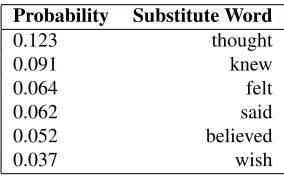
(1) “ Nobodythoughtyou could just in-ject DNA into someone ’s body and they would just suck it up.”
Probability Substitute Word
0.123 thought
0.091 knew
0.064 felt
0.062 said
0.052 believed
[image:2.612.114.256.584.672.2]0.037 wish
Table 1: Substitute Vector for “thought” in above sen-tence.
Table 1 illustrates the substitute vector of “thought” in (1). There is a row for each word in the vocabulary. For instance, probability of “knew” occurring in the position of “thought” is 9.1% in this context.
To calculate these probabilities, as described in (Yatbaz et al., 2012), a 4-gram language model is built with SRILM (Stolcke, 2002) on the corpora of the target languages. For French, Hungarian, Pol-ish and SwedPol-ish we used Europarl Corpus1(Koehn, 2005). For German, CONLL-X German Corpus is used (Buchholz and Marsi, 2006b). For He-brew, we combined HaAretz and Arutz 7 corpora of MILA2(Itai and Wintner, 2008). For the tokens seen less than 5 times we replace them with an unknown tag to handle unseen words in training and test data. We should note that these corpora are not provided to the other participants.
To estimate probabilities of lexical substitutes, for every token in our datasets, we use three tokens each on the left and the right side of the token as a con-text. Using Fastsubs (Yuret, 2012) we generated top 100 most likely substitute words. Top 100 substi-tute probabilities are then normalized to represent a proper probability distribution.
We should emphasize that a substitute vector is a function of the context and does not depend on the target word.
3.2 Morphological Features
In order to generate unsupervised word features, the second set of features that we use are morphological and orthographic features.
The orthographic feature set used is similar to the one defined in (Berg-Kirkpatrick et al.,2010)
INITIAL-CAP Capitalized words with the exception of sentence initial words.
NUMBER The token starts with a
digit.
CONTAINS-HYPHEN Lowercase words with an internal hyphen.
INITIAL-APOSTROPHE Tokens that start with an apostrophe.
The morpological features are obtained using the unlabeled corpora that are used for the generation
1
http://www.statmt.org/europarl/
2
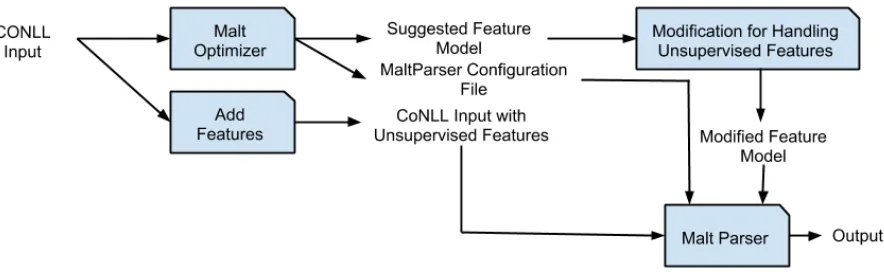
Figure 1: The Flow of The Modification for Handling New Features
of substitute vectors, using Morfessor defined in (Creutz and Lagus, 2005). We will only give a brief sketch of the model used. Morfessor splits each word into morphemes (word itself may also be a morpheme) which can be categorized under four groups, namely prefix, stem, suffix, non-morpheme. The model is defined as a maximum a posteriori
(MAP) estimate which maximizes the lexicon (set of morphemes) over the corpus.
The maximization problem is solved by using a greedy algorithm that iteratively splits and merges morphemes, then re-segments corpus using Viterbi algorithm and reestimates probabilities until conver-gence. Finally, a final merge step takes place to re-move all non-morphemes.
3.3 Co-occurence Embedding
For a pair of categorical variables, the Spherical Co-occurrence Data Embedding (S-CODE) framework (Maron et al., 2010) represents each of their values on a sphere such that frequently co-occurring values are positioned closely on this sphere.
The input of S-CODE are tuples of values of cate-gorical variables. In our case, these are word tokens, their substitutes, morphological and orthograpic fea-tures. We construct the tuples by sampling substitute words using substitute vectors, their corresponding morphological and orthographic features of the to-kens. On each row of the co-occurrence input, there are the target token, its substitute sampled from its substitute vector, morphological and orthographic features. Tokens having the similar substitutes, mor-phological and orthographic features will be closely located on the sphere at the end of this process. As
in (Yatbaz et al., 2012), the dimension of the sphere is 25, in other words for each word type seen in the corpora we have a 25 dimensional vector3.
4 Experiments
We conduct experiments using MaltParser (Nivre et al., 2007) and MaltOptimizer (Ballesteros and Nivre, 2012) with features provided in CONLL for-mat and the additional unsupervised features that we generated with default settings of the parsers. To make use of additional features, we need to modify MaltParser accordingly. Figure 1 shows that how we use MaltOptimizer and MaltParser with new tures. In order to handle auxiliary features, the fea-ture model file is modified in two different ways. We handle new features with feature functions Input[0] and Stack[0]4. We should note that other feature functions should also be experimented as a future work.
The following subsections explain the details of the experiments.
4.1 Experiment I
Our first approach was trying to use word embed-dings as they are with the MaltParser. For each token in the training and the test set, we added the corre-sponding 25-dimensional word vector from the word embeddings file to the training and test sets. If the word type is not present in the word embeddings, then, we use the unknown word vector.
3The vectors can be downloaded here :
https://github.com/wolet/sprml13-word-embeddings
4
Stack[0] Input[0]
LAS UAS LaA LAS UAS Labeled Accuracy
Real Valued Vectors 80.56 84.33 85.78 80.63 84.38 85.92
Binning, b=5 80.25 84.07 85.58 80.45 84.20 85.79
Binning, b=2 80.41 84.19 85.79 80.47 84.26 85.77
Clustering, k = 50 80.48 84.29 85.79 80.50 84.24 85.78 Clustering k = 300 80.49 84.23 85.83 80.58 84.31 85.82
LAS UAS LaS
[image:4.612.75.449.58.200.2]Baseline 80.36 84.11 85.72
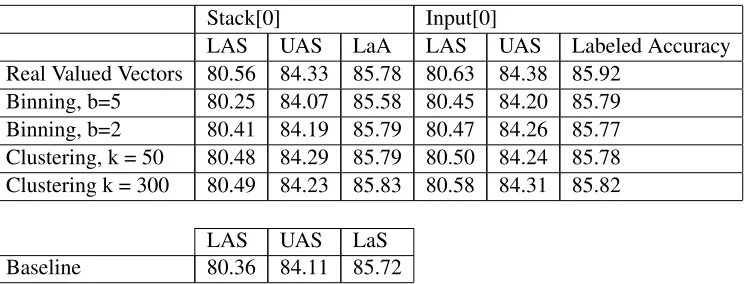
Table 2: Results on German with MaltParser of Development Set with Default Settings
Stack[0] Input[0]
LAS UAS LaS LAS UAS LaS
Real Valued Vectors 87.30 89.33 93.35 87.29 89.30 93.32
Binning, b =2 87.12 89.20 93.20 87.04 89.11 93.16
Clustering, k = 300 90.30 91.80 95.09 90.49 91.94 95.19
LAS UAS LaS
[image:4.612.69.519.357.710.2]Baseline 90.38 91.88 95.14
Table 3: Results on German with MaltOptimizer of Development Set
Gold Predicted
LAS UAS LaS LAS UAS LaS Predicted (Unofficial)
Best System 90.29 91.92 95.95 85.86 89.19 92.20 LAS UAS LaS
AI-KU 1 86.39 88.21 94.07 72.57 78.54 82.39 AI-KU 1 79.92 83.94 88.51
AI-KU 2 86.31 88.14 94.05 72.55 78.55 82.36 AI-KU 2 79.84 83.85 88.45
Baseline 85.71 87.50 93.70 79.00 83.35 87.73
Table 4: Results on French
Gold Predicted
LAS UAS LaS LAS UAS LaS Predicted (Unofficial)
Best System 91.83 93.20 96.06 86.95 91.64 94.38 LAS UAS LaS
AI-KU 1 86.98 88.71 93.70 82.32 85.31 89.95 AI-KU 1 84.08 86.71 91.13
AI-KU 2 86.95 88.67 93.67 82.29 85.30 89.95 AI-KU 2 83.93 86.54 91.05
Baseline 86.96 87.67 93.67 82.75 85.38 90.15
Table 5: Results on German
Gold Predicted
LAS UAS LaS LAS UAS LaS
Best System 83.87 88.95 89.19 80.89 86.7 86.93
AI-KU 1 79.42 84.48 86.52 69.01 75.84 79.01
AI-KU 2 78.73 83.79 85.98 62.27 75.84 79.01
Baseline 80.03 84.9 86.97 73.01 79.89 81.28
Gold Predicted
LAS UAS LaS LAS UAS LaS Predicted (Unofficial)
Best System 88.06 91.14 92.58 86.13 89.81 90.92 LAS UAS LaS
AI-KU 1 83.67 87.08 89.64 78.92 83.77 85.98 AI-KU 1 79.98 84.42 87.12
AI-KU 2 83.63 87.06 89.58 78.76 83.60 85.95 AI-KU 2 79.74 84.12 86.93
Baseline 83.14 86.56 89.20 79.63 83.71 85.89
Table 7: Results on Hungarian
Gold Predicted
LAS UAS LaS LAS UAS LaS
Best System 89.58 93.24 93.42 87.07 91.75 91.24 AI-KU 1 85.16 88.86 90.87 81.86 86.96 88.06 AI-KU 2 85.12 88.79 90.84 78.31 84.18 85.64 Baseline 80.49 86.41 86.94 79.89 85.80 86.24
Table 8: Results on Polish
Gold Predicted
LAS UAS LaS LAS UAS LaS
Best System 83.97 89.11 87.63 82.13 88.06 85.93
AI-KU 1 78.87 85.19 83.44 76.35 83.30 81.37
AI-KU 2 78.57 85.12 83.25 76.35 83.24 81.35
Baseline 77.67 84.6 82.36 75.82 83.20 80.88
Table 9: Results on Swedish
Gold Predicted
Precision Recall F1 Precision Recal F1
Best System 99.41 99.38 99.39 81.68 79.97 80.81
AI-KU 1 99.41 99.38 99.39 74.47 71.51 72.96
AI-KU 2 99.38 99.36 99.37 74.34 71.51 72.89
[image:5.612.71.448.573.659.2]MaltOptimizer Baseline 98.77 99.18 99.26 72.64 68.09 70.29
4.2 Experiment II
The second approach is discretizing the real valued vectors. For each dimension of word embeddings, we separatebequal sized bins. Then, for each vec-tor’s dimensions, we assign their corresponding bin numbers.
4.3 Experiment III
The third approach is clustering the word embed-dings. We use a modified k-means algorithm (Arthur and Vassilvitskii, 2007). We experiment with vary-ing number of clustersk.
For each token in training and test file, we use word type’s cluster id as an auxiliary feature. Again, if the token is not in the word embeddings file, we used the unknown word’s cluster id.
5 Results
In Table 2, the experiments on German with Malt-Parser without the optimization step are demon-strated. We use the default settings of the MaltParser as our baseline. We use training data consisting of 5000 sentences with gold tags as training set and the provided development data as test set.
When we use real valued word embeddings as an auxiliary feature, we observe slight improvement compared to MaltParser baseline. The large bin-ning size results in worse results compared to base-line due to sparsity. Clustering again leads to some improvement compared to MaltParser baseline. We also observe that increasing the number of clusters result in better scores compared to smallerk.
In Table 3, the results on German with MaltOp-timizer can be seen. As a baseline, again, we use training data consisting of 5000 sentences with gold tags as training set and the provided development data as test set. We use the baseline experiment’s parsing algorithm, feature model and learning algo-rithm to experiment with word embedding, binning and clustering on MaltParser.
Unlike in Table 2, in Table 3 we observe that only the clustering experiment outperforms the baseline but not significantly. Since clustering is leads to best results, for all other languages, we apply the same optimization and clustering pipeline. The only difference is that when the MaltOptimizer suggests Stack Projective as the best algorithm, instead of
In-put[0] ve use Stack[0], Stack[1], Stack[2] as feature functions. The two systems of AI-KU only differ in these feature functions.
In Table 3-7, the results of the best system, base-line MaltOptimizer result and our two submitted systems can be seen. For Polish, our system outper-foms the MaltOptimizer baseline significantly. For the rest of the languages, our systems are not signif-icantly better or worse than the baseline. We make an assumption that we need to find the optimum set-tings, for instance the number of clusters, for each language separately, instead of using the fixed set-tings for all languages.
For French, German, Hungarian the model trained on the data with gold features is mistakenly used for testing on the data with predicted features. To cor-rect these, for those languages, we report the unoffi-cial results that are obtained by training on predicted features.
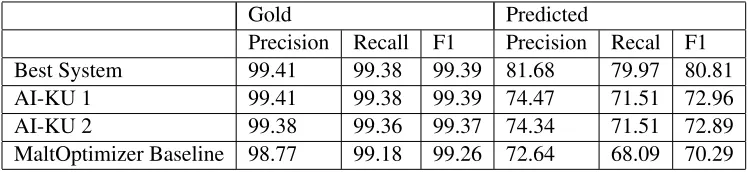
For French, there is also another evaluation met-ric. It is about capturing the Multi Word Expres-sions(MWE). Table 10 reports the results of MWE and it shows that our system is significantly better than MaltOptimizer baseline.
6 Conclusion
We can speculate on these results in couple of ways. First, for all languages we used the same number of clusters. The optimum number of clusters may vary with the syntactic properties of these languages. Similarly, the optimum dimension of the word em-beddings may vary with the languages. In addition, for co-occurence embedding and morphological in-duction we use the parameter settings of (Yatbaz et al., 2012) which is optimized for Part-of-Speech in-duction on Penn Treebank data. We suggest to find the optimum parameter settings for co-occurrence embedding and morphological induction as a future work.
Acknowledgments
We would like to thank Joakim Nivre and Deniz Yuret for valuable suggestions and their support.
References
D. Arthur and S. Vassilvitskii. 2007. k-means++: The advantages of careful seeding. In Proceedings of the eighteenth annual ACM-SIAM symposium on Discrete algorithms, pages 1027–1035. Society for Industrial and Applied Mathematics.
Miguel Ballesteros and Joakim Nivre. 2012. Maltop-timizer: A system for maltparser optimization. In
LREC, pages 2757–2763.
Chris Biemann, Claudio Giuliano, and Alfio Gliozzo. 2007. Unsupervised part-of-speech tagging support-ing supervised methods. In Proceedings of RANLP, volume 7.
Peter F Brown, Peter V Desouza, Robert L Mercer, Vin-cent J Della Pietra, and Jenifer C Lai. 1992. Class-based n-gram models of natural language. Computa-tional linguistics, 18(4):467–479.
S. Buchholz and E. Marsi. 2006a. CoNLL-X shared task on multilingual dependency parsing. SIGNLL. Sabine Buchholz and Erwin Marsi. 2006b. Conll-x
shared task on multilingual dependency parsing. In
Proceedings of the Tenth Conference on Computa-tional Natural Language Learning, CoNLL-X ’06, pages 149–164, Stroudsburg, PA, USA. Association for Computational Linguistics.
Marie Candito and Benoˆıt Crabb´e. 2009. Improving gen-erative statistical parsing with semi-supervised word clustering. In Proceedings of the 11th International Conference on Parsing Technologies, pages 138–141. Association for Computational Linguistics.
Marie Candito and Djam´e Seddah. 2010. Parsing word clusters. InProceedings of the NAACL HLT 2010 First Workshop on Statistical Parsing of Morphologically-Rich Languages, pages 76–84. Association for Com-putational Linguistics.
Ronan Collobert and Jason Weston. 2008. A unified ar-chitecture for natural language processing: Deep neu-ral networks with multitask learning. InProceedings of the 25th international conference on Machine learn-ing, pages 160–167. ACM.
Mathias Creutz and Krista Lagus. 2005. Inducing the morphological lexicon of a natural language from unannotated text. In Proceedings of AKRR’05, Inter-national and Interdisciplinary Conference on Adap-tive Knowledge Representation and Reasoning, pages 106–113, Espoo, Finland, June.
Dayne Freitag. 2004. Trained named entity recogni-tion using distriburecogni-tional clusters. In Proceedings of EMNLP, pages 262–269.
Yoav Goldberg, Reut Tsarfaty, Meni Adler, and Michael Elhadad. 2009. Enhancing unlexicalized parsing per-formance using a wide coverage lexicon, fuzzy tag-set mapping, and em-hmm-based lexical probabilities. In
Proceedings of the 12th Conference of the European Chapter of the Association for Computational Linguis-tics, pages 327–335. Association for Computational Linguistics.
Alon Itai and Shuly Wintner. 2008. Language resources for Hebrew. Language Resources and Evaluation, 42(1):75–98, March.
Philipp Koehn. 2005. Europarl: A parallel corpus for sta-tistical machine translation. InMT summit, volume 5. Terry Koo, Xavier Carreras, and Michael Collins. 2008.
Simple semi-supervised dependency parsing. Colum-bus, Ohio USA, June. ACL.
Percy Liang. 2005. Semi-supervised learning for natural language. Master’s thesis, MIT, May.
Yariv Maron, Michael Lamar, and Elie Bienenstock. 2010. Sphere embedding: An application to part-of-speech induction. In J. Lafferty, C. K. I. Williams, J. Shawe-Taylor, R.S. Zemel, and A. Culotta, editors,
Advances in Neural Information Processing Systems 23, pages 1567–1575.
Scott Miller, Jethran Guinness, and Alex Zamanian. 2004. Name tagging with word clusters and discrim-inative training. In In Proceedings of HLT-NAACL, pages 337–342.
Joakim Nivre, Johan Hall, Jens Nilsson, Atanas Chanev, G¨ulsen Eryigit, Sandra K¨ubler, Svetoslav Marinov, and Erwin Marsi. 2007. Maltparser: A language-independent system for data-driven dependency pars-ing.Natural Language Engineering, 13(2):95–135. Djame Seddah, Reut Tsarfaty, Sandra Kubler, Marie
Can-dito, Jinho Choi, Richard Farkas, Jennifer Foster, Iakes Goenaga, Koldo Gojenola, Yoav Goldberg, Spence Green, Nizar Habash, Marco Kuhlmann, Wolfgang Maier, Joakim Nivre, Adam Przepiorkowski, Ryan Roth, Wolfgang Seeker, Yannick Versley, Veronika Vincze, Marcin Wolinski, Alina Wroblewska, and Eric Villemonte de la Clergerie. 2013. Overview of the spmrl 2013 shared task: A cross-framework evalua-tion of parsing morphologically rich languages. In
Proceedings of the 4th Workshop on Statistical Pars-ing of Morphologically Rich Languages: Shared Task, Seattle, WA.
Andreas Stolcke. 2002. Srilm-an extensible language modeling toolkit. InProceedings International Con-ference on Spoken Language Processing, pages 257– 286, November.
Jun Suzuki, Hideki Isozaki, Xavier Carreras, and Michael Collins. 2009. An empirical study of semi-supervised structured conditional models for dependency parsing. In Proceedings of the 2009 Conference on Empirical Methods in Natural Language Processing: Volume 2-Volume 2, pages 551–560. Association for Computa-tional Linguistics.
Akira Ushioda. 1996. Hierarchical clustering of words and applications to nlp tasks. In Proceedings of the Fourth Workshop on Very Large Corpora, pages 28– 41.
Mehmet Ali Yatbaz, Enis Sert, and Deniz Yuret. 2012. Learning syntactic categories using paradigmatic rep-resentations of word context. In Proceedings of the 2012 Joint Conference on Empirical Methods in Natu-ral Language Processing and Computational NatuNatu-ral Language Learning, pages 940–951, Jeju Island, Ko-rea, July. Association for Computational Linguistics. Deniz Yuret. 2012. Fastsubs: An efficient and exact