Hybrid Combination of Constituency and Dependency Trees into an
Ensemble Dependency Parser
Nathan David Green and Zdenˇek ˇZabokrtsk´y Charles University in Prague
Institute of Formal and Applied Linguistics Faculty of Mathematics and Physics
Prague, Czech Republic
{green,zabokrtsky}@ufal.mff.cuni.cz
Abstract
Dependency parsing has made many ad-vancements in recent years, in particu-lar for English. There are a few de-pendency parsers that achieve compara-ble accuracy scores with each other but with very different types of errors. This paper examines creating a new depen-dency structure through ensemble learn-ing uslearn-ing a hybrid of the outputs of var-ious parsers. We combine all tree out-puts into a weighted edge graph, using 4 weighting mechanisms. The weighted edge graph is the input into our ensemble sys-tem and is a hybrid of very different parsing techniques (constituent parsers, transition-based dependency parsers, and a graph-based parser). From this graph we take a maximum spanning tree. We examine the new dependency structure in terms of accu-racy and errors on individual part-of-speech values.
The results indicate that using a greater number of more varied parsers will improve accuracy results. The combined ensemble system, using 5 parsers based on 3 different parsing techniques, achieves an accuracy score of 92.58%, beating all single parsers on the Wall Street Journal section 23 test set. Additionally, the ensemble system re-duces the average relative error on selected POS tags by 9.82%.
1 Introduction
Dependency parsing has made many advance-ments in recent years. A prime reason for the quick advancement has been the CoNLL shared task competitions. These competitions gave the community a common training/testing framework
along with many open source systems. These sys-tems have, for certain languages, achieved fairly high accuracy. Many of the top systems have comparable accuracy but vary on the types of errors they make. The approaches used in the shared task vary from graph-based techniques to transition-based techniques to the conversion of constituent trees produced by state-of-the-art con-stituent parsers. This varied error distribution makes dependency parsing a prime area for the application of new hybrid and ensemble algo-rithms.
Increasing accuracy of dependency parsing of-ten is in the realm of feature tweaking and opti-mization. The idea behind ensemble learning is to take the best of each parser as it currently is and allow the ensemble system to combine the outputs to form a better overall parse using prior knowl-edge of each individual parser. This is often done by different weighting or voting schemes.
2 Related Work
Ensemble learning (Dietterich, 2000) has been used for a variety of machine learning tasks and recently has been applied to dependency pars-ing in various ways and with different levels of success. (Surdeanu and Manning, 2010; Haf-fari et al., 2011) showed a successful combina-tion of parse trees through a linear combinacombina-tion of trees with various weighting formulations. To keep their tree constraint, they applied Eisner’s al-gorithm for reparsing (Eisner, 1996).
Parser combination with dependency trees has been examined in terms of accuracy (Sagae and Lavie, 2006; Sagae and Tsujii, 2007; Zeman and
ˇ
Zabokrtsk´y, 2005). However, the various tech-niques have generally examined similar parsers
or parsers which have generated various different models. To the best of our knowledge, our ex-periments are the first to look at the accuracy and part of speech error distribution when combining together constituent and dependency parsers that use many different techniques. However, POS tags were used in parser combination in (Hall et al., 2007) for combining a set of Malt Parser mod-els with success.
Other methods of parser combinations have shown to be successful such as using one parser to generate features for another parser. This was shown in (Nivre and McDonald, 2008), in which Malt Parser was used as a feature to MST Parser. The result was a successful combination of a transition-based and graph-based parser, but did not address adding other types of parsers into the framework.
3 Methodology
The following sections describe the process flow, choice of parsers, and datasets needed for oth-ers to recreate the results listed in this paper. Although we describe the specific parsers and datasets used in this paper, this process flow should work for any number of hybrid combina-tions of parsers and datasets.
3.1 Process Flow
To generate a single ensemble parse tree, our sys-tem takesN parse trees as input. The inputs are from a variety of parsers as described in 3.2. All edges in these parse trees are combined into a graph structure. This graph structure accepts weighted edges. So if more than one parse tree contains the same tree edge, the graph is weighted appropriately according to a chosen weighting al-gorithm. The weighting algorithms used in our experiments are described in 3.5.
[image:2.595.304.517.73.246.2]Once the system has a weighted graph, it then uses an algorithm to find a corresponding tree structure so there are no cycles. In this set of ex-periments, we constructed a tree by finding the maximum spanning tree using ChuLiu/Edmonds’ algorithm, which is a standard choice for MST tasks. Figure 1 graphically shows the decisions one needs to make in this framework to create an ensemble parse.
Figure 1: General flow to create an ensemble parse tree.
3.2 Parsers
To get a complete representation of parsers in our ensemble learning framework we use 5 of the most commonly used parsers. They range from graph-based approaches to transition-based approaches to constituent parsers. Constituency output is converted to dependency structures us-ing a converter (Johansson and Nugues, 2007). All parsers are integrated into the Treex frame-work ( ˇZabokrtsk´y et al., 2008; Popel et al., 2011) using the publicly released parsers from the re-spective authors but with Perl wrappers to allow them to work on a common tree structure.
• Graph-Based: A dependency tree is a spe-cial case of a weighted edge graph that spawns from an artificial root and is acyclic. Because of this we can look at a large history of work in graph theory to address finding the best spanning tree for each dependency graph. In this paper we use MST Parser (McDonald et al., 2005) as an input to our ensemble parser.
of Malt Parser (Nivre et al., 2007b), which in the shared tasks was often tied with the best performing systems. Additionally we use Zpar (Zhang and Clark, 2011) which is based on Malt Parser but with a different set of non-local features.
• Constituent Transformation While not a true dependency parser, one technique of-ten applied is to take a state-of-the-art con-stituent parser and transform its phrase based output into dependency relations. This has been shown to also be state-of-the-art in ac-curacy for dependency parsing in English. In this paper we transformed the constituency structure into dependencies using the Penn Converter conversion tool (Johansson and Nugues, 2007). A version of this converter was used in the CoNLL shared task to create dependency treebanks as well. For the fol-lowing ensemble experiments we make use of both (Charniak and Johnson, 2005) and Stanford’s (Klein and Manning, 2003) con-stituent parsers.
In addition to these 5 parsers, we also report the accuracy of an Oracle Parser. This parser is simply the best possible parse of all the edges of the combined dependency trees. If the reference, gold standard, tree has an edge that any of the 5 parsers contain, we include that edge in the Or-acle parse. Initially all nodes of the tree are at-tached to an artificial root in order to maintain connectedness. Since only edges that exist in a reference tree are added, the Oracle Parser main-tains the acyclic constraint. This can be viewed as the maximum accuracy that a hybrid approach could achieve with this set of parsers and with the given data sets.
3.3 Datasets
Much of the current progress in dependency pars-ing has been a result of the availability of common data sets in a variety of languages, made avail-able through the CoNLL shared task (Nivre et al., 2007a). This data is in 13 languages and 7 lan-guage families. Later shared tasks also released data in other genres to allow for domain adap-tation. The availability of standard competition, gold level, data has been an important factor in dependency based research.
For this study we use the English CoNLL data. This data comes from the Wall Street Journal (WSJ) section of the Penn treebank (Marcus et al., 1993). All parsers are trained on sections 02-21 of the WSJ except for the Stanford parser which uses sections 01-21. Charniak, Stanford and Zpar use pre-trained modelsec50spfinal, wsjPCFG.ser.gz, english.tar.gzrespectively. For testing we use sec-tion 23 of the WSJ for comparability reasons with other papers. This test data contains 56,684 to-kens. For tuning we use section 22. This data is used for determining some of the weighting fea-tures.
3.4 Evaluation
As an artifact of the CoNLL shared tasks competition, two standard metrics for com-paring dependency parsing systems emerged. Labeled attachment score (LAS) and unlabeled attachmentscore (UAS). UAS studies the struc-ture of a dependency tree and assesses whether the output has the correct head and dependency arcs. In addition to the structure score in UAS, LAS also measures the accuracy of the dependency la-bels on each arc. A third, but less common met-ric, is used to judge the percentage of sentences that are completely correct in regards to their LAS score. For this paper since we are primarily con-cerned with the merging of tree structures we only evaluate UAS (Buchholz and Marsi, 2006).
3.5 Weighting
Currently we are applying four weighting algo-rithms to the graph structure. First we give each parser the same uniform weight. Second we ex-amine weighting each parser output by the UAS score of the individual parser taken from our tun-ing data. Third we use plural voting weights (De Pauw et al., 2006) based on parser ranks from our tuning data. Due to the success of Plural vot-ing, we try to exaggerate the differences in the parsers by using UAS10 weighting. All four of these are simple weighting techniques but even in their simplicity we can see the benefit of this type of combination in an ensemble parser.
• Uniform Weights: an edge in the graph gets incremented +1 weight for each matching edge in each parser. If an edge occurs in 4 parsers, the weight is 4.
incremented by the value of it’s parsers in-dividual accuracy. So in the UAS results in Table 1 an edge in Charniak’s tree gets .92 added while MST gets .86 added to ev-ery edge they share with the resulting graph. This weighting should allow us to add poor parsers with very little harm to the overall score.
• Plural Voting Weights: In Plural Voting the parsers are rated according to their rank in our tuning data and each gets a “vote” based on their quality. With N parsers the best parser getsN votes while the last place parser gets 1 vote. In this paper, Charniak received 5 votes, Stanford received 4 votes, MST Parser received 3 votes, Malt Parser received 2 votes, and Zpar received 1 vote. Votes in this case are added to each edge as a weight.
• UAS10: For this weighting scheme we took each UAS value to the 10th power. This gave us the desired affect of making the differ-ences in accuracy more apparent and giving more distance from the best to worse parser. This exponent was empirically selected from results with our tuning data set.
4 Results
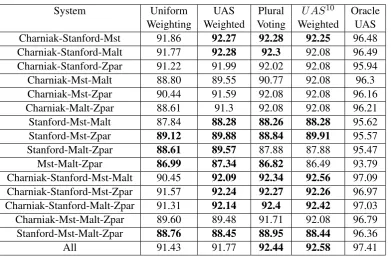
Table 1 contains the results of different parser combinations of the 5 parsers and Table 2 shows the baseline scores of the respective individual parsers. The results indicate that using two parsers will result in an “average” score, and no combination of 2 parsers gave an improvement over the individual parsers, these were left out of the table. Ensemble learning seems to start to have a benefit when using 3 or more parsers with a few combinations having a better UAS score than any of the baseline parsers, these cases are in bold throughout the table. When we add a 4th parser to the mix almost all configurations lead to an improved score when the edges are not weighted uniformly. The only case in which this does not occur is when Stanford’s Parser is not used.
Uniform voting gives us an improved score in a few of the model combinations but in most cases does not produce an output that beats the best in-dividual system. UAS weighting is not the best overall but it does give improved performance in
the majority of model combinations. Problemati-cally UAS weighted trees do not give an improved accuracy when all 5 parsers are used. Given the slight differences in UAS scores of the baseline models in Table 2 this is not surprising as the best graph edge can be outvoted as the number ofN parsers increases. The slight differences in weight do not seem to change the MST parse dra-matically when all 5 parsers are used over Uni-form weighting. Based on the UAS scores learned in our tuning data set, we next looked to amplify the weight differences using Plural Voting. For the majority of model combinations in Plural vot-ing we achieve improved results over the individ-ual systems. When all 5 parsers are used together with Plural Voting, the ensemble parser improves over the highest individual parser’s UAS score. With the success of Plural voting we looked to amplify the UAS score differences in a more sys-tematic way. We looked at using U ASx where x was found experimentally in our tuning data. UAS10 matched Plural voting in the amount of system combinations that improved over their in-dividual components. The top overall score is when we use UAS10 weighting with all parsers. For parser combinations that do not feature Char-niak’s parser, we also find an increase in over-all accuracy score compared to each individual parser, although never beating Charniak’s individ-ual score.
To see the maximum accuracy a hybrid combi-nation can achieve we include an Oracle Ensem-ble Parser in TaEnsem-ble 1. The Oracle Parser takes the edges from all dependency trees and only adds each edge to the Oracle Tree if the corresponding edge is in the reference tree. This gives us a ceil-ing on what ensemble learnceil-ing can achieve. As we can see in Table 1, the ceiling of ensemble learning is 97.41% accuracy. Because of this high value with only 5 parsers, ensemble learning and other hybrid approaches should be a very prosper-ous area for dependency parsing research.
re-System Uniform UAS Plural U AS10 Oracle Weighting Weighted Voting Weighted UAS Charniak-Stanford-Mst 91.86 92.27 92.28 92.25 96.48 Charniak-Stanford-Malt 91.77 92.28 92.3 92.08 96.49 Charniak-Stanford-Zpar 91.22 91.99 92.02 92.08 95.94
Charniak-Mst-Malt 88.80 89.55 90.77 92.08 96.3
Charniak-Mst-Zpar 90.44 91.59 92.08 92.08 96.16
Charniak-Malt-Zpar 88.61 91.3 92.08 92.08 96.21
Stanford-Mst-Malt 87.84 88.28 88.26 88.28 95.62
Stanford-Mst-Zpar 89.12 89.88 88.84 89.91 95.57
Stanford-Malt-Zpar 88.61 89.57 87.88 87.88 95.47
Mst-Malt-Zpar 86.99 87.34 86.82 86.49 93.79
Charniak-Stanford-Mst-Malt 90.45 92.09 92.34 92.56 97.09 Charniak-Stanford-Mst-Zpar 91.57 92.24 92.27 92.26 96.97 Charniak-Stanford-Malt-Zpar 91.31 92.14 92.4 92.42 97.03 Charniak-Mst-Malt-Zpar 89.60 89.48 91.71 92.08 96.79 Stanford-Mst-Malt-Zpar 88.76 88.45 88.95 88.44 96.36
[image:5.595.73.465.70.329.2]All 91.43 91.77 92.44 92.58 97.41
Table 1: Results of the maximum spanning tree algorithm on a combined edge graph. Scores are inboldwhen the ensemble system increased the UAS score over all individual systems.
Parser UAS Charniak 92.08
Stanford 87.88
MST 86.49
Malt 84.51 Zpar 76.06
Table 2: Our baseline parsers and corresponding UAS used in our ensemble experiments
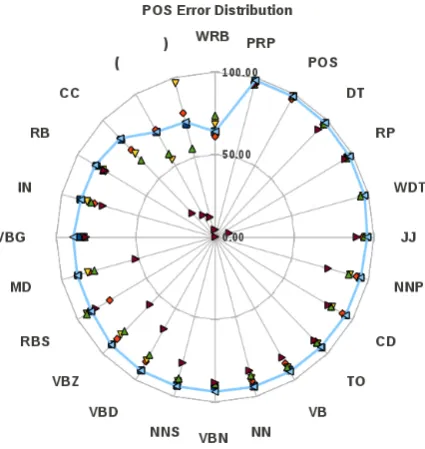
sult comes from the approaches themselves. MST parser is globally trained so the best mean solu-tion should be found. This is why errors on the longer sentences are about the same as the shorter sentences. Malt Parser on the other hand uses a greedy algorithm with a classifier that chooses a particular transition at each vertex. This leads to the possibility of the propagation of errors further in a sentence. Along with this line of research, we look at the error distribution for all 5 parsers along with our best ensemble parser configura-tion. Much like the previous work, we expect dif-ferent types of errors, given that our parsers are from 3 different parsing techniques. To examine if the ensemble parser is substantially changing the parse tree or is just taking the best parse tree and substituting a few edges, we examine the part of speech accuracies and relative error reduction
in Table 3.
As we can see the range of POS errors varies dramatically depending on which parser we ex-amine. For instance forCC, Charniak has 83.54% accuracy while MST has only 71.16% accuracy. The performance for certain POS tags is almost universally low such as the left parenthesis (. Given the large difference in POS errors, weight-ing an ensemble system by POS would seem like a logical choice in future work. As we can see in Figure 2, the varying POS accuracies indicate that the parsing techniques we have incorporated into our ensemble parser, are significantly differ-ent. In almost every case in Table 3, our ensemble parser achieves the best accuracy for each POS, while reducing the average relative error rate by 9.82%.
[image:5.595.72.163.377.464.2]POS Charniak Stanford MST Malt Zpar Best Relative Error Ensemble Reduction
CC 83.54 74.73 71.16 65.84 20.39 84.63 6.62
NNP 94.59 92.16 88.04 87.17 73.67 95.02 7.95
VBN 91.72 89.81 90.35 89.17 88.26 93.81 25.24
CD 94.91 92.67 85.19 84.46 82.64 94.96 0.98
RP 96.15 95.05 97.25 95.60 94.51 97.80 42.86
JJ 95.41 92.99 94.47 93.90 89.45 95.85 9.59
PRP 97.82 96.21 96.68 95.64 95.45 98.39 26.15
TO 94.52 89.44 91.29 90.73 88.63 94.35 -3.10
WRB 63.91 60.90 68.42 73.68 4.51 63.91 0.00
RB 86.26 79.88 81.49 81.44 80.61 87.19 6.77
WDT 97.14 95.36 96.43 95.00 9.29 97.50 12.59
VBZ 91.97 87.35 83.86 80.78 57.91 92.46 6.10
( 73.61 75.00 54.17 58.33 15.28 73.61 0.00
POS 98.18 96.54 98.54 98.72 0.18 98.36 9.89
VB 93.04 88.48 91.33 90.95 84.37 94.24 17.24
MD 89.55 82.02 83.05 78.77 51.54 89.90 3.35
NNS 93.10 89.51 90.68 88.65 78.93 93.67 8.26
NN 93.62 90.29 88.45 86.98 83.84 94.00 5.96
VBD 93.25 87.20 86.27 82.73 64.32 93.52 4.00
DT 97.61 96.47 97.30 97.01 92.19 97.97 15.06
RBS 90.00 76.67 93.33 93.33 86.67 90.00 0.00
IN 87.80 78.66 83.45 80.78 73.08 87.48 -2.66
) 70.83 77.78 96.46 55.56 12.50 72.22 4.77
VBG 85.19 82.13 82.74 82.25 81.27 89.35 28.09
Average 9.82
Table 3: POS accuracies for each of our systems that are used in the ensemble system. We use these accuracies to obtain the POS error distribution for our best ensemble system, which is the combination of all parsers using UAS10weighting. Relative error reduction is calculated between our best ensemble system against the Charniak
Figure 2: POS errors of all 5 parsers and the best en-semble system
cases where the POS is less frequent, our ensem-ble parser appears to average out the error distri-bution.
5 Conclusion
We have shown the benefits of using a maxi-mum spanning tree algorithm in ensemble learn-ing for dependency parslearn-ing, especially for the hybrid combination of constituent parsers with other dependency parsing techniques. This en-semble method shows improvements over the cur-rent state of the art for each individual parser. We also show a theoretical maximum oracle parser which indicates that much more work in this field can take place to improve dependency parsing ac-curacy toward the oracle score of 97.41%.
We demonstrated that using parsers of differ-ent techniques, especially including transformed constituent parsers, can lead to the best accuracy within this ensemble framework. The improve-ments in accuracy are not simply due to a few edge changes but can be seen to improve the ac-curacy of the majority of POS tags over all indi-vidual systems.
While we have only shown this for English, we expect the results to be similar for other lan-guages since our methodology is language in-dependent. Future work will contain different weighting mechanisms as well as application to
other languages which are included in CoNLL data sets.
6 Acknowledgments
This research has received funding from the European Commission’s 7th Framework Pro-gram (FP7) under grant agreement n◦ 238405 (CLARA)
References
Sabine Buchholz and Erwin Marsi. 2006. CoNLL-X shared task on multilingual dependency parsing. In
Proceedings of the Tenth Conference on Computa-tional Natural Language Learning, CoNLL-X ’06, pages 149–164, Stroudsburg, PA, USA. Association for Computational Linguistics.
Eugene Charniak and Mark Johnson. 2005. Coarse-to-fine n-best parsing and maxent discriminative reranking. InProceedings of the 43rd Annual Meet-ing on Association for Computational LMeet-inguistics, ACL ’05, pages 173–180, Stroudsburg, PA, USA. Association for Computational Linguistics. Guy De Pauw, Gilles-Maurice de Schryver, and Peter
Wagacha. 2006. Data-driven part-of-speech tag-ging of kiswahili. In Petr Sojka, Ivan Kopecek, and Karel Pala, editors,Text, Speech and Dialogue, vol-ume 4188 of Lecture Notes in Computer Science, pages 197–204. Springer Berlin / Heidelberg. Thomas G. Dietterich. 2000. Ensemble methods in
machine learning. InProceedings of the First In-ternational Workshop on Multiple Classifier Sys-tems, MCS ’00, pages 1–15, London, UK. Springer-Verlag.
Jason Eisner. 1996. Three new probabilistic mod-els for dependency parsing: An exploration. In
Proceedings of the 16th International Conference on Computational Linguistics (COLING-96), pages 340–345, Copenhagen, August.
Gholamreza Haffari, Marzieh Razavi, and Anoop Sarkar. 2011. An ensemble model that combines syntactic and semantic clustering for discriminative dependency parsing. InProceedings of the 49th An-nual Meeting of the Association for Computational Linguistics: Human Language Technologies, pages 710–714, Portland, Oregon, USA, June. Associa-tion for ComputaAssocia-tional Linguistics.
Johan Hall, Jens Nilsson, Joakim Nivre, G¨ulsen Eryigit, Be´ata Megyesi, Mattias Nilsson, and Markus Saers. 2007. Single malt or blended? a study in multilingual parser optimization. In
Proceedings of the CoNLL Shared Task Session of EMNLP-CoNLL 2007, pages 933–939.
English. In Proceedings of NODALIDA 2007, pages 105–112, Tartu, Estonia, May 25-26. Dan Klein and Christopher D. Manning. 2003.
Ac-curate unlexicalized parsing. InProceedings of the 41st Annual Meeting on Association for Computa-tional Linguistics - Volume 1, ACL ’03, pages 423– 430, Stroudsburg, PA, USA. Association for Com-putational Linguistics.
S. K¨ubler, R. McDonald, and J. Nivre. 2009. Depen-dency parsing. Synthesis lectures on human lan-guage technologies. Morgan & Claypool, US. Mitchell P. Marcus, Mary Ann Marcinkiewicz, and
Beatrice Santorini. 1993. Building a large anno-tated corpus of english: the Penn Treebank. Com-put. Linguist., 19:313–330, June.
Ryan McDonald, Fernando Pereira, Kiril Ribarov, and Jan Hajic. 2005. Non-projective dependency pars-ing uspars-ing spannpars-ing tree algorithms. In Proceed-ings of Human Language Technology Conference and Conference on Empirical Methods in Natural Language Processing, pages 523–530, Vancouver, British Columbia, Canada, October. Association for Computational Linguistics.
Joakim Nivre and Ryan McDonald. 2008. Integrat-ing graph-based and transition-based dependency parsers. In Proceedings of ACL-08: HLT, pages 950–958, Columbus, Ohio, June. Association for Computational Linguistics.
Joakim Nivre, Johan Hall, Sandra K¨ubler, Ryan Mc-Donald, Jens Nilsson, Sebastian Riedel, and Deniz Yuret. 2007a. The CoNLL 2007 shared task on dependency parsing. In Proceedings of the CoNLL Shared Task Session of EMNLP-CoNLL 2007, pages 915–932, Prague, Czech Republic, June. Association for Computational Linguistics. Joakim Nivre, Johan Hall, Jens Nilsson, Atanas
Chanev, Gulsen Eryigit, Sandra K¨ubler, Svetoslav Marinov, and Erwin Marsi. 2007b. MaltParser: A language-independent system for data-driven de-pendency parsing. Natural Language Engineering, 13(2):95–135.
Martin Popel, David Mareˇcek, Nathan Green, and Zdenˇek ˇZabokrtsk´y. 2011. Influence of parser choice on dependency-based mt. InProceedings of the Sixth Workshop on Statistical Machine Trans-lation, pages 433–439, Edinburgh, Scotland, July. Association for Computational Linguistics. Kenji Sagae and Alon Lavie. 2006. Parser
combi-nation by reparsing. InProceedings of the Human Language Technology Conference of the NAACL, Companion Volume: Short Papers, pages 129–132, New York City, USA, June. Association for Com-putational Linguistics.
Kenji Sagae and Jun’ichi Tsujii. 2007. Depen-dency parsing and domain adaptation with LR mod-els and parser ensembles. In Proceedings of the CoNLL Shared Task Session of EMNLP-CoNLL
2007, pages 1044–1050, Prague, Czech Republic, June. Association for Computational Linguistics. Mihai Surdeanu and Christopher D. Manning. 2010.
Ensemble models for dependency parsing: cheap and good? In Human Language Technologies: The 2010 Annual Conference of the North Ameri-can Chapter of the Association for Computational Linguistics, HLT ’10, pages 649–652, Stroudsburg, PA, USA. Association for Computational Linguis-tics.
Zdenˇek ˇZabokrtsk´y, Jan Pt´aˇcek, and Petr Pajas. 2008. TectoMT: Highly Modular MT System with Tec-togrammatics Used as Transfer Layer. In Proceed-ings of the 3rd Workshop on Statistical Machine Translation, ACL, pages 167–170.
Daniel Zeman and Zdenˇek ˇZabokrtsk´y. 2005. Im-proving parsing accuracy by combining diverse de-pendency parsers. InIn: Proceedings of the 9th In-ternational Workshop on Parsing Technologies. Yue Zhang and Stephen Clark. 2011. Syntactic