Annotation Schemes to Encode Domain Knowledge in Medical Narratives
Wilson McCoy
Dept. of Interactive Games and Media
Cecilia Ovesdotter Alm
Dept. of English
Cara Calvelli
College of Health Sciences and Technology
Rui Li
Computing and Information Sciences
Jeff B. Pelz
Center for Imaging Science
Pengcheng Shi
Computing and Information Sciences
Anne Haake
Computing and Information Sciences
Rochester Institute of Technology
Abstract
The broad goal of this study is to further the understanding of doctors’ diagnostic styles and reasoning processes. We analyze and validate methods for annotating verbal diag-nostic narratives collected together with eye-movement data. The long-term goal is to un-derstand the cognitive reasoning and decision-making processes of medical experts, which could be useful for clinical information sys-tems. The linguistic data set consists of transcribed recordings. Dermatologists were shown images of cutaneous conditions and asked to explain their observations aloud as they proceeded towards a diagnosis. We re-port on two linked annotation studies. In the first study, a subset of narratives were an-notated by experts using a unique annotation scheme developed specifically for capturing decision-making components in the diagnos-tic processof dermatologists. We analyze notator agreement as well as compare this an-notation scheme tosemantic typesof the Uni-fied Medical Language System as validation. In the second study, we explore the annota-tion ofdiagnostic correctnessin the narratives at three relevant diagnostic steps, and we also explore the relationship between the two an-notation schemes.
1 Introduction
From a scientific perspective, it is important to un-derstand the cognitive decision-making processes of physicians. This knowledge can be useful for natu-ral language processing systems and user-centered decision support in the medical field. Annotation
schemes can be used to encode such information. With the growth of electronic medical records, re-liable and robust annotation schemes can potentially also make the retrieval and use of archived medical information more effective. This research analyzes two annotation schemes in the context of dermatol-ogy for transcribed verbal medical narratives. One scheme is additionally compared to semantic types in the MetaMap semantic network contained in the Unified Medical Language System orUMLS (Aron-son, 2006) as external validation. This study furthers research in linguistically annotated corpora by cre-ating and validcre-ating schemes with future potential applications in the medical industry.
2 Data Set
For clarity, we begin by outlining the original data collection experiment (McCoy et al., 2012). The ex-periment included 16 physicians with dermatolog-ical expertise. Of these, 12 were attending physi-cians and 4 were residents (i.e., dermatologists in training). The experts were shown a series of 50 images of dermatological conditions.1 The experts’
verbal narratives were recorded, as were their eye-movements. 707 narratives were used in this study.
The participating physicians were instructed to narrate their thoughts and observations about each image to a silent student, while arriving at a differ-ential diagnosis and possible final diagnosis. This data elicitation approach is a modified version of the Master-Apprentice interaction scenario (Beyer and Holtzblatt, 1997). The verbal data were later
1Some images courtesy of Logical Images, Inc.
time-aligned using the speech processing tool Praat2 (Boersma, 2001) and stored as Praat TextGrid files. Disfluencies and pauses were also transcribed (e.g. Womack et al. (2012) analyzes certain disfluencies in this data set). The average length of a narrative is 55.6 seconds with an average of 105 words. There is an average of 15.4 pauses across narratives and an average total silent time of 19.7 seconds per narra-tive.
For methodological reasons, clean text transcripts were distributed to annotators in the two studies. These were cleaned of most disfluencies and agram-matical characteristics that otherwise could distract the annotator while reading.
3 Annotation Study 1: Diagnostic Thought Units
An annotation scheme was created to reveal the cognitive decision-making processes of physicians. This scheme divides the narratives into diagnostic units known henceforth asthought units. A thought unit is a single word or sequence of words to receive a descriptive label based on its part in the diagnos-tic process. With input from dermatologist and co-author Cara Calvelli, referred to below as MD 1, we defined a set of nine basic thought units. The cre-ation of this scheme was separate from the annota-tion procedure. The tags and abbreviaannota-tions are in Table 1.
Thought Unit Label Tag Abbr. Example
Patient Demographics DEM young
Body Location LOC arm
Configuration CON linear
Distribution DIS acral
Primary Morphology PRI papule
Secondary Morphology SEC scale
Differential Diagnosis DIF X,Y orZ Final Diagnosis DX this isX Recommendations REC PshouldQ
Table 1: Thought unit tags, their abbreviations given to experts in annotation study 1, and hypothetical examples. Thought units can span multiple words in the transcripts. For clarity, thought unit tags are in capital letters.
Of the narratives, 60 were chosen to be annotated
2See:http://www.fon.hum.uva.nl/praat/.
in the first study. These represented transcripts of 10 images, selected because of their differing medi-cal lesion morphologies. For each of the chosen im-ages, the three longest and three shortest transcripts were included, thus comprising examples with po-tentially larger vs. smaller numbers of thought unit tokens (e.g. to understand which thought units were likely to be skipped).
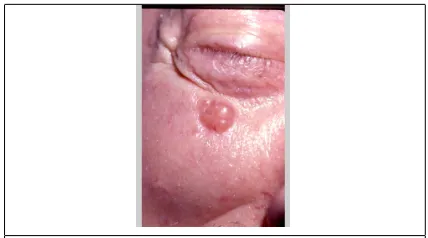
[image:2.612.319.533.177.296.2]Involving an [older patient’s]DEM [infraor-bital area]LOC is a [pearly papule]P RI with [overlying telangiectasia]SEC suggestive of a [basal cell carcinoma]DX.
Figure 1: An example annotated narrative. Annotated text is shown inside of brackets followed by the annotated thought unit tag abbreviation subscript.
Printed and shuffled transcripts of the 60 nar-ratives were independently provided to two physi-cians, referred to below as MD 1 and MD 2, who did not take part in the original data elicitation ex-periment. The expert annotators were instructed to mark sequences of words which they believed com-prised the provided thought units. A short example narrative as annotated by one expert and the associ-ated image is shown in Figure 1.
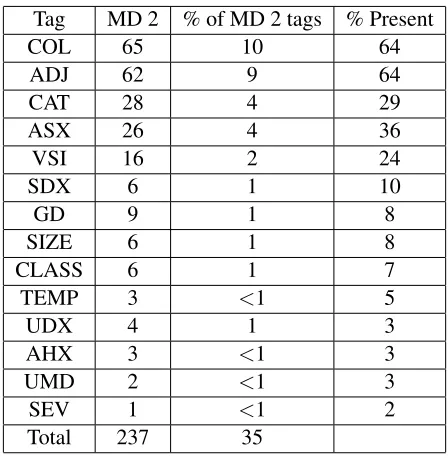
MD 2 expanded the tag set with an additional sub-set of thought unit tags, however, they are largely not considered in this analysis.3 This is because of their inability to be compared to thought unit tags used by MD 1 as well as their generally low frequency (9 of the 15 new thought units each account for less than 1% of MD 2’s thought unit tokens).
3
MD 2 added the tagsColor(COL),Adjective(ADJ), Dis-ease Category(CAT),Associated Skin Condition(ASX),Vague Skin Impression(VSI), Skin Morphologic Diagnosis (SDX),
General Description(GD),Size(SIZE),Descriptive Classifier
After these annotations were completed, and af-ter sufficient time had passed, the same set of 60 transcripts, reshuffled, were given to MD 1 again to annotate. MD 1 was aware that this was a re-annotation. MD 1’s original annotation is referred to as MD 1a and the re-annotation as MD 1b. With the completion of this annotation set, inter-annotator and intra-annotator agreement could be analyzed.
[image:3.612.329.527.60.184.2]Thought unit annotations were then time-aligned as tiers below a word tier in Praat. This allowed us to compare thought unit tokens directly along a tempo-ral scale visually as well as automatically. It also al-lows the comparison of both local and global speech phenomena. Figure 2 shows a slice of a diagnos-tic narrative in Praat with thought unit annotations that have perfect overlap between MD 1a and MD 1b. It also shows that there was partial disagreement by MD 2 regarding the SEC token. The MD 1a and MD 1b annotations included “surrounding” as part of the secondary lesion morphology and the MD 2 annotation did not. In this example, MD 2 also par-tially agreed with MD 1’s PRI tokens but not on the complete word sequence; “violaceous” is marked as COL, one of MD 2’s added tags.
Figure 2: A screenshot of the annotation data entry.
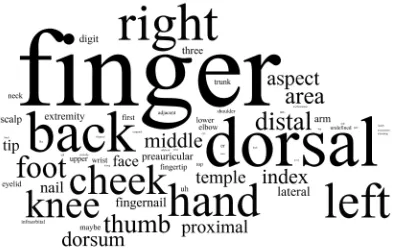
Wordle4was used to visualize the prominence of concepts by thought units, given frequencies. The word clouds forbody location (LOC) andprimary morphology(PRI) are shown in Figure 3 and Figure 4, respectively. In Figure 3, as expected, words re-lating to body parts are most prominent. In Figure 4, the most prominent words, plaque, papule, and patch, are important primary morphology types.
4
[image:3.612.328.528.249.353.2]See http://www.wordle.net. In Figures 3 and 4, concepts with multiple word forms were lemmatized.
Figure 3: A word cloud generated from all words marked asbody location.
Figure 4: A word cloud generated from all words marked asprimary morphology.
3.1 Analysis of Thought Units’ Distributions
Occurrences of each thought unit were tabulated. Raw counts as well as their percentages of the to-tal thought unit tokens are shown in Tables 2 and 3. The percent of narratives in which a thought unit tag appeared was also calculated. A tag was considered
presentin a narrative if any annotation (MD 1a, MD 2, or MD 1b) used it at least once in said narrative.
In regards to intra-annotation variation, the MD 1a annotation used a similar number of tokens as the MD 1b re-annotation. In fact, the tags themselves are also similarly distributed, varying by at most 5% of the total tokens. In regards to inter-annotation variation, the MD 2 annotation used roughly 144% and 143% the number of tag tokens that were used by the MD 1a and MD 1b annotations, respectively. This is largely because of the additional tags that MD 2 created.
[image:3.612.76.295.397.529.2]Tag MD 1a % of MD 1a tags MD 2 % of MD 2 tags MD 1b % of MD 1b tags % Present
PRI 106 23 98 15 117 25 100
LOC 39 8 97 14 58 12 88
DX 42 9 71 11 32 7 86
SEC 81 17 69 10 91 19 85
DIS 51 11 9 1 29 6 66
CON 47 10 29 4 54 12 64
DIF 73 16 35 5 64 14 61
DEM 25 5 25 4 22 5 34
REC 2 <1 3 <1 2 <1 3
[image:4.612.73.544.57.213.2]Total 466 100 436 65 469 100
Table 2: Provided thought unit tags used by each annotator, the percent of all tokens with that tag, and the percent of narratives in which tags were present. 35% of MD 2’s tags were self-created, see Table 3.
Tag MD 2 % of MD 2 tags % Present
COL 65 10 64
ADJ 62 9 64
CAT 28 4 29
ASX 26 4 36
VSI 16 2 24
SDX 6 1 10
GD 9 1 8
SIZE 6 1 8
CLASS 6 1 7
TEMP 3 <1 5
UDX 4 1 3
AHX 3 <1 3
UMD 2 <1 3
SEV 1 <1 2
Total 237 35
Table 3: Thought unit abbreviations created by MD 2, the percent of MD 2’s tokens assigned to tags, and the percent of narratives in which tags were present (see Table 2).
provided tags appeared in more than 60% of the an-notated narratives. These two tags werepatient de-mographics(DEM) andrecommendations(REC).
3.2 Temporal Distribution of Thought Units in the Diagnostic Process
The positions of thought unit tokens in the narra-tives combining MD 1a, MD 2, and MD 1b were also calculated and are shown in Figure 5 on the next page, excluding additional thought unit tags created by MD 2. Because tokens could span several words,
the time at the center of the token was used to calcu-late its position. This number was then normalized to a number from 0 to 1 with 0 being the beginning of the narrative and 1 being the end. Positions were rounded down to the nearest .05.
The overall temporal reasoning trajectory found seems intuitive. Doctors tend to follow a cogni-tive path with most DIS, DEM, CON, and LOC to-kens occurring toward the beginning, followed by PRI, SEC, and DIF tokens, and concluded with DX tokens. The REC tokens appear infrequently but mostly occur at the end alongside DIF and DX to-kens.
Doctors largely follow the same descriptive path of stating medical morphologies and other observ-able information, creating a differential diagnosis, and then choosing a final diagnosis, thus the anal-ysis confirmed our expectations. The observed trend could also relate to traditions and training in derma-tology. MD 1 and MD 2 did not know each other and received their dermatology training in different areas of the United States. We recognize that the analysis is biased towards MD 1 as that expert anno-tated twice.
We performed the temporal analysis on the new thought units created by MD 2, however the results were less conclusive and are therefore not included here. The created tagsColor (COL) andAdjective
[image:4.612.73.297.261.490.2]Figure 5: Distributions of provided thought unit tokens over narrative length, expressed as a ratio from 0 to 1 with 0 being the beginning and 1 being the end of the narrative. The frequency peak of each thought unit is marked.
fine granularity as a similar behavior was already captured by the provided thought units.
3.3 Agreement Metrics
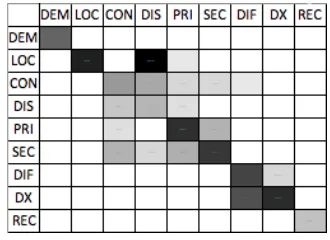
[image:5.612.343.508.284.404.2]Confusion matrices were created for each annota-tor pair. As a unit of agreement analysis, we com-pared overlap of tokens by individual words (includ-ing silences and disfluencies) because tokens could span and overlap in a variety of ways as shown in Figure 2. The intra-annotation matrix (MD 1a/MD 1b) is shown as a heat-map in Figure 6 with darker cells showing tags that were more often annotated together. Inter-annotation matrices were also cre-ated between MD 1a/MD 2 and MD 2/MD 1b but are not shown here. In figure 6, as a general trend, the diagonal shows that there was strong agreement on most tags. In this inter-annotation matrix, some of the most confused thought units are DIS and LOC which both refer to spatial phenomena as well as DIF and DX which both refer to diagnostic conclu-sions. We maintain each of these as separate labels, however, because it is good practice in dermatology to specifically assess each one.
[image:5.612.328.522.462.506.2]The annotator agreement measures of observed agreement and Cohen (1960) kappa were also cal-culated from the data set. For the results shown in Table 4, thought units created by MD 2 were reas-signed to one of the 9 provided tags based on the created confusion matrices. This was done only for this metric because MD 2 often used a created tag but in the same place as both MD 1 annotations as
Figure 6: A heat-map of MD 1a’s (columns) and MD 1b’s (rows) confusion matrix. Darker cells indicate greater to-ken overlap.
MD 1a - 2 2 - 1b 1a - 1b % Agreement 80.69 77.72 80.98
Kappa .56 .54 .62
Table 4: Agreement metrics for thought unit annotations. Calculations are performed pairwise for MD 1a, MD 2, and MD 1b. 1a - 1b is an intra-annotation measure.
shown in the case of COL and PRI tokens in Fig-ure 2. With this, these metrics better represent the agreement regarding positions of tokens instead of the disagreement between the tags used. The cal-culations of these metrics showed moderate to good agreement between all annotation pairs.
3.4 External Validation with UMLS MetaMap
Uni-fied Medical Language System (UMLS) (Boden-reider, 2004). With its 133 types, many of which are abstractions (such as “Conceptual Entity” and “Laboratory Procedure”), the UMLS ontology con-tains much fine-grained information. Our annota-tion scheme focuses on the cognitive process of der-matologists during a diagnostic procedure; we are not proposing a replacement for UMLS. Although UMLS and our annotation scheme are for different purposes (i.e., overall medicine vs. dermatology di-agnostics), we regard a comparison between the two valid.
The text of each thought unit annotation was used as a query to the MetaMap semantic network. This returned a list of MetaMap entries and their seman-tic types. MetaMap was configured to only return the most likely match, or matches in the case of a tie. The semantic type or types of each result were counted towards the relationship to the thought unit tag the word sequence corresponded to. These re-lationships were then analyzed. We found that for most thought units, the most frequently occurring semantic types were often similar to the definitions of our thought units. Some examples are the LOC tag having “Spatial Concept” and “Body Part, Or-gan, or Organ Component” as its two most com-mon semantic types and the DEM tag having “Age Group” and “Population Group” as its two most common semantic types.
A network density graph was created of all of these relationships with edge lengths inversely pro-portional to the strength of the relationship. It was too large and complex to show in this paper; instead, only the 40 strongest relationships were used to cre-ate a smaller network density graph shown in Figure 7. This also reduced noise from false positives re-turned by MetaMap.5
Based on Figure 7, a few conclusions can be drawn. PRI and SEC tags share many of the same semantic types. Eight of PRI’s eleven shown re-lationships include semantic types that are shared among SEC’s ten shown relationships. DIF has seven shown relationships compared to three of DX. Both of these thought units, however, are strongly related to “Neoplastic Process” and “Disease or Syn-drome”. Semantic types are also shared among DIS, LOC, and CON. These findings correspond to the confusion among these tags noted in Section 3.3 and Figure 6. Among the 40 strongest relationships, only one is not from the set of nine provided tags. This validates the tag set and indicates that perhapscolor
(COL) should be re-considered for inclusion in fu-ture work.
5
[image:6.612.115.494.470.644.2]Some noise, however, is still present. For example, the rela-tionship between “Medical Device” and two of our created tags exists because the word ‘scale’ exists in a dermatological sense and as the item to weigh objects.
4 Annotation Study 2: Diagnostic Correctness
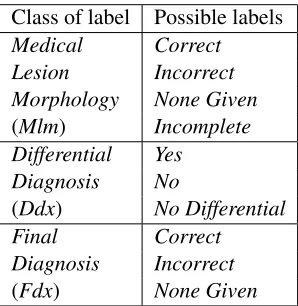
Cleaned transcripts were sent to three expert derma-tologists referred to as MD A, MD B, and MD C to evaluate each narratives’ correctness. Co-author Dr. Calvelli took part in this study as well due to limited resources and is referred to as MD A. Narra-tives were evaluated on three categories: correctness of themedical lesion morphology(Mlm), inclusion of the correct answer in the differential diagnosis
(Ddx), and correctness of the final diagnosis (Fdx). Annotators were asked to use tags provided in Ta-ble 5. Inter-annotator agreements were calculated by annotator pair and are shown in Table 6. There is very good agreement between the annotators in most metrics. The lowest scores were all regardingMlm
most likely because of its subjectivity and greater number of class labels.
We were interested in determining how the thought units analyzed in Section 3 related to cor-rectness annotations. To do this, we first calculated three accuracy scores for each narrative (one score for each diagnostic step scored by the annotators). The formula for correctness is shown below using Final Diagnosis (Fdx) as an example. Let t be a thought unit in the setT,nbe a narrative in setN, andabe an annotator in setA.
nscore =
∑|A|
i=1n(ai(Fdx)) =‘Correct’{10: True: False |A|
We then calculated the correctness based on thought unit presence using the following formula.
Class of label Possible labels
Medical Correct Lesion Incorrect Morphology None Given
(Mlm) Incomplete Differential Yes
Diagnosis No
(Ddx) No Differential Final Correct Diagnosis Incorrect
[image:7.612.312.546.57.158.2](Fdx) None Given
Table 5: Labels for correctness annotations. To not con-fuse these labels with thought unit labels (Section 3), they are written with an initial capital letter and italics.7
Diagnostic step Metric A - B B - C C - A
Mlm % Agr. 67.75 72.40 71.52
Ddx % Agr. 91.84 88.46 88.71
Fdx % Agr. 88.21 91.97 83.56
Mlm Kappa 0.24 0.22 0.39
Ddx Kappa 0.85 0.79 0.79
[image:7.612.111.260.509.662.2]Fdx Kappa 0.79 0.84 0.70
Table 6: Pairwise agreement metrics between MD A, MD B, and MD C performed on correctness annotations at three levels. Annotators assigned three labels to each nar-rative (one at each diagnostic step). See Table 5.
tscore = ∑|N|
i=1tinni{
nscore: True
0: False
∑|N|
i=1tinni{10: True: False
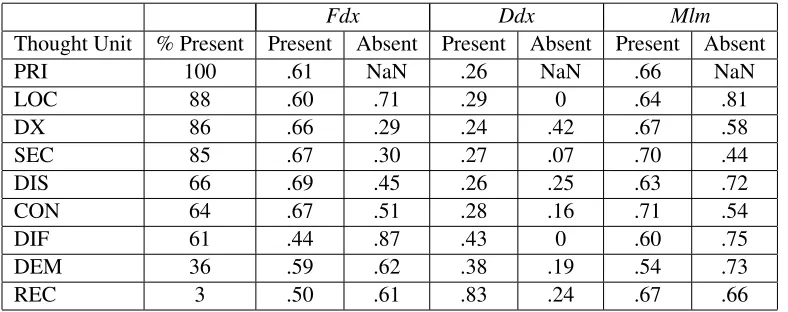
These scores were computed with the nine pro-vided thought units and are shown in Table 7.
As expected, when a DX token was present, a narrative was more often marked‘Correct’forFdx. Contrary to this general finding, the appearance of a DIF token decreased the ratio of‘Correct’ tags for
Fdx. This could be because we did not ask for a dif-ferential diagnosis in the elicitation experiment and experts generally gave differentials, so perhaps ex-perts were more likely to give a differential if they were unsure of their diagnosis. Another interesting finding was that DEM tokens also slightly decreased the ratio of‘Correct’ Fdx. We suspect that this is be-cause the observers were more likely to mention de-mographics when presented cases with which they are not as familiar.
5 Previous Work
Derma-Fdx Ddx Mlm
Thought Unit % Present Present Absent Present Absent Present Absent
PRI 100 .61 NaN .26 NaN .66 NaN
LOC 88 .60 .71 .29 0 .64 .81
DX 86 .66 .29 .24 .42 .67 .58
SEC 85 .67 .30 .27 .07 .70 .44
DIS 66 .69 .45 .26 .25 .63 .72
CON 64 .67 .51 .28 .16 .71 .54
DIF 61 .44 .87 .43 0 .60 .75
DEM 36 .59 .62 .38 .19 .54 .73
[image:8.612.111.505.57.213.2]REC 3 .50 .61 .83 .24 .67 .66
Table 7: Ratios of correctness of the three diagnostic steps when individual thought units are present vs. when they are absent (a tag is present in a narrative if at least one annotator used it at least once in thought unit annotation). Also included are the percent of narratives in which each thought unit appeared in.
tologists were instrumental in creating schemes for annotation and several dermatologists were involved in annotating the data set. By modeling our annota-tion scheme after the decision-making process of a trained physician, we can better capture the domain-specific knowledge and how it is being used. Niu and Hirst (2004) have done work with annotations of clinical texts. These contain much information but do not give us insight into the cognitive process. The data set reported on in this study shows diag-nostic cognitive processes through narrations spo-ken impromptu. Because of this, the data set cap-tures cognitive associations, including speculative reasoning elements. Such information could be use-ful in a decision-support system, for instance to alert physicians to commonly confused diagnostic alter-natives. Other work has been done in annotating medical texts. For example, Mowery et al. (2008) focused on finding temporal aspects of clinical texts, whereas we attempt to show the steps of the cogni-tive processes used by physicians during decision-making. Marciniak and Mykowiecka (2011) also re-port on annotating medical texts. They verified an automatic system against manual annotation of hos-pital discharge reports for linguistic morphologies.
Importantly, this study responds to the need iden-tified by Kokkinakis and Gronostaj (2010) for bet-ter methods for parsing scientific and medical data. The presented annotations schemes and the anno-tated data set we report upon will be useful for devel-oping and evaluating relevant systems for processing
clinical dermatology texts. This research is also a starting point for empirically exploring the theoreti-cal division of physicians’ decision-making systems by Croskerry (2009) into “intuitive” and “analytical” (p. 1022). We plan to investigate the relationship between thought units and Croskerry’s hypothesized differences in medical reasoning situations further.
6 Conclusion
This study investigates two annotation schemes that capture cognitive reasoning processes of dermatolo-gists. Our work contributes to the understanding the linguistic expression of cognitive decision-making in a clinical domain and appropriate annotation pro-cesses that capture such phenomena. With this in-formation, intuitive decision support systems and new electronic medical records storage and retrieval methods can be developed to help the growing field of medical technology. In future work, integration of gaze data will allow us to map eye-movement pat-terns to thought units; the multimodal approach will elucidate the link between visual perceptual and ver-bally expressed conceptual cognition.
Acknowledgements
References
Alan R. Aronson. 2006. MetaMap: Mapping Text to the UMLS Metathesaurus. July.
Hugh Beyer and Karen Holtzblatt. 1997.Contextual De-sign: Defining Customer-Centered Systems. Morgan Kaufmann.
Olivier Bodenreider. 2004. The Unified Medical Lan-guage System (UMLS): integrating biomedical termi-nology. Nucleic Acids Research, pages D267–D270. Paul Boersma. 2001. Praat, a system for doing phonetics
by computer.Glot International, pages 341–345. Jacob Cohen. 1960. A Coefficient of Agreement for
Nominal Scales. Educational and Psychological Mea-surement, 20:37–46.
Pat Croskerry. 2009. A Universal Model of Diagnostic Reasoning.Academic Medicine, pages 1022–1028. Udo Hahn and Joachim Wermter. 2004.
High-Performance Tagging on Medical Texts. Proceedings of the 20th international conference on Computational Linguistics, pages 973–979.
Dimitrios Kokkinakis and Maria Toporowska Gronostaj. 2010. Linking SweFN++ with Medical Resources, to-wards a MedFrameNet for Swedish. Proceedings of the NAACL HLT 2010 Second Louhi Workshop on Text and Data Mining of Health Documents, pages 68–71. Malgorzata Marciniak and Agnieszka Mykowiecka.
2011. Towards Morphologically Annotated Corpus of Hospital Discharge Reports in Polish. Proceedings of the 2011 Workshop on Biomedical Natural Language Procesing, ACL-HLT, pages 92–100.
Wilson McCoy, Cecilia Ovesdotter Alm, Cara Calvelli, Jeff Pelz, Pengcheng Shi, and Anne Haake. 2012. Linking Uncertainty in Physicians’ Narratives to Diag-nostic Correctness. Proceedings of the ExProM 2012 Workshop.
Danielle L. Mowery, Henk Harkema, and Wendy W. Chapman. 2008. Temporal Annotation of Clinical Text. BioNLP 2008: Current Trends in Biomedical Natural Language Processing, pages 106–107. Yun Niu and Graeme Hirst. 2004. Analysis of Semantic
Classes in Medical Text for Question Answering. ACL 2004 Workshop on Question Answering in Restricted Domains.
Kathryn Womack, Wilson McCoy, Cecilia Ovesdot-ter Alm, Cara Calvelli, Jeff Pelz, Pengcheng Shi, and Anne Haake. 2012. Disfluencies as Extra-Propositional Indicators of Cognitive Processing. Pro-ceedings of the ExProM 2012 Workshop.