Alignment-HMM-based Extraction of Abbreviations from Biomedical Text
Dana Movshovitz-Attias
Carnegie Mellon University 5000 Forbes Avenue Pittsburgh, PA 15213 USA
William W. Cohen
Carnegie Mellon University 5000 Forbes Avenue Pittsburgh, PA 15213 USA
Abstract
We present an algorithm for extracting abbre-viation definitions from biomedical text. Our approach is based on an alignment HMM, matching abbreviations and their definitions. We report 98% precision and 93% recall on a standard data set, and 95% precision and 91% recall on an additional test set. Our sults show an improvement over previously re-ported methods and our model has several ad-vantages. Our model: (1) is simpler and faster than a comparable alignment-based abbrevia-tion extractor; (2) is naturally generalizable to specific types of abbreviations,e.g., abbrevia-tions of chemical formulas; (3) is trained on a set of unlabeled examples; and (4) associates a probability with each predicted definition. Us-ing the abbreviation alignment model we were able to extract over 1.4 million abbreviations from a corpus of 200K full-text PubMed pa-pers, including 455,844 unique definitions.
1 Introduction
Abbreviations and acronyms are commonly used in the biomedical literature for names of genes, dis-eases and more (Ambrus, 1987). Abbreviation def-initions are a source of ambiguity since they may change depending on the context. The ability to rec-ognize and extract abbreviations and map them to a full definition can be useful for Information Ex-traction tasks (Yu et al., 2007) and for the complete understanding of scientific biomedical text.
Yu et al. (2002) distinguish the two follow-ing uses of abbreviations: (1) Common abbrevia-tions are those that have become widely accepted as
synonyms, such as hDNA, deoxyribonucleic acidi
or hAIDS, acquired immunodeficiency syndromei. These represent common fundamental and impor-tant terms and are often used, although not explic-itly defined within the text (Fred and Cheng, 2003). In contrast, (2)Dynamicabbreviations, are defined by the author and used within a particular article. Such definitions can often overlap, depending on the context. For example, the term PBS most com-monly abbreviates Phosphate Buffered Saline, but in other contexts may refer to the following: Pain Behavior Scale, Painful Bladder Syndrome, Paired Domain-Binding Site, Particle Based Simulation, Partitioned Bremer Support, Pharmaceutical Bene-fits Scheme, and more. Some abbreviations fall be-tween these two definitions in the sense that they are normally defined in the text, however, they have be-come widely used, and therefore they do not nor-mally overlap with other abbreviations. An exam-ple for this is the term ATP which, almost exclu-sively, abbreviates adenosine triphosphate, and is only rarely used in different contexts in biomedicine.
Gaudan et al. (2005) define two similar con-cepts, distinguishing Global and Local abbrevia-tions. Global abbreviations are not defined within the document, similar to common abbreviation. Lo-cal abbreviations appear in the document alongside the long form, similar to dynamic abbreviations. The contextual ambiguity of dynamic, or local, breviations makes them an important target for ab-breviation recognition tasks.
There is a great deal of variation in the way that different authors produce abbreviations. Our defini-tion ofabbreviationis quite flexible and can best be
represented by the set of examples described in Ta-ble 1. These include simple acronyms, in which the first letter of every word from the long form is rep-resented in the short form, as well as more complex cases such as: inner letter matches, missing short form characters, and specific substitutions (such as of a chemical element and its symbol). We gener-ally assume that the abbreviated form contains some contraction of words or phrases from the full form. This definition is consistent with the one defined by many other extraction systems (see e.g., (Schwartz and Hearst, 2002) and (Chang et al., 2002)).
We describe a method for extracting dynamic ab-breviations, which are explicitly defined in biomed-ical abstracts. For each of the input texts, the task is to identify and extract hshort form, long formi
pairs of the abbreviations defined within the text. We also provide a mapping, formed as an alignment, be-tween the characters of the two forms, and the prob-ability of this alignment according to our model.
Our approach is based on dividing the abbrevia-tion recogniabbrevia-tion task into the following stages: (1) Parsing the text and extractingcandidate abbrevia-tion pairs (long and short forms) based on textual cues, such as parentheses; (2) Recovering a valid alignment between the short and long form candi-dates (valid alignments are defined in Section 3.2). We perform a sequential alignment based on a pair-HMM; (3) Extracting a final short and long form from the alignment.
We will show that our approach is fast and accu-rate: we report 98% precision and 93% recall on a standard data set, and 95% precision and 91% recall on a validation set. The alignment model: (1) is sim-pler and faster than a comparable alignment-based abbreviation extractor; (2) is naturally generalizable to specific types of abbreviations; (3) is trained on a set of unlabeled examples; and (4) associates a prob-ability with each predicted definition.
2 Related Work
A wide variety of methods have been introduced for recognizing abbreviations in biomedical context. Many utilize one of the following techniques: rule-based extraction, and extraction that relies on an alignment of the abbreviation and full definition. Abbreviation extraction methods have been used in
two main contexts: to create online collections of abbreviations, normally extracted from PubMed ab-stracts (Zhou et al., 2006; Gaudan et al., 2005; Adar, 2004), and as part of larger learning frameworks, mainly for feature generation (Chowdhury et al., 2010; Huang et al., 2011).
Rule based extraction systems use a set of man-ually crafted pattern-matching rules to recognize and extract the pair of abbreviation and defini-tion: Acrophile (Larkey et al., 2000) is an acronym recognition system that exploits morphological rules based on the case of the characters in the definitions. Unlike many of the other available systems, it rec-ognized acronyms that are defined without paren-theses; The Alice system (Ao and Takagi, 2005) is based on three extraction phases, each employing an elaborate set of over 15 rules, patterns and stop word lists. Liu and Friedman (2003) use a set of statistical rules to resolve cases in which an abbre-viation is defined more than once with several dif-ferent definitions. While these methods normally achieve high performance results, their main draw-back is that they are difficult to implement and to extend. Rule development is normally based on a thorough investigation of the range of targeted ab-breviations and the resulting heuristic patterns con-tain subtleties that are hard to recreate or modify.
Several extraction methods have been developed based on some variant of the Longest Common Sub-sequence algorithm (LCS) (Schwartz and Hearst, 2002; Chang et al., 2002; Taghva and Gilbreth, 1999; Bowden et al., 1997). These systems search for at least one possible alignment of an abbrevia-tion and a full form definiabbrevia-tion.
au-Short Long Type of Abbreviation
AMS Associated Medical Services Acronym using the first letter of each long-form word. PS postsynaptic Inner letters are represented in the abbreviation. NTx cross-linked N-telopeptides 1. Phonetic substitution (cross→x).
2. The short form is out-of-order.
3. Words from the long form are missing in the short form (linked). EDI-2 Eating Disorders Inventory Characters from the short form are missing in the long form (-2). NaB sodium butyrate Substitution of a chemical element by its symbol (sodium→Na). MTIC
5-(3-N-methyltriazen-1-yl)-imidazole-4-carboxamide
Chemical formula.
EBNA-1 Epstein-Barr virus (EBV) nuclear antigen 1
Recursive definition, in which the long form contains another ab-breviation definition.
3-D three-dimensional Substitution of a number name and symbol (three→3). A&E accident and emergency Substitution of a word and symbol (and→&).
anti-Tac antibody to the alpha subunit of the IL-2 receptor
Synonym: the short form commonly represents the long form, al-though it is not a direct abbreviation of it.
R.E.A.L. ’Revised European-American Clas-sification of Lymphoid Neoplasms’
The long- and/or short-forms contain characters that are not di-rectly related to the abbreviation (e.g., punctuation symbols).
Table 1: Examples of biomedical abbreviations.
thors report, this algorithm is less specific than other approaches and consequently results in lower recall. We will show that by performing an explicit align-ment of the abbreviation using an alignalign-ment-HMM, our model results in more accurate predictions, and that the edit operations used in the alignment allow for natural extensions of the abbreviations domain.
Another frequently used alignment based ap-proach is that of Changet al.(2002), and it is closest to our approach. After calculating an abbreviation alignment, they convert the set of aligned terms into a feature vector which is scored using a binary logis-tic regression classifier. Using a correct threshold on the alignment scores produces a high performance abbreviation extractor. However this approach has several drawbacks. The run-time of this algorithm is fairly long (see Section 4.3), in part due to the steps following the alignment recovery, i.e., calcu-lating a feature vector, and generating an alignment score. Additionally, choosing a score threshold may depend on the genre of text, and different thresh-olds lead to a variety of quality in the results. We will show that presenting limitations on the range of available alignments can produce correct alignments more efficiently and quickly, maintaining high qual-ity results, without the need for threshold selection. Our alignment method distinguishes and penalizes inner and leading gaps in the alignment, and it
ap-plies a set of constraints on the range of legal align-ments. We will also show that relying solely on con-strained alignments still allows for flexibility in the definition of the range of desired abbreviations.
Ristad and Yianilos (1998) proposed a single state alignment-HMM for learning string-edit distance based on matched strings. In later work, Bilenko and Mooney (2003) extend this model to include affine gaps, by including in their model separate states for Matches, Deletions and Insertions. McCallum et al. (2005) describe a discriminative string edit CRF, following a similar approach to that of Bilenko and Mooney. The CRF model includes two disjoint sets of states, each representing either “matching” or “mismatching” string pairs. Each of the sets is sim-ilar to the model described by Bilenko and Mooney. All of these models require labeled training exam-ples, and the CRF approach also requires negative training examples, which train the “mismatching” states of the model. We describe an alignment HMM that is suited for aligning abbreviation long and short forms, and does not require any labeling of the input text or training examples.
3 Method
Description Result
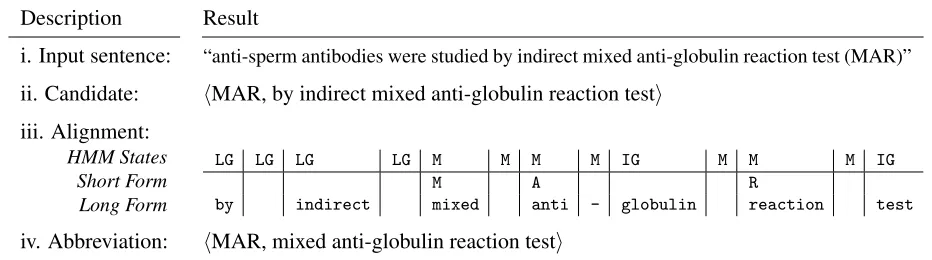
i. Input sentence: “anti-sperm antibodies were studied by indirect mixed anti-globulin reaction test (MAR)”
ii. Candidate: hMAR, by indirect mixed anti-globulin reaction testi
iii. Alignment: HMM States
Short Form Long Form
LG LG LG LG M M M M IG M M M IG
M A R
by indirect mixed anti - globulin reaction test
[image:4.612.73.539.56.186.2]iv. Abbreviation: hMAR, mixed anti-globulin reaction testi
Table 2: Example of the processing steps of a sample sentence. (i) Input sentence containing a single abbreviation. (ii) Candidate hshort form, long formipair extracted from the sentence (after truncating the long-form). (iii) The most likely (Viterbi) alignment of the candidate pair, using our alignment model. Each state corresponds to a single edit-operation, which consumed the corresponding short-form and long-form characters in the alignment. (iv) Final abbreviation, extracted from the alignment by removing leading gaps.
matching the two forms of a candidate definition. Finally we describe how to extract the final abbre-viation prediction out of the alignment.
3.1 Extracting candidate abbreviations
The process described below scans the text for tex-tual cues and extracts a list of candidate abbreviation pairs, for every input document, in the form: hshort form,long formi. The following text also describes the restrictions and conditions of what we consider to be valid candidate pairs. The assumptions made in this work are generally less restrictive that those introduced by previous extraction systems and they lead to a larger pool of candidate definitions. We will later show that false candidates normally pro-duce invalid alignment of their short and long forms, according to our alignment model, and so they are removed and do not affect the final results.
The parsing process includes a search for both single abbreviations, and abbreviation patterns. An example of a sentence with a single abbreviation can be seen in Table 2(i). We consider the fol-lowing two cases of a single abbreviation defini-tion: (1) “long form (short form)”, and (2) “short form (long form)”. Note that in some cases, the term within the parenthesis is parsed, e.g., in the following text, ELISAis extracted from the paren-thesis, by removing the text beyond the ’;’ symbol: “. . . human commercial enzyme-linked immunosor-bent assay (ELISA; BioGen, Germany) . . . ”.
We also consider abbreviation patterns which
define multiple abbreviations simultaneously, as demonstrated by these examples:
• “anti-sperm (ASA), anti-phospholipid (APA), and antizonal (AZA) antibodies” – The main noun (antibodies) follows the pattern.
• “Epithelial-mesenchymal transition (EMT) and interaction (EMI)” – The main noun (Epithelial-mesenchymal) is at the head of the pattern.
Using textual cues (patterns and parentheses) we extract candidate short and long forms. Whenever possible, we consider the term within the parenthe-sis as the short form, and the text to the left of the parenthesis (until the beginning of the sentence) as the candidate long form. We consider valid short forms to be no longer than 3 words, having between 1 and 15 characters, and containing at least one let-ter. In the case that the candidate short form was found to be invalid by these definitions, we switch the assignment of long and short forms. The long-form string is truncated, following Park and Byrd (2001), to a length ofmin(|A|+ 5,|A| ∗2), where
|A|is the length of the short form.
<“CRF-BP”, “ligands for the corticotrophin-releasing factor binding protein”>
| | | | | |C | |R | |F | |-|B | |P | ligands| |for| |the| |corticotrophin|-|releasing| |factor| | |binding| |protein|
!"
#$"
%"
&$"
'"
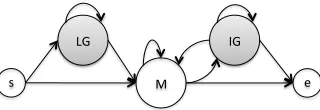
Figure 1: Abbreviation alignment HMM model with states: start (s), leading gaps (LG), match (M), inner gap (IG) and end (e).
Edit Operation
SF Match
LF Match
Valid States
LF deletion alpha-numeric char
LG, IG
LF deletion punct. symbol LG, M
LF deletion word LG, IG
SF deletion digit or punct. IG Match char (partial) word M
Match char char M
Substitution ’&’ ’and’ M Substitution ’1’-’9’ ’one’-’nine’ M Substitution chem. symbol chemical name M
Table 3: Edit operations used in the alignment HMM model including, long form (LF) and short form (SF) deletions, matches and substitutions. We note the SF and LF characters consumed by each edit operation, and the HMM states in which it may be used.
which detects possible segments that are missing in the alignment in either string (gaps).
3.2 Aligning candidate long and short forms
For each of the candidate pairs produced in the pre-vious step, we find the best alignment (if any) be-tween the short and the long form strings. We de-scribe an alignment HMM that is suited for abbrevi-ation alignments. The model is shown in Figure 1, and Table 2 shows the parsing process of a sam-ple sentence, including an alignment created for this sample using the model.
3.3 Abbreviation Alignment with Affine Leading and Inner Gaps
An alignment between a long and a short form of an abbreviation can be modeled as a series of edit oper-ations between the two strings, in which characters from the short form may match a single or a series of characters from the long form. In previous work, Bilenko and Mooney (2003) describe a generative
model for string edit distance with affine gaps, and an Expectation Maximization algorithm for learning the model parameters using a labeled set of match-ing strmatch-ings. We propose a similar model for alignmatch-ing the short and long form of an abbreviation, using an affine cost model for gaps
cost(g) =s+e·l (1)
wheresis the cost of starting a gap,eis the cost of extending a gap andlis the length of the gap. In our method, we use extracted candidate pairs (candidate short and long forms) as training examples.
As described above, candidate long forms are formed by extracting text preceding parentheses and truncating it to some length. This process may lead to candidate long forms that contain leading charac-ters that do not belong to the abbreviation, which will result in leading gaps in the final alignment. For example, the candidate long form presented in Table 2(ii) contains the leading text “by indirect “. While extra leading text is expected as an artifact of our candidates extraction method, inner alignment gaps are not expected to commonly appear in abbre-viation alignments, and are usually an indication of a bad alignment. The example presented in Table 2 is of an abbreviation thatdoescontain inner gaps (e.g.,
globulin) despite being a valid definition.
We distinguish leading and inner alignment gaps using a model with five states: Leading Gap (LG), Match (M), Inner Gap (IG), and two “dummy” states for the beginning and end of an alignment (Figure 1). Since leading and inner gaps are represented by dif-ferent states, their penalization is not coupled, i.e., they are associated with different s, e and l costs. We use the EM algorithm to learn the model param-eters, based on a set of unlabeled candidate pairs, following the assumption that many false-candidates will not produce a valid alignment, and will not af-fect training. This is in contrast to previous string edit distance models, which require labeled training examples.
The main effort in developing a successful ab-breviation alignment model involves generating a meaningful set of edit operations. The edit opera-tions used in our model,E =Ed∪Em∪Es, is shown
in Table 3 and includes: Ed, deletions of characters
from the short form; Em, matches of a full of
par-tial word from the long form to a character in the short form; and Es, word substitutions in which a
word from the long form is replaced by a symbol in the short form. Note that: (1) while all types of dele-tions from the long form are valid, deledele-tions from the short form are limited to digits and punctuation sym-bols, and (2) deletion of non-alpha-numeric charac-ters from the long form is not considered as opening a gap but as a match, as it is common for non-alpha-numeric characters to be missing in an abbreviation (i.e., be “matched” with the empty string,).
Let x = x1. . . xT be the short form candidate,
y = y1. . . yV be the long form candidate, and
a = hapinp=1, ap = (ep, qp, ixp, jyp), be a
pos-sible alignment of the strings x and y. a repre-sents as a sequence of HMM transitions,ap, where ep ∈ E is an edit operation that consumes
charac-ters fromx (deletion from the long form),y (dele-tion from the short form), or both (match or substi-tution), up to position ixp in x and jyp in y, and
is associated with a transition in the model to state
qp ∈ {LG,M,IG,e}. Letπ(q, q0)be the transition
probability between states q andq0, and let τ(q, e)
be the emission probability of the edit operationeat stateq. Given a candidate abbreviation pairhx, yi, and the model parametersπandτ, the probability of an alignment is given by
p(a|x, y, π, τ) =
|a|
Y
p=1
π(qp−1, qp)·τ(qp, ep) (2)
where q0 is the start state. This probability can be
calculated efficiently using dynamic programming with the forward-backward algorithm, and the most likely alignment corresponds to the Viterbi distance betweenxandy.
In our method, the model parameters, π and τ, are estimated using the EM algorithm on an unla-beled training set of candidate pairs that have been extracted from the text, without any further process-ing. At each EM iteration, we train on pairs that have valid alignments (see below) with non-zero proba-bility under the model parameters at that iteration.
3.3.1 Valid Alignments
Given the edit operations defined above, the only valid way of matching a letter from the short form
to the long form is by matching that letter to the beginning of a full or partial word, or by matching that letter using a substitution operation. There is no edit operation for deleting letters from the short form (only digits and punctuation symbols can be deleted). This means that for some candidate pairs there are no valid alignments under this model, in which case, no abbreviation will be predicted.
3.3.2 Extracting the Final Abbreviation
Given a valid alignment a between the candi-date pair,x andy, we create a truncated alignment,
a0, by removing fromainitial transitions in which
qp = LG. We consider a0 valid if the number of
matches ina0 =ha0pin0
p=1 is greater than the number
of deletions,
n0
X
p=1
I(q0p=M)>
n0
X
p=1
I(qp0 =IG) (3)
whereIis an indicator function.
The final abbreviation prediction is given by the portions of the x and y strings that are associated witha0, namedx0andy0, respectively. These may be truncated compared toxandy, as leading alignment gaps are removed. The final alignment probability is given byp(a0|x0, y0, π, τ).
3.4 Substitution Edit Operations
In contrast to rule-based extraction algorithms, in our model, it is easy to introduce new types of edit operations, and adjust the model to recognize a va-riety of abbreviation types. As an example, we have added a number of substitution operations (see Ta-ble 3), including an operation for the commonly used convention of replacing a chemical element name (e.g., Sodium) with its symbol (Na). These types of operations are not available using simpler models, such as that presented by Schwartz and Hearst (2002), making it impossible to recognize some important biomedical entities, such as chem-ical compounds (e.g., hN aB, SodiumButyratei). In contrast, such additions are natural in our model.
4 Evaluation
4.1 Abbreviation Extraction Analysis
Data Set Name Abstracts Abbreviations Testing Method
Development (D) Medstract 400 483 10-fold cross validation.
Validation (V) PubMed Sample 50 76 Training on set D and testing on set V.
Table 4: Evaluation Data Sets.
Model D (average %) V (%)
P R F1 P R F1
Alignment HMM 98 93 96 95 91 93
SH 96 88 91 97 83 89
Chang0.88 99 46 62 97 47 64
Chang0.14 94 89 91 95 91 93
Chang0.03 92 91 91 88 93 90
Chang0 49 92 64 53 93 67
Table 5: Results on validation (V) and development (D) sets. Average results are shown for D set, which was tested using 10-fold cross-validation (results rounded to nearest percent, all standard deviations were<0.1)
10 fold cross-validation over the publicly available Medstract corpus (Pustejovsky et al., 2002) which includes 400 Medline abstracts. The online version of the corpus was missing the Gold Standard annota-tions throughout the development of our algorithm, nor was it possible to get them through communica-tion with the authors. We therefore hand-annotated the Medstract data, yielding 483 abbreviation defi-nitions in the form ofhshort form,long formipairs. In order to be consistent with previous evaluations over Medstract, our annotations include only defini-tions in which either the short or the long form ap-pear in parenthesis, and it is assumed that there are no trailing gaps in the term preceding the parenthe-sis, although our model does detect such gaps.
We compare our results with two algorithms available for download: the Schwartz and Hearst (SH; (2002)) algorithm1, and the Changet al.(2002)
algorithm2 used at three score cutoffs reported in their paper (0.88, 0.14, 0.03). We also use a fourth score cutoff of0to account for any legal alignments produced by the Chang model.
In Table 5 we report precision (P), recall (R) and
1
Taken from http://biotext.berkeley.edu/software.html 2Taken from http://abbreviation.stanford.edu
F1 scores for all methods, calculated by
P = correct predicted abbreviations
all predicted abbreviations (4)
R = correct predicted abbreviations
all correct abbreviations (5)
On the development set, our alignment model achieves 98% precision, 93% recall and 96% F1 (av-erage values over cross-validation iterations, with standard deviations all under0.03).
To test the final model we used a validation dataset consisting of 50 abstracts, randomly selected out of a corpus of 200K full-text biomedical articles taken from the PubMed Central Open Access Sub-set (extracted in October 2010)3. These were hand-annotated, yielding 76 abbreviation definitions.
On the validation set, we predicted 69 out of 76 abbreviations, with 4 false predictions, giving 95% precision, 91% recall and 93% F1. Our alignment model results in higher F1 score over all baselines in both datasets (with Chang0.14giving equal results
on the validation set). Our results are most compa-rable with the Chang model at a score cutoff of0.14, though our model does not require selecting a score cutoff, and as we will show, it is considerably faster. Interestingly, our model results in lower recall than precision on both data sets. This may be due to a limited scope of edit operations.
In order to evaluate the usability of our method, we used it to scan the 200K full-text documents of the PubMed Central Open Access Subset corpus. The process completed in under 3 hours, yielding over 1.4 million abbreviations, including 455,844 unique definitions. A random sample of the ex-tracted abbreviations suggests a low rate of false positive predictions.
4.2 Error Analysis
Our model makes 4 incorrect predictions on the val-idation set, 3 of which are partial matches to the
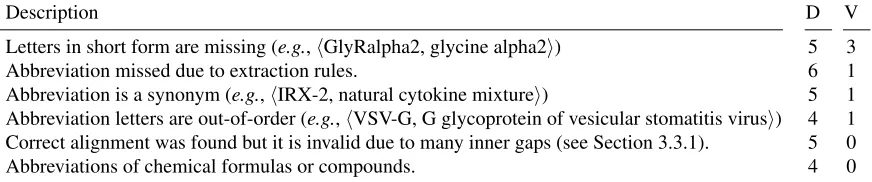
Description D V
Letters in short form are missing (e.g.,hGlyRalpha2, glycine alpha2i) 5 3
Abbreviation missed due to extraction rules. 6 1
Abbreviation is a synonym (e.g.,hIRX-2, natural cytokine mixturei) 5 1 Abbreviation letters are out-of-order (e.g.,hVSV-G, G glycoprotein of vesicular stomatitis virusi) 4 1 Correct alignment was found but it is invalid due to many inner gaps (see Section 3.3.1). 5 0
[image:8.612.90.526.58.149.2]Abbreviations of chemical formulas or compounds. 4 0
Table 6: Abbreviations missed in development (D) and validation (V) sets.
correct definitions,e.g., we predict the pairhGlOx, glutamate oxidasei instead of hGlOx, L-glutamate oxidasei. On the development set, 3 out of 5 incor-rect predictions are partial matches.
Our model did not extract 7 of the abbreviations from the validation set and 33 from the development set. Many of these abbreviations (6 from the valida-tion set and 29 from the development set) had one of the properties described in Table 6. The remain-ing 5 definitions have been missed due to miscel-laneous issues. Note that while we added several substitution operations for chemical formula recog-nition, the elaborate set of operations required for recovering the full range of chemical formulas was not included in this work, leading to 4 chemical for-mula abbreviations being missed.
4.3 Run-Time Analysis
We provide an estimated comparison of the run time of our method and the baseline algorithms. This analysis is especially interesting for cases in which an abbreviation extraction model is included within a larger learning framework (Chowdhury et al., 2010; Huang et al., 2011), and may be used in it in an online fashion. Run time was evaluated on an Apple iMac with 4GB 1333 MHz RAM, and a 3.06 GHz Core i3, double-core processor, by run-ning all models on a random set of 400 abstracts. In order to evaluate the run time contribution of the substitution operations introduced in our model we ran it both with (88 docssec ) and without (98docssec ) the use of substitution operations. We find that using substitutions did not have considerable effect on run time, adding under 1 ms for processing each docu-ment. We should note that the performance of the substitution-less model on this test data was similar to that of the original model, as substitutions were
relevant to only a smaller portion of the abbrevi-ations. As expected, the SH algorithm is consid-erably faster (6451 docssec ) than our model, as it is based on only a number of simple rules. The Chang model, however, is slower (4 docssec ) as it includes processing steps following the discovery of an ab-breviation alignment, which means that our model provides comparable results to the Chang model and runs an order-of-magnitude faster.
5 Conclusions and Discussion
We presented a method for extracting abbreviation definitions with high precision and high recall (95% precision, 91% recall and 93% F1 on a validation set). Our model achieves higher F1 on both the de-velopment and validation data sets, when compared with two popular extraction methods.
Our approach is based on a sequential genera-tive model, aligning the short and long form of an abbreviation. Using the proposed method we ex-tracted 1.4 million abbreviations from a corpus of 200K PubMed articles. This data can be valuable for Information Extraction tasks and for the full un-derstanding of biomedical scientific data.
The alignment abbreviation extractor can be eas-ily extended by adding edit-operations over short and long forms. This was demonstrated by including substitutions of chemical elements and their sym-bols, which facilitates recognition of chemical for-mulas and compounds.
Acknowledgments
This work was funded by grant 1R101GM081293 from NIH, IIS-0811562 from NSF and by a gift from Google. The opinions expressed in this paper are solely those of the authors.
References
E. Adar. 2004. Sarad: A simple and robust abbreviation dictionary. Bioinformatics, 20(4):527–533.
JL Ambrus. 1987. Acronyms and abbreviations.Journal of medicine, 18(3-4):134.
H. Ao and T. Takagi. 2005. Alice: an algorithm to extract abbreviations from medline. Journal of the American Medical Informatics Association, 12(5):576–586. M. Bilenko and R.J. Mooney. 2003. Adaptive duplicate
detection using learnable string similarity measures. In Proceedings of the ninth ACM SIGKDD interna-tional conference on Knowledge discovery and data mining, pages 39–48. ACM.
P.R. Bowden, P. Halstead, and T.G. Rose. 1997. Dic-tionaryless english plural noun singularisation using a corpus-based list of irregular forms. LANGUAGE AND COMPUTERS, 20:339–352.
J.T. Chang, H. Sch¨utze, and R.B. Altman. 2002. Cre-ating an online dictionary of abbreviations from med-line. Journal of the American Medical Informatics As-sociation, 9(6):612–620.
M. Chowdhury, M. Faisal, et al. 2010. Disease mention recognition with specific features. In Proceedings of the 2010 Workshop on Biomedical Natural Language Processing, pages 83–90. Association for Computa-tional Linguistics.
H.L. Fred and T.O. Cheng. 2003. Acronymesis: the exploding misuse of acronyms. Texas Heart Institute Journal, 30(4):255.
S. Gaudan, H. Kirsch, and D. Rebholz-Schuhmann. 2005. Resolving abbreviations to their senses in med-line. Bioinformatics, 21(18):3658–3664.
M. Huang, J. Liu, and X. Zhu. 2011. Genetukit: a soft-ware for document-level gene normalization. Bioin-formatics, 27(7):1032–1033.
L.S. Larkey, P. Ogilvie, M.A. Price, and B. Tamilio. 2000. Acrophile: an automated acronym extractor and server. InProceedings of the fifth ACM conference on Digital libraries, pages 205–214. ACM.
H. Liu, C. Friedman, et al. 2003. Mining terminological knowledge in large biomedical corpora. InPac Symp Biocomput, pages 415–426.
A. McCallum, K. Bellare, and F. Pereira. 2005. A condi-tional random field for discriminatively-trained finite-state string edit distance. In Conference on Uncer-tainty in AI (UAI).
Y. Park and R.J. Byrd. 2001. Hybrid text mining for find-ing abbreviations and their definitions. InProceedings of the 2001 conference on empirical methods in natu-ral language processing, pages 126–133.
J. Pustejovsky, J. Castano, R. Sauri, A. Rumshinsky, J. Zhang, and W. Luo. 2002. Medstract: creat-ing large-scale information servers for biomedical li-braries. In Proceedings of the ACL-02 workshop on Natural language processing in the biomedical domain-Volume 3, pages 85–92. Association for Com-putational Linguistics.
E.S. Ristad and P.N. Yianilos. 1998. Learning string-edit distance. Pattern Analysis and Machine Intelligence, IEEE Transactions on, 20(5):522–532.
A.S. Schwartz and M.A. Hearst. 2002. A simple algorithm for identifying abbreviation definitions in biomedical text. InPacific Symposium on Biocomput-ing 2003: Kauai, Hawaii, 3-7 January 2003, page 451. World Scientific Pub Co Inc.
K. Taghva and J. Gilbreth. 1999. Recognizing acronyms and their definitions. International Journal on Docu-ment Analysis and Recognition, 1(4):191–198. H. Yu, G. Hripcsak, and C. Friedman. 2002.
Map-ping abbreviations to full forms in biomedical articles. Journal of the American Medical Informatics Associa-tion, 9(3):262–272.
H. Yu, W. Kim, V. Hatzivassiloglou, and W.J. Wilbur. 2007. Using medline as a knowledge source for dis-ambiguating abbreviations and acronyms in full-text biomedical journal articles. Journal of biomedical in-formatics, 40(2):150–159.