Generating Grammar Exercises
Laura Perez-Beltrachini
Universit´e de Lorraine LORIA, UMR 7503 Vandoeuvre-l`es-Nancy
F-54500, France [email protected]
Claire Gardent
CNRS, LORIA, UMR 7503 Vandoeuvre-l`es-Nancy
F-54500, France [email protected]
German Kruszewski
Inria, LORIA, UMR 7503 Villers-l`es-Nancy
F-54600, France
Abstract
Grammar exercises for language learning fall into two distinct classes: those that are based on “real life sentences” extracted from exist-ing documents or from the web; and those that seek to facilitate language acquisition by pre-senting the learner with exercises whose syn-tax is as simple as possible and whose vo-cabulary is restricted to that contained in the textbook being used. In this paper, we in-troduce a framework (calledGramEx) which permits generating the second type of gram-mar exercises. Using generation techniques, we show that a grammar can be used to semi-automatically generate grammar exer-cises which target a specific learning goal; are made of short, simple sentences; and whose vocabulary is restricted to that used in a given textbook.
1 Introduction
Textbooks for language learning generally include grammar exercises.Tex’s French Grammar1for in-stance, includes at the end of each lecture, a set of grammar exercises which target a specific pedagog-ical goal such aslearning the plural form of nouns
1
Tex’s French Grammar http://www.laits. utexas.edu/tex/ is an online pedagogical reference grammar that combines explanations with surreal dialogues and cartoon images. Tex’s French Grammar is arranged like many other traditional reference grammars with the parts of speech (nouns, verbs, etc.) used to categorize specific grammar items (gender of nouns, irregular verbs). Individual grammar items are carefully explained in English, then exemplified in a dialogue, and finally tested in self-correcting, fill-in-the-blank exercises.
or learning the placement of adjectives. Figure 1 shows the exercises provided by this book at the end of the lecture on the plural formation of nouns. As exemplified in this figure, these exercises markedly differ from more advanced learning activities which seek to familiarise the learner with “real world sen-tences”. To supportin situlearning, this latter type of activity presents the learner with sentences drawn from the Web or from existing documents thereby exposing her to a potentially complex syntax and to a diverse vocabulary. In contrast, textbook grammar exercises usually aim to facilitate the acquisition of a specific grammar point by presenting the learner with exercises made up of short sentences involving a restricted vocabulary.
As shall be discussed in the next section, most ex-isting work on the generation of grammar exercises has concentrated on the automatic creation of the first type of exercises i.e., exercises whose source sentences are extracted from an existing corpus. In this paper, we present a framework (calledGramEx) which addresses the generation of the second type of grammar exercises used for language learning i.e., grammar exercises whose syntax and lexicon are strongly controlled. Our approach uses generation techniques to produce these exercises from an exist-ing grammar describexist-ing both the syntax and the se-mantics of natural language sentences. Given a ped-agogical goal for which exercises must be produced, theGramExframework permits producingFill in the blank(FIB, the learner must fill a blank with an ap-propriate form or phrase) andShuffle(given a set of lemmas or forms, the learner must use these to pro-duce a phrase) exercises that target that specific goal.
Give the plural form of the noun indicated in parentheses. Pay attention to both the article and the noun.
1. Bette aime _____ . (le bijoux) 2. Fiona aime ______ . (le cheval)
3. Joe-Bob aime ______ am´ericaines. (la bi`ere) 4. Tex n’aime pas ______ . (le choix)
5. Joe-Bob n’aime pas ______ difficiles. (le cours) 6. Tammy n’aime pas ______ . (l’hˆopital)
[image:2.612.147.421.53.186.2]7. Eduard aime ______. (le tableau) 8. Bette aime ______ de Tex. (l’oeil) 9. Tex aime ______ franc¸ais. (le po`ete) 10. Corey aime ______ fraˆıches. (la boisson) 11. Tammy aime ______ am´ericains. (le campus) 12. Corey n’aime pas ______ . (l’examen)
Figure 1: Grammar exercises from theTex’s French Grammartextbook
The exercises thus generated use a simple syntax and vocabulary similar to that used in theTex’s French Grammartextbook.
We evaluate the approach on several dimensions using quantitative and qualitative metrics as well as a small scale user-based evaluation. And we show that theGramExframework permits producing exercises for a given pedagogical goal that are linguistically and pedagogically varied.
The paper is structured as follows. We start by discussing related work (Section 2). In Section 3, we present the framework we developed to generate grammar exercises. Section 4 describes the exper-imental setup we used to generate exercise items. Section 5 reports on an evaluation of the exercise items produced and on the results obtained. Section 6 concludes.
2 Related Work
A prominent strand of research in Computer Aided Language Learning (CALL) addresses the automa-tion of exercise specificaautoma-tions relying on Natural Language Processing (NLP) techniques (Mitkov et al., 2006; Heilman and Eskenazi, 2007; Karama-nis et al., 2006; Chao-Lin et al., 2005; Coniam, 1997; Sumita et al., 2005; Simon Smith, 2010; Lin et al., 2007; Lee and Seneff, 2007). Mostly, this work targets the automatic generation of so-called objective test items i.e., test items such as multiple choice questions, fill in the blank and cloze exercise items, whose answer is strongly constrained and can therefore be predicted and checked with high accu-racy. These approaches use large corpora and ma-chine learning techniques to automatically generate the stems (exercise sentences), the keys (correct
an-swers) and the distractors (incorrect anan-swers) that are required by such test items.
Among these approaches, some proposals target grammar exercises. Thus, (Chen et al., 2006) de-scribes a system called FAST which supports the semi-automatic generation of Multiple-Choice and Error Detection exercises while (Aldabe et al., 2006) presents the ArikiTurri automatic question genera-tor for constructing Fill-in-the-Blank, Word Forma-tion, Multiple Choice and Error Detection exercises. These approaches are similar to the approach we propose. First, a bank of sentences is built which are automatically annotated with syntactic and morpho-syntactic information. Second, sentences are re-trieved from this bank based on their annotation and on the linguistic phenomena the exercise is meant to illustrate. Third, the exercise question is constructed from the retrieved sentences. There are important differences however.
First, in these approaches, the source sentences used for building the test items are selected from corpora. As a result, they can be very complex and most of the generated test items are targeted for intermediate or advanced learners. In addition, some of the linguistic phenomena included in the language schools curricula may be absent or insuf-ficiently present in the source corpus (Aldabe et al., 2006). In contrast, our generation based approach permits controlling both the syntax and the lexicon of the generated exercices.
As we shall see below, the information thus asso-ciated with sentences is richer than that obtained by chunking. In particular, it contains detailed linguis-tic information about the syntaclinguis-tic constructs (e.g., cleft subject) contained in the bank sentences. This permits a larger coverage of the linguistic phenom-ena that can be handled. For instance, we can re-trieve sentences which contain a relativised cleft ob-ject (e.g., This is the man whom Mary likes who sleeps) by simply stipulating that the retrieved sen-tences must be associated with the informationCleft Object).
To sum up, our approach differs from most exist-ing work in that it targets the production of syntac-tically and lexically controlled grammar exercises rather than producing grammar exercises based on sentences extracted from an existing corpus.
3 Generating Exercises
Given a pedagogical goal (e.g., learning adjective morphology), GramEx produces a set of exercise items for practicing that goal. The item can be ei-ther a FIB or a shuffle item; andGramExproduces both the exercise question and the expected solution. To generate exercise items, GramEx proceeds in three main steps as follows. First, a generation bank is constructed using surface realisation tech-niques. This generation bank stores sentences that have been generated together with the detailed lin-guistic information associated by the generation al-gorithm with each of these sentences. Next, sen-tences that permit exercising the given pedagogical goal are retrieved from the generation bank using a constraint language that permits defining pedagog-ical goals in terms of the linguistic properties as-sociated by the generator with the generated sen-tences. Finally, exercises are constructed from the retrieved sentences using each retrieved sentence to define FIB and Shuffle exercises; and the sentence itself as the solution to the exercise.
We now discuss each of these steps in more detail.
3.1 Constructing a Generation bank
The generation bank is a database associating sen-tences with a representation of their semantic con-tent and a detailed description of their syntactic and morphosyntactic properties. In other words, a
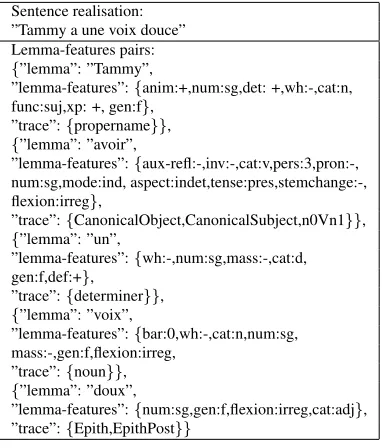
gen-Sentence realisation: ”Tammy a une voix douce” Lemma-features pairs:
{”lemma”: ”Tammy”,
”lemma-features”:{anim:+,num:sg,det: +,wh:-,cat:n, func:suj,xp: +, gen:f},
”trace”:{propername}},
{”lemma”: ”avoir”,
”lemma-features”:{aux-refl:-,inv:-,cat:v,pers:3,pron:-, num:sg,mode:ind, aspect:indet,tense:pres,stemchange:-, flexion:irreg},
”trace”:{CanonicalObject,CanonicalSubject,n0Vn1}},
{”lemma”: ”un”,
”lemma-features”:{wh:-,num:sg,mass:-,cat:d, gen:f,def:+},
”trace”:{determiner}},
{”lemma”: ”voix”,
”lemma-features”:{bar:0,wh:-,cat:n,num:sg, mass:-,gen:f,flexion:irreg,
”trace”:{noun}},
{”lemma”: ”doux”,
[image:3.612.332.523.54.278.2]”lemma-features”:{num:sg,gen:f,flexion:irreg,cat:adj}, ”trace”:{Epith,EpithPost}}
Figure 2: Morphosyntactic information associated by GraDewith the sentenceTammy a un voix douce
eration bank is a set of(Si, Li, σi)tuples whereSiis
a sentence,Liis a set of linguistic properties true of
that sentence andσiis its semantic representation.
L1:named(J bette n) A:le d(C RH SH) B:bijou n(C) G:aimer v(E J C),GraDewill output among others the following variants:
Bette aime le bijou (Bette likes the jewel), Bette aime les bijoux (Bette likes the jewels), C’est Bette qui aime le bijou (It is Bette who likes the jewel), C’est Bette qui aime les bijoux (It is Bette who likes the jewel), Bette aimait le bijou (Bette liked the jewel), Bette aimait les bijoux (Bette liked the jewels), ...
When generating from the grammar, the output is even less constrained since all derivations com-patible with the user-defined constraints will be pro-duced irrespective of semantic content. For instance, when settingGraDewith constraints restricting the grammar traversal to only derive basic clauses con-taining an intransitive verb, the output sentences in-clude among others the following sentences:
Elle chante (She sings), La tatou chante-t’elle? (Does the armadillo sing?), La tatou chante (The armadillo sings), Chacun chante -t’il (Does everyone sing? ), Chacun chante ( Ev-eryone sings), Quand chante la tatou? (When does the armadillo sing?), ...
Figure 2 shows the linguistic properties associ-ated with the sentence Tammy a une voix douce
(Tammy has a soft voice) by GraDe. To gener-ate exercises, GramEx makes use of the morpho-syntactic information associated with each lemma i.e., the feature-value pairs occurring as values of the lemma-features fields; and of their linguistic proper-ties i.e., the items occurring as values of the trace fields.
3.2 Retrieving Appropriate Sentences
To enable the retrieval of sentences that are appropri-ate for a given pedagogical goal, we define a query language on the linguistic properties assigned by
GraDe to sentences. We then express each peda-gogical goal as a query in that language; and we use these queries to retrieve from the generation bank appropriate source sentences. For instance, to re-trieve a sentence for building a FIB exercise where the blank is a relative pronoun, we query the gen-eration bank with the constraint RelativeP ronoun. This will return all sentences in the generation bank whose trace field contains the RelativeP ronoun
item i.e., all sentences containing a relative pronoun. We then use this sentence to build both the exercise question and its solution.
3.2.1 GramEx Query Language
We now define the query language used to retrieve sentences that are appropriate to build an exercise for a given pedagogical goal. Let B be a genera-tion bank and let(Si, Li, σi)be the tuples stored in
B. Then, aGramExqueryqpermits retrieving from B the set of sentences Si ∈ (Si, Li, σi) such that
Li satisfiesq. In other words,GramExqueries
per-mit retrieving from the generation bank all sentences whose linguistic properties satisfy those queries.
The syntax of the GramEx query language is as follows:
BoolExpr→BoolTerm
BoolTerm→BoolFactor|BoolTerm∨BoolFactor BoolFactor→BoolUnary|BoolFactor∧BoolUnary BoolUnary→BoolPrimary| ¬BoolPrimary
BoolPrimary→PrimitiveCond|(BoolExpr)|[BoolExpr] PrimitiveCond→traceItem|f eature=value
In words: the GramEx query language permits defining queries that are arbitrary boolean con-straints on the linguistic properties associated by
GraDe with each generated sentence. In addi-tion, complex constraints can be named and reused (macros); and expressions can be required to hold on a single lexical item ([ BoolExpr] indicates that BoolExpr should be satisfied by the linguistic prop-erties of a single lexical item).
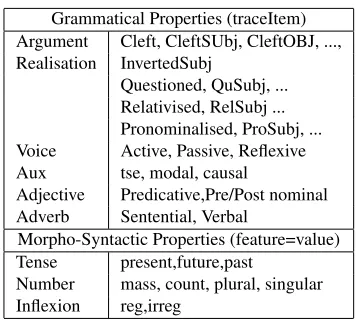
The signature of the language is the set of gram-matical (traceItem) and morpho-syntactic proper-ties (f eature = value) associated byGraDe with each generated sentence where traceItem is any item occurring in the value of a trace field and f eature = value any feature/value pair occurring in the value of alemma-featuresfield (cf. Fig-ure 2). The Table below (Table 1) shows some of the constraints that can be used to express pedagogical goals in theGramExquery language.
3.2.2 Query Examples
Grammatical Properties (traceItem) Argument Cleft, CleftSUbj, CleftOBJ, ..., Realisation InvertedSubj
Questioned, QuSubj, ... Relativised, RelSubj ... Pronominalised, ProSubj, ... Voice Active, Passive, Reflexive Aux tse, modal, causal
Adjective Predicative,Pre/Post nominal Adverb Sentential, Verbal
Morpho-Syntactic Properties (feature=value) Tense present,future,past
[image:5.612.96.275.51.211.2]Number mass, count, plural, singular Inflexion reg,irreg
Table 1: Some grammatical and morpho-syntactic prop-erties that can be used to specify pedagogical goals.
(1) a. EpithAnte
Tex pense que Tammy est une jolie tatou (Tex thinks that Tammy is a pretty armadillo)
b. [Epith ∧ flexion: irreg]
Tex et Tammy ont une voix douce (Tex and Tammy have a soft voice)
c. POBJinf ∧ CLAUSE
POBJinf≡(DE-OBJinf ∨ A-OBJinf) CLAUSE≡Vfin∧ ¬Mod ∧ ¬CCoord∧ ¬Sub Tammy refuse de chanter (Tammy refuses to sing)
Query (1a) shows a query for retrieving sentences containing prenominal adjectives which uses the grammatical (traceItem) property EpithAnte associ-ated with preposed adjectives.
In contrast, Query (1b) uses both grammatical and morpho-syntactic properties to retrieve sentences containing a postnominal adjective with irregular in-flexion. The square brackets in the query force the conjunctive constraint to be satisfied by a single lex-ical unit. That is, the query will be satisfied by sen-tences containing a lexical item that is both a post-nominal adjective and has irregular inflexion. This excludes sentences including e.g., a postnominal ad-jective and a verb with irregular inflexion.
Finally, Query (1c) shows a more complex case where the pedagogical goal is defined in terms of predefined macros themselves defined as GramEx
query expressions. The pedagogical goal is de-fined as a query which retrieves basic clauses (CLAUSE) containing a prepositional infinitival ob-ject (POBJinf). A sentence containing a
preposi-tional infinitival object is in turn defined (second line) as a prepositional object introduced either by thedeor the `apreposition. And a basic clause (3rd line) is defined as a sentence containing a finite verb and excluding modifiers, clausal or verb phrase co-ordination (CCORD) and subordinated clauses2
3.3 Building Exercise Items
In the previous section, we saw the mechanism used for selecting an appropriate sentence for a given pedagogical goal. GramEx uses such selected sen-tences as source or stem sensen-tences to build exercise items. The exercise question is automatically gen-erated from the selected sentence based on its asso-ciated linguistic properties. Currently,GramEx in-cludes two main types of exercises namely, Fill in the blank and Shuffle exercises.
FIB questions. FIB questions are built by remov-ing a word from the target sentence and replacremov-ing it with either: a blank (FIBBLNK), a lemma (FIBLEM)
or a set of features used to help the learner guess the solution (FIBHINT). For instance, in an exercise
on pronouns,GramEx will use the gender, number and person features associated with the pronoun by the generation process and display them to specify which pronominal form the learner is expected to provide. The syntactic representation (cf. Figure 2) associated by GraDe with the sentence is used to search for the appropriate key word to be removed. For instance, if the pedagogical goal is Learn Sub-ject Pronouns and the sentence retrieved from the generation bank is that given in (2a), GramEx will produce the FIBHINT question in (2b) by
search-ing for a lemma with categorycl(clitic) and feature
func=subjand using its gender value to provide the learner with a hint constraining the set of possible solutions.
(2) a. Elle adore les petits tatous (She loves small armadillos)
b....adore les petits tatous (gender=fem)
Shuffle questions. Similarly to FIB questions, shuffle exercise items are produced by inspecting and using the target derivational information. More specifically, lemmas are retrieved from the list of
2
lemma-feature pairs. Function words are (option-ally) deleted. And the remaining lemmas are “shuf-fled“ (MSHUF). For instance, given the source
sen-tence (2a), the MSHUF question (2b) can be
pro-duced.
(3) a. Tammy adore la petite tatou a. tatou / adorer / petit / Tammy
Note that in this case, there are several possible solutions depending on which tense and number is used by the learner. For such cases, we can either use hints as shown above to reduce the set of pos-sible solutions to one; or compare the learner’s an-swer to the set of output produced byGraDefor the semantics the sentence was produced from.
4 Experimental Setup
We carried out an experiment designed to assess the exercises produced byGramEx. In what follows, we describe the parameters of this experiment namely, the grammar and lexicons used; the input and the user-defined parameters constraining sentence gen-eration; and the pedagogical goals being tested.
4.1 Grammar and Lexicon
The grammar used is a Feature-Based Lexicalised Tree Adjoining Grammar for French augmented with a unification-based compositional semantics. This grammar contains around 1300 elementary trees and covers auxiliaries, copula, raising and small clause constructions, relative clauses, infini-tives, gerunds, passives, adjuncts, wh-clefts, PRO constructions, imperatives and 15 distinct subcate-gorisation frames.
The syntactic and morpho-syntactic lexicons used for generating were derived from various existing lexicons, converted to fit the format expected by
GraDeand tailored to cover basic vocabulary as de-fined by the lexicon used inTex’s French Grammar. The syntactic lexicon contains 690 lemmas and the morphological lexicon 5294 forms.
4.2 Pedagogical Goals
We evaluate the approach on 16 pedagogical goals taken from the Tex’s French Grammar book. For each of these goals, we define the corresponding linguistic characterization in the form of aGramEx
query. We then evaluate the exercises produced by
the system for each of these queries. The pedagog-ical goals tested are the following (we indicate in brackets the types of learning activity produced for each teaching goal by the system):
• Adjectives: Adjective Order (MSHUF),
Adjec-tive Agreement (FIBLEM), Prenominal
adjec-tives (FIBLEM), Present and Past Participial
used as adjectives (FIBLEM), Regular and
Ir-regular Inflexion (FIBLEM), Predicative
adjec-tives (MSHUF)
• Prepositions: Prepositional Infinitival Object (FIBBLNK), Modifier and Complement
Prepo-sitional Phrases (FIBBLNK)
• Noun: Gender (FIBLEM), Plural form ( FI-BLEM), Subject Pronoun (FIBHINT).
• Verbs: Pronominals (FIBLEM), -ir Verbs in
the present tense (FIBLEM), Simple past ( FI-BLEM), Simple future (FIBLEM), Subjunctive
Mode (FIBLEM).
4.3 GraDe’s Input and User-Defined Parameters
GraDe’s configuration As mentioned in Sec-tion 3, we run GraDe using two main configura-tions. In the first configuration,GraDesearch is con-strained by an input core semantics which guides the grammar traversal and forces the output sentence to verbalise this core semantics. In this configuration,
GraDe will only produce the temporal variations supported by the lexicon (the generated sentences may be in any simple tense i.e., present, future, simple past and imperfect) and the syntactic varia-tions supported by the grammar for the same MRSs (e.g., active/passive voice alternation and cleft argu-ments).
which do not include modifiers. Since the number of sentences that can be produced under this con-figuration is very large, we restrict the experiment by using a lexicon containing a single intransitive verb (chanter/To sing), a single common noun and a single proper name. In this way, syntactically struc-turally equivalent but lexically distinct variants are excluded.
Input Semantics We use two different sets of in-put semantics for the semantically guided configura-tion: one designed to test the pedagogical coverage of the system (Given a set of pedagogical goals, can
GramExgenerate exercises that appropriately target those goals?); and the other to illustrate linguistic coverage (How much syntactic variety can the sys-tem provide for a given pedagogical goal?).
The first set (D1) of semantic representations con-tains 9 items representing the meaning of exam-ple sentences taken from the Tex’s French Gram-mar textbook. For instance, for the first item in Figure 1, we use the semantic representation
L1:named(J bette n) A:le d(C RH SH) B:bijou n(C) G:aimer v(E J C). With this first set of input seman-tics, we test whetherGramExcorrectly produces the exercises proposed in the Tex’s French Grammar
book. Each of the 9 input semantics corresponds to a distinct pedagogical goal.
The second set (D2) of semantic representations contains 22 semantics, each of them illustrating dis-tinct syntactic configurations namely, intransitive, transitive and ditransitive verbs; raising and control; prepositional complements and modifiers; sentential and prepositional subject and object complements; pronominal verbs; predicative, attributive and par-ticipial adjectives. With this set of semantics, we introduce linguistically distinct material thereby in-creasing the variability of the exercises i.e., making it possible to have several distinct syntactic configu-rations for the same pedagogical goal.
5 Evaluation, Results and Discussion
Using the experimental setup described in the previ-ous section, we evaluate GramExon the following points:
• Correctness: Are the exercises produced by the generator grammatical, meaningful and
appro-priate for the pedagogical goal they are associ-ated with?
• Variability: Are the exercises produced linguis-tically varied and extensive? That is, do the ex-ercises for a given pedagogical goal instantiate a large number of distinct syntactic patterns?
• Productivity: How much doesGramExsupport the production, from a restricted number of se-mantic input, of a large number of exercises?
Correctness To assess correctness, we randomly selected 10 (pedagogical goal, exercise) pairs for each pedagogical goal in Section 4.2 and asked two evaluators to say for each pair whether the exer-cise text and solutions were grammatical, meaning-ful (i.e., semantically correct) and whether the ex-ercise was adequate for the pedagogical goal. The results are shown in Table 3 and show that the sys-tem although not perfect is reliable. Most sources of grammatical errors are cases where a missing word in the lexicon fails to be inflected by the generator. Cases where the exercise is not judged meaningful are generally cases where a given syntactic construc-tion seems odd for a given semantics content. For instance, the sentenceC’est Bette qui aime les bi-joux(It is Bette who likes jewels) is fine butC’est Bette qui aime des bijouxalthough not ungrammati-cal sounds odd. Finally, cases judged inappropriate are generally due to an incorrect feature being as-signed to a lemma. For instance,avoir(To have) is marked as an -ir verb in the lexicon which is incor-rect.
Grammatical Meaningful Appropriate
91% 96% 92%
Table 3: Exercise Correctness tested on 10 randomly se-lected (pedagogical goal, exercise pairs)
We also asked a language teacher to examine 70 exercises (randomly selected in equal number across the different pedagogical goals) and give her judg-ment on the following three questions:
Nb. Ex. 1 2 4 5 6 12 17 18 20 21 23 26 31 37 138
Nb. Sem 1 4 6 1 4 3 1 1 1 1 1 1 1 1 1
Table 2: Exercise Productivity: Number of exercises produced per input semantics
• B. The grammar topic at hand together with the complexity of the source sentence make the item appropriate for which language level? A1,A2,B1,B2,C13
• C. Utility of the exercise item: ambiguous (not enough context information to solve it) / correct
For Question 1, the teacher graded 35 exercises as 3, 20 as 2 and 14 as 1 pointing to similar problems as was independently noted by the annotators above. For question B, she marked 29 exercises as A1/A2, 24 as A2, 14 as A2/B1 and 3 as A1 suggesting that the exercises produced are non trivial. Finally, she found that 5 out of the 70 exercises lacked context and were ambiguously phrased.
Variability For any given pedagogical goal, there usually are many syntactic patterns supporting learn-ing. For instance, learning the gender of common nouns can be practiced in almost any syntactic con-figuration containing a common noun. We assess the variability of the exercises produced for a given ped-agogical goal by computing the number of distinct morpho-syntactic configurations produced from a given input semantics for a given pedagogical goal. We count as distinct all exercise questions that are derived from the same semantics but differ either in syntax (e.g., passive/active distinction) or in mor-phosyntax (determiner, number, etc.). Both types of differences need to be learned and therefore produc-ing exercises which, for a given pedagogical goal, expose the learner to different syntactic and morpho-syntactic patterns (all involving the construct to be learned) is effective in supporting learning. How-ever we did not take into account tense differences as the impact of tense on the number of exercises produced is shown by the experiment where we gen-erate by traversing the grammar rather than from a
3A1, A2, B1, B2 and C1 are reference levels established by the Common European Framework of Reference for Languages: Learning, Teaching, Assessment (cf. http: //en.wikipedia.org/wiki/Common_European_ Framework_of_Reference_for_Languages) for grading an individual’s language proficiency.
semantics. Table 4 shows for each (input semantics, teaching goal) pair the number of distinct patterns observed. The number ranges from 1 to 21 distinct patterns with very few pairs (3) producing a single pattern, many (33) producing two patterns and a fair number producing either 14 or 21 patterns.
Nb. PG 1 2 3 4 5 6
Nb. sent 213 25 8 14 10 6
Table 6: Pedagogical Productivity: Number of Teaching Goals the source sentence produced from a given seman-tics can be used for
Productivity When used to generate from seman-tic representations (cf. Section 4.3), GramEx only partially automates the production of grammar ex-ercises. Semantic representations must be manually input to the system for the exercises to be generated. Therefore the issue arises of how much GramEx
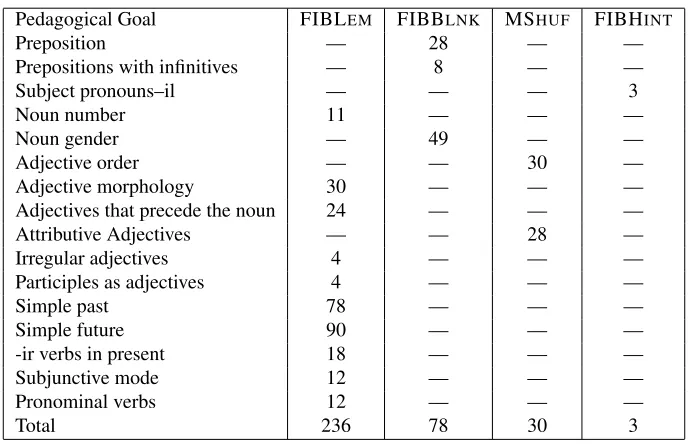
helps automating exercise creation. Table 5 shows the breakdown of the exercises produced per teach-ing goal and activity type. In total, GramEx pro-duced 429 exercises out of 28 core semantics yield-ing an output/input ratio of 15 (429/28). Further, Ta-ble 2 and 6 show the distribution of the ratio be-tween (i) the number of exercises produced and the number of input semantics and (ii) the number of teaching goals the source sentences produced from input semantics i can be used for. Table 6 (peda-gogical productivity) shows that, in this first exper-iment, a given input semantics can provide material for exercises targeting up to 6 different pedagogi-cal goals while Table 2 (exercise productivity) shows that most of the input semantics produce between 2 and 12 exercises4.
When generating by grammar traversal, under the constraints described in Section 4, from one input
Nb. SP 1 2 3 4 5 6 7 8 9 10 14 21
[image:9.612.134.480.125.349.2](S,G) 3 33 16 7 2 4 6 1 4 1 2 6
Table 4: Variability: Distribution of the number of distinct sentential patterns that can be produced for a given peda-gogical goal from a given input semantics
Pedagogical Goal FIBLEM FIBBLNK MSHUF FIBHINT
Preposition — 28 — —
Prepositions with infinitives — 8 — —
Subject pronouns–il — — — 3
Noun number 11 — — —
Noun gender — 49 — —
Adjective order — — 30 —
Adjective morphology 30 — — —
Adjectives that precede the noun 24 — — —
Attributive Adjectives — — 28 —
Irregular adjectives 4 — — —
Participles as adjectives 4 — — —
Simple past 78 — — —
Simple future 90 — — —
-ir verbs in present 18 — — —
Subjunctive mode 12 — — —
Pronominal verbs 12 — — —
Total 236 78 30 3
Table 5: Number and Types of Exercises Produced from the 28 input semantics
90 exercises are generated targeting 4 different ped-agogical goals (i.e. 4 distinct linguistic phenomena).
6 Conclusion
We presented a framework (calledGramEx) for gen-erating grammar exercises which are similar to those often used in textbooks for second language learn-ing. These exercises target a specific learning goal; and, they involve short sentences that make it eas-ier for the learner to concentrate on the grammatical point to be learned.
One distinguishing feature of the approach is the rich linguistic information associated by the gen-erator with the source sentences used to construct grammar exercises. Although space restriction pre-vented us from showing it here, this information includes, in addition to the morphosyntactic infor-mation and the grammatical properties illustrated in Figure 2 and Table 1 respectively, a semantic rep-resentation, a derivation tree showing how the parse tree of each sentence was obtained and optionally, an underspecified semantics capturing the core pred-icate/argument and modifier/modifiee relationships
expressed by each sentence. We are currently ploring how this information could be used to ex-tend the approach to transformation exercises (e.g., passive/active) where the relation between exercise question and exercise solution is more complex than in FIB exercises.
Another interesting question which needs further investigation is how to deal with exercise items that have multiple solutions such as example (3) above. Here we plan to use the fact that underspecified se-mantics inGraDepermits associating many variants with a given semantics.
Acknowledgments
We would like to thank the language teacher, Tex’s French Grammar developers, and the anonymous re-viewers for their useful comments. The research presented in this paper was partially supported by the European Fund for Regional Development within the framework of the INTERREG IV A Alle-gro Project5.
5
References
Itziar Aldabe, Maddalen Lopez de Lacalle, Montse Mar-itxalar, Edurne Martinez, and Larraitz Uria. 2006. Arikiturri: an automatic question generator based on corpora and nlp techniques. In Proceedings of the 8th international conference on Intelligent Tutoring Systems, ITS’06, pages 584–594, Berlin, Heidelberg. Springer-Verlag.
Liu Chao-Lin, Wang Chun-Hung, Gao Zhao-Ming, and Huang Shang-Ming. 2005. Applications of lexical information for algorithmically composing multiple-choice cloze items. In Proceedings of the second workshop on Building Educational Applications Us-ing NLP, EdAppsNLP 05, pages 1–8, Stroudsburg, PA, USA. Association for Computational Linguistics. Chia-Yin Chen, Hsien-Chin Liou, and Jason S. Chang.
2006. Fast: an automatic generation system for gram-mar tests. In Proceedings of the COLING/ACL on Interactive presentation sessions, COLING-ACL ’06, pages 1–4, Stroudsburg, PA, USA. Association for Computational Linguistics.
David Coniam. 1997. A preliminary inquiry into using corpus word frequency data in the automatic genera-tion of english language cloze tests. CALICO Journal, 14:15–33.
Claire Gardent and German Kruszewski. 2012. Gener-ation for grammar engineering. In11th International Conference on Natural Language Generation (ENLG). Michael Heilman and Maxine Eskenazi. 2007. Ap-plication of automatic thesaurus extraction for com-puter generation of vocabulary questions. In Proceed-ings of Speech and Language Technology in Education (SLaTE2007), pages 65–68.
Nikiforos Karamanis, Le An Ha, and Ruslan Mitkov. 2006. Generating multiple-choice test items from medical text: A pilot study. In Proceedings of the Fourth International Natural Language Generation Conference, pages 111–113, Sydney, Australia. John Lee and Stephanie Seneff. 2007. Automatic
gener-ation of cloze items for prepositions. Proceedings of Interspeech, pages 2173–2176.
Yi-Chien Lin, Li-Chun Sung, and Meng Chang Chen. 2007. An Automatic Multiple-Choice Question Gen-eration Scheme for English Adjective Understandings. In Workshop on Modeling, Management and Gener-ation of Problems/Questions in eLearning, the 15th International Conference on Computers in Education (ICCE 2007), pages pages 137–142.
Ruslan Mitkov, Le An Ha, and Nikiforos Karamanis. 2006. A computer-aided environment for generating multiple-choice test items. Natural Language Engi-neering, 12(2):177–194.
Adam Kilgarriff Simon Smith, P.V.S Avinesh. 2010. Gap-fill Tests for Language Learners: Corpus-Driven Item Generation. InProceedings of ICON-2010: 8th International Conference on Natural Language Pro-cessing.