Language Identification for Creating Language-Specific Twitter Collections
Shane Bergsma† Paul McNamee†,♮ Mossaab Bagdouri⋆ Clayton Fink♮ Theresa Wilson† †Human Language Technology Center of Excellence, Johns Hopkins University
♮Johns Hopkins University Applied Physics Laboratory, Laurel, MD ⋆Department of Computer Science, University of Maryland, College Park, MD
[email protected], [email protected], [email protected], [email protected], [email protected]
Abstract
Social media services such as Twitter offer an immense volume of real-world linguistic data. We explore the use of Twitter to obtain authen-tic user-generated text in low-resource lan-guages such as Nepali, Urdu, and Ukrainian. Automatic language identification (LID) can be used to extract language-specific data from Twitter, but it is unclear how well LID per-forms on short, informal texts in low-resource languages. We address this question by an-notating and releasing a large collection of tweets in nine languages, focusing on confus-able languages using the Cyrillic, Arabic, and Devanagari scripts. This is the first publicly-available collection of LID-annotated tweets in non-Latin scripts, and should become a standard evaluation set for LID systems. We also advance the state-of-the-art by evaluat-ing new, highly-accurate LID systems, trained both on our new corpus and on standard ma-terials only. Both types of systems achieve a huge performance improvement over the existing state-of-the-art, correctly classifying around 98% of our gold standard tweets. We provide a detailed analysis showing how the accuracy of our systems vary along certain di-mensions, such as the tweet-length and the amount of in- and out-of-domain training data.
1 Introduction
Twitter is an online social-networking service that lets users send and receive short texts called tweets. Twitter is enormously popular; more than 50 mil-lion users log in daily and bilmil-lions of tweets are sent each month.1 Tweets are publicly-available by
de-1http://mashable.com/2011/09/08/ Twitter-has-100-million-active-users/
fault and thus provide an enormous and growing free resource of authentic, unedited text by ordinary peo-ple. Researchers have used Twitter to study how hu-man language varies by time zone (Kicihu-man, 2010), census area (Eisenstein et al., 2011), gender (Burger et al., 2011), and ethnicity (Fink et al., 2012). Twit-ter also provides a wealth of user dialog, and a vari-ety of dialog acts have been observed (Ritter et al., 2010) and predicted (Ritter et al., 2011).
Of course, working with Twitter is not all roses and rainbows. Twitter is a difficult domain because unlike, for example, news articles, tweets are short (limited to 140 characters), vary widely in style, and contain many spelling and grammatical errors. Moreover, unlike articles written by a particular news organization, a corpus constructed from Twit-ter will contain tweets in many different languages.
This latter point is particularly troubling because the majority of language-processing technology is predicated on knowing which language is being pro-cessed. We are pursuing a long-term effort to build social media collections in a variety of low-resource languages, and we need robust language identifica-tion (LID) technology. While LID is often viewed as a solved problem (McNamee, 2005), recent re-search has shown that LID can be made arbitrarily difficult by choosing domains with (a) informal writ-ing, (b) lots of languages to choose from, (c) very short texts, and (d) unbalanced data (Hughes et al., 2006; Baldwin and Lui, 2010). Twitter exhibits all of these properties. While the problem of LID on Twitter has been considered previously (Tromp and Pechenizkiy, 2011; Carter et al., 2013), these studies have only targeted five or six western European lan-guages, and not the diversity of languages and writ-ing systems that we would like to process.
Our main contribution is the release of a large col-lection of tweets in nine languages using the Cyril-lic, Arabic, and Devanagari alphabets. We test dif-ferent methods for obtaining tweets in a given tar-get language (§2). We then use an online crowd-sourcing platform to have these tweets annotated by fluent speakers of that language (§3). We generate over 18,000 triple-consensus tweets, providing the first publicly-available collection of LID-annotated tweets in non-Latin scripts. The annotated cor-pus is available online at:http://apl.jhu.edu/
˜paulmac/lid.html. We anticipate our
multilin-gual Twitter collection becoming a standard evalua-tion set for LID systems.
We also implement two LID approaches and eval-uate these approaches against state-of-the-art com-petitors. §4.1 describes a discriminative classifier that leverages both the tweet text and the tweet meta-data (such as the user name, location, and landing pages for shortened URLs). §4.2 describes an effi-cient tool based on compression language models. Both types of systems achieve a huge improvement over existing state-of-the-art approaches, including the Google Compact Language Detector (part of the Chrome browser), and a recent LID system from Lui and Baldwin (2011). Finally, we provide further analysis of our systems in this unique domain, show-ing how accuracy varies with the tweet-length and the amount of in-domain and out-of-domain train-ing data. In addition to the datasets, we are releastrain-ing our compression language model tool for public use.
2 Acquiring Language-Specific Tweets
We use two strategies to collect tweets in specific languages: (§2.1) we collect tweets by users who follow language-specific Twitter sources, and (§2.2) we use the Twitter API to collect tweets from users who are likely to speak the target language.
2.1 Followers of Language-Specific Sources
Our first method is called the Sources method and involves a three-stage process. First, Twitter sources for the target language are manually identified. Sources are Twitter users or feeds who: (a) tweet in the target language, (b) have a large number of followers, and (c) act as hubs (i.e., have a high followers-to-following ratio). Twitter sources are
typically news or media outlets (e.g. BBC News), celebrities, politicians, governmental organizations, but they may just be prominent bloggers or tweeters. Once sources are identified, we use the Twitter API (dev.twitter.com) to query each source for its list of followers. We then query the user data for the followers in batches of 100 tweets. For users whose data is public, a wealth of information is returned, including the total number of tweets and their most recent tweet. For users who had tweeted above a minimum number of times. and whose most-recent-tweet tweet was in the character set for the target language, we obtained their most recent 100-200 tweets and added them to our collection.2
While we have used the above approach to ac-quire data in a number of different languages, for the purposes of our annotated corpus (§3), we select the subsets of users who exclusively follow sources in one of our nine target languages (Table 1). We also filter tweets that do not contain at least one charac-ter in the target’s corresponding writing system (we plan to address romanized tweets in future work).
2.2 Direct Twitter-API Collection
While we are most interested in users who follow news articles, we also tested other methods for ob-taining language-specific tweets. First, we used the Twitter API to collect tweets from locations where we expected to get some number of tweets in the tar-get language. We call this method the Twit-API col-lection method. To geolocate our tweets, the Twit-ter API’s geotag method allowed us to collect tweets within a specified radius of a given set of coordi-nates in latitude and longitude. To gather a sam-ple of tweets in our target languages, we queried for tweets from cities with populations of at least 200,000 where speakers of the target language are prominent (e.g., Karachi, Pakistan for Urdu; Tehran, Iran for Farsi; etc.). We collected tweets within a ra-dius of 25 miles of the geocoordinates. We also used the Search API to persistently poll for tweets from users identified by Twitter as being in the queried location. For Urdu, we also relied on the
identification code returned by the API for each tweet; we filter all our geolocated Urdu tweets that are not marked as Urdu.
We also obtained tweets through an information-retrieval approach that has been used elsewhere for creating minority language corpora (Ghani et al., 2001). We computed the 25 most frequent unique words in a number of different languages (that is, words that do not occur in the vocabularies of other languages). Unfortunately, we found no way to
en-force that the Twitter API return only tweets
con-taining one or more of our search terms (e.g., re-turned tweets for Urdu were often in Arabic and did not contain our Urdu search terms). There is a lack of documentation on what characters are supported by the search API; it could be that the API cannot handle certain of our terms. We thus leave further investigation of this method for future work.
3 Annotating Tweets by Language
The general LID task is to take as input some piece of text, and to produce as output a prediction of what language the text is written in. Our annotation and prediction systems operate at the level of individual tweets. An alternative would have been to assume that each user only tweets in a single language, and to make predictions on an aggregation of multiple tweets. We operate on individual tweets mainly be-cause (A) we would like to quantify how often users switch between languages and (B) we are also inter-ested in domains and cases where only tweet-sized amounts of text are available. When we do have multiple tweets per user, we can always aggregate the scores on individual predictions (§6 has some ex-perimental results using prediction aggregation).
Our human annotation therefore also focuses on validating the language of individual tweets. Tweets verified by three independent annotators are ac-cepted into our final gold-standard data.
3.1 Amazon Mechanical Turk
To access annotators with fluency in each language, we crowdsourced the annotation using Amazon Me-chanical Turk (mturk.com). AMT is an online la-bor marketplace that allows requesters to post tasks for completion by paid human workers. Crowd-sourcing via AMT has been shown to provide
high-quality data for a variety of NLP tasks (Snow et al., 2008; Callison-Burch and Dredze, 2010), including multilingual annotation efforts in translation (Zaidan and Callison-Burch, 2011b), dialect identification (Zaidan and Callison-Burch, 2011a), and building bilingual lexicons (Irvine and Klementiev, 2010).
3.2 Annotation Task
From the tweets obtained in§2, we took a random sample in each target language, and posted these tweets for annotation on AMT. Each tweet in the sample was assigned to a particular AMT job; each job comprised the annotation of 20 tweets. The job description requested workers that are fluent in the target language and gave an example of valid and invalid tweets in that language. The job instructions asked workers to mark whether each tweet was writ-ten for speakers of the target language. If the tweet combines multiple languages, workers were asked to mark as the target language if “most of the text is in [that language] excluding URLs, hash-tags, etc.” Jobs were presented to workers as HTML pages with three buttons alongside each tweet for validating the language. For example, for Nepali, a Worker can mark that a tweet is ‘Nepali’, ‘Not Nepali’, or ‘Not sure.’ We paid $0.05 per job and requested that each job be completed by three workers.
3.3 Quality Control
To ensure high annotation quality, we follow our established practices in only allowing our tasks to be completed by workers who have previously com-pleted at least 50 jobs on AMT, and who have had at least 85% of their jobs approved. Our jobs also dis-play each tweet as an image; this prevents workers from pasting the tweet into existing online language processing services (like Google Translate).
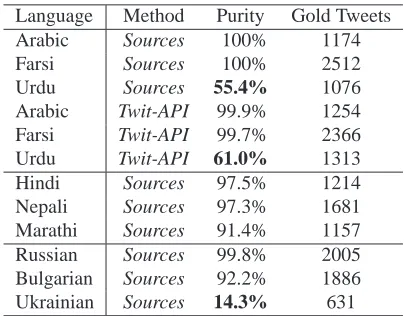
Language Method Purity Gold Tweets
Arabic Sources 100% 1174
Farsi Sources 100% 2512
Urdu Sources 55.4% 1076
Arabic Twit-API 99.9% 1254
Farsi Twit-API 99.7% 2366
Urdu Twit-API 61.0% 1313
Hindi Sources 97.5% 1214
Nepali Sources 97.3% 1681
Marathi Sources 91.4% 1157
Russian Sources 99.8% 2005
Bulgarian Sources 92.2% 1886
[image:4.612.85.287.56.214.2]Ukrainian Sources 14.3% 631
Table 1: Statistics of the Annotated Multilingual Twitter Corpus: 18,269 total tweets in nine languages.
predicted language was not the expected language. Our negative controls are validated tweets in a lan-guage that uses the same alphabet as the target (e.g., our negative controls for Ukrainian were taken from our LID-validated Russian and Bulgarian sources).
We collect aggregate statistics for each Worker over the control tweets of all their completed jobs. We conservatively discard any annotations by work-ers who get below 80% accuracy on either the posi-tive or negaposi-tive control tweets.
3.4 Dataset Statistics
Table 1 gives the number of triple-validated ‘Gold’ tweets in each language, grouped into those using the Arabic, Devanagari and Cyrillic writing sys-tems. The Arabic data is further divided into tweets acquired using the Sources and Twit-API methods. Table 1 also gives the Purity of the acquired re-sults; that is, the percentage of acquired tweets that were indeed in the target language. The Purity is calculated as the number of triple-verified gold tweets divided by the total number of tweets where the three annotators agreed in the annotation (thus triply-marked either Yes, No, or Not sure).
For major languages (e.g. Arabic and Russian), we can accurately obtain tweets in the target lan-guage, perhaps obviating the need for LID. For the Urdu sets, however, a large percentage of tweets are not in Urdu, and thus neither collection method is reliable. An LID tool is needed to validate the data. A native Arabic speaker verified that most of our invalid Urdu tweets were Arabic. Ukrainian is the most glaringly impure language that we collected,
with less than 15% of our intended tweets actually in Ukrainian. Russian is widely spoken in Ukraine and seems to be the dominant language on Twitter, but more analysis is required. Finally, Marathi and Bulgarian also have significant impurities.
The complete annotation of all nine languages cost only around $350 USD. While not insignificant, this was a small expense relative to the total human effort we are expending on this project. Scaling our approach to hundreds of languages would only cost on the order of a few thousand dollars, and we are investigating whether such an effort could be sup-ported by enough fluent AMT workers.
4 Language Identification Systems
We now describe the systems we implemented and/or tested on our annotated data. All the ap-proaches are supervised learners, trained from a col-lection of language-annotated texts. At test time, the systems choose an output language based on the in-formation they have derived from the annotated data.
4.1 LogR: Discriminative LID
We first adopt a discriminative approach to LID. Each tweet to be classified has its relevant informa-tion encoded in a feature vector,x¯. The annotated training data can be represented as N pairs of la-bels and feature vectors: {(y1,x¯1), ...,(yN,x¯N)}.
To train our model, we use (regularized) logistic re-gression (a.k.a. maximum entropy) since it has been shown to perform well on a range of NLP tasks and its probabilistic outputs are useful for down-stream processing (such as aggregating predictions over multiple tweets). In multi-class logistic regres-sion, the probability of each class takes the form of exponential functions over features:
p(y=k|x¯) = Pexp( ¯wk·x¯) jexp( ¯wj·x¯)
For LID, the classifier predicts the languagek that has the highest probability (this is also the class with highest weighted combination of features,w¯k·x¯).
We use two types of features in our classifier:
Character Features encode the character N-grams in the input text; characters are the standard information source for most LID systems (Cavnar and Trenkle, 1994; Baldwin and Lui, 2010). We have a unique feature for each unique N-gram in our training data. N-grams of up-to-four characters were optimal on development data. Each feature value is the (smoothed) log-count of how often the corresponding N-gram occurs in that instance. Prior to extracting the N-grams, we preprocess each tweet to remove URLs, hash-tags, user mentions, punctuation and we normalize all digits to 0.
Meta features encode user-provided information beyond the tweet text. Similar information has pre-viously been used to improve the accuracy of LID classifiers on European-language tweets (Carter et al., 2013). We have features for the tokens in the Twitter user name, the screen name, and self-reported user location. We also have features for prefixes of these tokens, and flags for whether the name and location are in the Latin script. Our meta features also include features for the hash-tags, user-mentions, and URLs in the tweet. We provide fea-tures for the protocol (e.g. http), hostname, and top-level domain (e.g..com) of each link in a tweet. For shortened URLs (e.g. viabit.ly), we query the URL server to obtain the final link destination, and provide the URL features for this destination link.
4.2 PPM: Compression-Based LID
Our next tool uses compression language models, which have been proposed for a variety of NLP tasks including authorship attribution (Pavelec et al., 2009), text classification (Teahan, 2000; Frank et al., 2000), spam filtering (Bratko et al., 2006), and LID (Benedetto et al., 2002). Our method is based on the prediction by partial matching (PPM) family of al-gorithms and we use the PPM-A variant (Cleary et al., 1984). The algorithm processes a string and de-termines the number of bits required to encode each character using a variable-length context. It requires only a single parameter, the maximal order, n; we usen = 5for the experiments in this paper. Given training data for a number of languages, the method seeks to minimize cross-entropy and thus selects the
Language Wikip. All
Arabic 372 MB 1058 MB
Farsi 229 MB 798 MB
Urdu 30 MB 50 MB
Hindi 235 MB 518 MB
Nepali 31 MB 31 MB
Marathi 32 MB 66 MB
Russian 563 MB 564 MB
Bulgarian 301 MB 518 MB
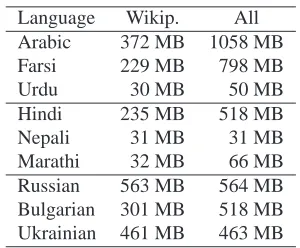
[image:5.612.350.500.55.179.2]Ukrainian 461 MB 463 MB
Table 2: Size of other PPM training materials.
language which would most compactly encode the text we are attempting to classify.
We train this method both on our Twitter data and on large collections of other material. These ma-terials include corpora obtained from news sources, Wikipedia, and government bodies. For our ex-periments we divide these materials into two sets: (1) just Wikipedia and (2) all sources, including Wikipedia. Table 2 gives the sizes of these sets.
4.3 Comparison Systems
We compare our two new systems with the best-available commercial and academic software.
TextCat: TextCat3 is a widely-used stand-alone LID program. Is is an implementation of the N-gram-based algorithm of Cavnar and Trenkle (1994), and supports identification in “about 69 lan-guages” in its downloadable form. Unfortunately, the available models do not support all of our target languages, nor are they compatible with the standard UTF-8 Unicode character encoding. We therefore modified the code to process UTF-8 characters and re-trained the system on our Twitter data (§5).
Google CLD: Google’s Chrome browser includes a tool for language-detection (the Google Compact
Language Detector), and this tool is included as a
li-brary within Chrome’s open-source code. Mike Mc-Candless ported this library to its own open source project.4The CLD tool makes predictions using text 4-grams. It is designed for detecting the language of web pages, and can take meta-data hints from the domain of the webpage and/or the declared webpage
3http://odur.let.rug.nl/vannoord/TextCat/ 4http://code.google.com/p/
Dataset Train Development Test
Arabic 2254 1171 1191
Devanagari 2099 991 962
[image:6.612.314.537.57.264.2]Cyrillic 2243 1133 1146
Table 3: Number of tweets used in experiments, by writ-ing system/classification task
encoding, but it also works on stand-alone text.5We use it in its original, unmodified form. While there are few details in the source code itself, the train-ing data for this approach was apparently obtained through Google’s internal data collections.
Lui and Baldwin ’11: Lui and Baldwin (2011) re-cently released a stand-alone LID tool, which they calllangid.py.6 They compared this system to state-of-the-art LID methods and found it “to be faster whilst maintaining competitive accuracy.” We use this system with its provided models only, as the software readme notes “training a model for langid.py is a non-trivial process, due to the large amount of computations required.” The sources of the provided models are described in Lui and Bald-win (2011). Although many languages are sup-ported, we restrict the system to only choose be-tween our data’s target languages (§5).
5 Experiments
The nine languages in our annotated data use one of three different writing systems: Arabic, Devanagari, or Cyrillic. We therefore define three classification tasks, each choosing between three languages that have the same writing system. We divide our an-notated corpus into training, development and test data for these experiments (Table 3). For the Ara-bic data, we merge the tweets obtained via our two collection methods (§2); for Devanagari/Cyrillic, all tweets are obtained using the Sources method. We ensure that tweets by a unique Twitter user occur in at most only one of the sets. The proportion of each language in each set is roughly the same as the proportions of gold tweets in Table 1. All of our Twitter-trained systems learn their models from this training data, while all hyperparameter tuning (such
5Google once offered an online language-detection API, but this service is now deprecated; moreover, it was rate-limited and not licensed for research use (Lui and Baldwin, 2011).
6https://github.com/saffsd/langid.py
System Arab. Devan. Cyrill. Trained on Twitter Corpus:
LogR: meta 79.8 74.7 82.0
LogR: chars 97.1 96.2 96.1
LogR: chars+meta 97.4 96.9 98.3
PPM 97.1 95.3 95.8
TextCat 96.3 89.1 90.3
Open-Domain: Trained on Other Materials:
Google CLD 90.5 N/A 91.4
Lui and Baldwin ’11 91.4 78.4 88.8
PPM (Wikip.) 97.6 95.8 95.7
PPM (All) 97.6 97.1 95.8
Trained on both Twitter and Other Materials:
PPM (Wikip.+Twit) 97.9 97.0 95.9
[image:6.612.93.283.57.107.2]PPM (All+Twit) 97.6 97.9 96.0
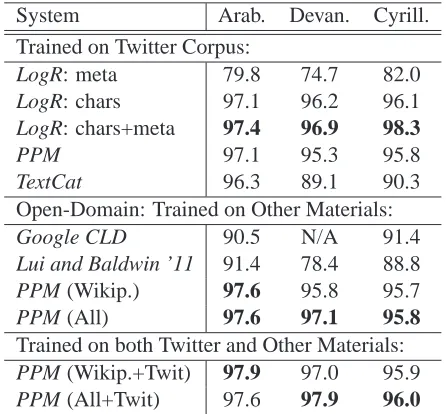
Table 4: LID accuracy (%) of different systems on held-out tweets. High LID accuracy on tweets is obtainable, whether training in or out-of-domain.
as tuning the regularization parameter of the LogR classifier) is done on the development set. Our eval-uation metric is Accuracy: what proportion of tweets in each held-out test set are predicted correctly.
6 Results
For systems trained on the Twitter data, both our
LogR and PPM system strongly outperform TextCat,
showing the effectiveness of our implemented ap-proaches (Table 4). Meta features improve LogR on each task. For systems trained on external data,
PPM strongly outperforms other systems, making
fewer than half the errors on each task. We also trained PPM on both the relatively small number of Twitter training samples and the much larger number of other materials. The combined system is as good or better than the separate models on each task.
50 60 70 80 90 100
10 100 1000
Accuracy (%)
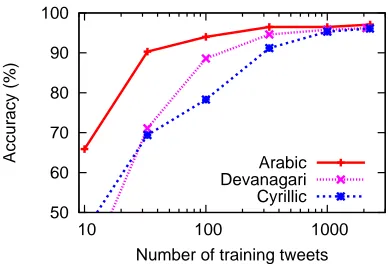
[image:7.612.90.285.53.185.2]Number of training tweets Arabic Devanagari Cyrillic
Figure 1: The more training data the better, but accuracy levels off: learning curve for LogR-chars (note log-scale).
50 60 70 80 90 100
100 1000 10000 100000 1e+06 1e+07
Accuracy (%)
Number of characters of training data Arabic Devanagari Cyrillic
Figure 2: Accuracy of PPM classifier using varying amounts of Wikipedia training text (also on log-scale).
terials in order to obtain its high accuracy.
In Figure 3, we show how the accuracy of our sys-tems varies over tweets grouped into bins by their length. Performance on short tweets is much worse than those closer to 140 characters in length.
We also examined aggregating predictions over multiple tweets by the same user. We extracted all users with≥4 tweets in the Devanagari test set (87 users in total). We then averaged the predictions of the LogR system on random subsets of a user’s test tweets, making a single decision for all tweets in a subset. We report the mean accuracy of running this approach 100 times with random subsets of 1, 2, 3, and all 4 tweets used in the prediction. Even with only 2 tweets per user, aggregating predictions can reduce relative error by almost 60% (Table 5).
Encouraged by the accuracy of our systems on an-notated data, we used our PPM system to analyze a large number of un-annotated tweets. We trained
PPM models for 128 languages using data that
in-cludes Wikipedia (February 2012), news (e.g., BBC News, Voice of America), and standard corpora such
88 90 92 94 96 98 100
40 60 80 100 120 140
Accuracy (%)
[image:7.612.328.530.55.186.2]Avgerage length of tweet (binned) Arabic Devanagari Cyrillic
Figure 3: The longer the tweet, the better: mean accuracy of LogR by average length of tweet, with tweets grouped into five bins by length in characters.
Number of Tweets 1 2 3 4
Accuracy 97.0 98.7 98.8 98.9
Table 5: The benefits of aggregating predictions by user: Mean accuracy of LogR-chars as you make predictions on multiple Devanagari tweets at a time
as Europarl, JRC-Acquis, and various LDC releases. We then made predictions in the TREC Tweets2011 Corpus.7
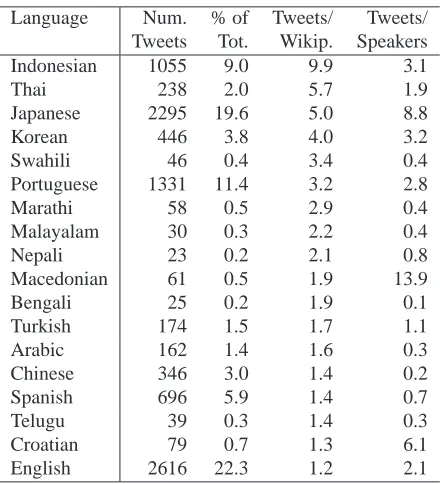
We observed 65 languages in roughly 10 million tweets. We calculated two other proportions using auxiliary data:8 (1) the proportion of Wikipedia
arti-cles written in each language, and (2) the proportion
of speakers that speak each language. We use these proportions to measure a language’s relative repre-sentation on Twitter: we divide the tweet-proportion by the Wikipedia and speaker proportions. Table 6 shows some of the most over-represented Twitter languages compared to Wikipedia. E.g., Indonesian is predicted to be 9.9 times more relatively com-mon on Twitter than Wikipedia. Note these are pre-dictions only; some English tweets may be falsely marked as other languages due to English impurities in our training sources. Nevertheless, the good rep-resentation of languages with otherwise scarce elec-tronic resources shows the potential of using Twitter to build language-specific social media collections.
7http://trec.nist.gov/data/tweets/This corpus, de-veloped for the TREC Microblog track (Soboroff et al., 2012), contains a two-week Twitter sample from early 2011. We processed all tweets that were obtained with a “200” response code using the
twitter-corpus-tools package.
[image:7.612.85.290.222.357.2]Language Num. % of Tweets/ Tweets/
Tweets Tot. Wikip. Speakers
Indonesian 1055 9.0 9.9 3.1
Thai 238 2.0 5.7 1.9
Japanese 2295 19.6 5.0 8.8
Korean 446 3.8 4.0 3.2
Swahili 46 0.4 3.4 0.4
Portuguese 1331 11.4 3.2 2.8
Marathi 58 0.5 2.9 0.4
Malayalam 30 0.3 2.2 0.4
Nepali 23 0.2 2.1 0.8
Macedonian 61 0.5 1.9 13.9
Bengali 25 0.2 1.9 0.1
Turkish 174 1.5 1.7 1.1
Arabic 162 1.4 1.6 0.3
Chinese 346 3.0 1.4 0.2
Spanish 696 5.9 1.4 0.7
Telugu 39 0.3 1.4 0.3
Croatian 79 0.7 1.3 6.1
[image:8.612.77.297.55.297.2]English 2616 22.3 1.2 2.1
Table 6: Number of tweets (1000s) and % of total for lan-guages that appear to be over-represented on Twitter (vs. proportion of Wikipedia and proportion of all speakers).
7 Related Work
Researchers have tackled language identification us-ing statistical approaches since the early 1990s. Cavnar and Trenkle (1994) framed LID as a text categorization problem and made their influential TextCat tool publicly-available. The related problem of identifying the language used in speech signals has also been well-studied; for speaker LID, both phonetic and sequential information may be help-ful (Berkling et al., 1994; Zissman, 1996). Insights from LID have also been applied to related problems such as dialect determination (Zaidan and Callison-Burch, 2011a) and identifying the native language of non-native speakers (Koppel et al., 2005).
Recently, LID has received renewed interest as a mechanism to help extract language-specific corpora from the growing body of linguistic materials on the web (Xia et al., 2009; Baldwin and Lui, 2010). Work along these lines has found LID to be far from a solved problem (Hughes et al., 2006; Baldwin and Lui, 2010; Lui and Baldwin, 2011); the web in gen-eral has exactly the uneven mix of style, languages, and lengths-of-text that make the real problem quite difficult. New application areas have also arisen, each with their own unique challenges, such as LID
for search engine queries (Gottron and Lipka, 2010), or person names (Bhargava and Kondrak, 2010).
The multilinguality of Twitter has led to the de-velopment of ways to ensure language purity. Rit-ter et al. (2010) use “a simple function-word-driven filter. . . to remove non-English [Twitter] conversa-tions,” but it’s unclear how much non-English sur-vives the filtering and how much English is lost. Tromp and Pechenizkiy (2011) and Carter et al. (2013) perform Twitter LID, but only targeting six common European languages. We focus on low-resource languages, where training data is scarce. Our data and systems could enable better LID for services likeindigenoustweets.com, which aims to “strengthen minority languages through so-cial media.”
8 Conclusions
Language identification is a key technology for ex-tracting authentic, language-specific user-generated text from social media. We addressed a previously unexplored issue: LID performance on Twitter text in low-resource languages. We have created and made available a large corpus of human-annotated tweets in nine languages and three non-Latin writ-ing systems, and presented two systems that can pre-dict tweet language with very high accuracy.9 While challenging, LID on Twitter is perhaps not as diffi-cult as first thought (Carter et al., 2013), although performance depends on the amount of training data, the length of the tweet, and whether we aggregate information across multiple tweets by the same user. Our next step will be to develop a similar approach to handle romanized text. We also plan to develop tools for identifying code-switching (switching lan-guages) within a tweet.
Acknowledgments
We thank Chris Callison-Burch for his help with the crowdsourcing. The first author was supported by the Natural Sciences and Engineering Research Council of Canada. The third author was supported by the BOLT program of the Defense Advanced Research Projects Agency, Contract No. HR0011-12-C-0015
References
Timothy Baldwin and Marco Lui. 2010. Language iden-tification: The long and the short of the matter. In
Proc. HLT-NAACL, pages 229–237.
Dario Benedetto, Emanuele Caglioti, and Vittorio Loreto. 2002. Language trees and zipping. Physical Review
Letters, 88(4):2–5.
Kay Berkling, Takayuki Arai, and Etienne Barnard. 1994. Analysis of phoneme-based features for lan-guage identification. In Proc. ICASSP, pages 289– 292.
Aditya Bhargava and Grzegorz Kondrak. 2010. Lan-guage identification of names with SVMs. In Proc.
HLT-NAACL, pages 693–696.
Andrej Bratko, Gordon V. Cormack, Bogdan Filipic, Thomas R. Lynam, and Blaz Zupan. 2006. Spam filtering using statistical data compression models.
JMLR, 6:2673–2698.
John D. Burger, John Henderson, George Kim, and Guido Zarrella. 2011. Discriminating gender on Twitter. In
Proc. EMNLP, pages 1301–1309.
Chris Callison-Burch and Mark Dredze. 2010. Creating speech and language data with amazon’s mechanical turk. In Proc. NAACL HLT 2010 Workshop on
Cre-ating Speech and Language Data with Amazon’s Me-chanical Turk, pages 1–12.
Simon Carter, Wouter Weerkamp, and Manos Tsagkias. 2013. Microblog Language Identification: Overcom-ing the Limitations of Short, Unedited and Idiomatic Text. Language Resources and Evaluation Journal. (forthcoming).
William B. Cavnar and John M. Trenkle. 1994. N-gram-based text categorization. In Proc. Symposium on
Document Analysis and Information Retrieval, pages
161–175.
John G. Cleary, Ian, and Ian H. Witten. 1984. Data compression using adaptive coding and partial string matching. IEEE Transactions on Communications,
32:396–402.
Jacob Eisenstein, Noah A. Smith, and Eric P. Xing. 2011. Discovering sociolinguistic associations with structured sparsity. In Proc. ACL, pages 1365–1374. Rong-En Fan, Kai-Wei Chang, Cho-Jui Hsieh, Xiang-Rui
Wang, and Chih-Jen Lin. 2008. LIBLINEAR: A li-brary for large linear classification. JMLR, 9:1871– 1874.
Clayton Fink, Jonathon Kopecky, Nathan Bos, and Max Thomas. 2012. Mapping the Twitterverse in the devel-oping world: An analysis of social media use in Nige-ria. In Proc. International Conference on Social
Com-puting, Behavioral Modeling, and Prediction, pages
164–171.
Eibe Frank, Chang Chui, and Ian H. Witten. 2000. Text categorization using compression models. In Proc.
DCC-00, IEEE Data Compression Conference, Snow-bird, US, pages 200–209. IEEE Computer Society
Press.
Rayid Ghani, Rosie Jones, and Dunja Mladenic. 2001. Automatic web search query generation to create mi-nority language corpora. In Proceedings of the 24th
annual international ACM SIGIR conference on Re-search and development in information retrieval,
SI-GIR ’01, pages 432–433, New York, NY, USA. ACM. Thomas Gottron and Nedim Lipka. 2010. A comparison of language identification approaches on short, query-style texts. In Proc. ECIR, pages 611–614.
Baden Hughes, Timothy Baldwin, Steven Bird, Jeremy Nicholson, and Andrew Mackinlay. 2006. Reconsid-ering language identification for written language re-sources. In Proc. LREC, pages 485–488.
Ann Irvine and Alexandre Klementiev. 2010. Using Me-chanical Turk to annotate lexicons for less commonly used languages. In Proc. NAACL HLT 2010 Workshop
on Creating Speech and Language Data with Ama-zon’s Mechanical Turk, pages 108–113.
Emre Kiciman. 2010. Language differences and meta-data features on Twitter. In Proc. SIGIR 2010 Web
N-gram Workshop, pages 47–51.
Moshe Koppel, Jonathan Schler, and Kfir Zigdon. 2005. Determining an author’s native language by mining a text for errors. In Proc. KDD, pages 624–628. Marco Lui and Timothy Baldwin. 2011. Cross-domain
feature selection for language identification. In Proc.
IJCNLP, pages 553–561.
Paul McNamee. 2005. Language identification: a solved problem suitable for undergraduate instruction. J. Comput. Sci. Coll., 20(3):94–101.
D. Pavelec, L. S. Oliveira, E. Justino, F. D. Nobre Neto, and L. V. Batista. 2009. Compression and stylometry for author identification. In Proc. IJCNN, pages 669– 674, Piscataway, NJ, USA. IEEE Press.
Alan Ritter, Colin Cherry, and Bill Dolan. 2010. Unsu-pervised modeling of twitter conversations. In Proc.
HLT-NAACL, pages 172–180.
Alan Ritter, Colin Cherry, and William B. Dolan. 2011. Data-driven response generation in social media. In
Proc. EMNLP, pages 583–593.
Rion Snow, Brendan O’Connor, Daniel Jurafsky, and An-drew Y. Ng. 2008. Cheap and fast—but is it good?: evaluating non-expert annotations for natural language tasks. In Proc. EMNLP, pages 254–263.
Ian Soboroff, Dean McCullough, Jimmy Lin, Craig Mac-donald, Iadh Ounis, and Richard McCreadie. 2012. Evaluating real-time search over tweets. In Proc.
William John Teahan. 2000. Text classification and segmentation using minimum cross-entropy. In Proc.
RIAO, pages 943–961.
Erik Tromp and Mykola Pechenizkiy. 2011. Graph-based n-gram language identication on short texts. In
Proc. 20th Machine Learning conference of Belgium and The Netherlands, pages 27–34.
Fei Xia, William Lewis, and Hoifung Poon. 2009. Lan-guage ID in the context of harvesting lanLan-guage data off the web. In Proc. EACL, pages 870–878.
Omar F. Zaidan and Chris Callison-Burch. 2011a. The arabic online commentary dataset: an annotated dataset of informal arabic with high dialectal content. In Proc. ACL, pages 37–41.
Omar F. Zaidan and Chris Callison-Burch. 2011b. Crowdsourcing translation: Professional quality from non-professionals. In Proc. ACL, pages 1220–1229. Marc A. Zissman. 1996. Comparison of four
ap-proaches to automatic language identification of tele-phone speech. IEEE Transactions on Speech and