Speech Retrieval in Unknown Languages: a Pilot Study
∗Xiaodan Zhuang# Jui Ting Huang# Mark Hasegawa-Johnson
Beckman Institute, Department of Electrical and Computer Engineering University of Illinois at Urbana-Champaign, U.S.A.
{xzhuang2,jhuang29,jhasegaw}@uiuc.edu
Abstract
Most cross-lingual speech retrieval assumes intensive knowledge about all involved lan-guages. However, such resource may not ex-ist for some less popular languages. Some applications call for speech retrieval in un-known languages. In this work, we lever-age on a quasi-langulever-age-independent subword recognizer trained on multiple languages, to obtain an abstracted representation of speech data in an unknown language. Language-independent query expansion is achieved ei-ther by allowing a wide lattice output for an audio query, or by taking advantage of dis-tinctive features in speech articulation to pro-pose subwords most similar to the given sub-words in a query. We propose using a re-trieval model based on finite state machines for fuzzy matching of speech sound patterns, and further for speech retrieval. A pilot study of speech retrieval in unknown languages is presented, using English, Spanish and Russian as training languages, and Croatian as the un-known target language.
1 Introduction
Dramatic increase in recorded speech media calls for efficient retrieval of audio files. Accessing speech media of a foreign language is a particularly impor-tant and challenging task, often referred to as cross-lingual speech retrieval or cross-cross-lingual spoken doc-ument retrieval.
∗This research is funded by NSF grants 0534106 and
0703624. The authors would like to thank Su-Youn Yoon for inspiring discussion.#The student authors contribute equally.
Previous work on cross-lingual speech retrieval mostly leverages on intensive knowledge about all the languages involved. Most reported work inves-tigates retrieval in a target language, in response to audio or text queries given in a different source lan-guage (Meng et al., 2000; Virga and Khudanpur, 2003). Usually, the speech media in the target lan-guage, and the audio queries in the source lanlan-guage, are converted to speech recognition transcripts us-ing large-vocabulary automatic speech recognizers (LVASR) trained for the target language and the source language respectively. The text queries, or transcribed audio queries, are translated to the tar-get language. Text retrieval techniques are applied to retrieve speech, by retrieving the correspond-ing LVASR transcription in the target language. In such systems, a large-vocabulary speech recognizer trained on the target language is essential, which requires the existence of a dictionary and labeled acoustic training data in that language.
LVASR currently do not exist for most of the 6000 languages on Earth. In some situations, knowledge about the target language is limited, and definitely not sufficient to enable training LVASR. Imagine an audio database in a target language unknown to a user, who needs to retrieve spoken content rel-evant to some audible query in this unknown lan-guage. For example, the user knows how the name “Obama” is pronounced in the target language, and wants to retrieve all spoken documents that contain the query word, from a database in this unknown language. A linguist might find himself/herself in this scenario when he or she tries to collect a large number of utterances containing some particular
phrases in an unknown language. Similarly, an in-formation analyst might wish to leverage on speech retrieval in unknown languages to organize critical information before engaging linguistic experts for finer analysis. We refer to such retrieval tasks as
speech retrieval in unknown languages, in which
lit-tle knowledge about the target language is assumed. A human linguist attempting to manually per-form speech retrieval in an unknown language would necessarily map the perceived speech (both database and query) into some cognitive abstraction or schema, representing, perhaps, the phonetic dis-tinctions that he or she has been trained to hear. Matching and retrieval of speech would then be per-formed based on such an abstraction. Two cog-nitive processes, assimilation and accommodation, take place when human brains are to process new information (Bernstein et al., 2007), such as speech in an unknown language. In accommodation, the in-ternal stored knowledge adapts to new information with which it is confronted. In assimilation, the new information, e.g., speech in an unknown language, is mapped to previously stored information, e.g., sub-words (phones) as defined by knowledge about the languages known to the listener.
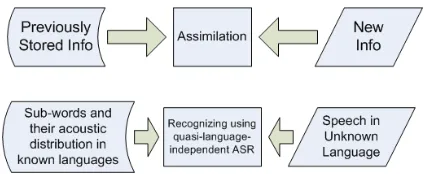
This paper models speech retrieval in unknown languages using a machine learning model of pho-netic assimilation. A quasi-language-independent subword recognizer is trained to capture salient sub-words and their acoustic distribution in multiple languages. This recognizer is applied on an un-known language, therefore mapping segments of the unknown speech to subwords in the known lan-guages. Through this machine cognitive process, the database and queries in the unknown language are represented as sequences of quasi-language-independent subwords. Speech retrieval is per-formed based on such representation. Figure 1 illus-trates that speech retrieval in an unknown language can be modeled as a special case of assimilation.
[image:2.612.316.528.54.141.2]This task differs from the more widely studied known-language speech retrieval task, in that no lin-guistic knowledge of the target language is assumed. We can only leverage on knowledge that can be applied by assimilation to the multiple known lan-guages. Therefore, this task is more like a cross-lingual sound pattern retrieval task, leveraged on quasi-language-independent subwords, rather than
Figure 1: Automatic speech retrieval in an unknown lan-guage (below) is modeled as a special case of the cogni-tive process called assimilation (above).
a translated spoken word/phrase retrieval task us-ing target language LVASR transcripts, as in most cross-lingual speech retrieval systems. The quasi-language-independent subword recognizer is trained on speech data other than the target language, and therefore generates much noisier recognition results, owing to potential mismatch between acoustic distri-butions, lack of dictionary and lack of a word-level language model.
To manage the extra difficulty, we adopt a sub-word lattice representation to encode a wide hypoth-esis space of recognized speech in the target lan-guage. Language-independent query expansion is achieved either by allowing a wide lattice output for an audio query, or by taking advantage of dis-tinctive features in speech articulation to propose quasi-language-independent subwords most similar to the given subwords in a query. Finite state ma-chines (FSM) constructed from the speech lattices are used to allow for fuzzy matching of speech sound patterns, and further for retrieval in unknown languages.
We carry out a pilot study of speech retrieval in unknown languages, using English, Spanish and Russian as training languages, and Croatian as the unknown target language. To explain the effect of additional knowledge about the target language, we demonstrate the improvements in retrieval perfor-mance that result by incrementally making available subword sequence models and acoustic models for the target language.
2 Quasi-Language-Independent subword Models
2.1 Deriving a subword set
of subwords, the question is to find an appropriate set of subword symbols. Schultz and Waibel (2001) reported that a global unit set for the source languages based on International Phonetic Alpha-bet (IPA) symbols outperforms language-dependent phonetic units in cross-lingual word recognition tasks, whereas language-dependent phonetic units are better models for multilingual word recognition (in which the target language is also one of the source languages). A multilingual task might ben-efit from partitioning the feature space according to language identity, i.e., to have different subsets of models aiming at different languages. By contrast, a cross-lingual task calls for one consistent set of models with language-independent properties in or-der to maximize portability into the new language.
To capture the necessary distinctions between dif-ferent phones across languages, we first pool to-gether individual phone inventories for source lan-guages, each of which has its phones tagged with a language identity, and then performed bottom-up clustering on the phone pool based on pairwise sim-ilarity between their acoustic models. Each cluster represents one distinct language-independent sub-word symbol. Since this set is still derived from multiple languages, we refer to these subword units as language-independent subwords. A quasi-language-independent subword set is derived by the following steps:
First, we encode all speech in the known lan-guages using a language-dependent phone set. Each symbol in this set is defined by the phone iden-tity and the language ideniden-tity. One single-Gaussian three-state left-to-right HMM is trained for each of these subword units.
Second, similarity between the language-dependent phones is estimated by the approximated KL divergence between corresponding acoustic models. As shown in (Vihola et al., 2002), KL divergence between single-Gaussian left-to-right HMMs can be approximated in closed form by Equation 1,
KLD(U, V) =
S
X
i=1
ri S
X
j=1
aUijlog aUij/aVij(1)
+
S
X
i=1
riI bUi :bVi
, (2)
whereaijis the transition probability to hidden state
j, and bi and ri are the observation distribution
and steady-state probability for hidden statei. For single-Gaussian distribution,I bUi :bVi can be ap-proximated by,
I(bUi :bVi ) = 1
2
h
log
ΣV
i
ΣU
i
+ trΣUi ΣVi −1− ΣUi −1
+ tr ΣVi −1 µUi −µVi µUi −µVi T i.
Third, we use the Affinity Propagation algorithm (Frey and Dueck, 2007) to conduct pairwise cluster-ing of phones based on the approximated KL diver-gence between acoustic models. The tendency for a data point (a phone) to be an exemplar of a cluster is controlled by the preference value assigned to that phone. The preference of a phoneiis set as follows to favor frequent phones to be cluster centers:
p(i) =klog(Ci), (3)
whereCi is the count of the phonei, andkis a
nor-malization term to control the total number of clus-ters. To discourage subwords from the same lan-guage to join a same cluster, pairwise distance be-tween them are offset by an additional amount, com-parable to the maximum pairwise distance between the models.
The resultant subword set is supposed to cap-ture quasi-language-independent phonetic informa-tion, and each subword unit has relatively distinctive acoustic distribution. These subwords are encoded using the corresponding cluster exemplars as surro-gates.
2.2 Recognizing subwords
We create context-dependent models for each subword, using the same strategy for build-ing context-dependent triphone models in LVASR (Woodland et al., 1994). A “triphone” is a subword with its context defined as its immediate preceding and following subwords. Each triphone is repre-sented by a continuous three-state left-to-right Hid-den Markov Model (HMM). Additionally, there is a one-state HMM for silence, two three-state HMMs for noise and unknown sound respectively. The number of Gaussian mixtures (9 to 21 Gaussians) is optimized according to a development set consisting of speech in the known languages. A standard tree-based state tying technique is adopted for parameter sharing between subwords with similar contexts.
The “language model” (LM), or more precisely subword sequence model, should generalize from the known languages to the unknown language. Our trial experiments showed that unigram statistics of subwords and their triphones is more transferable across languages than N-gram statistics. We also as-sume that infrequent triphones are less likely to be salient units that would carry the properties of the unknown language. Thus, we select the top frequent triphones and map the rest of the triphones to their center phones, forming a mixed vocabulary of fre-quent triphones and context-independent subwords. The frequencies of these vocabulary entries are used to estimate an unigram LM in the ASR system. Tri-phones in the ASR output are mapped back to its center subwords before the retrieval stage.
3 Speech Retrieval through Subword Indexing
In many cross-lingual speech retrieval systems, the speech media are processed by a large-vocabulary automatic speech recognizer (LVASR), which has access to vocabulary, dictionary, word language model and acoustic models for the target lan-guage. With all these resources, state-of-the-art speech recognition could give reasonable hypoth-esized word transcript, enabling direct application of text retrieval techniques. However, this is not the case in speech retrieval in unknown languages. Moreover, without the higher level linguistic knowl-edge, such as a word dictionary, this task aims to
find speech patterns that sound similar, as
approxi-mated by sequences of quasi-language-independent
subwords. Therefore, the sequential information in the hypothesized subwords is critical.
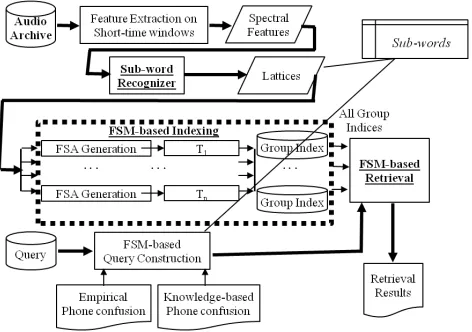
To deal with the significant noise in the subword recognition output, and to emphasize the sequential information, we use the recognizer to obtain sub-word lattices instead of one-best hypotheses. These lattices can be represented as weighted automata, which are compact representations of a large num-ber of alternative subword sequences, each asso-ciated with a weight indicating the uncertainty of the data. Therefore, indexing speech in unknown language can be achieved by indexing the corre-sponding weighted automata with quasi-language-independent subwords associated with the state tran-sitions.
[image:4.612.312.548.484.650.2]We adopt the weighted automata indexation algo-rithm reported in (Allauzen et al., 2004), which is optimal for searching subword sequences, as it takes time linear in the sum of the query size and the num-ber of speech media entries where it appears. The automata indexation algorithm also preserves the se-quential information, which is crutial for this task. We leverage on two kinds of knowledge for query expansion, namely empirical phone confusion and knowledge-based phone confusion. An illustration of our speech retrieval system is presented in Fig-ure 2. We detail the indexing approaching as well as query expansion and retrieval in this section.
3.1 Subword Finite State Machines as Speech Indices
We construct a full index that can be used to search for a query within all the speech utterancesui, i ∈
1, ..., n. In particular, this is achieved by construct-ing a weighted finite-state transducer T, mapping each queryxto the set of speech utterances where it appears. Each returned speech utteranceu is as-signed a score, which is the negative log of the ex-pected count of the queryxin utteranceu.
The subword lattice for speech utteranceuican be
represented as a weighted finite state automata Ai,
whose path weights correspond to the joint proba-bility of the observed speech and the hypothesized subword sequence. To get an automata whose path weights correspond to desired negative log of poste-rior probabilities, we simply need to apply a general weight-pushing algorithm toAiin the log semiring,
resulting in an automata Bi. In this automata Bi,
the probability of a given stringxis the sum of the probability of all paths that containsx.
The key point of constructing the index transducer Ti for uttereance ui is to introduce new paths that
enable matching between a query and any portions of the original paths, while properly normalizing the path weights. This is achieved by factor selection in (Allauzen et al., 2004). First, null output is intro-duced to each transition in the automata, converting the automata into a transducer. Second, a new tran-sition is introduced from a new unique initial state to each existing state, with null input and output. The weight associated with this transition is the negative log of the forward probability. Similarly, a new tran-sition is created from each state to a new unique final state, with null input and output as the labeliof the current utteranceui. The assicated weight is the
neg-ative log of the backward probability. General finite state machine optimization operations (Allauzen et al., 2007) of weighted ǫ-removal, determinization and minimization over the log semiring can be ap-plied to the resulting transducer. As shown in (Al-lauzen et al., 2004), the path with input of stringx and output of labelihas a weight corresponding to the negative log of the expected count ofxin utter-anceui.
To optimize the retrieval time, we divide all ut-terances into a few groups. Within each group, the utterance index transducers are unioned and
deter-minized to get one single index transducer for the group. It is then feasible to expedite retrieval by processing each group index transducer in a paral-lel fashion.
3.2 Query Expansion
While sequential information is important, ex-act string match is very unplausible in this chal-lenging task, even when subword lattices encode many alternative recognition hypotheses. Language-independent query expansion is therefore critical for success in retrieval. We carry out query expansion either by allowing a wide lattice output for an audio query, or by taking advantage of distinctive features in speech articulation to propose quasi-language-independent subwords most similar to the given sub-words in a query.
In particular, for a spoken query, ASR will gen-erate a subword lattice instead of a one-best sub-word sequence hypothesis. With the lattice, the au-dio query is encoded by the best hypothesis from ASR and its empirical phone confusion. The lattice can then be represented as a finite-state automata.
However, when the query is given as a target language subword sequence, we can no longer use the recognizer to obtain an expanded query. Fur-thermore, some target language subwords may not even exist in the quasi-language-independent sub-word set in the recognizer. In this case, knowledge-based phone confusion is engaged via the use of a set of distinctive featuresFj, j ∈ 1, ..., M for
hu-man speech (Chomsky and Halle, 1968), including labial, alveolar, post-alveolar, retroflex, voiced, as-pirated, front, back, etc.
We estimate similarity from phoneato phoneb, or more precisely, substitution tendency as in Equa-tion 4,
DF sim(a, b) = logNab Na
(4)
where
Nab = M
X
j=1
(Fja×Fjb = 1),
Na= M
X
j=1
The target subword sequence is first mapped to the derived subword set, by locating the identical or nearest member phone in the clustering and then adopting the surrogate for that cluster. This con-verted sequence of derived subwords is further ex-panded by adding the most likely alternative quasi-language-independent subwords, parallel to each original subword. Transitions to these alternative subwords are associated with the corresponding sub-stitution tendency based on distinctive features.
3.3 Search
An expanded query, either obtained from an audio query or a subword sequence query, is represented as a weighted finite state automata. Searching this query in the utterances is achieved by composing the query automata with the index transducer. This re-sults in another finite state transducer, which is fur-ther processed by projection on output, removal of ǫarcs and determinization. The output is a list of retrieved speech utterances, each with the expected count of the query.
Apparently, the precision and recall of the re-trieval results vary with the width of the subword lattices used for indexing as well as how much the query is expanded. We control the width of the sub-word lattices via the number of tokens and the max-imum probability decrease allowed for each step in the Viterbi decoding. The extend to which a sub-word sequence query is expanded is determined by the lowest allowed similarity between the original phone and an alternative phone. These parameters are set empirically.
4 Experiments
4.1 Dataset
The known language pool should cover as many lan-guage families as possible so that the derived sub-words could better approximate language indepen-dence. However, as a pilot study, this paper reports experiments using only languages within the Indo-European family. Table 1 summarizes the size of speech data from each language. Croatian is used as the unknown target language, and the other three languages are the known languages used for de-riving and training the quasi-language-independent subword models. We extracted 80% of all speakers
per language for training, and 10% as a development set.
Language ID Hours Spks Style
Croatian hrv 21.3 201 Read+answers
English hub 13.6 406 Broadcast
Spanish spa 14.6 120 Read+answers
Russian rus 2.5 63 Read+answers
Table 1: Summary for data: language ID, total length, number of speakers and speaking style for each language.
4.2 Settings
The speech retrieval task aims to find speech utter-ances that contain a particular query. We use two kinds of queries: 1) subword sequence queries, tran-scribed as a sequence of phonetic symbols in the tar-get language; 2) audio queries, each being an audio segment of the speech query in the target language.
Since we aim to match speech patterns that sound like each other, the queries used in this experiment are relatively short, about 3 to 5 syllables. This adds to the challenge in that very limited redundant in-formation is available for query-utterance matching. There are totally40subword sequences and40audio queries, each occurs in between 18 and 38 utterances out of a set of 576 utterances.
In addition to a cross-lingual retrieval system built using only the known languages, we incrementally augment resource on the target language to build more knowledgeable systems.
AM0LM0: Both the acoustic model (AM) and the language model (LM) are quasi-language-independent, trained using data in multiple known languages. This happens when no transcribed speech data or a defined phone set exist for the tar-get language. Essentially the system has no direct knowledge about the target language.
we can use. First, we map each of target mono-phones to source phone symbols: Any source cluster that contains a phonetic symbol with the same nota-tion as the target phonetic symbol becomes a surro-gate symbol for that target phone. If a target phone is unseen to the known languages, the most similar phone will be chosen first. The similarity is based on the distinctive features, as discussed in Section 3.2. Second, the target triphones are converted to possi-ble source triphones for which acoustic models ex-ist. Each target triphone not modeled in the source language AM is replaced with the corresponding di-phone (subword pair) if it exists, otherwise the cen-ter phone.
AMtLM0: This setting examines the perfor-mance gap due to the language model mismatch by using a quasi-language-independent source LM, but a target language AM. For the source triphones and monophones that do not exist in the target AM, they are mapped to target AMs in a way similar as de-scribed above.
AMtLMt: Both AM and LM are trained for the
target language. This setting provides an upper bound of the performance for different settings.
4.3 Metrics
We evaluate the performance for both subword recognition and speech retrieval, measured as fol-lows.
Recognition Accuracy: The ground truth is
en-coded using subwords in the target language while the recognition output is encoded using quasi-language-independent subwords in Section 2. To measure the recognition accuracy, we label each quasi-language-independent subword cluster using the most frequent target language subword that ap-pears in that cluster. The hypothesis subword se-quence is then compared against the groundtruth us-ing a dynamic-programmus-ing-based strus-ing alignment procedure. The recognition accuracy is defined as REC −ACC = HN−I ×100%, where H, I, and N are the numbers of correct labels, insertion errors and groundtruth labels respectively.
Retrieval Precision: The retrieval performance
is measured using Mean Average Precision (IR− M AP), defined as the mean of the Average Preci-sion (AP) for a set of different queries x. Mean Average Precision (IR−M AP) can be defined in
Equation 5. n is the number of ordered retrieved utterances andR is the total number of relevant ut-terances. fi is an indicator function whether theith
retrieved utterance does contain the query. Precision pmfor topmretrieved utterances can be calculated
aspm= m1 Pmk=1f(k).
IR−M AP = 1 Q
Q
X
x=1
AP(x),
AP(x) = 1 R(x)
nX(x)
i=1
fi(x)pi(x). (5)
We useIR−M APA andIR−M APS to denote
the retrieval MAP for audio queries and subword se-quence queries respectively.
4.4 Results
Table 2 presents a few examples of the derived quasi-language-independent subwords. As dis-cussed in Section 2, these subwords are obtained by bottom-up clustering of all the language-dependent IPA phones in the multiple known languages. The same IPA symbol across languages may lie in the same cluster, e.g.,/z/in Cluster 1, or different clus-ters, e.g.,/j/in Cluster 3 and 4. Although symbols within the same language are discouraged to be in one cluster, it still desirably happens for highly sim-ilar pairs, e.g.,/1/rusand/j/rusin Cluster 4.
Cluster ID Surrogate Other phone members 1 /z/hub /z/spa,/z/rus,/zj/rus
2 /tSj/
rus /tS/hub,/tS/spa
3 /j/hub /j/spa
4 /i:/hub /1/rus,/j/rus
Table 2: Examples of quasi-language-independent sub-words, as clusters of source language IPAs.
Table 3 compares the subword recognition and retrieval performance for the quasi-language-independent subwords and IPA phones. We can
Setting REC−ACC IR−M APA IR−M APS
IPA 37.18% 17.90% 31.40%
AM0LM0 42.52% 23.24% 32.62%
Setting AMtLMt AMtLM0 AM0LMt AM0LM0
REC−ACC 73.45% 67.29% 49.88% 42.52%
IR−M APA 58.82% 52.38% 28.32% 23.24%
[image:8.612.72.301.57.113.2]IR−M APS 76.96% 51.86% 34.95% 32.62%
Table 4: Performance of subword recognition and speech retrieval.
see that on the unknown language Croatian, the de-rived quasi-language-independent subwords outper-form the IPA symbol set in both phone recognition and retrieval using two kinds of queries.
narrow10 wide
20 30 40 50 60 70 80
Query Expansion
IR−MAP(%)
[image:8.612.100.262.233.364.2]AMtLMt AMtLM0 AM0LMt AM0LM0
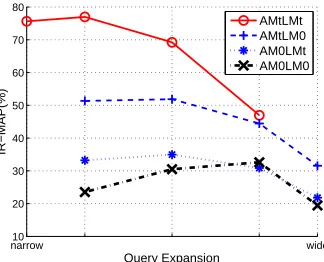
Figure 3: Speech retrieval performance for subword se-quence queries
narrow wide
15 20 25 30 35 40 45 50 55 60
Query Expansion
IR−MAP(%)
[image:8.612.99.263.433.562.2]AMtLMt AMtLM0 AM0LMt AM0LM0
Figure 4: Speech retrieval performance for audio queries
Table 4 presents the subword recognition accu-racy and retrieval performance with optimal query width. Figure 3 and Figure 4 presents speech retrieval performance at varying query widths for subword sequence queries and audio queries re-spectively. It is shown that speech retrieval in completely unknown language achieves MAP of 23.24% and 32.62% while the system trained using
the most available knowledge about the target lan-guage reaches MAP of 58.82% and 76.96%, for au-dio queries and subword sequence queries respec-tively. We also demonstrate access to phone fre-quency (AM0LMt) and acoustic data (AMtLM0) both boosts retrieval performance, and the effect is roughly additive (AMtLMt).
5 Conclusion and Discussion
In this work, we present a speech retrieval approach in unknown languages. This approach leverages on speech recognition based on quasi-language-independent subword models derived from multi-ple known languages, and finite state machine based fuzzy speech pattern matching and retrieval. Our experiments use Croatian as the unknown language and English, Russian and Spanish as the known lan-guages. Results show that the derived subwords out-perform the IPA symbols, and access to the subword language model and acoustic models in the unknown language explains the gap between this challenging task and retrieval with knowledge about the target language.
The proposed retrieval approach on unknown lan-guages can be viewed as a machine learning model of phonetic assimiliation, in which the segments in an unknown language are mapped to language-independent subwords learned from the multiple known languages. However, another important cog-nitive process, i.e., accomodation, is not yet mod-eled. We believe the capability to create new sub-words unseen in the known languages would lead to improved performance. In particular, speech seg-ments that are hypothesized by the quasi-language-independent subword recognizer with very low con-fidence scores can be clustered to form these new subwords, accomodating to the unknown language.
References
C. Allauzen, M. Mohri, and M. Saraclar. 2004. Gen-eral indexation of weighted automata – application to spoken utterance retrieval. In Proc. HLT-NAACL. C. Allauzen, M. Riley, J. Schalkwyk, W. Skut, and
M.Mohri. 2007. Openfst: A general and effi-cient weighted finite-state transducer library. In Proc.
CIAA.
Bernstein, Penner, Clarke-Stewart, and Roy. 2007.
Psy-chology. Houghton Mifflin Company.
Noam Chomsky and Morris Halle. 1968. The Sound
Pattern of English. New York: Harper and Row.
Brendan J. Frey and Delbert Dueck. 2007. Clustering by passing messages between data points. Science, 315:972–976.
Frederick Jelinek. 1998. Statistical Methods for Speech
Recognition. The MIT Press.
Helen Meng, Berlin Chen, Erika Grams, Sanjeev Khu-danpur, Wai-Kit Lo, Gina-Anne Levow, Douglas Oard, Patrick Schone, Karen Tang, Hsin-Min Wang, and Jian Qiang Wang. 2000. Mandarin-english informa-tion (MEI): Investigating translingual speech retrieval.
http://www.clsp.jhu.edu/ws2000/final reports/mei/ws00mei.pdf. Tanja Schultz and Alex Waibel. 2001. Language
inde-pendent and language adaptive acoustic modeling for speech recognition. Speech Communication, 35:31– 51.
M. Vihola, M. Harju, P. Salmela, J. Suontausta, and J. Savela. 2002. Two dissimilarity measures for hmms and their application in phoneme model clustering. In
Proc. ICASSP, volume 1, pages I–933 – I–936.
Paola Virga and Sanjeev Khudanpur. 2003. Transliter-ation of proper names in crosslingual informTransliter-ation re-trieval. In Proc. ACL 2003 workshop MLNER. P.C. Woodland, J.J. Odell, V. Valtchev, and S.J. Young.