A New Objective Function for Word Alignment
Tugba Bodrumlu Kevin Knight Sujith Ravi
Information Sciences Institute & Computer Science Department University of Southern California
[email protected], [email protected], [email protected]
Abstract
We develop a new objective function for word alignment that measures the size of the bilin-gual dictionary induced by an alignment. A word alignment that results in a small dictio-nary is preferred over one that results in a large dictionary. In order to search for the align-ment that minimizes this objective, we cast the problem as an integer linear program. We then extend our objective function to align corpora at the sub-word level, which we demonstrate on a small Turkish-English corpus.
1 Introduction
Word alignment is the problem of annotating a bilin-gual text with links connecting words that have the same meanings. Figure 1 shows sample input for a word aligner (Knight, 1997). After analyzing the text, we may conclude, for example, that sprok cor-responds to dat in the first sentence pair.
Word alignment has several downstream con-sumers. One is machine translation, where pro-grams extract translation rules from word-aligned corpora (Och and Ney, 2004; Galley et al., 2004; Chiang, 2007; Quirk et al., 2005). Other down-stream processes exploit dictionaries derived by alignment, in order to translate queries in cross-lingual IR (Sch¨onhofen et al., 2008) or re-score can-didate translation outputs (Och et al., 2004).
Many methods of automatic alignment have been proposed. Probabilistic generative models like IBM 1-5 (Brown et al., 1993), HMM (Vogel et al., 1996), ITG (Wu, 1997), and LEAF (Fraser and Marcu, 2007) define formulas for P(f | e) or P(e, f), with
ok-voon ororok sprok at-voon bichat dat
erok sprok izok hihok ghirok totat dat arrat vat hilat
ok-drubel ok-voon anok plok sprok at-drubel at-voon pippat rrat dat
ok-voon anok drok brok jok at-voon krat pippat sat lat
wiwok farok izok stok totat jjat quat cat
lalok sprok izok jok stok wat dat krat quat cat
lalok farok ororok lalok sprok izok enemok wat jjat bichat wat dat vat eneat
lalok brok anok plok nok iat lat pippat rrat nnat
wiwok nok izok kantok ok-yurp totat nnat quat oloat at-yurp
lalok mok nok yorok ghirok clok wat nnat gat mat bat hilat
lalok nok crrrok hihok yorok zanzanok wat nnat arrat mat zanzanat
lalok rarok nok izok hihok mok wat nnat forat arrat vat gat
Figure 1: Word alignment exercise (Knight, 1997).
hidden alignment variables. EM algorithms estimate dictionary and other probabilities in order to maxi-mize those quantities. One can then ask for Viterbi alignments that maximize P(alignment |e, f). Dis-criminative models, e.g. (Taskar et al., 2005), in-stead set parameters to maximize alignment accu-racy against a hand-aligned development set. EMD training (Fraser and Marcu, 2006) combines genera-tive and discriminagenera-tive elements.
Low accuracy is a weakness for all systems. Most practitioners still use 1990s algorithms to align their data. It stands to reason that we have not yet seen the last word in alignment models.
In this paper, we develop a new objective function for alignment, inspired by watching people manu-ally solve the alignment exercise of Figure 1. When people attack this problem, we find that once they create a bilingual dictionary entry, they like to
re-use that entry as much as possible. Previous
ma-chine aligners emulate this to some degree, but they are not explicitly programmed to do so.
We also address another weakness of current aligners: they only align full words. With few ex-ceptions, e.g. (Zhang et al., 2003; Snyder and Barzi-lay, 2008), aligners do not operate at the sub-word level, making them much less useful for agglutina-tive languages such as Turkish.
Our present contributions are as follows: • We offer a simple new objective function that
scores a corpus alignment based on how many distinct bilingual word pairs it contains. • We use an integer programming solver to
carry out optimization and corpus alignment. • We extend the system to perform
sub-word alignment, which we demonstrate on a Turkish-English corpus.
The results in this paper constitute a proof of con-cept of these ideas, executed on small corpora. We conclude by listing future directions.
2 New Objective Function for Alignment
We search for the legal alignment that minimizes the
size of the induced bilingual dictionary. By
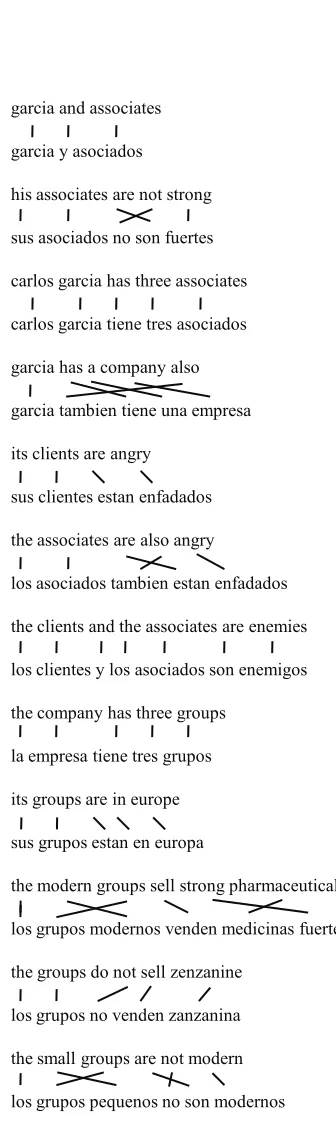
dictio-nary size, we mean the number of distinct word-pairs linked in the corpus alignment. We can im-mediately investigate how different alignments stack up, according to this objective function. Figure 2
garcia and associates
garcia y asociados
his associates are not strong
sus asociados no son fuertes
carlos garcia has three associates
carlos garcia tiene tres asociados
garcia has a company also
garcia tambien tiene una empresa
its clients are angry
sus clientes estan enfadados
the associates are also angry
los asociados tambien estan enfadados
the clients and the associates are enemies
los clientes y los asociados son enemigos
the company has three groups
la empresa tiene tres grupos
its groups are in europe
sus grupos estan en europa
the modern groups sell strong pharmaceuticals
los grupos modernos venden medicinas fuertes
the groups do not sell zenzanine
los grupos no venden zanzanina
the small groups are not modern
[image:2.612.315.483.54.621.2]los grupos pequenos no son modernos
garcia and associates
garcia y asociados
his associates are not strong
sus asociados no son fuertes
carlos garcia has three associates
carlos garcia tiene tres asociados
garcia has a company also
garcia tambien tiene una empresa
its clients are angry
sus clientes estan enfadados
the associates are also angry
los asociados tambien estan enfadados
the clients and the associates are enemies
los clientes y los asociados son enemigos
the company has three groups
la empresa tiene tres grupos
its groups are in europe
sus grupos estan en europa
the modern groups sell strong pharmaceuticals
los grupos modernos venden medicinas fuertes
the groups do not sell zenzanine
los grupos no venden zanzanina
the small groups are not modern
[image:3.612.74.244.70.624.2]los grupos pequenos no son modernos
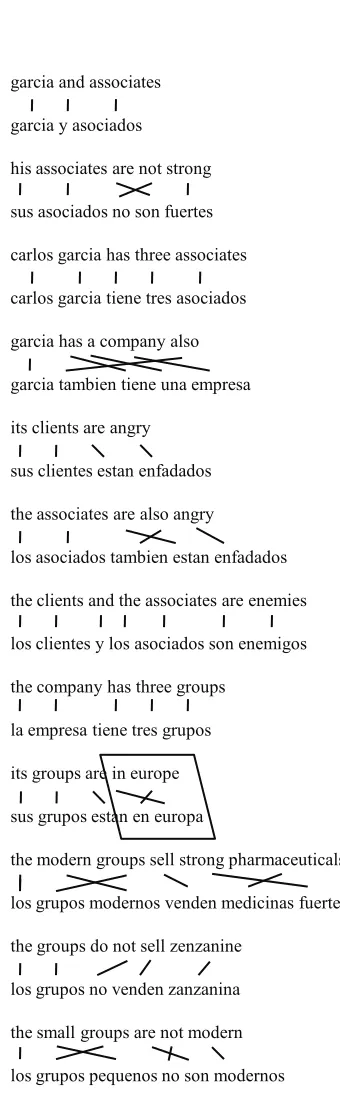
Figure 3: IP alignment. The induced bilingual dictionary has 28 distinct entries.
shows the gold alignment for the corpus in Figure 1 (displayed here as English-Spanish), which results in 28 distinct bilingual dictionary entries. By con-trast, a monotone alignment induces 39 distinct en-tries, due to less re-use.
Next we look at how to automatically rifle through all legal alignments to find the one with the best score. What is a legal alignment? For now, we con-sider it to be one where:
• Every foreign word is aligned exactly once (Brown et al., 1993).
• Every English word has either 0 or 1 align-ments (Melamed, 1997).
We formulate our integer program (IP) as follows. We set up two types of binary variables:
• Alignment link variables. If link-i-j-k = 1, that means in sentence pairi, the foreign word at positionjaligns to the English words at posi-tionk.
• Bilingual dictionary variables. If dict-f-e = 1, that means word pair (f, e) is “in” the dictio-nary.
We constrain the values of link variables to sat-isfy the two alignment conditions listed earlier. We also require that if link-i-j-k = 1 (i.e., we’ve decided on an alignment link), then dict-fij-eik should also
equal 1 (the linked words are recorded as a dictio-nary entry).1 We do not require the converse—just because a word pair is available in the dictionary, the aligner does not have to link every instance of that word pair. For example, if an English sentence has two the tokens, and its Spanish translation has two
la tokens, we should not require that all four links
be active—in fact, this would conflict with the 1-1
link constraints and render the integer program
un-solvable. The IP reads as follows:
minimize:
P
f,edict-f-e
subject to:
∀i,jPklink-i-j-k=1
∀i,kPj link-i-j-k≤1
∀i,j,k link-i-j-k≤dict-fij-eik
On our Spanish-English corpus, the cplex2solver obtains a minimal objective function value of 28. To
1f
ijis thejth foreign word in theith sentence pair.
get the second-best alignment, we add a constraint to our IP requiring the sum of thenvariables active in the previous solution to be less than n, and we re-run cplex. This forces cplex to choose different variable settings on the second go-round. We repeat this procedure to get an ordered list of alignments.3
We find that there are 8 distinct solutions that yield the same objective function value of 28. Fig-ure 3 shows one of these. This alignment is not bad, considering that word-order information is not en-coded in the IP. We can now compare several align-ments in terms of both dictionary size and alignment accuracy. For accuracy, we represent each alignment as a set of tuples< i, j, k >, whereiis the sentence pair,j is a foreign index, andkis an English index. We use these tuples to calculate a balanced f-score against the gold alignment tuples.4
Method Dict size f-score
Gold 28 100.0
Monotone 39 68.9
IBM-1 (Brown et al., 1993) 30 80.3 IBM-4 (Brown et al., 1993) 29 86.9
IP 28 95.9
The last line shows an average f-score over the 8 tied IP solutions.
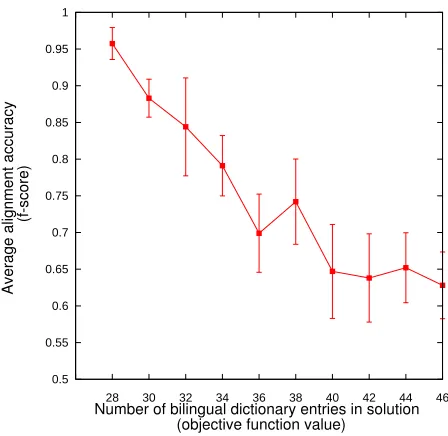
Figure 4 further investigates the connection be-tween our objective function and alignment accu-racy. We sample up to 10 alignments at each of several objective function values v, by first adding a constraint that dict variables add to exactlyv, then iterating the n-best list procedure above. We stop when we have 10 solutions, or when cplex fails to find another solution with valuev. In this figure, we see a clear relationship between the objective func-tion and alignment accuracy—minimizing the for-mer is a good way to maximize the latter.
3This method not only suppresses the IP solutions generated
so far, but it suppresses additional solutions as well. In partic-ular, it suppresses solutions in which all link and dict variables have the same values as in some previous solution, but some additional dict variables are flipped to 1. We consider this a fea-ture rather than a bug, as it ensures that all alignments in the n-best list are unique. For what we report in this paper, we only create n-best lists whose elements possess the same objective function value, so the issue does not arise.
4P = proportion of proposed links that are in gold,
R = proportion of gold links that are proposed, and f-score = 2PR/(P+R).
0.5 0.55 0.6 0.65 0.7 0.75 0.8 0.85 0.9 0.95 1
Average alignment accuracy
(f-score)
Number of bilingual dictionary entries in solution (objective function value)
[image:4.612.317.541.56.274.2]28 30 32 34 36 38 40 42 44 46
Figure 4: Relationship between IP objective (x-axis = size of induced bilingual dictionary) and alignment ac-curacy (y-axis = f-score).
Turkish English
yururum i walk yururler they walk
Figure 5: Two Turkish-English sentence pairs.
3 Sub-Word Alignment
We now turn to alignment at the sub-word level. Agglutinative languages like Turkish present chal-lenges for many standard NLP techniques. An ag-glutinative language can express in a single word (e.g., yurumuyoruz) what might require many words in another language (e.g., we are not walking). Naively breaking on whitespace results in a very large vocabulary for Turkish, and it ignores the multi-morpheme structure inside Turkish words.
un-supervised monolingual morpheme segmenters are also available (Goldsmith, 2001; Creutz and Lagus, 2005), though again, these do not do joint inference of alignment and word segmentation.
We extend our objective function straightfor-wardly to sub-word alignment. To test our exten-sion, we construct a Turkish-English corpus of 1616 sentence pairs. We first manually construct a regu-lar tree grammar (RTG) (Gecseg and Steinby, 1984) for a fragment of English. This grammar produces English trees; it has 86 rules, 26 states, and 53 ter-minals (English words). We then construct a tree-to-string transducer (Rounds, 1970) that converts En-glish trees into Turkish character strings, including space. Because it does not explicitly enumerate the Turkish vocabulary, this transducer can output a very large number of distinct Turkish words (i.e., charac-ter sequences preceded and followed by space). This transducer has 177 rules, 18 states, and 23 termi-nals (Turkish characters). RTG generation produces English trees that the transducer converts to Turk-ish, both via the tree automata toolkit Tiburon (May and Knight, 2006). From this, we obtain a parallel Turkish-English corpus. A fragment of the corpus is shown in Figure 6. Because we will concentrate on finding Turkish sub-words, we manually break off the English sub-word -ing, by rule, as seen in the last line of the figure.
This is a small corpus, but good for demonstrat-ing our concept. By automatically tracdemonstrat-ing the inter-nal operation of the tree transducer, we also produce a gold alignment for the corpus. We use the gold alignment to tabulate the number of morphemes per Turkish word:
n % Turkish types % Turkish tokens with n morphemes with n morphemes
1 23.1% 35.5%
2 63.5% 61.6%
3 13.4% 2.9%
Naturally, these statistics imply that standard whole-word aligners will fail. By inspecting the corpus, we find that 26.8 is the maximium f-score available to whole-word alignment methods.
Now we adjust our IP formulation. We broaden the definition of legal alignment to include breaking any foreign word (token) into one or more sub-word (tokens). Each resulting sub-word token is aligned
to exactly one English word token, and every En-glish word aligns to 0 or 1 foreign sub-words. Our
dict-f-e variables now relate Turkish sub-words to
English words. The first sentence pair in Figure 5 would have previously contributed two dict vari-ables; now it contributes 44, including things like
dict-uru-walk. We consider an alignment to be a set
of tuples< i, j1, j2, k >, wherej1andj2are start and end indices into the foreign character string. We create align-i-j1-j2-k variables that connect Turkish character spans with English word indices. Align-ment variables constrain dictionary variables as be-fore, i.e., an alignment link can only “turn on” when licensed by the dictionary.
We previously constrained every Turkish word to align to something. However, we do not want ev-ery Turkish character span to align—only the spans explicitly chosen in our word segmentation. So we introduce span-i-j1-j2 variables to indicate segmen-tation decisions. Only when span-i-j1-j2 = 1 do we requirePkalign-i-j1-j2-k = 1.
For a coherent segmentation, the set of active span variables must cover all Turkish letter tokens in the corpus, and no pair of spans may overlap each other. To implement these constraints, we create a lattice where each node represents a Turkish index, and each transition corresponds to a span variable. In a coherent segmentation, the sum of all span variables entering an lattice-internal node equals the sum of all span variables leaving that node. If the sum of all variables leaving the start node equals 1, then we are guaranteed a left-to-right path through the lat-tice, i.e., a coherent choice of 0 and 1 values for span variables.
The IP reads as follows:
minimize:
P
f,edict-f-e
subject to:
∀i,j1,j2Pkalign-i-j1-j2-k=span-i-j1-j2
∀i,kPj1,j2align-i-j1-j2-k≤1
∀i,j1,j2,kalign-i-j1-j2-k≤dict-fi,j1,j2-ei,k
∀i,jPj3span-i-j3-j =Pj3span-i-j-j3 ∀i,wPj>wspan-i-w-j = 1
(wranges over Turkish word start indices)
Turkish English
onlari gordum i saw them
gidecekler they will go
onu stadyumda gordum i saw him in the stadium
ogretmenlerim tiyatroya yurudu my teachers walked to the theatre cocuklar yurudu the girls walked
babam restorana gidiyor my father is walk ing to the restaurant
[image:6.612.154.461.73.174.2]. . . .
Figure 6: A Turkish-English corpus produced by an English grammar pipelined with an English-to-Turkish tree-to-string transducer.
you go to his office
onun ofisi- -ne gider- -sin
Gold alignment IP sub-word alignment
you go to his office
onun ofisi- -ne gider- -sin
my teachers ran to their house
ogretmenler- -im onlarin evi- -ne kostu
my teachers ran to their house
ogretmenler- -im onlarin evi- -ne kostu
i saw him
onu gordu- -m
i saw him
onu gordu- -m
we go to the theatre
tiyatro- -ya gider- -iz
we go to the theatre
tiyatro- -ya gider- -iz
they walked to the store
magaza- -ya yurudu- -ler
they walked to the store
magaza- -ya yurudu- -ler my aunt goes to their house
hala- -m onlarin evi- -ne gider
my aunt goes to their house
hal- -am onlarin evi- -ne gider 1.
2.
3.
5.
6. 4.
[image:6.612.75.505.253.630.2]The last two incorrect alignments in the figure are instructive. The system has decided to align English the to the Turkish noun morphemes tiyatro and magaza, and to leave English nouns theatre and
store unaligned. This is a tie-break decision. It is
equally good for the objective function to leave the unaligned instead—either way, there are two rele-vant dictionary entries.
We fix this problem by introducing a special NULL Turkish token, and by modifying the IP to re-quire every English token to align (either to NULL or something else). This introduces a cost for fail-ing to align an English token x to Turkish, because a new x/NULL dictionary entry will have to be cre-ated. (The NULL token itself is unconstrained in how many tokens it may align to.)
Under this scheme, the last two incorrect align-ments in Figure 7 induce four relevant dictio-nary entries (the/tiyatro, the/magaza, theatre/NULL,
store/NULL) while the gold alignment induces only
three (the/NULL, theatre/tiyatro, store/magaza), be-cause the/NULL is re-used. The gold alignment is therefore now preferred by the IP optimizer. There is a rippling effect, causing the system to correct many other decisions as well. This revision raises the alignment f-score from 61.4 to 83.4.
The following table summarizes our alignment re-sults. In the table, “Dict” refers to the size of the induced dictionary, and “Sub-words” refers to the number of induced Turkish sub-word tokens.
Method Dict Sub-words f-score Gold (sub-word) 67 8102 100.0 Monotone (word) 512 4851 5.5 IBM-1 (word) 220 4851 21.6 IBM-4 (word) 230 4851 20.3
IP (word) 107 4851 20.1
IP (sub-word, 60 7418 61.4 initial)
IP (sub-word, 65 8105 83.4 revised)
Our search for an optimal IP solution is not fast. It takes 1-5 hours to perform sub-word alignment on the Turkish-English corpus. Of course, if we wanted to obtain optimal alignments under IBM Model 4, that would also be expensive, in fact NP-complete (Raghavendra and Maji, 2006). Practical Model 4
systems therefore make substantial search approxi-mations (Brown et al., 1993).
4 Related Work
(Zhang et al., 2003) and (Wu, 1997) tackle the prob-lem of segmenting Chinese while aligning it to En-glish. (Snyder and Barzilay, 2008) use multilingual data to compute segmentations of Arabic, Hebrew, Aramaic, and English. Their method uses IBM mod-els to bootstrap alignments, and they measure the re-sulting segmentation accuracy.
(Taskar et al., 2005) cast their alignment model as a minimum cost quadratic flow problem, for which optimal alignments can be computed with off-the-shelf optimizers. Alignment in the modified model of (Lacoste-Julien et al., 2006) can be mapped to a quadratic assignment problem and solved with linear programming tools. In that work, linear program-ming is not only used for alignment, but also for training weights for the discriminative model. These weights are trained on a manually-aligned subset of the parallel data. One important “mega” feature for the discriminative model is the score assigned by an IBM model, which must be separately trained on the full parallel data. Our work differs in two ways: (1) our training is unsupervised, requiring no manually aligned data, and (2) we do not bootstrap off IBM models. (DeNero and Klein, 2008) gives an integer linear programming formulation of another align-ment model based on phrases. There, integer pro-gramming is used only for alignment, not for learn-ing parameter values.
5 Conclusions and Future Work
We have presented a novel objective function for alignment, and we have applied it to whole-word and sub-word alignment problems. Preliminary results look good, especially given that new objective func-tion is simpler than those previously proposed. The integer programming framework makes the model easy to implement, and its optimal behavior frees us from worrying about search errors.
We believe there are good future possibilities for this work:
1-to-1 affair than word-to-word alignment is, the 1-to-1 assumption is not justified in either case.
• Develop new components for the IP objec-tive. Our current objective function makes no reference to word order, so if the same word appears twice in a sentence, a tie-break en-sues.
• Establish complexity bounds for optimiz-ing dictionary size. We conjecture that opti-mal alignment according to our model is NP-complete in the size of the corpus.
• Develop a fast, approximate alignment al-gorithm for our model.
• Test on large-scale bilingual corpora.
Acknowledgments
This work was partially supported under DARPA GALE, Contract No. HR0011-06-C-0022.
References
P. Brown, V. Della Pietra, S. Della Pietra, and R. Mercer. 1993. The mathematics of statistical machine trans-lation: Parameter estimation. Computational linguis-tics, 19(2).
D. Chiang. 2007. Hierarchical phrase-based translation. Computational Linguistics, 33(2).
M. Creutz and K. Lagus. 2005. Inducing the morpho-logical lexicon of a natural language from unannotated text. In Proc. AKRR.
J. DeNero and D. Klein. 2008. The complexity of phrase alignment problems. In Proc. ACL.
A. Fraser and D. Marcu. 2006. Semi-supervised training for statistical word alignment. In Proc. ACL-COLING. A. Fraser and D. Marcu. 2007. Getting the structure right for word alignment: LEAF. In Proc. EMNLP-CoNLL. M. Galley, M. Hopkins, K. Knight, and D Marcu. 2004.
What’s in a translation rule. In Proc. NAACL-HLT. F. Gecseg and M. Steinby. 1984. Tree automata.
Akademiai Kiado.
J. Goldsmith. 2001. Unsupervised learning of the mor-phology of a natural language. Computational Lin-guistics, 27(2).
K. Knight. 1997. Automating knowledge acquisition for machine translation. AI Magazine, 18(4).
S. Lacoste-Julien, B. Taskar, D. Klein, and M. Jordan. 2006. Word alignment via quadratic assignment. In Proc. HLT-NAACL.
J. May and K. Knight. 2006. Tiburon: A weighted tree automata toolkit. In Proc. CIAA.
I. D. Melamed. 1997. A word-to-word model of transla-tional equivalence. In Proc. ACL.
F. J. Och and H. Ney. 2004. The alignment template approach to statistical machine translation. Computa-tional Linguistics, 30(4).
F. J. Och, D. Gildea, S. Khudanpur, A. Sarkar, K. Ya-mada, A. Fraser, S. Kumar, L. Shen, D. Smith, K. Eng, V. Jain, Z. Jin, and D. Radev. 2004. A smorgasbord of features for statistical machine translation. In Proc. HLT-NAACL.
C. Quirk, A. Menezes, and C. Cherry. 2005. De-pendency treelet translation: Syntactically informed phrasal SMT. In Proc. ACL.
U. Raghavendra and H. K. Maji. 2006. Computational complexity of statistical machine translation. In Proc. EACL.
W. Rounds. 1970. Mappings and grammars on trees. Theory of Computing Systems, 4(3).
P. Sch ¨onhofen, A. Bencz´ur, I. B´ır´o, and K. Csalog´any, 2008. Cross-language retrieval with wikipedia. Springer.
B. Snyder and R. Barzilay. 2008. Unsupervised multi-lingual learning for morphological segmentation. In Proc. ACL.
B. Taskar, S. Lacoste-Julien, and D. Klein. 2005. A dis-criminative matching approach to word alignment. In Proc. EMNLP.
S. Vogel, H. Ney, and C. Tillmann. 1996. HMM-based word alignment in statistical translation. In Proc. ACL. D. Wu. 1997. Stochastic inversion transduction gram-mars and bilingual parsing of parallel corpora. Com-putational Linguistics, 23(3).