Which System Differences Matter?
Using
`
1/`
2Regularization to Compare Dialogue Systems
Jos´e P. Gonz´alez-Brenes and Jack Mostow
Project LISTEN
Language Technologies Institute School of Computer Science
Carnegie Mellon University Pittsburgh, PA 15213, USA
{joseg,mostow}@cs.cmu.edu
Abstract
We investigate how to jointly explain the per-formance and behavioral differences of two spoken dialogue systems. The Join Evalu-ation and Differences IdentificEvalu-ation (JEDI), finds differences between systems relevant to performance by formulating the problem as a multi-task feature selection question. JEDI provides evidence on the usefulness of a recent method, `1/`p-regularized
regres-sion (Obozinski et al., 2007). We evaluate against manually annotated success criteria from real users interacting with five different spoken user interfaces that give bus schedule information.
1 Introduction
This paper addresses the problem of how to deter-mine which differences between two versions of a system affect their behavior. Researchers in Spo-ken Dialogue Systems (SDSs) can be perplexed as to which of the differences between alternative systems affect performance metrics (Bacchiani et al., 2008). For example, when testing on real users at differ-ent periods of time, the variance of the performance metrics might be higher than the difference between systems, causing (i) significantly different scores in identical systems deployed at different times, and (ii) the same score on different systems (Gonz´alez-Brenes et al., 2009).
We approach the problem of finding which system differences matter by describing dialogues as feature vectors constructed from the logs of dialogs gener-ated by the SDSs interacting with real users. Hence, we aim to identify features that jointly characterize the system differences and the performance of the
SDS being evaluated. These features should be able to (i) predict a performance metric and (ii) distin-guish between the two SDS being evaluated.
The main contribution of this paper is a novel al-gorithm for detecting differences between two sys-tems that can explain performance. Additionally, we provide details on how to implement state-of-the-art multi-task learning for SDSs.
The rest of this manuscript is organized as fol-lows. Section 2 reviews multi-task feature selection. Section 3 describes two algorithms to find which system differences matter. Section 4 describes the specific SDS used to illustrate our algorithms. Sec-tion 5 presents some experimental results. SecSec-tion 6 reviews related prior work. Section 7 presents some concluding remarks and future work. Appendix A provides implementation details of the multi-task learning approach we used.
2 Feature Selection
In this section we describe how we use regression to perform feature selection. Feature selection meth-ods construct and select subsets of features in order to build a good predictor. We focus our attention on feature selection methods that use complexity (regu-larization) penalties, because of their recent theoret-ical and experimental success (Yuan and Lin, 2006; Park and Hastie, 2007). We provide a more rigorous description of how to implement this formulation as an optimization problem in Appendix A.
We use labels to encode the output we want to predict. For example, if our performance metric is
binary, we label successful dialogues with a+1, and
unsuccesful dialogues with a−1. Given a training
set consisting of labeled dialogues, we want to learn
a model that assigns a label to unseen dialogues. We follow an approach called empirical risk minimiza-tion (Obozinski et al., 2007), that aims to minimize the error of fitting the training data, while penalizing the complexity of the model:
Minimize Model loss + λ Complexity (1)
Here the hyper-parameterλcontrols the trade-off
between a better fit to the training data (with a higher risk of over-fitting it), and a simpler model, with fewer features selected (and less predictive power). We now review the two components of risk mini-mization, model loss and complexity penalty.
2.1 Model Loss
We model probabilistically the loss of our model against the real-life phenomenon studied. Given a
dialogue x, with correct label l, its loss using a
modelβis:
lossβ(ˆy, x)≡P(y =l|x; reality)−P(ˆy =l|x;β) (2)
Hereyˆis the predicted value of the eventy. Sincel
is the true label,P(y =l|x; reality) = 1. To get the
overall loss of the model, we aggregate over the pre-diction loss of each of the dialogues in the training set by summing their individual loss calculated with
Equation 2. LetX ={x(1), x(2), . . . x(n)}be then
dialogues in the training set. Then the overall loss of
modelβis:
lossβ(y(1), x(1)) +· · ·+ lossβ(y(n), x(n))
Since we use discrete labels, we use a logistic
function to model their probability. Let x1, . . . xk
be the kfeatures extracted from dialoguex. Then
the logistic regression model is:
P(ˆy= +1|x;β) = 1
Z exp(β1x1+· · ·+βkxk)
Here β1...βk are the parameters of the model, and
Z simply normalizesP to ensure thatP is a valid
probability function (the range ofP should be 0 to
1):
Z = 1 + exp(β1x1+· · ·+βkxk)
Multi-task learning solves related regression problems at the same time using a shared representa-tion. We now describe the risk-minimization
formu-lation for multi-task learning. Letym be the value
of the performance metric. Letysbe the label of the
system that generated the dialogue. The individual
dialogue loss of using modelsβmandβsis:
lossβm(ˆym, x) + lossβs(ˆys, x)
2.2 Complexity Penalties
We consider a feature xi to be selected into the
model if its regression coefficient βi is non-zero.
Complexity penalties encourage selecting only a few features. We review several commonly used penal-ties (Zou and Hastie, 2005):
• `2 Penalty. Under some circumstances `2
penalties perform better than other types of
penalties (Zou and Hastie, 2005). The `2
penalty for a modelβis:
||β||`2 ≡ p
(β1)2+· · ·+ (βk)2
• `1 Penalty. An`1 penalty induces sparsity by
settingmanyparameters of the modelβto
ex-actly zero (Tibshirani, 1996).
||β||`1 ≡ |β1|+· · ·+|βk|
• `1/`2Penalty. Yuan and Lin (2006) proposed a group penalty for penalizing groups of fea-tures simultaneously. Previous work has shown that grouping features between tasks encour-ages features to be used either by all tasks or by none (Turlach et al., 2005; Obozinski et al., 2007; Lounici et al., 2009; Puniyani et al.,
2010). Our`1/`2 penalty is:
q
(β1m)2+ (βs
1)2
+...+
q
(βkm)2+ (βs k)2
3 Finding Features that Predict
Performance and System Differences
We find system differences that are predictive of SDS performance, relying on:
• Describing dialogues as feature vectors. The
• Finding system differences. The features of a classifier that distinguishes between SDSs, can be used to identify their differences
(Gonz´alez-Brenes et al., 2009). When comparing two
SDSs, we label the baseline system with −1,
and the alternate version with+1.
• Modeling performance. Although our
ap-proach does not depend on a specific perfor-mance metric, in this paper we use dialogue success, a binary indicator that triggers that the user’s query was answered by the SDS. Task completion is cheaper to compute than di-alogue success, as it does not require a man-ual human labeled reference, but we consider that dialogue success is a more accurate metric. Task completion is used in commercial applica-tions (Bacchiani et al., 2008), and has been ex-tensively studied in the literature (Walker et al., 2001; Walker et al., 2002; Hajdinjak and Mi-helic, 2006; Levin and Pieraccini, 2006; M¨oller et al., 2007; M¨oller et al., 2008; Schmitt et al., 2010). We encode success of dialogues by manually annotating them with a binary vari-able that distinguishes if the user query is ful-filled by the SDS.
We now present two algorithms to find what dif-ferences matter between systems. We introduce Se-rial EvaluatioN Analysis (SERENA) as a scaffold for the Join Evaluation and Differences Identifica-tion (JEDI) algorithm.
3.1 SERENA algorithm
The input to SERENA is a collection of log files created by two different SDSs and two functions that represent the correct label for the regression tasks. In our case these functions should return binary
la-bels (+1,−1): one task distinguishes between
suc-cessful and unsucsuc-cessful dialogues, and the other task distinguishes a baseline from an alternative SDS version. SERENA’s objective is to select features from one task, and use them to predict the other task. For example, SERENA selects features that predict differences between versions, and uses them to pre-dict performance.
Algorithm 1 provides the pseudo-code for
SER-ENA. Line 1 builds the training setXfrom parsing
the logs of the SDSs. Lines 2 and 3 create the output
Algorithm 1SERENA algorithm
Require: Logs1,Logs2are the collections of SDS
logs of two systems. task1, task2 are
func-tions that return the value of a performance
met-ric, and which system is being evaluated (−1if
is the baseline,+1otherwise).
1: X←extract features(Log1,Log2) 2: yt1 ←
htask
1(Logs1)
task1(Logs2) i
3: yt2 ← htask
2(Logs1)
task2(Logs2) i
4: // Select features that explain both tasks:
5: forλ={0.1,0.2, . . .}do 6: βt1 ←regression
`1(X,y t1, λ)
7: // Get feature weights:
8: X0 ←X; wherexk|∀xk∈X0, βkt1 6= 0
9: β∗ ←regression`2(X0,yt2, λ c)
10: end for
11: return β∗
variablesy for the regression tasks. Line 6 returns
the most predictive features using`1 regularization
as described in Section 2. Line 8 builds a new train-ing set, removtrain-ing the features that were not selected in line 6. Line 9 builds the final coefficients by fitting
a`2-regularized model using a constantλc. We
cal-culate the coefficients using an`2 penalty, because
it has a better fit to the data (Zou and Hastie, 2005). Moreover, by using the same penalty, we control for the idiosyncrasies different penalties have in param-eter learning. In the experiments described in Sec-tion 5, all of our experiments are reported fitting a
`2-regularized models.
SERENA is not conmutative with regards to the order of the tasks: selecting the features that predict performance and using them to predict system dif-ferences is not the same as the reverse. More impor-tantly, SERENA only searches in one of the tasks at a time. We are interested in finding the features that
explain both taskssimultaneously. In the next
sub-section we describe JEDI which makes use of recent advances in multi-task feature selection in order to find the features for both tasks at the same time.
3.2 JEDI algorithm
Algorithm 2JEDI algorithm
Require: Logs1,Logs2are the collections of SDS
logs of two systems. task1, task2 are
func-tions that return the value of a performance
met-ric, and which system is being evaluated (−1if
is the baseline,+1otherwise).
1: X←extract features(Log1,Log2) 2: yt1 ←
htask
1(Logs1)
task1(Logs2) i
3: yt2 ← htask
2(Logs1)
task2(Logs2) i
4: // Select features that explain both tasks:
5: forλ={0.1,0.2, . . .}do 6: βt1βt2 ←regression
`1/`2(X, ~y
t1, ~yt2, λ)
7: // Get feature weights:
8: X0 ←X; wherexk|∀xk∈X0, βkt1 6= 0
9: β∗←regression`2(X0,yt2, λ c)
10: end for
11: return β∗
jointly. To ensure a sparse feature set across the
tasks, it applies a`1/`2penalty. In this way, a feature
is either selected to predict performance and system differences, or it is not selected at all. In the next section we review a concrete example of a SDS in which we apply SERENA and JEDI.
4 Case Study
We use data collected from Let’s Go!, an
experi-mentary SDS available for research purposes1 that
provides bus planning information to the Pittsburgh East End community (Raux et al., 2006). Figure 1 shows a sample dialogue.
We assembled three disjoint datasets to have di-alogues just before and after what we considered important architectural differences of Let’s Go’s im-plementation. By going through the change log, we realize that the magnitude of the differences varies widely. Table 1 describes the date the systems were deployed, the description of the change in the SDS, and the number of dialogues in each set. From the 86 dialogues of “Set A”, half are a random sam-ple of the logs before the acoustic model was
re-trained (Log1), and the other half is a sample
af-ter the acoustic model was retrained (Log2). In the
case of the 84 dialogues of “Set B”, half of the logs
1
http://www.dialrc.org/
System: Welcome to the CMU Let’s Go! Bus Information System. How may I help you?
User: I’d like to go to Forbes and Mur-ray.
System: To Forbes and Murray. Where are you leaving from?
User: Carnegie Mellon.
System: From Carnegie Mellon. There are five buses running between Carnegie Mellon and Forbes and Murray: the 501, the 59U, the 61A, the 61B, and the 61C. What else can I do for you?
User: When is the next one?
[image:4.612.76.298.66.307.2]System: The next 61C going to Forbes and Murray will leave Carnegie Mellon at 5:13 PM.
Figure 1: Example of aLet’s Godialogue, from (Raux et al., 2006)
use an older version of the Olympus SDS infrastruc-ture (Bohus et al., 2007), and the other half uses Olympus II. Since each system was deployed in a different period of time, we want to corroborate that we are modeling the differences among systems, and not seasonal. Hence, for control conditions, we also chose a data set that contained no major change to the system or to other conditions (Set C).
Sets were built by randomly sampling from the collection of logs. They have the same number of di-alogues from each SDS version (baseline/alternate). Each dialogue was manually annotated to indicate whether the user’s query was fulfilled, and we re-moved from our analysis the two dialogues that were only partially fulfilled. The number of successful di-alogues is different from the number of unsuccessful dialogues.
Table 1:Dataset Description
Set Size Description Date
A 86 Baseline 8/05 10/05
New acoustic model 12/05 2/05
B 86 Baseline 8/06 10/06
New SDS architecture 6/07 7/07
C 84 Baseline 10/07 11/07
No change 11/07 12/07
script performs the standard transformation of
cen-tering feature values asz-scores with mean zero and
standard deviation one.
Table 2 summarizes the properties we are inter-ested to model. Dialogue properties are the features that summarize the behavior of the whole dialogue, and turn properties work at a finer-grain. We encode turn properties into features in the following way:
• Global average. Turn properties are averaged over the entire dialogue.
• Beginning window. Turn properties are aver-aged across an initial window. Based on pre-liminary experiments, we defined the window as the first 5 turns.
• State. We relied on the fact that SDSs are of-ten engineered as finite state automata (Bohus et al., 2007). Properties are averaged across the states that belong to a specific dialogue state (for example, asking departure place). Because we are interested in early identification of dif-ferences, we restricted state features to be in-side the beginning window.
5 Evaluation
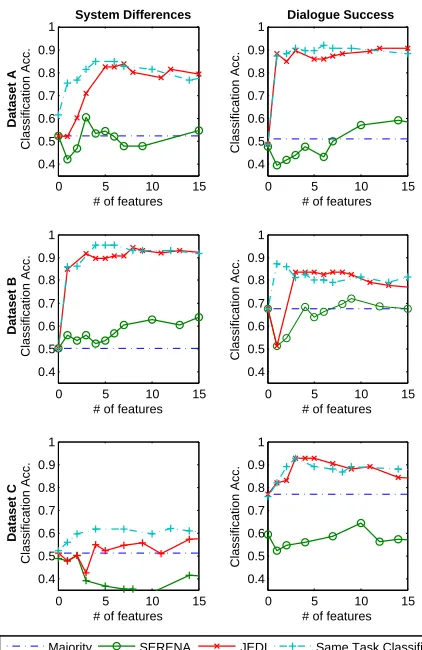
We assess the performance of our algorithms by evaluating the classification accuracy using the fea-tures selected. To facilitate assessment of SDS, we only consider models that select up to 15 features. Figure 2 reports mean classification accuracy using five-fold cross-validation. Its first column describes how well the features selected perform on detecting system differences, and the second column describes how well they predict task success as a performance metric. We compare JEDI and SERENA against the following approaches:
Table 2:Features
Dialogue Properties
# of re-prompted turns # of turns
Mean Dialogue length
is evening?, is weekend?, 0-23 hour
Turn Properties
Occurrences of wordw
# of parse errors
# of unrecognized words # of words
# of repeated words # of unique words Turn length Words per minute
Failed prompts (number and percentage) Mean Utterance Length
Barge-in (in seconds)
Machine-user pause (in seconds) User-machine pause (in seconds) Amplitude (power) statistics
• Majority classifier baseline. A classifier that always selects the majority class (datasets B and C are not balanced in the number of suc-cessful dialogues).
• Same Task ClassifierWe report the classifica-tion accuracy of the model trained and tested
on thesametask. Features are selected using
an`1penalty, and the coefficients are estimated
with`2-regularized logistic regression. For
ex-ample, in the column of the left, SERENA uses the most predictive features of system differ-ences to predict success, while the same task classifier uses them to predict system differ-ences. The same task classifier does not answer “which system differences matter”, it is just an interesting benchmark.
We used a one-sample t-test to check for
sta-tistically significant differences against the classifi-cation accuracy of the majority classifier baseline.
We used a paired-sample t-test to check for
sig-nificant differences in classification accuracy
be-tween classifiers. Paired samples have the sameλ
[image:5.612.330.524.74.371.2]risk-0 5 10 15 0.4
0.5 0.6 0.7 0.8 0.9
1 System Differences
# of features
Dataset A
Classification Acc.
0 5 10 15
0.4 0.5 0.6 0.7 0.8 0.9
1 Dialogue Success
# of features
Classification Acc.
0 5 10 15
0.4 0.5 0.6 0.7 0.8 0.9 1
# of features
Dataset B
Classification Acc.
0 5 10 15
0.4 0.5 0.6 0.7 0.8 0.9 1
# of features
Classification Acc.
0 5 10 15
0.4 0.5 0.6 0.7 0.8 0.9 1
# of features
Dataset C
Classification Acc.
0 5 10 15
0.4 0.5 0.6 0.7 0.8 0.9 1
# of features
Classification Acc.
Majority SERENA JEDI Same Task Classifier
Figure 2: Classification accuracy of different feature se-lection techniques
minimization formulation explained in Section 2. This hyper-parameter is related to the number of
fea-tures selected – as λincreases, the number of
fea-tures selected decreases. We use 5% as the signif-icance level at which to reject the null hypothesis. When checking for statistical differences, we tested
on the range ofλs computed2.
First we investigate the performance of the sim-pler algorithm SERENA. For Dataset A, SERENA does not yield significant differences over the ma-jority classifier baseline. For Dataset B, SERENA is significantly better than the majority classifier in predicting system differences, but is significantly worse for predicting success. This means that the or-der in which we choose the tasks in SERENA affects its performance. SERENA performs significantly worse in the Control Set C. We conclude that
SER-2
[image:6.612.83.294.76.401.2]λ={100,30,25,20,19,18, . . . ,1,0.5,0.25,0.1}
Table 3:Features selected in Dataset A
Feature Suc. Diff. JEDI
System-user pause 5 5
Weekend night? 3
% of failed prompts 4
“Forbes St.” word 5 3
[image:6.612.324.529.91.305.2]User’s max. power 5
Table 4:Features selected in Dataset B
Feature Suc. Diff. JEDI
% of failed prompts 5 4
User’s power std.dev. 5
Weekend night? 3
Unrecognized word 5
Words/min. 4
User-system pause 5
Turn length 5 5
ENA is not very reliable in predicting which system differences matter.
We now discuss how well JEDI is able to fill-in for the deficiencies of SERENA. As an “upper-bound”, we will compare it to a classifier trained and tested in the same task. This classifier significantly dom-inates over the majority baseline, even for the the Control Set C, where there were no changes in the SDS. This suggests that the classifier might be pick-ing up on seasonal differences. For Set A, JEDI per-forms significantly better than the majority classi-fier and than SERENA. For Set B, there are no sig-nificant differences between the upper-bound clas-sifier and JEDI when predicting for changes in the SDS. Again, JEDI dominates over SERENA and the majority baseline. For the Control Set C, JEDI is not statistically different from the majority baseline. This is the expected behavior, since the difference in performance cannot be explained by the differences between the SDS. We hypothesize that the classifi-cation accuracy of JEDI could be used as a distance function between SDS: The closer the accuracy of distinguishing SDS is to 50%, the more similar the SDSs are. Conversely, when JEDI is able to classify system differences closer to 100%, it is because the SDSs are more different.
in how many folds the feature was selected by JEDI and by classifiers trained to predict Success and SDS
differences using five-fold cross validation. The λ
used is selected to contain the closest to five features (ties are resolved randomly). We only report fea-tures that appeared in at least three folds. In Dataset A we see that time of day is selected to predict di-alogue success. Anecdotally, we have noticed that many users during weekend nights appear to be in-toxicated when calling the system. JEDI does not select “is weekend night” as a feature, because it has little predictive power to detect system differ-ences. In Dataset A, JEDI selects a speech recogni-tion feature (the token “Forbes St” was recognized), and an end-pointing feature. Since in Dataset A, the difference between systems correspond to a differ-ent acoustic model, these features make sense intu-itively. In Dataset B, JEDI detected that the features most predictive with system differences and success are percentage of failed prompts and the length of the turn. The models for both systems make sense after the fact. However, neither model was known beforehand, nor did we know which of many fea-tures considered would turn out to be informative. Anecdotally, the documentation of the history of changes of Let’s Go! is maintained manually. Some-times, because of human error, this history is incom-plete. The ability of JEDI to identify system differ-ences has been able to help completing the history of changes (Gonz´alez-Brenes et al., 2009).
6 Relation to Prior Work
The scientific literature offers several performance metrics to assess SDS performance (Polifroni et al., 1992; Danieli and Gerbino, 1995; Bacchiani et al., 2008; Suendermann et al., 2010). SDS are eval-uated using different objective and subjective met-rics. Examples of objective metrics are the mean number of turns in the dialogue, and dialogue suc-cess. Subjective evaluations study measure satisfac-tion through controlled user studies. Ai et al. (2007) studied the differences in using assessment metrics with real users and paid users.
PARADISE, a notable example of a SDS subjec-tive evaluation, finds linear predictors of a satisfac-tion score using automatic and hand-labeled features (Hajdinjak and Mihelic, 2006; Walker et al., 2001),
or only automatic features (Hastie et al., 2002). Sat-isfaction scores are calibrated using surveys in con-trolled experiments (M¨oller et al., 2007; M¨oller et al., 2008). Alternatively, Eckert et al. (1998) pro-posed simulated users to evaluate SDSs. Their per-formance metric has to be tuned with a subjective evaluation as well, in which they refer to the PAR-ADISE methodology. Our approach does not re-quire user surveys to be calibrated. Moreover, it would be feasible to adapt JEDI to regress to PAR-ADISE, or other performance metrics. Our work ex-tends previous studies that define performance met-rics, in proposing an algorithm that finds how system differences are related to performance.
7 Conclusions and Future Work
We have presented JEDI, a novel algorithm that finds features describing system differences relevant to a success metric. This is a novel, automated “glass box” assessment in the sense of linking changes in overall performance to specific behavioral changes. JEDI is an application of feature selection using reg-ularized regression.
We have presented empirical evidence suggesting that JEDI’s use of multi-task feature selection per-forms better than single-task feature selection. Fu-ture work could extend JEDI to quantify the vari-ability in performance explained by the differences found. Common techniques in econometrics, such as the Seemingly Unrelated Regressions (SUR) for-mulation (Zellner, 1962), may prove useful for this.
In our approach we used a single binary evalu-ation criterion. By using a different loss function, JEDI can be extended to allow continuous-valued metrics. Moreover, previous work has argued that evaluating SDSs should not be based on just a sin-gle criterion (Paek, 2001). JEDI’s multi-task for-mulation can be extended to include more than one performance criterion at the same time, and may prove helpful to understand trade-offs among differ-ent evaluation criteria.
A Implementation Details of Feature Selection
A.1 `1-Regularized Regression for Single-Task
Feature Selection
We first review using regression with`1
regulariza-tion for single-task feature selecregulariza-tion. Given a
train-ing set represented byX, denoting an×kmatrix,
where n is the number of dialogues, and k is the
number of features extracted for each dialogue, we want to find the coefficients of the parameter vector
~
β, that can predict the output variables described in
the vector~yof lengthn.
For this, we find the parameter vector that
mini-mizes the loss functionJ, penalized by a
regulariza-tion term (Tibshirani, 1996):
argmin ~
β
J(X, ~β, ~y) +λ||β~||`1 (3)
In the case of binary classification, outputs are
bi-nary (any giveny = ±1). A commonly used loss
functionJis the Logistic Loss:
Jlog(x, β, y)≡
1
1 +ey(x·β) (4)
The`p-norm of a vector~βis defined as:
||~β||`p≡
k X
i=1 |βi|p
1/p
The `∞-norm is defined as ||~β||`∞ ≡
max(β1, β2, . . . , βk).
The regularization term||~β||`1 in Equation 3
con-trols model complexity: The higher the value of the
hyper-parameter λ, the smaller number of features
selected. Conversely, the smaller the value of λ,
the better the fit to the training data, with higher risk of over-fitting it. Thus, Equation 3 jointly per-forms feature selection and parameter estimation; it
induces sparsity by setting many coefficients of ~β
to zero (Tibshirani, 1996). Features with non-zero coefficients are considered the features selected.
A.2 `1-Regularized Regression for Multi-Task
Feature Selection
`1regularization can be used to learn a classifier for
each ofT prediction taskindependently. In our case
we are interested in only two prediction tasks: ver-sion and success. We will index tasks with
super-script t, and we define Xt as the n ×k training
data for taskt, used to predict the output variable~yt.
Learning each model separately yields the following optimization problem (Obozinski et al., 2007):
argmin ~
βt
T X
t=1
J(Xt, ~βt, ~yt) +λ||β~t||`1 (5)
Solving this problem leads to individual sparsity in
each task (each ~βt has many zeros), but the model
does not enforce a common subset of features for all of the related output variables simultaneously (Turlach et al., 2005). In the next subsection we study how to achieve global sparsity across tasks.
A.3 `1/`p-Regularized Regression for
Multi-task Feature Selection
Although`1-regularization is very successful at
se-lecting individual features, it does not perform ad-equately when a group of features should enter or leave the model simultaneously (Yuan and Lin, 2006). Group LASSO (Yuan and Lin, 2006), which
relies on`1/`p-regularization to overcome this
lim-itation, by allowing groups of feature entering or
leaving the model simultaneously. `1/`p
regular-ization has been studied for multi-task learning by
grouping each of thekfeatures across theTlearning
tasks (Turlach et al., 2005; Obozinski et al., 2007; Lounici et al., 2009; Puniyani et al., 2010).
Let us defineBas an×Tmatrix, whosetth
col-umn is the parameter vector for the taskt. For
ex-ample, since we have two tasksB = [β~t=1, ~βt=2].
Let~βg denote the gth row of B. In the context of
multi-task learning, the`1/`p-norm of a matrixBis
defined as (Obozinski et al., 2007; Puniyani et al., 2010):
||B||`1/`p ≡
k X
g=1
||β~g||`p (6)
Multi-task feature selection with `1/`p
regular-ization is formulated as (Obozinski et al., 2007; Puniyani et al., 2010):
argmin
B T X
t=1
J(Xt, ~βt, ~yt) +λ||B||`1/`2 (7)
WhenT = 1, the multi-task problem of Equation 7
A.4 Optimization procedure
Puniyani et al. (2010) describe that finding the
pa-rameter coefficientsBof Equation 7 can be achieved
more easily by transforming the problem into an equivalent single-task multivariate regression. We
follow their procedure to createy~g,β~gandXg:
1. Concatenate the vectors~yt’s into a single
vec-tor~yg of lengthn×T. In our case, since we
have only two tasks (T = 2), we get the vector
~
yg= ~yt=1
~ yt=2
.
2. Similarly, we concatenate the~βt’s into ak×T
vectorβ~g, in our caseβ~g =
~βt=1
~
βt=2
.
3. Build a(n·T)×(k·T)block-diagonal matrix
Xg, whereXt’s are placed along the diagonal,
and the rest of the elements are set to zero. In our case since we only have two tasks this is
Xg =
Xt=1 ∅
∅ Xt=2
, where each ∅ denotes a
n×kzero-matrix. The expanded notation of
Xgis:
Xg≡
xt=1(1)
1 ... xt=1(1)k 0 ... 0
..
. ... ... ...
xt=1(n)
1 ... xt=1( n)
k 0 ... 0
0 ... 0 xt=2(1)1 ... xt=2(1)k
..
. ... ... ...
0 ... 0 xt=2( n)
1 ... xt=2( n)
k
Thus, the multi-task learning problem from Equa-tion 7 is equivalent to (Yuan and Lin, 2006; Puniyani et al., 2010):
argmin
B
J(Xg, ~βg, ~yg) +λ||B||`1/`2 (8)
In this work we solve this optimization problem
us-ing an existus-ing3 implementation of Block
Coordi-nate Descent (Schmidt et al., 2008) that solves
re-gression problems with a`1/`ppenalty.
Acknowledgments
This work was supported by the Institute of Ed-ucation Sciences, U.S. Department of EdEd-ucation,
3
Source code:http://www.cs.ubc.ca/˜murphyk/ Software/L1CRF/
through Grant R305A080628 to Carnegie Mellon University. The opinions expressed are those of the authors and do not necessarily represent the views of the Institute or U.S. Department of Education. We thank the educators, students, and LISTENers who helped generate, collect, and analyze our data, and the reviewers for their helpful comments. The first author was partially supported by the Costa Rican Ministry of Science and Technology (MICIT).
References
H. Ai, A. Raux, D. Bohus, M. Eskenazi, and D. Lit-man. 2007. Comparing spoken dialog corpora col-lected with recruited subjects versus real users. In
Proc. of the 8th SIGdial workshop on Discourse and Dialogue.
M. Bacchiani, F. Beaufays, J. Schalkwyk, M. Schuster, and B. Strope. 2008. Deploying GOOG-411: Early lessons in data, measurement, and testing. In IEEE International Conference on Acoustics, Speech and Signal Processing, 2008. ICASSP 2008, pages 5260– 5263.
D. Bohus, A. Raux, T. Harris, M. Eskenazi, and A. Rud-nicky. 2007. Olympus: an open-source framework for conversational spoken language interface research. InHLT-NAACL 2007 Workshop on Bridging the Gap: Academic and Industrial Research in Dialog Technol-ogy.
M. Danieli and E. Gerbino. 1995. Metrics for evaluat-ing dialogue strategies in a spoken language system. In Proceedings of the 1995 AAAI Spring Symposium on Empirical Methods in Discourse Interpretation and Generation, pages 34–39.
W. Eckert, E. Levin, and R. Pieraccini. 1998. Automatic evaluation of spoken dialogue systems. TWLT13: For-mal semantics and pragmatics of dialogue, pages 99– 110.
J. P. Gonz´alez-Brenes and J. Mostow. 2011. Classify-ing dialogue in high-dimensional space. Transactions of Speech and Language Processing; Special Issue on Machine Learning for Robust and Adaptive Spoken Dialogue Systems. In press.
J. P. Gonz´alez-Brenes, A. W. Black, and M. Eskenazi. 2009. Describing Spoken Dialogue Systems Differ-ences. InInternational Workshop on Spoken Dialogue Systems, Irsee, Germany. Springer–Verlat.
M. Hajdinjak and F. Mihelic. 2006. The PARADISE evaluation framework: Issues and findings. Computa-tional Linguistics, 32(2):263–272.
user satisfaction and task completion prediction. InIn LREC 2002, pages 641–648.
E. Levin and R. Pieraccini. 2006. Value-based opti-mal decision for dialog systems. InSpoken Language Technology Workshop, 2006. IEEE, pages 198 –201. K. Lounici, A.B. Tsybakov, M. Pontil, and van de Geer.
2009. Taking advantage of sparsity in multi-task learn-ing. InConference on Learning Theory, volume 1050, page 9, Montreal, Quebec.
S. M¨oller, P. Smeele, H. Boland, and J. Krebber. 2007. Evaluating spoken dialogue systems according to de-facto standards: A case study. Computer Speech and Language, 21(1):26 – 53.
S. M¨oller, K.P. Engelbrecht, and R. Schleicher. 2008. Predicting the quality and usability of spoken dialogue services. Speech Communication, 50(8-9):730–744. G. Obozinski, B. Taskar, and M.I. Jordan. 2007.
Multi-task feature selection. In The Workshop of Struc-tural Knowledge Transfer for Machine Learning in the 23rd International Conference on Machine Learning (ICML), Pittsburgh, PA.
T. Paek. 2001. Empirical methods for evaluating dia-log systems. In ACL 2001 Workshop on Evaluation Methodologies for Language and Dialogue systems, pages 3–10.
M.Y. Park and T. Hastie. 2007. L1-regularization path al-gorithm for generalized linear models. Journal of the Royal Statistical Society: Series B (Statistical Method-ology), 69(19):659–677.
J. Polifroni, L. Hirschman, S. Seneff, and V. Zue. 1992. Experiments in evaluating interactive spoken language systems. InProceedings of the workshop on Speech and Natural Language, pages 28–33. Association for Computational Linguistics.
K. Puniyani, S. Kim, and E.P. Xing. 2010. Multi-population GWA mapping via multi-task regularized regression. Bioinformatics, 26(12):208.
A. Raux, D. Bohus, B. Langner, A.W. Black, and M. Es-kenazi. 2006. Doing research on a deployed spoken dialogue system: one year of Let’s Go! experience. In
Ninth International Conference on Spoken Language Processing. ISCA.
M. Schmidt, K. Murphy, G. Fung, and R. Rosales. 2008. Structure learning in random fields for heart motion abnormality detection. In Computer Vision and Pat-tern Recognition, 2008. CVPR 2008. IEEE Conference on, pages 1 –8.
A. Schmitt, M. Scholz, W. Minker, J. Liscombe, and D. Suendermann. 2010. Is it possible to predict task completion in automated troubleshooters? In INTER-SPEECH, pages 94–97.
D. Suendermann, J. Liscombe, R. Pieraccini, and K. Evanini. 2010. “How am I Doing?”: A new
frame-work to effectively measure the performance of auto-mated customer care contact centers. In A. Neustein, editor,Advances in Speech Recognition: Mobile Envi-ronments, Call Centers, and Clinics, pages 155–180. Springer.
R. Tibshirani. 1996. Regression shrinkage and selection via the lasso. Journal of the Royal Statistical Society. Series B (Methodological), 58(1):267–288.
B.A. Turlach, W.N. Venables, and S.J. Wright. 2005. Simultaneous variable selection. Technometrics, 47(3):349–363.
M. Walker, C. Kamm, and D. Litman. 2001. Towards de-veloping general models of usability with PARADISE.
Natural Language Engineering, 6(3):363–377. M. A. Walker, I. Langkilde-Geary, H. W. Hastie,
J. Wright, and A. Gorin. 2002. Automatically train-ing a problematic dialogue predictor for a spoken di-alogue system. Journal of Artificial Intelligence Re-search, 16:293–319.
M. Yuan and Y. Lin. 2006. Model selection and esti-mation in regression with grouped variables. Journal of the Royal Statistical Society: Series B (Statistical Methodology), 68(1):49–67.
A. Zellner. 1962. An efficient method of estimating seemingly unrelated regressions and tests for aggrega-tion bias.Journal of the American Statistical Associa-tion, 57(298):pp. 348–368.