“The day after the day after tomorrow?” A machine learning approach to
adaptive temporal expression generation:
training and evaluation with real users
Srinivasan Janarthanam, Helen Hastie, Oliver Lemon, Xingkun Liu
Interaction Lab
School of Mathematical and Computer Sciences (MACS) Heriot-Watt University
{sc445, h.hastie, o.lemon, x.liu}@hw.ac.uk
Abstract
Generating Temporal Expressions (TE) that are easy to understand, unambiguous, and rea-sonably short is a challenge for humans and Spoken Dialogue Systems. Rather than devel-oping hand-written decision rules, we adopt a data-driven approach by collecting user feed-back on a variety of possible TEs in terms of task success, ambiguity, and user prefer-ence. The data collected in this work is freely available to the research community. These data were then used to train a simulated user and a reinforcement learning policy that learns an adaptive Temporal Expression generation strategy for a variety of contexts. We evalu-ate our learned policy both in simulation and with real users and show that this data-driven adaptive policy is a significant improvement over a rule-based adaptive policy, leading to a 24% increase in perceived task completion, while showing a small increase in actual task completion, and a 16% decrease in call dura-tion. This means that dialogues are more ef-ficient and that users are also more confident about the appointment that they have agreed with the system.
1 Introduction
Temporal Expressions are linguistic expressions that are used to refer to a date and are often a source of confusion in human-human, human-computer and text interactions such as emails and instant messag-ing. For example, “Let’s meet next Sunday”– “do you mean Sunday this week or a week on Sunday?”. (Mccoy and Strube, 1999) state that changes in tem-poral structure in text are often indicated by either
cue words and phrases (e.g. “next Thursday”, “this week”, “tomorrow”), a change in grammatical time of the verb (e.g. present tense versus future tense), or changes in aspect (e.g. atomic versus extended events versus states as defined by (Moens and Steed-man, 1988)). In this study, we will concentrate on the first of these phenomena, generating TEs with the optimal content and lexical choice.
Much work in the field of Natural Language Pro-cessing concerns understanding and resolving these temporal expressions in text (Gerber et al., 2002; Pustejovsky et al., 2003; Ahn et al., 2007; Mazur and Dale, 2007; Han et al., 2006), however, little work has looked at how best to plan and realise tem-poral expressions in order to minimize ambiguity and confusion in a Spoken Dialogue System (SDS). (Reiter et al., 2005) presented a data driven ap-proach to generating TEs to refer to time in weather forecast information where appropriate expressions were identified using contextual features using su-pervised learning. We adopt an adaptive, data-driven reinforcement learning approach instead. Similar data-driven approaches have been applied to infor-mation presentation (Rieser et al., 2010; Walker et al., 2007) where each Natural Language Generation (NLG) action is a sequential decision point, based on the current dialogue context and expected long-term reward of that action. A data-driven approach has also been applied to the problem of referring expres-sion generation in dialogue for expert and novice-users of a SDS (Janarthanam and Lemon, 2010). However, to date, there has been no previous work on adaptive data-driven approaches fortemporal re-ferring expression generation, where uncertainty in
the stochastic environment is explicitly modelled. The data-driven approach to temporal expression generation presented here is in the context of ap-pointment scheduling dialogues. The fact that there are multiple ways that a time slot can be referred to leads to an interesting NLG problem of how best to realise a TE for a particular individual in a particular context for certain domains. For example, the fol-lowing expressions all vary in terms of length, ambi-guity, redundant information and users’ preference: “next Friday afternoon” or “Friday next week at the same time”, or “in the afternoon, a week on Friday”. Temporal Expressions contain two types of refer-ences: absolute references such as “Tuesday” and “12th January”, and relative references such as “to-morrow” and “this Tuesday”. Generating TEs there-fore, involves both in selecting appropriate pieces of information (date, day, time, month, and week) to present and deciding how to present them (absolute or relative reference).
Our objective here is to convey a target appoint-ment slot to users using an expression that is optimal in terms of the trade-off between understandability, length and user preference.
2 Methodology
We address the issue of generating TEs by adopting a data-driven approach that has four stages. Firstly, we define Temporal Expression Units (TEU) as de-scribed in Section 2.1. Secondly, we design and im-plement a web-based data collection, gathering met-rics on the TEUs in various contexts for a variety of date types (Section 3). Thirdly, we train a user simulation and use it to learn a policy using rein-forcement learning techniques that generates the op-timal combination of TEUs for each context (Sec-tion 4). Finally, we deploy and evaluate this pol-icy in a Spoken Dialogue System for appointment scheduling and show that our learned policy per-forms better than a hand-written, adaptive one (re-sults presented in Section 5).
2.1 Temporal Expression Units
For this study, TEs are broken down into 5 cate-gories or units (TEUs) presented in a fixed order: DAY, DATE, MONTH, WEEK and TIME. Each of these units can be expressed relative to the current
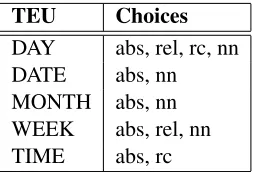
[image:2.612.364.493.62.148.2]TEU Choices DAY abs, rel, rc, nn DATE abs, nn MONTH abs, nn WEEK abs, rel, nn TIME abs, rc
Table 1: TEU choices where abs is absolute, rel is rela-tive, rc is relative to context and nn is none
day and to the current context (i.e. previously men-tioned dates). Specifically, there are 3 unit attributes: absolute (e.g. DAY=abs “Tuesday”); relative to cur-rent day (e.g. DAY=rel “tomorrow”); and relative to context (e.g. DAY=rc “the following day”).
Certain restrictions on possible TEU combina-tions were imposed, for example, DATE=rc and DAY=rel were combined to be just DAY=rel, and some combinations were omitted on the basis that it is highly unlikely that they would be uttered in natural speech, for example WEEK=rel and MONTH=abs would result in “this week in Septem-ber”. Finally, every TE has to contain a time (am or pm for this application). The possible combinations are summarised in Table 1.
3 Data Collection
The data collection experiment was in two parts (Task 1 and Task 2) and was designed using the We-bexp experimental software1. Webexp is a client-server set up where a client-server application hosts the ex-periment and stores the exex-perimental files, logs and results. The client side runs an applet on the user’s web-browser.
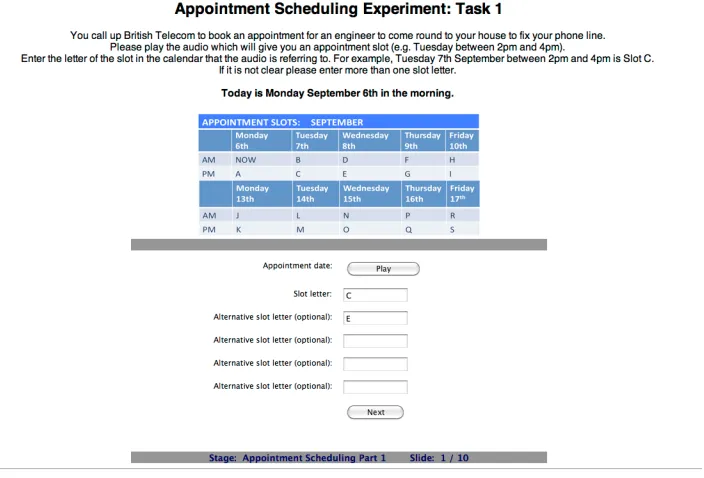
In Task 1, participants listened to an audio file containing a TE generated from absolute and rela-tive TEUs (see Figure 1). No relarela-tive-context (rc) TEUs were used in Task 1 since the dialogue ex-cerpt presented was in isolation and therefore had no context. Each participant was asked to listen to 10 different audio files in a sequence corresponding to a variety of dates randomly chosen from 8 pos-sible dates. The participant then had to identify the correct appointment slot that the system is referring to. There is scope for the participant to add multi-ple answers in order to capture potential ambiguity
1
Figure 1: Screen shot of Task 1 in the on-line data collection experiment
of a TE, and we report on this below. The 8 dates that were used to generate the TEs fell into a two week period in a single month which is in-line with the evaluation set-up of the appointment scheduling SDS discussed in Section 5.3.
For each date, the TE was randomly picked from a set of 30 possible combinations of TEUs. Each TEU was generated by a rule-based realiser and synthe-sized using the Baratinoo synthesizer (France Tele-com, 2011). This realiser generates text from a can-didate list for each TEU based on the given date. For example, if the slot currently being discussed is Tuesday 7th, the realiser would generate “tomor-row” for DAY=rel; if the date in discussion was Wednesday 8th then DAY=rel would be realised as “the day after tomorrow”. There was potential for overlap of stimuli, as any given TE for any given date may be assessed by more than one participant.
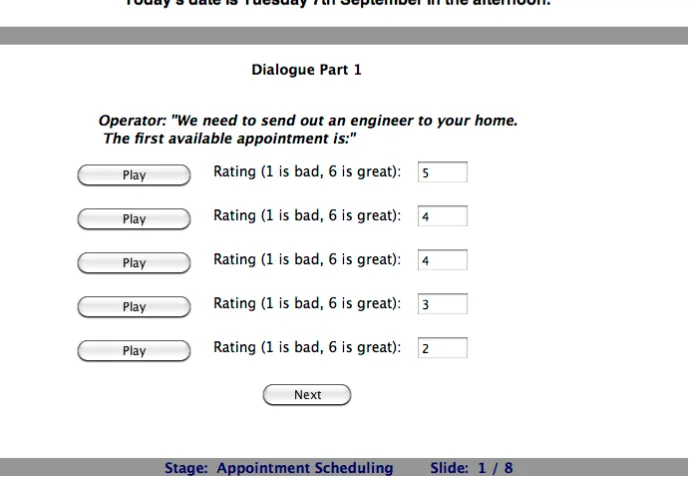
Task 2 of the experiment was in two stages. In the first stage (Task 2A), the participants are given to-day’s date and the following dialogue excerpt; Op-erator: “We need to send out an engineer to your home. The first available appointment is . . .” (see Figure 2). They are then asked to listen to 5 audio files of the system saying different TEs for the same
date and asked to rate preference on a scale of 1-6 (where 1 is bad and 6 is great.) For the second stage (Task 2B), the dialogue is as follows; Operator: “so you can’t do Wednesday 8th September in the morn-ing.” and then the participants are asked to listen to 5 more audio files that are generated TEs includ-ing relative context such as “how about Thursday at the same time?”. This two-stage process is then re-peated 4 times for each participant.
Table 2 summarizes the metrics collected in the different parts of the experiment. The metric Dis-tance is calculated in terms of the number of slots from the current date to the target date (TD). In-stances were grouped into four distance groups: G1: TD is 1-2 slots away; G2: TD is 3-6 slots away; G3: TD is 7-11 slots away and G4: TD more than 11 slots away. P replay is calcuated by the total num-ber of replays divided by the total numnum-ber of plays for that temporal expression, i.e. the probability that the temporal expression played is requested to be re-played. P ambiguous is calculated by the number of times a given temporal expression is given more than 1 interpretation divided by the total number of times that the same given referring expression is answered.
Figure 2: Screen shot of Task 2 in the on-line data collection experiment
730 TE samples collected. Although Task 2 directly followed on from Task 1, there was a significant drop out rate as only 48 participants completed the second task resulting in 1,920 TE samples. Partici-pants who completed both tasks were rewarded by a chance to win an Amazon voucher.
3.1 Data Analysis
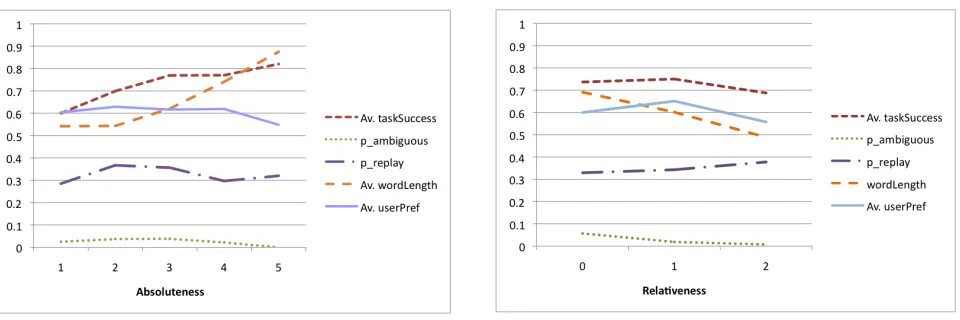
Figure 3 shows various metrics with respect to TE absoluteness and relativeness is the number of ab-solute and relative TEUs respectively. These two graphs represent the state space that the genera-tion policy described in Secgenera-tion 4 is exploring, trad-ing off between various features such as Length, taskSuccessanduserPref.
As we can see, there is a tendency for average
taskSuccess to increase as absoluteness increases whereas, for relativeness the distribution is more even. The TE with the greatesttaskSuccess has an
absoluteness of 4 and zero relativeness: DATE=abs, MONTH=abs, WEEK=abs, TIME=abs (e.g. “11th September, the week starting the 10th, between 8am and 10am”) and the TE with the least taskSuccess
has an absoluteness of only 2, again with no rela-tiveness: DATE=abs, TIME=abs, (e.g. “8th between 8am and 10am”).
Figure 3: Graph showing the trade-offs between various metrics with respect to absoluteness and relativeness (number of absolute/relative TEUs) in terms of probabilities or normalised values.
Metric Description Task
P ambiguous Probability that the
expres-sion is ambiguous to the user
1
taskSuccess Correct slot identified 1
P replay Probability of replay
(mea-sure of understandability)
1 & 2
Length Expression length in terms
of number of TEUs that are non null divided by the total number of possible TEUs (5)
1 & 2
wordLength Expression length in words
normalised over max num of words (15)
1 & 2
userPref Preference rating of audio
from 1-6
2
Distance Distance from target date
(TD) to current date in terms of number of slots
[image:5.612.73.291.355.602.2]1 & 2
Table 2: Metrics collected in various parts of the experi-ment
The probability of ambiguity and replay does not seem to be affected by absoluteness. The most am-biguous TE has an absoluteness of 3 and zero rela-tiveness: DAY=abs MONTH=abs TIME=abs, (e.g. “Tuesday September between 8am and 10am”) in-dicating that a date is needed for precision. The TEs that the participants were most likely to replay tended to be short e.g. “Tomorrow at the same time”. This may be due to the clarity of the speech synthe-siser.
4 Learning a TE generation policy
Reinforcement learning is a machine learning ap-proach based on trial and error learning, in which a learning agent learns to map sequences of “opti-mal” actions to environment or task states (Sutton and Barto, 1998). In this framework the problem of generating temporal expressions is presented as a Markov Decision Process. The goal of the learn-ing agent is to learn to choose those actions that ob-tain maximum expected reward in the long run. In this section, we present the reinforcement learning setup for learning temporal expression generation policies.
4.1 Actions and States
In this learning setup, we focus only on generating the formal specification and treat the set of TEU choices as the sequential actions of the learning agent. Table 1 presents the choices that are available for each TEU.
distance (in terms of time slots: morning or after-noon appointments) between (1) the current date and the target slot and (2) the current date and the slot in context. Based on the distance, the target slot was classified to belong to one of the four dis-tance groups (G1-G4). The slot in context repre-sents whether there was any other slot already men-tioned in the conversation so far, so that the system has an option to use “relative context” expressions to present day and time information. Information concerning the target slot’s group and the slot in con-text make up the state space of the Markov Decision Process (MDP).
4.2 User Simulation
We built a user simulation to simulate the dialogue behaviour of a user in appointment scheduling con-versations based on the data from real users de-scribed in Section 3. It responds to the TE used by the system to refer to an appointment slot. It responds by either accepting, rejecting, or clarify-ing the offered slot based on the user’s own calen-dar of available slots. For instance, the simulated user rejects an offered slot if the user is not avail-able at that time. If they accept or reject an offered slot, the user is assumed to understand the TE unam-biguously. However, if the user is unable to resolve the appointment slot from the TE, it responds with a clarification request. The simulation responded with a dialogue action (Au,t) to TEs based on the sys-tem’s dialogue act (As,t), system’s TE (T Es,t). The following probabilistic model was used to generate user dialogue actions:
P(Au,t|As,t, T Es,t, G, C, Cal)
In addition toT Es,tandAs,t, other factors such as distance between the target slot and the current slot (G), the previous slot in context (C), and the user’s calendar (Cal) were also taken into account.Gis ei-ther G1, G2, G3 or G4 as explained in Section 3. The User’s dialogue action (Au,t) is one of the three: Ac-cept slot, Reject slot or Request Clarification. The probability of clarification request was calculated as the average of the ambiguity and replay probabilities seen in real user data.
4.3 Reward function
The learning agent was rewarded for each TE that it generated. The reward given to the agent was based on trade-offs between three variables: User prefer-ence (UP), Length of the temporal expression (L), and Clarification request probability (CR). UP for each TE is obtained from Task 2 of the data collec-tion. In the following reward function, UP is nor-malised to be between 0 and 1. L is based on number of TEUs used. The maximum number of TEUs that can be used is 5 (i.e. DAY, DATE, WEEK, MONTH, TIME). L is calculated as follows:
Length of TE (L) = N o. of used T EU sM ax. no. of T EU s The clarification request (CR) is set to be 1 if the user responds to the TE with a Request Clarification and 0 otherwise. Reward is therefore calculated on a turn-by-turn basis using the following formula:
Reward = U P ∗ 10.0− L∗ 10.0−CR ∗ 10.0
In short, we chose a reward function that penalises TEs that are long and ambiguous, and which rewards TEs that users prefer. It also indirectly rewards task success by penalising ambiguous TEs resulting in clarification requests. This trade-off structure is evi-dent from the data collection where TEs that are too long are dispreferred by the users (see Figure 3). The maximum possible reward is 6 (i.e. UP=1, CR=0, L=2/5) and the minimum is -20 (i.e. UP=0, CR=1, L=1). Note that other reward functions could be ex-plored in future work, for example maximising only for user preference or length.
4.4 Training
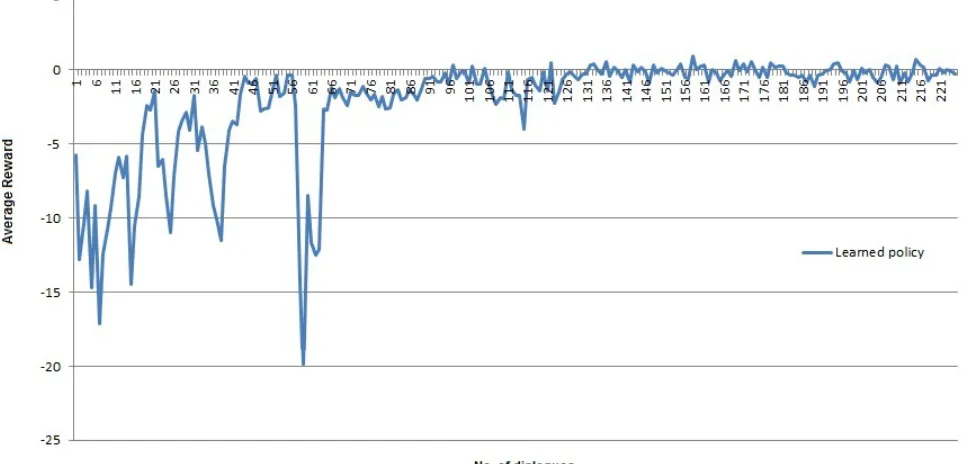
Figure 4: Learning curve
the long-term reward. Figure 4 shows the learning curve of the agent.
Table 3 presents the TE generation policy learned by the agent. As one can observe, it used a mini-mum number of TEUs to avoid length penalties in the reward. In all cases, MONTH and WEEK in-formation have not been presented at all. For target slots that were closest (in group G1) and the farthest (in group G4), it used relative forms of day (e.g. “to-morrow”, “next Tuesday”, etc.). This is probably because users dispreferred day information for in-between slots (e.g. “the day after the day after to-morrow”). Also, MONTH information may have been considered to be irrelevant due to the fact that the two week window over which the data has been collected do not span over two different months.
5 Evaluation
In this section, we present the baseline policies that were evaluated along with the learned policy. We then present the results of evaluation.
Slots Specification learned
1-2 DAY=rel;DATE=abs;MONTH=nn;
>11 WEEK=nn;TIME=abs
3-11 DAY=nn;DATE=abs;MONTH=nn; WEEK=nn;TIME=abs
Table 3: Learned policy
5.1 Baseline policies
The following are the baseline TEG policies:
1. Absolute policy: always use absolute for-mats for all TEUs (i.e. DAY=abs; DATE=abs; MONTH=abs; WEEK=abs; TIME=abs)
2. Minimal policy: always use a minimal format with only date, month and time information in their absolute forms (i.e. DAY=nn; DATE=abs; MONTH=abs; WEEK=nn; TIME=abs)
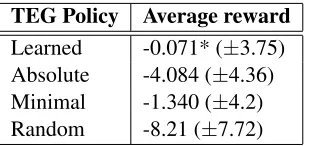
TEG Policy Average reward Learned -0.071* (±3.75) Absolute -4.084 (±4.36) Minimal -1.340 (±4.2) Random -8.21 (±7.72)
Table 4: Evaluation with simulated users (* p < 0.05, two-tailed independent samples t-test)
5.2 Results
We evaluated the learned policy and the three other hand-coded baseline TE generation policies with our user simulation model. Each policy generated 1,000 TEs in different states. Table 4 present the results of evaluation with simulated users. On average, the learned policy scores higher than all the baseline policies and the differences between the average re-ward of the learned policy and the other baselines are statistically significant. This shows that target slots can be presented using different TEs depending on how far they are from the current date and such adaptation can produce less ambiguous, shorter and user preferred expressions.
5.3 Evaluation with real users
The policy was also integrated into an NLG com-ponent of a deployed Appointment Scheduling spo-ken dialogue system. Please note that this is differ-ent from the web environmdiffer-ent in which the training data was collected. Our data-driven policy was acti-vated when the system informs the user of an avail-able time slot. This system was compared to the exact same system but with a rule-based adaptive baseline system. In the rule-based policy MONTH, DATE and TIME were always absolute, DAY was relative if the target date was less than three days away (i.e. “today, tomorrow, day after tomorrow”), and WEEK was always relative (i.e. “this week, next week”). All 5 information units were included in the realisation (e.g. “Thursday the 15th July in the after-noon, next week”) although the order was slightly different (DAY-DATE-MONTH-TIME-WEEK).
In this domain, the user tries to make an appoint-ment for an engineer to visit their home. Each user is given a set of 2-week calendars which shows their availability and the goal is to arrange an appoint-ment when both they and the engineer are available.
There were 12 possible scenarios that were evenly rotated across participants and systems. Each sce-nario is categorised in terms of scheduling difficulty (Hard/Medium/Easy). Scheduling difficulty is cal-culated for User Difficulty (UD) and System Diffi-culty (SD) separately to assess the system’s mixed initiative ability. Scheduling difficulty is calculated as the ordinal of the first session that is free for both the User and the System. Hard scenarios are with an ordinal of 3 or 4; Medium with an ordinal of 2, and Easy with an ordinal of 1. There are 4 scenarios in each of these difficulty categories for both the user and system. To give an example, in Scenario 10, the user can schedule an appointment on Wednes-day afternoon but he/she also has one free session on the previous Tuesday afternoon when the engi-neer is busy therefore UD = 2. For the system, in this scenario, the first free session it has is on the Wednesday afternoon therefore SD=1. In this case, the scenario is easier for the system than the user be-cause the system could just offer the first session that it has free.
Parameters Learned Baseline
TEG TEG
[image:9.612.74.305.65.174.2]Actual Task Success 80.05% 78.57% Perceived Task Success 74.86%* 60.50% User satisfaction 4.51* 4.30 No. system turns 22.8 23.2 Words per system turn 13.16* 17.3 Call duration 88.60 sec * 105.11 sec
Table 5: Results with real users (* statistically significant difference at p<0.05)
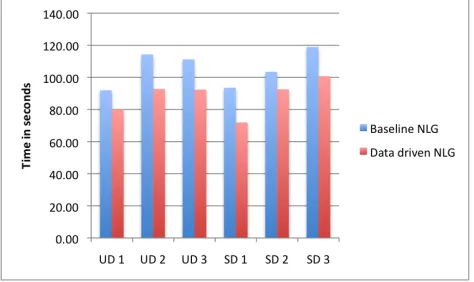
results in shorter dialogues and greater confidence in the user that they have had a successful dialogue. Although the learned policy was trained to generate optimal TEs within a two week window and there-fore is not general policy for all TE generation prob-lems, we believe that the data-driven approach that we have followed can generalise to other TE gener-ation tasks.
Figure 5: Graph comparing length of dialogues for user (UD) and system difficulty (SD)
6 Conclusion
We have presented a principled statistical learning method for generating Temporal Expressions (TEs) that refer to appointment slots in natural language utterances. We presented a method for gathering data on TEs with an on-line experiment and showed how we can use these data to generate TEs us-ing a Markov Decision Process which can be opti-mised using reinforcement learning techniques. We showed that a TEG policy learned using our
frame-2
independent two-tailed t-test p<0.05
work performs signifcantly better than hand-coded adaptive policies with real users as well as with sim-ulated users.
The data collected in this work has been freely released to the research community in 20113.
Acknowledgements
The research leading to these results has received funding from the EC’s 7th Framework Programme (FP7/2007-2013) under grant agreement no. 216594 (CLASSiC project www.classic-project. org), (FP7/2011-2014) under grant agreement no. 248765 (Help4Mood project), (FP7/2011-2014) un-der grant agreement no. 270435 (JAMES project), (FP7/2011-2014) under grant agreement no. 270019 (SpaceBook project), and from the EPSRC, project no. EP/G069840/1. We would also like to thank our CLASSiC project colleagues at Cambridge Univer-sity and France Telecom / Orange Labs.
References
D. Ahn, J. van Rantwijk, and M. de Rijke. 2007. A Cascaded Machine Learning Approach to Interpret-ing Temporal Expressions. InProceedings of
NAACL-HLT 2007.
France Telecom. 2011. Baratinoo expressive speech syn-thesiser.http://tts.elibel.tm.fr.
L. Gerber, L. Ferro, I. Mani, B. Sundheim, G. Wilson, and R. Kozierok. 2002. Annotating Temporal Infor-mation: From Theory to Practice. InProceedings of
HLT.
B. Han, D. Gates, and L. Levin. 2006. Understanding temporal expressions in emails. InHLT-NAACL 2006. Srinivasan Janarthanam and Oliver Lemon. 2010. Learn-ing to adapt to unknown users: referrLearn-ing expression generation in spoken dialogue systems. InACL ’10. P. Mazur and R. Dale. 2007. The DANTE Temporal
Ex-pression Tagger. InProceedings of the 3rd Language
and Technology Conference, Poznan, Poland.
Kathleen F. Mccoy and Michael Strube. 1999. Taking time to structure discourse: Pronoun generation be-yond accessibility. InProc. of the 21th Annual Con-ference of the Cognitive Science Society.
M. Moens and M. Steedman. 1988. Temporal ontology and temporal reference. InComputational Linguistics, volume 14(2), pages 15–28.
3
[image:9.612.68.305.350.491.2]J. Pustejovsky, J. Castano, R. Ingria, R. Sauri, R. Gaizauskas, A. Setzer, G. Katz, and D. Radev. 2003. TimeML: Robust specification of event and temporal expressions in text. InAAAI Spring Sympo-sium on New Directions in Question-Answering, Stan-ford, CA.
E. Reiter, S. Sripada, J. Hunter, and J. Yu. 2005. Choos-ing words in computer-generated weather forecasts. Artificial Intelligence, 167:137169.
Verena Rieser, Oliver Lemon, and Xingkun Liu. 2010. Optimising information presentation for spoken dia-logue systems. InProc. ACL 2010.
R. Sutton and A. Barto. 1998. Reinforcement Learning. MIT Press.
Marilyn A. Walker, Candace A. Kamm, and Diane J. Lit-man. 2000. Towards Developing General Models of Usability with PARADISE. Natural Language Engi-neering, 6(3).