
SAMER: A Semi-Automatically Created Lexical Resource for Arabic
Verbal Multiword Expressions Tokens Paradigm and their
Morphosyntactic Features
Mohamed Al-Badrashiny, Abdelati Hawwari, Mahmoud Ghoneim, and Mona Diab Department of Computer Science, The George Washington University
{badrashiny,abhawwari,mghoneim,mtdiab}@gwu.edu
Abstract
AlthoughMWEare relatively morphologically and syntactically fixed expressions, several types of flexibility can be observed in MWE, verbal MWE in particular. Identifying the degree of morphological and syntactic flexibility ofMWE is very important for many Lexicographic and NLP tasks. Adding MWE variants/tokens to a dictionary resource requires characterizing the flexibility among other morphosyntactic features. Carrying out the task manually faces several challenges since it is a very laborious task time and effort wise, as well as it will suffer from coverage limitation. The problem is exacerbated in rich morphological languages where the average word in Arabic could have 12 possible inflection forms. Accordingly, in this paper we introduce a semi-automatic Arabic multiwords expressions resource (SAMER). We propose an automated method that identifies the morphological and syntactic flexibility of Arabic Verbal Multiword Expressions (AVMWE). All observed morphological variants and syntactic pattern alternations of anAVMWEare automatically acquired using large scale corpora. We look for three morphosyntactic aspects ofAVMWEtypes investigating derivational and inflectional variations and syntactic templates, namely: 1) inflectional variation (inflectional paradigm) and calculating degree of flexibility; 2) derivational productivity; and 3) identifying and classifying the different syntactic types. We build a comprehensive list ofAVMWE. Every token in the AVMWElist is lemmatized and tagged with POS information. We then search Arabic Gigaword and All ATBs for all possible flexible matches. For eachAVMWEtype we generate: a) a statistically ranked list ofMWE-lexeme inflections and syntactic pattern alternations; b) An abstract syntactic template; and c) The most frequent form. Our technique is validated using a GoldenMWEannotated list. The results shows that the quality of the generated resource is 80.04%.
1 Introduction
Multiword expressions (MWE) are complex lexemes that contain at least two words reflecting a single concept. They can be morphologically and syntactically fixed expressions but also we note that they can exhibit flexibility especially in verbalMWE. Such morphosyntactic flexibility increases difficulties in computational processing ofMWEas they are harder to detect. Characterizing the internal structure of
MWEis considered very important for many natural language processing tasks such as syntactic parsing and applications such as machine translation (Ghoneim and Diab, 2013; Carpuat and Diab, 2010). In lexicography, entries for MWE in a lexicon should provide a description of the syntactic behavior of theMWEconstructions, such as syntactic peculiarities and morphosyntactic constraints (Calzolari et al., 2002). Automatically identifying the syntactic patterns and listing/detecting their possible variations would help in lexicographic representation ofMWE, as the manual annotation ofMWEvariants suffer from many disadvantages such as time and effort consuming, subjectivity and limited coverage.
The problem is exacerbated for morphologically rich languages, where an average word could have up to 12 morphological analyses such as the case for the Arabic language which is highly inflectional.
This work is licenced under a Creative Commons Attribution 4.0 International Licence. Licence details: http://creativecommons.org/licenses/by/4.0/
Several challenges are encountered in automatic identification and parsing ofMWEin Arabic especially verbal ones, because of their highly morphosyntactic flexibility.
This paper focuses on the Arabic verbal MWE(AVMWE) in Modern Standard Arabic (MSA). We broadly consider a MWE as a verbal one if it contains at least one verb in its elements. We focus exclusively on the flexibility of the elements existing in the AVMWE and their syntactic alternatives. Lexical flexibility (word/word) is meant to be outside the scope of this paper (Ex. rajaE bixuf∼ayo Hunayon1Vs.EAd bixuf∼ayo Hunayonwhere both expressions meanreturn empty handed).
From a theoretical point of view, we identify four components, for eachAVMWEas shown in Table 1. The verbal components are any verb within aMWE. Elements are the non-verbal components such as noun, adjective or particle. The syntactic variable is a slot that reflects the syntactic function in aMWE
without being itself a part of the construction, and the gaps are some inserted modifiers that might occur betweenMWEelements (Hawwari et al., 2014).
Verbal component Gap Syntactic variable Element-1 Element-2 Element-3 Syntactic variable BW >aEoTaY >amosi (FulAnN) AlDawo’ Al>axoDar li- (FulAnK)
En-Gloss gave yesterday (somebody) the-light the-green to (something/somebody)
En-translation (somebody) gave the green light to (somebody/something)
Table 1: Example for the entities we are considering within aMWE
The main objective of our work is to automatically acquire all observed morphological variants and syntactic pattern alternations of aMWEusing large scale corpora, using an empirical method to identify the morphological and syntactic flexibility ofAVMWE.
2 Related Work
A considerable amount of literature has been published on the morphosyntactic characteristics ofMWE
. These studies focused on various morphological aspects, within different contexts on different lan-guages. Gurrutxaga and Alegria (2012) and Baldwin et al. (2003) applied latent semantic analysis to build a model of multiword expression decomposability. This model measures the similarity between a multiword expression and its elements words, and considers the constructions with higher similarities are greater decomposability.
Diab and Bhutada (2009) present a supervised learning approach to classify the idiomaticity of the Verb-Noun Constructions (VNC) depending on context in running text.
Savary (2008) presents a comparative survey of eleven lexical representation approaches to the inflec-tional aspects inMWEin different languages, including English, French, Polish Serbian German, Turkish and Basque.
Al-Haj et al. (2013) applied to Modern Hebrew an architecture for lexical representation of MWEs. The goal was to integrate system that can morphologically process Hebrew multiword expressions of various types, in spite of the complexity of Hebrew morphology and orthography.
Zaninello and Nissim (2010) present three electronic lexical resources for ItalianMWE. They created a series of example corpora and a database ofMWEmodeled around morphosyntactic patterns.
Nissim and Zaninello (2013) employed variation patterns to deal with morphological variation in order to create a lexicon and a repository of variation patterns for MWE in morphologically-rich Romance languages.
Al-Sabbagh et al. (2013) describe the construction of a lexicon of Arabic Modal Multiword Expres-sions and a repository for their variation patterns. They used an unsupervised approach to build a lexicon for Arabic Modal Multiword Expressions and a repository for their variation patterns. The lexicon con-tains 10,664 entries of MSA and Egyptian modalMWEand collocation, linked to the repository.
The closest work to ours is that of (Hawwari et al., 2012). They created a list of different types of Arabic MWE collected from various dictionaries which were manually annotated and grouped based on their syntactic type. The main goal was to tag a large scale corpus of Arabic text using a
matching algorithm and automatically annotated to enrich and syntactically classify the givenMWElist. Their work didn’t approach the derivational or lexical aspects.
To the best of our knowledge, to date, none of the previous addressed the systematic investigation of morphosyntactic features and derivational productivity ofAVMWEand their syntactic properties.
3 Linguistic Background
This section gives a brief overview of the linguistic background of the verbal inflectional and derivational system in Modern Standard Arabic.
3.1 Arabic Verbal MWE (AVMWE)
The verbal MWEis a MWE that includes a verb or more within its word elements. AVMWEcould be classified, according to their lexical nature, into three types:
• Verbal Idioms: We mean by verbal Idiom any idiomatic expression that has a verb within its com-ponents. An example of verbal idiom is as follows: taraka (fulAnN) Al-jamala bi-maA Hamala2. [(someone) left every thing behind]
• Light verb (support verb): a light verb construction is consisting of: a) a verb that is semantically light, and b) a noun or verbal-noun carries the core meaning of the construction. >axa* (fulAnN) Al-v>ora[(someone take a revenge]
• Verb Particle construction: An expression includes a verb and a particle that they have together a meaning. (this construction includes phrasal verbs):ragiba (fulAnN) fi[wish for]
AMWEis considered flexible when it has more than one accepted inflected or syntactic form. Flexibility can be applied to inflectional, derivational, syntactic and lexical aspects of a MWE. We roughly distin-guish between flexibility and idiomaticity as follows: flexibility affects the morphosyntactic properties, and idiomaticity is more related to the compositionality and semantic content of anMWE.
Inflection is a morphological subfield that belongs to single words encoding its inflectional categories (number, gender, person, case, tense, voice, mood, aspect) using several affixes to represent the mor-phosyntactic variation. Inflectional flexibility of anMWE is a sum of the inflectional flexibility of its elements.
AMWEtoken instance includes every possible inflectional variation form of theMWEtype that can occur in a corpus. On the other hand, aMWEtype is the canonical (citation) form that is used to be the basic form representing all the possible tokens of aMWE lexeme. Lexicographers chose the simplest form to be a canonical form serving as a head word or citation form for a lexical entry. By anMWE
lexeme we refer to all the possible inflectional forms that are observed for theMWEin a corpus.
3.2 Inflectional Categories
The Arabic verb has the following inflectional categories:
• Tense: perfective, imperfective, imperative
• Voice: active, passive
• Mood: indicative (marofuwE), subjunctive (manoSuwb), jussive (majozuwm)
However, verb subject inflects for person (first, second, third person), gender (masculine, feminine), number (singular, dual, plural) and syntactic case (nominative (marofuwE), accusative (manoSuwb), gen-itive (majoruwr)).
AVMWEvary in their inflectional flexibility degree. One group is fixed, for exampleHad∼ivo wa-lA Haraj(speak freely), second group has a degree of flexibility as >aTolaq (fulAnN) sAqyohi li-AlryiH
(ran away), the verb>aTolaqis fully flexible for any affixes (>aTlaqA,>aTlaquw,>aTlaqato, etc).
Matcher
Input MWE
Matches in lemma form
Surface Form Retriever
MWE Paradigm
MWE Canonical Form Paradigm
Creator
[image:4.595.140.458.62.198.2]Canonical form Creator
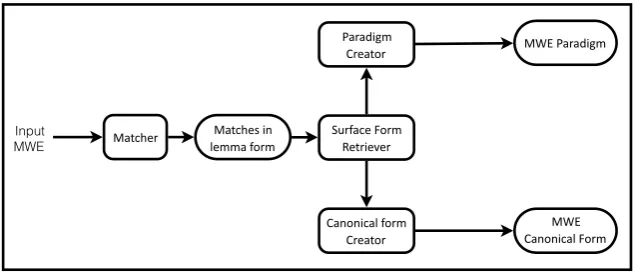
Figure 1: MWE paradigm and canonical form finder pipeline: MPD.
3.3 Derivational Productivity
Derivation is a very productive and regular word-formation mechanism in the Arabic language. Unlike inflection, derivation belongs to the lexicon and is completely syntax independent. As AVMWE vary in productivity, some allow verbal derivations, for examplefAza bi-qaSabi Alsaboqi(he came first/he is the winner) allows the derived nominal MWE fA}izN bi-qaSabi Alsaboqi, where the verb fAza is derivationally related to the noun fA}izN. On the other hand, there are many AVMWE that are fixed derivationally as they do not exhibit derivational productivity for example>aSobaH ha$iymaF ta*oruw-hu AlriyAHu(vanish).
3.4 Syntactic flexibility
As it is a Verb Phrase (VP),AVMWEis governed by VP grammatical rules and operations such as word order, agreement, government. Syntactic flexibility for anMWE occurs in texts in different configura-tions. Some ofAVMWEhave some degree of syntactic flexibility, which appears in word order variability for a givenMWE(VSO:balag Alsayolu AlzubaY(it reached the limits), SVO:Alsayolu balag AlzubaY). Although word order in Arabic is relatively free, the word-order flexibility in AVMWE occurs rarely, because the AVMWEphrases are more rigid than ordinary phrases syntactically. An example for the syntactic fixedAVMWEisAixotalaTa AlHAbilu biAln∼Abili(it became a mess).
4 Approach
We introduce an automatic approach for building a morphosyntactic lexicon for Arabic verbal MWE
starting from a gold seed list. We use a manually created list of Arabic verbalMWEand try to find all possible matches with any morphological variations in a large dataset in a process ofMWE Paradigm detection (MPD). After that we create the morphosyntactic feature vector of each match and calculate the level of flexibility of eachMWE.
Figure 1 illustrates the different components of the MPD system. For each new MWE expression in seed list, the “Matcher” component replaces each word in the inputMWEwith its lemma to find all possible inflections for theMWEduring the matching process. Since deverbals such as verbal nouns, past participle active, and past participle passive inherit the semantic and syntactic structures from their verbs they are derived from, the “Matcher” component adds the derivatives of each verb in the input MWE
as possible matching candidates in addition to its lemma. Technically these are derivational variants. That way, we can find all possible forms of the inputMWEduring the matching process. For example, if the input is the MWE “fAz biqaSabi Alsaboqi meaning he is the winner”, it will be matched with “fAzuw biqaSabi Alsaboqimeaningthe winning” and “fA}izN biqaSabi Alsaboqimeaningthe winner”, reflecting inflectional variation withfAzbeing observed asfAzuwin the former, and derivational variation withfAzbeing observed asfA}izNin the latter.
possibility of gapping between the words (Ex.fAz Alwalad biqaSabi Alsaboqithe boy is the winner) or word ordering (Ex.waqaEa fiy HaySa bayoSa. Orfiy HaySa bayoSa waqaEagot confused).
The preprocessed datasets have a one-to-one mapping between the input surface form of each sentence and its corresponding lemma form. Thus, the “Surface Form Retriever” component uses that to find the original surface form of each sentence retrieved by the “Matcher” component. The “Paradigm Creator” component generates a unique list of all surface form sentences retrieved by the “Surface Form Retriever” component to create a list of all possible morphological variations of the inputMWE. To make the list as generic as possible, we replace each word that is not part of the MWE with its POS tag. The “Canonical Form Creator” after that uses the full list of sentences created by the the “Surface Form Retriever” component and finds the most frequent matched form of the inputMWE
For each word in the matchedMWE, we create a morphosyntactic feature vector of nine elements that are being extracted from the POS tags of the matchedMWE.The first element is the POS. Three elements (aspect, voice, mood) are only for verbs, while nominals have the following attributes (case, state), and (person, number, gender) apply to all words. In addition to that, we try to identify the candidate subject and object for each match as follows:
• Subject: The candidate subject is identified as the pronoun attached to the verb if it is explicitly mentioned in the pos of the verb, otherwise it is the first nominative nominal after the verb;
• Object: The candidate object is identified as the pronoun attached to the verb if it is explicitly mentioned in the pos of the verb. Otherwise it is the first accusative nominal after the verb.
5 Experimental Setup
5.1 Datasets
We use different types of datasets to evaluate our approach for creating theMWE token paradigm re-source.
Corpora used for the resource creation:
• ATB: The Arabic Treebanks. The selected ATBs represent three different genres: Newswire;3Broadcast News;4and, Weblogs;5
• Gigawords: The Arabic Gigaword fourth edition;6
• AVMWE: Is a list of more about 4000 verbalMWEsemi automatically extracted from two traditional Arabic Monolingual Dictionaries;
• Verbs-to-Derivatives: Is a list of 10k MSA verbs and their possible derivations. It is developed to help our system recognize the derivational relations between verbs and their nominal counterparts (Active participle, passive participle and Gerund) (Hawwari et al., 2013).
Evaluation Datasets:
• DevDB: 2000 randomly selected lines from theATBandGigawordsused for system tuning;
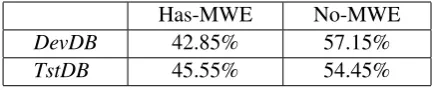
• TstDB: 2000 randomly selected lines from theATBandGigawordsused for system evaluation. BothDevDBandTstDBare manually annotated. Each line is annotated with a presence/absence tag indicating whether anMWEfrom theAVMWElist or not. If a line is annotated as having anMWE, all of the elements of thisMWEare annotated and the number of gaps between each two elements is identified. Table 2 shows the annotation distribution of both datasets
3ATB-P1-V4.1(LDC2010T13),ATB-P2-V3.1 (LDC2011T09) and ATB-P3-V3.2 (LDC2010T08)
4ATB-P5-V1.0 (LDC2009E72), ATB-P7-V1.0 (LDC2009E114), ATB-P10-V1.0 (LDC2010E22) and ATB-P12-V2.0 (LDC2011E17)
Has-MWE No-MWE
DevDB 42.85% 57.15%
[image:6.595.190.409.62.107.2]TstDB 45.55% 54.45%
Table 2:MWEAnnotation distribution across the evaluation datasets.
5.2 Data Preparation
To enable matching based on Lemma and POS, we processed theATBandGigawordsinto a a series of tuples with the following elements: “Token-Lemma-POS”. ForATB, we extracted this format from the gold analysis in the integrated files. ForGigawords, we usedMADAMIRAtoolkit (Pasha et al., 2014) for tokenization, lemmatization and POS tagging. The selected tokenization scheme is ATB-tokenization and the POS tag-set isATBfull tag-set. TheAVMWEwas also processed usingMADAMIRAto guarantee consistency in the matching process.MADAMIRAprovides a list of possible analyses per word with the most probably one selected as the candidate analysis. Due to short context, the accuracy of the selected analysis byMADAMIRAwasn’t high. Accordingly, we post-processed the list of possible analyses per word and selected the most probable analysis that matches the gold assigned coarse-grained POS.
6 Paradigm Detection Evaluation
We used the processedAVMWElist as the input goldMWElist to our paradigm detection system MPD. Also,Verbs-to-Derivativesis used to help the matching algorithm to match the derivatives of each verb in the input multi words expressions as well.
Table 3 shows the results of running the paradigm detector on DevDB with different schemes (i.e. different gapping sizes and with and without enabling word reordering). We report the results as the F-score of correctly tagging anMWEinDevDB, the F-score of correctly tagging the sentences that do not have MWE, and the weighted average F-score of both of them for all schemes. The results shows that the best weighted Average F-score is 80.61% when we allow a maximum gap size of 2 between the
MWEconstituent words and without enabling the word order to be varied.
By running the best setup on theTstDB, we found that the weighted average F-score is 80.04%
with-words-reordering without-words-reordering
Max-Gap-Size MWE tagging No-MWE tagging Avg-Fscore MWE tagging No-MWE tagging Avg-Fscore
0 66.62% 81.75% 75.27% 65.80% 81.75% 74.92%
1 75.14% 82.34% 79.25% 73.81% 83.29% 79.23%
2 77.40% 80.39% 79.11% 77.09% 83.25% 80.61%
4 73.87% 70.30% 71.83% 76.20% 79.89% 78.31%
8 68.39% 52.53% 59.33% 73.42% 74.07% 73.79%
16 63.15% 26.02% 41.93% 69.94% 66.24% 67.83%
32 60.64% 5.93% 29.37% 68.04% 61.45% 64.27%
65 60.08% 0.70% 26.14% 67.82% 60.67% 63.73%
[image:6.595.74.524.593.706.2]any 59.99% 0.00% 25.71% 67.82% 60.67% 63.73%
6.1 Error Analysis
Type %
gap 31.23%
order 20.15%
pp-attachment 20.15%
polysemous 17.88%
MADAMIRA 6.55%
literal 3.53%
Eval-err 0.25%
[image:7.595.212.386.89.186.2]Syn-function 0.25%
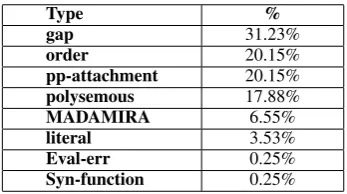
Table 4: Paradigm detector error analysis
Table 4 shows the error distribution of the paradigm detector on theTstDB. We can see that limiting the maximum gapping size to two and disabling word reordering while matching are the main sources of errors. Together they are responsible for 51.38% of the errors, which suggests that the gap size and word reordering should be more flexible. We should have some smarter way to decide the gapping size and words reordering status perMWEtype; not by generalizing them on all types. For example “ya>oxu* bi+ Eayon AlAiEotibArmeansconsiders” did not match with “ta>oxu*mA TuriH fiy mu&otamar Al-manAmapbi+ EayonAljid∼iyap wa+AlAiEotibAr” because of the gapping size restriction. And “ba*al jahodi +hmeansdid his effort” did not match with “AljuhuwdAltiytabo*ulul +hA” because the word reordering is disabled.
Another challenging problem responsible for 20.15% of the errors is the verb particle construction; where a certain verb when attached to a certain preposition, they act like an MWE. This issue is that while matching, it is hard to know if a certain preposition should be attached to the target verb or another one. This leads to false identification for the match if the decision of the attachment was not correct. Ex: “yajib EalaY +hmeanshe should be” incorrectly matched with “yajib>n yaEoqidEalaY>roDihi he
has to held on his land” becauseEalaY is considered attached to “yajib” while it is actually attached
toyaEoqidas it assumed a gapping of two words, while it should have attached the particle to the low, second and closest verbyaEoqid.
Polysemy is also a hard problem. It is responsible for 17.88% of the errors. Errors due polysemy occur when words in the inputMWEtype have more than one meaning. But since the matching process only takes the lemma and POS into account and word senses are not part of the matching, the paradigm detector could tag some cases as valid matches. Ex:“Hayovu kAn meaning wherever” is incorrectly matched with “Hayovu kAnAlAibonu yaloEab meaning because the sone was playing”. The issue came from the wordHayovuthat meanswhereorbecause.
The morphological analyzer and POS tagger (MADAMIRA) is the source of 6.55% of the errors. When
MADAMIRAincorrectly analyzes some words, some wrong matches occur. Ex: “*ahabat riyHu +hu
meanshas been forgotten” did not match with “*ahabot riyHi +hu” becauseMADAMIRAanalyzed the word “*ahabatmeansgone” as “*ahabotmeansI went”
3.53% of the errors are due to the MWEbeing idiomatic in some contexts and literal in others. Ex. “tajAwaz Huduwd +hu” meaning “Exceeded his limits” incorrectly matched “tatajAwaz AlHuduwd
AljugorAfiy∼ap” meaning “Transcended the geographic boundaries”
The remaining 0.5% errors are due to some minor issues: 0.25% errors are due to manual annotation errors, while the other 0.25% errors are due to fact that the matched morphological variant from the input
MWE has a different syntactic function than the inputMWE. Ex. “HAwal EabavAF” meaning “Tried in vain” is incorrectly matched with “yHAwl AlEbv” meaning “Attempted to tamper with”. This is because the word “EabavAF” which is an adverb is a derivation of the noun “AlEbv” which plays the role of an object in this verb noun construction.
7 SAMER
To build the proposed ArabicMWEresource, we ran the paradigm detector on theATBandGigawords
MWEin the inputAVMWElist.
The automatically created resource is reflected in the following five tables:
• All matches table: Contains the 732335 matches that are automatically detected by the paradigm detector and pointers to their original locations in theATBandGigawords;
• Flexibility table: This table has the 1884 rows representing the types ofMWE that the paradigm detector found matches for. The columns represent the words of theMWEwhere the value of each cell shows the number of different forms that this element matched with. For example if a certain cell has the number “5”, this means that its corresponding word matched with five different unique morphological variants;
• MWE-Lexeme table: This table shows the different morphological forms of each word in each
MWEand their probabilities that are identified by the paradigm detector;
• Sorted-Grouped-tokens table: Shows the probability of all matches of eachMWEin a descending order. So, if there is aMWEthat has 10 matches, we calculate the unique form for each of them and find the probability of each unique value. The number of grouped types of all matches is 38408;
• MWE-Types table: this table has1884 rows; one row for eachMWEtype. The columns show num-ber of matches, the most frequent token with its probability, and the union of the morphosyntactic features of each word across all tokens of eachMWEtype. Example: if the union of the gender of the second word across all matches ofMWEnumberiis{M,F}; this means that the second word of theMWEnumberihas a flexibility to change the gender between masculine or feminine.
7.1 Statistical Analyses
The number of the MWE types in our automatically created resource is 1884. They consist of 1901 unique verbal words and 3104 unique non-verbal words. Each type of the 1884MWEhas an average fan out of 20 different forms due to the morphological or inflectional changes theMWEwords.
The results show that 15.5% of theMWEtypes do not allow any gaps between the constituent words (No-Gaps), while 52.1% of theMWEtypes allow gapping between all the constituent words (Full-Gaps) and the remaining 32.4% of the types allow gapping only between some of the constituent words (Part-Gaps).
Examples:
• No-Gaps: “dub∼ira bi+ layolKmeaningconspired” matched with “dub∼ira bi+ layolK”
• Full-Gaps: “ka$af AlqinAE Eanmeaningunveiled” matched using one gap between the first two words with “ka$af b +h AlqnAE En meaningunveiled using it” and using one gap between the second two words with “tk$f AlqnAE AlzA}f Enmeaningunveiled the fake thing”
• Part-Gaps: “ka$∼ar Ean>anoyAbi +hmeaningexpress anger” matched using one gap between the first two words with “tuka$∼ir turokiyA Ean>anoyAbi +hA meaning Turkey expressed its anger”
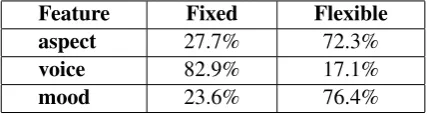
Tables 5 and 6 show the morphosyntactic feature flexibility distribution for the non-verbal components and the verbal ones respectively across allMWEmatches. The tables show that the mood is the most rigid feature (76.4% of theMWEtypes have fixed mood) while gender is the most flexible feature (87.08% of theMWEtypes have different values of the gender within the matched cases).
Feature Fixed Flexible gender 87.08% 12.92%
number 85.18% 14.82%
case 56.28% 43.72%
[image:9.595.192.406.243.300.2]state 63.66% 36.34%
Table 5: Morphosyntactic feature flexibility of the non-verbal components of allMWEtypes
Feature Fixed Flexible aspect 27.7% 72.3%
voice 82.9% 17.1%
mood 23.6% 76.4%
Table 6: Morphosyntactic feature flexibility of the verbal components of allMWEtypes
8 Conclusion
We introduced an automatically builtMWEresource that covers all the morphological variations of a list ofAVMWEin the basic form. Each morphological variant is accompanied with all of its instances in theATBand ArabicGigawords. Furthermore, for each word in theMWE, we added a morphosyntactic feature vector of nine elements{pos, aspect, voice, mood, person, gender, number, case, state)}. We validated our approach constructing an automaticMWEparadigm detector in running text. Our system yielded an weighted average f-score of 80.61% on a dev set, and 80.04% on an unseen test data. The error analysis shows that there is no generalized maximum gapping size, and enabling or disabling word reordering decisions should not be generalized on allMWEin the input list. Instead, more sophisticated techniques are required to find the best decisions for each case.
References
Hassan Al-Haj, Alon Itai, and Shuly Wintner. 2013. Lexical representation of multiword expressions in morphologically-complex languages. International Journal of Lexicography, page ect036.
Rania Al-Sabbagh, Jana Diesner, and Roxana Girju. 2013. Using the semantic-syntactic interface for reliable arabic modality annotation. InProceedings of the Sixth International Joint Conference on Natural Language Processing, pages 410–418, Nagoya, Japan, October. Asian Federation of Natural Language Processing. Timothy Baldwin, Colin Bannard, Takaaki Tanaka, and Dominic Widdows. 2003. An empirical model of
mul-tiword expression decomposability. In Proceedings of the ACL 2003 Workshop on Multiword Expressions: Analysis, Acquisition and Treatment - Volume 18, MWE ’03, pages 89–96, Stroudsburg, PA, USA. Association for Computational Linguistics.
Nicoletta Calzolari, Charles J Fillmore, Ralph Grishman, Nancy Ide, Alessandro Lenci, Catherine MacLeod, and Antonio Zampolli. 2002. Towards best practice for multiword expressions in computational lexicons. InLREC. Marine Carpuat and Mona Diab. 2010. Task-based evaluation of multiword expressions: A pilot study in statistical machine translation. InHuman Language Technologies: The 2010 Annual Conference of the North American Chapter of the Association for Computational Linguistics, HLT ’10, pages 242–245, Stroudsburg, PA, USA. Association for Computational Linguistics.
Mahmoud Ghoneim and Mona T Diab. 2013. Multiword expressions in the context of statistical machine transla-tion. InIJCNLP, pages 1181–1187.
Antton Gurrutxaga and Iaki Alegria. 2012. Measuring the compositionality of nv expressions in basque by means of distributional similarity techniques. In Nicoletta Calzolari (Conference Chair), Khalid Choukri, Thierry Declerck, Mehmet U?ur Do?an, Bente Maegaard, Joseph Mariani, Asuncion Moreno, Jan Odijk, and Stelios Piperidis, editors,Proceedings of the Eight International Conference on Language Resources and Evaluation (LREC’12), Istanbul, Turkey, may. European Language Resources Association (ELRA).
Abdelati Hawwari, Kfir Bar, and Mona Diab. 2012. Building an arabic multiword expressions repository. Proc. of the 50th ACL, pages 24–29.
Abdelati Hawwari, Wajdi Zaghouani, Tim O’Gorman, Ahmed Badran, and Mona Diab. 2013. Building a lex-ical semantic resource for arabic morphologlex-ical patterns. In Communications, Signal Processing, and their Applications (ICCSPA), 2013 1st International Conference on, pages 1–6, Feb.
Abdelati Hawwari, Mohammed Attia, and Mona Diab. 2014. A framework for the classification and annotation of multiword expressions in dialectal arabic. ANLP 2014, page 48.
Malvina Nissim and Andrea Zaninello. 2013. Modeling the internal variability of multiword expressions through a pattern-based method. ACM Transactions on Speech and Language Processing (TSLP), 10(2):7.
Arfath Pasha, Mohamed Al-Badrashiny, Mona Diab, Ahmed El Kholy, Ramy Eskander, Nizar Habash, Manoj Pooleery, Owen Rambow, and Ryan M. Roth. 2014. MADAMIRA: A Fast, Comprehensive Tool for Morpho-logical Analysis and Disambiguation of Arabic. InProceedings of LREC, Reykjavik, Iceland.
Agata Savary. 2008. Computational Inflection of Multi-Word Units, a contrastive study of lexical approaches. Linguistic Issues in Language Technology, 1(2):1–53.
![Crystal structure of diethyl 3,3′ [(2 fluorophenyl)methylidene]bis(1H indole 2 carboxylate)](data:image/gif;base64,R0lGODlhAQABAIAAAP///wAAACH5BAEAAAAALAAAAAABAAEAAAICRAEAOw==)