Post-hoc Manipulations of Vector Space Models
with Application to Semantic Role Labeling
Jenna Kanerva and Filip Ginter Department of Information Technology
University of Turku, Finland [email protected],[email protected]
Abstract
In this paper, we introduce several vector space manipulation methods that are ap-plied to trained vector space models in a post-hoc fashion, and present an applica-tion of these techniques in semantic role labeling for Finnish and English. Specifi-cally, we show that the vectors can be cir-cularly shifted to encode syntactic infor-mation and subsequently averaged to pro-duce representations of predicate senses and arguments. Further, we show that it is possible to effectively learn a linear trans-formation between the vector representa-tions of predicates and their arguments, within the same vector space.
1 Introduction
Recently, there has been much progress in the de-velopment of highly scalable methods for induc-ing vector space representations of language. In particular, theword2vec method (Mikolov et al., 2013b) is capable of training on billions of tokens in a matter of hours, producing high quality rep-resentations. An exciting property exhibited by the vector spaces induced usingword2vecis that they preserve a number of linguistic regularities, lending themselves to simple algebraic operations with the vectors (Mikolov et al., 2013c) and linear mapping between different spaces (Mikolov et al., 2013a). These can be seen aspost-hocoperations manipulating the vector space with the significant advantage of not requiring a new task-specific rep-resentation to be induced, as is customary.
In this paper, we will investigate several addi-tional such methods. Firstly, we will show how syntax information can be encoded by the circular shift operation and demonstrate that such shifted vectors can be averaged in a meaningful manner to represent predicate arguments. And secondly, we
will show that linear transformations of the vec-tor spaces can be successfully applied also within a single vector space, to tasks such as transform-ing the vector of a predicate into the vector of its argument with a particular role.
To test the above-mentioned operations in an extrinsic setting, we will develop these methods within the context of the Semantic Role ing (SRL) task. Automatic Semantic Role Label-ing is the process of identifyLabel-ing the semantic ar-guments of predicates, and assigning them labels describing their roles. A predicate and its argu-ments form a predicate-argument structure, which describes events such aswhodoeswhattowhom,
whenandwhere.
The SRL task is “semantic” in its nature and therefore suitable for the application and testing of vector space representations and methods for their manipulation. However, rather than merely adding features derived from vector spaces into an existing system, we will approach the develop-ment from a different angle and test whether these representations of words and the similarities they induce can be used for predicate argument role as-signment and predicate sense disambiguation as the primary source of information, with little ad-ditional features.
In addition to the standard English CoNLL’09 dataset, we will apply the methods also to Finnish SRL, testing the applicability ofword2vecand the overall methodology that we will develop in this paper to this highly inflective language. With its considerably larger and sparser surface form lex-icon, Finnish poses interesting challenges of its own, and only little attention has been dedicated to the application of distributional semantics meth-ods specifically to Finnish. This is also partly due to the lack of sufficiently sized corpora, which we address in this work by using a 1.5B token corpus of Internet Finnish.
In order to be able to test the proposed
ods on SRL, we need to carry out not only role labeling and predicate sense disambiguation, but also argument detection. As a secondary theme, we thus test whether dependency parse graphs in the semantically motivated Stanford Dependen-cies (SD) scheme can be used as-is to perform ar-gument identification. We are especially interested in this scheme as it is designed to capture seman-tically contentfulrelations (de Marneffe and Man-ning, 2008) and would thus appear to be the ideal choice as the underlying syntactic representation for SRL.
2 Data and Task Setting
Throughout the paper, we will use the exact same task setting as in the CoNLL’09 Shared Task on Syntactic and Semantic Dependencies in Multiple Languages (Hajiˇc et al., 2009). The input of the SRL system are automatically generated syntactic parses and the list of predicate tokens to be con-sidered in each sentence. For each of the predi-cates, the SRL system is expected to predict the
sense of the predicate, identify all tokens which are its arguments, and for each argument, iden-tify its role. As the primary measure of perfor-mance, we will use thesemantic F-scoredefined in the CoNLL shared task. This F-score is cal-culated from the precision and recall of argument identification (calculated in the obvious manner) and also incorporates the sense of the predicate via an additional “dummy” argument. We use the of-ficial implementation of the metric distributed on the Shared Task site.1
We will report our results on two SRL datasets: the Finnish PropBank (Haverinen et al., 2013a) and the English SRL dataset from the CoNLL’09 Shared Task. The Finnish PropBank is built on top of the Turku Dependency Treebank (TDT), a 205K token corpus of general Finnish (Haverinen et al., 2013b) annotated using the SD scheme, in-cluding manually annotated conjunct propagation and other dependency relations from the non-basic layer of the scheme. These extended SD analyzes are thus not strictly trees, rather they are directed labeled graphs (see Figure 1). The Finnish Prop-Bank has 22 different argument roles of which 7 are numbered core roles and 15 are modifier roles. The Finnish data has 164,530 training tokens with 27,603 occurrences of 2,826 unique predicate-1http://ufal.mff.cuni.cz/conll2009-st/
scorer.html
He ate.01 lunch and then washed.01 dishes .
<nsubj:A0 dobj:A1>cc> <advmod:AM-TMP dobj:A1>
conj>
[image:2.595.311.527.65.106.2]<nsubj:A0 punct>
Figure 1: Extended Stanford Dependencies scheme combined with PropBank annotation.
sense combinations. The English CoNLL data is derived from the PropBank and NomBank corpora (Palmer et al., 2005; Meyers et al., 2004) and it has a total of 54 different argument roles. In addition to the same 22 roles as Finnish, English also has discontinuous variants for each role. The English data has 958,024 training tokens with 178,988 oc-currences of 15,880 unique predicate-sense com-binations.
All Finnish results are reported on the test sub-set of the Finnish PropBank, and have no previ-ously published baseline to compare with. The results we report for English are produced on the official test section of the CoNLL’09 data and are thus directly comparable to the official results re-ported in the Shared Task.
In the test phase, we follow the Shared Task set-ting whereby morphological and syntactic analy-sis is predicted as well, i.e., no gold standard data enters the system other than the tokenization and the information of which tokens constitute predi-cates. We produce the Finnish morphological and syntactic analyses for the test set with the parsing pipeline of Haverinen et al. (2013b), composed of a morphological analyzer and tagger (Hal´acsy et al., 2007; Pirinen, 2008; Lind´en et al., 2009), de-pendency parser (Bohnet, 2010) and a machine-learning based component for predicting the ex-tended SD dependencies (Nyblom et al., 2013). While the English data is provided with automati-cally produced dependency parses, we are specifi-cally interested in the SD scheme and therefore we re-parse the corpus with the Stanford parser2
tak-ing a union of the base and collapsed dependency outputs to match the Finnish data.
The vector space models used throughout this paper are induced using the word2vec software (skip-gram architecture with default parameters). For Finnish, the model is trained on 1.5 billion to-kens of Finnish Internet texts gathered from the
Common Crawldataset.3 The data was
split and tokenized using the OpenNLP4toolchain
trained on TDT, and processed in the same man-ner as the above-mentioned test set. This gives us the opportunity to build two models, one for the word forms and the other for the lemmas. Both Finnish models have 300 dimensions. For En-glish, the vector representation is induced on the union of the English Wikipedia (1.7B tokens) and the English Gigaword corpus (4B tokens), the to-tal training data size thus being 5.7 billion tokens.5
Sentence splitting and tokenization was carried out using the relevant modules from theBRAT pack-age (Stenetorp et al., 2012).6 The English model
has 200 dimensions.
3 Method
In this section, we will describe the methods de-veloped for argument identification, argument role labeling and predicate sense disambiguation, the three steps that must be implemented to obtain a full SRL system.
3.1 Argument identification
In a semantically-oriented dependency scheme, such as SD, it can be expected that a notable proportion of arguments (in the SRL sense) are directly attached to the predicate, and argument identification can be reduced to assuming that — with a limited number of systematic exceptions — every argument is a dependent of the predicate. The most frequent case where the assumption does not hold in Finnish are the copula verbs, which are not analyzed as heads in the SD scheme. For En-glish, a common case are the auxiliaries, which govern the main verb in the CoNLL data and are thus marked as arguments for other higher-level predicates as well. In the SD scheme, on the other hand, the main verb governs the auxiliary taking also its place in the syntactic tree. Since the fo-cus of this paper lies in role assignment, we do not go beyond developing a simple rule set to deal with a limited number of such cases. In Section 6, we will contrast this simple argument identifica-tion method to that of the winning CoNLL’09 sys-tem and we will show that while for Finnish the above holds surprisingly well, the performance on the English data is clearly sub-optimal.
4http://opennlp.apache.org/
5We are thankful to Sampo Pyysalo for providing us with the Englishword2vecmodel.
6http://brat.nlplab.org
Finnish
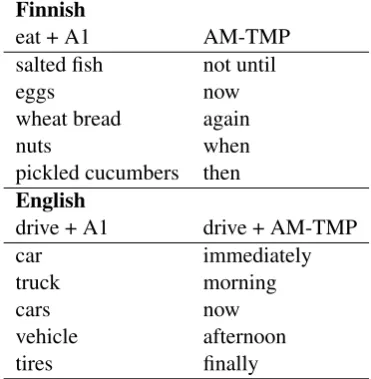
eat + A1 AM-TMP salted fish not until
eggs now
wheat bread again
nuts when
pickled cucumbers then
English
drive + A1 drive + AM-TMP
car immediately
truck morning
cars now
vehicle afternoon
[image:3.595.323.509.64.254.2]tires finally
Table 1: Five most similar words for the given average argument vectors. AM-TMPrefers to the temporal modifier role. Note that the average vec-tors for Finnish modifier roles are estimated inde-pendently from the predicates (see Section 3.4).
3.2 Role Classification
Our initial role classification algorithm is based on calculating the vector representation of an “aver-age argument” with a given role. For every predi-catexand every roler, we calculate the represen-tation of the average argument with the role as
A(x, r) = P
(r,x,y)yˆ
count , (1) whereyˆrefers to the L2 normalized version ofy, andcount to the number of training pairs that are summed over. We are thus averaging the normal-ized vectors of all wordsyseen in the training data as an argument of the predicatexwith the roler. To establish the role for some argumenty during testing, we can simply choose the role whose av-erage argument vector has the maximal similarity toy, i.e.
arg maxr sim(A(x, r), y), (2)
3.3 Incorporating syntax
As we will demonstrate shortly, incorporating in-formation about dependency relations can lead to a substantial performance gain. To incorporate the dependency relation information into the role clas-sification method introduced above, we apply the technique of circular shifting of vectors. This tech-nique was previously used in the context of Ran-dom Indexing (RI)to derive new vectors from ex-isting ones in a deterministic fashion (Basile and Caputo, 2012). In RI, the shift operation is how-ever not used on the final vectors, but rather al-ready during the induction of the vector represen-tation.
Given a vector representation of an argumenty, we can encode the dependency relation ofy and its predicate by circularly shifting the vector of y by an offset assigned separately to each possi-ble dependency relation. The assignment is arbi-trary, but such that no two relations are assigned the same offset. We will denote this operation as yd, meaning the vector y circularly shifted to the right by the offset assigned to the dependency relationd. For instance, circularly shifting a vec-tora= (1,2,3,4,5)to the right by an offset of 2 results ina2 = (4,5,1,2,3).
We can incorporate the dependency relations when calculating the average vectors representing arguments as follows:
A(x, r) = P
(r,d,x,y)yˆd
count , (3) where (r, d, x, y) iterates over all predicate-argument pairs(x, y)whereyhas the dependency relationdand roler. The role of an argument in the test phase is established as before, by taking the role which maximizes the similarity to the av-erage vector:
arg maxr sim(A(x, r), yd) (4)
In the cases, where arguments are not direct de-pendents of the predicate, we use zero as the shift offset.
To motivate this approach and illustrate its im-plications, consider the two sentences (1)The cat chases the dog. (2) The dog chases the cat. In the first sentence the dogis an object which cor-responds to the theme role A1, whereas in the second sentence it is a subject with the agent role A0. The role labeling decision is, how-ever, in both cases based on the similarity value
sim(A(chases, r), dog), predicting A1, which is incorrect in the latter case. When we incorporate the syntactic information by shifting the vector ac-cording to its syntactic relation to the predicate, we obtain two diverging similarity values because dognsubjanddog dobjare essentially two different vectors. This leads to the correct predic-tion in both cases.
Relative to the base method, incorporating the syntax improves the semantic F-score from 61.32% to 66.23% for Finnish and from 65.05% to 66.55% for English. For Finnish, the gain is rather substantial, while for English we see only a moderate but nevertheless positive effect. This demonstrates that, indeed, the circular shifting op-eration successfully encodes syntactic information both into the average vectorsAand the candidate argument vectorsy.
3.4 Core arguments vs. modifiers
In comparison to modifier roles, the assignment of core (numbered) argument roles is consider-ably more influenced by the predicate sense and therefore must be learned separately, which we also confirmed in initial experiments. The modi-fier roles, on the other hand, are global in the sense that they are not tied to any particular predicate. This brings out an interesting question of whether the modifier roles should be learned independently of the predicate or not. We find that the best strat-egy is to learn predicate-specific modifier vectors in English and global modifier vectors in Finnish.
Another problem, particularly common in the Finnish PropBank stems from the distinction be-tween core roles and modifier roles. For instance, for the predicate to move the argument meaning the destination of the moving action has the core role A2, while for a number of other predicates which may optionally take a destination argument, the directional modifier role AM-DIR would be used. This leads to a situation where core argu-ments receive a high score for a modifier role, and modifier roles are over-predicted at the expense of core argument roles. To account for this, we introduce the following simple heuristics. If the predicate lacks a core rolerafter prediction, iter-ate through predicted modifier rolesp1. . .pn and
change the prediction frompitorifrhas the
max-imum similarity among the core roles and the dif-ference sim(pi, y)−sim(r, y) is smaller than a
develop-ment set distinct from the test set.
We observe a 2.05pp gain in Finnish when using this method, whereas in English this feature is less significant with an improvement of only 0.3pp.
3.5 Fall-back for unknown words
The above-mentioned techniques based purely on vector representations with no additional features fail if the vector space model lacks the argument token which prevents the calculation of the nec-essary similarities. To address this problem, we build separately for each POS a “generic” repre-sentation by averaging the vectors of all training data tokens that have the POS and occurred only once. These vectors, representing a typical rare word of a given POS, are then used in place of words missing from the vector space model.
Another solution taking advantage from the vector space representation is used in cases where a predicate is not seen in the training data and therefore we have no information about its argu-ment structure. We query for predicates closest to the unseen predicate and take the average argu-ment vectors from the most similar predicate that was seen during the training.
Together, these two techniques result in a mod-est gain of approximately 1pp for both languages.
3.6 Sense classification
One final step required in SRL is the disambigua-tion of the sense of the predicate. Here we ap-ply an approach very similar to that used for role classification, whereby for every sense of every predicate, we calculate an average vector repre-senting that sense. This is done as follows: For every predicate sense, we average the vector rep-resentations of all dependents and governors7 of
all occurrences of that sense in the training data, circularly shifted to encode their syntactic relation to the predicate. To assign a sense to a predicate during testing, we average the shifted vectors cor-responding to its dependents and governors in the sentence, and choose the sense whose average vec-tor is the nearest. Using this approach, we obtain a 84.18% accuracy for Finnish and 92.68% for En-glish, compared to 79.89% and 92.88% without the syntax information. This corresponds to a sub-stantial gain for Finnish but, surprisingly, a small drop for English. For the rare predicates that are 7Recall we use the extended SD scheme where a word can have several governors in various situations.
not seen in the training data, we have no informa-tion about their sense inventory and therefore we simply predict the sense “.01” which is the cor-rect choice in 79.56% of the cases in Finnish and 86.64% in English.
4 Role Labeling with Linear Transformations
As we discussed earlier, it was recently shown that the word2vec spaces preserve a number of lin-guistic regularities, and an accurate mapping be-tween two word2vec-induced vector spaces can be achieved using a simple linear transformation. Mikolov et al. (2013a) have demonstrated that a linear transformation trained on source-target lan-guage word pairs obtained from Google Translate can surprisingly accurately map word vectors from one language to another, with obvious applications to machine translation. It is also worth noting that this is not universally true of all vector space rep-resentation methods, as Mikolov et al. have shown for example for Latent Semantic Analysis, which exhibits this property to a considerably lesser ex-tent. In addition to testing the applicability of the
word2vec method in general, we are specifically interested whether these additional properties can be exploited in the context of SRL. In particular, we will test whether a similar linear vector space transformation can be used to map the vectors of the predicates onto those of their arguments.
More formally, for each role r, we will learn a transformation matrix Wr such that for a vector
representationx of some predicate, Wrx will be
close to the vector representation of its arguments with the roler. For instance, ifxis the represen-tation of the predicate(to) eat, we aim forWA1x
to be a vector similar to the vectors representing edible items (roleA1). The transformation can be trained using the tuples(r, x, y)of predicatexand its argumenty with the roler gathered from the training data, minimizing the error
X
(x,y)
kWrx−yk2 (5)
over all training pairs (separately for eachr). We minimize the error using the standard stochastic gradient descent method, whereby the transfor-mation matrix is updated separately for each pair
(x, y)using the equation
whereis the learning rate whose suitable value is selected on the development set. The whole proce-dure is repeated until convergence is reached, ran-domly shuffling the training data after each round of training.
Using the transformation, we can establish the most likely role for the argumentyof a predicate xas
arg maxr sim(Wrx, y) (7)
wheresimis the cosine similarity function, i.e. in the exact same manner as for the average argument method described in the previous section, with the difference that the vector for the average argument is not calculated directly from the training data, but rather obtained through the linear transforma-tion of the predicate vector.
As an alternative approach, we can also learn the reverse transformation RWr such thatRWry
is close to x, i.e. the transformation of the argu-mentyonto the predicatex. Note that hereRWris
not the same asWT
r ; we train this reverse
transfor-mation separately using the same gradient descent method. We then modify the method for finding the most likely role for an argument by taking the average of the forward and reverse transformation similarities:
arg maxr sim(Wrx, y) +2sim(x, RWry) (8)
Note that we make no assumptions about the vector spaces wherexandyare drawn from; they may be different spaces and they do not need to be matched in their dimensionality either, as there is no requirement thatW andRW be square matri-ces. In practice, we find that the best strategy for both Finnish and English is to represent both the predicates and arguments using the space induced from word forms, however, we have also tested on Finnish representing the predicates using the space induced from lemmas and the arguments using a space induced from word forms, with only mini-mally worse results. This shows that the transfor-mation does not degrade substantially even when mapping between two different spaces.
With this strategy, we reach an F-score of 62.71% in Finnish and 63.01% in English. These results are on par with the scores obtained with the average argument method, showing that a lin-ear transformation is effective also in this kind of problems.
To incorporate syntax information, we train transformation matricesWr,d andRWr,d for each
dependency relation drather than relying on the circular shift operation which cannot be captured by linear transformations.8As some combinations
ofranddmay occur only in the test data, we use the matricesWr andRWr as a fall-back strategy.
In testing, we found that even if the (r, d) com-bination is known from the training data, a small improvement can be obtained by taking the aver-age of the similarities with and without syntactic information as the final similarity. Incorporating these techniques into the basic linear transforma-tion improves the semantic F-score from 62.71% to 65.88% for Finnish and from 63.01% to 67.04% for English. The improvement for both languages is substantial.
5 Supervised classification approach In the previous sections, we have studied an ap-proach to SRL based purely on the vector space representations with no additional features. We have addressed the choice of the argument role by simply assigning the role with the maximum sim-ilarity to the argument. To test the gain that could be obtained by employing a more advanced tech-nique for aggregating the scores and incorporating additional features, we train a linear multi-class support vector machine to assign the role to every detected argument. As features, we use the simi-larity values for each possible role using the best performing method for each language,9 the sense
of the predicate, and — separately for the predi-cate and the argument — the token itself, its POS, morphological tags, every dependency relation to its governors, and every dependency relation to its dependents. The similarities are encoded as feature weights, while all other features are bi-nary. We use the multi-class SVM implementa-tion from the SVM-multiclass package (Joachims, 1999), setting the regularization parameter on the development set using a grid search.
For both languages, we observe a notable gain in performance, leading to the best scores so far. In Finnish the improvement in F-score is from 66.23% to 73.83% and in English from 67.04% to 70.38%. However, as we will further discuss in Section 6, in Finnish the contribution of the simi-larity features is modest.
8Note that this does not affect the overall computational cost, as the total number of training examples remains un-changed and the transformation matrices are small in size.
Finnish English
Average vectors
full method 66.23 66.55 –modifier vs. core role 64.18 66.25
–syntax 61.32 65.05
Linear transformation
full method 65.88 67.04
–syntax 62.71 63.01
Supervised classification
[image:7.595.356.478.61.225.2]full method 73.83 70.38 only similarity features 64.21 65.89 –similarity features 73.54 67.51 –lexical features 65.51 58.42 Table 2: Overview of main results and a feature ablation study. Modifier vs. core rolerefers to the algorithm presented in Section 3.4. In the super-vised classification part,-lexical featuresrefers to the removal of features based on word forms, pred-icate sense and role similarities.
6 Results and discussion
All results discussed throughout Sections 3 to 5 are summarized in Table 2, which also serves as a coarse feature ablation study. Overall, we see that the average vector and linear transformation methods perform roughly on par, with the aver-age vector method being slightly better for Finnish and slightly worse for English. Both vector space-based methods gain notably from syntax informa-tion, confirming that the manner in which this in-formation is incorporated is indeed meaningful.
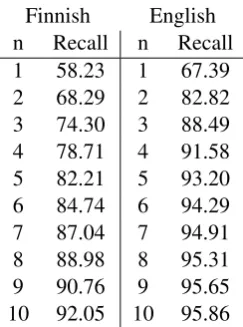
Adding the SVM classifier on top of these two methods results in a substantial further raise in per-formance, demonstrating that to be competitive on SRL, it is necessary to explicitly model also ad-ditional information besides the semantic similar-ity between the predicate and the argument. This is particularly pronounced for Finnish where the present SVM method does not gain substantially from the similarity-based features, while English clearly benefits. To shed some light on this differ-ence, we show in Table 3 the oracle accuracy of role labeling for top-1 through top-10 roles as or-dered by their similarity scores. The performance on English is clearly superior to that on Finnish. An important factor may be the fact that — in terms of token count — the CoNLL’09 English training size is nearly six times that of the Finnish PropBank and the English vector space model was induced on a nearly four times larger text corpus.
Finnish English n Recall n Recall 1 58.23 1 67.39 2 68.29 2 82.82 3 74.30 3 88.49 4 78.71 4 91.58 5 82.21 5 93.20 6 84.74 6 94.29 7 87.04 7 94.91 8 88.98 8 95.31 9 90.76 9 95.65 10 92.05 10 95.86
Table 3: A study of how many times (%) the cor-rect role is among the top n most similar roles when the arguments are known in advance. Left: Similarities taken from the average vector method on Finnish. Right: Similarities from the linear transformation method on English.
Finnish English Average vectors 66.23 / 89.89 66.55 / 79.57 Linear transf. 65.88 / 89.92 67.04 / 80.85 Supervised 73.83 / 89.29 70.38 / 78.71 Table 4: Overall results separately for all main methods (labeled/unlabeled semantic F-score).
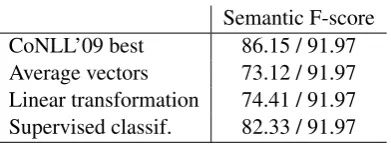
[image:7.595.74.290.68.241.2]Prop-Semantic F-score CoNLL’09 best 86.15 / 91.97 Average vectors 73.12 / 91.97 Linear transformation 74.41 / 91.97 Supervised classif. 82.33 / 91.97 Table 5: Performance of suggested methods with argument identification from the top-performing CoNLL’09 system (labeled/unlabeled F-score).
Bank was originally developed specifically on top of the SD scheme, while the English PropBank and NomBank corpora were not.
7 Related work
While different methods have been studied to build task specific vector space representations, post-hoc methods to manipulate the vector spaces without retraining are rare. Current SRL systems utilize supervised machine learning approaches, and typically a large set of features. For instance, the winning system in the CoNLL’09 shared task (SRL-only) introduces a heavy feature engineer-ing system, which has about 1000 potential fea-ture templates from which the system discovers the best set to be used (Zhao et al., 2009b). Word similarities are usually introduced to SRL as a part of unsupervised or semi-supervised meth-ods. For example, Titov and Klementiev (2012) present an unsupervised clustering method ap-plying word representation techniques, and De-schacht and Moens (2009) used vector similarities to automatically expand the small training set to build semi-supervised SRL system. Additionally, Turian et al. (2010) have shown that word repre-sentations can be included among the features to improve the performance of named entity recogni-tion and chunking systems.
8 Conclusions
We set out to test two post-hoc vector space ma-nipulation techniques in the context of semantic role labeling. We found that the circular shift op-eration can indeed be applied also to other vector representations as a way to encode syntactic infor-mation. Importantly, the circular shift is applied to a pre-existing vector space representation, rather than during its induction, and is therefore task-independent. Further, we find that such shifted vectors can be meaningfully averaged to represent predicate senses and arguments.
We also extended the study of the linear trans-formation between two vector spaces and show that the same technique can be used also within a single space, mapping the vectors of predicates onto the vectors of their arguments. This map-ping produces results that are performance-wise on par with the average vectors method, demon-strating a good generalization ability of the lin-ear mapping and the underlyingword2vec vector space representation. Here it is worth noting that — if we gloss over some obvious issues of am-biguity — the mapping between two languages demonstrated by Mikolov et al. is conceptually a to-one mapping, at least in contrast to the one-to-many nature of the mapping between predicates and their arguments. These results hint at the pos-sibility that a number of problems which can be re-duced to the “predict a word given a word” pattern may be addressable with this simple technique.
With respect to the application to SRL, we have shown that it is possible to carry out SRL based purely on the vector space manipulation meth-ods introduced in this paper, outperforming sev-eral entries in the CoNLL-09 Shared Task. How-ever, it is perhaps not too surprising that much more is needed to build a competitive SRL sys-tem. Adding an SVM classifier with few relatively simple features derived from the syntactic analy-ses in addition to features based on vector similities, and especially adding a well-performing ar-gument identification method, can result in a sys-tem close to approaching state-of-the-art perfor-mance, which is encouraging.
As future work, it will be interesting to study to which extent SRL, and similar applications would benefit from addressing the one-to-many nature of the underlying problem. While for some predi-cates the arguments likely form a cluster that can be represented as a single average vector, for other predicates, such asto see, it is not the case. Find-ing methods which allow us to model this property of the problem will constitute an interesting direc-tion with broader applicadirec-tions beyond SRL.
Acknowledgements
References
Pierpaolo Basile and Annalina Caputo. 2012. Encod-ing syntactic dependencies usEncod-ing Random IndexEncod-ing and Wikipedia as a corpus. In Proceedings of the 3rd Italian Information Retrieval (IIR) Workshop, volume 835, pages 144–154.
Bernd Bohnet. 2010. Very high accuracy and fast de-pendency parsing is not a contradiction. In Proceed-ings of the 23rd International Conference on Com-putational Linguistics, pages 89–97. Association for Computational Linguistics.
Koen Deschacht and Marie-Francine Moens. 2009. Semi-supervised semantic role labeling using the la-tent words language model. InProceedings of the 2009 Conference on Empirical Methods in Natural Language Processing: Volume 1-Volume 1, pages 21–29. Association for Computational Linguistics. Jan Hajiˇc, Massimiliano Ciaramita, Richard
Johans-son, Daisuke Kawahara, Maria Ant`onia Mart´ı, Llu´ıs M`arquez, Adam Meyers, Joakim Nivre, Sebastian Pad´o, Jan ˇStˇep´anek, et al. 2009. The CoNLL-2009 shared task: Syntactic and semantic dependencies in multiple languages. InProceedings of the Thir-teenth Conference on Computational Natural Lan-guage Learning: Shared Task, pages 1–18. Associa-tion for ComputaAssocia-tional Linguistics.
P´eter Hal´acsy, Andr´as Kornai, and Csaba Oravecz. 2007. HunPos: an open source trigram tagger. In Proceedings of the 45th annual meeting of the ACL on interactive poster and demonstration sessions, pages 209–212. Association for Computational Lin-guistics.
Katri Haverinen, Veronika Laippala, Samuel Kohonen, Anna Missil¨a, Jenna Nyblom, Stina Ojala, Timo Vil-janen, Tapio Salakoski, and Filip Ginter. 2013a. Towards a dependency-based PropBank of general Finnish. InProceedings of the 19th Nordic Confer-ence on Computational Linguistics (NoDaLiDa’13), pages 41–57.
Katri Haverinen, Jenna Nyblom, Timo Viljanen, Veronika Laippala, Samuel Kohonen, Anna Mis-sil¨a, Stina Ojala, Tapio Salakoski, and Filip Ginter. 2013b. Building the essential resources for Finnish: the Turku Dependency Treebank. Language Re-sources and Evaluation, pages 1–39.
Thorsten Joachims. 1999. Making large-scale SVM learning practical. In Advances in Kernel Meth-ods - Support Vector Learning, pages 169–184. MIT Press.
Krister Lind´en, Miikka Silfverberg, and Tommi Piri-nen. 2009. HFST tools for morphology — an effi-cient open-source package for construction of mor-phological analyzers. In State of the Art in Com-putational Morphology, volume 41 of Communica-tions in Computer and Information Science, pages 28–47.
Marie-Catherine de Marneffe and Christopher D. Man-ning. 2008. The Stanford typed dependencies rep-resentation. In Coling 2008: Proceedings of the workshop on Cross-Framework and Cross-Domain Parser Evaluation, pages 1–8. Coling 2008 Organiz-ing Committee.
Adam Meyers, Ruth Reeves, Catherine Macleod, Rachel Szekely, Veronika Zielinska, Brian Young, and Ralph Grishman. 2004. The NomBank project: An interim report. InHLT-NAACL 2004 Workshop: Frontiers in Corpus Annotation, pages 24–31.
Tomas Mikolov, Quoc V. Le, and Ilya Sutskever. 2013a. Exploiting similarities among languages for machine translation. CoRR (arxiv.org), abs/1309.4168.
Tomas Mikolov, Ilya Sutskever, Kai Chen, Greg S. Cor-rado, and Jeff Dean. 2013b. Distributed representa-tions of words and phrases and their compositional-ity. InAdvances in Neural Information Processing Systems 26, pages 3111–3119.
Tomas Mikolov, Wen-tau Yih, and Geoffrey Zweig. 2013c. Linguistic regularities in continuous space word representations. InProceedings of the 2013 Conference of the North American Chapter of the Association for Computational Linguistics: Human Language Technologies, pages 746–751. Associa-tion for ComputaAssocia-tional Linguistics, June.
Jenna Nyblom, Samuel Kohonen, Katri Haverinen, Tapio Salakoski, and Filip Ginter. 2013. Pre-dicting conjunct propagation and other extended Stanford Dependencies. In Proceedings of the In-ternational Conference on Dependency Linguistics (Depling 2013), pages 252–261.
Martha Palmer, Daniel Gildea, and Paul Kingsbury. 2005. The proposition bank: An annotated cor-pus of semantic roles. Computational Linguistics, 31(1):71–106.
Tommi Pirinen. 2008. Suomen kielen ¨a¨arellistilainen automaattinen morfologinen j¨asennin avoimen l¨ahdekoodin resurssein. Master’s thesis, University of Helsinki.
Pontus Stenetorp, Sampo Pyysalo, Goran Topi´c, Tomoko Ohta, Sophia Ananiadou, and Jun’ichi Tsu-jii. 2012. BRAT: a web-based tool for nlp-assisted text annotation. InProceedings of the Demonstra-tions at the 13th Conference of the European Chap-ter of the Association for Computational Linguistics, pages 102–107. Association for Computational Lin-guistics.
Joseph Turian, Lev Ratinov, and Yoshua Bengio. 2010. Word representations: a simple and general method for semi-supervised learning. InProceedings of the 48th Annual Meeting of the Association for Compu-tational Linguistics, pages 384–394. Association for Computational Linguistics.
Hai Zhao, Wenliang Chen, Jun’ichi Kazama, Kiyotaka Uchimoto, and Kentaro Torisawa. 2009a. Multilin-gual dependency learning: Exploiting rich features for tagging syntactic and semantic dependencies. In Proceedings of the Thirteenth Conference on Computational Natural Language Learning: Shared Task, pages 61–66. Association for Computational Linguistics.