Computationally Rational Saccadic Control: An Explanation of Spillover
Effects Based on Sampling from Noisy Perception and Memory
Michael Shvartsman
Department of Psychology University of Michigan [email protected]
Richard L. Lewis
Department of Psychology University of Michigan
Satinder Singh
Computer Science & Eng. University of Michigan [email protected]
Abstract
Eye-movements in reading exhibit frequency spillover effects: fixation durations on a word are affected by the frequency of the previous word. We explore the idea that this effect may be an emer-gent property of a computationally rational eye-movement strategy that is navigating a tradeoff be-tween processing immediate perceptual input, and continued processing of past input based on mem-ory. We present an adaptive eye-movement con-trol model with a minimal capacity for such pro-cessing, based on a composition of thresholded se-quential samplers that integrate information from noisy perception and noisy memory. The model is applied to the List Lexical Decision Task and shown to yield frequency spillover—a robust prop-erty of human eye-movements in this task, even with parafoveal masking. We show that spillover in the model emerges in approximately optimal con-trol policies that sometimes process memory rather than perception. We compare this model with one that is able to give priority to perception over mem-ory, and show that the perception-priority policies in such a model do not perform as well in a range of plausible noise settings. We explain how the frequency spillover arises from a counter-intuitive but fundamental property of sequenced thresholded samplers.
1 Introduction and overview
Our interest is in understanding how eye-movements are controlled in service of linguis-tic tasks involving reading—more specifically, how saccadic decisions are conditioned on the moment-by-moment state of incremental percep-tual and cognitive processing. The phenomena we are concerned with here are spillover effects, where fixation durations on a word are affected by linguistic properties of the prior word or words. The specific idea we explore is that spillover ef-fects may be emergent properties of a computa-tionally rational control strategy that is navigating a tradeoff between processing immediate percep-tual input, and continued processing of past input based on a memory of recent stimuli.
The paper is organized as follows. We first review evidence that eye-movement control in reading is strategically adaptive, and describe our
theoretical approach. We then review evidence from gaze-contingent eye-tracking paradigms— some existing and some new—that suggests that frequency spillover is not driven exclusively by parafoveal preview of upcoming words. We take this as evidence that frequency spillover may be driven in part by processing of words that con-tinues after the eyes have moved away. We then extend an existing adaptive control model of eye-movements with a minimal capacity for such con-tinued processing, by allowing it to process a memory of past input. The model is based on a simple composition of thresholded sequential samplers that integrate information from noisy perception and noisy memory. Threshold parame-ters define the control policy and their values de-termine how processing resources are allocated to perception and memory. We provide a com-putational rationality analysis of the model’s pol-icy space: First, we show that frequency spillover emerges in top-performing policies, where perfor-mance is evaluated on the same task and payoff given to human participants. Second, we show that a model capable of spillover does no worse than an otherwise identical model that can elim-inate spillover by always attending to perception when it can, and that the spillover-capable poli-cies in such a model do no worse than spillover-incapable ones across the speed-accuracy tradeoff curve, and in fact do better in some portions of the noise parameter space. Finally, we trace the origin of the effect to a counter-intuitive but fun-damental property of the dynamics of sequenced thresholded samplers.
2 Adaptive control of eye-movements: Evidence and theoretical approach A growing body of evidence suggests that eye-movements in reading are strategic adaptations that manifest at the level of individual fixations. For example, Rayner and Fischer (1996) showed
that when participants are searching for a partic-ular word in a text rather than reading for full comprehension, saccade durations are shortened and the magnitude of frequency effects is reduced. Wotschack (2009) showed that readers assigned the task of proofreading read more slowly and per-formed more second-pass reading with fewer skips than in a control reading-for-comprehension task.
People also adapt reading behavior to within-task manipulations of difficulty and payoff. Wotschack (2009) showed that people change their reading behavior in response to manipula-tions of the difficulty of comprehension quesmanipula-tions. Lewis et al. (2013) showed that people adapt their eye movements in response to changes in quanti-tative task payoffs. Payoffs emphasizing speed at the expense of accuracy result in shorter fixation durations and lower accuracies.
We seek to develop a model that can explain such variation in eye-movement behavior as a ra-tional adaptation to the task (including utility) and the internal oculomotor and cognitive architecture (Lewis et al., 2013). Such a model would permit a
computational rationalityanalysis (Lewis et al., to appear) because the problem of rational behavior is defined in part by the bounded mechanisms of the posited computational architecture.
We constrain our architectural assumptions by building on existing theories of oculomotor archi-tecture, such as E-Z Reader (Reichle et al., 2009). But we enrich these architectures with explicit as-sumptions about the policy space of saccadic con-trol, and with assumptions about the processing of noisy perception and memory. This enriched ar-chitecture is then embedded in a minimal cogni-tive system that is capable of performing a com-plete experimental task. The comcom-plete model af-fords computational rationality analyses because it can be used to derive the implications of saccadic control policies for task performance.
3 The nature of spillover effects
Our aim in this section is to establish a link be-tween spillover and the continued processing of past input based on memory. Consider a pair of words in sequence: wordn−1 and wordn. There
are three natural explanations for how the fre-quency of wordn−1 could affect the duration of fixations on wordn. (1) During fixation of wordn,
perceptual information from wordn−1 is available in the parafovea and continues to be processed.
masked unmasked
●
●
●
●
●
●
●
●
230 250 270 290 310
high low high low
Fixated Word Frequency
Single Fixation Dur
ation
Prev. Word Frequency
●
●
high
[image:2.595.317.514.62.216.2]low
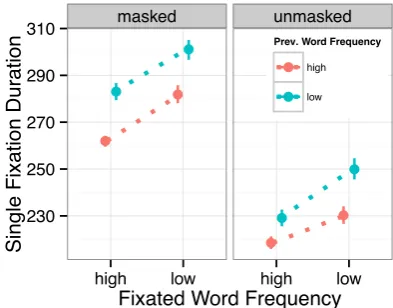
Figure 1: Frequency spillover in the List Lexical Decision Task.Single fixation durations (fixations when the word was fixated only once) on words as a function of the fixated and previous word’s frequency. Frequencies are binned by a median split; error bars are bootstrapped standard errors.
We call this the parafoveal review explanation. (2) During fixation on wordn−1, perceptual infor-mation from wordn is available in the parafovea;
the frequency of wordn−1 affects the degree to which this information is processed, and this in turns affects the subsequent fixation duration on wordn. We call this theparafoveal preview
expla-nation. (3) During fixation of wordn, processing
of wordn−1 continues based on some memory of the perception of wordn−1, and this processing is
affected by the frequency of wordn−1. We call this thememoryexplanation.
It is unlikely that spillover is driven by parafoveal review because the effective visual field in reading does not extend to the left of the current word (Rayner et al., 1980).
The standard paradigm for investigating the re-lationship between spillover effects and parafoveal preview is some form of parafoveal masking (Rayner, 1975): a nonveridical preview of wordn
is shown until the eye crosses an invisible bound-ary just before wordn, at which point wordn is
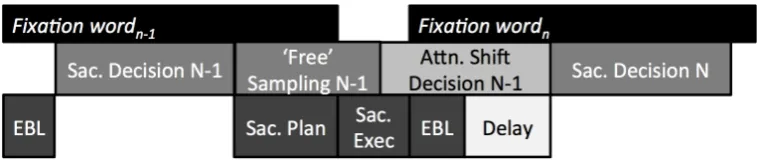
Figure 2: Example dynamics of a decision to saccade from wordn−1 to wordn. The memory-driven
attention shift decision can delay the start of perceptual sampling on the next word, potentially creating spillover. A detailed description of the dynamics depicted in this figure is in§4.
memory explanation warrants consideration. We now summarize unpublished data consistent with these findings in a simple linguistic task that we also use to test the new model reported below.
Spillover in the List Lexical Decision Task
(LLDT). We use the List Lexical Decision Task
(LLDT) (Lewis et al., 2013), an extension of a task introduced by Meyer and Schvaneveldt (1971). In the LLDT participants must determine whether a list of six strings contains all words, or con-tains a single nonword. All strings are four char-acters in length and separated by six character spaces. The task was designed to require sequen-tial eye-movements and contact with the mental lexicon (but not higher-level linguistic process-ing), to minimize parafoveal processing (via the wide spacing), and to yield a high proportion of single-fixation durations (via short strings).
Two versions of the task were performed by separate participant groups. In the masked con-dition, we used a gaze-contingent moving window paradigm wherein all strings but the fixated string were replaced with hashmarks (####). In the un-masked condition, all six strings remained visible. Figure 1 shows the effects of word frequency on single fixation durations. The main result of cur-rent interest is that frequency spillover is evident in both conditions, despite the wide spacing in the unmasked condition, and the complete denial of parafoveal preview in the masked condition.
The work reviewed above and our new data are consistent with an account of spillover in which both parafoveal preview (if available) and memory-based processing are operative. Our con-cern here is with the latter: understanding how a noisy memory of recently seen stimuli might be incorporated into an adaptive oculomotor architec-ture, and exploring whether rational exploitation of that memory might lead to spillover.
4 A model of saccadic control with noisy memory for recent perception
Our new model extends the one presented in Lewis et al. (2013) to include a noisy memory that buffers perceptual input. We develop it in the con-text of the LLDT, but its essential elements are not tied to this task. It is most easily understood by first considering the dynamics of a single decision to saccade from one word to the next, as presented in Figure 2. After describing these dynamics we summarize the model’s key assumptions and asso-ciated mathematical specification.
The dynamics of a decision to saccade from
wordn−1 to wordn. The eye first fixates
wordn−1. Some time passes before information
from the retina becomes available for perceptual processing (the eye-brain lag, EBL in Figure 2). A sequence of noisy perceptual samples then arrive and are integrated via an incremental and noisy Bayesian update of a probability distribution over lexical hypotheses in a manner described below. The perceptual samples are also buffered by stor-ing them in a memory that contains samples from only one word. When the probability of one of the hypotheses reaches thesaccade threshold, saccade planning is initiated. Perceptual sampling (marked asfree samplingin Figure 2 because its length is not under adaptive control) continues in parallel with saccade planning until the fixation ends, and then for another EBL amount longer (these are samples received at the retina during the fixation and only now arriving at the lexical processor).
eye-brain lag on wordnis completed. Perceptual
sam-ples from wordnwill not be processed until
atten-tion is shifted away from the memory-based pro-cessing of wordn−1. Thus the memory processing on wordn−1 may delay processing of perceptual samples from wordn; perceptual samples arriving
during this time are buffered in the memory. In this way the posterior update is a limited compu-tational resource and its relative allocation to per-ception or memory is determined by the saccade and attention shift thresholds. To the extent that the time to reach the attention shift threshold is sensitive to the frequency of wordn−1, the model may exhibit a spillover frequency effect.
Lexical processing as rise-to-threshold
deci-sionmaking. The decisions to plan a saccade,
shift attention, and make a motor response are re-alized as Multi-hypothesis Sequential Probability Ratio Tests (Baum and Veeravalli, 1994; Dragalin et al., 2000). At each timestep, the model per-forms a Bayes update based on a noisy sample drawn from perception or memory, with the pos-terior at each timestep becoming the prior for the next timestep. Our choice of word representation follows Norris (2006) in representing a letter as a unit-basis vector encoding and a word as a con-catenation of such vectors.
To generate a perceptual sample, mean-zero Gaussian perception noise with standard devia-tion (SD) σp is added to each component of the
word representation vector. Each perceptual sam-ple is also stored in a memory buffer, and mem-ory samples are generated by uniformly draw-ing a stored sample from memory (with replace-ment), and adding an additional mean-zero Gaus-sian memory noise with SD σm to each
posi-tion. Before each Bayesian update, whether us-ing a sample from perception or memory, mean-zero Gaussianupdate noisewith SDσuis added to
each component of the word representation vector. Thus a Bayes update from a perceptual sample in-cludes two noise terms, while a Bayes update from a memory sample includes three noise terms. All noises are drawn independently. The three SD’s,
σp, σmandσu, are free parameters in the model,
and we explore their implications below.
The model uses the update specified in the ap-pendix in Lewis et al. (2013) except for the noise generation specified above and the consequent change in the likelihood computation. The lexical
hypotheses are updated as follows:
P rnew(Sk|sk,T) = P r(s
k|Sk,T)P r
old(Sk,T)
P
SP r(sk|Sk,T)P rold(Sk,T) (1) whereskis a sample generated as above from the
letterstring (word or nonword) in the current posi-tionk,Skis the hypothesis that the string at
posi-tionkisS, andT is a multinomial distribution re-flecting the current belief of (a) whether this is an all-words trial and (b) otherwise, where the non-word is located. The eye movement planning and attention shift decisions are conditioned on the dis-tribution of probabilitiesP r(Sk)for all strings in
the current position. When the maximum of these probabilities crosses a saccade planning threshold
θs, saccade planning begins. When the maximum
crosses the attention shift threshold θa, attention
shifts to the next word1. Each sample takes 10ms, a fixed discretization parameter.
The likelihood of drawing perceptual or mem-ory samplesfor a stringS is computed from the unit-basis word representation as follows:
P r(s|S) =Y
i
f(si;µi, σ) (2)
where iindexes the unit-basis vector representa-tion of samplesand some true letterstringS(and so µi is either 0 or 1), σ is the sampling noise
(dependent on whether the samples are memory or perceptual samples as specified below), and
f(x;µ, σ)is the probability density function of the normal distribution with meanµand standard de-viationσ.
We simplify the likelihood computation for memory samples by treating the perception and memory samples as independent. For present purposes this assumption may be treated as a bound on the architecture. The σ in Equa-tion 2 isq(σ2
p+σ2u)for perceptual samples and
q
(σ2
p+σm2 +σu2) for memory samples. At each
sample the string-level probabilities in each posi-tion are aggregated to the multinomial trial-level decision variableT as described above. GivenT
the model computes the probability of a word trial
P r(W) or nonword trialP r(N) = 1−P r(W). When either of these probabilities exceeds the mo-tor response threshold θr, motor response
plan-ning commences.
0.5 1.5 2.5
●
● ● ● ● ● ●
● ● ● ●
● ● ● ● ●
● ● ● ● ● ●
● ● ● ● ● ●
● ● ● ● ● ● ● ●
● ● ●
● ● ● ●
● ● ● ● ●
● ● ● ●
● ● ● ● ● ● ●
● ● ●
● ● ● ●
● ● ●
● ● ●
● ● ● 0
20 40 60
0 20 40 60
0 20 40 60
0.5
1.5
2.5
0.5 1.5 2.5 0.5 1.5 2.5 0.5 1.5 2.5
Update Noise
Spillo
ver Eff
ect
P
erceptual Noise
[image:5.595.80.517.69.232.2]Memory Noise
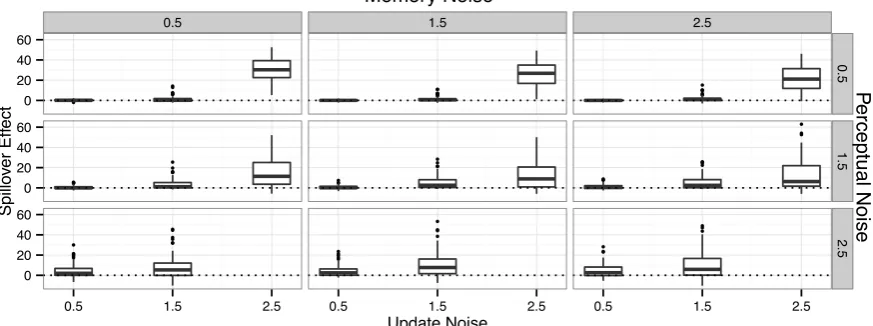
Figure 3: Spillover effects generated by the top 5% of policies across different settings of memory, per-ception, and update noise. On each distinct machine defined by a combination of noise settings, policies (settings ofθs, θm, θr) were evaluated by the same task payoff given to human participants in the
exper-iment described in§3. Boxplots show spillover effects of the top-performing 5% of policies. Spillover effects are the difference in mean single fixation durations on wordn when wordn−1 is low frequency and when wordn−1is high frequency (low/high determined by median split). The highest noise settings in the bottom row are not shown because performance was near-chance even for the best policies.
The prior probability of an all-words trial is 0.5, so the prior probability of a word in each position
kis1−0.5
6 . Therefore, we set the prior probabili-ties of words in each position to corpus frequency counts (Kuˇcera and Francis, 1967), normalized to sum to this value,1−0.5
6 . Nonword probabilities are uniformly distributed over the remainder, 0.5
6 .
Oculomotor and Manual Architecture. The
remainder of the architectural parameters are stage durations that are simulated as gamma deviates with means based on previous work or indepen-dently estimated from data. The key parameters for present purposes are the 50ms mean eye-brain lag and 125ms saccade planning time, following Reichle et al. (2009), and the 40ms mean sac-cade execution time, based on estimates from our own human participants. The standard deviation of each distribution is 0.3 times the mean. We transform the means and standard deviations into scale and shape parameters for a Gamma distri-bution and then draw duration values from these Gammas independently for every word and trial.
5 A computational rationality analysis We explore whether spillover effects might be a signature of computationally rational behavior in two ways. First, we evaluate a space of policies (parameterized byθs, θm, θr) against the task
pay-off given to our human participants, and show that
top-performing policies yield frequency spillover consistent with human data, and poor-performing policies do not. Second, we extend the model’s policy space to allow it to prioritize perception over memory samples when both are available (eliminating spillover in those policies), and show that the spillover portions of the policy space per-form better than non-spillover ones under any im-posed speed-accuracy tradeoff in plausible noise settings, and never perform worse.
●
● ●
● ● ●
● ● ●
−2 0 2 4 6
0.5 1.0 1.5 2.0 2.5
Memory Noise
Mean Ratio of N
−
1 to
N Frequency Eff
ect Best 5% of policiesBest 5% of policies with
memory threshold = 0 Bottom 50% of policies
Model
●
● ●
masked unmasked
[image:6.595.83.514.63.220.2]Humans
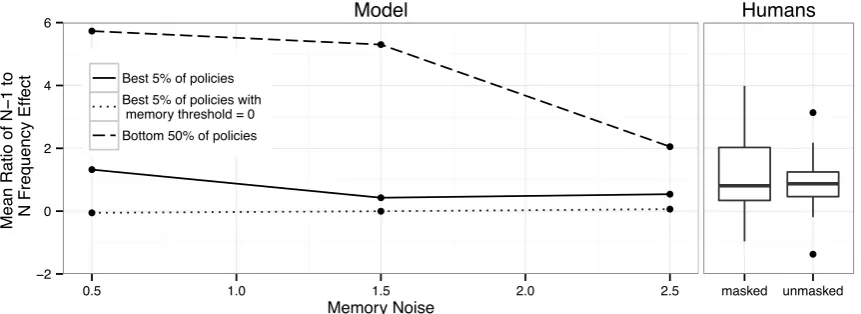
Figure 4: Normalized spillover effect in model (vs. memory noise) and human participants. We define normalized spillover as the ratio of the spillover (wordn−1) frequency effect size to the foveal (wordn)
frequency effect size; this normalizes against scale differences between high and low noise architectures.
Left: Mean normalized spillover effect at different memory noises for best performing 5% of policies with and without memory sampling, and worst 50% performing policies. Right: Mean human spillover effect sizes in masked and unmasked versions of LLDT.
payoff given to our participants in the unpublished masking experiment described above. We ex-plored a discretized policy space as follows: we let
θsrange between 0.199 and 0.999 in steps of 0.05;
θmbetween 0.19999 and 0.99999 in steps of 0.05,
and also includeθm = 0which prevents memory
sampling; andθrbetween 0.599 and 0.999 in steps
of 0.1. We explored all 1530 permutations. Figure 3 shows the distribution of spillover ef-fect sizes in the top 5% of policies (evaluated by task payoff, not fit to human data), for a range of noise parameter settings (at higher noise set-tings, even the best policies are close to chance performance). The top 5% of policies average 7.78 points per trial across the noise and policy range, and the bottom 50% average 1.32 points. The fig-ure shows that top-performing policies show lit-tle to no spillover when update noise is low, posi-tive but small spillover effects when update noise is moderate, and sizable positive spillover effects when update noise is relatively high. These results are consistent with spillover as a rational adapta-tion to belief update noise.
Figure 4 (left panel) shows normalized spillover effects (the ratio of the wordn−1 frequency effect to the wordn frequency effect) for the best
poli-cies, the bottom 50% of polipoli-cies, and the best policies constrained with a memory threshold of zero (θm = 0). Whenθm = 0, the spillover
ef-fect is zero as expected. The top performing poli-cies in the unconstrained space generate nonzero spillover effects that are consistent with the human
data, but the poor performing policies do not (Fig-ure 4, right panel). We know that the top perform-ing policies exploit memory because they do yield nonzero spillover effects, and the values ofθmare
nonzero for these policies.
Our second evaluation asks whether a model that is constrained to always give priority to pro-cessing perceptual samples over memory samples will perform better than the present model, which has the flexibility to give priority to memory over perception. To explore this, we added a single bi-nary policy parameter, theperceptual prioritybit. If this bit is set, then the model has the choice be-tween memory sampling from wordn−1 and per-ceptual sampling from wordn, it always chooses
the latter. Such an option is not available in the previous model—there is no setting of the saccade and memory thresholds that will always use mem-ory samples when only they are available, but also never choose to use memory samples when per-ceptual samples can be used. With the perper-ceptual priority bit set, the model is capable of exploiting the least noisy samples available to it, but is inca-pable of exhibiting spillover effects.
0.5, 0.5, 0.5 0.5, 0.5, 2.5 1.5, 1.5, 1.5
0.5 0.6 0.7 0.8 0.9 1.0
1000 2000 3000 1000 2000 3000 1000 2000 3000
RT
Accur
acy
spillover <= 5ms spillover > 5ms
[image:7.595.87.495.74.201.2]Spillover−capable spillover−incapable
Figure 5: Speed-accuracy tradeoff curves for some representative noise settings. Each individual point corresponds to one policy (i.e. setting of the three decision thresholds). Plotted are mean trial RT and accuracy (computed from 5000 simulated trials), color-coded by whether the policies yielded spillover frequency effects. Lines mark the best speed-accuracy tradeoff available to spillover-capable and inca-pable policies. Each plot is labeled at the top with the noise setting(perceptual, memory, update).
both spillover-capable and -incapable policies. In the left plot of the figure, noise is low enough over-all such that responses are very fast and spillover-capable policies do no worse and no better than spillover-incapable policies. In the middle plot, update noise is higher, and the optimal speed-accuracy tradeoff is better for the model that can yield spillover, consistent with the exploitation of memory sampling to mitigate update noise. In the right plot, perception and memory noise are high enough that it is not useful to sample from mem-ory at the expense of perception. All the noise settings we explored (see Figure 3 for the range) yield one of these three patterns, or the uninter-esting case of near-chance performance. In no setting does the spillover-capable model perform worse than the spillover-incapable one. The noise settings cover a range from implausibly-high ac-curacy to chance performance, and so we con-clude that spillover-capable policies dominate, in that they do no worse, and occasionally do better, than those constrained to give priority to percep-tion over memory.
6 Why spillover arises from sequenced thresholded samplers
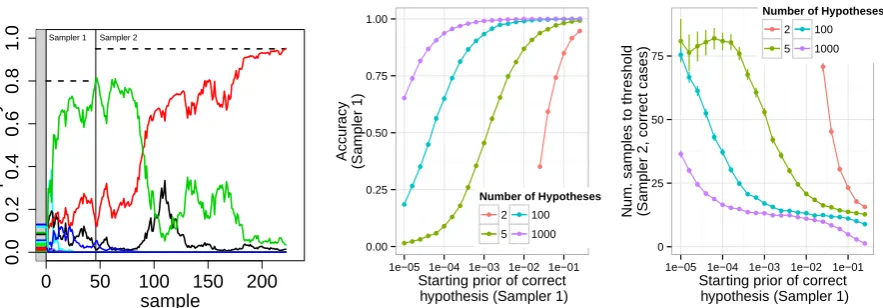
We have demonstrated through simulations that the model yields frequency spillover through a composed sequence of perception and memory sampling. We have not yet addressed the ques-tion of how or why this happens. Indeed, it is ini-tially somewhat puzzling that an effect of priors (set by lexical frequency) would persist after the initial perceptual sampling thresholdθpis passed,
because this fixed threshold must be exceeded no matter the starting prior.
The crucial insight is that it is not always the case that the true word hypothesis reaches the threshold first; i.e., the decision to initiate saccade planning may be based on (partial) recognition of a different word than the true word. In such cases, at the start of memory sampling, the hypothesis for the true word is farther from the memory threshold
θmthan if the true word had been (partially)
recog-nized. Incorrect decisions are more likely for low frequency words, so in expectation the memory-driven attention shift mechanism will start farther from its threshold for low-frequency words, and therefore take longer to reach threshold, delaying the following word more.
0 50 100 150 200 0.0 0.2 0.4 0.6 0.8 1.0 sample probability
Sampler 1 Sampler 2 ●●
● ● ● ● ● ● ● ● ● ● ● ● ● ● ● ● ● ● ● ● ● ● ● ● ● ● ● ● ● ● ● ● ● ● ● ● ● ● ● ● ● ● ● ● ● ● ● ● ● ● ● ● ● ● ● ● ● ● ● ● ● ● ● ● ● ● ● ● ● ● ● ● ● 0.00 0.25 0.50 0.75 1.00
1e−05 1e−04 1e−03 1e−02 1e−01
Starting prior of correct hypothesis (Sampler 1)
Accur
acy
(Sampler 1)
Number of Hypotheses
● ● ● ● 2 5 100 1000 ● ● ● ● ● ● ● ● ● ● ● ● ● ● ● ● ● ● ● ● ● ● ● ● ● ● ● ● ● ● ● ● ● ● ● ● ● ● ● ● ● ● ● ● ● ● ● ● ● ● ● ● ● ● ● ● ● ● ● ● ● ● ● ● ● ● ● ● ● ● ● ● ● ● ● 0 25 50 75
1e−05 1e−04 1e−03 1e−02 1e−01
Starting prior of correct hypothesis (Sampler 1) Num. samples to threshold (Sampler 2, correct cases)
Number of Hypotheses
[image:8.595.80.522.67.221.2]● ● ● ● 2 5 100 1000
Figure 6:A simple example illustrating how the prior for a thresholded sampler affects its final posterior, and therefore the prior for a subsequent coupled sampler, despite the fixed threshold. Left: An example ‘recovery’ trial for 500 hypotheses (words). Middle: Accuracy for the first sampler as a function of the prior of the true hypothesis.Right: Second sampler finishing times as a function of to the true-hypothesis prior in the first sampler.
7 Discussion and Conclusion
We briefly highlight the key properties of the model that yield our result and how they may gen-eralize beyond our particular implementation.
Post-perceptual processing. Although we adopted a second MSPRT sampler, spillover may arise from other processes with access to the pos-terior of the perceptual sampling, such that it can recover from perceptually misidentified words. In the present model we investigated the possibil-ity that post-perceptual memory-based processing could be partially motivated by mitigating noise in the update process itself. But it is almost cer-tainly the case that post-perceptual processing is required in the course of reading for indepen-dent reasons, and such processing could also yield spillover frequency effects in a way that the mem-ory sampling process does. (A challenge for such an alternate process is that spillover effects per-sist in the LLDT in the absence of required higher level syntactic or semantic processing).
A tradeoff between processing perception and memory. The serial queuing model is a simple re-alization (inspired by EZ-Reader (Reichle et al., 1998)) of a limited resource that can be allocated to perceptual and memory processing, but an alter-native parallel attention machine might recover the results, as long as it suffers from the same tradeoff that processing the previous word from memory will slow down processing of the fixated word.
Direct oculomotor control.In the present model saccade planning is triggered directly by the
per-ceptual evidence accumulation process, and as such is not obviously compatible with autonomous saccade generation models like SWIFT (Engbert et al., 2005). It may be possible to layer SWIFT’s time-delayed foveal inhibition over a sequential sampling process, but we note that spillover ef-fects were part of the empirical motivation for such delayed control.
The present model and results open several av-enues for future work. These include the interac-tions of memory-based or post-perceptual process-ing with models of saccade plannprocess-ing that include saccade targeting, re-targeting, and cancellation, as well as buttonpress behavior (e.g. in the self-paced moving window paradigm). The role that parafoveal preview plays in spillover effects can also be explored, including how the model (and thus human participants) might navigate the trade-off between using parafoveal preview information (noisy due to eccentricity) and using memory of past input in the service of a reading task. Fi-nally, it is possible to explore the spillover expla-nation in an architecture capable of higher-level sentence processing in service of different reading task goals.
Acknowledgments
References
C.W. Baum and V.V. Veeravalli. 1994. A sequential
procedure for multihypothesis testing. IEEE
Trans-actions on Information Theory, 40(6):1994–2007.
Vladimir P Dragalin, Alexander G Tartakovsky, Venu-gopal V Veeravalli, and Senior Member. 2000. Mul-tihypothesis Sequential Probability Ratio Tests Part II : Accurate Asymptotic Expansions for the
Ex-pected Sample Size. IEEE Transactions on
Infor-mation Theory, 46(4):1366–1383.
Ralf Engbert, Antje Nuthmann, Eike M. Richter, and Reinhold Kliegl. 2005. SWIFT: a dynamical model
of saccade generation during reading. Psychological
review, 112(4):777–813, October.
John M. Henderson and Fernanda Ferreira. 1990. Effects of foveal processing difficulty on the per-ceptual span in reading: Implications for attention
and eye movement control. Journal of
Experimen-tal Psychology: Learning, Memory, and Cognition,
16(3):417–429.
Sheila M. Kennison and Charles Clifton. 1995. De-terminants of parafoveal preview benefit in high and low working memory capacity readers: implications
for eye movement control. Journal of
experimen-tal psychology. Learning, memory, and cognition,
21(1):68–81, January.
Henry Kuˇcera and W. Nelson Francis. 1967.
Compu-tational analysis of present-day American English. Brown University Press, Providence, RI.
Richard L. Lewis, Michael Shvartsman, and Satinder Singh. 2013. The Adaptive Nature of Eye Move-ments in Linguistic Tasks: How Payoff and
Archi-tecture Shape Speed-Accuracy Trade-Offs. Topics
in cognitive science, pages 1–30, June.
Richard L. Lewis, Andrew Howes, and Satinder Singh.
to appear. Computational rationality: Linking
mechanism and behavior through utility
maximiza-tion. Topics in Cognitive Science.
David E. Meyer and Roger Schvaneveldt. 1971. Fa-cilitation in recognizing pairs of words: Evidence of
a dependence between retrieval operations. Journal
of Experimental Psychology, 90:22–34.
Dennis Norris. 2006. The Bayesian reader: explain-ing word recognition as an optimal Bayesian
de-cision process. Psychological review, 113(2):327–
357, April.
Keith Rayner and Martin H. Fischer. 1996. Mind-less reading revisited: eye movements during
read-ing and scannread-ing are different. Perception &
psy-chophysics, 58(5):734–47, July.
Keith Rayner, Arnold D. Well, and Alexander Pollat-sek. 1980. Asymmetry of the effective visual field
in reading. Perception & psychophysics, 27(6):537–
44, June.
Keith Rayner. 1975. The perceptual span and
periph-eral cues in reading. Cognitive Psychology, 7(1):65–
81, January.
E D Reichle, a Pollatsek, D L Fisher, and K Rayner. 1998. Toward a model of eye movement control in
reading. Psychological review, 105(1):125–57,
Jan-uary.
Erik D. Reichle, Tessa Warren, and Kerry McConnell. 2009. Using E-Z Reader to model the effects of higher level language processing on eye movements
during reading. Psychonomic bulletin & review,
16(1):1–21, February.
Walter Schroyens, Franc¸oise Vitu, Marc Brysbaert, and G´ery D’Ydewalle. 1999. Eye movement control during reading: foveal load and parafoveal process-ing. The Quarterly journal of experimental
psychol-ogy, 52(4):1021–46, November.
Sarah J. White, Keith Rayner, and Simon P. Liv-ersedge. 2005. Eye movements and the modulation of parafoveal processing by foveal processing
dif-ficulty: A reexamination. Psychonomic bulletin &
review, 12(5):891–6, October.
Christiane Wotschack. 2009.Eye Movements in