A Multilingual Evaluation of Three Spelling Normalisation
Methods for Historical Text
Eva Pettersson1,2, Beáta Megyesi1and Joakim Nivre1
(1) Department of Linguistics and Philology Uppsala University
(2) Swedish National Graduate School of Language Technology
Abstract
We present a multilingual evaluation of approaches for spelling normalisation of historical text based on data from five languages: English, German, Hungarian, Icelandic, and Swedish. Three different normalisation methods are evaluated: a simplistic filtering model, a Levenshtein-based approach, and a character-Levenshtein-based sta-tistical machine translation approach. The evaluation shows that the machine transla-tion approach often gives the best results, but also that all approaches improve over the baseline and that no single method works best for all languages.
1 Introduction
Language technology for historical text is a field of research imposing a variety of challenges. Nev-ertheless, there is an increasing need for natural language processing (NLP) tools adapted to his-torical texts, as an aid for researchers in the hu-manities field. For example, the historians in the Gender and Work project are studying what men and women did for a living in the Early Mod-ern Swedish society (Ågren et al., 2011). In this project, researchers have found that the most im-portant words in revealing this information are verbs such asfishing,sellingetc. Instead of man-ually going through written sources from this time period, it is therefore assumed that an NLP tool that automatically searches through a number of historical documents and presents the contained verbs (and possibly their complements), would make the process of finding relevant text passages more effective.
A major challenge in developing language tech-nology for historical text is that historical language often is under-resourced with regard to annotated data needed for training NLP tools. This
prob-lem is further aggravated by the fact that histori-cal texts may refer to texts from a long period of time, during which language has changed. NLP tools trained on 13th century texts may thus not perform well on texts from the 18th century. Fur-thermore, historical language usually shows a sub-stantial variation in spelling and grammar between different genres, different authors and even within the same text written by the same author, due to the lack of spelling conventions.
To deal with the limited resources and the high degree of spelling variation, one commonly ap-plied approach is to automatically normalise the original spelling to a more modern spelling, be-fore applying the NLP tools. This way, NLP tools available for the modern language may be used to analyse historical text. Even though there may be structural differences as well between histor-ical and modern language, spelling is the most striking difference. Moreover, language technol-ogy tools such as taggers often to some degree rely on statistics on word form n-grams and to-ken frequencies, implying that spelling moderni-sation is an important step for improving the per-formance of such tools when applied to historical text. This paper presents an evaluation of three approaches to spelling normalisation: 1) a filter-ing approach based on corpus data, 2) an approach based on Levenshtein edit distance, and 3) an approach implementing character-based statistical machine translation (SMT) techniques. These ap-proaches have previously solely been evaluated in isolation, without comparison to each other, and for one or two languages only. We compare the results of the different methods in a multilingual evaluation including five languages, and we show that all three approaches have a positive impact on normalisation accuracy as compared to the base-line. There is no single method that yields the highest normalisation accuracy for all languages, but for four out of five languages within the scope
of our study, the SMT-based approach gives the best results.
2 Related Work
Spelling normalisation of historical text has pre-viously been approached using techniques such as dictionary lookup, edit distance calculations, and machine translation.
Rayson et al. (2005) tried an approach based on dictionary lookup, where a mapping scheme from historical to modern spelling for 16th to 19th cen-tury English texts was manually created, resulting in the VARD tool (VARiant Detector) comprising 45,805 entries. The performance of the normal-isation tool was evaluated on a set of 17th cen-tury texts, and compared to the performance of modern spell checkers on the same text. The re-sults showed that between a third and a half of all tokens (depending on which test text was used) were correctly normalised by both VARD and MS Word, whereas approximately one third of the to-kens were correctly normalised only when using VARD. The percentage of tokens correctly nor-malised only by MS Word was substantially lower; approximately 6%. VARD was later further devel-oped into VARD2, combining the original word list with data-driven techniques in the form of pho-netic matching against a modern dictionary, and letter replacement rules based on common spelling variation patterns (Baron and Rayson, 2008).
Jurish (2008) argued that due to the lack of or-thographic conventions, spelling generally reflects the phonetic form of the word to a higher de-gree in historical text. Furthermore, it is assumed that phonetic properties are less resistant to di-achronic change than orthography. Accordingly, Jurish explored the idea of comparing the simi-larity between phonetic forms rather than ortho-graphic forms. For grapheme-to-phoneme conver-sion, a module of the IMS German Festival text-to-speech system (Black and Taylor, 1997) was used, with a rule-set adapted to historical word forms. Evaluation was performed on a corpus of historical German verse quotations extracted from
Deutsches Wörterbuch, containing 5,491,982 to-kens (318,383 types). Without normalisation, ap-proximately 84% of the tokens were recognised by a morphological analyser. After normalisa-tion, 92% of the tokens were recognised. Adding lemma-based heuristics, coverage increased fur-ther to 94% of the tokens.
A Levenshtein similarity approach to normal-isation was presented by Bollmann et al. (2011) for Early New High German, where Levenshtein-based normalisation rules were automatically de-rived from a word-aligned parallel corpus consist-ing of the Martin Luther Bible in its 1545 edi-tion and its 1892 version, respectively. Using this normalisation technique, the proportion of words with a spelling identical to the modern spelling in-creased from 65% in the original text to 91% in the normalised text. This normalisation method was further evaluated by Bollmann (2013), comparing the performance of the RFTagger applied to histor-ical text before and after normalisation. For every evaluation text, the tagger was trained on between 100 and 1,000 manually normalised tokens, and evaluated on the remaining tokens in the same text. For one manuscript from the 15th century, tagging accuracy was improved from approximately 29% to 78% using this method.
Another Levenshtein-based approach to nor-malisation was presented by Pettersson et al. (2013b), using context-sensitive, weighted edit distance calculations combined with compound splitting. This method requires no annotated his-torical training data, since normalisation candi-dates are extracted by Levenshtein comparisons between the original historical word form and present-day dictionary entries. However, if a cor-pus of manually normalised historical text is avail-able, this can optionally be included for dictio-nary lookup and weighted Levenshtein calcula-tions, improving precision. This technique was evaluated for Early Modern Swedish, and in the best setting, the proportion of words in the his-torical text with a spelling identical to the mod-ern gold standard spelling increased from 64.6% to 86.9%.
Pettersson et al. (2013a) treated the normalisa-tion task as a translanormalisa-tion problem, using character-based SMT techniques in the spelling normalisa-tion process. With the SMT-based approach, the proportion of tokens in the historical text with a spelling identical to the modern gold standard spelling increased from 64.6% to 92.3% for Early Modern Swedish, and from 64.8% to 83.9% for 15th century Icelandic. It was also shown that nor-malisation had a positive effect on subsequent tag-ging and parsing.
for handling present-day SMS messages and mi-croblog text such as Twitter. In both genres there is a high degree of spelling variation, ad hoc ab-breviations and ungrammatical structures impos-ing the problem of data sparseness. Similar meth-ods for spelling normalisation may thus be used for both tasks. Han and Baldwin (2011) pre-sented a method for normalising SMS and Twitter text based on morphophonemic similarity, com-bining lexical edit distance, phonemic edit dis-tance, prefix substring, suffix substring, and the longest common subsequence. Context was taken into account by means of dependency structures generated by the Stanford Parser applied to a cor-pus of New York Times articles. In the best set-ting, a token-level F-score of 75.5% and 75.3% was reported for SMS messages and Twitter texts respectively.
3 Approaches
3.1 The Filtering Approach
The filtering approach presupposes access to a par-allel training corpus of token pairs with historical word forms mapped to their modernised spelling. In the normalisation process, whenever a token is encountered that also occurred in the training data, the most frequent modern spelling associated with that token in the training corpus is chosen for nor-malisation. Other tokens are left unchanged.
3.2 The Levenshtein-based Approach
The Levenshtein-based approach was originally presented by Pettersson et al. (2013b). In its basic version, no historical training data is needed, which is an important aspect considering the common data sparseness issue, as discussed in Section 1. Instead, a modern language dictionary or corpus is required, from which normalisation candidates are extracted based on edit distance comparisons to the original historical word form. If there is parallel data available, i.e. the same text in its historical and its modernised spelling, this data can be used to make more reliable Lev-enshtein calculations by assigning weights lower than 1 to frequently occurring edits observed in the training data. The weights are then calculated by comparing the frequency of each edit occurring in the training corpus to the frequency with which the specific source characters are left unchanged, in accordance with the following formula:
Frequency of Unchanged
Frequency of Edit + Frequency of Unchanged
Context-sensitive weights are added to handle ed-its affecting more than one character. The context-sensitive weights are calculated by the same for-mula as the single-character weights, and include the following operations:
• double deletion:personnes→persons
• double insertion:strait→straight
• single-to-double substitution:juge→judge
• double-to-single substitution:moost→most
For all historical word forms in the training cor-pus that are not identical in the modern spelling, all possible single-character edits as well as multi-character edits are counted for weighting. Hence, the historical word form personnes, mapped to the modern spelling persons, will yield weights for double-to-single deletion of-ne, as illustrated above, but also for single deletion of-nand single deletion of-e.
Finally, a tuning corpus is used to set a threshold for which maximum edit distance to allow between the original word form and its normalisation candidate(s). Based on the average edit distance between the historical word forms and their modern spelling in the tuning corpus, the threshold is calculated by the following formula (where 1.96 times the stan-dard deviation is added to cover 95% of the cases):
avg editdistance+(1.96∗standard deviation)
If several normalisation candidates have the same edit distance as compared to the source word, the most frequent candidate is chosen, based on mod-ern corpus data. If none of the highest-ranked nor-malisation candidates are present in the corpus, or if there are several candidates with the same fre-quency distribution, a final candidate is randomly chosen.
3.3 The SMT-based Approach
character-level translation between closely related languages (Matthews, 2007; Vilar et al., 2007; Nakov and Tiedemann, 2012). In character-level SMT, phrases are modeled as character sequences instead of word sequences, and translation models are trained on character-aligned parallel corpora whereas language models are trained on character N-grams.
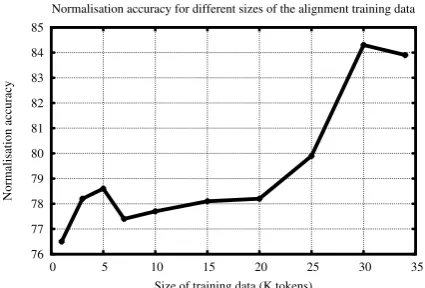
Since the set of possible characters in a lan-guage is far more limited than the number of pos-sible word forms, and the same corpus will present a larger quantity of character instances than token instances, only a rather small amount of parallel data is needed for training the translation models and the language models in character-based trans-lation. Pettersson et al. (2013a) showed that with a training and tuning set of only 1,000 pairs of his-torical word forms mapped to modern spelling, a normalisation accuracy of 76.5% was achieved for Icelandic, as compared to 83.9% with a full-sized training corpus of 33,888 token pairs. Their full experiment on varying the size of the training data is illustrated in Figure 1.
76 77 78 79 80 81 82 83 84 85
0 5 10 15 20 25 30 35
Normalisation accuracy
Size of training data (K tokens)
[image:4.595.81.294.409.553.2]Normalisation accuracy for different sizes of the alignment training data
Figure 1: Normalisation accuracy when varying the size of the alignment training data.
We use the same set of training data for the SMT approach as for the filtering approach and for the assignment of weights in the Levenshtein-based approach, i.e. a set of token pairs mapping his-torical word forms to their manually modernised spelling. These corpora have the format of one to-ken per line, with blank lines separating sentences. To fully adapt this format to the format needed for training the character-based translation mod-els, the characters within each token are separated by space. The SMT system will now regard each
character as a word, the full token as a sentence and the entire sentence as a section.
The SMT engine used is Moses with all its stan-dard components. A phrase-based model is ap-plied, where the feature weights are trained us-ing MERT with BLEU over character-sequences as the objective function. The maximum size of a phrase (sequence of characters) is set to 10.
Two different character alignment techniques are tested: (i) the word alignment toolkit GIZA++ (Och and Ney, 2000), and (ii) a weighted finite state transducer implemented in the m2m-aligner (Jiampojamarn et al., 2007). GIZA is run with standard word alignment models for character un-igrams and bun-igrams, whereas the m2m aligner implements transducer models based on context-independent single character and multi-character edit operations. The transducer is trained us-ing EM on (unaligned) parallel trainus-ing data, and the final model can then be used to produce a Viterbi alignment between given pairs of charac-ter strings.
An example is given in Figure 2, where the Ice-landic word formsmeðr→meðurandgiallda→
galdahave been aligned at a character-level using the m2m-aligner. In this example, the symbol represents empty alignments, meaning insertions or deletions. The symbol in the source word
meðrdenotes the insertion ofuin the target word
meður. Likewise, thesymbol in the target word
galdadenotes the deletion ofias compared to the source wordgiallda. Furthermore, the alignment of giallda to galda illustrates the inclusion of multi-character edit operations, where the colon denotes a 2:1 alignment where both letterslandd
in the source word correspond to the single letter
din the target word.
m|e|ð||r| m|e|ð|u|r| g|i|a|l|l:d|a| g||a|l|d|a| Figure 2: m2m character-level alignment.
4 Data
tun-ing and evaluation corpora, which are well-known concepts within SMT. These data sets have been created by extracting every 9th sentence from the total corpus to the tuning corpus, and every 10th sentence to the evaluation corpus, whereas the rest of the sentences have been extracted to a training corpus.1
In the filtering approach, there is in fact no distinction between training and tuning corpora, since both data sets are combined in the dictionary lookup process. As for the Levenshtein edit dis-tance approach, the training corpus is used for ex-tracting single-character and multi-character edits by comparing the historical word forms to their modern spelling. The edits extracted from the training corpus are then weighted based on their relative frequency in the tuning corpus.
The historical texts used for training and evalu-ation are required to be available both in their orig-inal, historical spelling and in a manually mod-ernised and validated spelling. A modern trans-lation of a historical text is generally not usable, since word order and sentence structure have to re-main the same to enable training and evaluation of the proposed methods. The access to such data is very limited, meaning that the data sets used in our experiments vary in size, genres and time periods between the languages.
4.1 English
For training, tuning and evaluation in the En-glish experiments, we use the Innsbruck Cor-pus of English Letters, a manually normalised collection of letters from the period 1386–1698. This corpus is a subset of the Innsbruck Com-puter Archive of Machine-Readable English Texts, ICAMET (Markus, 1999). A subset of the British National Corpus (BNC) is used as the single mod-ern language resource both for the Levenshtein-based and for the SMT-Levenshtein-based approach. Table 1 presents in more detail the data sets used in the English experiments.
4.2 German
For training, tuning and evaluation in the German experiments, we use a manually normalised sub-set of theGerManCcorpus of German texts from the period 1650–1800 (Scheible et al., 2011). This subset contains 22 texts from the period 1659– 1780, within the genres of drama, newspaper text,
1For information on how to access the data sets used in
our experiments, please contact the authors.
Resource Data Tokens Types
[image:5.595.318.519.63.160.2]Training ICAMET 148,852 18,267 Tuning ICAMET 16,461 4,391 Evaluation ICAMET 17,791 4,573 Lev. dict. BNC 2,088,680 69,153 Lev. freq. BNC 2,088,680 69,153 SMT lm BNC 2,088,680 69,153
Table 1: Language resources for English.
letters, sermons, narrative prose, humanities, sci-ence och legal documents. The German Parole
corpus is used as the single modern language re-source both for the Levenshtein-based and for the SMT-based approach (Teubert (ed.), 2003). Table 2 presents in more detail the data sets used in the German experiments.
Resource Data Tokens Types
Training GerManC 39,887 9,055 Tuning GerManC 5,418 2,056 Evaluation GerManC 5,005 1,966 Lev. dict. Parole 18,662,243 662,510 Lev. freq. Parole 18,662,243 662,510 SMT lm Parole 18,662,243 662,510
Table 2: Language resources for German.
4.3 Hungarian
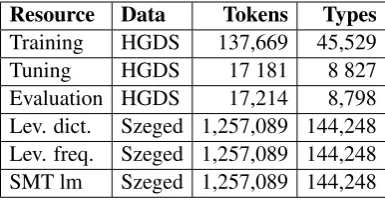
For training, tuning and evaluation in the Hungar-ian experiments, we use a collection of manually normalised codices from the Hungarian Gener-ative Diachronic Syntax project, HGDS (Simon, To appear), in total 11 codices from the time pe-riod 1440–1541. The Szeged Treebank is used as the single modern language resource both for the Levenshtein-based and for the SMT-based ap-proach (Csendes et al., 2005). Table 3 presents in more detail the data sets used in the Hungarian experiments.
Resource Data Tokens Types
Training HGDS 137,669 45,529 Tuning HGDS 17 181 8 827 Evaluation HGDS 17,214 8,798 Lev. dict. Szeged 1,257,089 144,248 Lev. freq. Szeged 1,257,089 144,248 SMT lm Szeged 1,257,089 144,248
[image:5.595.321.514.629.729.2]4.4 Icelandic
For training, tuning and evaluation in the Ice-landic experiments, we use a manually normalised subset of the Icelandic Parsed Historical Cor-pus(IcePaHC), a manually tagged and parsed di-achronic corpus of texts from the time period 1150–2008 (Rögnvaldsson et al., 2012). This sub-set contains four texts from the 15th century: three sagas (Vilhjálm’s saga,Jarlmann’s saga, and Ec-tor’s saga) and one narrative-religious text ( Miðal-daævintýri). As a dictionary for Levenshtein cal-culations we use a combination of Beygingar-lýsing Íslensks Nútímamáls, BÍN (a database of modern Icelandic inflectional forms (Bjarnadót-tir, 2012)), and all tokens occurring 100 times or more in theTagged Icelandic Corpus of Contem-porary Icelandic texts, MÍM (Helgadóttir et al., 2012).2 The frequency-based choice of a final
nor-malisation candidate in the Levenshtein approach, as well as the training of a language model in the SMT approach, are done on all tokens occurring 100 times or more in the MÍM corpus. Table 4 presents in more detail the data sets used in the Icelandic experiments.
Resource Data Tokens Types
Training IcePaHC 52,440 9,748
Tuning IcePaHC 6,443 2,270
Evaluation IcePaHC 6,384 2,244 Lev. dict. BÍN+MÍM 27,224,798 2,820,623 Lev. freq. MÍM 21,339,384 9,461
SMT lm MÍM 21,339,384 9,461
Table 4: Language resources for Icelandic.
4.5 Swedish
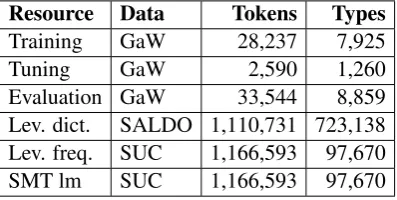
For training, tuning and evaluation in the Swedish experiments, we use balanced subsets of the Gen-der and Work corpus (GaW) of court records and church documents from the time period 1527– 1812 (Ågren et al., 2011). As a dictionary for Lev-enshtein calculations we use SALDO, a lexical re-source developed for present-day written Swedish (Borin et al., 2008). For frequency-based choice of a final normalisation candidate, we use the Stock-holm Umeå corpus (SUC) of text representative of the Swedish language in the 1990s (Ejerhed and Källgren, 1997). The SUC corpus is also used
2The BÍN database alone is not sufficient for Levenshtein
calculations, since it only contains content words.
to train a language model in the SMT-based ap-proach. Table 5 presents in more detail the data sets used in the Swedish experiments.
Resource Data Tokens Types
Training GaW 28,237 7,925
Tuning GaW 2,590 1,260
[image:6.595.319.518.117.217.2]Evaluation GaW 33,544 8,859 Lev. dict. SALDO 1,110,731 723,138 Lev. freq. SUC 1,166,593 97,670 SMT lm SUC 1,166,593 97,670
Table 5: Language resources for Swedish.
5 Results
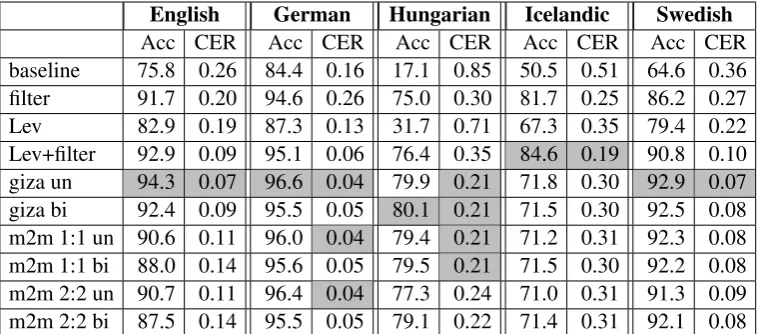
Table 6 presents the results for different languages and normalisation methods, given in terms of nor-malisation accuracy, i.e. the percentage of tokens in the normalised text with a spelling identical to the manually modernised gold standard, and
character error rate (CER), providing a more pre-cise estimation of the similarity between the nor-malised token and the gold standard version at a character level. Table 7 summarises the results in terms ofPrecision (Pre),Recall (Rec)andF-score (F) for the filtering approach, the Levenshtein-based approach (with and without filtering), and the best-performing SMT-based approach.
For the Levenshtein experiments, we have used context-sensitive weights, as described in Section 3.2. In the SMT approach, we run GIZA with standard word alignment models for character un-igrams (un) and bun-igrams (bi). The m2m aligner is implemented with single character edit operations (1:1) and multi-character operations (2:2).
The baseline case shows the proportion of to-kens in the original, historical text that already have a spelling identical to the modern gold stan-dard spelling. In the Hungarian text, only 17.1% of the historial tokens have a modern spelling, with a character error rate of 0.85. For German on the other hand, accuracy is as high as 84.4%, with a character error rate of only 0.16. At a first glance, the historical spelling in the Hungar-ian corpus appears to be very similar to the mod-ern spelling. A closer look however reveals re-current differences involving single letter substi-tutions and/or the use of accents, as forfiayval→
fiaival,m˙eghalanac→meghalánakandhazaba→
English German Hungarian Icelandic Swedish
Acc CER Acc CER Acc CER Acc CER Acc CER baseline 75.8 0.26 84.4 0.16 17.1 0.85 50.5 0.51 64.6 0.36 filter 91.7 0.20 94.6 0.26 75.0 0.30 81.7 0.25 86.2 0.27 Lev 82.9 0.19 87.3 0.13 31.7 0.71 67.3 0.35 79.4 0.22 Lev+filter 92.9 0.09 95.1 0.06 76.4 0.35 84.6 0.19 90.8 0.10 giza un 94.3 0.07 96.6 0.04 79.9 0.21 71.8 0.30 92.9 0.07 giza bi 92.4 0.09 95.5 0.05 80.1 0.21 71.5 0.30 92.5 0.08 m2m 1:1 un 90.6 0.11 96.0 0.04 79.4 0.21 71.2 0.31 92.3 0.08 m2m 1:1 bi 88.0 0.14 95.6 0.05 79.5 0.21 71.5 0.30 92.2 0.08 m2m 2:2 un 90.7 0.11 96.4 0.04 77.3 0.24 71.0 0.31 91.3 0.09 m2m 2:2 bi 87.5 0.14 95.5 0.05 79.1 0.22 71.4 0.31 92.1 0.08
Table 6: Normalisation results given in accuracy (Acc) and character error rate (CER).
English German Hungarian Icelandic Swedish
Pre Rec F Pre Rec F Pre Rec F Pre Rec F Pre Rec F
[image:7.595.111.490.62.229.2]filter 93.6 97.8 95.7 95.0 99.6 97.2 77.4 96.0 85.7 89.3 90.6 89.9 87.5 98.3 92.6 Lev 92.7 88.6 90.7 91.0 95.6 93.2 68.0 37.3 48.2 85.4 76.1 80.5 90.5 86.6 88.5 Lev+filter 97.4 95.2 96.3 97.3 97.7 97.5 96.2 78.8 86.7 95.6 88.0 91.7 96.6 93.8 95.2 SMT 98.2 95.9 97.0 98.7 97.9 98.3 98.3 81.3 89.0 82.0 85.2 83.6 98.6 94.1 96.3
Table 7: Normalisation results given in precision (Pre), recall (Rec) and F-score (F).
The Icelandic corpus also has a relatively low number of tokens with a spelling identical to the modern spelling. Even though the Hungarian and Icelandic texts are older than the English, German, and Swedish texts, the rather low proportion of to-kens with a modern spelling in the Icelandic cor-pus is rather surprising, since the Icelandic lan-guage is generally seen as conservative in spelling. A closer inspection of the Icelandic corpus reveals the same kind of subtle single letter divergences and differences in the use of accents as for Hun-garian, e.g.ad→aðandhun→hún.
The simplistic filtering approach (filter), re-lying solely on previously seen tokens in the training data, captures frequently occurring word forms and works surprisingly well, improving normalisation accuracy by up to 63 percentage units. The Levenshtein-based approach (Lev) in its basic version, with no parallel training data available, also improves normalisation ac-curacy as compared to the baseline. However, for all languages, the simplistic filtering approach yields significantly higher normalisation accuracy than the more sophisticated Levenshtein-based ap-proach does. This could be partly explained by the fact that frequently occurring word forms have a high chance of being captured by the filter-ing approach, whereas the Levenshtein-based ap-proach runs the risk of consistently normalising
high-frequent word forms incorrectly. For exam-ple, in the English Levenshtein normalisation pro-cess, the high-frequent word formstondehas con-sistently been normalised tostoneinstead ofstand, due to the larger edit distance betweenstondeand
stand. The even more common word form ben, which should optimally be normalised tobeen, has consistently been left unchanged asben, since the BNC corpus, which is used for dictionary lookup in the English setup, contains the proper name
Ben. The issue of proper names would not be a problem if a modern dictionary were used for Levenshtein comparisons instead of a corpus, or if casing was taken into account in the Levenshtein comparisons. There would however still be cases left like stonde being incorrectly normalised to
stoneas described above, which would be disad-vantageous to the Levenshtein-based method. The low recall figures, especially for Hungarian, also indicates that there may be old word forms that are not present in modern dictionaries and thus are out of reach for the Levenshtein-based method, as for the previously discussed Hungarian word form
meghalának.
that combining these two techniques would per-form better than one approach only, since high-frequent word forms are consistently normalised correctly by the filter, whereas previously unseen tokens are handled through Levenshtein compar-isons. This combination does indeed perform bet-ter for all languages, and for Icelandic this is by far the most successful normalisation method of all.
For the SMT-based approach, it is interesting to note that the simple unigram models in many cases perform better than the more advanced bigram and multi-character models. We also tried adding the filter to the SMT approach, so that only tokens that could not be matched through dictionary lookup based on the training corpus, would be considered for normalisation by the SMT model. This did however not have a positive effect on normalisa-tion accuracy, probably because the training data has already been taken care of by the SMT model, so adding the filter only led to redundant informa-tion and incorrect matches, deteriorating the re-sults. For four out of five languages, the GIZA un-igram setting yields the highest normalisation ac-curacy of all SMT models evaluated. For Hungar-ian, the GIZA bigram modell performs marginally better than the unigram model.
From the presented results, it is not obvious which normalisation approach to choose for a new language. For Icelandic, the Levenshtein-based approach combined with the filter leads to the highest normalisation accuracy. For the rest of the languages, the SMT-based approach with the GIZA unigram or bigram setting gives the best re-sults. Generally, the Levenshtein-based method could be used for languages lacking access to an-notated historical data with information on both original and modernised spelling. If, on the other hand, such data is available, the filtering approach, or the combination of filtering and Levenshtein calculations, would be likely to improve normal-isation accuracy. Moreover, the effort of training a character-based SMT system for normalisation would be likely to further improve the results.
It would be interesting to also compare the re-sults between the languages, in a language evo-lution perspective. This is however not feasible within the scope of this study, due to the differ-ences in corpus size, genres and covered time pe-riods, as discussed in Section 4.
6 Conclusion
We have performed a multilingual evaluation of three approaches to spelling modernisation of historical text: a simplistic filtering model, a Levenshtein-based approach and a character-based statistical machine translation method. The results were evaluated on historical texts from five languages: English, German, Hungarian, Ice-landic and Swedish. We see that all approaches are successful in increasing the proportion of tokens in the historical text with a spelling identical to the modernised gold standard spelling. We conclude that the proposed methods have the potential of enabling us to use modern NLP tools for analysing historical texts. Which approach to choose is not clear, since the results vary for the different lan-guages in our study, even though the SMT-based approach generally works best. If no historical training data is available, the Levenshtein-based approach could still be used, since only a mod-ern dictionary is required for edit distance com-parisons. If there is a corpus of token pairs with historical and modern spelling available, training an SMT model could however result in improved normalisation accuracy. Since the SMT models are character-based, only a rather small amount of training data is needed for this task, as discussed in Section 3.3.
References
Maria Ågren, Rosemarie Fiebranz, Erik Lindberg, and Jonas Lindström. 2011. Making verbs count. The research project ’Gender and Work’ and its method-ology. Scandinavian Economic History Review, 59(3):271–291. Forthcoming.
Alistair Baron and Paul Rayson. 2008. Vard2: A tool for dealing with spelling variation in historical cor-pora. In Postgraduate Conference in Corpus Lin-guistics, Aston University, Birmingham.
Kristín Bjarnadóttir. 2012. The Database of Modern Icelandic Inflection. In AfLaT2012/SALTMIL joint workshop on Language technology for normalisa-tion of less-resourced languages, Istanbul, May. Alan W. Black and Paul Taylor. 1997. Festival speech
synthesis system: system documentation. Technical report, University of Edinburgh, Centre for Speech Technology Research.
Marcel Bollmann, Florian Petran, and Stefanie Dipper. 2011. Rule-based normalization of historical texts. InProceedings of the Workshop on Language Tech-nologies for Digital Humanities and Cultural Her-itage, pages 34–42, Hissar, Bulgaria.
Marcel Bollmann. 2013. POS tagging for historical texts with sparse training data. In Proceedings of the 7th Linguistic Annotation Workshop & Interop-erability with Discourse, pages 11–18, Sofia, Bul-garia, August. Association for Computational Lin-guistics.
Lars Borin, Markus Forsberg, and Lennart Lönngren. 2008. Saldo 1.0 (svenskt associationslexikon ver-sion 2). Språkbanken, University of Gothenburg. C. Csendes, J. Csirik, T. Gyimóthy, and A. Kocsor.
2005. The Szeged Treebank. In Proceedings of the Eighth International Conference on Text, Speech and Dialogue (TSD 2005), Karlovy Vary, Czech Re-public.
Eva Ejerhed and Gunnel Källgren. 1997. Stockholm Umeå Corpus. Version 1.0. Produced by ment of Linguistics, Umeå University and Depart-ment of Linguistics, Stockholm University. ISBN 91-7191-348-3.
Bo Han and Timothy Baldwin. 2011. Lexical normali-sation of short text messages: Makn sens a #twitter. In Association for Computational Linguistics, edi-tor,Proceedings of the 49th Annual Meeting of the Association for Computational Linguistics, pages 368–378, Portland, Oregon, USA, June.
Sigrún Helgadóttir, Ásta Svavarsdóttir, Eiríkur Rögn-valdsson, Kristín Bjarnadóttir, and Hrafn Loftsson. 2012. The Tagged Icelandic Corpus (MÍM). In
Proceedings of the Workshop on Language Tech-nology for Normalisation of Less-Resourced Lan-guages, pages 67–72.
Sittichai Jiampojamarn, Grzegorz Kondrak, and Tarek Sherif. 2007. Applying many-to-many alignments and hidden markov models to letter-to-phoneme conversion. In Proceedings of the Annual Confer-ence of the North American Chapter of the Asso-ciation for Computational Linguistics (NAACL-HLT 2007), pages 372–379, Rochester, NY, April. Bryan Jurish. 2008. Finding canonical forms
for historical German text. In Angelika Storrer, Alexander Geyken, Alexander Siebert, and Kay-Michael Würzner, editors,Text Resources and Lex-ical Knowledge: Selected Papers from the 9th Con-ference on Natural Language Processing (KON-VENS 2008), pages 27–37. Mouton de Gruyter, Berlin.
Manfred Markus, 1999. Manual of ICAMET (Inns-bruck Computer Archive of Machine-Readable En-glish Texts). Leopold-Franzens-Universität Inns-bruck.
David Matthews. 2007. Machine transliteration of proper names. Master’s thesis, School of Informat-ics.
Preslav Nakov and Jörg Tiedemann. 2012. Combin-ing word-level and character-level models for ma-chine translation between closely-related languages. InProceedings of the 50th Annual Meeting of the As-sociation for Computational Linguistics (Volume 2: Short Papers), pages 301–305, Jeju Island, Korea, July. Association for Computational Linguistics. F. J. Och and H. Ney. 2000. Improved statistical
align-ment models. pages 440–447, Hongkong, China, October.
Eva Pettersson, Beáta Megyesi, and Tiedemann Jörg. 2013a. An SMT approach to automatic annotation of historical text. InProceedings of the NoDaLiDa 2013 workshop on Computational Historical Lin-guistics, May.
Eva Pettersson, Beáta Megyesi, and Joakim Nivre. 2013b. Normalisation of historical text using context-sensitive weighted Levenshtein distance and compound splitting. In Proceedings of the 19th Nordic Conference on Computational Linguistics (NoDaLiDa), May.
Paul Rayson, Dawn Archer, and Nicholas Smith. 2005. VARD versus Word – A comparison of the UCREL variant detector and modern spell checkers on En-glish historical corpora. In Proceedings from the Corpus Linguistics Conference Series on-line e-journal, volume 1, Birmingham, UK, July.
Silke Scheible, Richard J. Whitt, Martin Durrell, and Paul Bennett. 2011. A Gold Standard Corpus of Early Modern German. In Proceedings of the 5th Linguistic Annotation Workshop, pages 124–128, Portland, Oregon, USA, June. Association for Com-putational Linguistics.
Eszter Simon. To appear. Corpus building from Old Hungarian codices. In Katalin É. Kiss, editor, The Evolution of Functional Left Peripheries in Hungar-ian Syntax. Oxford University Press.
Wolfgang Teubert (ed.). 2003. German Parole Corpus. Electronic resource, Oxford Text Archive.