Semantic Parsing using Distributional Semantics and Probabilistic Logic
Islam Beltagy§ Katrin Erk† Raymond Mooney§
§Department of Computer Science †Department of Linguistics The University of Texas at Austin
Austin, Texas 78712
§{beltagy,mooney}@cs.utexas.edu †[email protected]
Abstract
We propose a new approach to semantic parsing that is not constrained by a fixed formal ontology and purely logical infer-ence. Instead, we use distributional se-mantics to generate only the relevant part of an on-the-fly ontology. Sentences and the on-the-fly ontology are represented in probabilistic logic. For inference, we use probabilistic logic frameworks like Markov Logic Networks (MLN) and Prob-abilistic Soft Logic (PSL). This seman-tic parsing approach is evaluated on two tasks, Textual Entitlement (RTE) and Tex-tual Similarity (STS), both accomplished using inference in probabilistic logic. Ex-periments show the potential of the ap-proach.
1 Introduction
Semantic Parsing is probably best defined as the task of representing the meaning of a natural lan-guage sentence in some formal knowledge repre-sentation language that supports automated infer-ence. A semantic parser is best defined as having three parts, a formal language, an ontology, and an inference mechanism. Both the formal language (e.g. first-order logic) and the ontology define the formal knowledge representation. The formal lan-guage uses predicate symbols from the ontology, and the ontology provides them with meanings by defining the relations between them.1. A formal
expression by itself without an ontology is insuf-ficient for semantic interpretation; we call it un-interpreted logical form. An unun-interpreted logical form is not enough as a knowledge representation 1For conciseness, here we use the term “ontology” to refer
to a set of predicates as well as a knowledge base (KB) of axioms that defines a complex set of relationships between them
because the predicate symbols do not have mean-ing in themselves, they get this meanmean-ing from the ontology. Inference is what takes a problem repre-sented in the formal knowledge representation and the ontology and performs the target task (e.g. tex-tual entailment, question answering, etc.).
Prior work in standard semantic parsing uses a pre-defined set of predicates in a fixed ontology. However, it is difficult to construct formal ontolo-gies of properties and relations that have broad coverage, and very difficult to do semantic parsing based on such an ontology. Consequently, current semantic parsers are mostly restricted to fairly lim-ited domains, such as querying a specific database (Kwiatkowski et al., 2013; Berant et al., 2013).
We propose a semantic parser that is not re-stricted to a predefined ontology. Instead, we use distributional semantics to generate the needed part of an on-the-flyontology. Distributional se-mantics is a statistical technique that represents the meaning of words and phrases as distributions over context words (Turney and Pantel, 2010; Lan-dauer and Dumais, 1997). Distributional infor-mation can be used to predict semantic relations like synonymy and hyponymy between words and phrases of interest (Lenci and Benotto, 2012; Kotlerman et al., 2010). The collection of pre-dicted semantic relations is the “on-the-fly ontol-ogy” our semantic parser uses. A distributional semantics is relatively easy to build from a large corpus of raw text, and provides the wide cover-age that formal ontologies lack.
The formal language we would like to use in the semantic parser is first-order logic. However, dis-tributional information is graded in nature, so the on-the-fly ontology and its predicted semantic re-lations are also graded. This means, that standard first-order logic is insufficient because it is binary by nature. Probabilistic logic solves this problem because it accepts weighted first order logic for-mulas. For example, in probabilistic logic, the
synonymy relation between “man” and “guy” is represented by: ∀x. man(x) ⇔ guy(x)|w1 and the hyponymy relation between “car” and “vehi-cle” is: ∀x. car(x) ⇒ vehicle(x)|w2 wherew1 andw1are some certainty measure estimated from the distributional semantics.
For inference, we use probabilistic logic frameworks like Markov Logic Networks (MLN) (Richardson and Domingos, 2006) and Probabilistic Soft Logic (PSL) (Kimmig et al., 2012). They are Statistical Relational Learning (SRL) techniques (Getoor and Taskar, 2007) that combine logical and statistical knowledge in one uniform framework, and provide a mechanism for coherent probabilistic inference. We implemented this semantic parser (Beltagy et al., 2013; Beltagy et al., 2014) and used it to perform two tasks that require deep semantic analysis, Recognizing Textual Entailment (RTE), and Semantic Textual Similarity (STS).
The rest of the paper is organized as follows: section 2 presents background material, section 3 explains the three components of the semantic parser, section 4 shows how this semantic parser can be used for RTE and STS tasks, section 5 presents the evaluation and 6 concludes.
2 Background
2.1 Logical Semantics
Logic-based representations of meaning have a long tradition (Montague, 1970; Kamp and Reyle, 1993). They handle many complex semantic phe-nomena such as relational propositions, logical operators, and quantifiers; however, they can not handle “graded” aspects of meaning in language because they are binary by nature. Also, the logi-cal predicates and relations do not have semantics by themselves without an accompanying ontology, which we want to replace in our semantic parser with distributional semantics.
To map a sentence to logical form, we use Boxer (Bos, 2008), a tool for wide-coverage semantic analysis that produces uninterpreted logical forms using Discourse Representation Structures (Kamp and Reyle, 1993). It builds on the C&C CCG parser (Clark and Curran, 2004).
2.2 Distributional Semantics
Distributional models use statistics on contextual data from large corpora to predict semantic sim-ilarity of words and phrases (Turney and Pantel,
2010; Mitchell and Lapata, 2010), based on the observation that semantically similar words occur in similar contexts (Landauer and Dumais, 1997; Lund and Burgess, 1996). So words can be rep-resented as vectors in high dimensional spaces generated from the contexts in which they occur. Distributional models capture the graded nature of meaning, but do not adequately capture log-ical structure (Grefenstette, 2013). It is possi-ble to compute vector representations for larger phrases compositionally from their parts (Lan-dauer and Dumais, 1997; Mitchell and Lapata, 2008; Mitchell and Lapata, 2010; Baroni and Zamparelli, 2010; Grefenstette and Sadrzadeh, 2011). Distributional similarity is usually a mix-ture of semantic relations, but particular asymmet-ric similarity measures can, to a certain extent, predict hypernymy and lexical entailment distri-butionally (Lenci and Benotto, 2012; Kotlerman et al., 2010).
2.3 Markov Logic Network
Markov Logic Network (MLN) (Richardson and Domingos, 2006) is a framework for probabilis-tic logic that employ weighted formulas in first-order logic to compactly encode complex undi-rected probabilistic graphical models (i.e., Markov networks). Weighting the rules is a way of soft-ening them compared to hard logical constraints. MLNs define a probability distribution over possi-ble worlds, where a world’s probability increases exponentially with the total weight of the logical clauses that it satisfies. A variety of inference methods for MLNs have been developed, however, their computational complexity is a fundamental issue.
2.4 Probabilistic Soft Logic
over the continuous space of values of the random variables in the model. Then, PSL’s MPE infer-ence (Most Probable Explanation) finds the over-all interpretation with the maximum probability given a set of evidence. It turns out that this op-timization problem is second-order cone program (SOCP) (Kimmig et al., 2012) and can be solved efficiently in polynomial time.
2.5 Recognizing Textual Entailment
Recognizing Textual Entailment (RTE) is the task of determining whether one natural language text, the premise, Entails, Contradicts, or not related (Neutral) to another, thehypothesis.
2.6 Semantic Textual Similarity
Semantic Textual Similarity (STS) is the task of judging the similarity of a pair of sentences on a scale from 1 to 5 (Agirre et al., 2012). Gold standard scores are averaged over multiple human annotations and systems are evaluated using the Pearson correlation between a system’s output and gold standard scores.
3 Approach
A semantic parser is three components, a formal language, an ontology, and an inference mecha-nism. This section explains the details of these components in our semantic parser. It also points out the future work related to each part of the sys-tem.
3.1 Formal Language: first-order logic
Natural sentences are mapped to logical form us-ing Boxer (Bos, 2008), which maps the input sentences into a lexically-based logical form, in which the predicates are words in the sentence. For example, the sentence “A man is driving a car” in logical form is:
∃x, y, z. man(x)∧agent(y, x) ∧drive(y)∧
patient(y, z)∧car(z)
We call Boxer’s output alone an uninterpreted logical form because predicates do not have mean-ing by themselves. They still need to be connected with an ontology.
Future work: While Boxer has wide coverage,
additional linguistic phenomena like generalized quantifiers need to be handled.
3.2 Ontology: on-the-fly ontology
Distributional information is used to generate the needed part of an on-the-fly ontology for the given
input sentences. It is encoded in the form of weighted inference rules describing the seman-tic relations connecting words and phrases in the input sentences. For example, for sentences “A man is driving a car”, and “A guy is driving a vehicle”, we would like to generate rules like ∀x. man(x)⇔guy(x)|w1indicating that “man” and “guy” are synonyms with some certaintyw1, and∀x. car(x)⇒vehicle(x)|w2indicating that “car” is a hyponym of “vehicle” with some cer-tainty w2. Other semantic relations can also be easily encoded as inference rules like antonyms ∀x. tall(x)⇔ ¬short(x)|w, contextonymy rela-tion ∀x. hospital(x) ⇒ ∃y. doctor(y)|w. For now, we generate inference rules only as syn-onyms (Beltagy et al., 2013), but we are experi-menting with more types of semantic relations.
In (Beltagy et al., 2013), we generate infer-ence rules between all pairs of words and phrases. Given two input sentencesT andH, for all pairs
(a, b), wherea andb are words or phrases of T
and H respectively, generate an inference rule:
a → b | w, where the rule’s weight w = sim(−→a ,−→b), and simis thecosine of the angle between vectors −→a and−→b. Note that this simi-larity measure cannot yet distinguish relations like synonymy and hypernymy. Phrases are defined in terms of Boxer’s output to be more than one unary atom sharing the same variable like “a little kid” which in logic islittle(k)∧kid(k), or two unary atoms connected by a relation like “a man is driv-ing” which in logic isman(m)∧agent(d, m)∧
drive(d). We used vector addition (Mitchell and Lapata, 2010) to calculate vectors for phrases.
Future Work: This can be extended in many
directions. We are currently experimenting with asymmetric similarity functions to distinguish se-mantic relations. We would also like to use longer phrases and other compositionality techniques as in (Baroni and Zamparelli, 2010; Grefenstette and Sadrzadeh, 2011). Also more inference rules can be added from paraphrases collections like PPDB (Ganitkevitch et al., 2013).
3.3 Inference: probabilistic logical inference
E, the set of weighted first order logical expres-sions (rule baseRB), and a queryQ. Inference is the process of calculatingP r(Q|E, RB).
Probabilistic logic frameworks define a proba-bility distribution over all possible worlds. The number of constants in a world depends on the number of the discourse entities in the Boxer out-put, plus additional constants introduced to han-dle quantification. Mostly, all constants are com-bined with all literals, except for rudimentary type checking.
4 Tasks
This section explains how we perform the RTE and STS tasks using our semantic parser.
4.1 Task 1: RTE using MLNs
MLNs are the probabilistic logic framework we use for the RTE task (we do not use PSL here as it shares the problems of fuzzy logic with proba-bilistic reasoning). The RTE’s classification prob-lem for the relation betweenT andH, and given the rule base RB generated as in 3.2, can be split into two inference tasks. The first is find-ing if T entails H, P r(H|T, RB). The second is finding if the negation of the text¬T entailsH,
P r(H|¬T, RB). In caseP r(H|T, RB) is high, while P r(H|¬T, RB) is low, this indicates En-tails. In case it is the other way around, this indi-cates Contradicts. If both values are close to each other, this meansT does not affect probability of
Hand that is an indication of Neutral. We train a classifier to map the two values to the final classi-fication decision.
Future Work: One general problem with
MLNs is its computational overhead especially for the type of inference problems we have. The other problem is that MLNs, as with most other probabilistic logics, make the Domain Closure Assumption (Richardson and Domingos, 2006) which means that quantifiers sometimes behave in an undesired way.
4.2 Task 2: STS using PSL
PSL is the probabilistic logic we use for the STS task since it has been shown to be an effective approach to compute similarity between struc-tured objects. PSL does not work “out of the box” for STS, because Lukasiewicz’s equation for the conjunction is very restrictive. We addressed this problem (Beltagy et al., 2014) by replacing
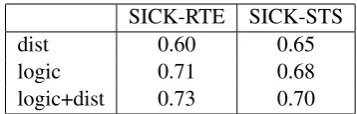
SICK-RTE SICK-STS
dist 0.60 0.65
logic 0.71 0.68
[image:4.595.326.505.61.118.2]logic+dist 0.73 0.70
Table 1: RTE accuracy and STS Correlation
Lukasiewicz’s equation for the conjunction with an averaging equation, then change the optimiza-tion problem and the grounding technique accord-ingly.
For each STS pair of sentences S1,S2, we run PSL twice, once where E = S1, Q = S2 and another whereE = S2,Q = S1, and output the two scores. The final similarity score is produced from a regressor trained to map the two PSL scores to the overall similarity score.
Future Work: Use a weighted average where
different weights are learned for different parts of the sentence.
5 Evaluation
The dataset used for evaluation is SICK: Sentences Involving Compositional Knowledge dataset, a task for SemEval 2014. The initial data release for the competition consists of 5,000 pairs of sentences which are annotated for both RTE and STS. For this evaluation, we performed 10-fold cross validation on this initial data.
Table 1 shows results comparing our full approach (logic+dist) to two baselines, a distributional-only baseline (dist) that uses vector addition, and a probabilistic logic-only baseline (logic) which is our semantic parser without distri-butional inference rules. The integrated approach
(logic+dist) out-performs both baselines.
6 Conclusion
Acknowledgments
This research was supported by the DARPA DEFT program under AFRL grant FA8750-13-2-0026. Any opinions, findings, and conclusions or recom-mendations expressed in this material are those of the author and do not necessarily reflect the view of DARPA, DoD or the US government. Some ex-periments were run on the Mastodon Cluster sup-ported by NSF Grant EIA-0303609.
References
Eneko Agirre, Daniel Cer, Mona Diab, and Aitor Gonzalez-Agirre. 2012. Semeval-2012 task 6: A pilot on semantic textual similarity. InProceedings of Semantic Evaluation (SemEval-12).
Marco Baroni and Roberto Zamparelli. 2010. Nouns are vectors, adjectives are matrices: Representing adjective-noun constructions in semantic space. In Proceedings of Conference on Empirical Methods in Natural Language Processing (EMNLP-10).
Islam Beltagy, Cuong Chau, Gemma Boleda, Dan Gar-rette, Katrin Erk, and Raymond Mooney. 2013. Montague meets Markov: Deep semantics with probabilistic logical form. In Proceedings of the Second Joint Conference on Lexical and Computa-tional Semantics (*SEM-13).
Islam Beltagy, Katrin Erk, and Raymond Mooney. 2014. Probabilistic soft logic for semantic textual similarity. InProceedings of Association for Com-putational Linguistics (ACL-14).
Jonathan Berant, Andrew Chou, Roy Frostig, and Percy Liang. 2013. Semantic parsing on Freebase from question-answer pairs. In Proceedings of Confer-ence on Empirical Methods in Natural Language Processing (EMNLP-13).
Johan Bos. 2008. Wide-coverage semantic analysis with Boxer. In Proceedings of Semantics in Text Processing (STEP-08).
Stephen Clark and James R. Curran. 2004. Parsing the WSJ using CCG and log-linear models. In Pro-ceedings of Association for Computational Linguis-tics (ACL-04).
Juri Ganitkevitch, Benjamin Van Durme, and Chris Callison-Burch. 2013. PPDB: The paraphrase database. InProceedings of North American Chap-ter of the Association for Computational Linguistics: Human Language Technologies (NAACL-HLT-13).
L. Getoor and B. Taskar, editors. 2007. Introduction to Statistical Relational Learning. MIT Press, Cam-bridge, MA.
Edward Grefenstette and Mehrnoosh Sadrzadeh. 2011. Experimental support for a categorical composi-tional distribucomposi-tional model of meaning. In Proceed-ings of Conference on Empirical Methods in Natural Language Processing (EMNLP-11).
Edward Grefenstette. 2013. Towards a formal distri-butional semantics: Simulating logical calculi with tensors. InProceedings of Second Joint Conference on Lexical and Computational Semantics (*SEM 2013).
Hans Kamp and Uwe Reyle. 1993. From Discourse to Logic. Kluwer.
Angelika Kimmig, Stephen H. Bach, Matthias Broecheler, Bert Huang, and Lise Getoor. 2012. A short introduction to Probabilistic Soft Logic. In Proceedings of NIPS Workshop on Probabilistic Programming: Foundations and Applications (NIPS Workshop-12).
Lili Kotlerman, Ido Dagan, Idan Szpektor, and Maayan Zhitomirsky-Geffet. 2010. Directional distribu-tional similarity for lexical inference. Natural Lan-guage Engineering.
Tom Kwiatkowski, Eunsol Choi, Yoav Artzi, and Luke Zettlemoyer. 2013. Scaling semantic parsers with on-the-fly ontology matching. In Proceedings of Conference on Empirical Methods in Natural Lan-guage Processing (EMNLP-13).
T. K. Landauer and S. T. Dumais. 1997. A solution to Plato’s problem: The Latent Semantic Analysis the-ory of the acquisition, induction, and representation of knowledge. Psychological Review.
Alessandro Lenci and Giulia Benotto. 2012. Identify-ing hypernyms in distributional semantic spaces. In Proceedings of the first Joint Conference on Lexical and Computational Semantics (*SEM-12).
Kevin Lund and Curt Burgess. 1996. Producing high-dimensional semantic spaces from lexical co-occurrence. Behavior Research Methods, Instru-ments, and Computers.
Jeff Mitchell and Mirella Lapata. 2008. Vector-based models of semantic composition. In Proceedings of Association for Computational Linguistics (ACL-08).
Jeff Mitchell and Mirella Lapata. 2010. Composition in distributional models of semantics. Journal of Cognitive Science.
Richard Montague. 1970. Universal grammar. Theo-ria, 36:373–398.
Matthew Richardson and Pedro Domingos. 2006. Markov logic networks. Machine Learning, 62:107–136.