Less destructive cleaning of web documents by using standoff annotation
Maik St¨uhrenberg
Institut f¨ur Deutsche Sprache / Mannheim, Germany
Abstract
Standoff annotation, that is, the separa-tion of primary data and markup, can be an interesting option to annotate web pages since it does not demand the re-moval of annotations already present in web pages. We will present a standoff se-rialization that allows for annotating well-formed web pages with multiple annota-tion layers in a single instance, easing pro-cessing and analyzing of the data.
1 Introduction
Using web pages as primary data for linguistic cor-pora often includes the procedure of cleaning and normalizing the files. Tools such as POS taggers and linguistic parsers often require the input data to be raw text, that is, without any markup at all. In addition, adding markup layers on top of an al-ready annotated file (such as an XHTML page) of-ten results in markup overlaps – violating XML’s wellformedness constraints (Bray et al., 2008).1
Since the original version of the web page is the origin of every further processing, we save this version unaltered. We call this version the “raw data”. As a next step we create a primary data file containing all textual information but no anno-tation as input for the before-mentioned linguis-tic processing tools.2 Every output of a
process-ing step is stored in a separate folder, makprocess-ing each step of the pipeline reproducible. However, if we want to compare multiple annotation layers, it is preferable to not have to deal with a couple of files stored in a large number of folders. To combine both the original HTML annotation and additional
1The discussion of this issue goes back to the days of
SGML, including a large number of proposals for supporting overlapping markup not cited here due to space restrictions.
2Of course, this is only necessary, if the tool in question
does not support pre-annotated input files.
annotation layers, standoff annotation can be an interesting option.
2 Standoff annotation
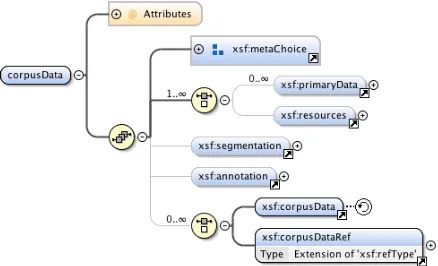
Standoff annotation is the separation of primary data and markup. The concept as such is not new at all, and there are several reasons to use this approach such as read-only primary data (which is the case as well when dealing with non-textual data) or copyright restrictions. St¨uhren-berg and Jettka (2009) discuss some existing se-rialization formats, including XStandoff (XSF), which we will use in this paper to demon-strate its ability to process pre-annotated doc-uments. An XStandoff instance roughly con-sists of the corpusData root element, under-neath zero or more primaryData elements, a
segmentation, and anannotationelement
[image:1.595.307.526.499.632.2]can occur, amongst others – see Figure 1 for a graphical overview.
Figure 1: A graphical overview of XStandoff’s root element
The two latter elements define two base con-structs of standoff annotation formats: (1) the identification of regions of primary data (called segments in XStandoff) used as anchors for one or more annotations, and (2) the way in which an-notations are stored.
2.1 Segmentation
In case oftextual primary datasuch as web pages, segments can be identified by delimiting the char-acter stream by means of tokenization methods (for example by splitting text into a stream of char-acters).
T h i s i s a w o r d
00|01|02|03|04|05|06|07|08|09|10|11|12|13|14
The serialization in XStandoff can be seen be-low. In this example, we have selected the charac-ter span ranging from “0” to “4”, resulting in the selection of the word “This”.3
<segment xml:id="seg_text1" primaryData="txt" type=" char" start="0" end="4"/>
Since web pages consists of (Unicode) charac-ters as well, it is possible to treat the markup as part of the character stream and in fact, this was the only way to segment primary data in XStand-off version 1 (and its predecessor SGF). However, this mechanism can be error-prone when using pre-annotated primary data because of the white space handling in XML. In this case, it is more promising to use the element node tree of an ex-isting annotation as an initial traversal for the se-lection of the respective textual part. As an exam-ple we use a (valid) XHTML file, from which the first div element is selected by using an XPath 2.0 (Berglund et al., 2010) expression (the exam-ple can be seen in Listing 1 in Section 2.2).4
<segment xml:id="seg_html1" primaryData="pd1" target ="xhtml:html/xhtml:body/xhtml:div[1]"/>
This approach is limited to work on XML in-stances only, that is, documents that are at least well-formed according to the XML specification, including XHTML files and those HTML5 pages that use the XHTML syntax, see Chapter 9 of the HTML5 spec (Berjon et al., 2014). Since the larger part of the World Wide Web does not ful-fill this requirement, tools such as TagSoup5 or
HTML Tidy6can be used to pre-process those web
3The optionalprimaryDataattribute’s value refers to
the corresponding primary data file via XML ID/IDREF identity constraints ((in case of multiple primary data files – in the example to the id “txt”, not via a URI. It does not pro-vide any hint about its MIME type, this information is stored in the respectiveprimaryDataelement shown in Listing 2.
4Apart from XPath, the XPointer specification defined in
DeRose et al. (2002a; 2002b) and used in XCES (see (Ide et al., 2000) and Section 5) would be another option. However, since XPointer support is very sparse, XPath is a more natural fit.
5See http://ccil.org/˜cowan/XML/XML/
tagsoup/for further details.
6See http://tidy.sourceforge.net/ for
fur-ther details.
pages. This cleaning process is less aggressive since in most cases it only results in changes of the structural markup and since we have already saved the file in its original form, destructive changes can be detected afterwards.
2.2 Annotations
Standoff annotations may be stored in the same or a different file. XStandoff, as an integrated seri-alization format, not only combines segmentation and all annotation layers in a single instance, but sticks as close as possible to the original inline annotation format. Element and attribute names remain unchanged as well as the tree-like struc-ture of the element nodes. Textual element content is deleted since it can be referenced via the cor-responding segment, and additional attributes are added. The converted annotation layer is stored underneath one of XStandoff’slayerelements.7
The document grammar (defined by an XSD 1.1 schema file) does not require the subtree under-neath thelayerelement to be valid (by using the value lax for the processContents attribute of the xs:any element wildcard), but is has to meet the well-formedness constraints defined in the XML specification.
Using the simple XHTML page shown in Listing 1 as primary data, we can select parts of the sentence with XPath 2.0 expressions – for example, the noun phrase (and the pro-noun) “This” is selected by the expression
xhtml:html/xhtml:body/substring(xhtml:div[1],1,4)
using the substring() function (Malhotra et al., 2010).
Listing 1: Example XHTML page
<html xmlns="http://www.w3.org/1999/xhtml"> <head><title>Instance</title></head> <body><div>This is a word.</div></body> </html>
Listing 2 shows the XStandoff instance using this XHTML page as primary data. As an annota-tion layer, we have added a partial POS annotaannota-tion (including sentence boundary detection).
Listing 2: XStandoff instance with XHTML pri-mary data and POS annotation
<corpusData xml:id="c1" xmlns="http://www.xstandoff. net/2009/xstandoff/1.1"
xmlns:xsf="http://www.xstandoff.net/2009/xstandoff /1.1">
<primaryData xml:id="p1">
<primaryDataRef uri="instance.html" mimeType=" application/xhtml+xml" encoding="utf-8"/>
7XML Namespaces (Bray et al., 2009) are used to
</primaryData> <segmentation>
<segment xml:id="seg1" target="xhtml:html/ xhtml:body/xhtml:div[1]"/>
<segment xml:id="seg2" target="xhtml:html/ xhtml:body/substring(xhtml:div[1],1,4)"/> <!-- [...] -->
</segmentation> <annotation>
<level xml:id="pos"> <layer>
<s xmlns="http://www.xstandoff.net/pos" xsf:segment="seg1">
<np xsf:segment="seg2"> <pron xsf:segment="seg2"/> </np>
<!-- [...] --> </s>
</layer> </level> </annotation> </corpusData>
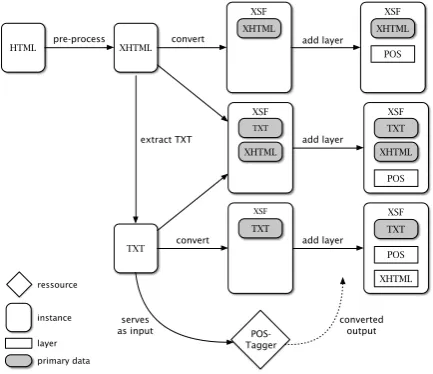
Additional annotation levels and layers (see Witt (2004) for a discussion about the distinction of levels and layers) can be added any time. Since XStandoff supports not only multiple annotation layers but multiple primary data files as well, there are two alternative XSF representations possible, if we extract the written text from the XHTML file and use it as primary data file: (1) The TXT file is used as additional primary data file (and serves as input for other linguistic annotation tools, see Listing 3); (2) the TXT file serves as the single pri-mary data file and both the XHTML and the POS annotation are stored as annotation levels and lay-ers. For the second option it is again necessary to pre-process the XHTML file with the already mentioned tools.
Listing 3: XStandoff instance with two primary data files and POS annotation
<corpusData xml:id="c1" xmlns="http://www.xstandoff. net/2009/xstandoff/1.1"
xmlns:xsf="http://www.xstandoff.net/2009/xstandoff /1.1">
<primaryData xml:id="p1">
<primaryDataRef uri="instance.html" mimeType=" application/xhtml+xml" encoding="utf-8"/> </primaryData>
<primaryData xml:id="txt">
<primaryDataRef uri="instance.txt" mimeType="text /plain" encoding="utf-8"/>
</primaryData> <segmentation>
<segment xml:id="seg1" primaryData="p1" target=" xhtml:html/xhtml:body/xhtml:div[1]"/> <segment xml:id="seg2" primaryData="p1" target="
xhtml:html/xhtml:body/substring(xhtml:div [1],1,4)"/>
<!-- [...] -->
<segment xml:id="seg_txt1" primaryData="txt" start="0" end="4"/>
</segmentation> <annotation>
<level xml:id="pos"> <layer>
<s xmlns="http://www.xstandoff.net/pos" xsf:segment="seg1">
<np xsf:segment="seg2">
<pron xsf:segment="seg2 seg_txt1"/> </np>
<!-- [...] --> </s>
</layer>
[image:3.595.308.525.136.323.2]</level> </annotation> </corpusData>
Figure 2 shows the three possible representa-tions.
HTML XHTML
TXT
XSF XHTML
POS
XSF TXT
POS XHTML
XSF TXT
POS
XHTML XSF
XHTML
XSF
TXT
XHTML
XSF
TXT
pre-process convert add layer
extract TXT
convert
layer primary data instance
add layer
add layer
POS-Tagger serves
as input
converted output ressource
Figure 2: Possible XStandoff instances
3 Creating XStandoff instances
It it cumbersome to create XStandoff instances by hand due to its separation of primary data and an-notation. In addition, most annotation tools create inline instances and can only use raw text as input files. Therefore, we have created a set of XSLT 2.0 transformation stylesheets (the XStandoff Toolkit) that allow for the easy conversion between an in-line XML instance (containing a single annotation layer) to a single-layered XStandoff instance, and the merging of XStandoff instances over the very same primary data.
The XSLT stylesheet inline2xsf requires an input XML file ideally containing elements bound by XML namespaces since XStandoff uses XML namespaces for the layer separation (if no namespace is present, it will be generated). The process of converting an inline annotation to XSF is divided into two steps: After segments are built on the basis of the elements and the character stream of the underlying primary data, the anno-tation layer is produced by converting the former inline annotation and linking its elements to the according segments byID/IDREFbinding.
ID/IDREF mechanism in XStandoff for estab-lishing connections between segmentelements and the corresponding annotation, manually merg-ing of XStandoff files is quite unpromismerg-ing. The
mergeXSF XSLT stylesheet converts two XSF
instances into a single one containing the annota-tion levels (or layers) from both input files and nor-malizing the corresponding segments.8 The merge
process leads to a complete reorganization of the segment list making it necessary to update the seg-ment references of the eleseg-ments in the XStandoff annotation layers. All that is done by applying the
mergeXSFscript.
Other stylesheets allow for the extraction and removal of single annotation layers, or a quick overview of overlapping annotations – see St¨uhrenberg and Jettka (2009) for a detailed dis-cussion. The current version of the stylesheet only supports the merging of two single XStandoff files at a time, additional files have to be merged suc-cessively. However, there is a web-based solu-tion that uses the native XML database BaseX9
as backend as well as a Java GUI that eases bulk transformation, merging and analyzing XStandoff instances.
In Jettka and St¨uhrenberg (2011), different vi-sualization options for concurrent markup (for ex-ample, the underlying XHTML annotation and one or more linguistic annotation layers) based on XStandoff are discussed, including newer web technologies such as WebGL for a three-dimensional visualization of overlapping subtrees. Although the examples given in this paper are quite short, Piez (2010; 2012) has already shown that the underlying concept is capable of visualiz-ing larger instances (such as whole books) as well. The full version of the XStandoff Toolkit can be obtained at XStandoff’s website10, although up to
now it has not been adapted to support the addi-tional segmentation mechanism for valid XHTML files described in Section 2.1.
8Especially this normalization can be problematic: On the
one hand, there are segments spanning over the same string of the primary data (but with distinct IDs) that have to be re-placed by a singlesegmentelement in the output instance. On the other hand, there are two segments with the same ID spanning over different character positions that have to get new unique IDs.
9Seehttp://basex.orgfor further details. 10Seehttp://xstandoff.netfor further details.
4 Using XStandoff
The format as such has been successfully used in various projects for different purposes, such as storage format for multiple annotated corpora as part of an semi-automatic anaphora resolu-tion (St¨uhrenberg and Goecke, 2008), import/-export serialization of the web-based annotation tool Serengeti (Diewald et al., 2008; Poesio et al., 2011), and as annotation format for lexical chains (Waltinger et al., 2008), amongst others. Due to the fact, that the newly introduced segmen-tation for pre-annotated and multimodal primary data (St¨uhrenberg, 2013) are still under develop-ment, XStandoff has not been used for larger web corpora yet.
Regarding the size of an XStandoff instance with multiple annotation layers compared to a number of inline annotation instances, it is hard to make a general expression about the increase/de-crease in size. On the one hand, an XStand-off instance usually does not include the primary data (resulting in a smaller file size), on the other hand the meta information included in an XSF in-stance such as the additional segmentation mech-anism add to the overall file size. Single heavily annotated XSF instances can take up to multiple megabytes in size, however, there have not been any problems to process these files with standard XML tools such as XSLT and XQuery. Densely annotated texts benefit from the fact that segments over a defined text span (or XHTML subtree) are only instantiated once, resulting in a state of pro-cessing in which additional annotation layer do only add very few if any segmentelements to the resulting XStandoff instance. As a rule of thumb, it is highly recommended to use native XML databases such as the already-mentioned BaseX or eXist11 as storage backends for
analyz-ing large corpora.
5 XStandoff compared
Since the concept of standoff annotation as such is not new at all, a variety of serialization for-mats already exist. The most prominent candi-date for a standoff serialization format supporting multiple annotations is the Graph Annotation For-mat (GrAF), the pivot forFor-mat of the international standard ISO 24612:2012 (Linguistic Annotation Framework). However, there are different versions
of the format: The partial document grammar in the ISO standard differs from the one that is avail-able at its web site12 while the first release of the
GrAF-annotated Manually Annotated Sub-Corpus (MASC)13 again uses different element and
at-tribute names.
Another issue is that the standard is quite indif-ferent in terms of the segmentation over the pri-mary data. While anchors are defined via string values, the standard states that, “[a]pplications are expected to know how to parse the string repre-sentation of an anchor into a location in the ar-tifact being annotated” (Table 3, in the standard document). Although pre-annotated primary data is supported14, one either may include markup as
part of the character stream when referring to char-acter positions, or use a combination of an XPath 2.0 expression to select the element containing the text, and an offset to select the corresponding part of the character string (see Section 3.3.4 of the standard) – XPath 2.0’ssubstring()function shown in Listing 2 is not used.
Concerning the annotation itself, GrAF uses a feature structure format that resembles the seri-alization standardized in ISO 24610-1 and Chap-ter 18 of the TEI P5 (Burnard and Bauman, 2014). Converting existing annotation into this format can be considered as a more complex task and the resulting subtrees may become quite large (see Stegmann and Witt (2009) for a discussion of TEI feature structures as serialization for multiple an-notated XML instances).
6 Conclusion and future development Standoff annotation can be a valuable means in an-notating web corpora, especially when combined with a strict policy of storing both the raw data and the primary data as non-altered files. With its segmentation mechanism supporting XPath 2.0 expressions, XStandoff can use only slightly pro-cessed XHTML pages together with their respec-tive annotation layers, allowing for less destrucrespec-tive cleaning of web pages.
Since the segmentation mechanism discussed in this paper have been added to XStandoff only re-cently, non-textual primary data is not yet sup-ported by the current version of the XStandoff
12See http://www.xces.org/ns/GrAF/1.0/for
further details.
13See http://www.anc.org/MASC/About.html
for further details.
14The preferred primary data format is raw text.
Toolkit. Although it is much easier to identify the respective subtrees of valid XHTML pages (for example by using XPath visualization and/or se-lection tools such as the one included in the oXy-gen XML Editor15) compared to computing
char-acter positions, an automatic instantiation of seg-ments is preferred. We plan to include the segmen-tation over pre-annotated files in one of the next iterations of the XStandoff Toolkit.
References
Anders Berglund, Scott Boag, Don Chamberlin, Mary F. Fern´andez, Michael Kay, Jonathan Robie, and J´erˆome Sim´eon. 2010. XML Path Language (XPath). Version 2.0 (Second Edition). W3C Rec-ommendation, World Wide Web Consortium.
Robin Berjon, Steve Faulkner, Travis Leithead, Erika Doyle Navara, Edward O’Connor, Silvia Pfeiffer, and Ian Hickson. 2014. Html5. a vocabulary and associated apis for html and xhtml. W3C Candidate Recommendation, World Wide Web Consortium.
Tim Bray, Jean Paoli, C. M. Sperberg-McQueen, Eve Maler, and Franc¸ois Yergeau. 2008. Extensible Markup Language (XML) 1.0 (Fifth Edition). W3C Recommendation, World Wide Web Consortium. Tim Bray, Dave Hollander, Andrew Layman, Richard
Tobin, and Henry S. Thompson. 2009. Namespaces in XML 1.0 (third edition). W3C Recommendation, World Wide Web Consortium.
Lou Burnard and Syd Bauman, editors. 2014. TEI P5:
Guidelines for Electronic Text Encoding and Inter-change. Text Encoding Initiative Consortium, Char-lottesville, Virginia. Version 2.6.0. Last updated on 20th January 2014, revision 12802.
Steven J. DeRose, Ron Jr. Daniel, Paul Grosso, Eve Maler, Jonathan Marsh, and Norman Walsh. 2002a. XML Pointer Language (XPointer). W3C Working Draft, World Wide Web Consortium.
Steven J. DeRose, Eve Maler, and Ron Jr. Daniel. 2002b. XPointer xpointer() Scheme. W3C Work-ing Draft, World Wide Web Consortium.
Nils Diewald, Maik St¨uhrenberg, Anna Garbar, and Daniela Goecke. 2008. Serengeti – webbasierte
Annotation semantischer Relationen. Journal for
Language Technology and Computational Linguis-tics, 23(2):74–93.
Shudi (Sandy) Gao, C. M. Sperberg-McQueen, and Henry S. Thompson. 2012. W3C XML Schema Definition Language (XSD) 1.1 Part 1: Structures. W3C Recommendation, World Wide Web Consor-tium.
Nancy M. Ide, Patrice Bonhomme, and Laurent
Ro-mary. 2000. XCES: An XML-based
Encod-ing Standard for LEncod-inguistic Corpora. In
Proceed-ings of the Second International Language Re-sources and Evaluation (LREC 2000), pages 825– 830, Athens. European Language Resources Asso-ciation (ELRA).
ISO/TC 37/SC 4/WG 1. 2006. Language Resource Management — Feature Structures – Part 1: Fea-ture StrucFea-ture Representation. International Stan-dard ISO 24610-1:2006, International Organization for Standardization, Geneva.
ISO/TC 37/SC 4/WG 1. 2012. Language Resource Management — Linguistic annotation framework (LAF). International Standard ISO 24612:2012, International Organization for Standardization, Geneva.
Daniel Jettka and Maik St¨uhrenberg. 2011. Visual-ization of concurrent markup: From trees to graphs,
from 2d to 3d. In Proceedings of Balisage: The
Markup Conference, volume 7 ofBalisage Series on Markup Technologies, Montr´eal.
Ashok Malhotra, Jim Melton, Norman Walsh, and Michael Kay. 2010. XQuery 1.0 and XPath 2.0 Functions and Operators (Second Edition). W3C Recommendation, World Wide Web Consortium.
Wendell Piez. 2010. Towards Hermeneutic Markup:
An architectural outline. In Digital Humanities
2010 Conference Abstracts, pages 202–205, Lon-don. The Alliance of Digital Humanities Organisa-tions and The Association for Literary and Linguis-tic Computing and The Association for Computers and the Humanities and The Society for Digital Hu-manities – Soci´et´e pour l’´etude des m´edias interactif.
Wendell Piez. 2012. Luminescent: parsing LMNL by
XSLT upconversion. In Proceedings of Balisage:
The Markup Conference, volume 8 ofBalisage Se-ries on Markup Technologies, Montr´eal.
Massimo Poesio, Nils Diewald, Maik St¨uhrenberg, Jon Chamberlain, Daniel Jettka, Daniela Goecke, and Udo Kruschwitz. 2011. Markup Infrastructure for the Anaphoric Bank: Supporting Web Collabora-tion. In Alexander Mehler, Kai-Uwe K¨uhnberger, Henning Lobin, Harald L¨ungen, Angelika Storrer,
and Andreas Witt, editors,Modeling, Learning and
Processing of Text Technological Data Structures,
volume 370 of Studies in Computational
Intelli-gence, pages 175–195. Springer, Berlin and Heidel-berg.
Jens Stegmann and Andreas Witt. 2009. TEI Feature Structures as a Representation Format for Multiple
Annotation and Generic XML Documents. In
Pro-ceedings of Balisage: The Markup Conference,
vol-ume 3 ofBalisage Series on Markup Technologies,
Montr´eal.
Maik St¨uhrenberg and Daniela Goecke. 2008. SGF – an integrated model for multiple annotations and its
application in a linguistic domain. InProceedings
of Balisage: The Markup Conference, volume 1 of
Balisage Series on Markup Technologies, Montr´eal. Maik St¨uhrenberg and Daniel Jettka. 2009. A toolkit for multi-dimensional markup: The development of
SGF to XStandoff. InProceedings of Balisage: The
Markup Conference, volume 3 ofBalisage Series on Markup Technologies, Montr´eal.
Maik St¨uhrenberg. 2013. What, when, where? Spatial
and temporal annotations with XStandoff. In
Pro-ceedings of Balisage: The Markup Conference,
vol-ume 10 ofBalisage Series on Markup Technologies,
Montr´eal.
Ulli Marc Waltinger, Alexander Mehler, and Maik St¨uhrenberg. 2008. An integrated model of lexi-cal chaining: application, resources and its format. In Angelika Storrer, Alexander Geyken, Alexander
Siebert, and Kay-Michael W¨urzner, editors,
KON-VENS 2008 – Erg¨anzungsband Textressourcen und lexikalisches Wissen, pages 59–70, Berlin.
Andreas Witt. 2004. Multiple hierarchies: New
As-pects of an Old Solution. InProceedings of Extreme