Scope Disambiguation as a Tagging Task
Kilian Evang
CLCG, Rijksuniversiteit Groningen [email protected]
Johan Bos
CLCG, Rijksuniversiteit Groningen [email protected]
Abstract
In this paper we present a pragmatic account of scope alternation involving universal quantifiers in a lexicalist framework based on CCG and DRT. This account can derive the desired reading for 96% of all cases of scope interaction involving universal quantification mediated by prepositions in a real corpus. We show how this account allows for recasting scope resolution as a simple token classification task, providing a simpler handle for statistical approaches to scope resolution than previous accounts.
1
Introduction
The correct handling of scope-bearing operators such as quantifiers, negation and intensional verbs is crucial for constructing logical form from text that capture the intended meaning. A lot of work has been done to describe the scope alternation behavior especially of quantifiers and to construct underspecified meaning representations from which all (theoretically) possible readings of a sentence containing them can be enumerated (Reyle, 1993; Bos, 1996; Copestake et al., 2005; Egg et al., 2001). The problem of finding the preferred reading in each concrete case has also been addressed, using machine learning (Higgins and Sadock, 2003; Andrew and MacCartney, 2004; Srinivasan and Yates, 2009; Manshadi and Allen, 2011).
Despite these efforts, existing wide-coverage semantic parsers do not typically resolve scope. Either the semantic representations they output are shallow and do not use logical quantifiers, which is sufficient for many applications but not for model-theoretic reasoning. Or they leave the output underspecified or always deterministically pick the same scoping behavior for a given quantifier.
How to make a semantic parser aware of scope alternation? We argue that an additional layer of tags is a good way. A semantic parser can use these tags to guide its decisions—just like it might use a layer of word sense tags and a layer of named-entity tags, and just like a syntactic parser uses part-of-speech tags. Scope tags can guide the construction of logical forms from the start and thereby avoid the additional computational and representational complexity of underspecified representations. At the same time, this approach avoids the need to change the syntactic parsing model.
In this paper we show how we applied this technique to the semantic parsing system of Curran et al. (2007). It consists of C&C, a statistical syntactic parser whose output includes predicate-argument structures, and Boxer, a semantic construction component which builds interpretable semantic repre-sentations. The resulting enhanced system is being used in constructing the Groningen Meaning Bank (GMB), a large corpus of English text annotated with logical form (Basile et al., 2012).
2
Formal Background
λp.( x
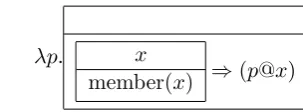
member(x) ; (p@x)) λp. x
member(x) ⇒(p@x)
Figure 1: Generalized quantifiers denoted by the NPsa memberandevery member
λio.λdo.λsu.λmp.(su@λx.(io@λy.(do@λz.(
e
give(e) Agent(e, x) Recipient(e, y)
Theme(e, z)
[image:2.595.294.446.68.124.2]; (mp@e)))))
Figure 2: Semantics of the verbgive, ignoring tense. The core consists of a DRS introducing an event discourse referenteand relating it to the arguments using thematic role relations. The modifier semantics is applied toe, the result is combined with the core DRS using merge reduction (;). The rest is largely for dealing with NP arguments.
categories that determine the ways in which constituents are allowed to combine, right of it are semantic categories that specify the semantics of a constituent based on the semantics of the constituents that com-bined to form it. There are a number of combinatory rules besides forward application, and each specifies syntax and semantics in a similar way. Boxer’s most important task is thus to assign a semantics to each word; given the derivation, the semantics of each phrase then follows deterministically.
The semantics of all functor categories, such as verbs and prepositions, must be prepared to combine with their arguments and therefore must be functions. They are specified using the notation of the lambda calculus. For example, the semantics of a ditransitive verb has the form λio.λdo.λsu.sent where io,
do,suare variables standing for the semantics of the indirect object, the direct object and the subject respectively, reflecting the order in which the verb arguments combine syntactically, and sent is the semantics of the resulting sentence, specified in terms of the verb meaning andio,do,su.
Boxer uses a neo-Davidsonian event semantics, expressing verb meanings using event individuals that permit an unlimited number of verb modifiers. This motivated a decision to represent sentence meanings themselves as functions—from event properties to sentence meanings—to allow modifiers to combine with them. sent above is therefore always of the form λmp.drswhere mp is a variable standing for an event property anddrsis an expression that evaluates to a proper truth-theoretic meaning representation in the form of a discourse representation structure (DRS; Kamp and Reyle, 1993).
All noun phrases are analyzed as generalized quantifiers, i.e. functions from individual properties to DRSs. Figure 1 shows the semantics ofa memberandevery memberas examples. Verb semantics take the status of NPs as generalized quantifiers into account by usingpredicate abstraction: they apply an NP semantics to a property that expresses the core verb meaning, modifier meanings, and meanings of any previously absorbed arguments. For example, for a ditransitive verb, thedrspart above has the form
(su@λx.(do@λy.(io@λz.drs0))). Figure 2 shows a full semantics of the verbgive.
3
Scope-mediating Categories
3.1 Verbs
It is easy to see from Figure 2 that in our lexical-semantic framework, it is the semantics of a verb that determines the relative scope of its arguments. For example, with the given lexical entry, the sentence
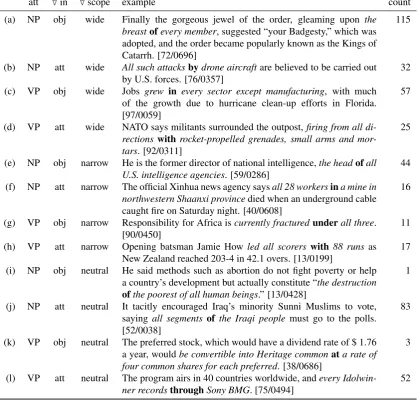
Table 1: Eight types of scope interaction involving universal quantifiers, mediated by a preposition. Columns indicate what the preposition attaches to (verb or noun phrase), which of its arguments contains the universal quantifier (object or the phrase it attaches to), and whether the universal quantifier has wide or narrow scope. All examples are from the Groningen Meaning Bank (GMB); numbers in brackets are GMB document identifiers.
att ∀in ∀scope example count
(a) NP obj wide Finally the gorgeous jewel of the order, gleaming upon the
breastofevery member, suggested “your Badgesty,” which was
adopted, and the order became popularly known as the Kings of Catarrh. [72/0696]
115
(b) NP att wide All such attacksbydrone aircraftare believed to be carried out
by U.S. forces. [76/0357]
32
(c) VP obj wide Jobs grew in every sector except manufacturing, with much
of the growth due to hurricane clean-up efforts in Florida. [97/0059]
57
(d) VP att wide NATO says militants surrounded the outpost,firing from all
di-rectionswith rocket-propelled grenades, small arms and
mor-tars. [92/0311]
25
(e) NP obj narrow He is the former director of national intelligence,the headofall U.S. intelligence agencies. [59/0286]
44
(f) NP att narrow The official Xinhua news agency saysall 28 workersina mine in
northwestern Shaanxi provincedied when an underground cable
caught fire on Saturday night. [40/0608]
16
(g) VP obj narrow Responsibility for Africa iscurrently fracturedunderall three. [90/0450]
11
(h) VP att narrow Opening batsman Jamie How led all scorers with 88 runs as New Zealand reached 203-4 in 42.1 overs. [13/0199]
17
(i) NP obj neutral He said methods such as abortion do not fight poverty or help a country’s development but actually constitute “the destruction
ofthe poorest of all human beings.” [13/0428]
1
(j) NP att neutral It tacitly encouraged Iraq’s minority Sunni Muslims to vote, saying all segments of the Iraqi people must go to the polls. [52/0038]
83
(k) VP obj neutral The preferred stock, which would have a dividend rate of $ 1.76 a year, wouldbe convertible into Heritage commonata rate of four common shares for each preferred. [38/0686]
3
(l) VP att neutral The program airs in 40 countries worldwide, andevery
Idolwin-ner recordsthroughSony BMG. [75/0494]
52
3.2 Prepositions
Scope interactions involving universal quantifiers and mediated by prepositions can roughly be classified along three binary distinctions: whether the preposition attaches to a verb or a noun, whether it is the object of the preposition or the phrase it attaches to that contains the universal quantifier, and whether the universal quantifier takes wide scope over the other argument of the preposition. Table 1 has an example for each situation.
head of all agencies
N (N\N)/NP NP
λx.
head(x) λobj.λp.λx.((p@x); (obj@λy. of(x, y) )) λp. x
agency(x) ⇒(p@x)
>
N\N
λp.λx.((p@x); y
agency(y) ⇒ of(x, y)
)
<
N
λx.
head(x)
y
agency(y) ⇒ of(x, y)
∗
NP
λp.(
x
head(x)
y
agency(y) ⇒ of(x, y)
[image:4.595.151.444.68.240.2]); (p@x))
Figure 3: NP derivation with narrow-scope modifier
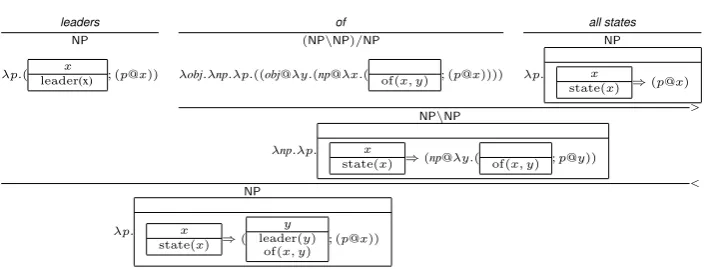
leaders of all states
NP (NP\NP)/NP NP
λp.( x
leader(x) ; (p@x)) λobj.λnp.λp.((obj@λy.(np@λx.( of(x, y) ; (p@x)))) λp. x
state(x) ⇒(p@x)
>
NP\NP
λnp.λp. x
state(x) ⇒(np@λy.( of(x, y) ;p@y))
<
NP
λp. x
state(x) ⇒(
y
leader(y)
of(x, y)
; (p@x))
Figure 4: NP derivation with wide-scope modifier
in (i–l). Finally, in rare cases, both of the aforementioned criteria may apply simultaneously. The only example we found of this in the corpus is given in (1) below, where the modifierin all major cities and townsshould be outscoped byan Islamic alliance, but outscopemembers. In such cases, our scheme is too coarse-grained to derive the desired semantics.
(1) Members of an Islamic alliance and other parties took to the streets Saturdayinall major cities and towns, where speakers denounced General Musharraf for breaking his promise. [50/0210]
Scope alternation in these configurations can be effected using just two scope tags on prepositions, indi-cating modifier wide scope (invas in a,c,f,h) vs. modified constituent wide scope (noninvas in b,d,e,g). For cases like (i–l), one tag can be used as the default.
In the case of verb phrase modifiers, preposition semantics effecting the desired scope behavior are straightforward to implement (Figure 5). For noun phrase modifiers, things are trickier. Firstly, narrow-scope modifiers need to apply to individual properties whereas wide-scope modifiers need to apply to generalized quantifiers. The easiest way to ensure this is to give the preposition the syntactic type((N\N)/NP) in the former case and((NP\NP)/NP)in the latter before parsing. Thus, in this case, the syntactic structure is affected. Both categories are well supported in the standard model of the C&C parser trained on CCGbank (Hockenmaier and Steedman, 2007), and although the assignment of lexical categories is integrated with parsing, the parser can be forced using tricks to pick a particular category. Example derivations for both cases are shown in Figures 3 and 4.
[image:4.595.121.476.264.399.2]λobj.λvp.λsubj.λmp.((vp@subj)@λe.(obj@λy.(
with(e, y) ; (mp@e))))
λobj.λvp.λsubj.λmp.(obj@λy.((vp@subj)@λe.(
with(e, y) ; (mp@e))))
Figure 5: Two possible semantics of a preposition attaching to a VP. Syntactically, it combines first with its object, then with the VP, then the resulting extended VP combines with the subject, henceλobj.λvp.λsubj.... Semantically, in the first entry, vpis first applied tosubj, yielding a sentence meaning, which is then modified by applying it to an event property (λe....). In the second entry, application to the preposition object to the corresponding property is moved out of the scope of all of this to give it scope over the verb and its arguments. In both cases, the additionalλmpensures that a proper sentence meaning results, allowing for additional modifiers.
4
Annotation and Results
For studying quantifier scope interactions in the wild, we use the Groningen Meaning Bank (GMB), a freely available annotated English corpus of currently a little over 1 million tokens in 7,600 documents, made up mainly of political news, country descriptions, fables and legal text. Since a pilot study showed that clear deviations from the default scope order of verbal arguments (subject>objects in surface order) is very rare (only 12 of 206 cases), we decided to focus on scope interactions mediated by prepositions.
Using the syntactic annotation of the GMB we extracted all prepositions where either the object or the modified constituent contains one of the universally-quantifying determinersevery,eachandall. We discarded prepositions serving as discourse connectives as inWithall ballots cast, people are awaiting the results because they relate propositions to each other rather than individuals with which we are concerned. We also discarded prepositions that are part of fixed expressions such asinall,atall, as well as the of in NPs such asallofthe leaders, which we assume to mean the same asall leaders. Finally, we cast aside the prepositionsincluding,excludingandexceptas deserving special treatment not within the scope of this work. This left us with 456 instances which were manually annotated by one annotator for scope behavior. The counts are shown in the last column of Table 1.
In cases of doubt, we generally preferred annotations resulting in the logically weaker reading. For example, in (2), we could either assume a separate termination event for each banking license or a single termination event for them all, and we preferred the former by giving the universal quantifier wide scope.
(2) the International Banking Repeal Act of 2002 resulted inthe terminationofall offshore banking licenses[03/0688]
5
Discussion
Our approach deals with scope alternation at the level of functor semantics, thus is syntactically con-strained. There are some scope orderings, such as interleaved verb arguments and modifiers, that it cannot derive. Also, specific indefinites pose problems in cases such as (f), and will probably show need for special treatment even more clearly once we broaden our attention to their interactions with intensional verbs and negation, see e.g. Geurts (2010). A more powerful account of indefinites is pro-posed within CCG in Steedman (2012). However, it remains to be seen whether it can be implemented efficiently within a wide-coverage parser, see Kartsaklis (2010). Another phenomenon we haven’t dealt with yet is scope interaction between universals and negation.
References
Andrew, G. and B. MacCartney (2004). Statistical resolution of scope ambiguity in natural language. Unpublished manuscript.
Basile, V., J. Bos, K. Evang, and N. Venhuizen (2012). Developing a large semantically annotated corpus. InProceedings of the Eighth International Conference on Language Resources and Evaluation (LREC-2012), Istanbul, Turkey, pp. 3196–3200.
Bos, J. (1996). Predicate Logic Unplugged. In P. Dekker and M. Stokhof (Eds.), Proceedings of the Tenth Amsterdam Colloquium, ILLC/Dept. of Philosophy, University of Amsterdam, pp. 133–143.
Bos, J. (2009). Towards a large-scale formal semantic lexicon for text processing. In C. Chiarcos, R. Eckart de Castilho, and M. Stede (Eds.),Proceedings of the Biennal GSCL Conference 2009, pp. 3–14. Gunter Narr Verlag.
Copestake, A., D. Flickinger, I. Sag, and C. Pollard (2005). Minimal recursion semantics: An introduc-tion.Journal of Research on Language and Computation 3(2–3), 281–332.
Curran, J., S. Clark, and J. Bos (2007). Linguistically Motivated Large-Scale NLP with C&C and Boxer. InProceedings of the 45th Annual Meeting of the Association for Computational Linguistics Compan-ion Volume Proceedings of the Demo and Poster SessCompan-ions, Prague, Czech Republic, pp. 33–36.
Egg, M., A. Koller, and J. Niehren (2001). The constraint language for lambda structures. Logic, Language and Information 10, 457–485.
Geurts, B. (2010). Specific indefinites, presuppositions, and scope. In R. Buerle, U. Reyle, and T. E. Zimmermann (Eds.),Presuppositions and discourse, pp. 125–158. Emerald Group.
Hendriks, H. (1993). Studied Flexibility: Categories and Types in Syntax and Semantics. Ph. D. thesis, University of Amsterdam.
Higgins, D. and J. Sadock (2003). A machine learning approach to modeling scope preferences. Com-putational Linguistics 29(1), 73–96.
Hockenmaier, J. and M. Steedman (2007). Ccgbank: a corpus of ccg derivations and dependency struc-tures extracted from the penn treebank. Computational Linguistics 33(3), 355–396.
Kamp, H. and U. Reyle (1993). From Discourse to Logic; An Introduction to Modeltheoretic Semantics of Natural Language, Formal Logic and DRT. Dordrecht: Kluwer.
Kartsaklis, D. (2010). Wide-coverage CCG parsing with quantifier scope. Master’s thesis, University of Edinburgh.
Manshadi, M. and J. Allen (2011). Unrestricted quantifier scope disambiguation. In Proceedings of TextGraphs-6: Graph-based Methods for Natural Language Processing, Portland, Oregon, pp. 51–59. Association for Computational Linguistics.
Reyle, U. (1993). Dealing with ambiguities by underspecification: Construction, representation and deduction.Journal of Semantics 10, 123–179.
Srinivasan, P. and A. Yates (2009). Quantifier scope disambiguation using extracted pragmatic knowl-edge: Preliminary results. InProceedings of the 2009 Conference on Empirical Methods in Natural Language Processing: Volume 3-Volume 3, pp. 1465–1474. Association for Computational Linguis-tics.
Steedman, M. (2001). The Syntactic Process. The MIT Press.