Statistical Morph Analyzer (SMA++) for Indian Languages
Saikrishna Srirampur IIIT Hyderabad saikrishna.srirampur @research.iiit.ac.in Ravi Chandibhamar IIIT Hyderabad chandibhamar.ravi @students.iiit.ac.in Radhika Mamidi IIIT Hyderabad radhika.mamidi @iiit.ac.in AbstractStatistical morph analyzers have proved to be highly accurate while being comparatively easier to maintain than rule based approaches. Our morph analyzer (SMA++) is an improvement over the statistical morph analyzer (SMA) described in Malladi and Mannem (2013). SMA++ predicts the gender, number, person, case (GNPC) and the lemma (L) of a given token. We modified the SMA in Malladi and Mannem (2013), by adding some rich machine learning features. The feature set was chosen specifically to suit the characteristics of Indian Languages. In this paper we apply SMA++ to four Indian languages viz. Hindi, Urdu, Telugu and Tamil. Hindi and Urdu belong to the Indic1 language family. Telugu and Tamil belong to the Dravidian2language family. We
compare SMA++ with some state-of-art statistical morph analyzers viz. Morfette in Chrupała et al. (2008) and SMA in Malladi and Mannem (2013). In all four languages, our system performs better than the above mentioned state-of-art SMAs.
1 Introduction
Morphological analysis for Indian Languages (ILs) is defined as the analysis of a word in terms of its lemma (L), gender (G), number (N), person (P), case (C), vibhakti3, tense, aspect and modality. A tool
which predicts Morph Analysis of a word is called a Morph Analyzer (MA).
Statistical Morph Analyzer (SMA) is an MA which uses machine learning to predict the morph infor-mation . Using the training data and the feature-set, statistical models are formed. These models help to predict the morph-analysis of the test data. This works for all words, including out of vocabulary (OOV) words. SMA is language independent. We chose Indian Languages for our study and built an SMA which is targeted for different ILs.
Indian languages are lexically and grammatically similar. Lexical borrowing4occurs between languages.
Gramatically, there are many similarities. Indian languages aresynthetic5; derivational and inflectional
morphologies result in the formation of complex words by stringing two or more morphemes. ILs pre-dominantly havesubject-object-verb (SOV)word order. They show agreement6among words. We
cap-tured such type of characteristics, by building a robust feature set.
2 Related Work
Traditionally, morphological analysis for Indian languages has been done using the rule based approach. For Hindi, the MA by Bharati et al. (1995) is most widely used among the NLP researchers in the Indian Community. Goyal and Lehal (2008) and Kanuparthi et al. (2012) MAs are advanced versions of the Bharati et al. (1995)’s analyzer. Kanuparthi et al. (2012) built a derivational MA for Hindi by introducing a layer over the Bharati et al. (1995)’s MA .It identifies 22 derivational suffixes which help in providing derivational analysis for the word whose suffix matches with one of these 22 suffixes.
1The Indic languages are the dominant language family of the Indian subcontinent, generally spoken in the regions of
northern India and Pakistan
2The Dravidian languages are spoken mainly in southern India
3Vibhakti is a Sanskrit grammatical term that encompasses post-positionals and case endings for nouns, as well as inflection
and auxiliaries for verbs. It is also referred as case-marker
4A word from one language that has been adapted for use in another is a borrowed word. 5a synthetic language is a language with a high morpheme-per-word ratio
6Agreement or Concord happens when a word changes form depending on the other words to which it relates
There have not been many updates in the rule based analyzers and the problem of not predicting OOV words is still a significant one. SMA in Malladi and Mannem (2013) is a data-driven MA which focuses primarily on Hindi.
For Urdu, B¨ogel et al. (2007) proposes an approach which uses Finite State Transducers. It introduces and discusses the issues that arise in the process of building finite-state MA for Urdu. For Telugu, Sunitha and Kalyani (2009) propose an approach of improving the existing rule based Telugu MA. They did this, using possible decompositions of the word, inflected by many morphemes. SMA in Malladi and Mannem (2013) evaluates the results for Urdu and Telugu as well. Not much research has been done in Morphological Analysis for Tamil.
3 Our Approach 3.1 Feature Set
The feature-set was chosen specifically to suit the Indian Languages. The following are the features used:
(i) Suffixes : Indian languages show inflectional morphology. The inflectional morphemes carry the G,N,P and C of a word. These morphemes generally occur in the form of suffixes. Hence, to capture the inflectional behaviour of ILs we considered thesuffixesas a feature for the ML task. We considered suffixes whose length was maximum 7 characters.
(ii) Previous morph tags7 and next morph tags: Agreement is an important characteristic of ILs.
Through agreement, GNPC of a token may percolate to the other tokens. An example to this is, if the subject (noun) is masculine, then the verb form should also be masculine. To capture agreement, we considered features which carried the GNPC of the neighbouring words. Previous morph tagsfeature captures predicted morph tag of previous 3 tokens. Next morph tagsfeature captures the set of morph tags of the next token, if found in the training corpus.
(iii) Word Forms: ILs are morphologically rich languages. Words carry rich information regarding GNPC. To capture this characteristic we considered three features relating to word forms. word present captures the word form of the present token.word previouscaptures the word form of the previous token. word nextcaptures the word form of the next token.
(iv) Part of Speech(POS) : POS is one of the of the fundamental ML feature of any NLP task. Based on the POS of the word, the set of possible inflections can be found. For example,verbshave a set of inflections andnounshave another set. To capture such information we included POS in the feature-set.
(v) Other features: Features such aslength of the tokenandcharacter types in the token(eg. numbers, alphabets and so on) have also been considered.
The Support Vector Machine (SVM) (using linear classifier) was used for the ML task .
3.2 Choosing Class Labels
For the ML task, the class-labels for G, N, P, C were chosen from the training data itself. For lemma, the class-labels were formed based on the edit-distance8operations required to convert the given token to its
lemma. This idea was inspired by Chrupała (2006), who introduced the concept of edit-operations9for
lemmatization.
The Algorithm is explained using an example. Consider the tokencrying. The lemma forcryingiscry.
Step 1:The token and its lemma are reversed.cryingbecomesgniyrcandcrybecomesyrc.
Step 2: Note the edit operations required to convert reversed token to the reversed lemma. To convert gniyrctoyrcwe need to delete the characters at the 1st, 2nd and 3rd indices. Hence the edit operations would be [d 1, d 2, d 3], where ’d’ represents delete operation.
Step 3:The set of edit operations would form the class-label. [d 1, d 2, d 3] would be the class-label and would be added to the set of class-labels.
7The possible values of each G, N, P, C and L form the morph tags. eg. ’m’ (masculine) is a morph tag for gender. 8Edit distance is a way of quantifying how dissimilar two strings (e.g., words) are to one another by counting the minimum
number of operations required to transform one string into the other.
Similarly, the class-label for the token playingand the lemmaplay would be [d 1, d 2, d 3]. By this, playing - playandcrying - cryhave the same class label, because they have the common suffix-ing.
4 Experiments
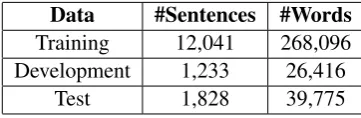
Experiments were conducted for 4 ILs, viz. Hindi, Urdu, Telugu and Tamil. For Hindi, the Hindi Treebank (HTB) released as part of the 2012 Hindi Parsing Shared Task (Sharma et al., 2012) was used for the ML task. The statistical models were tuned on development data and evaluated on test data. Table 1. shows the HTB statistics.
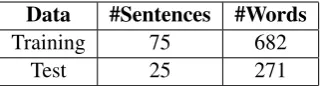
For Urdu, the Urdu Treebank (UTB) released as a part of the 2012 Proceedings of TLT (Bhat and Sharma (2012)) was used for evaluation. Table 2. represents the UTB statistics. For Telugu, the Telugu Treebank (TTB) released for ICON 2010 Shared Task (Husain et al. (2010)) was used for evaluation. Table 3. represents the TTB statistics. For Tamil, the Tamil Treebank (TaTB) released by the The Indian Languages Machine Translation (ILMT)10project was used for evaluation. Table 4. represents the TaTB
statistics.
Data #Sentences #Words
Training 12,041 268,096 Development 1,233 26,416
[image:3.595.207.388.292.351.2]Test 1,828 39,775
Table 1: HTB Statistics.
Data #Sentences #Words
Training 5,700 159,743 Test 1,453 39,803
Table 2: UTB Statistics.
Data #Sentences #Words
Training 1300 5125
Test 150 600
Table 3: TTB Statistics.
10This consortium project is funded by Ministry of Communication and Information Technology, Technology Development
Data #Sentences #Words
Training 75 682
Test 25 271
Table 4: TaTB Statistics.
5 Results
The feature-set, which was specifically chosen for ILs, contributed to high accuracies. The results are shown for 4 Indian Languages. The results for each of L, G, N, P and C are shown individually, as well as in combination.
5.1 Hindi
The results are presented all five L ,G, N, P and C. The results are compared to 3 MAs viz. the traditional Rule Based MA (RBA) for Hindi, Morfette (M) in Chrupała et al. (2008) and SMA in Malladi and Man-nem (2013) (SMA-M). There are two divisions for results. One for the Overall test data and other for the Out of Vocabulary (OOV) test data. SMA++ out performed other three MAs in almost all combinations. The results for OOV data are more pronounced. Table 5. shows the Hindi results.
Analysis Test Data - Overall (%) Test Data - OOV (%) RBA M SMA-M SMA++ RBA M SMA-M SMA++ L 86.69 94.14 95.84 98.43 82.48 90.30 89.51 93.07
G 79.59 95.05 96.19 96.21 44.06 72.03 82.65 83.11
N 80.50 94.09 95.37 95.47 47.56 84.89 90.44 92.81
P 84.13 94.88 96.38 96.28 53.89 84.76 94.85 96.17
C 81.20 93.91 95.32 95.43 47.36 80.21 88.52 89.45
L+C 72.06 88.56 91.39 94.01 44.66 72.89 79.09 82.92
G+N+P 73.81 88.36 91.11 90.36 38.58 62.33 76.52 77.24
G+N+P+C 70.87 84.43 87.78 88.51 35.95 55.74 69.99 72.36
L+G+N+P 66.28 83.44 87.51 89.26 38.46 57.85 69.13 72.82
[image:4.595.219.380.62.105.2]L+G+N+P+C 63.41 79.73 84.25 85.87 38.49 51.52 63.06 65.96
Table 5: Hindi Results
5.2 Urdu
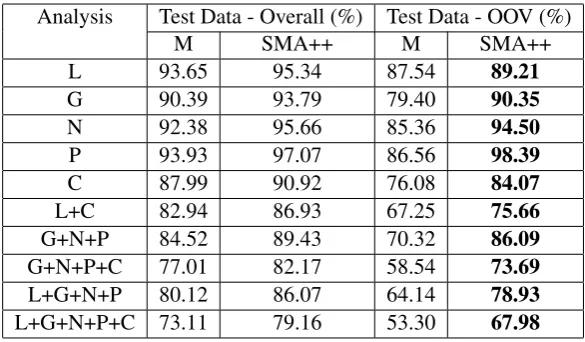
Analysis Test Data - Overall (%) Test Data - OOV (%)
M SMA++ M SMA++
L 93.65 95.34 87.54 89.21
G 90.39 93.79 79.40 90.35
N 92.38 95.66 85.36 94.50
P 93.93 97.07 86.56 98.39
C 87.99 90.92 76.08 84.07
L+C 82.94 86.93 67.25 75.66
G+N+P 84.52 89.43 70.32 86.09
G+N+P+C 77.01 82.17 58.54 73.69
L+G+N+P 80.12 86.07 64.14 78.93
[image:5.595.152.445.61.232.2]L+G+N+P+C 73.11 79.16 53.30 67.98
Table 6: Urdu Results for SMA++ and M
Analysis Test Data - Overall (%) Test Data - OOV (%) SMA-M SMA++ SMA-M SMA++ G 89.14 93.79 88.18 90.35
N 91.62 95.66 91.35 94.50
P 93.37 97.07 95.53 98.39
[image:5.595.166.436.273.359.2]C 85.49 90.92 79.01 84.07
Table 7: Urdu Results for SMA++ and SMA-M
5.3 Telugu
[image:5.595.160.437.506.620.2]The results are presented for G, N, P and C. The results are compared to 2 MAs viz. Morfette (M) in Chrupała et al. (2008) and SMA in Malladi and Mannem (2013) (SMA-M). Results are presented for both Overall test data and OOV test data. SMA++ significantly out performed Morfette (M). The results ofOverall Datafor SMA++ and SMA-M are very close, but more importantly the results ofOOV data for SMA++ are higher than SMA-M. Table 8. presents the results in comparison with Morfette (M) and Table 9. presents the results in comparison with SMA-M.
Analysis Test Data - Overall (%) Test Data - OOV (%)
M SMA++ M SMA++
G 95.49 96.33 87.82 89.85
N 87.31 90.48 65.48 77.67
P 94.49 94.49 86.80 86.80 C 94.49 95.66 84.26 90.36
G+N+P 85.48 88.81 60.91 74.62
G+N+P+C 84.14 86.81 57.36 70.56
Analysis Test Data - Overall (%) Test Data - OOV (%) SMA-M SMA++ SMA-M SMA++ G 96.49 96.33 89.85 89.85 N 90.65 90.48 75.13 77.67
P 94.82 94.49 85.79 86.80
[image:6.595.164.436.61.148.2]C 96.49 95.66 89.34 90.36
Table 9: Telugu Results for SMA++ and SMA-M
5.4 Tamil
The results are presented for G, N, P and C. The results are compared to Morfette (M) in Chrupała et al. (2008). SMA++ out performs Morfette (M). Table 10. presents the results in comparison with Morfette (M).
Analysis Test Data - Overall (%) Test Data - OOV (%)
M SMA++ M SMA++
G 90.40 91.14 85.18 91.36
N 88.93 90.04 83.95 87.04
P 98.15 98.89 96.91 98.14
C 87.82 94.46 80.86 91.98
G+N+P 80.81 82.66 70.99 80.25
G+N+P+C 76.38 78.97 64.20 74.07
Table 10: Tamil Results
6 Conclusions and Future Work:
For all the four ILs, SMA++ out performs other SMAs. For Hindi, the L+G+N+P+C accuracy was
85.87%. For Urdu, the L+G+N+P+C accuracy was 79.16%. For Telugu, G+N+P+C accuracy was
86.81%and for Tamil it was78.97%. These high values show that SMA++ is a marked improvement over the SMA in Malladi and Mannem (2013) . We studied two families of ILs, viz. Indic and Dravidian, because most of the ILs fall into these two groups. We plan to run SMA++ to predict Lemma in Telugu and Tamil. We plan to extend our work to European Languages such as Polish, German, French etc. We are currently working on the error analysis of our system. In future, we plan to deploy SMA++ for the ILMT project.
References
Akshar Bharati, Vineet Chaitanya, Rajeev Sangal, and KV Ramakrishnamacharyulu. 1995. Natural language processing: a Paninian perspective. Prentice-Hall of India New Delhi.
Riyaz Ahmad Bhat and Dipti Misra Sharma. 2012. A dependency treebank of urdu and its evaluation. In Proceed-ings of the Sixth Linguistic Annotation Workshop, pages 157–165. Association for Computational Linguistics.
Tina B¨ogel, Miriam Butt, Annette Hautli, and Sebastian Sulger. 2007. Developing a finite-state morphological analyzer for urdu and hindi. Finite State Methods and Natural Language Processing, page 86.
Grzegorz Chrupała, Georgiana Dinu, and Josef Van Genabith. 2008. Learning morphology with morfette.
Grzegorz Chrupała. 2006. Simple data-driven contextsensitive lemmatization. Procesamiento del Lenguaje Natu-ral, 37:121–127.
[image:6.595.157.438.258.373.2]Samar Husain, Prashanth Mannem, Bharat Ram Ambati, and Phani Gadde. 2010. The icon-2010 tools contest on indian language dependency parsing. Proceedings of ICON-2010 Tools Contest on Indian Language Depen-dency Parsing, ICON, 10:1–8.
Nikhil Kanuparthi, Abhilash Inumella, and Dipti Misra Sharma. 2012. Hindi derivational morphological ana-lyzer. InProceedings of the Twelfth Meeting of the Special Interest Group on Computational Morphology and Phonology, pages 10–16. Association for Computational Linguistics.
Deepak Kumar Malladi and Prashanth Mannem. 2013. Context based statistical morphological analyzer and its effect on hindi dependency parsing. In Fourth Workshop on Statistical Parsing of Morphologically Rich Languages, volume 12, page 119.
Dipti Misra Sharma, Prashanth Mannem, Joseph vanGenabith, Sobha Lalitha Devi, Radhika Mamidi, and Ranjani Parthasarathi, editors. 2012. Proceedings of the Workshop on Machine Translation and Parsing in Indian
Languages. The COLING 2012 Organizing Committee, Mumbai, India, December.
KVN Sunitha and N Kalyani. 2009. A novel approach to improve rule based telugu morphological analyzer. In