LEABHARLANN CHOLAISTE NA TRIONOIDE, BAILE ATHA CLIATH TRINITY COLLEGE LIBRARY DUBLIN OUscoil Atha Cliath The University of Dublin
Terms and Conditions of Use of Digitised Theses from Trinity College Library Dublin Copyright statement
All material supplied by Trinity College Library is protected by copyright (under the Copyright and Related Rights Act, 2000 as amended) and other relevant Intellectual Property Rights. By accessing and using a Digitised Thesis from Trinity College Library you acknowledge that all Intellectual Property Rights in any Works supplied are the sole and exclusive property of the copyright and/or other I PR holder. Specific copyright holders may not be explicitly identified. Use of materials from other sources within a thesis should not be construed as a claim over them.
A non-exclusive, non-transferable licence is hereby granted to those using or reproducing, in whole or in part, the material for valid purposes, providing the copyright owners are acknowledged using the normal conventions. Where specific permission to use material is required, this is identified and such permission must be sought from the copyright holder or agency cited.
Liability statement
By using a Digitised Thesis, I accept that Trinity College Dublin bears no legal responsibility for the accuracy, legality or comprehensiveness of materials contained within the thesis, and that Trinity College Dublin accepts no liability for indirect, consequential, or incidental, damages or losses arising from use of the thesis for whatever reason. Information located in a thesis may be subject to specific use constraints, details of which may not be explicitly described. It is the responsibility of potential and actual users to be aware of such constraints and to abide by them. By making use of material from a digitised thesis, you accept these copyright and disclaimer provisions. Where it is brought to the attention of Trinity College Library that there may be a breach of copyright or other restraint, it is the policy to withdraw or take down access to a thesis while the issue is being resolved.
Access Agreement
By using a Digitised Thesis from Trinity College Library you are bound by the following Terms & Conditions. Please read them carefully.
R andom Sam pling and Large D eviation s
by
Brian McGurk
A thesis subm itted to
the University of Dublin
for the degree of
Doctor of Philosophy
School of M athematics,
University of Dublin, Trinity College
Declaration
This thesis has not been submitted as an exercise for a degree at any other University.
Except where otherwise stated, the work described herein has been carried out by the
author alone. This thesis may be borrowed or copied upon request with the permission of
the Librarian, University of Dubhn, Trinity College. The copyright belongs jointly to the
University of Dublin and Brian McGurk.
Signature of Author
Abstract
In this thesis, we are concerned w ith the effect of random ly sampling a stochastic process. We consider two stochastic processes: the underlying process, {X t}teri and the observation process a strictly increasing process taking values in r . The process of interest is generated by sampling the underlying process a t th e tim es specified by th e observation process,
We call this transform ation random sampling and refer to {¥„} as the observed, or sample, process.
In particular, we are interested in how the large deviations properties of th e process are affected by this operation and so we only consider those th a t satisfy an LDP. In th e case where the process counting the num ber of observations is Poisson, a formula can be obtained for the new ra te function in term s of the rate function for the underlying process. Using order theoretic ideas, we can, in certain cases, characterise th e inverse to this formula and p artially determ ine the rate function of the underlying process, given only th a t of the observed process. Applying this formula w hen the underlying process is Markov, we derive a novel expression for the 2-state Markov rate function.
Acknowledgem ents
Many people deserve a share of my thanks for their help and support in the course of
my research.
John Lewis has been a constant source of encouragement over my time in DIAS. A part
from the practical matters of maintaining the Applied Probability Group, on which he has
worked ceaselessly, I have benefitted greatly from his wide-ranging mathematical experience.
Most of all, on those days when the proof doesn’t work, I have relied on John’s confidence
when mine has evaporated.
Raymond Russell has displayed unflagging patience under a barrage of half-baked ideas
and conjectures. The adjacency of his office was certainly to blame, but not so much as his
willingness to listen and sound advice. Of course, he is only one among many to have heard
me discourse on the technical minutiae of lemmas. I point to Fergal Toomey, Ken Duffy,
Cormac Walsh, Mark Dukes and Paul Watts, whose help I gratefully acknowledge; they
have provided much advice and many interesting conversations on all things mathematical.
I should single out Ken, Paul and Cormac for their proof-reading of this thesis, which has
reduced the number of mistakes therein.
My time in DIAS was made much easier by the smooth running of the administration;
by Anne Goldsmith’s assistance with library resources and by Margaret Matthews for all her
help with travel arrangements. Ian Dowse has provided an impeccably maintained computer
system; I am very grateful for th at and for what he has taught me of its workings.
While I have worked on this thesis, and in particular over the final few months, Lisa
Carey has been very supportive and understanding. She has played a large part in making
the last three years a happy and productive time for me. She has also helped me with my
words.
Finally, I would like to thank my parents for the love and support they have provided
me with throughout my life. More so than anyone else, they axe responsible for my being
able to do this research, and th at is but one of my many debts to them.
C ontents
1
Introdu ction
1
1.1 W hat are large deviation asy m p to tics?...
1
1.2 W hat we talk about when we talk about random sam p lin g ...
4
2
Large deviations
7
2.1 Semi-continuity, set functions and level s e t s ...
8
2.2 The vague and narrow path to the L D P ... 10
2.3 Varadhan’s t h e o r e m ...12
2.4 Stochastic p r o c e s s e s ...21
3
M arkov un derlying
processes
27
3.1 Randomly sampled Markov processes...27
3.2 The rate function of a Markov c h a i n ...32
4
P oisson sam pling : I
38
4.1 A rough s k e t c h ... 38
4.2 The d e t a i l s ...40
5
P oisson sam plin g : II
59
5.1 Galois c o n n e c tio n s ...
5.2 Recovering the underlying rate f u n c tio n ... 62
6 N on -P o isso n sam pling
"^2
6.1 Correlated processes and large d e v ia tio n s ... 75
6.2 Stationarity and correlation structure after s a m p lin g ... 77
Chapter 1
Introduction
We are interested in considering how certain asymptotic properties of a stochastic process
are affected by considering only the values assumed by th a t process at a random subset of
its index set. Specifically, we have in mind a second stochastic process which determines
a strictly increasing sequence of times at which the first process is observed. We wish to
determine how the two processes interact in generating the observed process and how much
information it is possible to regain about the asymptotics of the underlying process.
In particular, we are concerned with looking at the large deviation asymptotics of the
process. In Chapter 2, we provide a technical summary of the aspects of the theory which
are relevant to our investigations. In the following section, we provide a context for the
abstract treatm ent with a heuristic discussion of a concrete example.
1.1
W hat are large deviation asym ptotics?
The theory of large deviations grew from a study of the probabilities of rare events in
widely different areas, most famously risk theory and thermodynamics. It is concerned with
rare events whose probabilities decay due to some inherent scaling. To provide a concrete
example, consider the much beloved coin-tossing experiment. Out of n tosses of an unbiased
coin, we expect th at roughly half will come up heads. In fact, the weak law of large numbers
tells us th at the probability of
unusual
behaviour becomes arbitrarily small as we toss more
and more coins. To be precise, if we write the proportion of heads after
n
tosses as M „,
C H APTER 1. INTRO DU CTIO N
2then the weak law of large numbers tells us that for an arbitrarily small e,
Large deviation theory tells us how this probability decays when examined on an exponential
scale.
An obvious question to ask is why we expect decay on an exponential scale to be of
interest. The answer to this lies in the fact that we assume that successive coin tosses are
independent and statistically identical. Hence, any particular sequence of heads and tails
is equally likely. As a consequence of this, the probability of any event which depends only
on the aggregate behaviour, such as our example where we look at the proportion of heads,
will be determined by the number of different sequences which give rise to th at behaviour.
This means that the probability of getting an unusually high number of heads, after many
tosses, will be dominated by those sequences where the number of
extra heads have been
more or less evenly distributed throughout the course of the experiment. This is the case
simply because there are a far greater number of these sequences th an with the extra heads
arriving in a clump. It is not hard to see th a t as the number of tosses grows, so too does
the domination of the probability by those sequences where the heads are most evenly
distributed. Effectively, as
n becomes larger, the deviation from the expected behaviour is
shared as equally as is possible over all the coin tosses. Since we axe thus expecting each
toss to behave in a similarly deviant fashion, and the tosses are independent of each other,
we would expect that the probability would roughly factor into n equal contributions. In
other words, where
x is some number greater than
we might hope to prove the existence
of the Hmit
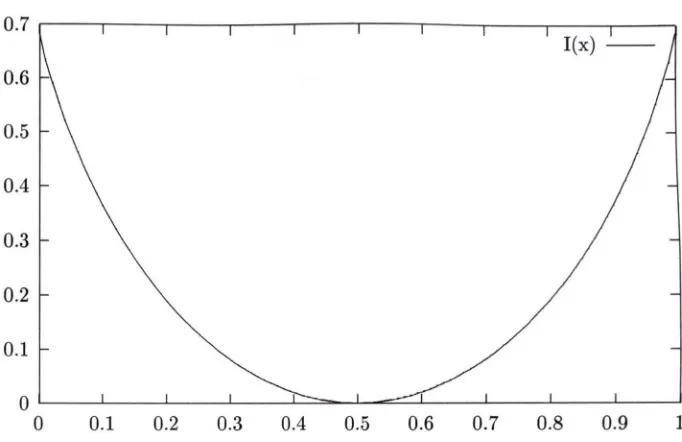
I{x)
is called the
rate function because it describes the rate of decay of the probability,
lim P( Mn w x ) " .
n —)>oo
To be more specific, a typical large deviation statement is of the form
n^oo n
lim — logP( Mn ~ a;) = —/(a ;).
(1.1)C H APTER 1. INTRO DU CTIO N
3
0.7
I(x)
0.60.5
0.4
0.3
0.2 0.11
0 0.1 0.2
0.3
0.4
0.5
0.6
0.7
0.80.9
Figure 1-1: The rate function for coin tossing
we sometimes write equation (1.1) using the following notation,
F { M n ^ x )
Obviously, the rate function has to be non-negative everywhere, and it reaches zero at
the mean because the probability of this typical behaviour tends to 1. In the case of our
coin-tossing example, a graph of the rate function is shown in Figure 1.1.
[image:9.517.71.412.91.312.2]C H APTER 1. INTRO DU CTIO N
4
half the time and with a frequency of 0.8 the rest of the time.
In a more general situation, we can consider arbitrary stochastic processes and ask
whether some large scale property of the process, such as its empirical average, satisfies
a large deviation principle (LDP). In such cases, the heuristic argument above can break
down. For example,
heavy-tailed
processes, where, for each individual random variable,
the probability of unusual behaviour does not decay quickly, may satisfy LDPs on hyper-
exponential scales. In such cases, the deviation can be caused by the action of a single
random variable, rather than being spread over the entire history of the process, and the
rate function will not necessarily be convex.
The precise definition of an abstract LDP is somewhat technical and is covered in Chap
ter 2. In the general case, instead of a sequence of laws of empirical averages, as for
coin-tossing, we look at an arbitrary sequence of measures and examine the logarithmic
asymptotics of the sequence on certain sets, against some specified scale. Roughly speaking,
the LDP holds when
lim
log P(
e -B) = - inf 7 (x ),
n —>oo
l/^
xeB
for
B
in some suitably defined class of sets.
1.2
W hat we talk about w hen we talk about random sam
pling
We have in mind a situation where a stochastic process can only be observed at certain times,
which are governed by some other random process. Thus the observer has only partial infor
mation about the behaviour of the underlying process. As a concrete, if somewhat artificial,
example, consider the transit time along some city bus route, subject to unpredictable vari
ations, as the underlying stochastic process. Consider also an individual commuter who,
subject to random whims, may choose alternatives to the public transport provided. We
could describe this situation as a random sampling of the transit time process. The process
consisting of the commuter’s transit times on public transport is obviously related to the
underlying process, but there is also an effect due to his random decision process.
C H APTER 1. INTRO DU CTIO N
5
the
observation process, and the time of the n^^ observation is usually denoted T„.
Nt
typically refers to the number of observations before time
t. In th at case, the
observed
process, consisting of the sequence of samples, is defined by
Yn := X t^ .
We are interested in finding out how the random sampling transformation affects the large
deviations properties of the underlying process, and, if possible, relating the rate functions
of {Xt} and {T„} to that of {Vn}. We would expect th at the asymptotic properties of the
process would be changed by this operation, since the number of ways in which an event can
happen is greatly increased by the addition of random time intervals between observations.
For instance, to achieve some deviation of the observed process, either the underlying process
could behave in a similarly deviant fashion and the observations be typically distributed,
or the underlying process could behave in a more typical manner and the deviation be
attributable to an unusual sequence of observations. Hence, to use the cost analogy, we
can see there should be some trade-off of the cost of atypical behaviour of the underlying
process against that of atypical behaviour of the observation process.
We start by considering a concrete example where the underlying process is a Markov
process and the times between observations are independent. In this case, the resulting
process can be completely described by a Markov chain, the large deviation properties of
which are well-known. When the state space of the Markov process consists of only two
values, and the inter-observation times are exponentially distributed, we can identify the
Markov chain precisely. This we describe in Chapter 3, where we use this result to come up
with a new, if rather unwieldy, formula for the rate function of a 2-state Markov chain.
In so doing, we rely on a formula which is at the centre of Chapter 4 where we relax the
conditions on the underlying process while keeping the Poisson structure of the observation
process. In this case, we can derive a formula which describes the rate function for the
observed process in term s of the underlying one.
CHAPTER 1. INTRODUCTION
drawn from the first m (n) elements, where
6
lim
= ^ ,
for /? € (0,1).
n->oo m (nj
Its distribution is such that every distinct set of n samples in
,m} is equally likely.
When the empirical average of the underlying deterministic sequence converges, they show
th at the resulting stochastic process obeys an LDP and they provide a formula for the rate
function. They generalise this analysis to consider empirical measures.
For the most part, we restrict our intentions to continuous time processes. When the
arguments used in Chapter 4 are converted to the discrete time case, the observation pro
cess we choose has geometrically distributed inter-observation times, this being the closest
analogue of the Poisson process. This process conforms to the conditions for the LDP de
rived by Dembo and Zeitouni, and, in that case, the rate function they derive occurs as an
intermediate step in the derivation of the rate function in the discrete time random sampling
transformation.
C hapter 2
Large deviations
The aim of this chapter is to provide an abstract introduction to some of the technical aspects
of the theory of large deviations and to define some concepts th at we will use throughout the
remaining chapters. We use the framework described and developed by Lewis and Pfister
in [7]. A minor, but potentially confusing, difference is th at in our discussion of the LDP,
the rate function is defined to have a different sign to th at of the rate function in [7]. We
do this because, outside of this chapter, we are only interested in the large deviations of
probability measures, whose logarithm is always non-positive. For this reason, we follow the
convention of the probability literature and choose to deal with non-negative rate functions.
This implies th at the rate function be lower, rather than upper, semi-continuous.
In Section 2.1, we define some of the terminology we will use and state some simple results
regarding the properties of semi-continuous functions and their relation to set functions. In
the following section we describe the incremental approach to proving an LDP which is
explained in some detail by Lewis and Pfister in [7]. In Section 2.3, we investigate the
general form of Varadhan’s theorems, originally proved by Varadhan in [10]. We prove
these theorems, in a more restricted setting, within the framework of [7]. In Section 2.4, we
review some issues relating to stochastic processes and the LDPs deriving from them.
The material in Sections 2.1 and 2.2 is not original, begin merely a summary of [7], b u t
in Section 2.3, where proofs are provided either the result or the method of proof is believed
to be novel.
C H APTER 2. LARG E D EVIATIO NS
8
2.1
Sem i-continuity, set functions and level sets
In advance of discussing the definition of an LDP, it is helpful to gather together some facts
about semi-continuous functions, set functions and the links between them. Let X be a
Hausdorff topological space, and let
G denote a generic member of Q, the collection of open
sets.
For a function / : X ^ E, its
level sets are those of the form
{x : f { x )
<
a},
for some finite a. We say that / is lower semi-continuous (Isc) iff all its level sets are closed.
/ is upper semi-continuous (use) if —/ is Isc, or, in other words, if all sets of the form
{x : f {x)
^ a} are closed, for finite
a.
A set function is a function from a class of subsets of X
to E. We define two operations,
which transform set functions into real-valued functions on
X
and vice versa. We only
concern ourselves with set functions whose domain includes
Q.
D efinition 1
For a set function c, the inf-derivative
of c is
{x)
inf c[G] = {c[G]
: G £ Q , x E G} .
G 3 xFor a function / : X -> E,
the sup-integral
of f is
'^/[G] :=
sup f i x ) .
xGGUsing this terminology, for an arbitrary function we define semi-continuous regularisations.
D efin ition 2
For an arbitrary function f : X
R, we define the use regularisation by
fO
and the Isc regularisation by
f . : = i i r
C H APTER 2. L A RG E DEVIATIONS
9
L em m a 2.1
/
is use if and only if
=
f-Proof.
For any a, we define
Ga •— {x :
f {x) < a}.
Assume first that / is use. Since
f ^ ^ f
automatically, we need only prove the opposite
inequality. Fix x, and take any a > f {x). Since / is use,
Ga G Q, and of course
[Go] ^ o-
Therefore, because
Ga B x,
f ^{x)
= inf sup /(y ) ^
a.
G 3x y e USince this holds for all
a > f {x),
we can conclude th at
f ^
^ / .
On the other hand, assuming th at /^ = / , we want to show th a t
Ga is open.
Ga =
<x :
inf sup
f{y) < a
G 3 x y S G=
\ 3 G 3 X such th at
G is open and G C Gqj- .
Thus
Ga is equal to its interior and so is open. Hence / is use.
□
For an arbitrary function, / , it can be shown, by a similar argument to th a t used in
proving the second part of the previous lemma, that (x :
f ^{x)
< a} is open for all
finite a.
Hence,
f ^
is always use. Of course, parallel statements hold true for the Isc regularisation:
/o is Isc for any / , and / itself is Isc if and only if / = /<>.
Using this characterisation of upper semi-continuity, we can show th at the inf-derivative
of c, a set function, is a use function by showing that for any a:,
{' ^cY{x)
<
^c{x),
and this follows from the fact that
sup inf
c\G'] ^ c[G],
V G 9 a:
y ^ G C ' 3 yCH APTER 2. LA RG E D EVIATIO NS
10
2.2
The vague and narrow path to the LDP
In later chapters, we will only be concerned with LDPs on
but for the present we wish
to define a more general setting in which to prove the extension to Varadhan’s theorem.
We consider a sequence of measures
on a HausdorfF topological space
X ,
equipped with a Borel structure. We denote the collection of closed sets by
T ,
and the
compact sets by
1C.
We let
denote a scale, an increasing sequence of positive real
numbers, diverging to +oo. We are interested in examining the exponential asymptotic
properties of these measures on this scale. To this end, we make the following definitions
m n [ B ] : =
:^logM„[5];
m[B] :=
limsupm„[jB];
n —> 0 0
rn\B]
:= lim in fm „ f5 l.
n —>-00Using these definitions, we can state the abstract LDP as follows.
D efinition 3
{M„}
satisfies an LDP, on the scale
{ V n } ,with rate function I : X ^ R, if
the following conditions are satisfied
(L D P l)
I is lower semi-continuous;
(L D P 2)
I has compact level-sets;
(L D PS)
- i n f / ( a ; )
^
m[G] ,
y O e Q ;
xGG(L D P 4)
fn[F]
^ - i n f / ( x ) ,
F ^ T .
i g FThere is a general approach to showing the existence of a rate function for a given
sequence {(M^, V'„)} which relies on finding a function to satisfy a weaker set of conditions,
and then using topological arguments to show that this function qualifies as a rate function.
We make these weaker conditions precise in the following definition.
D e fin itio n 4 {M„}
satisfies a
vague
LDP on the scale
{Ki}
with
r a t efunction I, if I sat
isfies L D P l, LDPS and
CH APTER 2. LARG E D EVIATIO NS
11
In order to establish some useful conditions under which a vague LDP is guaranteed, we
define two new functions.
fi{x)
;=
inf m[ G] ,
— G B x
JI (x) :=
inf m [G] ,
G Bxcalled, respectively, the upper and lower deviation functions. This pair of functions can be
used to show the existence of the function I,
satisfying the vague LDP.
The inf-derivative of a set function is necessarily upper semi-continuous, which means
th at
—/£
and
—JIboth satisfy LD Pl. We also note th at the definition of ^ implies
sup /i (x) < m [G] , V G e ^ ,
x e G ~and it is proved in [7, Lemma 2.5], via the principle of the largest term, th at
m [K] ^ sup
J l { x ) ,V K € /C.
x€ KHence, if /i and
JIare equal, then the conditions for the vague LDP are met by the negative
of th at function. In this case, we define the Ruelle-Lanford (RL) function,
/i(x)
:= [i{x) =Jl{x) .
Of course, this merely reduces the problem of proving the vague LDP to showing the
existence of the RL function. However, there is a fact to note about the definition of the
upper and lower deviation functions which helps us to do this. If 6 is a base of Borel
neighbourhoods, then for all G G ^ there exists
B E B such th at
B C G. Since both m and
m are increasing set functions, this means th at (using
B
to denote a generic element of B)
u (x)
= inf
m [G]
= inf m [B] ,
- ’ G ^ x — ^ ^ B 3x~ ^ ^JI (x)
= inf m [G]
= inf m [B] .
^ G 3 x ^ B a x ^
Hence, if we can show that for some such base,
B,
CH APTER 2. LARG E D EVIATIO NS
12
then we can conclude that the RL function exists. At several points, we will use this
technique in the case where
X
is
, where the open balls are a base for the usual topology.
In certain cases, it is possible to promote a vague LDP to a full LDP. This involves two
steps, the first is changing the scope of the upper bound by showing that the rate function
satisfies LDP4, rather than ju st LDP4’; the second is proving th a t the level sets of the
rate function are compact. W ith the strengthening of the upper bound from compact sets
to closed sets, we get what Lewis and Pfister term a
narrow
LDP. Some authors, such as
Dembo and Zeitouni in [4], define an LDP to be what we term a narrow LDP; they then
use the term
good
to describe a rate function with compact level sets.
If all closed sets are compact, then LDP4’ implies LDP4, and since the level sets of a
lower semi-continuous function are closed, by definition, we can move immediately from a
vague to a full LDP. In most cases th at will concern us in this thesis,
X
itself is compact,
in which case all closed sets are also compact. Therefore, in such cases, if we choose to
prove the LDP via showing the existence of the RL function, then that is in fact all th a t
we need to prove since its existence guarantees a vague LDP which leads automatically to
the full LDP. Lewis and Pfister show that, even if the space is not compact, the
exponential
tightness
condition guarantees th at a sequence satisfying a vague LDP will obey a full LDP.
D efinition
5
A sequence of measures,
{Mn},
is exponentially tight on the scale
{V'n}
if
there exists a sequence, {K n}, of compact subsets of X such that
lim
ffi[X\Kn\ = —oc .
n->oo
In [7, Section 5], they show th at if a sequence of measures obeys a vague LDP and is
exponentially tight on the same scale, then the sequence obeys a narrow LDP with the
same rate function. In the case where
X
is regular, this rate function is unique, and so is
equal to the RL function whose level sets are compact, which completes the conditions for
the full LDP.
2.3
Varadhan’s theorem
We now investigate a method of using an LDP for one sequence of measures to prove an
C H A P T E R 2. L A R G E D E V IA T IO N S 13
A s s u m p tio n 2.1 {M„}n^i is a sequence o f locally finite measures on a H ausdorff space X , which obey an LD P on the scale {Vn} with rate function I = —jj,, where /i is the R L function fo r the sequence.
We are interested in considering th e large deviations of a sequence of exponentially tilted measures, where we define
Jb
W ith suitable conditions on the sequence of functions {gn}i we can show th a t ^n)} satisfies an LDP. In keeping w ith the notation of the previous section, we define th e following functions.
:= :^ log M ^ '^ [5]
m^\B] := lim inf [5 ], H^ix) inf [G] ,
n->-oo — G 3 x
m^[B] := lim su p m n " [S ], Ti^ix) := inf [G] .
n —)-oo G 3x
T he result known as V aradhan’s theorem concerns the exponential asym ptotics of th e tilte d m easure applied to the whole space, [X].
Varadhan’s approach
In V aradhan’s original paper, [10], he imposes certain convergence criteria on the sequence of functions which ensure th a t the tilted measures, applied to the whole space, have the app ropriate exponential asym ptotics. In order to obtain th e upper bound, he also imposes a tail condition on the tilte d measures which ensures th a t th e functions do not grow too quickly. This condition is trivially satisfied by a sequence of functions which are uniformly bounded.
CH APTER 2. LARG E DEVIATIONS
14
V I
Ve > 0, there exists a neighbourhood, N
9 xq, such th at for all sufficiently
large n and
all x E N,
9n{^) ^ 9
(^0)
^ 5
V 2
Ve > 0, there exists a neighbourhood, N 3 Xq, such th at for all sufficiently
large
nand all a;
6 AT,9n{x) >
gixo) - e;
and the tail condition,
V 3
lim lim sup
l o g [
5„ “ ^[L,oo)] = -
0 0.
L->oo n-foo
Vn
Using these conditions, Varadhan proves the result in three stages. First, he proves the
upper bound.
T heorem 2.2
If condition VI holds at every x for the function g{x), and VS is satisfied,
then
m^[X] < sup {g{x) - I{x)} .
x ex
Next, he defines the set
X
qto be the set of points in X
where condition V2 holds and this
gives the following lower bound.
T heorem 2.3
^ sup {c;(a:) - I{x)} .
x £ X oThese are then combined to give the result known as Varadhan’s theorem.
T heorem 2.4
I f condition V3 holds and there exists a function g \ X ^ B. satisfying
condition VI at every x such that
sup {g{x) - I{x)} = sup{(/(a;)
- I{x)} ,
x e X o ajGX
then
CHAPTER 2. LARG E DEVIATIONS
15
T h e L ew is-P fister approach
In the more common statement of Varadhan’s theorem, the sequence of tilted measures is
obtained from the original sequence by means of a single function,
= M® , (2.1)
where
g :
X —)■ K is some locally bounded function. This is the situation considered by
Lewis
and
Pfister in [7]. In the case where
g
is continuous, they show the existence of, and
identify, the RL function
jjP = ll + g^ (2.2)
and conclude th at the sequence satisfies a vague LDP. As explained in the previous section,
when the space is compact, a vague LDP is equivalent to a full LDP, and so they get the
following theorem.
Theorem 2.5
If X is compact then, for a locally bounded, continuous function,
g
:
X
—
>• M,
rn^[X] = rn^[X]
= sup {g(a:) -
I{x)} .
xex
They also show th at for an arbitrary Hausdorff space, this vague LDP can be promoted to
a full LDP by using Varadhan’s condition, V3.
In the remainder of this section, we wish to expand the approach taken by Lewis and
Pfister to cover the situation where the measures are tilted by a sequence of functions. We
also explore equivalent conditions to VI and V2.
A central lemma in the investigation of tilted measures, defined as in equation (2.1),
in [7, section 2], states that
[i{x)+goix)
<
<
J l{ x) + g ^ {x ),
l£{x) + go{x) ^ yP{x)
<
-Ji{x)+g^{x).
If
g
is continuous, then
g<> = g^,
and
C H APTER 2. LARG E DEVIATIO NS
16
and the existence of
fx
gives the vague LDP for {(IV!^,F„)} with the rate function given
in equation (2.2).
We can prove a similar lemma in the more general setting, but we require more than ju st
continuity of the limit function to attain equality. However, before imposing any conditions
on {^n}) a-iid without needing to assume th a t ^ = /Z, we can prove the following;
Lem m a 2.6
Let Qn be locally bounded and measurable for all n. Then the upper and lower
deviation functions for
are related to those for (Mn,F„)
by
~pp{x) <
Ti{x)+ inf lim sup sup
5„ ( y ) ,
G 3 x n-^oo y&Gli^{x) ^
+ sup lim inf inf
gniv) ■
— — G 3 x n ^ o o y € GProof.
The proofs of the inequalities are almost identical, so we will just prove the first.
For any open set
G,
m^[G] ^ m„[G] + sup
c/n(y)-y e GIn fact, for
G D G' 3 x,
[G'] ^
[G'] + sup
(y),
y e GmP [G'] ^
fn[G'] + lim sup sup
(y).
n->oo y e GTaking the infimum over
G' and the supremum over
G,
ju®(x) ^ /7(a;) + inf lim sup sup
3n{y).
G 3x n —> o o j/£G□
{^n}-C H A P T E R 2. L A R G E D E V IA T IO N S 17
{Cg){x) ;= in f lim sup sup 5„(y ). G Bx n->oo 2/ec?
Lem ma 2.6 th en implies
H + {Sg) ^ ^ n + {Cg) ,
and hence equality of (Sg) (x) and (£g) (x) implies existence of th e RL function at x for the tilted sequence. Not surprisingly, it tu rn s out th a t th e conditions V I and V2 are sufficient to dem onstrate the equality of Cg and Sg, and in fact, they are also necessary.
L em m a 2.7
{Cg) (x) ^ g{x) <=> VI holds at x fo r g{x).
{Sg) {x) ^ g{x) V2 holds at x fo r g{x).
P ro o f. We check the details for the first equivalence by simply following the definitions.
{Cg) {x) < g{x)
<;=^ inf lim sup sup gn{y) g { x ) , G3x n —>oo 2/€u
V e > 0 , 3 G g 3 a : s.t. lim sup sup gn{y) ^ g{x) + e , n —>oo y€Gc
V e > 0 , 3 G e 9 x S.t. Ve ' > 0 , 3 iVff s . t . sup sup 9n(y) ^ 9(a;) + e + e ', \/S > 0 , 3 G s 3 X , Ns s.t. sup sup gn{y) ^ g{^) + S ,
n > N s y € G s V I holds a t X for g { x )
The proof of th e second equivalence is identical. O
CH APTER 2. LA RG E DEVIATIONS
18consider
gn(x) = i n x + 2
—n x
a: ^ or a; ^ 0
The hm it of gn{x) is zero for all a;, b u t there does not exist G 9 a: for which supg„ is not G
ultim ately 1.
If th e conditions V I and V2 b o th hold at a point x E X w ith value g{x), then we say
th a t condition V is satisfied, where th e condition is stated as follows.
(V ) Ve > 0, there exists
G 3 x
andN
such th a t \gniy) ~ g(^)l <e
,V n
>N
.So, if we assume th a t condition V holds true a t a point x, we know from Lemmas 2.6 and 2.7
th a t the RL function exists there and is given by
H^ix) = iJ,{x)+g{x),
and if condition V is m et at every x € X , we know th a t the tilted measures obey a vague
LDP. If X is compact then, as explained before, V aradhan’s theorem is im m ediate; since we
know th a t X is also open, we can use the equal bounds provided by th e u pper and lower
deviation functions.
sup IjL^{x) ^ ^ fnP[X] ^ sup /i®(x),
Using th e observation in Lem ma 2.9, this can be sum m arised in th e following theorem.
T h e o r e m 2 .8 I f X is compact, then for a sequence of locally bounded functions gn : X —> K,
which satisfy condition V at all x E X
lim log f = sup {g{x) — I ( x ) } ,
n-^oo Vn J x xeX
where g(x) — lim n->oo
W hen th e space is not com pact, it is more difficult to apply th e style of argum ent used
C H A P T E R 2. L A R G E D E V IA T IO N S 19
L o ca lly u n ifo r m c o n v e rg e n c e
We now wish to detail some implications, an d provide alternative formulations, of condition
V.
W hen V holds at a point x, we know th a t given e > 0, there exists an open neighbourhood
G 3 X such th a t \gn{y) — 5(a:^)| < e for all y & G. Since all such G certainly contain x, we
obtain th e following n atu ral result.
L em m a 2.9
I f V holds at x fo r the value g{x), then lim gn{x) exists and is equal to g{x). n —>ooIn order to make condition V easier to check we prove a couple of theorem s about the
convergence of sequences of functions. F irst of all we isolate th e convergence aspect of
V aradhan’s condition.
D efinition 6
The convergence of a sequence of functions, {gn}, to the function, g, is locallyuniform iff given e > 0 and x £ X , there exists a neighbourhood of G 3 x, and an N such
that,
\9n{y) - g{y)\ < e, ^ y £ G , n > N .
T heorem 2.10
The convergence of gn to g is locally uniform and g is continuous if andonly if condition V holds at every x E X .
Proof.
Considering the “i f ’ p art first, we sta rt by proving th e continuity of g. ByLemma 2.9, we know th a t g is the pointwise limit of the sequence {^n}- For any e > 0,
condition V tells us th a t there exists G 3 x and num ber N such th a t
\9n { y ) - g { x ) \ < e, y y e G , n > N ,
<
e,y y €G,
\ g { y ) - g { x ) \ < e, ^ y e G . lim gn(y) - g{x)n—¥oo
Hence g is continuous.
Now we wish to show th a t th e convergence is locally uniform. Consider e > 0 . Since g
is continuous there exists a set Gi 3 x such th a t
C H A P T E R 2. L A R G E D E V IA T IO N S 20
and, by condition V, there exists a set G2 3 x, and a number N such that
\ 9 n { y ) - g i x ) \ < V y G G2, n > i V .
Hence, as required
\ 9n{y) - g{ y ) \ < e, Vy e Gi n G2,n > iV.
The proof of the “only if” part is almost identical. Again, taJie e > 0 . Since g is
continuous, and the convergence of to g is locally uniform, we know there exist open
neighbourhoods of x, Gi and G2 and a number N such that
\ 9ni v) - g{y)\ < ^ , \g{y) - g{x)\ < € , V y e G i n G2,n > iV,
\9n{ y ) - g{x)\ < 2e , V y e Gi n G2,n > iV,
which shows that condition V is satisfied. □
For characterising the convergence of sequences of functions, uniform convergence on
compact subsets is a more common criterion than locally uniform convergence. T he following
theorem shows that it is, in fact, sufficient, and in the case o f locally com pact spaces,
necessary.
T h e o r e m 2 .1 1 If the convergence to g, of the sequence of functions {gn}> is locally uniform,
then it is uniform on compact subsets of X .
In a locally compact space, if the sequence converges uniformly to g on compact subsets,
then the convergence is locally uniform.
P r o o f. Assum e first that the convergence is locally uniform. Then, given a compact subset
i f , and e > 0, then for every x E K , we can find a neighbourhood G^ 9 x, and a number
Nx, such that
l f f n { y ) - 5 ( y ) l < e , M y e G x , n > N x .
CHAPTER 2. LARG E DEVIATIONS
{Gxii- ■
■,
whose union contains
K.
Hence
21
\9n{y) -g{.y)\
< e,
Vy G
K , n >
max{JVxi, . . . , ■
On the other hand, if X is locally compact then every point, x, has a compact neigh
bourhood, say
Kx-
Since convergence is compact on this subset and it contains an open
neighbourhood, we can conclude th at condition V holds at this point.
□
2.4
Stochastic processes
The LDPs which will concern us in the following chapters derive from either the empirical
averages, or empirical measures, of stochastic processes.
Em pirical Averages
For a stochastic process, {1^}, taking values in S, we might be interested in the large
deviation properties of the sequence of measures, {M„}, defined by
M„ [B]
^ ^
^ ^
Borel sets
B.
These measures are the laws of the empirical means. We will usually only consider the
empirical average of a 2-state process. In that case, the average at time n tells us the
number of those
n
random variables in each of the states; for instance, if S = {0,1}, then
the partial sum, Yi
is the number of times the process has been in state 1.
Em pirical M easures
For a process where the cardinality of the state space is greater than two, the partial sum is
likely to hide the percentage of the total time spent in each state. To capture the same type
of information about such a process, we construct the empirical measure. The empirical
measure of a discrete-time process, {V^}) is a measure on E, defined by
C H APTER 2. LA RG E D EVIATIO NS
22
In order to examine the large deviations of the laws of these measures, we need to specify a
topology on the space of measures,
M.
(S). In general, this space can have many topologies,
but we will only concern ourselves with processes taking values in a finite set. We let the
cardinality of S be M and, to simplify notation, we take E to be the set {1, . . . , M}. In this
case, each measure can represented as a sum of Dirac measures;
M ^ M [{i}] Si ■ ^ i^M
In this way, to each measure, we can associate a vector in
We define the set of all
probability vectors
r = {y € ]R+ : yi + •. • yjw = 1} ,
and the natural mapping to this set from the space of measures,
C
: M ( S ) ^ r ,
C :
/i 1-^ ^/i[{l}],...
.
We will refer to the components of the image vector as the
coordinatesof the measure. We
take r to be equipped with a topology which is the relativisation of the usual topology on
. Since
C
is bijective, we will talk about a measure and its coordinates interchangeably.
In particular, we will refer to an LDP on F, for the coordinates of the empirical measure,
as an LDP on
A i
(S) for the empirical measures.
R elative entropy and accessib ility
For the purposes of defining some further notation, we consider a E-valued stochastic process
consisting of independent random variables sharing a common distribution on S;
C H A P T E R 2. L A R G E D E V IA T IO N S 23
Let yUn be th e empirical measure of th e process at time n, and define := C(fin) so th a t
O f course, th e components of this vector m ust be of the form ^ for fc G { 0 ,1 ,... n}, and so
we define the following finite subset of F, which contains th e attainable vectors at tim e n,
Tn = {q S r : nqi G N for all 1 ^ i ^ M } .
Thus, we have th a t for y G r \ r „ , P ^ ~ ^ ~ ^ for
q
G Fn,This function occurs frequently in C hapter 4, and so, w ith exponential asym ptotics in m ind,
we define, for
q
G F„,ft„(q,v)
:= i
logP ( U(”) = q ) = i log
-
- f f(q| v)
- ff
(q)
, (2.3)
where H
(u|
v ), the relative entropy ofu
w ith respect to v , is defined foru
G F byM
H { u \ v )
: =Vi
i=l ®
and -ff(u), th e entropy of u G F is given by
M
H { u ) : = - ' ^ U i l o g U i .
The relative entropy, i / (• | v ) , is the rate function for th e laws of the empirical measures
of {Yn}. We also extend /i„ to a set function by the following definition. For B , a Borel
subset of F, we define
fc „ (S ,v ) ;= i l o g l 5 3 I ,
^ \qeBnr„ /
C H APTER 2. LA RG E D EVIATIO NS
24
P
Lastly, we wish to define the set of probability vectors from which a given vector is
accessible.
This definition helps to simplify some technical details of the proofs in Chapter 4.
For a process such as {Fn}, it is possible to choose v, the vector describing the distribution,
zero. We say that a state is accessible from v if it has a non-zero probability of being visited.
A support for a probability measure is any set whose measure is 1. Similarly, we define the
support, 5 (v ), of a probability vector, v, to be
We have, therefore, th at for v G .A(x), Uj = 0 => Xj = 0.
Continuous tim e processes and m easurability
Although the process resulting from the random sampling transformation is necessarily a
discrete time process, we will also deal with continuous time processes. The underlying
process in many cases will be indexed by R-|_, rather than N. The statem ent of the LDP in
continuous time is almost identical to that in discrete time. For example, we can define the
empirical average of a process
by
and then look at an LDP for the sequence
{Ci^Zt))
the scale
t.
The discussion of LDPs earlier in this chapter goes through analogously when the se
quence of measures is indexed by R rather than N. However, there is a potential difficulty is
in the definition of quantities such as the integral in equation (2.4). In order to guarantee
th at functions such as
Zt
are measurable, we need to impose an additional measurability
constraint on the process {Xi}. In [5], Doob defines measurability of a stochastic process
to be on the boundary of F. In th a t case, the probability of visiting certain states will be
and using this, the set of vectors from which x is accessible is given by
^ (x ) := {v e F : 5(x) C 5(v)} .
CH APTER 2. LA RG E DEVIATIO NS
25
in the following way:
D efinition 7
A stochastic process
{XtjtgR,
defined on the probability triple
is
measurable iff the function X
: O x K ->• K,
where X{u},t) = Xt{u}), is measurable with
respect to the product space
x R,
x B, X x
Leb).
Doob discusses stochastic convergence properties th at guarantee measurability, and shows
how measurability of a stochastic process ensures th at integrals of the process, such as in
equation (2.4), are measurable.
Throughout the remaining chapters, we will assume th a t all continuous time processes
are measurable.
The Poisson process
In this section, we wish to gather a few facts about the Poisson process, which we will have
need of in Chapter 4.
Consider a Poisson process with rate
a, {Nt}teM.+i
defined on the probability triple
We will be principally interested in the related process,
which defines
the sequence of jum p times.
Since
Nt
is Poisson, {T„+i — T„} are independent and are all exponentially distributed with
parameter
a.
Using this simple structure, it is not difficult to see th at the joint law of
{ Ti ,. . . , T„} has a density given by
Of course, by integrating over the first n — 1 variables, we see th a t the law of T„ has the
density
We also make use of the fact th a t the laws of T „/n obey an empirical average LDP on
Tn =
sup{i
: Nt < n } .
(2.5)
the scale n. This can be easily seen from Cramer’s theorem (see, for example, [4, C hapter
C H APTER 2. L A RG E DEVIATIONS
26
given by
A(0) = logE e^^i,
= , ‘° « ( * )
’+ 0 0 ,
V
Hence, we can conclude th at
{C^Tn/n)}
satisfy an LDP
Fenchel transform of A,
I r it)
= sup{i0 — A(0)} ,
e
— a t —
log(o;i) — 1.
(2.8)
The scaled cum ulant generating function
We made use in the previous section of the scaled cumulant generating function (sCGF);
this is a very useful tool in the theory of large deviations. In general, for a discrete time
process {X„}, the sCGF is defined by
A(0) := lim — logE exp
+ . . . +
,
7i->oo
n
\
/
where this limit exists. The usefulness of the sCGF stems from the fact th a t existence of
the rate function implies, by Varadhan’s theorem, existence of the sCGF, and furthermore
th at A is the Legendre-Fenchel transform of
I.
If, in addition,
I
is known to be convex,
then there is a duality and
I
is the Legendre transform of A. This is often the easiest way
to calculate the rate function.
6 < a
(2.7)
9
a .
Legendre-Chapter 3
Markov underlying processes
For this initial investigation of random sampling, we will restrict our attention to a specific
class of processes. If we examine random sampling in discrete time, we have the option of
choosing an uncorrelated underlying process, for instance a Bernoulli process. However, for
any choice of observation process (with strictly increasing observation times), it is not hard
to see th at the observed process is identical in distribution to the underlying process. So,
in order to have a non-trivial transformation to examine, we work with a correlated process
and choose a Markov process as a relatively simple example.
In fact, we choose to work in continuous time since, despite some additional technical
considerations, the calculations are more tractable. We will use a Poisson process to deter
mine the sequence of observations and restrict the underlying process to lie in the class of
finite state Markov processes. An almost identical analysis can be carried out in discrete
time if we replace the continuous time Markov process by a Markov chain and the observa
tion process by a counting process whose inter-arrival times are geometrically distributed.
3.1
R andom ly sam pled Markov processes
Let
P) be a probability triple. W ith respect to this triple, we denote the time of the
observation by the random variable
and the number of observations before time
t
by
Nt,
where
Nt
:= sup
{ n : T n
.
C H APTER 3. M A R K O V UNDERLYING PROCESSES
We also define the inter-observation process,
by
28
W fi • — '^ n ^ n - 1 )
where To := 0.
A ssu m p tion 3.1
The inter-observation times {Wn} are independent and share a common
distribution with W , an almost surely bounded random variable taking values in
K_)_.
We denote the underlying process by
and its countable state space by S. For
convenience we take S to be a copy of N. We define
T - t:=
cr ( X t )and
:= a {Xs : s ^
t) .A ssu m p tion 3.2
{ Xf } is a time-homogeneous Markov process with transition function
F{ i , j ; t ) : =
P(
Xg+t = j
|
=
i)
,
Vs
^
0.
The sample process is then given by
: = X t^ .
We are interested in finding out how the correlation structure of {Xj} is related to that
of {yn}- As shown in the following theorem, the Markov character is preserved by the
sampling.
T heorem 3.1
{yn}neN
is a Markov chain with transition matrix
f,j-.= E F { i , r , W ) .
Proof.
We wish to show th at for any
G S,
CHAPTER 3. M A R K O V UNDERLYING PROCESSES
29
a { Y o , Y n )
is generated by the family V
consisting of all sets of the form
{w : F o M =
= in}
.V is a partition of fi, and is countable due to the countability of S. Therefore, we can write
P { Y n + i = i n + i \ Y o , . . . , Y n ) { u ; ) =
Y 1
(3.1)
P { B )
{BeV:P{B)>0} ^
and
P ( l i + i = i» + i I M (3-2)
{ k € f ^ : P { Y n = k ) >0} '
We can calculate these functions explicitly. For an arbitrary set
B
= {Yb = *0) • • • 5 =in}
GV
)we can use Theorem 4.1 to write
P ( = *n+l} n -S )
~ P ( Yq — id, ■ ■ ■ 1 ^n+l ~ '^n+l )
=
J
X . . . X d t n + l ) P { X o = i o , X t ^ = i l , . . . = i n + l ) •Now, since
is a Markov process, we can rewrite the integrand as
P ( X o = *0) = ■*!, ■ ■ • = *n+l )
= P ( Xq = *0) • • • t Xfn ~ *n ) -P' (*n> *n+l) ^n+1 ~~ ^n) ■
This expression only depends on tn+i through the difference
{tn+i — tn) and so, since {T„}
C H A P T E R 3 . M A R K O V U N D E R L Y I N G P R O C E S S E S
30
P(
{^+1
— *71+1} n 5 )
= J ^ {T i,...,T n ) [ d t i X ■ ■ ■ ^ d t j i ) P { X Q =
= i i , . .. ,Xt„ = in)
poo
X / C ( ^ w ) { d w ) P i ' i ' n , i n + l ’, w )
J w=0
= P ( Y o = i o , . . . , Y n = i n ) ' ^ ( F { i n , i n + i ; W ) ^
= P { B ) E ( ^ F { i n , i n + i ; W ) ) .
By summing over
ij
6 S, for each j ^ n — 1, and taking
in = k,
we can also conclude th at
P { Y n + i = i n + l , Y „ = k ) = P { Y n = k ) E ■
Hence, using the equations (3.1,3.2), we can see that
P(
Y n + l = i \ Y n ) = P { Y n + l = i \ Y o , . . . , Y n ) = Y , E ( ^ F { j , r , W ) ) .je s
□
In order to further our investigation, we now choose to be more specific about the
underlying process.
A ssu m p tion 3.3 {X*}
is a stationary 2-state process, taking values in
{0,1},
with transi
tion function
F(i,r,t) =
: =n ^ O
where, with
Aq,Ai > 0,
Prom the condition th at {Xt} be stationary, we know th at its starting distribution must
CH APTER 3. M A R K O V UNDERLYING PROCESSES
31Starting from this distribution, the process then consists of a sequence of alternate sojourn
times in states
0and
1, whose lengths are exponentially distributed with parameters Aq, Airespectively.
In the light of this further assumption, {^71}) being a stationary 2-state Markov chain,
is characterised by the two transition probabilities
a
:= P ( y
„+1
= 1| yn = 0 ) ,
d
:= P ( F n + i = 0 | Yn= l )
.By applying Theorem 3.1, we can calculate these probabilities in the case where the obser
vation process is Poisson.
T heorem 3.2
I f W is exponentially distributed with parameter a then
^0
j
j
a =
---;---
and
a ■
Aq + A i -|- CK Aq + A i -|- Q;
Proof.
We first calculate
a.
Using Theorem 3.1, we can write
roo
a = E[e^^]^-^=
(3.3)
Jo
We first need to evaluate
e^^.
Because of the simple form of A, it is easy to see that
= ( - A o - A i ) A
= > A ^ =
( - A o - Ai r - ' A ,
and so.
^ { t A r
n!
n —O
1 0 \ g-(Ao+Ai)t — 1 / —Aq Aq