Effect of 1-MCP on Gas Exchange and Carbohydrate
Concentrations of the Cotton Flower and Subtending Leaf
under Water-Deficit Stress
Dimitra A. Loka*, Derrick M. Oosterhuis
Department of Crop, Soil, and Environmental Sciences, University of Arkansas, Fayetteville, USA. Email: *[email protected]
Received October 6th, 2012; revised November 17th, 2012; accepted December 20th, 2012
ABSTRACT
Ethylene is an endogenous plant hormone that increases under adverse environmental conditions, resulting in leaf and fruit abscission and ultimately yield reduction. In cotton, however, the effects of water-deficit stress on ethylene pro-duction have been uncertain. In this study it was hypothesized that application of an ethylene inhibitor 1-Methylcyclo- propene (1-MCP) would prevent ethylene production and result in alleviation of water-deficit stress consequences on the physiology and metabolism of the cotton flower and subtending leaf. To test this hypothesis, growth chamber ex-periments were conducted in 2009-2010 with treatments consisting of (C) untreated well-watered control, (C + 1MCP) well-watered plus 1-MCP, (WS) untreated water-stressed control, and (WS + 1MCP) water-stressed plus 1-MCP. The plants were subjected to two consecutive drying cycles during flowering, approximately 8 weeks after planting, and 1-MCP was foliar applied at a rate of 10 g. ai/ha at the beginning of each drying cycle. The results showed that 1-MCP application had no significant effect on gas exchange functions and did not prevent reductions from water stress in leaf photosynthesis, respiration and stomatal conductance. However, application of 1-MCP resulted in a decrease in sucrose content of water-stressed pistils compared to the control indicating that 1-MCP has the potential to interfere in carbohy-drate metabolism of reproductive units.
Keywords: Cotton; 1-Methylcyclopropene; Ethylene; Water-Deficit Stress; Carbohydrates; Gas Exchange
1. Introduction
Plant growth and crop yields are greatly affected by lim- ited water supply [1]. Approximately one third of culti- vated areas around the world are subjected to inadequate supplies of water [2], and the severity of the problem is expected to increase due to the changing climatic trends [3].
Cotton (Gossypium hirsutum L.), a perennial with a complex and indeterminate growth habit that originated in hot and arid areas [4], is considered to be relatively drought tolerant. However, defense mechanisms such as leaf and root osmotic adjustment [5,6] accumulation of compatible osmolytes [7], production of heat shock pro- teins [8] as well as high water use efficiency [9] are as- sociated with cotton’s indeterminate growth habit [10]. As a result, due to its domestication and cultivation as an annual crop, modern cotton cultivars suffer significant yield decreases under conditions of limited water supply [11].
Ethylene is a plant growth hormone involved in nu-
merous physiological functions [12] and its synthesis is continually occurring at low rates under normal condi- tions. However, the production of ethylene significantly increases under conditions of biotic or abiotic stresses [13-15]. Water-deficit stress and ethylene interaction has been the subject of much debate since contrasting results have been reported for different crops [12,14,16-18].
In cotton, water-deficit stress has been observed to in- crease ethylene production ultimately resulting in leaf and fruit abscission [19-21]. However, in later studies, Morgan et al. [13] reported that ethylene rates of wa- ter-stressed intact plants were decreased, and suggested that ethylene production depends on the rate that the stress is imposed, and those findings were confirmed by Bugbee (2011) [22] and Klassen and Bugbee (2003) [18].
tors (nearly 10-fold) compared to ethylene [24]. Appli- cation of 1-MCP on climacteric fruits has been shown to decrease ethylene production [24-26], respiration [24-27] and chlorophyll degradation [24,27,28]. However, in cotton, application of 1-MCP has produced contrasting results. Kawakami et al. (2010) [29] observed that appli- cation of 1-MCP on 4-week-old water-stressed cotton plants increased stomatal resistance, water potential and activity of antioxidant enzymes while it decreased mem- brane leakage compared to the control [29]. On the con- trary, da Costa and Cothren (2011) [30] reported that 1-MCP had no effect on gas exchange, chlorophyll con- tent and dry matter partitioning of 16-week-old wa- ter-stressed cotton plants while the increase in the num- ber of reproductive nodes that was observed in 1-MCP treated water-stressed plants did not result in higher yield since 1-MCP caused higher fruit abscission [30]. Never- theless, no further explanation was given on the reason for higher abscission. Recent research in other crops [31-34] has indicated that ethylene increases due to wa-ter-deficit stress result in perturbations in the carbohy-drate metabolism of reproductive units that consequently result in yield losses. Bearing in mind that the leaf sub-tending to the fruit is providing the majority of photo-synthates to the developing boll in cotton [35], the objec-tive of these studies was to evaluate the possible amelio-rating effect of the anti-ethylene plant regulator, 1-MCP on cotton’s floral buds and subtending leaves under con-ditions of limited water supply during reproductive de-velopment. It was hypothesized that application of 1- MCP would prevent ethylene action and result in alle- viation of water deficit stress effects on the cotton flower and consequently prevent yield loss.
2. Materials and Methods
Growth chamber studies were conducted and repeated at the Altheimer Laboratory, University of Arkansas, dur- ing 2009-2010. Cotton (Gossypium hirsutum L.,) cultivar ST 5288B2F was planted in 2L pots containing Sunshine potting media mix#1 (SunGro Distribution Inc., Bellevue, WA). Pots were arranged in a growth chamber (Conviron PGW36, Conviron Inc., Winnipeg, Canada) that was equipped with incandescent and fluorescent lamps and set for a 12h photoperiod with a photosynthetic flux den- sity (PPFD) of 800 - 850 µmol/m²s and a relative humid- ity of 60%. Normal day/night temperatures of 32˚C/24˚C (maximum during the day and minimum during the night) were imposed throughout the duration of the experiments simulating a normal diurnal variation. All pots received half-strength Hoagland’s nutrient solution daily to main- tain adequate nutrients and water until flowering, ap- proximately eight weeks after planting and induction of
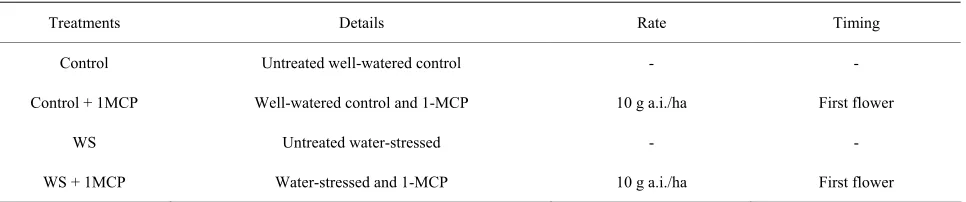
water-deficit stress and 1-MCP application treatments, after which plants were watered only with deionized wa- ter. The experiments were arranged in a completely ran- domized design with two factors that consisted of wa- ter-deficit stress and 1-MCP application. Application of 1-MCP started at flowering (approximately eight weeks after planting) and the treatments consisted of: Untreated well-watered control (C), Control + 1-MCP (C + 1MCP), Untreated water stressed (WS), and Water Stress + 1- MCP (WS + 1MCP) with fifteen replications for each treatment (Table1). The rate of 1-MCP was 10 g a.i./ha. Control plants received optimum quantities of water during the experiment. Optimum quantity was deter- mined by weighing the plants the day before and after watering to saturation and allowing for excess drainage. A water-stress cycle consisted of withholding water from the pots until stomatal closure, after which the stress was relieved by re-watering with optimum quantity. This process was repeated twice. 1-MCP was applied with a CO2 backpack sprayer calibrated to deliver 187 l/ha two
days after water supply had been discontinued (day 2 and day 8). The adjuvant AF-400 (Rohm Hass, Philadelphia, PA) was used for all 1-MCP applications at 0.375% v/v.
2.1. Stomatal Conductance Measurements
Stomatal conductance measurements (n = 10) were taken daily from the fourth uppermost main-stem leaf from 11:00 a.m. until 1:00 p.m. using a Decagon SC-1 Poro- meter (Decagon Inc., Pullman, WA). Three measure- ments on various areas of the leaf were taken and then averaged. The results were expressed as mmol/m²s.
2.2. Photosynthesis and Respiration Measurements
A Li-Cor Model 6200 portable photosynthesis system (LICOR Inc., Lincoln, NE) was used to determine pho- tosynthetic and respiratory rates for the attached, fourth main-stem leaf from the terminal of the plant (n = 10). Photosynthesis measurements were taken at 1:00 p.m. one and four days after spraying. Respiratory rates were taken at 2:00 p.m. one and four days after spraying after turning off the lights in the growth chambers for 15 min- utes and additionally covering the plant with a black cloth during the measurement.
2.3. Carbohydrate Content Measurements
Table 1. Rate and timing of treatments applied.
Treatments Details Rate Timing
Control Untreated well-watered control - -
Control + 1MCP Well-watered control and 1-MCP 10 g a.i./ha First flower
WS Untreated water-stressed - -
WS + 1MCP Water-stressed and 1-MCP 10 g a.i./ha First flower
flowers and their subtending leaves were sampled from each replication-plant and they were oven dried for 3 days at 50˚C and then ground with a mortar and pestle. The ground tissue was extracted 3 times with 80% aque- ous ethanol (800 ml ethanol/L) and the samples were centrifuged after each extraction at 5000 rpm and finally the fractions were pooled. Active charcoal was then added to the pooled fractions to remove substances that could interfere with the carbohydrate measurements and the samples were centrifuged again at 3500 rpm. The supernatant was immediately stored at −80˚C for later determination of sucrose and hexose (fructose and glu- cose) with a MultiScan Ascent Microplate Reader (Thermo Fisher Scientific Inc., Waltham, MA). A glucose HK- assay kit (Sigma Chemical Company, St Louis, MO) was used. A 10µl aliquot of each extract was pipetted into a well of a microtitration plate and the plate was incubated at 50˚C for 40 min to evaporate ethanol. Ten microliters of water were then added to each well along with 100 µl of glucose assay reagent and the plate was incubated again for 15 min at 30˚C. The absorbance was measured at 340 nm using a microplate reader. Subsequently, 0.25 enzyme units of phosphoglucose isomerase was added to the extracts in each well of the plate and the absorbance was again measured at 340 nm after which, 83 enzyme units of invertase were added to the extracts and the mi-crotitration plate was incubated at 30˚C for 60 min. The absorbance was measured at 340 nm.
2.4. Statistical Analysis
A two factor factorial statistical analysis was used to evaluate the results using JMP8 software (SAS Institute, Cary, NC). The factors consisted of experiment, water regime, and 1-MCP application. No interaction was ob- served between the two separate experiments, so the re- sults were pooled and the means were taken. Analysis of variance and student’s t-test were used to analyze statis- tical significance. The days of the experiment were not considered a factor and a single ANOVA was done for each day to compare differences among treatment com- binations.
3. Results
3.1. Stomatal Conductance
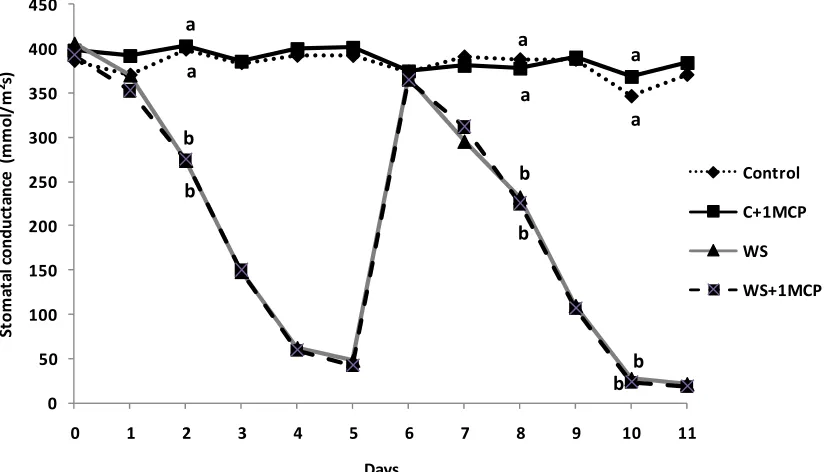
Leaf stomatal conductance was significantly lower in water-stressed plants compared to the control (Figure 1) in both watering cycles of the study. Stomatal conduc- tance began to decrease 3 days after water supply was stopped, reaching its lowest at 48 mmol/m²s for un- treated water-stressed plants and 42 mmol/m²s for 1- MCP treated water-stressed plants in 6 days. Upon re- watering, stomatal conductance measurements returned to same levels as the control. No significant interaction (P = 0.1043) was observed between 1-MCP application and water-deficit stress regime in any day of the experi-ment while a significant effect of the water regime (P < 0.001) was observed on days 0, 1, 3, 4, 6, 7, 8, 10 and 11 with water-deficit stress significantly lowering stomatal conductance rates compared to the control. On the other hand, stomatal conductance rates of 1-MCP treated wa- ter-stressed plants were similar to the rates of untreated water-stressed leaves and significantly lower compared to the control.
3.2. Photosynthesis and Respiration
Photosynthetic rates for the fourth main-stem leaf from the terminal were significantly decreased under con- ditions of water-deficit stress compared to the control (Figure 2). 1-MCP had no significant effect on prevent- ing reductions in photosynthetic rates under water- limited supply, since photosynthetic rates were decreased by 43% without 1-MCP application, and by 41% after 1-MCP application, compared to the control, respec- tively.
0 50 100 150 200 250 300 350 400 450
0 1 2 3 4 5 6 7 8 9 10 11
St
o
m
at
al
co
nduc
ta
nc
e
(m
mo
l/
m²
s)
Days
Control C+1MCP WS WS+1MCP
a
a
b
b
a
a
b b a
a
b
[image:4.595.93.505.102.338.2]b
Figure 1. Effect of water-deficit stress and 1-MCP application on leaf stomatal conductance. Plants were imposed on two 5-day drying cycle. Water was withheld on day 0 and reapplied at the end of day 5. 1-MCP was applied on days 2 and 8.
0 2 4 6 8 10 12 14 16
Control Control+1MCP WS WS+1MCP
Phot
os
yn
th
e
si
s
(m
m
o
l/
m
²s)
a a
b b
Figure 2. Effect of water-deficit stress and 1-MCP application on leaf photosynthesis 4 days after induction of stress. Bars with the same letter are not significantly different (P = 0.05). Error bars represent ± 1 standard error.
compared to the control after 1-MCP application.
3.3. Total Soluble Carbohydrate Content
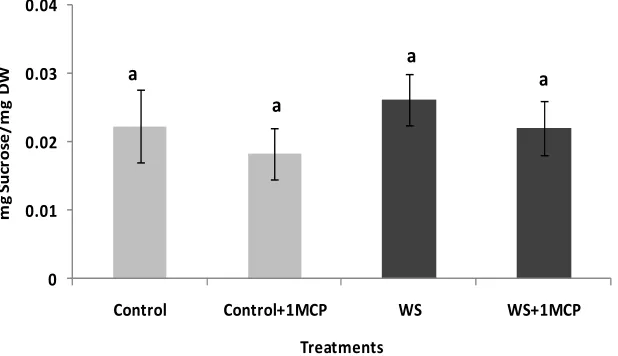
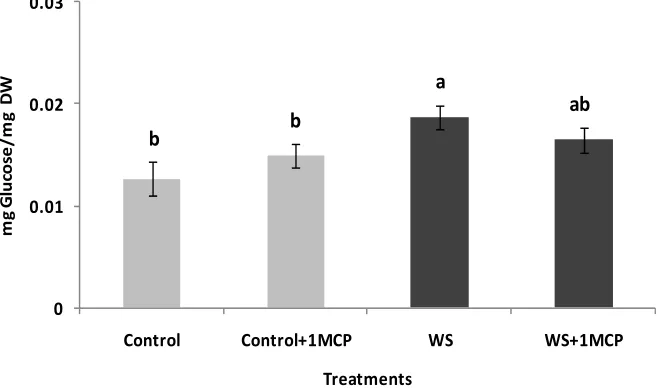
Water-deficit stress caused a significant increase in su- crose concentrations of the pistil (Figure 4), however, sucrose concentrations of the subtending leaf remained unaffected (Figure 5). On the other hand, glucose levels of the pistil remained at the same levels as the control (Figure 6), whereas a significant increase was observed in the glucose concentrations of the water-stressed sub- tending leaves compared to the control (Figure 7). Both
fructose levels of both the pistil and the subtending leaf remained unaffected under conditions of water-deficit stress and their levels were similar to the control (data not shown).
[image:4.595.149.447.383.558.2]‐2
‐1.5
‐1
‐0.5
0
Control Control + 1MCP WS WS+1MCP
Re
sp
ir
at
io
n
(m
mo
l/
m²
s)
Treatments
a a
[image:5.595.152.444.98.270.2]b b
Figure 3. Effect of water-deficit stress and 1-MCP application on leaf respiration 4 days after induction of stress. Bars with the same letter are not significantly different (P = 0.05). Error bars represent ± 1 standard error.
0 0.01 0.02 0.03
Control Control+1MCP WS WS+1MCP
mg
Su
cr
o
se
/
m
g
DW
Treatments a
b bc
[image:5.595.147.450.314.486.2]c
Figure 4. Effect of water-deficit stress and 1-MCP application on pistil sucrose content. Columns with the same letter are not significantly different (P = 0.05). Error bars represent ± 1 standard error.
0 0.01 0.02 0.03 0.04
Control Control+1MCP WS WS+1MCP
mg
Su
cr
o
se
/
m
g
DW
Treatments a
a
a
a
[image:5.595.147.456.530.708.2]0 0.005 0.01
Control Control+1MCP WS WS+1MCP
mg
Glu
co
se
/mg
DW
Treatments
a
a
a
[image:6.595.148.450.96.273.2]a
Figure 6. Effect of water-deficit stress and 1-MCP application on pistil glucose content. Columns with the same letter are not significantly different (P = 0.05). Error bars represent ± 1 standard error.
0 0.01 0.02 0.03
Control Control+1MCP WS WS+1MCP
mg
Gl
u
co
se
/m
g
DW
Treatments a
ab b
b
Figure 7. Effect of water-deficit stress and 1-MCP application on leaf glucose content. Columns with the same letter are not significantly different (P = 0.05). Error bars represent ± 1 standard error.
4. Discussion
Stomatal closure and consequently decreased stomatal conductance is a well-documented plant response to lim- ited water conditions [37] in order to prevent excess wa- ter loss and in our study significant reductions of leaf stomatal conductance rates were observed in water- stressed plants compared to the control. Similar reduc- tions in leaf stomatal conductance rates under water- deficit stress have been reported in cotton by numerous researchers [24,25,33,34] with the exception of Ack- erson et al. (1977) [35] who observed that leaf stomatal conductance of field-grown cotton was only slightly af- fected. However, we speculate that this differential re- sponse was due to the differences in light intensity as well as the more gradual imposition of water-deficit
[image:6.595.135.468.317.511.2]kami et al. (2010) [29] where it was observed that 1-MCP treated water-stressed plants exhibited higher stomatal resistance compared to untreated water-stressed plants and the authors concluded that ethylene production increases under conditions of limited water supply. However, in their experiment plants were subjected in water stress during their vegetative stage and not during their reproductive stage leading us to speculate that the differential to our study results are due to the differential ethylene production depending on the growth stage [40].
As expected, photosynthetic and respiratory rates of water-stressed plants were significantly compromised compared to well-watered control. Regarding photosyn- thesis, similar decreases in leaf photosynthesis under conditions of limited water supply have been observed in cotton [25,41,42] as well as several other species [43,44]. Unlike photosynthesis, diverse opinions have been ex- pressed on the effect of water-deficit stress on leaf respi- ration with several researchers reporting significant de- creases [45-47] while Ghashgaie et al. (2001) [48] no- ticed the opposite, and Lawlor and Fock (1977) [49] re- ported no change. In cotton, contrary to our results, Pallas et al. (1967) [50] reported an increase in respire- tion under water stress, however we speculate that this is due to the different growth stages the stress was imposed in their studies.While exogenous application of ethylene has been reported to result in decreases in photosynthesis and respiration rates in soybean (Glycine max L.) [51], peanut (Arachis hypogea L.) [35] wheat (Triticum aesti- vum L.), maize (Zea mays L.), pea (Pisum sativum L.), beans (Phaseolus vulgaris L.), cotton [53] and lettuce (Lactuca sativa L.) [53], application of 1-MCP failed to prevent reduction of both photosynthetic and respiratory rates. In accordance with our results Bugbee (2011) [22] and da Costa and Cothren (2011) [30] reported that 1-MCP application had no effect on water-stressed cotton leaf gas exchange functions, leading us to accept their conclusion that water-deficit stress has no effect on leaf ethylene production rates and leaf gas exchange func- tions in cotton.
Similarly to leaf gas exchanger functions, leaf carbo- hydrate metabolism was significantly affected from wa- ter-deficit stress, while 1-MCP application had no sig- nificant effect. In our study, limited water-supply re- sulted in increases in leaf glucose concentrations whereas, fructose and sucrose concentrations remained similar to the control. Increases in leaf hexose concentrations under conditions of water-deficit stress have also been reported in other crops such as soybean [54], and barley (Hor- deum vulgare, L.) [55], while in cotton Eaton and Ergle (1948) [56], Timpa et al. (1986) [57] and Parida et al. (2007) [58] observed that water-stressed leaves contained higher glucose concentrations and similar sucrose levels
compared to the control indicating an impairment in photosynthate translocation mechanism. Observations in Arabidopsis have suggested that ethylene is implicated in leaf carbohydrate metabolism through modulating trans- location of photosynthates [59], and also through regula- tion of enzymes such as invertase and sucrose synthase [60] and carbohydrate concentrations [61,62]. However, in our study leaf glucose, fructose and sucrose concentra- tions of 1-MCP treated plants were similar to those of untreated plants under both water-stressed and well-wa- tered conditions leading us to assume that ethylene is not implicated in leaf carbohydrate metabolism of cotton.
Pistil carbohydrate metabolism was expected to be similar to leaf carbohydrate metabolism due to the sub- tending leaf being the main provider of photosynthate products to the pistil [63]. However, pistil carbohydrate metabolism was significantly affected by both water- deficit stress and 1-MCP application. Water-deficit re- sulted in significant increases in pistil sucrose concentra- tions, while pistil glucose and fructose concentrations remained unaffected. The differential responses between leaf and pistil carbohydrate concentrations were attrib- uted to tissue specific regulation of sucrose cleaving en- zymes, with invertase being up-regulated in the leaves and down-regulated in the fruiting forms under condi- tions of water-deficit stress [27,62]. In support of our speculation increases in sucrose accumulation of repro- ductive units under limited water supply have been pre- viously observed in soybean, wheat, maize and rice (Oryza sativa L.) [34,54,64-66] and have been associated with cessation of ovary and anther growth due to inhibit- tion of sucrose cleaving enzymes function. In cotton, Guinn (1976) [21] reported that no significant differences were observed in carbohydrate accumulation of 4-day old bolls that had been subjected to limited water supply. We speculate that the contrasting to our study results are due to differences in water-deficit stress imposition and age of tissue. Nevertheless, Guinn (1976) [21] reported that ethylene levels of water-stressed bolls were significantly higher compared to control.
cantly inhibiting sucrose accumulation under water-stress compared to the untreated water-stressed plants. How- ever, reductions in sucrose concentrations, even though not significant, were observed between the treated well- watered and the untreated well-watered leading us to assume 1-MCP decreased plant sensitivity to ethylene that is produced naturally during cotton flowering [13, 73]. Nevertheless, Morgan et al. (1990) [13] reported that flowering cotton plants subjected to water stress showed a decrease in ethylene production rates, while no changes in ethylene production rates were reported by Bugbee (2011) [22] and da Costa and Cothren (2011) [30]. Since ethylene rates were not determined in our study we cannot comment if 1-MCP affected ethylene production rates, however we can conclude that ethylene affects carbohydrate metabolism of cotton reproductive units. We speculate that the differential response of 1-MCP observed in cotton leaves and pistils is attributed either to the lower number of receptors existing in the leaves compared to the reproductive units [74] or to the differ-ential regulation of sucrose cleaving enzymes due to tis-sue specific response of ethylene under conditions of water-deficit stress [40].
In summary, the results of our study indicated that water-deficit stress during reproductive development resulted in significant decreases in cotton leaf stomatal conductance, photosynthesis and respiration. Application of 1-MCP failed to ameliorate the negative consequences of water-deficit stress on cotton gas exchange functions indicating that either ethylene evolution from the leaves is minimal under conditions of water stress or ethylene evolution is uncoupled from cotton leaf’s gas exchange functions. However, the significant decrease in pistil su- crose concentrations indicates that ethylene plays a rather important role in the regulation of carbohydrate metabo- lism in reproductive tissues. Further research is needed to elucidate the exact site of modulation and factors con- trolling the interaction between ethylene production un- der water-deficit stress and cotton carbohydrate accumu- lation.
REFERENCES
[1] P. J. Kramer, “Water Deficits and Plant Growth,” In: P. J. Kramer, Ed., Water Relations of Plants, Academic Press, New York, 1983, pp. 342-389.
doi:10.1016/B978-0-12-425040-6.50015-1
[2] A. Massaci, S. M. Nabiev, L. Petrosanti, S. K. Nematov, T. N. Chernikova, K. Thor and J. Leipner, “Response of the Photosynthetic Apparatus of Cotton (Gossypium hir-sutum L.) to the Onset of Drought Stress Under Field Conditions Studied by Gas-Exchange Analysis and Chlo- rophyll Fluorescence Imaging,” Plant Physiology and Biochemistry, Vol. 46, No. 2, 2008, pp. 189-195.
doi:10.1016/j.plaphy.2007.10.006
[3] H. N. L. Houerou, “Climate Changes, Drought and De- sertification,” Journal of Arid Environment, Vol. 34, No. 2, 1996, pp. 133-185. doi:10.1006/jare.1996.0099 [4] J. A. Lee, “Cotton as a World Crop,” In: R. J. Kohel and C.
F. Lewis, Eds., Cotton Agronomy Monogram 24. Ameri- can Statistical Association, CSSA, SSSA, Madison, 1984, pp. 1-25.
[5] D. M. Oosterhuis and S. D. Wullschleger, “Osmotic Ad- justment in Cotton (Gossypium Hisrsutum L.) Leaves and Roots in Response to Water Stress,” Plant Physiology, Vol. 84, No. 4, 1987, pp. 1154-1157.
doi:10.1104/pp.84.4.1154
[6] A. L. Nepomuceno, D. M. Oosterhuis and J. M. Stewart, “Physiological Responses of Cotton Leaves and Roots to Water Deficit Induced by Polythelene Glycol,” Environ- mental and Experimental Botany, Vol. 40, No. 1, 1998, pp. 29-41. doi:10.1016/S0098-8472(98)00018-5
[7] V. V. Kuznetsov, V. Rakitin and V. N. Zholkevich, “Ef- fects of Preliminary Heat-Shock Treatment on Accumula- tion of Osmolytes and Drought Resistance in Cotton Plants during Water Deficiency,” Physiologia Plantarum, Vol. 107, No. 4, 1999, pp. 399-406.
doi:10.1034/j.1399-3054.1999.100405.x
[8] J. J. Burke, J. L. Hatfield, R. R. Klein and J. E. Mullet, “Accumulation of Heat Shock Proteins in Field Grown Soybean,” Plant Physiology, Vol. 78, No. 2, 1985, pp. 394- 398. doi:10.1104/pp.78.2.394
[9] R. C. Ackerson, D. R. Krieg, T. D. Miller and R. E. Zartman, “Water Relations of Field Grown Cotton and Sorghum: Temporal and Diurnal Changes in Leaf Water, Osmotic, and Turgor Potentials,” Crop Science, Vol. 17, No. 1, 1977, pp. 76-78.
doi:10.2135/cropsci1977.0011183X001700010022x [10] J. E. Quisenberry and B. Roark, “Influence of Indetermi-
nate Growth Habit on Yield and Irrigation Water-Use Ef- ficiency in Upland Cotton,” Crop Science, Vol. 16, No. 1976, pp. 762-765.
doi:10.2135/cropsci1976.0011183X001600060005x [11] H. Basal, C. W. Smith, P. S. Thaxton and J. K. Hemphill,
“Seedling Drought Tolerance in Upland Cotton,” Crop Science, Vol. 45, No. 2, 2005, pp. 766-771.
doi:10.2135/cropsci2005.0766
[12] F. B. Abeles, “Regulation of Ethylene Production by Internal, Environmental and Stress Factors. IV. Abiotic Stress,” In: F. B. Abeles, P. W. Morgan and M. E. Salt- veit, Eds., Ethylene in Plant Biology, Academic Press Inc., San Diego, 1973, pp. 83-101.
[13] P. W. Morgan, C. J. He, J. A. De Greef and M. P. De Proft, “Does Water Deficit Stress Promote Ethylene Syn- thesis by Intact Plants?” Plant Physiology, Vol. 94, No. 4, 1990, pp. 1616-1624. doi:10.1104/pp.94.4.1616
[14] P. W. Morgan and M. C. Drew, “Ethylene and Plant Re-sponses to Stress,” Physiologia Plantarum, Vol. 100, No. 3, 1997, pp. 620-630.
doi:10.1111/j.1399-3054.1997.tb03068.x
Stress-Induced Ethylene Production in Wheat,” Plant Physiology, Vol. 96, 1991, pp. 406-410.
doi:10.1104/pp.96.2.406
[16] N. J. Stumpff and J. D. Johnson, “Ethylene Production by Loblolly Pine Seedlings Associated with Water Stress,” Physiologia Plantarum, Vol. 69, No. 1, 1987, pp. 167- 172. doi:10.1111/j.1399-3054.1987.tb01962.x
[17] J. J. Irigoyen, D. W. Emerich and M. Sanchez-Diaz, “Al- falfa Leaf Senescence Induced by Drought Stress: Photo- synthesis, Hydrogen Peroxide Lipid Metabolism, Lipid Peroxidation and Ethylene Evolution,” Physiologia Plan- tarum, Vol. 84, No. 1, 1992, pp. 67-72.
doi:10.1111/j.1399-3054.1992.tb08766.x
[18] S. P. Klassen and B. Bugbee, “Ethylene Synthesis and Sensitivity in Crop Plants,” Horticulture Science, Vol. 39, No. 7, 2003, pp. 1546-1552.
[19] B. L. McMichael, W. R. Jordan and R. D. Powell, “An Effect of Water Stress on Ethylene Production by Intact Cotton Petioles,” Plant Physiology, Vol. 49, 1972, pp. 658-660. doi:10.1104/pp.49.4.658
[20] B. L. McMichael, W. R. Jordan and R. D. Powell, “Ab- scission Processes in Cotton: Induction by Plant Water Deficit,” Agronomy Journal, Vol. 65, No. 2, 1973, pp. 202-204.
doi:10.2134/agronj1973.00021962006500020005x [21] G. Guinn, “Water Deficit and Ethylene Evolution by
Young Cotton Bolls,” Plant Physiology, Vol. 57, No. 3, 1976, pp. 403-405. doi:10.1104/pp.57.3.403
[22] B. Bugbee, “Effect of Environment on Ethylene Synthesis and Cotton,” In: D. M. Oosterhuis, Ed., Stress Physiology in Cotton, The Cotton Foundation, Cordova, 2011, pp. 85-96.
[23] E. C. Sisler and M. Serek, “Inhibitors of Ethylene Re- sponses in Plants at the Receptor Level: Recent Devel- opments,” Physiologia Plantarum, Vol. 100, No. 3, 1997, pp. 577-582. doi:10.1111/j.1399-3054.1997.tb03063.x [24] S. M. Blankenship and J. M. Dole, “1-Methylcyclopro-
pene: A Review,” Postharvest Biology and Technology, Vol. 28, No. 1, 2003, pp. 1-25.
doi:10.1016/S0925-5214(02)00246-6
[25] L. Dong, H. Zhou and S. Lurie, “Ripening of Red Rosa Plums: Effect of Ethylene and 1-Methylcyclopropene,” Australian Journal of Plant Physiology, Vol. 28, No. 10, 2001, pp. 1039-1045.
[26] J. D. Jeong, D. J. , Huber and S. A. Sargent, “Influence of 1-Methylcyclopropene (1-MCP) on Ripening and Cell Wall Matrix Polysaccharides of Avocado (Persea ameri- cana) Fruit,” Postharvest Biology and Technology, Vol. 25, No. 3, 2002, pp. 241-256.
doi:10.1016/S0925-5214(01)00184-3
[27] X. T. Fan and J. P. Mattheis, “Yellowing of Broccoli in Storage Is Reduced by 1-Methylcyclopropene” Horticul- ture Science, Vol. 35, No. 5, 2000, pp. 885-887. [28] W. B. Jiang, Q. Sheng, X. J. Zhou, M. J. Zhang and X. J.
Liu, “Regulation of Detached Coriander Leaf Senescence by 1-Methylcyclopropene and Ethylene,” Postharvest Bi- ology and Technology, Vol. 26, No. 3, 2002, pp. 339-345.
doi:10.1016/S0925-5214(02)00068-6
[29] E. M. Kawakami, D. M. Oosterhuis and J. L. Snider, “Physiological Effects of 1-Methylcyclopropene on Well- Watered and Water-Stressed Cotton Plants,” Journal of Plant Growth Regulation, Vol. 29, No. 3, 2010, pp. 280- 288. doi:10.1007/s00344-009-9134-3
[30] V. A. Da Costa and J. T. Cothren, “Drought Effects on Gas Exchange, Chlorophyll, and Plant Growth of 1-Me- thylcyclopropene Treated Cotton,” Agronomy Journal, Vol. 103, No. 4, 2011, pp. 1230-1241.
doi:10.2134/agronj2010.0479
[31] M. N. Andersen, F. Asch, F. Wu, C. R. Jensen, H. Naested, V. O. Mogensen and K. E. Koch, “Soluble In- vertase Expression Is an Early Target of Drought Stress during the Critical, Abortion-Sensitive Phase of Young Ovary Development in Maize,” Plant Physiology, Vol. 130, No. 2, 2002, pp. 591-604. doi:10.1104/pp.005637 [32] J. Yang, J. Zhang, Y. Ye, Z. Wang, Q. Zhu and L. Liu,
“Involvement of Abscisic Acid and Ethylene in the Re- sponses of Rice Grains to Water Stress during Grain Fill- ing,” Plant Cell and Environment, Vol. 27, No. 8, 2004, pp. 1055-1064. doi:10.1111/j.1365-3040.2004.01210.x [33] H. Bielorai and P. A. M. Hopmans, “Recovery of Leaf
Water Potential, Transpiration, and Photosynthesis of Cotton during Irrigation Cycles,” Agronomy Journal, Vol. 67, No. 5, 1975, pp. 629-632.
doi:10.2134/agronj1975.00021962006700050011x [34] J. E. Ephrath, A. Marani and B. A. Bravdo, “Effects of
Moisture Stress on Stomatal Resistance and Leaf Water Potential in Cotton (Gosssypium Hirsutum): I. Controlled Levels of Stress” Field Crops Research, Vol. 23, No. 2, 1990, pp. 117-131. doi:10.1016/0378-4290(90)90107-M [35] R. C. Ackerson, D. R. Krieg, C. L. Haring and N. Chang,
“Effects of Plant Water Status on Stomatal Activity, Pho- tosynthesis, and Nitrate Reductase Activity of Field Grown Cotton,” Crop Science, Vol. 17, No. 1, 1977, pp. 81-84.
doi:10.2135/cropsci1977.0011183X001700010023x [36] D. L. Hendrix, “Rapid Extraction and Analysis of Non-
structural Carbohydrates in Plant Tissues,” Crop Science, Vol. 33, No. 6, 1993, pp. 1306-1311.
doi:10.2135/cropsci1993.0011183X003300060037x [37] T. C. Hsiao, “Plant Responses to Water Stress,” Annual
Reviews of Plant Physiology, Vol. 24, 1973, pp. 519-570. doi:10.1146/annurev.pp.24.060173.002511
[38] J. E. Pallas and S. J. Kays, “Inhibition of Photosynthesis by Ethylene—A Stomatal Effect,” Plant Physiology, Vol. 70, No. 2, 1982, pp. 598-601. doi:10.1104/pp.70.2.598 [39] C. Vitogliano and G. V. Hoad, “Leaf Stomatal Resistance,
Ethylene Evolution and ABA-Levels as Influenced by 2-Chloroethyl-Phosphonic Acid,” Scientia Horticulturae, Vol. 8, No. 2, 1978, pp. 101-106.
doi:10.1016/0304-4238(78)90013-4
[41] M. J. Lacape, J. Wery and D. J. M. Annerose, “Relation- ships between Plant and Soil Water Status in Five Field- Grown Cotton Cultivars,” Field Crops Research, Vol. 57, No. 1, 1998, pp. 29-43.
doi:10.1016/S0378-4290(97)00111-1
[42] W. T. Pettigrew, “Physiological Consequences of Mois- ture Deficit Stress in Cotton,” Crop Science, Vol. 44, No. 4, 2004, pp. 1265-1272. doi:10.2135/cropsci2004.1265 [43] J. Flexas, J. Bota, J. Galmes, H. Medrano and M. Ribas-
Carbo, “Keeping A Positive Carbon Balance under Ad- verse Conditions: Responses of Photosynthesis and Res- piration to Water Stress,” Physiologia Plantarum, Vol. 127, No. 3, 2006, pp. 343-352.
doi:10.1111/j.1399-3054.2006.00621.x
[44] D. W. Lawlor and W. Tezara, “Causes of Decreased Photosynthetic Rate and Metabolic Capacity in Water- Deficient Leaf Cells: A Critical Evaluation of Mecha- nisms and Integration of Processes,” Annals of Botany, Vol. 103, No. 4, 2009, pp. 561-579.
doi:10.1093/aob/mcn244
[45] F. W. T. De Vries, J. M. Witlage and D. Kremer, “Rates of Respiration and of Increase in Structural Dry Matter in Young Wheat, Ryegrass and Maize Plants in Relation to Temperature, to Water Stress and to Their Sugar Con- tent,” Annals of Botany, Vol. 44, No. 5, 1979, pp. 595- 609.
[46] K. J. McCree, C. E. Kallsen and S. G. Richardson, “Car- bon Balance of Sorghum Plants during Osmotic Adjust- ment to Water Stress,” Plant Physiology, Vol. 76, No. 4, 1984, pp. 898-902. doi:10.1104/pp.76.4.898
[47] M. Ribas-Carbo, N. L. Taylor, L. Giles, S. Busquets, P. M. Finnegan and D. A. Day, “Effects of Water Stress on Respiration in Soybean Leaves,” Plant Physiology, Vol. 139, No. 1, 2005, pp. 466-473.
doi:10.1104/pp.105.065565
[48] J. Ghashgaie, M. Duranceau, F. W. Badeck, G. Cornic, M. T. Adeline and E. Deleens,” Δ C13 of CO2 Respired in the Dark in Relation to Δ C13 of Leaf Metabolites: Com- parison between Nicotiana sylvestris and Helianthus an- nuus under Drought,” Plant Cell and Environment, Vol. 24, No. 5, 2001, pp. 505-515.
doi:10.1046/j.1365-3040.2001.00699.x
[49] D. W. Lawlor and H. Fock, “Water Stress Induced Changes in the Amounts of Some Photosynthetic As- similation Products and Respiratory Metabolites of Sun- flower Leaves” Journal of Experimental Botany, Vol. 28, No. 2, 1977, pp. 329-337. doi:10.1093/jxb/28.2.329 [50] J. E. Pallas, B. E. Michel and D. G. Harris, “Photosynthe-
sis, Transpiration, Leaf Temperature, and Stomatal Ac- tivity of Cotton Plants under Varying Water Potentials,” Plant Physiology, Vol. 42, No. 1, 1967, pp. 76-88. doi:10.1104/pp.42.1.76
[51] C. A. Gunderson and G. E. Taylor, “Ethylene Directly Inhibits Foliar Gas Exchange in Glycine max,” Plant Physiology, Vol. 95, No. 1, 1991, pp. 337-339.
doi:10.1104/pp.95.1.337
[52] G. E. Taylor and C. A. Gunderson, “The Response of Foliar Gas Exchange to Exogenously Applied Ethylene,”
Plant Physiology, Vol. 82, No. 3, 1986, pp. 653-657. doi:10.1104/pp.82.3.653
[53] C. He and F. T. Davies, “Ethylene Reduces Plant Gas Exchange and Growth of Lettuce Grown from Seed to Harvest under Hypobaric and Ambient Total Pressure,” Journal of Plant Physiology, Vol. 169, No. 4, 2012, pp. 369-378. doi:10.1016/j.jplph.2011.11.002
[54] F. Liu, C. R. Jensen and M. N. Andersen, “Drought Stress Effect on Carbohydrate Concentration in Soybean Leaves and Pods during Early Reproductive Development: Its Implication in Altering Pod Set,” Field Crops Research, Vol. 86, No. 1, 2004, pp. 1-13.
doi:10.1016/S0378-4290(03)00165-5
[55] B. Teulat, C. Borries and D. This, “New QTLs Identified for Plant Water Status, Water-Soluble Carbohydrate and Osmotic Adjustment in a Barley Population Grown in a Growth-Chamber under Two Water Regimes,” Theoreti- cal and Applied Genetics, Vol. 103, No. 1, 2001, pp. 161- 170. doi:10.1007/s001220000503
[56] F. M. Eaton and D. R. Ergle, “Carbohydrate Accumula- tion in the Cotton Plant at Low Moisture Levels,” Plant Physiology, Vol. 23, No. 2, 1948, pp. 169-187.
doi:10.1104/pp.23.2.169
[57] J. D. Timpa, J. J. Burke, J. E Quisenberry and C. W. Wendt, “Effects of Water Stress on the Organic Acid and Carbohydrate Composition of Cotton Plants,” Plant Physi- ology, Vol. 82, No. 3, 1986, pp. 724-728.
doi:10.1104/pp.82.3.724
[58] A. K. Parida, V. S. Dagaonkar, M. S. Phalak, G. V. Umalkar and L. P. Aurangabadkar, “Alterations in Pho- tosynthetic Pigments, Protein and Osmotic Components in Cotton Genotypes Subjected to Short-Term Drought Stress Followed by Recovery,” Plant Biotechnology Re- ports, Vol. 1, No. 1, 2007, pp. 37-48.
doi:10.1007/s11816-006-0004-1
[59] L. Zhou, J. C. Jang, T. L. Jones and J. Sheen, “Glucose and Ethylene Signal Transduction Cross-Talk Revealed by an Arabidopsis Glucose-Insensitive Mutant,” Plant Bi- ology, Vol. 95, No. 17, 1998, pp. 10294-10299.
[60] F. Rolland, E. Baena-Gonzalez and J. Sheen, “Sugar Sensing and Signaling in Plants: Conserved and Novel Mechanisms,” Annual Reviews of Plant Biology, Vol. 57, 2006, pp. 675-709.
doi:10.1146/annurev.arplant.57.032905.105441
[61] P. Leon and J. Sheen, “Sugar and Hormone Connec- tions,” Trends in Plant Science, Vol. 8, No. 3, 2003, pp. 110-116. doi:10.1016/S1360-1385(03)00011-6
[62] K. E. Koch, “Sucrose Metabolism:Regulatory Mecha- nisms and Pivotal Roles in Sugar Sensing and Plant De- velopment,” Current Opinion in Plant Biology, Vol. 7, No. 3, 2004, pp. 235-246. doi:10.1016/j.pbi.2004.03.014 [63] D. A. Ashley, “14C-Labelled Photosynthate Translocation
and Utilization in Cotton Plants,” Crop Science, Vol. 12, No. 1, 1972, pp. 69-72.
doi:10.2135/cropsci1972.0011183X001200010023x [64] J. R. Schussler and M. E. Westgate, “Assimilate Flux
Crop Science, Vol. 35, No. 4, 1995, pp. 1074-1080. doi:10.2135/cropsci1995.0011183X003500040026x [65] C. Zinselmeier, B. R. Jeong and J. S. Boyer, “Starch and
the Control of Kernel Number in Maize at Low Water Potentials,” Plant Physiology, Vol. 121, No. 1, 1999, pp. 25-35. doi:10.1104/pp.121.1.25
[66] H. S. Saini and M. E. Westgate, “Reproductive Develop- ment in Grain Crops during Drought,” Advances in Agro- nomy, Vol. 68, 1999, pp. 59-96.
doi:10.1016/S0065-2113(08)60843-3
[67] R. A. Saftner, “Effect of Ethylene on Sucrose Uptake in Root Discs of Sugar Beet,” Plant Cell Physiology, Vol. 27, No. 5, 1986, pp. 853-860.
[68] C. Chervin, N. Terrier, A. Ageorges, F. Ribes and T. Kuapunyakoon, “Influence of Ethylene on Sucrose Ac- cumulation in Grape bErry,” American Journal of Enol- ogy and Viticulture, Vol. 57, No. 4, 2006, pp. 511-513. [69] K. Ishizawa and Y. Esashi, “Action Mechanism of Eth-
ylene in the Control of Sugar Translocation in Relation to Rice Coleoptiles Growth. I. Sucrose Metabolism,” Plant
Cell Physiology, Vol. 29, No. 1, 1988, pp. 131-141. [70] J. Xu, G. H. Pemberton, E. C. Almira, D. R. McCarty and
K. E. Koch, “The Ivr1 Gene for Invertase in Maize,” Plant Physiology, Vol. 108, No. 3, 1995, pp. 1293-1294. doi:10.1104/pp.108.3.1293
[71] P. K. Mohapatra, P. K. Naik and R. Patel, “Ethylene In- hibitors Improve Dry Matter Partitioning and Develop- ment of Late Flowering Spikelets on Rice Panicles,” Aus- tralian Journal of Plant Physiology, Vol. 27, No. 4, 2000, pp. 311-323. doi:10.1071/PP99057
[72] P. K. Naik and P. K. Mohapatra, “Ethylene Inhibitors Enhanced Sucrose Synthase Activity and Promoted Grain Filling of Basal Rice Kernels,” Australian Journal of Plant Physiology, Vol. 27, No. 11, 2000, pp. 997-1008. [73] J. A. Lipe and P. W. Morgan, “Ethylene, a Regulator of
Young Fruit Abscission,” Plant Physiology, Vol. 51, No. 5, 1973, pp. 949-953. doi:10.1104/pp.51.5.949