Named Entity Recognition in Estonian
Alexander Tkachenko Institute of Computer Science
University of Tartu Liivi 2, Tartu, Estonia
Timo Petmanson Institute of Computer Science
University of Tartu Liivi 2, Tartu, Estonia
timo [email protected]
Sven Laur
Institute of Computer Science University of Tartu Liivi 2, Tartu, Estonia
Abstract
The task of Named Entity Recognition (NER) is to identify in text predefined units of information such as person names, organizations and locations. In this work, we address the problem of NER in Esto-nian using supervised learning approach. We explore common issues related to building a NER system such as the us-age of languus-age-agnostic and languus-age- language-specific features, the representation of named entity tags, the required corpus size and the need for linguistic tools. For system training and evaluation purposes, we create a gold standard NER corpus. On this corpus, our CRF-based system achieves an overallF1-score of 87%.
1 Introduction
Named Entity Recognition (NER) is the task of identification of information units in text such as person names, organizations and locations. It is an important subtask in many natural language processing (NLP) applications such as text sum-marization, information filtering, relation extrac-tion and quesextrac-tion answering. NER has been extensively studied for widely spoken languages such as English with the state-of-the-art systems achieving near-human performance (Marsh and Perzanowski, 1998), but no research has yet been done in regards to Estonian.
The main difference of Estonian, a Finno-Ugric language, compared to English is high morpholog-ical richness. Estonian is a synthetic language and has relatively high morpheme-per-word ratio. It has both agglutinative and fusional (inflective) el-ements: morphemes can express one or more syn-tactic categories of the word. Although Estonian is considered a subject-verb-object (SVO) language, all phrase permutations are legal and widely used.
These factors make NLP for Estonian particularly complicated.
In this work, we address the problem of NER in Estonian using supervised learning approach. We explore common issues related to building a NER system such as the usage of language-agnostic and language-specific features, the representation of named entity tags, the required corpus size and the need for linguistic tools.
To train and evaluate our system, we have cre-ated a gold standard NER corpus of Estonian news stories, in which we manually annotated occur-rences of locations, persons and organizations. Our system, based on Conditional Random Fields, achieves an overall cross-validation F1-score of 87%, which is compatible with results reported for similar languages.
Related work. The concept of NER originated in the 1990s in the course of the Message Under-standing Conferences (Grishman and Sundheim, 1996), and since then there has been a steady in-crease in research boosted by evaluation programs such as CoNLL (Tjong Kim Sang and De Meul-der, 2003) and ACE (ACE, 2005). The earliest works mainly involved using hand-crafted linguis-tic rules (Grishman, 1995; Wakao et al., 1996). Rule-based systems typically achieve high preci-sion, but suffer low coverage, are laborious to build and and not easily portable to new text do-mains (Lin et al., 2003). The current dominant ap-proach for addressing NER problem is supervised machine learning (Tjong Kim Sang and De Meul-der, 2003). Such systems generally read a large annotated corpus and induce disambiguation rules based on discriminative features. Frequently used techniques include Hidden Markov Models (Bikel et al., 1997), Maximum Entropy Models (Bender et al., 2003) and Linear Chain Conditional Ran-dom Fields (McCallum and Li, 2003). The down-side of supervised learning is the need for a large,
annotated training corpus.
Recently, some research has been done on NER for highly inflective and morphologically rich lan-guages similar to Estonian. Varga and Simon (2007) report F1-score of 95% for Hungarian in business news domain using a Maximum Entropy classifier. Notably, authors state that morpho-logical preprocessing only slightly improves the overall performance. Konkol and Konop´ık (2011) also use Maximum Entropy based approach for NER in Czech achieving 79% F1-score. Pinnis (2012) reports F-score of 60% and 65% for Lat-vian and Lithuanian languages respectively us-ing CRF classifier with morphological preprocess-ing and some custom refinements. K¨uc¸¨uk and others (2009) describe a rule-based NER system for Turkish language which achieves F1-score of 79%. We observe that the reported results are no-tably inferior compared to well-studied languages such as English. This can be explained by the lan-guage complexity and the lack of required linguis-tic tools and annotated corpora.
2 The Corpus
Papers on NER for English language commonly use publicly available named entity tagged corpora for system development and evaluation (Tjong Kim Sang and De Meulder, 2003; Chinchor, 1998). As no such resources are available for the Estonian, we have built our corpus from scratch. Our corpus consists of 572 news stories published in the local online newspapers Delfi1 and Pos-timees2between 1997 and 2009. Selected articles cover both local and international news on a range of topics including politics, economics and sports. The total size of the corpus is 184,638 tokens.
The raw text was preprocessed using the mor-phological disambiguatort3mesta(Kaalep and Vaino, 1998). The processing steps involve tok-enization, lemmatization, part-of-speech tagging, grammatical and morphological analysis. The re-sulting dataset was then manually name entity tagged. Due to the limited resources, the cor-pus was first tagged by one of the authors and then examined by the other, after which conflicting cases were resolved. Following the MUC guide-lines (Chinchor, 1998), we distinguish three types of entities: person names (PER), locations (LOC) and organizations (ORG). Words that do not fall
1
http://delfi.ee
[image:2.595.312.525.62.284.2]2http://postimees.ee
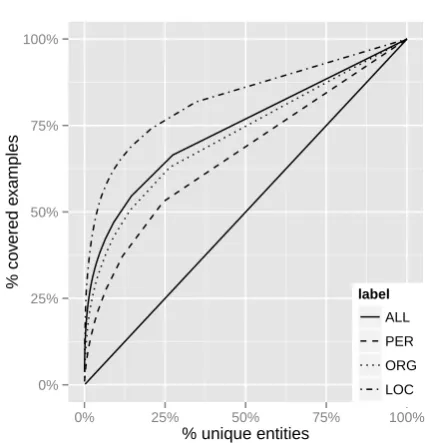
Figure 1: Cumulative number of examples cov-ered by unique entities, starting with the most fre-quent.
into any of these categories were tagged asother (O). We assume that named entities do not over-lap. In case a named entity is contained within another named entity, only the top-level entity is annotated. Table 1 and Figure 1 give an overview of named entity occurrences in the corpus.
PER LOC ORG Total All 5762 5711 3938 15411 Unique 3588 1589 1987 7164
Table 1: Number of named entities in the corpus.
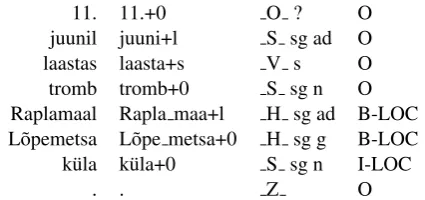
The corpus is organized closely follow-ing CoNLL03 formattfollow-ing conventions (Tjong Kim Sang and De Meulder, 2003). In a data file, each line corresponds to a word with empty lines representing sentence boundaries. Each line con-tains four fields: the word itself, its lemma, its grammatical attributes3 and its named entity tag. Named entity tags are encoded using a widely accepted BIO annotation scheme (Ramshaw and Marcus, 1995). Figure 2 demonstrates an example sentence.
The corpus is freely available for research pur-poses and is accessible at the repository of public language resources of Tartu University (Laur et al.,
3Definition of the attributes can be found at
[image:2.595.319.509.456.501.2]11. 11.+0 O ? O juunil juuni+l S sg ad O laastas laasta+s V s O tromb tromb+0 S sg n O Raplamaal Rapla maa+l H sg ad B-LOC L˜opemetsa L˜ope metsa+0 H sg g B-LOC k¨ula k¨ula+0 S sg n I-LOC
[image:3.595.76.289.62.162.2]. . Z O
Figure 2: An example sentence in the corpus: On the 11th of June, a tornado devastated Lypemetsa village in Rapla county.
2013).
3 System Overview
Two important components in the design of a NER system are features and a learning algorithm. Fea-tures encode characteristic attributes of words rel-evant for the classification task. Possible examples of features are word lemma, part of speech, occur-rence in some dictionary. The task of a learning algorithm is to study the features over a large col-lection of annotated documents and identify rules that capture entities of a particular type.
3.1 Features
In our system, we have implemented the following groups of features:
Base-Line Features. This group includes fea-tures based mostly on the word’s orthog-raphy: (1) word itself in lowercase; (2) word prefixes and suffixes of lengths 3-4; (3) word type: capitalized, all-capitalized, is-number, is-alphanumeric, dash, apostrophe, digit, dot, contains-capitalized-letter, is-punctuation-mark; (4) word parts before and after a dash in case of compound words; (5) whether the word is first in the sen-tence.
Morphological Features. These features are based on information provided by morphological disambiguatort3mesta: word lemma, POS-tag, word case, word ending, constituent morphemes.
Dictionary-based Features. We composed a large dictionary of entities covering common per-son names and surnames, local and international organizations and geographical locations. The dic-tionary contains entities in both Estonian and En-glish. The lists of Estonian entities were obtained
from multiple public on-line resources. A large collection of entities in English was downloaded from the web site of the Illinois Named Entity Tagger (Ratinov and Roth, 2009). Table 2 gives an overview of dictionary size and content. The dictionary covers 21% of the unique entities in the corpus, out of which 41% are unambiguous, meaning that the entity matches exactly one cate-gory in the dictionary.
Collected entities were preprocessed with a morphological disambiguator t3mesta. Words were replaced with their lemmas and turned to lower case. For a dictionary lookup we employed a leftmost longest match approach.
Dictionary Type Size
Common Estonian first names (KeeleWeb, 2010) 5538 Common first and second names in English 9348 (Ratinov and Roth, 2009)
Person full names in English (Ratinov and Roth, 2009) 877037 Estonian locations (Maa-amet, 2013) 7065 International locations in Estonian (P¨all, 1999) 6864 Locations in English (Ratinov and Roth, 2009) 5940 Estonian organisations (Kaubandus-T¨o¨ostuskoda, 2010) 3417 International organisations (Ratinov and Roth, 2009) 329
Total 903279
Table 2: Dictionaries and numbers of entries.
WordNet Features. Estonian Wordnet is a knowledge base containing more than 27000 different concepts (sets of synonymous words) (Kerner et al., 2010). Wordnet encodes various se-mantic relationships between the concepts, which can be used as valuable information in NER tasks.
Based on the lemmas and their part-of-speech, we used Wordnet relations to encode hyperonymy, be in a state, belongs to a class and synset id infor-mation as extra features.
Global features. Global features enable to ag-gregate context from word’s other occurrences in the same document (Chieu and Ng, 2003). We im-plemented global features as described in (Ratinov and Roth, 2009). For each occurrencew1, . . . , wN
of the word wthe set of features c(wi) is
gener-ated: (1) word is capitalized in document at any position, but the beginning of a sentence; (2) pre-ceding word is a proper name; (3) following word is a proper name; (4) preceding word’s presence in gazetteers; (5) following word’s presence in gazetteers. Then, a set of features of the wordwis extended with the aggregated contextSN
3.2 Learning Algorithm
In this work, we use conditional random fields model (CRFs). CRFs are widely used for the task of NER due to their sequential nature and ability to handle a large number of features. Our choice is also substantiated by our earlier experiments on Estonian NER, where CRFs have demonstrated superior performance over a Maximum Entropy classifier (Tkachenko, 2010). We use CRFs imple-mented in the Mallet software package (McCal-lum, 2002).
4 Experiments and Results
In this section, we conduct a number of experi-ments to investigate the system behavior with re-spect to different factors.
We assess system performance using standard precision, recall andF1measure (Tjong Kim Sang and De Meulder, 2003). Scores for individual en-tity types are obtained by averaging results of 10-fold cross-validation on the full dataset. When splitting the data, document bounds are taken into account so that content of a single document fully falls either into training or test set. In this way, we minimize terminology transfer between sam-ples used for training and testing. To summarize the results of an experiment with a single number, we report the weighted average of a corresponding measure over all entity types.
4.1 Named Entity Tag Representation
[image:4.595.330.500.61.106.2]The choice of NE tag representation scheme has been shown to have significant effect on NER sys-tem performance (Ratinov and Roth, 2009). In this experiment, we set out to determine which scheme works best for the Estonian language. We consider two frequently used schemes – BIO (Ramshaw and Marcus, 1995) and BILOU. BIO format iden-tifies each token as either the beginning, inside or outside of NE. BILOU format additionally distin-guishes the last token of multi-token NEs as well as unit-length NEs. Hence, given NEs of three types (per, loc, org), the BIO scheme will produce 7 and BILOU 13 distinct tags.
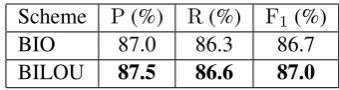
Table 3 compares system performance using BIO and BILOU schemes. BILOU outperforms BIO in both precision and recall achieving a mod-est, but statistically significant 0.3 ppt improve-ment in F1-score. This agrees with related re-search for the English language (Ratinov and Roth, 2009). In the following experiments we use
Scheme P(%) R(%) F1(%)
BIO 87.0 86.3 86.7
BILOU 87.5 86.6 87.0
Table 3: End system performance using BIO and BILOU tag representation schemes. BILOU out-performs BIO (p-value 0.04).
a superior BILOU scheme.
4.2 Feature Utility Analysis
Feature group P(%) R(%) F1(%)
1) Baseline 83.3 76.8 79.9
2) 1) + Morphological 85.3 84.0 84.7 3) 2) + Dictionary 86.3 85.1 85.7 4) 2) + WordNet 85.4 84.2 84.8
5) 2) + Global 85.7 84.7 85.2
[image:4.595.310.522.228.319.2]6) All Features 87.5 86.6 87.0
Table 4: System performance using different groups of features.
Table 4 illustrates system performance using groups of features introduced in Section 3.1. We note that for each token we have included fea-tures from its immediate neighbors in the win-dow of size 2. Morphological features demon-strate a major effect, increasing F1-score by 4.8 ppt. Further inclusion ofDictionary,WordNetand Globalfeatures improvesF1-score by 1.0, 0.1 and 0.5 ppt respectively. By combining all groups of features, we achieve an overallF1-score of 87%. Results for individual types of named entities are presented in Table 5. It is worth mentioning, that we have also attempted to do automatic feature se-lection usingχ2-test and by discarding infrequent features. However, both methods resulted in a sig-nificant loss of performance.
NE type P(%) R(%) F1(%)
PER 90.2 91.6 90.9
ORG 80.0 74.7 77.1
LOC 89.4 89.6 89.5
ALL 87.5 86.6 87.0
Table 5: End-system performance.
4.3 Corpus Size
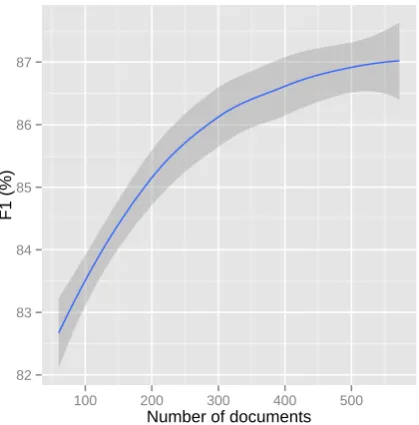
[image:4.595.329.501.591.669.2]10-fold cross-validation experiments with an increas-ing number of documents. In Figure 3, we observe the steepest gain in performance up to 300 doc-uments, which further starts to flatten out. This indicates that our corpus is of an appropriate size for the task at hand, and that our system design is feasible.
Figure 3: End-system smoothed F1-score with increasing number of documents in the cross-validation corpus. Shaded area depicts 95% confi-dence interval.
4.4 NER without Morphological Analysis
In the previous section, we have shown that ex-tending the baseline feature set with morpholog-ical features significantly boosts system perfor-mance. However, morphological analysis was per-formed with a commercial tool which may not be available due to licensing restrictions. It is, there-fore, interesting to explore system performance without using such language specific features. In this experiment, we omit all the features produced by morphological analyzer. Since we still want to usedictionaryandglobalfeatures, we need to ad-dress an issue of word form normalization. For this purpose, we have built a simple statistical lem-matizer by analyzing lemmas and their inflected forms in Estonian Reference Corpus (Kaalep et al., 2010). As a result, we have achievedF1-score of 84.8% – a 2.2 ppt decrease compared to the best result (see Table 6).
We conclude that even for highly inflective lan-guages such as Estonian simple techniques for
[image:5.595.80.290.173.386.2]lemmatizer P(%) R(%) F1(%) custom 86.4 83.3 84.8 t3mesta 87.5 86.6 87.0
Table 6: Performance comparison of NER systems usingt3mestaand our custom-built lemmatizer.
word form normalization, such as our lemmatizer, enable to achieve performance not much inferior than sophisticated linguistic tools.
5 Conclusions
In this work, we have addressed design challenges in building a robust NER system for Estonian. Our experiments indicate that a supervised learn-ing approach uslearn-ing a rich set of features can effec-tively handle the complexity of the language. We demonstrated the importance of the features based on linguistic information, external knowledge and context aggregation. We observed that the choice of tag representation scheme affects system per-formance with BILOU outperforming a widely used BIO scheme. We also showed that an accept-able performance in NER can be achieved with-out using sophisticated language-specific linguis-tic tools, such as morphological analyzer. Last, but not least, we have built a first gold standard cor-pus for NER in Estonian and made it freely avail-able for future studies. On this corpus, our sys-tem achieves an overall cross-validationF1-score of 87%.
Acknowledgments
We would like to thank Filosoft4for kindly provid-ing us morphological disambiguatort3mesta.
References
ACE. 2005. Automatic content extraction 2005 eval-uation. Webpage: http://www.itl.nist. gov/iad/mig//tests/ace/ace05/.
Oliver Bender, Franz Josef Och, and Hermann Ney. 2003. Maximum entropy models for named entity recognition. InProceedings of the seventh confer-ence on Natural language learning at HLT-NAACL, volume 4, pages 148–151. Association for Compu-tational Linguistics.
Daniel M Bikel, Scott Miller, Richard Schwartz, and Ralph Weischedel. 1997. Nymble: a high-performance learning name-finder. InProceedings
of the fifth conference on Applied natural language processing, pages 194–201. Association for Compu-tational Linguistics.
Hai Leong Chieu and Hwee Tou Ng. 2003. Named en-tity recognition with a maximum entropy approach. InIn Proceedings of the Seventh Conference on Nat-ural Language Learning, pages 160–163.
Nancy Chinchor. 1998. Muc-7 named entity task defi-nition, version 3.5. InProc. of the Seventh Message Understanding Conference.
Ralph Grishman and Beth Sundheim. 1996. Message understanding conference-6: A brief history. In Pro-ceedings of COLING, volume 96, pages 466–471.
Ralph Grishman. 1995. The NYU system for MUC-6 or where’s the syntax? In Proceedings of the 6th conference on Message understanding, pages 167– 175. Association for Computational Linguistics.
Heiki-Jaan Kaalep and Tarmo Vaino. 1998. Kas vale meetodiga ˜oiged tulemused? Statistikale tuginev eesti keele morfoloogiline ¨uhestamine. Keel ja Kir-jandus, pages 30–38.
Heiki-Jaan Kaalep, Kadri Muischnek, Kristel Uiboaed, and Kaarel Veskis. 2010. The Estonian Reference Corpus: its composition and morphology-aware user interface. InProceedings of the 2010 conference on Human Language Technologies–The Baltic Perspec-tive: Proceedings of the Fourth International Con-ference Baltic HLT 2010, pages 143–146. IOS Press.
Eesti Kaubandus-T¨o¨ostuskoda. 2010. List of Estonian organizations. Available athttp://www.koda. ee/?id=1916.
KeeleWeb. 2010. List of common Estonian first names. Available athttp://www.keeleveeb. ee/.
Kadri Kerner, Heili Orav, and Sirli Parm. 2010. Growth and revision of Estonian WordNet. Princi-ples, Construction and Application of Multilingual Wordnets, pages 198–202.
Michal Konkol and Miloslav Konop´ık. 2011. Max-imum entropy named entity recognition for Czech language. InText, Speech and Dialogue, pages 203– 210. Springer.
Dilek K¨uc¸¨uk et al. 2009. Named entity recognition experiments on Turkish texts. InFlexible Query An-swering Systems, pages 524–535. Springer.
Sven Laur, Alexander Tkachenko, and Timo Petman-son. 2013. Estonian NER corpus. Available at http://metashare.ut.ee/repository/ search/?q=Estonian+NER+corpus.
Winston Lin, Roman Yangarber, and Ralph Grishman. 2003. Bootstrapped learning of semantic classes from positive and negative examples. In Proceed-ings of ICML-2003 Workshop on The Continuum from Labeled to Unlabeled Data, volume 1, page 21.
Maa-amet. 2013. List of Estonian locations. Avail-able at http://www.maaamet.ee/index. php?lang_id=1&page_id=505.
Elaine Marsh and Dennis Perzanowski. 1998. Muc-7 evaluation of IE technology: Overview of results. In Proceedings of the seventh message understanding conference (MUC-7), volume 20.
Andrew McCallum and Wei Li. 2003. Early results for named entity recognition with conditional random fields, feature induction and web-enhanced lexicons. In Proceedings of the seventh conference on Nat-ural language learning at HLT-NAACL, volume 4, pages 188–191. Association for Computational Lin-guistics. TEST.
Andrew Kachites McCallum. 2002. Mallet: A ma-chine learning for language toolkit. Available at http://mallet.cs.umass.edu/.
M¯arcis Pinnis. 2012. Latvian and Lithuanian named entity recognition with TildeNER.Seed, 40:37.
Peeter P¨all. 1999. Maailma kohanimed. Eesti Keele Sihtasutus. Available athttp://www.eki.ee/ knab/mkn_ind.htm.
Lance A Ramshaw and Mitchell P Marcus. 1995. Text chunking using transformation-based learning. In Proceedings of the Third ACL Workshop on Very Large Corpora, pages 82–94. Cambridge MA, USA.
Lev Ratinov and Dan Roth. 2009. Design challenges and misconceptions in named entity recognition. In Proceedings of the Thirteenth Conference on Com-putational Natural Language Learning, pages 147– 155.
Erik F Tjong Kim Sang and Fien De Meulder. 2003. Introduction to the CoNLL-2003 shared task: Language-independent named entity recognition. In Proceedings of the seventh conference on Natural language learning at HLT-NAACL, volume 4, pages 142–147. Association for Computational Linguis-tics.
Alexander Tkachenko. 2010. Named entity recogni-tion for the Estonian language. Master’s thesis, Uni-versity of Tartu.
D´aniel Varga and Eszter Simon. 2007. Hungarian named entity recognition with a maximum entropy approach.Acta Cybernetica, 18(2):293–301.