Proceedings of the 11th International Conference on Finite State Methods and Natural Language Processing, pages 39–43,
Parsing Morphologically Complex Words
Kay-Michael W¨urzner
∗ University of Potsdam, Psychology Dept.Karl-Liebknecht-Str. 24-25 14476 Potsdam, Germany [email protected]
Thomas Hanneforth
University of Potsdam, Linguistics Dept.Karl-Liebknecht-Str. 24-25 14476 Potsdam, Germany
Abstract
We present a method for probabilistic parsing of German words. Our approach uses a mor-phological analyzer based on weighted finite-state transducers to segment words into lexical units and a probabilistic context free grammar trained on a manually created set of word trees for the parsing step.
1 Introduction
Most existing systems for automatic, morphological analysis of German focus on flat structures, i.e. the segmentation into morphemes and the identification of their features and the involved operations. But as soon as more than one operation leads to the word in ques-tion, possible orderings of these operations can be cap-tured in different hierarchical structures. Consider Ex. (1) from Faaß et al. (2010),
(1) unPref
un translate¨ubersetzV barableSuff ‘untranslatable’
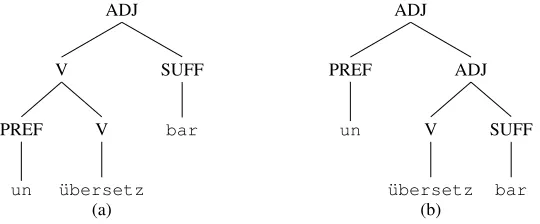
The adjectiveun¨ubersetzbaris analyzed as a combina-tion of the prefixun, the verbal stem¨ubersetzand the suffixbar. This analysis could be assigned two struc-tures (depicted in Fig. 1): either the prefixation (a) or the suffixation (b) occurs first.
Research on human morphological processing has long moved from linear segmentations to more ad-vanced representations of the morphological structure of words (Libben, 1993; Libben, 1994). We aim to pro-vide researchers in this field with hierarchical morpho-logical analyses for all words in our lexical database
dlexDB(Heister et al., 2011).
In the following, we present an approach for the au-tomatic assignment of hierarchical structures to com-plex words using flat morphological analyses and a PCFG1. As a case study, we apply our method to the
∗This author’s work was funded by the DFG (grant no. KL 955/19-1).
1We assume here the usual definition of a context-free grammar (CFG)G= (V,T,S,P)consisting of non-terminal (V) and terminal symbols (T), a start symbolS ∈V and a set of context-free productionsP. In aprobabilistic CFG (PCFG; Booth, 1969), each production is assigned with a probability.
parsing of German adjectives. To do so, we created a corpus of manually annotated word trees for 5,000 structurally ambiguous adjectives. We describe types of ambiguity and their distribution in the training set and report results of the parsing process in dependence of various grammar transformations.
1.1 Word Formation and Structures
Word formation is the combination of morphemes to form new words. We distinguish between inflection (combination of a free morpheme with one or more af-fixes to fulfill agreement),compounding(combination of several free morphemes) and derivation (combina-tion of a morpheme with an affix to change the category and/or the meaning of a word). Conversionmight be considered a special case of derivation. Here, a change of a word’s category occurs without any affixes being involved.
Word formation processes which are involved in the creation of a complex word can be linearly ordered. Multiple possible orderings lead to structural ambigui-ties. Ex. (2) gives examples for the possible different types of ambiguity2: Compound – Suffix,Compound –
Compound,Prefix – Suffix,Prefix – Compound.
(2) a. MenschN
human enlinkFreundfriend N lichly Suff ‘humanitarian’
b. dunkelA
dark Ascheash N graugrayA ‘dark ashen’
c. nichtPref
non ObjektobjectN iviveSuff ‘non-objective’
d. abPref
off GasgasN freifreeA ‘zero-emission’
The decision which ordering is the correct one is driven by morphological as well as semantic restrictions on the involved morphemes. The tree given in Fig. 1a for example could be ruled out by the fact that verbs may
2Since inflection in German is triggered by a word’s con-text to ensure agreement and from a productive point of view always takes place last in word formation, we ignore it in our list and for the remainder of this work and restrict ourselves to base forms (lemmas) of the words in question.
ADJ
SUFF
bar V
V
¨
ubersetz PREF
un
ADJ
ADJ
SUFF
bar V
¨
ubersetz PREF
un
[image:2.612.174.444.22.134.2](a) (b)
Figure 1: Possible tree structures for the morphological analysis in Example (1).
not be combined with the prefixunin German. As an example for semantic restrictions consider the analysis forantirheumatischgiven in Ex. (3).
(3) antiPref
anti RheumarheumatismN tlinkischish Suff ‘antirheumatic’
Since the concept of “antirheumatism” does not exist, we assume that the suffixation with isch takes place first.
1.2 Morphological Analysis
Before parsing, input words must be segmented into their basic units. In addition, the parser needs sufficient categorical annotation to get started. For that purpose, we used the TAGH morphology (Geyken and Han-neforth, 2006), a comprehensive computational mor-phology system for German based on weighted finite-state transducers.
Computer morphology systems normally suffer from oversegmentation: a sufficiently long enough word gets segmented in all possible ways, resulting in a lot of am-biguous readings most of which are nonsensical. To tackle this problem, the TAGH morphology (TAGH-M) makes use of three strategies:
1. TAGH-M measures morphological complexity by associating each derivation and compounding rule with a context-dependent penalty weight. These weights are taken from atropical semiringweight structure (Kuich and Salomaa, 1986), that is, weights are added along a path in the weighted finite-state automaton representing a set of mor-phological analyses, and, among the competing analyses, the one with the least weight is selected.
2. TAGH-M is not strictly morpheme-based, but in-stead more oriented towards semantics. In Ger-man, there are a lot of overtly morphologically complex words which nevertheless denote simple concepts. Take for example the exocentric com-pound Geizhals (‘scrapepenny’). But it can be also segmented intoGeiz(‘miserliness’) andHals (‘neck’). TAGH-M’s base lexicon now contains morphological simple entries like Hals, but mor-phologically complex ones likeGeizhalsas well.
In association with the weighting mechanism, this means, that lexicalized but complex forms will be always given priority.
3. The word formation grammar underlying TAGH-M is very carefully crafted. Looking at adjective formation, the corresponding subgrammar con-tains approx. 3,000rules. These rules are divided
into groups, responsible for prefixation, tion, compounding and conversion. The suffixa-tion part of the grammar is itself divided into fur-ther groups, one for each productive adjective suf-fix like-isch,-igor-lich.3 Every suffixation rule is
associated with a number of base stems of differ-ent category (nouns, names, etc.) which happen to take this particular suffix. The association of affixes and stems is derived from a huge list of en-tries taken from the German Google books corpus (see also Sec. 2.2).
By incorporating these three strategies, TAGH-M avoids a lot of segmentation ambiguities which would otherwise enter into the subsequent parsing phase.
In addition, TAGH-M inserts marker symbols (for separable and non-separable prefixes, suffixes, link-ing morphemes and free morphemes), reduces allomor-phic variants to their underlying citation form and an-notates each segment with a morphological category taken from a set of approx. 20 categories.
Ex. (4) shows the preferred segmentation of the ad-jectivel¨anderspezifisch(‘country-specific’).
(4) Land hNi \er hli # spezif hfi ∼ isch hai
The symbols enclosed in angle brackets denote the morphosyntactic category of the segment:hNiis a free noun, whilehairepresents a bound adjective (suffix -isch); hfidenotes a neoclassical formative andhlia linking morpheme. The segmentation symbol # marks a free morpheme boundary, while∼flags a following suffix. Annotated segments as well as segmentation markers enter the subsequent parsing phase.
1.3 Parsing
To get an initial grammar for the training experi-ments reported on in Sec. 3, we manually derived a context-free grammar based on the grammar underly-ing TAGH-M. For parsunderly-ing, this grammar was automat-ically converted into an unweightedfinite tree automa-ton, FTA(Comon et al., 2007). Transitions of FTAs are either of the form
w→q (1)
which introduce the leaves of a tree, or rules of the form
f(q1,q2, . . . ,qk)→q (2)
which describek-branching tree nodes with labelf; the qis are the states of the FTA. The language of an FTA is the set of trees generated by the FTA.
Finite-tree automata offer an advantage over context-free grammars: their transitions decouple the label (functor)f of the transition (which corresponds to a context-free rule’s left-hand side) from the destination stateq of the transition (which reflects the context in which the subtree might be inserted). This for exam-ple make techniques like parent annotation (see below) easily applicable since annotated categories are repre-sented in the states of the FTA, not its translation labels. For word structure parsing, we used an intersection based approach (Hanneforth, 2013).
1.3.1 Lexicalization
In lexicalized grammars, individual productions are specialized for certain lexical items. Non-terminal symbols are extended with lexical information as shown in Fig. 2.
Adj-lich
Adj-lich
Suff-lich
lich N-Freund
Freund Pref-un
[image:3.612.355.494.27.152.2]un
Figure 2: A lexicalized word tree.
This example is an instance of so called head lex-icalization (Charniak, 1997). Lexical information of the rightmost constituent is percolated through the tree. Lexicalizing a grammar is a way to add some kind of contextual information tocontext-freegrammars.
1.3.2 Parent Annotation
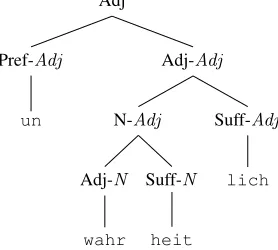
Parent annotation (Johnson, 1998) is another way of enriching a CFG with contextual information. The cat-egory of some non-terminal is added to the labels of its daughters as shown in Fig. 3.
Extending the grammar as described above increases the number of non-terminals and productions. This can
Adj
Adj-Adj
Suff-Adj
lich N-Adj
Suff-N
heit Adj-N
wahr Pref-Adj
[image:3.612.133.248.434.534.2]un
Figure 3: A word tree with parent annotation.
lead to sparseness problems in the probabilistic case. These problems can be dealt with by applying some smoothing method (Collins, 1999).
2 Method
In what follows, we describe our pilot study for the generation of parse trees for morphologically complex words. Our goal is to determine the most likely struc-ture for each item in the test set, namely a large set of German adjectives.
2.1 Procedure
We decided to evaluate a statistical parsing approach using a PCFG. The aforementioned hand-crafted CFG which covers the different types of ambiguity was used to create candidate trees (cf. Fig. 1) for a set of train-ing items (see Sec. 2.2). The design of the grammar also ensured that there is always an unary derivation from the pre-terminal to the terminal level. This al-lowed us to keep lexical rules separate from the rest of the grammar. The grammar contains no further unary productions.
After the manual annotation step described in Sec. 2.2, we divided the data into 10 equal parts and in-duced context-free productions from the trees in each part. For each subtree
X
Y1. . . Yn
a production X → Y1. . . Yn was added toP. We also stored the production’s frequency in each of the 10 sub-parts.
Estimation of the probabilities for the productions in P and evaluation of the resulting PCFG was done by iterating over the sub-parts Gi which served as a test set while the rest was used for training.
Ambiguity Number
Compound – Suffix 5,239
Prefix – Suffix 1,136
Compound – Compound 447
Prefix – Compound 0
Table 1: Numbers of different types of structural ambi-guities within a set of20,000adjectives.
Pr(Y1. . . Yn|X) =
c(X →Y1. . . Yn) + 1 c(X→(V ∪T)+) +|P| (3)
In order to capture restrictions as those mentioned above, we applied various transformations on the trees prior to the grammar induction resulting in differ-ent grammar versions: (1) specialization of the pre-terminal level for bound morphemes, (2) specialization of the pre-terminal level for frequent free morphemes, (3) lexicalization of adjective suffixes and (4) parent annotation. The specialization of the pre-terminal level may be considered as lexicalization of only the lexical rules.
2.2 Materials
We chose the Google booksN-grams (Google Incor-porated, 2009) as our source for training and test ma-terials. The list of unigrams contains all words with a frequency greater or equal to ten within the German portion of the Google books corpus (all in all3,685,340
types). From this list, we extracted a large number of adjectives using a list of known adjective suffixes (see Sec. 1.2) and manually filtered this list for optical char-acter recognition errors and false positives (e.g. verbal forms). This set was extended using known adjectives from various hand-maintained lexical resources result-ing in a list of338,423adjectives.
Initially, we randomly selected10,000words with a length of8 ≤ n ≤ 20(which were unique for their lemma; i.e., only one instance per lemma was selected) from this list. These words were morphologically an-alyzed and parsed along the lines of sections 1.2 and 1.3. The resulting analyses were manually checked for errors in the morphological analysis and the word trees. Detected errors led to readjustments of both the morphological analyzer and the grammar. Finally, only roughly a quarter of the items were assigned more than one tree (the main reason for this is that TAGH-M al-ready removes a lot of possible ambiguities). That is why we added another10,000 words (this time with
a length of10 ≤ n ≤ 25) to get more ambiguous
forms. Tab. 1 shows the numbers of the different pos-sible types of ambiguity in the test set.
For training and evaluating the PCFG, we manually selected the preferred tree for 5,000 structurally am-biguous adjectives.
2.3 Evaluation
We usedevalb(Sekine and Collins, 1997) to evaluate the different probabilistic grammars extracted from the training materials as described in Sec. 2.1. We report their performance in terms of (1)tagging accuracy, i.e., the proportion of correct pre-terminal to terminal as-signments, (2)bracketing accuracy, i.e., the proportion of correct rule applications and (3)complete matches, i.e. the proportion of identities between manually se-lected and automatically generated trees.
3 Results and Discussion
Table 2 summarizes the results for the different gram-mar versions. The corresponding tree transformations are applied in a cumulative way. Due to the inclusion of the morpheme annotation done by TAGH-M into the grammar, tagging accuracy is always 100% and thus omitted in Table 2.
The biggest improvement is gained through the spe-cialization of frequent free morphemes. This trans-formation helps us to model binding preferences for certain morphemes. Consider for example the noun Freund (‘friend’) which is very often combined with the suffixlichin order to formfreundlich(‘friendly’). There are many compounds withfreundlichas anwen-derfreundlichwhere, due to semantic restrictions, the noun compound as first component is not an option.
Head-lexicalization did not improve parsing re-sults with one exception: The test materials contain many coordinative structures like psychischphysisch (‘psycho-physical’), thus the production Adj → Adj Adjhas a fairly high probability. But there is one notable exception to this rule: In words like Ex. (5),
(5) NationN
nation alalSuff SozialistNsocialist ischish Suff ‘Nazi’
a coordinative analysis is also available, but adjectives formed withalalmost always combine with a noun if possible. Lexicalizingalsuccessfully models this be-havior. It will be subject to further work to system-atically test for other equally successful lexicalization patterns.
Parent annotation does not add very much to the per-formance of the grammar which is due to the relatively simple structures that we encounter during parsing of words compared to the parsing of sentences.
If we look at the remaining errors, it is striking that most of these originate from exceptions from the typi-cal formation patterns. The prefix ¨uber(‘over’) is usu-ally combined with adjectives but in some rare cases it operates as a noun prefix (¨Ubermensch, ‘superman’). Derivations from these nouns are assigned with the wrong analysis by our grammar.
Ger-Grammar Number of prod. Bracketing acc. Complete match
baseline 63 91.64% 82.05%
specialized bound morphemes 196 92.20% 83.04%
specialized freq. free morphemes 238 94.92% 89.11%
lexicalized suffixal 274 96.26% 92.02%
parent annotation 481 95.91% 93.34%
Table 2: Number of non-lexical productions as well as proportions of correct bracketing and complete matches for different PCFGs.
man nouns where the great number of compounds will be the major challenge.
Acknowledgements
We would like to thank Edmund Pohl for creat-ing the web-based tree traincreat-ing tool (http://www. dlexdb.de/wordstruct) and the anonymous re-viewers for their helpful remarks.
References
Taylor L. Booth. 1969. Probabilistic Representation of Formal Languages. InIEEE Conference Record of 10th Annual Symposium on Switching and Automata Theory, pages 74–81.
Eugene Charniak. 1997. Statistical Techniques for Natural Language Parsing. AI Magazine, 18(4):33– 43.
Michael John Collins. 1999. Head-Driven Statistical Models for Natural Language Parsing. Ph.D. thesis, University of Pennsylvania.
Hubert Comon, Max Dauchet, Remi Gilleron, Christof L¨oding, Florent Jacquemard, Denis Lugiez, So-phie Tison, and Marc Tommasi. 2007. Tree Au-tomata Techniques and Applications. Available on: http://www.grappa.univ-lille3. fr/tata. release October, 12th 2007.
Gertrud Faaß, Ulrich Heid, and Helmut Schmid. 2010. Design and Application of a Gold Standard for Morphological Analysis: SMOR as an Example of Morphological Evaluation. In Nicoletta Calzo-lari, Khalid Choukri, Bente Maegaard, Joseph Mari-ani, Jan Odijk, Stelios Piperidis, Mike Rosner, and Daniel Tapias, editors, Proceedings of the seventh LREC conference, pages 803–810.
Alexander Geyken and Thomas Hanneforth. 2006. TAGH: A Complete Morphology for German based on Weighted Finite State Automata. InFinite State Methods and Natural Language Processing, volume 4002 of Lecture Notes in Computer Science, pages 55–66, Berlin, Heidelberg. Springer.
Google Incorporated. 2009. Google Books Ngrams. http://books.google.com/ngrams.
Thomas Hanneforth. 2013. An Efficient Parsing Algo-rithm for Weighted Finite-tree Automata. In prepa-ration.
Julian Heister, Kay-Michael W¨urzner, Johannes Bubenzer, Edmund Pohl, Thomas Hanneforth, Alexander Geyken, and Reinhold Kliegl. 2011. dlexDB – eine lexikalische Datenbank f¨ur die psy-chologische und linguistische Forschung. Psycholo-gische Rundschau, 62(1):10–20.
Mark Johnson. 1998. PCFG Models of Lingusitic Tree Representations. Computational Linguistics, 24(4):612–632.
Werner Kuich and Arto Salomaa. 1986. Semirings, Automata, Languages, volume 5 of EACTS Mono-graphs on Theoretical Computer Science. Springer. Gary Libben. 1993. Are Morphological Structures
Computed During Word Recognition? Journal of Psycholinguistic Research, 22(5):533–544.
Gary Libben. 1994. Computing Hierarchical Morpho-logical Structure: A Case Study. Journal of Neu-rolinguistics, 8(1):49–55.