Evaluating Unsupervised Language Model Adaptation Methods for
Speaking Assessment
Shasha Xie Microsoft 1020 Enterprise Way Sunnyvale, CA 94089 [email protected]
Lei Chen
Educational Testing Service 600 Rosedale Rd
Princeton, NJ [email protected]
Abstract
In automated speech assessment, adaptation of language models (LMs) to test questions is im-portant to achieve high recognition accuracy However, for large-scale language tests, the ordinary supervised training, which uses an expensive and time-consuming manual tran-scription process, is hard to utilize for LM adaptation. In this paper, several LM adap-tation methods that require either no manual transcription process or just a small amount of transcriptions have been evaluated. Our ex-periments suggest that these LM adaptation methods can allow us to obtain considerable recognition accuracy gain with no or low hu-man transcription cost.
Index Terms: language model adaptation, unsuper-vised training, Web as a corpus
1 Introduction
Automated speech assessment, a fast-growing area in the speech research field (Eskenazi, 2009), typ-ically uses an automatic speech recognition (ASR) system to recognize spontaneous speech responses and use the recognition outputs to generate the fea-tures for scoring. Since the recognition accuracy di-rectly influences the quality of the speech features, especially for the features related to word entities, such as those measuring grammar accuracy and vo-cabulary richness, it is important to use ASR sys-tems with high recognition accuracy.
Adaptation of language models (LMs) to test re-sponses is an effective method to improve recogni-tion accuracy. However, it is difficult to only use
the ordinary supervised training to adapt LMs to test questions. First, for high-stake tests administered globally, a very large pool of test questions have to be used to strengthen the tests’ security and validity. Since a large number of test questions have many possible answers for each question, a large set of au-dio files needs to be transcribed to cover response content. Second, due to time and cost constraints, it may not be practical to have a pre-test to collect enough speech responses for adaptation purposes. Therefore, it is important to pursue other methods to obtain LM adaptation data in a faster and lower-cost way than the ordinary supervised training.
As we will review in Section 2, some promising technologies, such asunsupervised training, active learning, and LM adaptation based on Web data, have been utilized in broadcast news recognition, di-alog system, and so on. In this paper on the LM adaptation task used in automated speech scoring systems, we will report our experiments to obtain LM adaptation data in a faster and more economical way that requires little human involvement. To our knowledge, this is the first such work reported in the automated speech assessment area.
The rest of the paper is organized as follows: Sec-tion 2 reviews the related previous research results; Section 3 describes the English test, the data used in our experiments, and the ASR system used; Sec-tion 4 reports the experiments of different methods we tried to obtain LM adaptation data; Section 5 dis-cusses our findings and plans for future research.
2 Previous Work
Unsupervised training is the method of using untran-scribed audio to adapt a language model (LM). An initial ASR model (seed model) is used to recognize the untranscribed audio, and the obtained ASR out-puts are used in the follow-up LM adaptation. (Chen et al., 2003) utilized unsupervised LM adaptation on broadcast news (BN) recognition. The unsuper-vised adaptation method reduces the word error rate (WER) by 2% relative to using the baseline LM. (Bacchiani and Roark, 2003) reported that unsuper-vised LM adaptation provided an absolute error rate reduction of3.9%over the un-adapted baseline per-formance by using17hours of untranscribed adap-tation data. This was 51%of the 7.7% adaptation error rate reduction obtained by using an ordinary supervised adaptation method.
Active learning is used to reduce the number of training examples to be annotated by automatically processing the unlabeled examples and then select-ing the most informative ones with respect to a given cost function. (Riccardi and Hakkani-Tur, 2003; Tur et al., 2005) proposed using a combination of unsupervised and active learning for ASR training to minimize the workload of human transcription. Their experiments showed that the amount of la-beled data needed for a given recognition accuracy can be reduced by 75%when combining these two training approaches.
A recent trend in Natural Language Processing (NLP) and speech recognition research is utilizing Web data to improve the LMs, especially when in-domain training material is limited. (Ng et al., 2005) investigated LM topic adaptation using Web data. Experiments in recognizing Mandarin tele-phone conversations showed that use of filtered Web data leads to a7%reduction in the character recog-nition error rate. (Sarikaya et al., 2005) used Web data to adapt LMs used in a spoken dialog system. From a limited in-domain data set, they generated a series of search queries and retrieved Web pages from Google using these queries. In their recog-nition experiment done on a dialog system, they achieved a5.2%word error reduction by using the Web data, compared to a baseline LM trained on
1700in-domain utterances.
3 Test, Data, and ASR
Our in-domain data was from The Test of English for International Communication, TOEICR, which tests non-native English speakers’ basic speaking ability required in international business communi-cations. In our experiments, we focused onopinion
testing questions. An example question is: “Do you agree with the statement that a company should only hire experienced employees? Use specific reasons to support your answer”.
A state-of-the-art HMM LVCSR system, which was provided by a leading ASR vendor, was used in our experiments. It contains a cross-word tri-phone acoustic model (AM) and a combination of bi-gram, tri-gram, and up to four-gram LMs. The AM and LM are trained by supervised training from about
800 hours of audio and manual transcriptions of non-native English speaking data collected from the Test Of English as a Foreign Language (TOEFLR). TOEFLR is targeted to assess test-takers’ ability to use English to study in an institution using En-glish as its primary teaching language. Speaking content from TOEFLR data is quite different from the content shown in TOEICR data. When testing this recognizer on a held-out evaluation set extracted from the TOEFLR test, a word error rate (WER) of 33.0%1 is observed. This recognizer was used as
theseedrecognizer in our experiments.
4 Experiments
We collected a set of audio responses from the TOEICR test, focusing on opinion questions. This data set was randomly selected from different first-language (L1) and English speaking proficiency lev-els. Then, these audio files were manually tran-scribed. In our experiments, 1470 responses were used for LM adaptation and the remaining 184 re-sponses were used to evaluate speech recognition
accuracy. When using the seed recognizer with-out any adaptation, the WER on the evaluation set is 42.8%, which is much higher than the accuracy achieved on the TOEFLR data (33.0%). Using the ordinary supervised training, adapting LMs using these 1470 manual transcriptions, the WER is re-duced to 34.7%, close to the performance on the in-domain TOEFLR data. Note that a fixed dictio-nary with a vocabulary size of about20,000words, which in general is much larger than the vocabulary mastered by non-native test takers, was used in our experiment.
4.1 Unsupervised LM adaptation
Using the seed recognizer trained on the TOEFLR data, we recognized1470adaptation responses and selected varying amounts of ASR outputs for LM adaptation. From ASR outputs of all responses, we selected the responses with high confidence scores estimated by the seed recognizer so that we could use the ASR outputs with higher recognition accu-racy on the LM adaptation task. We used two meth-ods to measure the confidence score for each re-sponse from word-level confidence scores. First, we took the average of all word confidence scores a re-sponse contains, as shown in Equation 1.
ConfperW ord=
1
N N
X
i=1
conf(wi) (1)
whereconf(wi)is the confidence score of word,wi. The other method we used considers each word’s du-ration, as shown in Equation 2.
ConfperSec=
PN
i=1d(wi)∗conf(wi)
PN
i=1d(wi)
(2)
whered(wi)is the duration ofwi.
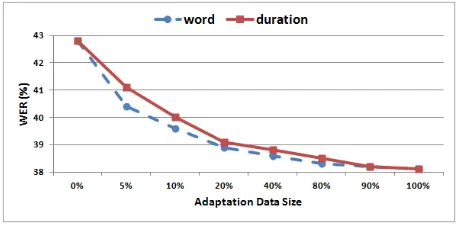
In Figure 1, we showed the WER after running unsupervised LM adaptation, where the adaptation responses were selected if they had high word-based (ConfperW ord) or duration-based (ConfperSec) confidence scores. The data sizes used for adapta-tion vary from0%(without any adaptation) to100%
(using all adaptation data). We observe continuous reduction of WER when using more and more adap-tation data. Selecting responses by the word-based
[image:3.612.312.541.132.245.2]confidence scores performs a little better than the se-lection method based on the confidence scores nor-malized by corresponding word durations. However, there is no significant difference between these two selection criteria.
Figure 1: Unsupervised LM adaptation performance us-ing different sizes of development set data.
ASR accuracy may vary within each response. Therefore, instead of using entire responses, we also explored using smaller units for LM adaptation. All of the ASR outputs were split into word sequences with fixed lengths (10-15words), and the ones with higher per-word confidence scores (ConfperW ord) were extracted for model adaptation. Our experi-ment shows that using word-sequence pieces rather than entire responses leads to a faster WER reduc-tion. When only using5%of the adaptation data, we obtained3.5%absolute WER reduction compared to the baseline result without adaptation. Note that we only obtained2.5%absolute WER reduction when using entire responses in adaptation.
4.2 Web data LM adaptation
Web pages were downloaded and texts on these Web pages were extracted. We examined the Web search results (including URLs and texts) returned by the BootCat tool. The returned Web data has varied matching rates among these prompts and are gen-erally noisy.
By using only the default setup provided by the BootCat tool, we collected5312sentences in total. After a simple text normalization, we used the ob-tained Web data for LM adaptation, and the WER on the evaluation data was38.5%. This WER result is a little higher than the WER result achieved by unsupervised LM adaptation (38.1%). Without tran-scribing any response from test-takers, the language model adaptation using Web data already helps to improve recognition accuracy. Then, we tried us-ing both the Web data and the ASR hypotheses for adaptation, and we can further decreased the WER to37.6%. This is lower than using the two LM adap-tation data sets separately.
4.3 Semi-supervised approaches for LM adaptation
For semi-supervised LM adaptation, we replaced the speech responses of lower confidence scores with their corresponding human transcripts. We hoped that by using the responses with high confidence scores together with a small amount of human tran-scripts, we could get better performance by intro-ducing less noise during adaptation. We set differ-ent thresholds for selecting the low confidence re-sponses and replacing them with human transcripts. We find that just manually transcribing a limited amount of audio data gives us further WER reduc-tion, compared to using unsupervised learning. Af-ter transcribing just100responses,6.8%of1470 re-sponses in the adaptation data set, semi-supervised learning can achieve61.73%of the WER reduction (8.1%) obtained by using the ordinary supervised training that requires transcription of all 1470 re-sponses.
4.4 Discussion
In Table 1, we compared the performance of all the adaptation methods mentioned in this paper, includ-ing two unsupervised methods adapted usinclud-ing the ASR hypotheses and “related” Web data, and one
semi-supervised method 2, replacing the ASR hy-potheses of lower confidence scores with their corre-sponding human transcripts. For a convenient com-parison, we also include the baseline (without LM adaptation) and the result of using the supervised adaptation. All the proposed unsupervised/semi-supervised methods can significantly improve the ASR performance compared to the baseline result. For projects with time limits, we can use these unsupervised/semi-supervised methods to help us get relatively good ASR outputs.
Table 1: The WER on the evaluation set using different LM adaptation methods.
baseline unsupervised semi super.
ASR Web ASR&Web
42.8 38.1 38.5 37.6 37.8 34.7
5 Conclusions and Future Work
In this paper, we reported our experiments in ap-plying several LM adaptation methods to automated speech scoring systems that require few, if any, hu-man transcripts, which are expensive and slow to obtain for large-sized adaptation data sets. The un-supervised training (using ASR transcriptions from a seed ASR system) clearly shows higher accuracy than a ASR system without any domain adaptation. We also used test questions to collect related texts from Web. Even though such Web data may be noisy and its relatedness to real test responses is not al-ways guaranteed, text data collected from the Web is helpful to adapt LMs to better fit the responses to test questions. To better cope with recognition er-rors brought on by using the unsupervised training method, we proposed using human transcriptions on a small amount of poorly recognized responses. Us-ing such little human involvement further helps to obtain a lower WER. Therefore, based on the ex-periments described in this paper, we conclude that these novel LM adaptation methods provide promis-ing solutions to let us skip the ordinary supervised training for LM adaptation tasks frequently used in automated speech scoring.
2
The reported experiments in this paper were con-ducted on a limited-size data set. We plan to increase the testing data to a larger size and hope to cover more types of test questions and spoken tests. In ad-dition, we plan to investigate how to automatically generate Web search queries based on test questions.
References
M. Bacchiani and B. Roark. 2003. Unsupervised lan-guage model adaptation. In2003 IEEE International Conference on Acoustics, Speech, and Signal Process-ing, 2003. Proceedings.(ICASSP’03).
M. Baroni and S. Bernardini. 2004. BootCaT: bootstrap-ping corpora and terms from the web. InProceedings of LREC, volume 2004, page 13131316.
L. Chen, J. L Gauvain, L. Lamel, and G. Adda. 2003. Unsupervised language model adaptation for broad-cast news. In2003 IEEE International Conference on Acoustics, Speech, and Signal Processing, 2003. Pro-ceedings.(ICASSP’03).
L. Chen, K. Zechner, and X Xi. 2009. Improved pro-nunciation features for construct-driven assessment of non-native spontaneous speech. InNAACL-HLT. M. Eskenazi. 2009. An overview of spoken language
technology for education. Speech Communication, 51(10):832–844.
K. Livescu and J. Glass. 2000. Lexical modeling of non-native speech for automatic speech recogni-tion. In Acoustics, Speech, and Signal Processing, 2000. ICASSP’00. Proceedings. 2000 IEEE Interna-tional Conference on, volume 3, pages 1683–1686. T. Ng, M. Ostendorf, M. Y Hwang, M. Siu, I. Bulyko, and
X. Lei. 2005. Web-data augmented language mod-els for mandarin conversational speech recognition. In
Proc. ICASSP, volume 1.
G. Riccardi and D. Z Hakkani-Tur. 2003. Active and un-supervised learning for automatic speech recognition. InProc. 8th European Conference on Speech Commu-nication and Technology.
R. Sarikaya, A. Gravano, and Y. Gao. 2005. Rapid lan-guage model development using external resources for new spoken dialog domains. In Proc. ICASSP, vol-ume 1, pages 573–576.