Opinion Holder and Target Extraction for Verb-based Opinion Predicates
– The Problem is Not Solved
Michael Wiegand and Marc Schulder
Spoken Language Systems Saarland University D-66123 Saarbr¨ucken, Germany [email protected]
Josef Ruppenhofer
Dept. of Information Science and Language Technology
Hildesheim University D-31141 Hildesheim, Germany
Abstract
We offer a critical review of the current state of opinion role extraction involving opinion verbs. We argue that neither the currently available lexical resources nor the manually annotated text corpora are sufficient to appropriately study this task. We introduce a new corpus focusing on opinion roles of opinion verbs from the Subjectivity Lexicon and show potential benefits of this corpus. We also demon-strate that state-of-the-art classifiers per-form rather poorly on this new dataset compared to the standard dataset for the task showing that there still remains sig-nificant research to be done.
1 Introduction
We present a critical review of previous research in opinion holder and target extraction. Opinion holders (OH)are the entities that express an opin-ion, whileopinion targets (OT)are the entities or propositions at which sentiment is directed. The union of opinion holders and opinion targets are referred to asopinion roles.
In this work we focus on opinion roles evoked by verbs. We examine verbs since opinion role extraction is considered a lexical semantics task and for such tasks verbs are the central focus.
We argue for more lexical resources and corpora that are less biased by domain artifacts. The com-mon practice for producing labeled corpora has so far mostly been extracting contiguous sentences from a particular domain and then labeling those sentences with regard to the entities that were in-tended to be extracted, i.e. opinion holders and/or opinion targets. In this paper we argue that cer-tain important aspects of the task of opinion role extraction get overlooked if one exclusively con-siders those corpora that are currently available.
We particularly focus on the relationship between opinion roles and their syntactic argument realiza-tion. Previous work hardly addressed this issue since either little variation between opinion roles and their syntactic arguments was perceived on the corpora on which this task was examined, or there were other domain-specific properties that could be used in order to extract opinion roles correctly without the knowledge about opinion role realiza-tion.
Currently, there exists only one commonly ac-cepted corpus for English containing manual an-notation of both opinion holders and targets, i.e. the MPQA corpus (Deng and Wiebe, 2015). Apart from that, not a single lexical resource for that specific task is available. Moreover, there does not exist any publicly available tool that supports
both opinion holder and target extraction. Typi-cal applications, such as opinion summarization, however, require both components simultaneously (Stoyanov and Cardie, 2011). These facts indicate that there definitely needs to be more research on the task of opinion role extraction.
In order to stimulate more research in this di-rection, we present a verb-based corpus for opin-ion role extractopin-ion. The difference to previous datasets is that it has been sampled in such a way that all opinion verbs of a common sentiment lexi-con are widely represented. Previous corpora have a bias towards those opinion expressions that are frequent in a particular domain. We demonstrate on two opinion holder extraction systems that per-formance on the new corpus massively drops com-pared to their performance on a standard dataset. This shows that current systems are not fit for open-domain classification.
2 Opinion Roles and Lexical Semantics
Conventional syntactic or semantic levels of rep-resentation do not capture sufficient information that allows a reliable prediction in what argument
positions an opinion role may be realized. This is illustrated by (1) and (2) which show that, even with the PropBank-like semantic roles (i.e.agent,
patient1) assigned to the entities, one may not be able to discriminate between the opinion roles.
(1) [Peter]OH
agentdislikes[Mary]OTpatient.
(2) [Peter]OT
agentdisappoints[Mary]OHpatient.
We assume that it is lexical information that de-cides in what argument position opinion roles are realized. That is, a verb, such as dislike, believe
orapplaud, belongs to a group with different lin-guistic properties than verbs, such as disappoint,
interest orfrighten. However, the realizations of opinion roles observed in (1) and (2) are not the only possibilities. In (3), there is no explicitly mentioned opinion holder while the target is the agent. Such cases are triggered by verbs, such as
gossip,blossomordecay.
(3) [These people]OT
agentaregossipinga lot.
Another type of opinion verb is presented in (4) and (5) where two viewpoints are evoked by the same verb in the same sentence. (4) denotes the sentiment view of Peter towards Mary while (5) represents the sentiment view ofMarytowards Pe-ter(i.e.PetermadeMaryfeel better).
(4) [Peter]OH
agentconsoles[Mary]OTpatient.
(5) [Peter]OT
agentconsoles[Mary]OHpatient.
These types ofselectional preferences (1)-(5) have been observed before including the case
of multiple viewpoint evocation (4)-(5), most
prominently by Ruppenhofer et al. (2008). Yet lit-tle research on opinion role extraction has actu-ally paid attention to this issue. One exception is Wiegand and Klakow (2012) who experiment with an induction approach to distinguish cases like (1) and (2). Nonetheless, datasets and lists of types of opinion verbs have not been publicly released.
The above analysis suggests more research on lexical resources is required. In the following, we show that existing resources are not suitable to provide the type of information we are looking for. As a reference of opinion verbs, we use the set of 1175verbs contained in theSubjectivity Lexicon
(Wilson et al., 2005). Our main assumption is that the opinion verbs from that lexicon can be consid-ered a representative choice of all kinds of opinion expressions that exists in the English language.
1Byagentand patient, we mean constituents labeled as
A0andA1in PropBank (Kingsbury and Palmer, 2002).
3 On the Potential of Existing Lexical Resources
In §2, we demonstrated the need for acquiring more lexical knowledge about opinion verbs for open-domain opinion role extraction. This raises the question whether existing general-purpose re-sources could be exploited for this purpose. If one considers the plethora of different lexical re-sources developed for sentiment analysis, i.e. sen-timent lexicons listing subjective expressions and their prior polarity (Wilson et al., 2005; Bac-cianella et al., 2010; Taboada et al., 2011), emo-tion lexicons (Mohammad and Turney, 2013) or connotation lexicons (Kang et al., 2014), one finds, however, that with respect to opinion role extraction there is a gap. What is missing is a lex-icon that states for each opinion verb in which ar-gument position an opinion role can be found.
3.1 Sparsity and Other Shortcomings of FrameNet
One resource that has previously been examined for this task isFrameNet(Baker et al., 1998). The idea is to identify in frames (which predominantly contain opinion expressions) those frame elements that typically contain either opinion holders or opinion targets. Once this mapping has been es-tablished, a FrameNet-parser, such as Semafor (Das et al., 2010), could be used to automati-cally recognize frame structures in natural lan-guage text. By consulting the mapping from frame elements to opinion roles, specific opinion roles could be extracted. Kim and Hovy (2006) fol-lowed this approach for a set of opinion verbs and adjectives. Thus, they were able to correctly re-solve some problems which cannot be re-solved with the help of syntactic parsing or PropBank-like se-mantic roles, such as the role distinctions in (1) and (2). For instance, while the opinion holders in (6) and (7) map to the same frame element
EX-PERIENCER, the PropBank-like semantic roles
differ. Unfortunately, the resulting mapping lists from that work are not publicly available.
(6) [PeterEXPERIENCER]OHagentdislikes[Mary]OTpatient.
(7) [Peter]OT
agentdisappoints[MaryEXPERIENCER]OHpatient.
Table 1 shows some statistics of our opinion verbs with regard to matched frames and frame el-ements. Considering that there are 615 different frame elements associated to the different frames2
2This count conflates frame elements of the same name
# opinion verbs (from the Subjectivity Lexicon) 1175 # opinion verbs with at least one frame 691 # different frames associated with opinion verbs 306 # different frame elements associated with opinion verbs 615
Table 1: Statistics of opinion verbs w.r.t frames and frame elements from FrameNet.
containing at least one of our opinion verbs, it becomes obvious that mapping opinion roles to frame elements is a challenging undertaking.
One major shortcoming of the FrameNet-approach for opinion role extraction is that the cur-rent FrameNet (version 1.5) still severely suffers from a data-sparsity problem. For example, ap-proximately 45% of the opinion verbs from the Subjectivity Lexicon are missing from FrameNet (Table 1). Even though there exist ways to ex-pand the knowledge contained in FrameNet (Das and Smith, 2012), there are also conceptual prob-lems with the current FrameNet-ontology (Rup-penhofer and Rehbein, 2012). Since FrameNet is a general-purpose resource, there is no guar-antee that frame structures perfectly match selec-tional preferences of opinion roles. For instance, we found that there are many frames that con-tain opinion verbs with different selectional pref-erences. The frame SCRUTINY, for example,
typ-ically contains many verbs that take an opinion holder in agent position and an opinion target in patient position (e.g.investigateoranalyse). How-ever, it also contains different verbs, such as pry.
Prying meansto be interested in someone’s per-sonal life in a way that is annoying or offensive
(Macmillan Dictionary). Given this definition, we must note that this verb also contains another opin-ion view (in additopin-ion to the one also conveyed by the other verbs in this frame – as exemplified by (8) and (9)), namely that of the speaker of the ut-terance (condemning the behaviour of the agent of
pry). As a consequence, the agent ofpryis also an opinion target while its respective opinion holder is the speaker of the utterance (10).
(8) [The police]OHinvestigated[her]OTthoroughly.
(9) [The press]OHcontinues topry[into their affairs]OT.
(10) [The press]OTcontinues topryinto their affairs.(OH: speaker of the
utterance)
3.2 WordNet Lacking Syntactic Knowledge
At first glance, using WordNet (Miller et al., 1990) as a way to acquire knowledge for selec-tional preferences of opinion verbs seems a bet-ter albet-ternative. This resource has a far greabet-ter lexical coverage than FrameNet (for example, the set of opinion verbs from the Subjectivity
Lexi-con are all Lexi-contained in WordNet). A straightfor-ward solution for using that resource in the cur-rent task would be to group opinion verbs that share the same selectional preferences for opin-ion holders and targets with the help of the Word-Net ontology graph. One common way of doing so would be the application of some bootstrap-ping method in which one defines seed opinion verbs with distinct selectional preferences (for in-stance, one defines as one group opinion verbs that take agents as opinion holders, such asdislike, as another group verbs that take patients as opinion holders, such asdisappoint, and so on) and prop-agate their labels to the remaining opinion verbs via the WordNet graph. Such bootstrapping on WordNet has been effectively used for the induc-tion of sentiment lexicons (Esuli and Sebastiani, 2006; Rao and Ravichandran, 2009) or effect pred-icates (Choi and Wiebe, 2014). It relies on a good similarity metric in order to propagate the labels from labeled seed words to unlabeled words.
We experimented with the metrics in Word-Net::Similarity (Pedersen et al., 2004) and found that the opinion verbs most similar to a specified opinion verb do not necessarily share the same syntactic properties. For example, Table 2 lists the12 opinion verbs most similar tooutrage and
please, which are typical opinion verbs that take an opinion holder in patient position and an opin-ion target in agent positopin-ion.3 (They would be plau-sible candidates for verb seeds for that verb cat-egory.) Unfortunately, among the list of similar verbs, we find many opinion verbs which have opinion holder and target in a different argument position, such ashateon the list foroutrage:
(11) [Mary]OT
agentoutrages/appals/scandalizes/...[Peter]OHpatient.
(12) [Peter]OH
agenthates/fears/loves/...[Mary]OTagent.
From a semantic point of view, the similarities obtained look reasonable. rage, hate and dread
bear a semantic resemblance to outrage. How-ever, the syntactic properties, i.e. the selectional (argument) preferences, which are vital for opin-ion role extractopin-ion, differ from outrage. Word-Net is a primarilysemanticresource (mainly with a view towards lexical relations rather than va-lence or argument structure), syntactic aspects that would be necessary in order to induce selectional preferences, are missing. Therefore, we suspect that, by itself, WordNet is not a useful resource for the extraction of opinion roles.
outrage: appall, scandalize, anger, rage, sicken, temper, hate, fear, love, alarm, dread, tingle
please: delight, enthral, enchant, gratify, signify, obviate, madden, blind, avoid, despair, disagree, crush
Table 2: The12most similar verbs tooutrageand
please according to the WordNet::Similarity (un-derlined verbs donotshare the selectional prefer-ence of the respective target verb).
verbs adjectives tokens types tokens types
252 113 1467 302
Table 3: Comparison of distribution of opinion verbs and opinion adjectives in the Darmstadt Ser-vice Review Corpus (DSRC).
4 Text Corpora for Fine-Grained Sentiment Analysis
The previous section suggested that none of those existing lexical resources yield the type of infor-mation that is required for opinion role extraction. We now also look at available text corpora and ex-amine whether they reflect opinion verbs in such a way that the problem of opinion role extraction can be appropriately evaluated on them. We start by looking at the review domain.
4.1 Why the review domain is not suitable for studying opinion role extraction for verbs
There has been a lot of research on the review domain, which also means that there are several datasets from different domains allowing cross-domain sentiment analysis. However, for more in-depth opinion role extraction evoked by verb pred-icates, these types of texts seem to be less suitable – despite the plethora of previous publications on opinion target extraction (Hu and Liu, 2004; Jakob and Gurevych, 2010; Liu et al., 2013b; Liu et al., 2013a; Liu et al., 2014). We identified the follow-ing reasons for that:
Firstly, the subtask of opinion holder extraction is not really relevant on this text type. Product reviews typically reflect the author’s views on a particular product. Therefore, the overwhelming majority of explicitly mentioned opinion holders
agent of verb patient of verb no (direct) relationship
21.8 44.5 33.8
Table 4: Proportion of relationships between opin-ion targets and opinopin-ion verbs in the Darmstadt Ser-vice Review Corpus (DSRC).
refer to the author of the pertaining review. Secondly, opinion roles evoked by opinion verbs are less frequent. We extracted all sentences with opinion targets from the Darmstadt Service Review Corpus (DSRC)(Toprak et al., 2010)4and counted the parts of speech of the corresponding opinion expressions. Table 3 compares the fre-quency of opinion adjectives and verbs. It shows that adjectives are much more frequent than verbs. Thirdly, the review domain is typically focused on products, e.g. movies, books, electronic devices etc. This also means that only specific semantic types are eligible for opinion holders and targets, e.g. persons are less likely to be opinion targets. Therefore, much of the research in opinion target extraction relies on entity priors. By that we mean that (supervised) classifiers learn weights for spe-cific entities (typically nouns or noun phrases) of how likely they represent a priori an opinion tar-get (Zhuang et al., 2006; Qiu et al., 2011; Liu et al., 2013b; Liu et al., 2014). For example, in the movie domain Psychois very likely to be an opinion target as will beiPhonein the electronics domain. However, as such features do not trans-fer to other domains, they distract research efforts from the universally applicable feature of selec-tional preferences. Table 4, for example, shows the proportion of different relationships between opinion targets and opinion verbs on DSRC. It shows that there is a considerable number of tar-gets in both agent position (14) and patient posi-tion (13) & (15). So, it is not trivial to detect opin-ion targets here. However, if one looks at typical sentences that fall into these two classes, one finds that entity priors and a few other heuristics would help to solve this extraction problem.
For example, all a supervised classifier would need to learn is that the personal pronoun I can never be an opinion target (13) – in the review domain it is typically an opinion holder. (This is a typical entity prior that can be learned.) Oth-erwise, agents are preferred opinion targets (14) but if the agent is not realized, we simply tag the patient (15). We found that these simple heuris-tics would manage to correctly identify more than 70% of opinion targets on DSRC (being a depen-dent of some opinion verb). Under these circum-stances, one does not need to know that recom-mend and stink have different selectional
prefer-4We chose this corpus as a typical representative corpus
MPQA VERB
# sentences 15753 1073
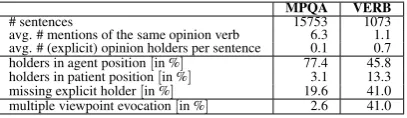
[image:5.595.81.285.62.121.2]avg. # mentions of the same opinion verb 6.3 1.1 avg. # (explicit) opinion holders per sentence 0.1 0.7 holders in agent position[in %] 77.4 45.8 holders in patient position[in %] 3.1 13.3 missing explicit holder[in %] 19.6 41.0 multiple viewpoint evocation[in %] 2.6 41.0
Table 5: Statistics of MPQA and VERB.
ences on opinion targets.
(13) Irecommend[this site]OT
patientto anyone.
(14) [Their programs]OT agentstink.
(15) Avoid[this institution]OT
patientif you are a Canadian student!
These heuristics may work on review datasets, but they become misleading when used in a cross-domain setting, since their predictiveness may be confined to specific domains. For example, in a novel written in the first person, the mere occur-rence of Iis not telling. No mention ofI in Sen-tence (16) (taken from Gulliver’s Travels) repre-sents an opinion holder.
(16) When[I]left Mr. Bates,[I]went down to my father: where[...] [I]got forty pounds, and a promise of thirty pounds a year to maintain me at Leyden: there[I]studied physic two years and seven months[...]
4.2 Is the news domain any better?
While we think that the review domain is less suit-able for opinion role extraction, the conditions we find on news corpora seem more promising. Typ-ically, news corpora tend to be multi-topic. As a consequence, opinion targets can be of differ-ent semantic types. Persons can function both as opinion holders and targets. In other words, corpus artifacts like the ones mentioned in §4.1 are less likely to be helpful in solving the task. The fact that the only corpus with a significant amount of both opinion holders and targets anno-tated, namelyMPQA 3.0(Deng and Wiebe, 2015), consists of news text, further lends itself to the us-age of that domain. Moreover, we do not have a bias towards adjectives. On the MPQA corpus, for example, we actually found that there are10% more opinion verb mentions than opinion adjec-tive mentions. This analysis may suggest that the existing MPQA corpus would be suitable for our studies. Yet in the next sections, we show why for the study of opinion roles of opinion verbs, it is advisable to consider yet another corpus.
5 Our New Opinion Verb Corpus
With our new corpus for fine-grained analysis, we mainly pursue three goals that, as discussed above, are not sufficiently met by previous resources:
1. Our corpus is designed for the evaluation of opinion role extraction systems focusing on mentions of opinion verbs.
2. It should widely represent various types of selectional preferences. 3. It should appropriately represent multiple viewpoint evocation.
Our new corpus was sampled from the North
American News Text Corpus (LDC95T21). The
dataset comprising 1073 sentences contains 753 opinion holders,745opinion targets and499 opin-ion targets of a speaker view (e.g. as in (3)). We sampled in such a way that all opinion verbs from the Subjectivity Lexicon were contained (Goal 1). To compare: In the MPQA corpus, almost every second opinion verb is unattested.
In order to demonstrate that our new corpus is a more suitable resource in order to study se-lectional preferences (Goal 2) and multiple view-point evocation (Goal 3), we prepared some statis-tics regarding mentions of opinion verbs and their properties in the MPQA corpus and our corpus (denoted by VERB). Due to the unavailability of MPQA 3.0, we had to use MPQA 2.0, whose annotation with regard to opinion targets is in-complete. We therefore compare opinion verbs only with regard to their opinion holders. How-ever, given the strong interrelations between opin-ion holders and targets (Yang and Cardie, 2013), we think that if it is shown that our corpus better represents the versatility of opinion holders, this should (almost) equally also apply for opinion tar-gets.
Table 5 examines the types of argument posi-tions in which an opinion holder is realized. We distinguish between three different roles (already informally introduced in §2): the holder is in
agent position (example: dislike), the holder is
in patient position(example: disappoint) or the
verbs of the Subjectivity Lexicon, shows that other types of opinion verbs are actually underrepre-sented in MPQA. The same can be said about mul-tiple viewpoint evocation. (The number for this latter phenomenon is surprisingly high. We found that the reason of this is that there are many verbs that follow the pattern ofpry(9)-(10), i.e. convey-ing both a view of its agent and another view of the speaker, such as idealize, moan, overempha-size,patronize,snub,swindleortrivialize.)
We should wonder what impact this bias of opinion role realizations has on building classi-fiers. If one just focuses on MPQA, then always considering opinion holders in agent position will mean being right in almost80%of the cases. Sim-ilarly, there is no need to consider multiple view-point evocation. So, this explains why previous research paid little attention to these issues.
6 Details on Annotation
We followed the annotation scheme of Ruppen-hofer et al. (2014). It is based on SalsaTigerXML (Erk and Pad´o, 2004), an annotation scheme origi-nally devised for representing FrameNet-like se-mantic roles. On a sample of 200 sentences, we measured an interannotation agreement of Co-hen’sκ=0.69for opinion holders andκ=0.63for opinion targets. The corpus is going to be made publicly available to the research community.
7 Some Baselines
We now empirically prove that further research on opinion role extraction is needed. For this proof, we consider the two previously discussed corpora, MPQA and VERB. MPQA is chosen as a train-ing set.5 It is also the largest corpus. We want to show that despite its size, open-domain opin-ion role extractopin-ion requires some informatopin-ion that is still not contained in that corpus. Almost every second opinion verb from the Subjectivity Lexicon is not contained in that corpus.
In this evaluation, we only consider opinion holders. One reason for this is that opinion hold-ers are less controvhold-ersial to annotate (this also usu-ally results in a higher interannotation agreement (§6)). Another reason is that there is no publicly available extraction system that covers targets.
For our experiments, we use the sequence la-beler from Johansson and Moschitti (2013),
Mul-5The split-up of training and test set on the MPQA corpus
follows the specification of Johansson and Moschitti (2013).
Classifier MPQA(train+test) VERB(test)
MultiRel 72.54 44.80
CK 62.98 43.88
Table 6: F-scores of opinion-holder classifiers on the MPQA corpus and the new VERB corpus.
tiRel. We chose this classifier since it is currently the most sophisticated system for opinion holder extraction and it is publicly available.MultiRel in-corporates relational features taking into account interactions between multiple opinion cues. In ad-dition to MultiRel, we also consider convolution kernels (CK) from Wiegand and Klakow (2012). We include that classifier since it achieved overall better performance than the traditional CRFs on a wide set of experiments (Wiegand and Klakow, 2012) including on cross-domain settings.
In the evaluation, we only consider the opinion holders of our opinion verbs. Recall that we are only interested in the study of opinion roles asso-ciated with opinion verbs.
Table 6 shows the results. MultiRel produces the best performance on MPQA, but on VERB suffers from a similar domain-mismatch as CK. This drop in performance is not only due to the fact that many opinion verbs do not occur in MPQA, but also because the selectional preferences of these uncovered verbs differ from the majority ob-served in MPQA (Table 5).
8 Conclusion
Acknowledgements
We would like to thank Stephanie K¨oser for annotating parts of the resources presented in this paper. The authors were par-tially supported by the German Research Foundation (DFG) under grants RU 1873/2-1 and WI 4204/2-1.
References
Stefano Baccianella, Andrea Esuli, and Fabrizio Se-bastiani. 2010. SentiWordNet 3.0: An Enhanced Lexical Resource for Sentiment Analysis and Opin-ion Mining. InProceedings of the Conference on Language Resources and Evaluation (LREC), pages 2200–2204, Valletta.
Collin F. Baker, Charles J. Fillmore, and John B. Lowe. 1998. The Berkeley FrameNet Project. In Proceedings of the International Conference on Computational Linguistics and Annual Meeting of the Association for Computational Linguistics (COLING/ACL), pages 86–90, Montr´eal, Quebec, Canada.
Yoonjung Choi and Janyce Wiebe. 2014. +/-EffectWordNet: Sense-level Lexicon Acquisition for Opinion Inference. InProceedings of the Con-ference on Empirical Methods in Natural Language Processing (EMNLP), pages 1181–1191, Doha, Qatar.
Dipanjan Das and Noah A. Smith. 2012. Graph-Based Lexicon Expansion with Sparsity-Inducing Penalties. In Proceedings of the Human Lan-guage Technology Conference of the North Ameri-can Chapter of the ACL (HLT/NAACL), pages 677– 687, Montr´eal, Quebec, Canada.
Dipanjan Das, Nathan Schneider, Desai Chen, and Noah A. Smith. 2010. Probabilistic Frame-Semantic Parsing. In Proceedings of the Hu-man Language Technology Conference of the North American Chapter of the ACL (HLT/NAACL), pages 948–956, Los Angeles, CA, USA.
Lingjia Deng and Janyce Wiebe. 2015. MPQA 3.0: An Entity/Event-Level Sentiment Corpus. In Proceedings of the Human Language Technology Conference of the North American Chapter of the ACL (HLT/NAACL), pages 1323–1328, Denver, CO, USA.
Katrin Erk and Sebastian Pad´o. 2004. A powerful and versatile xml format for representing role-semantic annotation. InProceedings of the Conference on Language Resources and Evaluation (LREC), pages 799–802, Lisbon, Portugal.
Andrea Esuli and Fabrizio Sebastiani. 2006. Senti-WordNet: A Publicly Available Lexical Resource for Opinion Mining. In Proceedings of the Con-ference on Language Resources and Evaluation (LREC), pages 417–422, Genova, Italy.
Minqing Hu and Bing Liu. 2004. Mining and Sum-marizing Customer Reviews. InProceedings of the ACM SIGKDD International Conference on Knowl-edge Discovery & Data Mining (KDD), pages 168– 177, Seattle, WA, USA.
Niklas Jakob and Iryna Gurevych. 2010. Extracting Opinion Targets in a Single- and Cross-Domain Set-ting with Conditional Random Fields. In Proceed-ings of the Conference on Empirical Methods in Nat-ural Language Processing (EMNLP), pages 1035– 1045, Boston, MA, USA.
Richard Johansson and Alessandro Moschitti. 2013. Relational Features in Fine-Grained Opinion Analy-sis.Computational Linguistics, 39(3):473–509.
Jun Seok Kang, Song Feng, Leman Akoglu, and Yejin Choi. 2014. ConnotationWordNet: Learning Con-notation over the Word+Sense Network. In Pro-ceedings of the Annual Meeting of the Association for Computational Linguistics (ACL), pages 1544– 1554, Baltimore, MD, USA.
Soo-Min Kim and Eduard Hovy. 2006. Extracting Opinions, Opinion Holders, and Topics Expressed in Online News Media Text. In Proceedings of the ACL Workshop on Sentiment and Subjectivity in Text, pages 1–8, Sydney, Australia.
Paul Kingsbury and Martha Palmer. 2002. From TreeBank to PropBank. In Proceedings of the Conference on Language Resources and Evaluation (LREC), pages 1989–1993, Las Palmas, Spain. Kang Liu, Liheng Xu, Yang Liu, and Jun Zhao.
2013a. Opinion Target Extraction Using Partially-Supervised Word Alignment Model. In Proceed-ings of the International Joint Conference on Artifi-cial Intelligence (IJCAI), pages 2134–2140, Beijing China.
Kang Liu, Liheng Xu, and Jun Zhao. 2013b. Syntactic Patterns versus Word Alignment: Extracting Opin-ion Targets from Online Reviews. InProceedings of the Annual Meeting of the Association for Compu-tational Linguistics (ACL), pages 1754–1763, Sofia, Bulgaria.
Kang Liu, Liheng Xu, and Jun Zhao. 2014. Extracting Opinion Targets and Opinion Words from Online Reviews with Graph Co-ranking. InProceedings of the Annual Meeting of the Association for Computa-tional Linguistics (ACL), pages 314–324, Baltimore, MD, USA.
George Miller, Richard Beckwith, Christiane Fell-baum, Derek Gross, and Katherine Miller. 1990. Introduction to WordNet: An On-line Lexical Database. International Journal of Lexicography, 3:235–244.
Ted Pedersen, Siddharth Patwardhan, and Jason Miche-lizzi. 2004. WordNet::Similarity – Measuring the Relatedness of Concepts. In Proceedings of the Human Language Technology Conference of the North American Chapter of the ACL–Demonstration Papers (HLT/NAACL), pages 38–41, Boston, MA, USA.
Guang Qiu, Bing Liu, Jiajun Bu, and Chun Chen. 2011. Opinion Word Expansion and Target Extrac-tion through Double PropagaExtrac-tion. Computational Linguistics, 37(1):9–27, March.
Delip Rao and Deepak Ravichandran. 2009. Semi-Supervised Polarity Lexicon Induction. In Proceed-ings of the Conference on European Chapter of the Association for Computational Linguistics (EACL), pages 675–682, Athens, Greece.
Josef Ruppenhofer and Ines Rehbein. 2012. Seman-tic frames as an anchor representation for sentiment analysis. InProceedings of the Workshop on Com-putational Approaches to Subjectivity and Sentiment Analysis (WASSA), pages 104–109, Jeju, Korea. Josef Ruppenhofer, Swapna Somasundaran, and Janyce
Wiebe. 2008. Finding the Source and Targets of Subjective Expressions. InProceedings of the Conference on Language Resources and Evaluation (LREC), pages 2781–2788, Marrakech, Morocco. Josef Ruppenhofer, Julia Maria Struß, Jonathan
Son-ntag, and Stefan Gindl. 2014. IGGSA-STEPS: Shared Task on Source and Target Extraction from Political Speeches. Journal for Language Technol-ogy and Computational Linguistics, 29(1):33–46. Veselin Stoyanov and Claire Cardie. 2011.
Automati-cally Creating General-Purpose Opinion Summaries from Text. InProceedings of Recent Advances in Natural Language Processing (RANLP), pages 202– 209, Hissar, Bulgaria.
Maite Taboada, Julian Brooke, Milan Tofiloski, Kim-berly Voll, and Manfred Stede. 2011. Lexicon-Based Methods for Sentiment Analysis. Computa-tional Linguistics, 37(2):267 – 307.
Cigdem Toprak, Niklas Jakob, and Iryna Gurevych. 2010. Sentence and Expression Level Annotation of Opinions in User-Generated Discourse. In Proceed-ings of the Annual Meeting of the Association for Computational Linguistics (ACL), pages 575–584, Uppsala, Sweden.
Michael Wiegand and Dietrich Klakow. 2012. Gener-alization Methods for In-Domain and Cross-Domain Opinion Holder Extraction. InProceedings of the Conference on European Chapter of the Association for Computational Linguistics (EACL), pages 325– 335, Avignon, France.
Theresa Wilson, Janyce Wiebe, and Paul Hoffmann. 2005. Recognizing Contextual Polarity in Phrase-level Sentiment Analysis. In Proceedings of the Conference on Human Language Technology and
Empirical Methods in Natural Language Process-ing (HLT/EMNLP), pages 347–354, Vancouver, BC, Canada.
Zhibiao Wu and Martha Palmer. 1994. Verb seman-tics and lexical selection. InProceedings of the An-nual Meeting of the Association for Computational Linguistics (ACL), pages 133–138, Las Cruces, NM, USA.
Bishan Yang and Claire Cardie. 2013. Joint Infer-ence for Fine-grained Opinion Extraction. In Pro-ceedings of the Annual Meeting of the Association for Computational Linguistics (ACL), pages 1640– 1649, Sofia, Bulgaria.