Evaluating Models of Computation and Storage
in Human Sentence Processing
Minh-Thang Luong∗ Stanford University
Timothy J. O’Donnell∗ MIT
Noah D. Goodman Stanford University
Abstract
We examine the ability of several mod-els of computation and storage to explain reading time data. Specifically, we demon-strate on both the Dundee and the MIT reading time corpora, that fragment gram-mars, a model that optimizes the trade-off between computation and storage, is able to better explain people’s reaction times than two baseline models which ex-clusively favor either storage or computa-tion. Additionally, we make a contribu-tion by extending an existing incremental parser to handle more general grammars and scale well to larger rule and data sets.1
1 Introduction
A basic question for theories of language repre-sentation, processing, and acquisition is how the linguistic system balances storage and reuse of lexical units with productive computation. At first glance, the question appears simple: words are stored; phrases and sentences are computed. However, a closer look quickly invalidates this picture. Some canonically computed structures, such as phrases, must be stored, as witnesses by verbal idioms like leave no stone unturned2
(Nunberg et al., 1994). There is also composi-tionality at the sub-word level: affixes like ness
inpine-scentedness, are almost always composed productively, whereas other affixes, e.g., th in
warmth, are nearly always stored together with stems (O’Donnell, 2015). Facts such as these have
∗indicates equal contribution.
1Our code and data are available at http:// stanford.edu/˜lmthang/earleyx/.
2Meaning:prevent any rock from remaining rightside up.
led to a consensus in the field that storage and computation are properties that cut across differ-ent kinds of linguistic units and levels of linguistic structure (Di Sciullo and Williams, 1987)—giving rise to hetergeneous lexicon3 theories, in the
ter-minology of Jackendoff (2002b).
Naturally, the question of what is computed and what is stored has been the focus of intense empirical and theoretical research across the lan-guage sciences. On the empirical side, it has been the subject of many detailed linguistic anal-yses (e.g., Jackendoff (2002a)) and specific phe-nomena such as composition versus retrieval in word or idiom processing have been examined in many studies in experimental psycholinguistics (Hay, 2003; O’Donnell, 2015). On the theoretical side, there have been many proposals in linguistics regarding the structure and content of the hetero-geneous lexicon (e.g., Fillmore et al. (1988), Jack-endoff (2002b)). More recently, there have been a number of proposal from computational linguis-tics and natural language processing for how a learner might infer the correct pattern of compu-tation and storage in their language (De Marcken, 1996; Bod et al., 2003; Cohn et al., 2010; Post and Gildea, 2013; O’Donnell, 2015).
However, there remains a gap between de-tailed, phenomenon-specific studies and broad ar-chitectural proposals and learning models. Re-cently, however, a number of methodologies have emerged which promise to bridge this gap. These methods make use of broad coverage probabilis-tic models which can encode representational and inferential assumptions, but which can also be ap-plied to make detailed predictions on large psy-cholinguistic datasets encompassing a wide
vari-3A hetergeneous lexicon contains not only words but also affixes, stems, and phrasal units such as idioms.
ety of linguistic phenomena. In the realm of syn-tax, one recent approach has been to use proba-bilistic models of sentence structures, paired with incremental parsing algorithms, to produce precise quantitative predictions for variables such as read-ing times (Roark et al., 2009) or eye fixation times (Demberg and Keller, 2008; Mitchell et al., 2010; Frank and Bod, 2011; Fossum and Levy, 2012; van Schijndel and Schuler, 2013). To date, no models of storage and computation in syntax have been applied to predict measures of human read-ing difficulty.
In this work, we employ several of the models of computation and storage studied by O’Donnell (2015), to examine human sentence process-ing. We demonstrate that the fragment grammars model (O’Donnell et al., 2009; O’Donnell et al., 2011)—a model that treats the question of what to store and what to compute productively as a prob-abilistic inference—better explains human read-ing difficulty than two “limitread-ing-case” baselines, MAP adaptor grammars (maximal storage) and Dirichlet-multinomial PCFG (maximal computa-tion), in two datasets: the Dundee eye-tracking corpus (Kennedy and Pynte, 2005) and the MIT reading time dataset (Bachrach et al., 2009).
2 Goals and Scope of the Paper
Before moving on, we remark on the goals and scope of the current study. The emergence meth-ods connecting wide-coverage probabilistic gram-mars and psycholinguistic data offer great poten-tial to test theoretical models quantitatively, at scale, and on a variety of detailed phenomena. However, studies using these methods also involve many moving parts, often making their results dif-ficult to interpret.
To connect probabilistic models of syntactic computation and storage to reading time or eye fix-ation data, practioners need to:
1. Preprocess train and test data sets by tok-enizing words, limiting sentence lengths, and handling unknown words.
2. Decide on a suitable grammatical formalism: determine a hypothesis space of stored items and specify a probability model over that space.
3. Choose and implement a probabilistic model to extract grammars from the training set.
4. Pick a test set annotated with reading diffi-culty information, e.g., eye fixation or read-ing times.
5. Choose a specific incremental parsing algo-rithm to generate word-by-word parsing pre-dictions.
6. Determine the theoretical quantity that will be used as a predictor, e.g., surprisalor en-tropy reduction.
7. Choose a suitable linking model to regress theoretical predictions against human data, controlling for participant-specific factors and nuisance variables.
Given this wide array of design decisions, it is often difficult to compare results across stud-ies or to determine which theoretical assumptions are crucial to the performance of models. For the field to make progress, studies must be replicable and each of the above factors (and potentially oth-ers) must be varied systematically in order to iso-late their specific consequences. We contribute to-wards this process in three ways.
First, we report results for three models which differ only in terms of how they address the prob-lem of what to store and what to compute (see Section 3). Otherwise, modeling and analysis as-sumptions are exactly matched. Moreover, the models represent three “limiting cases” in the space of storage and computation — store all max-imal structures, store only minmax-imal structures, and treat the problem as a probabilistic inference. Al-though none of the models represents a state-of-the-art model of syntactic structure, this study should provide important baselines against which to compare in future proposals.
Second, to make this study possible, we extend an existing incremental parser to address two tech-nical challenges by: (a) handling more general in-put grammars and (b) scaling better to extremely large rule sets. This parser can be used with any model that can be projected to or approximated by a probabilistic context-free grammar. We make this parser available to the community for future research.
predicted values for all examined data points to-gether with our analysis scripts. This should fa-cilitate the replication of these specific results and direct numerical comparison with later proposals.
3 Approaches to Computation and Storage
In this paper we study the ability of three mod-els to predict reading difficulty as measured by either eye-fixation or reading times — the
full-parsing model, implemented by Dirichlet-multinomial probabilistic context-free grammars (DMPCFG) (Kurihara and Sato, 2006; Johnson et al., 2007), the full-listing mode, implemented by maximum a posteriori adaptor grammars (MAG) (Johnson et al., 2006), and the inference-based
model, implemented by fragment grammars (FG) (O’Donnell, 2015).
All three models start with the same un-derlying base system—a context-free grammar (CFG) specifying the space of possible syntactic derivations—and the same training data—a cor-pus of syntactic trees. However, the models dif-fer in what they store and what they compute. The full-parsing model can be understood as a fully-compositional baseline equivalent to a Bayesian version of the underlying CFG. The full-listing model, by contrast, stores all full derivations (i.e., all derivations down to terminal symbols) and sub-derivations in the input corpus. These stored (sub)trees can be thought of as extending the CFG base component with rules that directly rewrite nonterminal symbols to sequence of terminals in a single derivational step.
Finally, the inference-based model treats the problem of what tree fragments to store, and which parts of derivations to compute as an inference in a Bayesian framework, learning to store and and reuse those subtrees which best explain the data while taking into account two prior biases for simplicity. The first bias prefers to explain the data in terms of a smaller lexicon of stored tree fragments. The second bias prefers to ac-count for each input sentence with smaller num-bers of derivational steps (i.e., fragments). Note that these two biases compete and thus give rise to a tradeoff. Storing smaller, more abstract frag-ments allows the model to represent the input with a more compact lexicon, at the cost of using a greater number of rules, on average, in individual derivations. Storing larger, more concrete
frag-ments allows the model to derive individual sen-tences using a smaller number of steps, at the cost of expanding the size of the stored lexicon. The inference-based model can be thought of as ex-tending the base CFG with rules, inferred from the data, that expand larger portions of derivation-tree structure in single steps, but can also include non-terminals on their right-hand side (unlike the full-listing model).
As we mentioned above, none of these models take into account various kinds of structure—such as headedness or other category-refinements—that are known to be necessary to achieve state-of-the-art syntactic parsing results (Petrov et al., 2006; Petrov and Klein, 2007). However, the results re-ported below should be useful for situating and in-terpreting the performance of future models which do integrate such structure. In particular, these re-sults will enable ablation studies which carefully vary different representational devices.
4 Human Reading Time Prediction
To understand the effect of different approaches to computation and storage in explaining human re-action times, we employ the surprisal theory pro-posed by Hale (2001) and Levy (2008). These studies introduced surprisal as a predictor of the difficulty in incremental comprehension of words in a sentence. Because all of the models described in the last section can be used to compute sur-prisal values, they can be used to provide predic-tions for processing complexity and hence, gain insights about the use of stored units in the human sentence processing. The surprisal values for these different models are dervied by means of a proba-bilistic, incremental Earley parser (Stolcke, 1995; Earley, 1968), which we describe below.
4.1 Surprisal Theory
The surprisal theory of incremental language pro-cessing characterizes the lexical predictability of a wordwtin terms of a surprisal value, the negative
log of the conditional probability of a word given its preceding context, −logP(wt|w1. . . wt−1).
time duration in both eye-tracking and self-paced reading studies (Boston et al., 2008; Demberg and Keller, 2008; Roark et al., 2009; Frank, 2009; Wu et al., 2010; Mitchell et al., 2010).
4.2 The Incremental Parser
The computation of surprisal values requires ac-cess to an incremental parser which can compute the prefix probabilities associated with a string s
under some grammar—the total probability over all derivation using the grammar which generate strings prefixed by s (Stolcke, 1995). The pre-fix probability is an important concept in compu-tational linguistics because it enables probabilis-tic predictions of possible next words (Jelinek and Lafferty, 1991) via the conditional probabilities
P(wt|w1. . . wt−1) = PP(w1...w(w1...wt−t)1). It also allows
estimation of incremental costs in a stack decoder (Bahl et al., 1983). Luong et al. (2013) used pre-fix probabilities as scaling factors to avoid numer-ical underflow problems when parsing very long strings.
We extend the implementation by Levy (2008) of the probabilistic Earley parser described in Stol-cke (1995) which computes exact prefix probabil-ities. Our extension allows the parser (a) to handle arbitrary CFG rewrite rules and (b) to scale well to large grammars.4
The implementation of Levy (2008) only ex-tracts grammars implicit in treebank inputs and restricts all pre-terminal rules to single-terminal rewrites. To approximate the incremental predic-tions of the models in this paper, we require the ability to process rules that include sequences of multiple terminal and non-terminal symbols on their right-hand side. Thus, we extend the im-plementation to allow efficient processing of such structures (property a).
With regards to property (b), we note that pars-ing against the full-listpars-ing model (MAG) is pro-hibitively slow because the approximating gram-mars for the model contain PCFG rules which ex-haustively list the mappings from every nontermi-nal in the input corpus to its terminontermi-nal substring, leading to thousands of rules. For example, for the Brown corpus section of the Penn Treebank
(Mar-4Other recent studies of human reading data have made use of the parser of Roark (2001). However, this parser inco-porates many specific design decisions and optimizations— ”baking in” aspects of both the incremental parsing algorithm and a model of syntactic structure. As such, since it does not accept arbitrary PCFGs, it is unsuitable for this present study.
cus et al., 1993), we extracted 778K rules for the MAG model, while the number of rules in the DM-PCFG and the inference-based (FG) grammars are 75K and 146K respectively. Parsing the MAG is also memory intensive due to multi-terminal rules that rewrite to long sequences of terminals, be-cause, for example, anS node must rewrite to an entire sentence. Such rules result in an exploding number of states during parsing as the Earley dot symbol moves from left to right.
To tackle this issue, we utilize atriedata struc-ture to efficiently store multi-terminal rules and quickly identify (a) which rules rewrite to a par-ticular string and (b) which rules have a parpar-ticular prefix.5 These extensions allow our
implementa-tion to incorporate multi-terminal rules in the pre-diction step of the Earley algorithm, and to effi-ciently incorporate which of the many rules can contribute to the prefix probability in the Earley scanning step.
We believe that our implementation should be useful to future studies of reading difficulty, allow-ing efficient computation of prefix probabilities for any model which can be projected to (or approxi-mated by) a PCFG—even if that approximation is very large. publicly available athttp://url.
5 Experiments
5.1 Data
Our three models models are trained on the Wall Street Journal (WSJ) portion of the Penn Treebank (Marcus et al., 1994). In particular, because we have access to gold standard trees from this cor-pus, it is possible to compute the exact maximum a posteriori full-parsing (DMPCFG) and full-listing (MAG) models, and output PCFGs corresponding to these models.6
We evaluate our models on two different cor-pora: (a) theDundee corpus(Kennedy and Pynte, 2005) with eye-tracking data on naturally occur-ring English news text and (b) the MIT corpus
(Bachrach et al., 2009) with self-paced reading data on hand-constructed narrative text. The
for-5Specifically, terminal symbols are used as keys in our trie and at each trie node, e.g., corresponding to the key se-quence a b c, we store two lists of nonterminals: (a) the complete list – where each non-terminalX corresponds to a multi-terminal ruleX → a b c, and (b) the prefixlist – where each non-terminalXcorresponds to a multi-terminal ruleX →a b c . . . d. We also accumulated probabilities for each non-terminal in these two lists as we traverse the trie.
mer has been a popular choice in many sentence processing studies (Demberg and Keller, 2008; Mitchell et al., 2010; Frank and Bod, 2011; Fos-sum and Levy, 2012; van Schijndel and Schuler, 2013). The latter corpus, with syntactically com-plex sentences constructed to appear relatively natural, is smaller in size and has been used in work such as Roark et al. (2009) and Wu et al. (2010). We include both corpora to demonstrate the reliability of our results.
Detailed statistics of these corpora are given in Table 1. The last column indicates the num-ber of data points (i.e., word-specific fixation or reading times) used in our analyses below. This dataset was constructed by excluding data points with zero reading times and removing rare words (with frequencies less than 5 in the WSJ training data). We also exclude long sentences (of greater than40words) for parsing efficiency reasons.
sent word subj orig filtered Dundee 2,370 58,613 10 586,131 228,807
[image:5.595.346.488.369.426.2]MIT 199 3,540 23 81,420 69,702
Table 1:Summary statistics of reading time cor-pora– shown are the number of sentences, words, subjects, data points before (orig) and after filter-ing (filtered).
5.2 Metrics
Following (Frank and Bod, 2011; Fossum and Levy, 2012), we present two analyses of the sur-prisal predictions of our models: (a) alikelihood
evaluation and (b) apsychologicalmeasure of the ability of each model to predict reading difficulty.
For the former, we simply average the negative surprisal values, i.e.,logp(wn|w1. . . wn−1), of all
words in the test set, computing the average log likelihood of the data under each model.7 This can
be understood as simply a measure of goodness of fit of each model on each test data set.
For the latter, we perform a linear mixed-effects analysis (Baayen et al., 2008) to evaluate how well the model explains reading times in the test data. The lme4 package (Bates et al., 2011) is used to fit our linear mixed-effects models. Following (Fossum and Levy, 2012), eye fixation and reading times are log-transformed to produce more nor-mally distributed data.8 We include the
follow-7Exponentiating this value gives the perplexity score. 8For the Dundee corpus, we use the first-pass reading time.
ing common predictors as fixed effects for each word/participant pair: (i) position of the word in the sentence, (ii) the number of characters in the word, (iii) whether the previous word was fixated, (iv) whether the next word was fixated, and (v) the log of the word unigram probability.9
All fixed effects were centered to reduce collinearity. We include by-word and by-subject intercepts as random effects. Thebasemodel re-sults reported below include only these fixed and random factors. To test the ability of our three theoretical models of computation and storage to explain the reading time data, we include surprisal predictions from each model as an additional fixed effect. To test the signficance of these results, we perform nested model comparisons withχ2tests.
5.3 Results
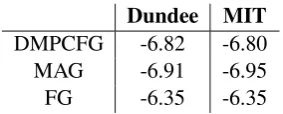
For thelikelihoodevaluation, the values in Table 2 demonstrate that the FG model provides the best fit to the data. The results also indicate a ranking over the three models, FG≻DMPCFG≻MAG.
Dundee MIT
DMPCFG -6.82 -6.80 MAG -6.91 -6.95 FG -6.35 -6.35
Table 2: Likelihood Evaluation – the average negative suprirsal values given by each model (DMPCFG, MAG, FG) on all words in each cor-pus (Dundee, MIT).
For thepsychologicalevaluation, we present re-sults of our nested model comparisons under two settings: (a) additive in which we independently add each of the surprisal measures to the base
model and (b) subtractive, in which we take the
fullmodel consisting of all the surprisal measures and independently remove one surprisal measure each time.
Results of the additive setting are shown in Ta-ble 3, demonstrating the same trend as observed in the likelihood evaluation. In particular, the FG model yields the best improvement in terms of model fit as captured by theχ2(1)statistics,
indi-cating that it is more explanatory of reaction times when added to thebasemodel as compared to the DMPCFG and the MAG predictions. The ranking
is also consistent with the likelihood results: FG
≻DMPCFG≻MAG.
Models χ2(1)Dundeep χ2(1)MIT p
[image:6.595.312.531.61.118.2]base+DMPCFG 70.9 <2.2E-16 38.5 5.59E-10 base+MAG 10.9 9.63E-04 0.1 7.52E-01 base+FG 118.3 <2.2E-16 62.5 2.63E-15
Table 3:Psychological accuracy, additive tests–
χ2(1)andpvalues achieved by performing nested
model analysis between the models base+X and thebasemodel.
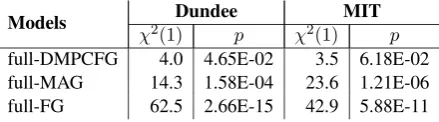
For the subtractive setting, results in Table 4 highlight the fact that several models significantly (p < 0.01) explains variance in fixation times above and beyond the other surprisal-based pre-dictors. The FG measure proves to be the most influential predictor (with χ2(1) = 62.5 for the
Dundee corpus and42.9for the MIT corpus). Ad-ditionally, we observe that DMPCFG does not sig-nificantly explain more variance over the other predictors. This, we believe, is partly due to the presence of the FG model, which captures much of the same structure as the DMPCFG model.
Models χ2(1)Dundeep χ2(1)MIT p
full-DMPCFG 4.0 4.65E-02 3.5 6.18E-02 full-MAG 14.3 1.58E-04 23.6 1.21E-06
[image:6.595.75.296.97.157.2]full-FG 62.5 2.66E-15 42.9 5.88E-11
Table 4: Psychological accuracy, subtractive test–χ2(1)andpvalues achieved by performing
nested model analysis between the models full-X
and thefullmodel.
Additionally, we examine the coefficients of the surprisal predictions of each model. We extracted coefficients for individual surprisal measures in-dependently from each of the modelsbase+X. As shown in the columns Indep in Table 5, all coef-ficients are positive, implying, sensibly, that the more surprising a word, the longer time it takes to process that word.
Moreover, when all surprisal measures appear together in the same full model (columns Joint), we observe a consistent trend that the coefficients for DMPCFG and FG are positive, whereas that of the MAG is negative.
5.4 Discussion
Our results above indicate that the inference-based model provides the best account of our test data,
Models Indep.DundeeJoint Indep.MITJoint
[image:6.595.76.296.401.462.2]DMPCFG 5.94E-03 1.95E-03 8.08E-03 3.24E-03 MAG 1.00E-03 -1.41E-03 1.54E-04 -2.82E-03 FG 5.13E-03 5.49E-03 5.88E-03 6.97E-03
Table 5: Mixed-effects coefficients – the Indep.
columns refer to the coefficients learned by the mixed-effects modelsbase+X(one surprisal mea-sure per model), whereas the Jointcolumns refer to coefficients of all surprisal measures within the
fullmodel.
both in terms of the likelihood it assigns to the test corpora and in terms of its ability to explain human fixation times. With respect to the full-parsing model this result is unsurprising. It is widely known that the conditional independence assump-tions of PCFGs make them poor models of syn-tactic strcutre, and thus—presumably—of human sentence processing. Other recent work has shown that reasonable (though not state-of-the-art) pars-ing results can be achieved uspars-ing models which re-lax the conditional independence assumptions of PCFGs by employing inventories of stored tree-fragments (i.e.,tree-substitution grammars) simi-lar to the fragment grammars model (De Marcken, 1996; Bod et al., 2003; Cohn et al., 2010; Post and Gildea, 2013; O’Donnell, 2015).
The comparison with the full-listing model is more interesting. Not only does the full-listing model produce the worst performance of the three models in both corpora and for both evaluations, it actually produces negative correlations with read-ing times. We believe this result is indicative of a simple fact: while it has become clear that there is lexical storage of many syntactic constructions, and—in fact—the degree of storage may be con-siderably more than previously believed (Trem-blay and Baayen, 2010; Bannard and Matthews, 2008)—syntax is still a domain which is mostly compositional. The full-listing model overfits, leading to nonsensical reading time predictions. In fact, this is likely a logical necessity—the vast combinatorial power implicit in natural language syntax means that even for a system with tremen-dous memory capacity, only a small fraction of po-tential structures can be stored.
6 Conclusion
human sentence processing, demonstrating that a model which treates the problem as a case-by-case probabilistic inference provides the best fit to read-ing time datasets, when compared to two “limit-ing case” models which always compute or always store. However, as we emphasized in the introduc-tion we see our contribuintroduc-tion as primarily method-ological. None of the models studied here repre-sent state-of-the-art proposals for syntactic struc-ture. Instead, we see these results together with the tools that we make available to the community, as providing a springboard for later research that will isolate exactly which factors, alone or in concert, best explain human sentence processing.
Acknowledgment
We gratefully acknowledge the help of Asaf Bachrach for making the MIT reading time dataset available to us. We thank the annonymous review-ers for their valuable comments and feedbacks.
References
R. Harald Baayen, Doug J. Davidson, and Douglas M. Bates. 2008. Mixed-effects modeling with crossed random effects for subjects and items. Journal of
Memory and Language, 59(4):390–412.
Asaf Bachrach, Brian Roark, Alex Marantz, Susan Whitfield-Gabrieli, Carlos Cardenas, , and John D.E. Gabrieli. 2009. Incremental prediction in naturalis-tic language processing: An fmri study.
Lalit R. Bahl, Frederick Jelinek, and Robert L. Mer-cer. 1983. A maximum likelihood approach to con-tinuous speech recognition. IEEE Transactions on
Pattern Analysis and Machine Intelligence,
PAMI-5(2):179 –190.
Colin Bannard and Danielle Matthews. 2008. Stored word sequences in language learning: The effect of familiarity on children’s repetition of four-word combinations. Psychological Science, 19(3):241– 248.
Douglas Bates, Martin Maechler, and Ben Bolker, 2011. lme4: Linear mixed-effects models using S4 classes. R package version 0.999375-42.
Rens Bod, Remko Scha, and Khalil Sima’an, editors. 2003.Data-Oriented Parsing. CSLI, Stanford, CA.
Marisa F. Boston, John T. Hale, Reinhold Kliegl, Umesh Patil, and Shravan Vasishth. 2008. Parsing costs as predictors of reading difficulty: An evalua-tion using the potsdam sentence corpus. Journal of
Eye Movement Research, 2(1):1–12.
Trevor Cohn, Phil Blunsom, and Sharon Goldwater. 2010. Inducing tree-substitution grammars.
Jour-nal of Machine Learning Research, 11:3053–3096.
Carl De Marcken. 1996. Unsupervised Language Ac-quisition. Ph.D. thesis, Massachusetts Institute of Technology.
Vera Demberg and Frank Keller. 2008. Data from eye-tracking corpora as evidence for theories of syntactic processing complexity.Cognition, 109(2):193–210. Anna Maria Di Sciullo and Edwin Williams. 1987.On
the Definition of Word. MIT Press, Cambridge, MA.
Jay Earley. 1968. An Efficient Context-Free Parsing
Algorithm. Ph.D. thesis, Carnegie Mellon
Univer-sity.
Charles J. Fillmore, Paul Kay, and Mary Catherine O’Connor. 1988. Regularity and idiomaticity in grammatical constructions: The case of let alone.
Language, 64(3):501–538, September.
Victoria Fossum and Roger Levy. 2012. Sequential vs. hierarchical syntactic models of human incremental sentence processing. InCMCL.
Stefan L Frank and Rens Bod. 2011. Insensitivity of the human sentence-processing system to hierarchi-cal structure.Psychological Science, 22(6):829–34. Stefan L. Frank. 2009. Surprisal-based comparison be-tween a symbolic and a connectionist model of sen-tence processing. InCogSci.
John Hale. 2001. A probabilistic Earley parser as a psycholinguistic model. InNAACL.
Jennifer Hay. 2003. Causes and Consequences of
Word Structure. Routledge, New York, NY.
Ray Jackendoff. 2002a. Foundations of Language. Oxford University Press, New York.
Ray Jackendoff. 2002b. What’s in the lexicon? In S. Nooteboom, F. Weerman, and F. Wijnen, editors,
Storage and Computation in the Language Faculty.
Kluwer Academic Press, Dordrecht.
Frederick Jelinek and John D. Lafferty. 1991. Compu-tation of the probability of initial substring genera-tion by stochastic context-free grammars. Computa-tional Linguistics, 17(3):315–323.
Mark Johnson, Thomas L. Griffiths, and Sharon Gold-water. 2006. Adaptor grammars: A framework for specifying compositional nonparametric bayesian models. InNIPS.
Mark Johnson, Thomas Griffiths, and Sharon Gold-water. 2007. Bayesian inference for PCFGs via Markov chain Monte Carlo. InNAACL.
Kenichi Kurihara and Taisuke Sato. 2006. Variational bayesian grammar induction for natural language. InICGI.
Roger Levy. 2008. Expectation-based syntactic com-prehension.Cognition, 106(2):1126–1177.
Minh-Thang Luong, Michael C. Frank, and Mark John-son. 2013. Parsing entire discourses as very long strings: Capturing topic continuity in grounded lan-guage learning.TACL, 1(3):315–323.
Mitchell P. Marcus, Mary Ann Marcinkiewicz, and Beatrice Santorini. 1993. Building a large anno-tated corpus of English: the Penn treebank. Compu-tational Linguistics, 19(2):313–330.
Mitchell Marcus, Grace Kim, Mary Ann
Marcinkiewicz, Robert MacIntyre, Ann Bies, Mark Ferguson, Karen Katz, and Britta Schas-berger. 1994. The Penn treebank: Annotating predicate argument structure. InHLT.
Jeff Mitchell, Mirella Lapata, Vera Demberg, and Frank Keller. 2010. Syntactic and semantic factors in processing difficulty: an integrated measure. In
ACL.
Geoffrey Nunberg, Ivan A. Sag, and Thomas Wasow. 1994. Idioms.Language, 70(3):491–538.
Timothy J. O’Donnell, Noah D. Goodman, and Joshua B. Tenenbaum. 2009. Fragment grammars: Exploring computation and reuse in language. Tech-nical Report MIT-CSAIL-TR-2009-013, MIT Com-puter Science and Artificial Intelligence Laboratory Technical Report Series, Cambridge, MA.
Timothy J. O’Donnell, Jesse Snedeker, Joshua B. Tenenbaum, and Noah D. Goodman. 2011. Pro-ductivity and reuse in language. InCogSci.
Timothy J. O’Donnell. 2015. Productivity and Reuse in Language: A Theory of Linguistic Computation
and Storage. The MIT Press, Cambridge,
Mas-sachusetts.
Slav Petrov and Dan Klein. 2007. Improved inference for unlexicalized parsing. InHLT-NAACL.
Slav Petrov, Leon Barrett, Romain Thibaux, and Dan Klein. 2006. Learning accurate, compact, and inter-pretable tree annotation. InCOLING-ACL.
Matt Post and Daniel Gildea. 2013. Bayesian tree sub-stitution grammars as a usage-based approach.
Lan-guage and Speech, 56(3):291–308.
Brian Roark, Asaf Bachrach, Carlos Cardenas, and Christophe Pallier. 2009. Deriving lexical and syntactic expectation-based measures for psycholin-guistic modeling via incremental top-down parsing.
InEMNLP.
Brian Roark. 2001. Probabilistic top-down parsing and language modeling.Computational Linguistics, 27:249–276.
Andreas Stolcke. 1995. An efficient probabilis-tic context-free parsing algorithm that computes prefix probabilities. Computational Linguistics, 21(2):165–201.
Andreas Stolcke. 2002. Srilm-an extensible language modeling toolkit. InICSLP.
Antoine Tremblay and R. Harald Baayen. 2010. Holis-tic processing of regular four-word sequences: A be-havioral and ERP study of the effects of structure, frequency, and probability on immediate free recall.
InPerspectives on Formulaic Language:
Acquisi-tion and CommunicaAcquisi-tion, pages 151–173.
Contin-uum.
Marten van Schijndel and William Schuler. 2013. An analysis of frequency- and memory-based process-ing costs. InNAACL-HLT.