EDRAK: Entity-Centric Data Resource for Arabic Knowledge
Mohamed H. Gad-Elrab Mohamed Amir Yosef
Max-Planck-Institut f¨ur Informatik Saarbr¨ucken, Germany
{gadelrab|mamir|weikum}@mpi-inf.mpg.de
Gerhard Weikum
Abstract
Online Arabic content is growing very rapidly, with unmatched growth in Ara-bic structured resources. Systems that per-form standard Natural Language Process-ing (NLP) tasks such as Named Entity Dis-ambiguation (NED) struggle to deliver de-cent quality due to the lack of rich Arabic entity repositories. In this paper, we in-troduce EDRAK, an automatically gener-ated comprehensive Arabic entity-centric resource. EDRAK contains more than two million entities together with their Arabic names and contextual keyphrases. Man-ual evaluation confirmed the qMan-uality of the generated data. We are making EDRAK publicly available as a valuable resource to help advance research in Arabic NLP and IR tasks such as dictionary-based Named-Entity Recognition, entity classification, and entity summarization.
1 Introduction
1.1 Motivation
Rich structured resources are crucial for several Information Retrieval (IR) and NLP tasks; further-more, resources quality significantly influence the performance of those tasks. For example, build-ing a dictionary-based Named Entity Recognition (NER) system, requires a comprehensive and accu-rate dictionary of names (Darwish, 2013; Shaalan, 2014). Problems like Word Sense Disambiguation (WSD) and Named Entity Disambiguation (NED) require name and context dictionaries to resolve the correct word sense or entity respectively (Weikum et al., 2012).
Arabic digital content is growing very rapidly; it is among the top growing languages on the Inter-net1. However, the amount of structured or semi-1www.internetworldstats.com/stats7.htm
structured Arabic content is lagging behind. For example, Wikipedia is one of the main resources from where many modern Knowledge Bases (KB) are extracted. It is heavily used in the literature for IR and NLP tasks. However, the size of the Arabic Wikipedia is an order of magnitude smaller than the English one. Furthermore, the structured data in the Arabic Wikipedia, such as info boxes, are on average of less quality in terms of coverage and accuracy.
On the other hand, the amount and quality of the English structured resources on the Inter-net are unrivaled. The English Wikipedia is fre-quently updated, and contains the most recent events for example. It is important to leverage English resources in order to augment the cur-rently poor Arabic ones. For example, both the English and Arabic Wikipedia have articles about Christian Dior and Eric Schmidt and hence the Arabic Wikipedia knows, at least, one po-tential Arabic name for both (the Arabic page title). However, Arabic Wikipedia knows nothing about Christian Schmidt2, although, at least, his
name can be learned automatically from only the English and Arabic Wikipedia’s interwiki links.
To this end, it is compelling to automatically generate Arabic resources using cross-language ev-idences. This would help overcome the scarcity problem of Arabic resources and improve the per-formance of many Arabic NLP and IR tasks.
1.2 Contributions
Our contributions can be summarized into:
• Introducing EDRAK: an automatically gen-erated Arabic entity-centric resource built on top of the English and Arabic Wikipedia’s.
• Manual assessment of EDRAK, conducted by Arabic native speakers.
2German Federal Minister of Food and Agriculture, 2015
• Making EDRAK publicly available to the re-search community to help advance the field of Arabic NLP.
1.3 EDRAK Use-cases
EDRAK is an entity-centric Arabic resource that is a valuable asset for many NLP and IR tasks. For example, EDRAK contains a comprehensive dictionary for different potential Arabic names for entities gathered from both the English and Arabic Wikipedia’s. Such dictionary can be used for build-ing an ArabicDictionary-based NER(Darwish, 2013).
In addition to the name dictionary, the resource contains a large catalog of entity Arabic textual con-text in the form of keyphrases. They can be used to estimateEntity-Entity Semantic Relatedness scores such as in Hoffart et al. (2012).
Furthermore, both the name dictionary and the entity contextual keyphrases are the corner-stone of state-of-the-artNamed Entity Disambiguation (NED) systems (Hoffart et al., 2011).
Entities in EDRAK are classified under the type hierarchy of YAGO (Hoffart et al., 2013). Together with the keyphrases, EDRAK can be used to build anEntity Summarizationsystem as in (Tylenda et al., 2011), or to build aFine-grained Semantic Type Classifierfor named entities as in (Yosef et al., 2012; Yosef et al., 2013).
2 Related Work
Different approaches to enrich Arabic resources have used cross-lingual evidences. Among the gen-erated resources, some are entity-aware and useful for semantic analysis tasks. Others are purely tex-tual dictionaries without any notion of canonical entities.
2.1 Entity-Aware Resources
Wikipedia, as the largest comprehensive online en-cyclopedia, is the most used corpus for creating entity-aware resources such as YAGO (Hoffart et al., 2013), DBpedia (Auer et al., 2007) and Free-base (Bollacker et al., 2008). Due to the limited size of Arabic Wikipedia, building strong semantic resources becomes a challenge. Several research efforts have been exerted to go beyond Arabic Wikipedia to construct a rich entity-aware resource.
AIDArabic(Yosef et al., 2014) is an NED sys-tem for Arabic text that uses an entity-name dictio-nary and an entity-context catalog extracted from
Wikipedia. They leveraged Wikipedia titles, dis-ambiguation pages, redirects, and incoming anchor texts to populate theentity-name dictionary. In ad-dition, Wikipedia categories, incoming Wikipedia links page titles, and outgoing anchor texts were used in building theentity-context catalog. In order to overcome the small size of Arabic Wikipedia, they proposed building an entity catalog includ-ing entities from both the English and Arabic Wikipedia’s. While theircatalogwas comprehen-sive, theirname dictionaryas well ascontext cata-logsuffered from the limited coverage in the Arabic Wikipedia. Hence, the recall of the NED task was heavily harmed.
Google-Word-to-Concept(GW2C)
(Spitkovsky and Chang, 2012) is a multilin-gual resource mapping strings (i.e. names) to English Wikipedia concepts (including NEs). For entity-names, they harvested strings from Wikipedia titles, inter-Wikipedia links anchors, as well as manually created anchor texts from non-Wikipedia pages (i.e. web dump) with links to Wikipedia pages. The resource did not offer anyentity-context information. The full resource contained 297M string-to-concept mapping. Nevertheless, the share of the Arabic records did not exceed 800K mapping. Finally, usingGW2C in the entity linking task achieved above median coverage for English. In contrast, the results for the multilingual entity linking were less than the median.
BabelNet(Navigli and Ponzetto, 2012) is a mul-tilingual resource built using Wikipedia entities and WordNet senses. They used the sense la-bels, Wikipedia titles from incoming links, out-going anchor texts, redirects and categories as sources for disambiguation context. In addition, machine translation services were used to translate Wikipedia concepts to other languages. Neverthe-less, translation was not applied on Named-Entities. They achieved good results using BabelNet as re-source for cross-lingual Word Sense disambigua-tion (WSD).
2.2 Entity-free Resources
JRC-Names contained 617K multilingual name variants with only 17K Arabic records.
Attia et al. (2010), built an Arabic lexi-con Named-Entity resource using Arabic Word-Net (Black et al., 2006) and Arabic Wikipedia. They extracted instantiable nouns from WordNet as Named-Entity candidates. Then, they used Wikipedia categories and inter-lingual Wikipedia pages to identify name candidates exploiting cross-lingual evidences. The resource contained 45K Arabic names along their correspondent lexical in-formation.
Azab et al. (2013) compiled CMUQ-Arabic-NET Lexicon corpus, an English-Arabic names dictionary from Wikipedia as well as parallel English-Arabic news corpora. They used off-the-shelf NER system on the English side of the data. NER results were projected onto the Arabic side ac-cording to the word-alignment information. Addi-tionally, they included Wikipedia inter-lingual links titles in their dictionary as well as coarse-grained type information (PERSONorORGANIZATION).
3 High-level Methodology
Our objective is to produce a comprehensive Ara-bic entity repository together with rich entity Ara-bic names dictionaryand entityArabic keyphrases catalog. We augment an Arabic Wikipedia-based entity repository by translating English names and keyphrases. Off-the-shelf translation systems are not suitable for translating named entities (Al-Onaizan and Knight, 2002; H´alek et al., 2011; Azab et al., 2013). Therefore, we incorporate three translation techniques:
1. External Name Dictionaries: We harness the existing English-Arabic name dictionar-ies via semantic and syntactic equivalence, for example, if two strings from one or more dictionaries are linking to the same canonical entity, we consider them a potential transla-tion of each other.
2. Statistical Machine Translation: We train an SMT system on English-Arabic parallel names corpora.
3. Transliteration: We build a transliteration system for persons names by training an SMT system on an English-Arabic parallel persons names corpora on the character level.
Data generated from all techniques are fused together to form a comprehensive Arabic resource obtained by translating an existing English one.
4 Creation of EDRAK
In this section, we start with describing EDRAK. Then, we explain the pre-processing steps applied on the data. The rest of the section explains in detail the creation process of EDRAK following the methodology explained in Section 3.
4.1 EDRAK in a Nutshell
EDRAK is an entity-centric resource that con-tains a catalog of entities together with their po-tential names. In addition, each entity has a con-textual characteristic description in the form of keyphrases. Keyphrases and keywords are assigned scores based on their popularity and correlation with different entities.
EDRAK contains an entity catalog based on YAGO3 KB (Mahdisoltani et al., 2015), compiled from both English and Arabic Wikipedia’s. We fa-vored YAGO as our underlying KB over other avail-able multilingual KBs because it is geared for pre-cision instead of recall. Therefore, it is more salient for applying SMT techniques for example. We used the English Wikipedia dump of 12-January-2015 in conjunction with the Arabic dump of 18-December-2014 to build an Arabic YAGO3 KB.
EDRAK’sentity-name dictionary is extracted from different pieces of Wikipedia that exist in YAGO3 KB. Namely, we harness Wikipedia page titles and redirects. In addition, we include YAGO3
rdfs:labelsextracted from anchor texts and disam-biguation pages in Wikipedia. Entity context is compiled from anchor texts, category names in the Wikipedia entity page. In addition, we include titles of Wikipedia pages linking to this entity.
The above data pieces extracted from the Ara-bic Wikipedia are included in EDRAK as it is, while those extracted from the English Wikipedia are translated/transliterated using one of the tech-niques introduced in the Section 3. We followed the same approach as in AIDA (Hoffart et al., 2011) to generate statistics aboutentities importanceand
keyphrases weights.
4.2 Data Pre-processing
English Entity
Person?
Persons SMT Non-Persons
SMT
Found? Found?
Combined SMT Combined
SMT
Arabic Name Yes No
No No
[image:4.595.91.284.61.255.2]Yes Yes
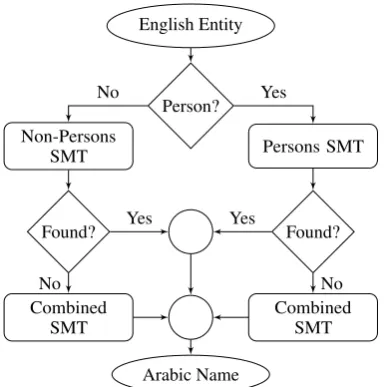
Figure 1: Architecture of Type-Aware Names Translation System
(Pasha et al., 2014) or Stanford Arabic Word Segmenter (Monroe et al., 2014) should be used to perform morphological-based pre-processing. Stanford Word Segmenter provides interpolatable handy Java API, hence has been used to pre-process the data. Text has been segmented by separating clitics, and normalized byRemoving Tatweel, Nor-malizing Digits,Normalizing Alif, andRemoving Diacritics. This helps achieving better coverage for our data, and computing more accurate statistics.
4.3 External Names Dictionaries
EDRAK harnesses Google-Word-to-Concept (GW2C)(Spitkovsky and Chang, 2012) multilin-gual resource in order to capture more names from the web. GW2C is created automatically without applying manual verification or post-processing. Therefore, it contains noise that should be filtered out. In order to include GW2C in EDRAK dictionary, we performed the following steps:
• Language detection We used off-the-shelf language detection tools developed by Shuyo (2010) to filter out non-Arabic records. Only 736K out of 297M were Arabic entries.
• Filtering ambiguous names We utilized the provided conditional probability scores to filter out generic anchor texts such as ”Read more”, ”Wikipedia page” or ”
AKYJ.JºKð úΫ YK QÖÏ@
”. We ignore strings with conditional probability less than a thresh-old of 0.01.PER NON-PER ALL CMUQ-Ar. 28,493 34,116 62,609 Wikipedia 33,962 79,699 128,790 Both 62,455 113,815 191,399
Table 1: Entity Names SMT Training Data Size
• Name-level post-processing We post-processed the data by applying normalization and data cleaning. (e.g. removing punctuation and URLs).
• Mapping to EDRAK Entities We used Wikipedia pages URLs to map extracted names from GW2C to EDRAK’s Entity repos-itory.
In addition toGW2C, we used lexical named-entities resources as look-up dictionary to translate English entity names. English names were matched strictly against those dictionaries to get the accurate Arabic names. We used the multilingual resource
JRC-Names(Steinberger et al., 2011) that includes several name-variants along with partial language tags. After automatically extracting the Arabic records, English-Arabic pairs were included in our lookup dictionary. Similarly, we included CMUQ-Arabic-NETlexicon corpus (Azab et al., 2013) the lookup dictionary.
4.4 Translation
We trained cdec (Dyer et al., 2010), a full fledged SMT system, to translate English Names into Ara-bic ones. As training data, we fused a parallel corpus of English-Arabic names from multiple resources. We used a dictionary compiled from Wikipedia interwiki links together with CMUQ-Arabic-NETdictionary (Azab et al., 2013). While the latter contains name-type information, for the interwiki links, we leveraged YAGO KB to restrict our training data to only named-entities and to ob-tain semantic types information for each. 5% of the data have been used for tuning the parameters of SMT. The properties of the training data are summarized in Table 1.
[image:4.595.312.523.64.134.2]Table Name Major Columns Description
entity ids - id- entity Lists all entities together with their numerical IDs.
dictionary - mention- entity - source
Contains information about the candidate entities for a name. It keeps track of the source of the entry to allow application-specific filtering.
entity keyphrases
- entity - keyphrase - source - weight
Holds the characteristic description of entities in the form of keyphrases. The source of each keyphrase is kept for application-specific filtering.
entity types - entity- types [] Stores YAGO semantic types to which this entity belongs.
entity rank - entity- rank Ranks all entities based on the number of incoming links in both the Englishand Arabic Wikipedia. This can be used as a measure for entity prominence.
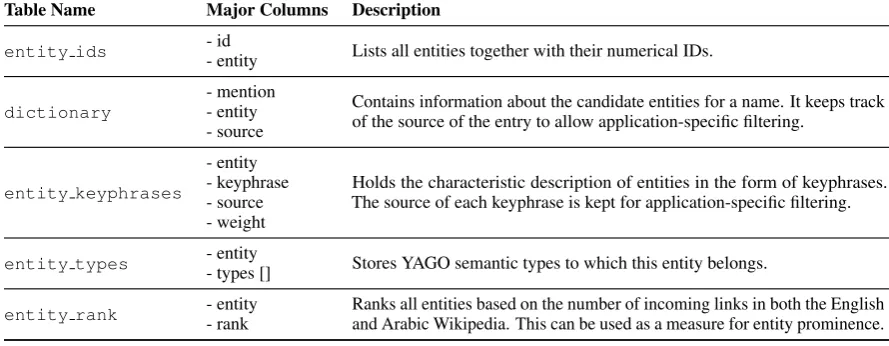
Table 2: Main SQL Tables in EDRAK
name using the corresponding system. If it fails, we switch to the fallback system. In the second COMBINEDapproach, we use the system trained onALLdataset to translate all names regardless of the entity type.
In addition, we are translating Wikipedia Cat-egories to be included in entities contextual keyphrases. To this end, we train the SMT sys-tem on English-Arabic parallel data of categories names harvested from Wikipedia interwiki links. The size of the training data is 43K name pairs, of which 5% have been used for tuning SMT parame-ters as well.
4.5 Transliteration
Recent research has focused on building Arabiza-tion systems that are geared towards transliteraArabiza-tion general and informal text, without any special han-dling for entity names (Al-Badrashiny et al., 2014). To this end, we had to build a transliteration system optimized for names. Transliteration is ap-plicable on many NON-PERSON entities. How-ever, applying it for such entities will create a lot of inaccurate entries that should be either fully or partially translated, or those that can only be learned from manually crafted dictionaries such as movie names. It is also worth noting that ORGANIZATION names that contain a person name such as ”Bill Gates Foundation” will be cor-rectly translated using theCOMBINEDsystem ex-plained above.
Transliteration has been applied onPERSONS names only. We used the PERSONS part of the training data (Table 1) used for translation, and trained an SMT system on the character-level. 5% of the data have been used for parameter tuning of
the SMT system. EachPERSONentity has English
FirstNameandLastName. Transliteration has been applied for each, and on aFullNamecomposed by concatenating both.
5 Statistics and Technical Details
5.1 Technical Description
We are publicly releasing EDRAK for the research community. EDRAK is available in the form of an SQL dump, and can be downloaded from the Down-loadssection in AIDA project pagehttp://www. mpi-inf.mpg.de/yago-naga/aida/. We followed the same schema used in the original AIDA framework (Hoffart et al., 2011) for data storage. Highlights of the SQL dump are shown in Table 2. EDRAK’s comprehensive entity catalog is stored in SQL tableentity ids. Each entity has many potential Arabic names together stored in SQL tabledictionary. In addition, each entity is assigned a set of Arabic contextual keyphrases stored in SQL tableentity keyphrases.
Semantic Type # entities
PERSON 1,220,032
EVENT 199,846
LOCATION 360,108
ORGANIZATION 196,305
ARTIFACT 359,071
Table 3: Number of Entities per Type in EDRAK
Technique # of entries
Google W2C 241,104
CMUQ-Arabic-NET 23,338
JRC 4148
Translation 11,222,876 Transliteration 9,578,658
Table 4: Number of Entity-Name pairs per Genera-tion Technique
5.2 Statistics
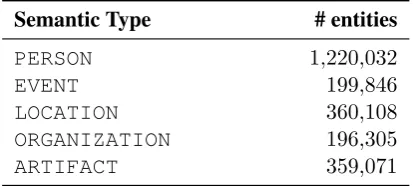
EDRAK is the largest publicly available Arabic entity-centric resource we are aware of. It con-tains around 2.4M entities classified under YAGO type hierarchy. The numbers of entities per high level semantic type are summarized in Table 3. The contributions of each generation technique are sum-marized in Table 4. Numbers show that automatic generation contributes way more entries than name dictionaries. In addition, translation delivers more entries than transliteration since it is applied on all types of entities (in contrast to only persons for transliteration).
The most similar resource to EDRAK is the one used in AIDArabic system to perform NED on Ara-bic text. However, AIDAraAra-bic resource is compiled solely from manual entries in both English and Arabic Wikipedia’s such as Wikipedia categories, without incorporating anyautomaticdata genera-tion techniques. Therefore, the size of AIDArabic resource is constrained by the amount of Arabic names and contextual keyphrases available in the Arabic Wikipedia. In order to show the impact of our automatic data enrichment techniques, we compare the size of EDRAK to that of AIDArabic resource. Detailed statistics are shown in Table 5. Clearly, EDRAK is an order of magnitude larger than the resource used in AIDArabic.
[image:6.595.78.285.63.156.2]AIDArabic EDRAK Unique Names 333,017 9,354,875 Entities with Names 143,394 2,400,340 Entity-Name Pairs 495,245 21,669,568 Unique Keyphrases 885,970 7,918,219 Entity-Keyphrase Pairs 5,574,375 211,681,910
Table 5: AIDArabic vs EDRAK
5.3 Data Example
Many prominent entities do not exist in the Arabic Wikipedia, and hence do not appear in any Wikipedia-based resource. For exam-ple,Christian Schmidt, the current German Federal Minister of Food and Agriculture, and Edward W. Morley, a famous American scien-tist, are both missing in the Arabic Wikipedia3.
EDRAK’s data enrichment techniques managed to automatically generate reasonable potential names as well as contextual keyphrases for both. Table 6 lists a snippet of what EDRAK knows about those two entities.
6 Manual Assessment
6.1 Setup
We evaluated all aspects of data generation in EDRAK. Entity names belong to four different sources:First Name,Last Name, Wikipedia redi-rects, andrdfs:labelrelation which carries names extracted from Wikipedia page titles, disambigua-tion pages and anchor texts.
As explained in Section 4, we implemented two different name translation approaches, the first con-siders entity semantic type (which we refer to as Type-Aware system), and the second uses a uni-versal system for translating all names (which is referred to asCombined).
Data assessment experiment covered all types of data against both translation approaches. Addition-ally, we conducted experiments to assess the qual-ity of translating Wikipedia categories. Finally, we evaluated the performance of transliteration when applied on English person names. We randomly sampled the generated data and conducted an on-line experiment to manually assess the quality of the data.
Entity Generated Arabic Names Generated Keyphrases
Christian Schmidt
àñk.
YJÒ
IJÖÞ
HYJÖÞ
àAJQ»
àAJQ»
HYJÒ àAJQ»
IJÖÞ àAJQ»
É®JÓ IJÖÞ àAJQ»
HYJÖÞ àAJQ»
É®JÓ HYJÖÞ àAJQ»
áJQ»
éJ KAÖÏB@ éKXAm'B@ ¨A ¯YË@ èP@ Pð
éJjÓ éJ«AÒJk.@ AKPA ¯AK. ú ¯ XAm'B@ àñJAJ
úæÊ£B@ ©ÒJm.×
éJË@PYJ ®Ë@ éJ KAÖÏB@ ¨A ¯YË@ èP@ Pð
É®JÓ HYJÖÞ àAJQ»
é«@P QË@ àAÖÏ@ Z@P Pð
PYKQ ¯ QJK. Q KAë
éJ KAÖÏB@ éJË@PYJ ®Ë@ ¨A ¯YË@ èP@ Pð
½KPYKQ ¯ QJK. Q KAë
é«@P P àAÖÏ@ Z@P Pð
úæÊ£B@ é«ñÒm.×
àAÖÏ@ àñJ KAÖÏQK.
úæÊ£B@ é«ñÒj.ÖÏ@
éJËAJË@ éÓñºmÌ'@ àA£Qå
PYKQ ¯ QJK. Q KAë
AKPA ¯AK. ú ¯ éJjÓ éJ«AÒJk.@ XAm
'B@ àñJAJ
É®JÓ IJÖÞ àAJQ»
IËAJË@ éÓñºmÌ'@ àA£Qå
àAÖÏ@ é«@P QË@ Z@P Pð
Edward W. Morley
P@ðX@
XP@ðX@
XP@ðX@
úÍPñÓ ñJÊK.X XP@ðX@
úÍPñÓ XP@ðX@
úÍPñÓ XP@ðX@
úÍPñÓ QÓAJËð XP@ðX@
úÍPñÓ +ð XP@ðX@
úÍPñÓ +ð XP@ðX@
úÍPñÓ QÓAJÊK +ð XP@ðX@
úÍPñÓ QÓAJÊK +ð XP@ðX@
úÍPñÓ P@ðX@
XPðX@
úÍPñÓ +ð ø@
XP@ðX
úÍQÓ
úÍPñÓ
úÍPñÓ
úÍQÓ
àñJºKQÓ@ éJKAK Q ¯ àñJKAJÒJ»
.J « è QKAg.
ð Q ¯ éK.Qm.'
àQ +ð » éJÖßXA¿@
úæ.KQj.JË@ àñJKAK Q ¯
éJºKQÓB@ éJºÊ ¯ éJªÔg.
éJK.Q ªË@ úÍ@PYJ ®Ë@ ®jÖÏ@ éªÓAg. ñm.'Q k
àQ +ð » éªÓAg. A¿
úÍPñÓ éëñ ¯
J£ àñJKAK QK + ¬
ú»QÓB@ éJKAK Q ¯ àñJºKQÓ@ àñJKAJÒJ»
àQ +ð » éJÖßXA¿B@
éJ KYJ.Ë@ ZAJÒJºË@ t'PAK
éJºÊ ¯ éJºKQÓB@ éJªÒm.Ì'@
àñQ» HñJË@ ÐAñK. àð QKA ¯
éJ KYJ.Ë@ ZAJÒJºË +È ú æÓ QË@ ÉÊË@
éJ»ñº éÊm.×
XPñ ®KPAë H.Q «
úÍPñÓð àñʾJÓ éK.Qm.
'
ð Q ¯ PAJ.J k@
Approach Source Translations @ Top-K Precision @ Top-K
1 2 3 1 2 3
Persons
Type-Aware
First Name 8 10 12 87.50 80.00 66.67 Last Name 14 17 19 92.86 88.24 78.95 rdfs:label 156 288 383 79.49 63.19 57.44 redirects 113 210 285 69.91 57.62 50.18
Combined
First Name 7 10 12 100.00 90.00 75.00 Last Name 16 22 25 87.50 81.82 76.00 rdfs:label 160 307 421 81.25 64.82 57.24 redirects 108 210 288 67.59 60.00 54.51
Transliteration First NameLast Name 2694 18852 27976 80.7770.21 61.5463.83 56.5855.91
Non-Persons Type-Aware
rdfs:label 269 519 742 53.16 43.16 36.66 redirects 191 370 526 45.55 34.86 30.99
Combined rdfs:labelredirects 273195 533378 770539 49.8246.67 41.8439.42 36.7534.69
[image:8.595.71.525.69.340.2]Categories Categories Categories 118 234 340 67.80 52.99 46.18
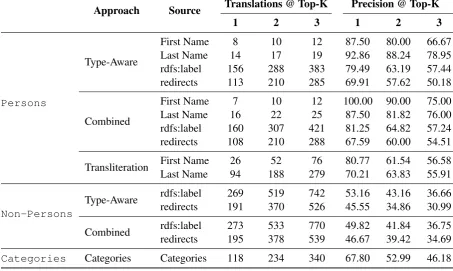
Table 7: Assessment Results of Applying SMT for Translating Entities and Wikipedia Categories Names
6.2 Task Description
We asked a group of native Arabic speakers to man-ually judge the correctness of the generated data using a web-based tool. Each participant was pre-sented around 150 English Names together with the top three potential Arabic translations or translitera-tion proposed by cdec (or less if cdec proposed less than three translations). Participants were asked to pick all possible correct Arabic names. Evalua-tors had the option to skip the name if they needed to. Each English Name was evaluated by three different persons.
6.3 Assessment Results
In total, we had 55 participants who evaluated 1646 English surface forms, that were assigned 4463 po-tential Arabic translations. Participants were native Arabic speakers that are based in USA, Canada, Europe, KSA, and Egypt. Their homelands span Egypt, Jordan, and Palestine. Translation assess-ment results are shown in Table 7. Evaluation re-sults are given per entity type, translation approach and name origin. Since cdec did not return three potential translations for each name, we computed the total number of translations added when consid-ering up to top one or two or three results. For each case, we computed the corresponding precision based on participants annotations.
6.4 Discussion
Data was randomly sampled from all generated data, and the size of each test set reflects the distri-bution of the sources included in the original data. For example, names originating fromrdfs:label re-lation are an order of magnitude more than those coming fromFirstName, andLastNamerelations.
The quality of the generated data varies accord-ing to the entity type, name source and generation technique. For example, the quality of translated Wikipediaredirects is consistently less than that of other sources. This is due to the nature of redi-rects. They are not necessarily another variation of the entity name. In addition,redirectstend to be longer strings, and hence are more error-prone thanrdfs:labels. For example, ”European Union common passport design” which redirects to the entity Passports of the European Union could not be correctly translated. Each token was translated correctly, but the final tokens order was wrong. Evaluators were asked to annotate such examples as wrong. However, such ordering problems are less critical for applications that incorporate partial matching techniques. Categories tend to be rela-tively longer than entity names, hence they exhibit the same problems as redirects.
Although the size of the evaluatedFirstName
results are as expected. Translating one token name is relatively an easy task. In addition, cdec returned only one or two translations for the majority of the names as shown in Table 7.
Results also show that the type-aware translation system does not necessarily improve results, and using one universal system can deliver comparable results for most of the cases.
Person names transliteration unexpectedly achieved less quality than translation. Names are pronounced differently across countries. For exam-ple, a USA-based annotator is expecting ”Friedrich” to be written “
½KPYKQ ¯
”, while a Germany-based one is expecting it to be written as “PYKQ ¯
”.Inter-annotator agreement was measured using Fleiss’ kappa to be 0.484 indicating moderate agreement.
7 Conclusion
In this paper we introduced EDRAK: and entity-centric Arabic resource. EDRAK is an entity repos-itory that contains around 2.4M entities, with their potential Arabic names. In addition, EDRAK as-sociates each entity with a set of keyphrases. Data in EDRAK has been extracted from the Arabic Wikipedia and other available resources. In addi-tion, we automatically translated parts of the En-glish Wikipedia and used them to enrich EDRAK. Data have been manually assessed. Results showed that the quality is adequate for consumption by other NLP and IR systems. We are making the resource publicly available to help advance the re-search for the Arabic language.
Acknowledgments
We would like to thank the anonymous reviewers for their valuable feedback. We would also like to show our gratitude to the volunteers who par-ticipated in our manual assessment task. Finally, we are also immensely grateful to Waleed Ammar, Chris Dyer, and Hassan Sajjad for their valuable advice about translation and transliteration using cdec framework.
References
Mohamed Al-Badrashiny, Ramy Eskander, Nizar Habash, and Owen Rambow. 2014. Automatic Transliteration of Romanized Dialectal Arabic. In
Proceedings of the 18th Conference on Computa-tional Natural Language Learning, CoNLL 2014, Baltimore, Maryland, USA.
Yaser Al-Onaizan and Kevin Knight. 2002. Translat-ing Named Entities UsTranslat-ing MonolTranslat-ingual and Bilin-gual Resources. InProceedings of the 40th Annual Meeting on Association for Computational Linguis-tics, ACL 2002, Stroudsburg, PA, USA.
Mohammed Attia, Antonio Toral, Lamia Tounsi, Mon-ica Monachini, and Josef van Genabith. 2010. An Automatically Built Named Entity Lexicon for Ara-bic. InProceedings of the 7th International Confer-ence on Language Resources and Evaluation, LREC 2010, Valletta, Malta.
Sren Auer, Christian Bizer, Georgi Kobilarov, Jens Lehmann, and Zachary Ives. 2007. DBpedia: A Nucleus for a Web of Open Data. InProceedings of the 6th International Semantic Web Conference, ISWC 2007, Busan, Korea.
Mahmoud Azab, Houda Bouamor, Behrang Mohit, and Kemal Oflazer. 2013. Dudley North visits North London: Learning When to Transliterate to Arabic. InProceedings of the 2013 Conference of the North American Chapter of the Association for Computa-tional Linguistics: Human Language Technologies, NAAC-HLT 2013, Atlanta, Georgia.
William Black, Sabri Elkateb, and Piek Vossen. 2006. Introducing the Arabic Wordnet Project. InIn Pro-ceedings of the 3rd International WordNet Confer-ence, GWC 2006, Jeju Island. Korea.
Kurt Bollacker, Colin Evans, Praveen Paritosh, Tim Sturge, and Jamie Taylor. 2008. Freebase: A Col-laboratively created Graph Database for Structuring Human Knowledge. In Proceedings of the 2008 ACM SIGMOD International Conference on Man-agement of Data, SIGMOD 2008, New York, NY, USA.
Kareem Darwish. 2013. Named Entity Recognition Using Cross-lingual Resources: Arabic as an Exam-ple. InProceedings of the 51st Annual Meeting of the Association for Computational Linguistics, ACL 2013, Sofia, Bulgaria.
Chris Dyer, Adam Lopez, Juri Ganitkevitch, Johnathan Weese, Ferhan Ture, Phil Blunsom, Hendra Seti-awan, Vladimir Eidelman, and Philip Resnik. 2010. cdec: A Decoder, Alignment, and Learning Frame-work for Finite-state and Context-free Translation Models. InProceedings of the Association for Com-putational Linguistics, ACL 2010, Uppsala, Swe-den.
Ondrej H´alek, Rudolf Rosa, Ales Tamchyna, and On-drej Bojar. 2011. Named Entities from Wikipedia for Machine Translation. InProceedings of the Con-ference on Theory and Practice of Information Tech-nologies, ITAT 2010, Velk´a Fatra, Slovak Republic. Johannes Hoffart, Mohamed Amir Yosef, Ilaria
Weikum. 2011. Robust Disambiguation of Named Entities in Text. InProceedings of the Conference on Empirical Methods in Natural Language Process-ing, EMNLP 2011, Edinburgh, UK.
Johannes Hoffart, Stephan Seufert, Dat Ba Nguyen, Martin Theobald, and Gerhard Weikum. 2012. KORE: Keyphrase Overlap Relatedness for Entity Disambiguation. InProceedings of the 21st ACM In-ternational Conference on Information and Knowl-edge Management, CIKM 2012, Hawaii, USA. Johannes Hoffart, Fabian M. Suchanek, Klaus
Berberich, and Gerhard Weikum. 2013. YAGO2: A Spatially and Temporally Enhanced Knowledge Base from Wikipedia. Journal of Artificial Intelli-gence.
Farzaneh Mahdisoltani, Joanna Biega, and Fabian M Suchanek. 2015. Yago3: A Knowledge Base from Multilingual Wikipedias.
Will Monroe, Spence Green, and Christopher D. Man-ning. 2014. Word Segmentation of Informal Ara-bic with Domain Adaptation. InProceedings of the 52nd Annual Meeting of the Association for Com-putational Linguistics, ACL 2014, Baltimore, MD, USA.
Roberto Navigli and Simone Paolo Ponzetto. 2012. BabelNet: The Automatic Construction, Evaluation and Application of a Wide-coverage Multilingual Se-mantic Network.Journal of Artificial Intelligence. Arfath Pasha, Mohamed Al-Badrashiny, Mona Diab,
Ahmed El Kholy, Ramy Eskander, Nizar Habash, Manoj Pooleery, Owen Rambow, and Ryan M Roth. 2014. MADAMIRA: A Fast, Comprehensive Tool for Morphological Analysis and Disambiguation of Arabic. Proceedings of the Language Resources and Evaluation Conference, LREC 2014, Reykjavik, Ice-land.
Khaled Shaalan. 2014. A Survey of Arabic Named En-tity Recognition and Classification. Computational Linguistics.
Nakatani Shuyo. 2010. Language Detection Library for Java.
Valentin I. Spitkovsky and Angel X. Chang. 2012. A Cross-lingual Dictionary for English Wikipedia Concepts. InProceedings of the 8th International Conference on Language Resources and Evaluation, LREC 2012, Istanbul, Turkey.
Ralf Steinberger, Bruno Pouliquen, Mijail Kabadjov, Jenya Belyaeva, and Erik van der Goot. 2011. JRC-NAMES: A Freely Available, Highly Multilingual Named Entity Resource. InProceedings of the In-ternational Conference Recent Advances in Natural Language Processing, RANLP 2011, Hissar, Bul-garia.
Tomasz Tylenda, Mauro Sozio, and Gerhard Weikum. 2011. Einstein: Physicist or Vegetarian? Summariz-ing Semantic Type Graphs for Knowledge Discov-ery. InProceedings of the 20th International Confer-ence on World Wide Web, WWW 2011, Hyderabad, India.
Gerhard Weikum, Johannes Hoffart, Ndapandula Nakashole, Marc Spaniol, Fabian M Suchanek, and Mohamed Amir Yosef. 2012. Big Data Methods for Computational Linguistics.IEEE Data Engineering Bulletin.
Mohamed Amir Yosef, Sandro Bauer, Johannes Hof-fart Marc Spaniol, and Gerhard Weikum. 2012. HYENA: Hierarchical Type Classification for Entity Names. InProc. of the 24th International Confer-ence on Computational Linguistics, COLING 2012, Mumbai, India.
Mohamed Amir Yosef, Sandro Bauer, Johannes Hof-fart Marc Spaniol, and Gerhard Weikum. 2013. HYENA-live: Fine-Grained Online Entity Type Classification from Natural-language Text. In Pro-ceedings of the 51st Annual Meeting of the Asso-ciation for Computational Linguistics, ACL 2013, Sofia, Bulgaria.