Using Comparable Corpora to Adapt MT Models to New Domains
Ann Irvine
Center for Language and Speech Processing Johns Hopkins University
Chris Callison-Burch
Computer and Information Science Dept. University of Pennsylvania
Abstract
In previous work we showed that when us-ing an SMT model trained on old-domain data to translate text in a new-domain, most errors are due to unseen source words, unseen target translations, and in-accurate translation model scores (Irvine et al., 2013a). In this work, we target er-rors due to inaccurate translation model scores using new-domain comparable cor-pora, which we mine from Wikipedia. We assume that we have access to a large old-domain parallel training corpus but only enough new-domain parallel data to tune model parameters and do evaluation. We use the new-domain comparable corpora to estimate additional feature scores over the phrase pairs in our baseline models. Augmenting models with the new features improves the quality of machine transla-tions in the medical and science domains by up to1.3BLEU points over very strong baselines trained on the 150 million word Canadian Hansard dataset.
1 Introduction
Domain adaptation for machine translation is known to be a challenging research problem that has substantial real-world application. In this set-ting, we have access to training data in some old-domain of text but very little or no training data in the domain of the text that we wish to translate. For example, we may have a large corpus of par-allel newswire training data but no training data in the medical domain, resulting in low quality trans-lations at test time due to the mismatch.
In Irvine et al. (2013a), we introduced a tax-onomy for classifying machine translation errors
related to lexical choice. Our ‘S4’ taxonomy in-cludes seen, sense, score, and search errors. Seen errors result when a source language word or phrase in the test set was not observed at all during training. Sense errors occur when the source lan-guage word or phrase was observed during train-ing but not with the correct target language trans-lation. If the source language word or phrase was observed with its correct translation during train-ing, but an incorrect alternative outweighs the cor-rect translation, then a score error has occurred. Search errors are due to pruning in beam search decoding. We measured the impact of each error type in a domain adaptation setting and concluded that seen and sense errors are the most frequent but that there is also room for improving errors due to inaccurate translation model scores (Irvine et al., 2013a). In this work, we targetscoreerrors, using comparable corpora to reduce their frequency in a domain adaptation setting.
We assume the setting where we have an old-domain parallel training corpus but no new old-domain training corpus.1 We do, however, have access to a mixed-domain comparable corpus. We iden-tify new-domain text within our comparable cor-pus and use that data to estimate new translation features on the translation models extracted from old-domain training data. Specifically, we focus on the French-English language pair because care-fully curated datasets exist in several domains for tuning and evaluation. Following our prior work, we use the Canadian Hansard parliamentary pro-ceedings as our old-domain and adapt models to both the medical and the science domains (Irvine et al., 2013a). At over 8 million sentence pairs,
1Some prior work has referred to old-domain and
new-domain corpora as out-of-new-domain and in-new-domain, respec-tively.
the Canadian Hansard dataset is one of the largest publicly available parallel corpora and provides a very strong baseline. We give details about each dataset in Section 4.1.
We use comparable corpora to estimate sev-eral signals of translation equivalence. In partic-ular, we estimate the contextual, topic, and or-thographic similarity of each phrase pair in our baseline old-domain translation model. In Sec-tion 3, we describe each feature in detail. Us-ing just5thousand comparable new-domain doc-ument pairs, which we mine from Wikipedia, and five new phrase table features, we observe perfor-mance gains of up to1.3BLEU points on the sci-ence and medical translation tasks over very strong baselines.
2 Related Work
Recent work on machine translation domain adap-tation has focused on either the language model-ing component or the translation modelmodel-ing com-ponent of an SMT model. Language modeling re-search has explored methods for subselecting new-domain data from a large monolingual target lan-guage corpus for use as lanlan-guage model training data (Lin et al., 1997; Klakow, 2000; Gao et al., 2002; Moore and Lewis, 2010; Mansour et al., 2011). Translation modeling research has typi-cally assumed that either (1) two parallel datasets are available, one in the old domain and one in the new, or (2) a large, mixed-domain parallel training corpus is available. In the first setting, the goal is to effectively make use of both the old-domain and the new-domain parallel training corpora (Civera and Juan, 2007; Koehn and Schroeder, 2007; Fos-ter and Kuhn, 2007; FosFos-ter et al., 2010; Haddow and Koehn, 2012; Haddow, 2013). In the sec-ond setting, it has been shown that, in some cases, training a translation model on a subset of new-domain parallel training data within a larger train-ing corpus can be more effective than ustrain-ing the complete dataset (Mansour et al., 2011; Axelrod et al., 2011; Sennrich, 2012; Gasc´o et al., 2012).
For many language pairs and domains,no new-domain parallel training data is available. Wu et al. (2008) machine translate new-domain source language monolingual corpora and use the syn-thetic parallel corpus as additional training data. Daum´e and Jagarlamudi (2011), Zhang and Zong (2013), and Irvine et al. (2013b) use new-domain comparable corpora to mine translations for
un-seen words. That work follows a long line of re-search on bilingual lexicon induction (e.g. Rapp (1995), Schafer and Yarowsky (2002), Koehn and Knight (2002), Haghighi et al. (2008), Irvine and Callison-Burch (2013), Razmara et al. (2013)). These efforts improve S4 seen, and, in some in-stances, sense error types. To our knowledge, no prior work has focused on fixing errors due to inaccurate translation model scores in the set-ting where no new-domain parallel training data is available.
In Klementiev et al. (2012), we used compara-ble corpora to estimate several features for a given phrase pair that indicate translation equivalence, including contextual, temporal, and topical simi-larity. The definitions of phrasal and lexical con-textual and topic similarity that we use here are taken from our prior work, where we replaced bilingually estimated phrase table features with the new features and cited applications to low re-source SMT. In this work we also focus onscoring a phrase table using comparable corpora. How-ever, here we work in a domain adaptation setting and seek to augment, not replace, an existing set of bilingually estimated phrase table features.
3 Phrase Table Scoring
We begin with a scored phrase table estimated us-ing our old-domain parallel trainus-ing corpus. The phrase table contains about 201 million unique source phrases up to length seven and about 479 million total phrase pairs. We use Wikipedia as a source for comparable document pairs (details are given in Section 4.1). We augment the bilingually estimated features with the following: (1) lexical and phrasal contextual similarity estimated over a comparable corpus, (2) lexical and phrasal topi-cal similarity estimated over a comparable corpus, and (3) lexical orthographic similarity.
Contextual Similarity We estimate contextual similarity2by first computing a context vector for each source and target word and phrase in our phrase table using the source and target sides of our comparable corpus, respectively. We begin by collecting vectors of counts of words that appear in the context of each source and target phrase,ps and pt. We use a bag-of-words context consist-ing of the two words to the left and two words to
2Similar todistributional similarity, which is typically
the right of each occurrence of each phrase. Vari-ous means of computing the component values of context vectors from raw context frequency counts have been proposed (e.g. Rapp (1999), Fung and Yee (1998)). Following Fung and Yee (1998), we compute the value of thek-th component of ps’s contextual vector,Cps, as follows:
Cpsk “nps,k˚ plogpn{nkq `1q
where nps,k and nk are the number of times the
k-th source word,sk, appears in the context ofps and in the entire corpus, and n is the maximum number of occurrences of any word in the data. Intuitively, the more frequentlyskappears withps and the less common it is in the corpus in general, the higher its component value. The context vector for ps, Cps, is M-dimensional, where M is the
size of the source language vocabulary. Similarly, we computeN-dimensional context vectors for all target language words and phrases, whereN is the size of the target language vocabulary.
We identify the most probable translationtfor each of the M source language words, s, as the target word with the highestppt|squnder our word aligned old-domain training corpus. Given this dictionary of unigram translations, we thenproject eachM-dimensional source language context vec-tor into theN-dimensional target language context vector space. To compare a given pair of source and target context vectors, Cps and Cpt,
respec-tively, we compute their cosine similarity, or their dot product divided by the product of their magni-tudes:
simcontextualpps, ptq “ Cps¨Cpt ||Cps||||Cpt||
For a given phrase pair in our phrase table, we estimatephrasalcontextual similarity by directly comparing the context vectors of the two phrases themselves. Because context vectors for phrases, which tend to be less frequent than words, can be sparse, we also compute lexical contextual simi-larity over phrase pairs. We define lexical con-textual similarity as the average of the concon-textual similarity between all word pairs within the phrase pair.
Topic Similarity Phrases and their translations are likely to appear in articles written about the same topic in two languages. We estimate topic similarity using the distribution of words and phrases across Wikipedia pages, for which we
have interlingual French-English links. Specif-ically, we compute topical vectors by counting the number of occurrences of each word and phrase across Wikipedia pages. That is, for each source and target phrase,psandpt, we collectM -dimensional topic vectors, whereMis the number of Wikipedia page pairs used (in our experiments,
M is typically5,000). We use Wikipedia’s inter-lingual links to align the French and English topic vectors and normalize each topic vector by the to-tal count. As with contextual similarity, we com-pare a pair of source and target topic vectors,Tps
andTpt, respectively, using cosine similarity:
simtopicpps, ptq “ Tps ¨Tpt ||Tps||||Tpt||
We estimate both phrasal and lexical topic simi-larity for each phrase pair. As before, lexical topic similarity is estimated by taking an average topic similarity across all word pairs in a given phrase pair.
Orthographic Similarity We make use of one additional signal of translation equivalence: ortho-graphic similarity. In this case, we do not refer-ence comparable corpora but simply compute the edit distance between a given pair of phrases. This signal is often useful for identifying translations of technical terms, which appear frequently in our medical and science domain corpora. However, because of word order variation, we do not mea-sure edit distance on phrase pairs directly. For ex-ample, Frenchembryon humain translates as En-glish human embryo; embryon translates as em-bryo andhumain translates as human. Although both word pairs are cognates, the words appear in opposite orders in the two phrases. Therefore, directly measuring string edit distance across the phrase pair would not effectively capture the relat-edness of the words. Hence, we only measure lex-ical orthographic similarity, not phrasal. We pute lexical orthographic similarity by first com-puting the edit distance between each word pair,
wsandwt, within a given phrase pair, normalized by the lengths of the two words:
simorthpws, wtq “ edpw|w s, wtq
s||wt|
2
We then compute the average normalized edit dis-tance across all word pairs.
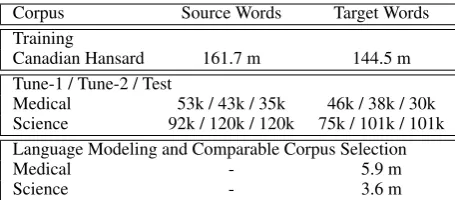
log-Corpus Source Words Target Words Training
Canadian Hansard 161.7 m 144.5 m Tune-1 / Tune-2 / Test
Medical 53k / 43k / 35k 46k / 38k / 30k Science 92k / 120k / 120k 75k / 101k / 101k Language Modeling and Comparable Corpus Selection
Medical - 5.9 m
[image:4.595.72.300.62.162.2]Science - 3.6 m
Table 1: Summary of the size of each corpus of text used in this work in terms of the number of source and target word tokens.
linear translation models. We describe our ex-periments with different minimum score cutoffs in Section 4.2.
4 Experimental Setup
4.1 Data
We assume that the following data is available in our translation setting:
• Large old-domain parallel corpus for training
• Small new-domain parallel corpora for tun-ing and testtun-ing
• Large new-domain English monolingual cor-pus for language modeling and identifying new-domain-like comparable corpora
• Large mixed-domain comparable corpus, which includes some text from the new-domain
These data conditions are typical for many real-world uses of machine translation. A summary of the size of each corpus is given in Table 1.
Our old-domain training data is taken from the Canadian Hansard parliamentary proceedings dataset, which consists of manual transcriptions and translations of meetings of the Canadian par-liament. The dataset is substantially larger than the commonly used Europarl corpus, containing over 8 million sentence pairs and about 150 mil-lion word tokens of French and English.
For tuning and evaluation, we use new-domain medical and science parallel datasets released by Irvine et al. (2013a). The medical texts con-sist of documents from the European Medical Agency (EMEA), originally released by Tiede-mann (2009). This data is primarily taken from prescription drug label text. The science data is made up of translated scientific abstracts from the
fields of physics, biology, and computer science. For both the medical and science domains, we use three held-out parallel datasets of about 40 and 100 thousand words,3 respectively, released by Irvine et al. (2013a). We do tuning on dev1, additional parameter selection ontest2, and blind testing ontest1.
We use large new-domain monolingual English corpora for language modeling and for selecting new-domain-like comparable corpora from our mixed domain comparable corpus. Specifically, we use the English side of the medical and science training datasets released by Irvine et al. (2013a). We do not use the parallel French side of the train-ing data at all; our data setttrain-ing assumes that no new-domain parallel data is available for training. We use Wikipedia as a source of compara-ble corpora. There are over half a million pairs of inter-lingually linked French and English Wikipedia documents.4 We assume that we have enough monolingual new-domain data in one lan-guage to rank Wikipedia pages according to how new-domain-like they are. In particular, we use our new-domain English language modeling data to measure new-domain-likeness. We could have targeted our learning even more by using our new-domain French test sets to select comparable cor-pora. Doing so may increase the similarity be-tween our test data and comparable corpora. How-ever, to avoid overfitting any particular test set, we use our large English new-domain language mod-eling corpus instead.
For each inter-lingually linked pair of French and English Wikipedia documents, we compute the percent of English phrases up to length four that are observed in the English monolingual new-domain corpus and rank document pairs by the ge-ometric mean of the four overlap measures. More sophisticated ways to identify new-domain-like Wikipedia pages (e.g. (Moore and Lewis, 2010)) may yield additional performance gains, but, qual-itatively, the ranked Wikipedia pages seem rea-sonable for the purposes of generating a large set of top-k new-domain document pairs. The top-10 ranked pages for each domain are listed in Table 2. The top ranked science domain pages are primar-ily related to concepts from the field of physics but also include computer science and chemistry
3Or about 4 thousand lines each. The sentences in the
medical domain text are much shorter than those in the sci-ence domain.
Science Medical Diagnosis (artificial intelligence) Pregabalin
Absorption spectroscopy Cetuximab Spectral line Fluconazole Chemical kinetics Calcitonin Mahalanobis distance Pregnancy category Dynamic light scattering Trazodone
Amorphous solid Rivaroxaban Magnetic hyperthermia Spironolactone
[image:5.595.74.289.61.174.2]Photoelasticity Anakinra Galaxy rotation curve Cladribine
Table 2:Top 10 Wikipedia articles ranked by their similar-ity to large new-domain English monolingual corpora.
topics. The top ranked medical domain pages are nearly all prescription drugs, which makes sense given the content of the EMEA medical corpus.
4.2 Phrase-based Machine Translation
We word align our old-domain training corpus using GIZA++ and use the Moses SMT toolkit (Koehn et al., 2007) to extract a translation gram-mar. In this work, we focus on phrase-based SMT models, however our approach to using new-domain comparable corpora to estimate translation scores is theoretically applicable to any type of translation grammar.
Our baseline models use a phrase limit of seven and the standard phrase-based SMT feature set, in-cluding forward and backward phrase and lexical translation probabilities. Additionally, we use the standard lexicalized reordering model. We exper-iment with two 5-gram language models trained using SRILM with Kneser-Ney smoothing on (1) the English side of the Hansard training corpus, and (2) the relevant new-domain monolingual En-glish corpus. We experiment with using, first, only the old-domain language model and, then, both the old-domain and the new-domain language models. Our first comparison system augments the stan-dard feature set with the orthographic similarity feature, which is not based on comparable cor-pora. Our second comparison system uses both the orthographic feature and the contextual and topic similarity features estimated over arandom set of comparable document pairs. The third sys-tem estimates contextual and topic similarity using new-domain-like comparable corpora. We tune our phrase table feature weights for each model separately using batch MIRA (Cherry and Fos-ter, 2012) and new-domain tuning data. Results are averaged over three tuning runs, and we use the implementation of approximate randomization
released by Clark et al. (2011) to measure the statistical significance of each feature-augmented model compared with the baseline model that uses the same language model(s).
As noted in Section 3, the features that we estimate from comparable corpora may be zero-valued. We use our second tuning sets5 to tune a minimum threshold parameter for our new fea-tures. We measure performance in terms of BLEU score on the second tuning set as we vary the new feature threshold between1e´07and0.5for each domain. A threshold of0.01, for example, means that we replace all feature with values less than 0.01 with 0.01. For both new-domains, perfor-mance drops when we use thresholds lower than 0.01 and higher than 0.25. We use a minimum threshold of0.1for all experiments presented be-low for both domains.
5 Results
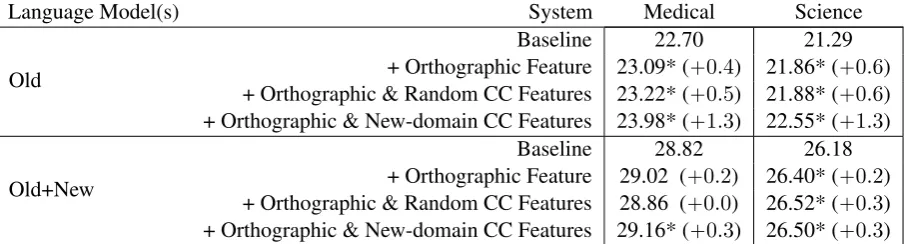
Table 3 presents a summary of our results on the test set in each domain. Using only the old-domain language model, our baselines yield BLEU scores of22.70and21.29on the medical and science test sets, respectively. When we add the orthographic similarity feature, BLEU scores increase signifi-cantly, by about0.4on the medical data and0.6on science. Adding the contextual and topic features estimated over a random selection of comparable document pairs improves BLEU scores slightly in both domains. Finally, using the most new-domain like document pairs to estimate the contextual and topic features yields a1.3BLEU score improve-ment over the baseline in both domains. For both domains, this result is a statistically significant im-provement6over each of the first three systems.
In both domains, the new-domain language models contribute substantially to translation qual-ity. Baseline BLEU scores increase by about 6 and 5 BLEU score points in the medical and science domains, respectively, when we add the new-domain language models. In the medical do-main, neither the orthographic feature nor the or-thographic feature in combination with contextual and topic features estimated over random docu-ment pairs results in a significant BLEU score improvement. However, using the orthographic feature and the contextual and topic features es-timated over new-domain document pairs yields a
Language Model(s) System Medical Science
Old
Baseline 22.70 21.29
+ Orthographic Feature 23.09* (`0.4) 21.86* (`0.6)
+ Orthographic & Random CC Features 23.22* (`0.5) 21.88* (`0.6)
+ Orthographic & New-domain CC Features 23.98* (`1.3) 22.55* (`1.3)
Old+New
Baseline 28.82 26.18
+ Orthographic Feature 29.02 (`0.2) 26.40* (`0.2)
+ Orthographic & Random CC Features 28.86 (`0.0) 26.52* (`0.3)
[image:6.595.74.529.64.186.2]+ Orthographic & New-domain CC Features 29.16* (`0.3) 26.50* (`0.3)
Table 3: Comparison between the performance of baseline old-domain translation models and domain-adapted models in translating science and medical domain text. We experiment with two language models:old, trained on the English side of our Hansard old-domain training corpus andnew, trained on the English side of the parallel training data in each new domain. We use comparable corpora of5,000(1) random, and (2) the most new-domain-like document pairs to score phrase tables. All results are averaged over three tuning runs, and we perform statistical significance testing comparing each system augmented with additional features with the baseline system that uses the same language model(s). * indicates that the BLEU scores are statistically significant with pă0.01.
small but significant improvement of 0.3 BLEU. In the science domain, in contrast, all three aug-mented models perform statistically significantly better than the baseline. Contextual and topic fea-tures yield only a slight improvement above the model that uses only the orthographic feature, but the difference is statistically significant. For the science domain, when we use the new domain lan-guage model, there is no difference between esti-mating the contextual and topic features over ran-dom comparable document pairs and those chosen for their similarity with new-domain data.
Differences across domains may be due to the fact that the medical domain corpora are much more homogenous, containing the often boiler-plate text of prescription drug labels, than the sci-ence domain corpora. The scisci-ence domain cor-pora, in contrast, contain abstracts from several different scientific fields; because that data is more diverse, a randomly chosen mixed-domain set of comparable corpora may still be relevant and use-ful for adapting a translation model.
We experimented with varying the number of comparable document pairs used for estimating contextual and topic similarity but saw no sig-nificant gains from using more than5,000in ei-ther domain. In fact, performance dropped in the medical domain when we used more than a few thousand document pairs. Our proposed approach orders comparable document pairs by how new-domain-like they are and augments models with new features estimated over the top-k. As a result, using more comparable document pairs means that there is more data from which to estimate sig-nals, but it also means that the data is less
new-domain like overall. Using a new-domain similarity threshold to choose a subset of comparable doc-ument pairs may prove useful in future work, as the ideal amount of comparable data will depend on the type and size of the initial mixed-domain comparable corpus as well as the homogeneity of the text domain of interest.
We also experimented with using a third lan-guage model estimated over the English side of our comparable corpora. However, we did not see any significant improvements in translation qual-ity when we used this language model in combina-tion with the old and new domain language mod-els.
6 Conclusion
7 Acknowledgements
This material is based on research sponsored by DARPA under contract HR0011-09-1-0044 and by the Johns Hopkins University Human Lan-guage Technology Center of Excellence. The views and conclusions contained in this publica-tion are those of the authors and should not be interpreted as representing official policies or en-dorsements of DARPA or the U.S. Government.
References
Amittai Axelrod, Xiaodong He, and Jianfeng Gao. 2011. Domain adaptation via pseudo in-domain data selection. InProceedings of the Conference on Empirical Methods in Natural Language Processing (EMNLP).
Colin Cherry and George Foster. 2012. Batch tuning strategies for statistical machine translation. In Pro-ceedings of the Conference of the North American Chapter of the Association for Computational Lin-guistics (NAACL).
Jorge Civera and Alfons Juan. 2007. Domain adap-tation in statistical machine translation with mixture modelling. InProceedings of the Workshop on Sta-tistical Machine Translation (WMT).
Jonathan H. Clark, Chris Dyer, Alon Lavie, and Noah A. Smith. 2011. Better hypothesis testing for statistical machine translation: controlling for optimizer instability. InProceedings of the Confer-ence of the Association for Computational Linguis-tics (ACL).
Hal Daum´e, III and Jagadeesh Jagarlamudi. 2011. Domain adaptation for machine translation by min-ing unseen words. In Proceedings of the Confer-ence of the Association for Computational Linguis-tics (ACL).
George Foster and Roland Kuhn. 2007. Mixture-model adaptation for SMT. In Proceedings of the Workshop on Statistical Machine Translation (WMT).
G. Foster, C. Goutte, and R. Kuhn. 2010. Discrimi-native instance weighting for domain adaptation in SMT. In Proceedings of the Conference on Em-pirical Methods in Natural Language Processing (EMNLP).
Pascale Fung and Lo Yuen Yee. 1998. An IR approach for translating new words from nonparallel, compa-rable texts. InProceedings of the Conference of the Association for Computational Linguistics (ACL). Jianfeng Gao, Joshua Goodman, Mingjing Li, and
Kai-Fu Lee. 2002. Toward a unified approach to sta-tistical language modeling for chinese. ACM Trans-actions on Asian Language Information Processing (TALIP).
Guillem Gasc´o, Martha-Alicia Rocha, Germ´an Sanchis-Trilles, Jes´us Andr´es-Ferrer, and Francisco Casacuberta. 2012. Does more data always yield better translations? InProceedings of the Confer-ence of the European Association for Computational Linguistics (EACL).
Barry Haddow and Philipp Koehn. 2012. Analysing the effect of out-of-domain data on SMT systems. In Proceedings of the Workshop on Statistical Machine Translation (WMT).
Barry Haddow. 2013. Applying pairwise ranked op-timisation to improve the interpolation of transla-tion models. In Proceedings of the Conference of the North American Chapter of the Association for Computational Linguistics (NAACL).
Aria Haghighi, Percy Liang, Taylor Berg-Kirkpatrick, and Dan Klein. 2008. Learning bilingual lexi-cons from monolingual corpora. InProceedings of the Conference of the Association for Computational Linguistics (ACL).
Ann Irvine and Chris Callison-Burch. 2013. Su-pervised bilingual lexicon induction with multiple monolingual signals. InProceedings of the Confer-ence of the North American Chapter of the Associa-tion for ComputaAssocia-tional Linguistics (NAACL). Ann Irvine, John Morgan, Marine Carpuat, Hal Daum´e
III, and Dragos Munteanu. 2013a. Measuring ma-chine translation errors in new domains. Transac-tions of the Association for Computational Linguis-tics, 1(October).
Ann Irvine, Chris Quirk, and Hal Daume III. 2013b. Monolingual marginal matching for translation model adaptation. In Proceedings of the Confer-ence on Empirical Methods in Natural Language Processing (EMNLP).
Dietrich Klakow. 2000. Selecting articles from the language model training corpus. In Proceedings of the IEEE International Conference on Acoustics, Speech, and Signal Processing (ICASSP).
Alex Klementiev, Ann Irvine, Chris Callison-Burch, and David Yarowsky. 2012. Toward statistical ma-chine translation without parallel corpora. In Pro-ceedings of the Conference of the European Associ-ation for ComputAssoci-ational Linguistics (EACL). Philipp Koehn and Kevin Knight. 2002. Learning a
translation lexicon from monolingual corpora. In ACL Workshop on Unsupervised Lexical Acquisi-tion.
Philipp Koehn and Josh Schroeder. 2007. Experiments in domain adaptation for statistical machine transla-tion. InProceedings of the Workshop on Statistical Machine Translation (WMT).
Richard Zens, Chris Dyer, Ondrej Bojar, Alexandra Constantin, and Evan Herbst. 2007. Moses: Open source toolkit for statistical machine translation. In Proceedings of the Conference of the Association for Computational Linguistics (ACL).
Sung-Chien Lin, Chi-Lung Tsai, Lee-Feng Chien, Ker-Jiann Chen, and Lin-Shan Lee. 1997. Chinese lan-guage model adaptation based on document classifi-cation and multiple domain-specific language mod-els. InFifth European Conference on Speech Com-munication and Technology.
Saab Mansour, Joern Wuebker, and Hermann Ney. 2011. Combining translation and language model scoring for domain-specific data filtering. In Pro-ceedings of the International Workshop on Spoken Language Translation (IWSLT).
Robert C. Moore and William Lewis. 2010. Intelli-gent selection of language model training data. In Proceedings of the Conference of the Association for Computational Linguistics (ACL).
Reinhard Rapp. 1995. Identifying word translations in non-parallel texts. InProceedings of the Confer-ence of the Association for Computational Linguis-tics (ACL).
Reinhard Rapp. 1999. Automatic identification of word translations from unrelated English and Ger-man corpora. In Proceedings of the Conference of the Association for Computational Linguistics (ACL).
Majid Razmara, Maryam Siahbani, Reza Haffari, and Anoop Sarkar. 2013. Graph propagation for para-phrasing out-of-vocabulary words in statistical ma-chine translation. In Proceedings of the Confer-ence of the Association for Computational Linguis-tics (ACL).
Charles Schafer and David Yarowsky. 2002. Inducing translation lexicons via diverse similarity measures and bridge languages. InProceedings of the Confer-ence on Natural Language Learning (CoNLL).
Rico Sennrich. 2012. Perplexity minimization for translation model domain adaptation in statistical machine translation. InProceedings of the Confer-ence of the European Association for Computational Linguistics (EACL).
J¨org Tiedemann. 2009. News from OPUS - A collec-tion of multilingual parallel corpora with tools and interfaces. In N. Nicolov, K. Bontcheva, G. An-gelova, and R. Mitkov, editors,Recent Advances in Natural Language Processing (RANLP).
Hua Wu, Haifeng Wang, and Chengqing Zong. 2008. Domain adaptation for statistical machine transla-tion with domain dictransla-tionary and monolingual cor-pora. In Proceedings of the International Confer-ence on Computational Linguistics (COLING).