SHEF-Lite 2.0: Sparse Multi-task Gaussian Processes for Translation
Quality Estimation
Daniel Beck and Kashif Shah and Lucia Specia
Department of Computer Science University of Sheffield Sheffield, United Kingdom
{debeck1,kashif.shah,l.specia}@sheffield.ac.uk
Abstract
We describe our systems for the WMT14 Shared Task on Quality Estimation (sub-tasks 1.1, 1.2 and 1.3). Our submissions use the framework of Multi-task Gaus-sian Processes, where we combine multi-ple datasets in a multi-task setting. Due to the large size of our datasets we also ex-periment with Sparse Gaussian Processes, which aim to speed up training and predic-tion by providing sensible sparse approxi-mations.
1 Introduction
The purpose of machine translation (MT) quality estimation (QE) is to provide a quality prediction for new, unseen machine translated texts, with-out relying on reference translations (Blatz et al., 2004; Specia et al., 2009; Bojar et al., 2013). A common use of quality predictions is the decision between post-editing a given machine translated sentence and translating its source from scratch, based on whether its post-editing effort is esti-mated to be lower than the effort of translating the source sentence.
The WMT 2014 QE shared task defined a group of tasks related to QE. In this paper, we de-scribe our submissions for subtasks 1.1, 1.2 and 1.3. Our models are based on Gaussian Pro-cesses (GPs) (Rasmussen and Williams, 2006), a non-parametric kernelised probabilistic frame-work. We propose to combine multiple datasets to improve our QE models by applying GPs in a multi-task setting. Our hypothesis is that us-ing sensible multi-task learnus-ing settus-ings gives im-provements over simply pooling all datasets to-gether.
Task 1.1 focuses on predicting post-editing ef-fort for four language pairs: English-Spanish (en-es), Spanish-English (es-en), English-German
(en-de), and German-English (de-en). Each con-tains a different number of source sentences and their human translations, as well as 2-3 versions of machine translations: by a statistical (SMT) system, a rule-based system (RBMT) system and, for en-es/de only, a hybrid system. Source sen-tences were extracted from tests sets of WMT13 and WMT12, and the translations were produced by top MT systems of each type and a human translator. Labels range from 1 to 3, with 1 in-dicating a perfect translation and 3, a low quality translation.
The purpose of task 1.2 is to predict HTER scores (Human Translation Error Rate) (Snover et al., 2006) using a dataset composed of 896 English-Spanish sentences translated by a MT sys-tem and post-edited by a professional translator. Finally, task 1.3 aims at predicting post-editing time, using a subset of 650 sentences from the Task 1.2 dataset.
For each task, participants can submit two types of results: scoring and ranking. For scoring, eval-uation is made in terms of Mean Absolute Error (MAE) and Root Mean Square Error (RMSE). For ranking, DeltaAvg and Spearman’s rank correla-tion were used as evaluacorrela-tion metrics.
2 Model
Gaussian Processes are a Bayesian non-parametric machine learning framework considered the state-of-the-art for regression. They assume the pres-ence of a latent functionf :RF →R, which maps
a vectorxfrom feature spaceF to a scalar value. Formally, this function is drawn from a GP prior:
f(x)∼ GP(0, k(x,x0)),
which is parameterised by a mean function (here,
0) and a covariance kernel functionk(x,x0). Each
response value is then generated from the function evaluated at the corresponding input,yi=f(xi)+ η, whereη∼ N(0, σ2
n)is added white-noise.
Prediction is formulated as a Bayesian inference under the posterior:
p(y∗|x∗,D) = Z
fp(y∗|x∗, f)p(f|D),
where x∗ is a test input, y∗ is the test response
value andDis the training set. The predictive pos-terior can be solved analitically, resulting in:
y∗ ∼ N(kT∗(K+σn2I)−1y,
k(x∗, x∗)−kT∗(K+σn2I)−1k∗),
where k∗ = [k(x∗,x1)k(x∗,x2). . . k(x∗,xn)]T
is the vector of kernel evaluations between the training set and the test input andKis the kernel matrix over the training inputs (the Gram matrix). The kernel function encodes the covariance (similarity) between each input pair. While a vari-ety of kernel functions are available, here we fol-lowed previous work in QE using GP (Cohn and Specia, 2013; Shah et al., 2013) and employed a squared exponential (SE) kernel with automatic relevance determination (ARD):
k(x,x0) =σf2 exp −12
F X
i=1
xi−x0 i li
! ,
whereF is the number of features, σ2
f is the
co-variance magnitude and li > 0 are the feature
lengthscales.
The resulting model hyperparameters (SE vari-anceσ2
f, noise varianceσ2nand SE lengthscalesli)
were learned from data by maximising the model likelihood. All our models were trained using the GPy1 toolkit, an open source implementation of
GPs written in Python.
2.1 Multi-task learning
The GP regression framework can be extended to multiple outputs by assuming f(x) to be a vec-tor valued function. These models are commonly referred ascoregionalizationmodels in the GP lit-erature ( ´Alvarez et al., 2012). Here we refer to them as multi-task kernels, to emphasize our ap-plication.
In this work, we employ a separable multi-task kernel, similar to the one used by Bonilla et al. (2008) and Cohn and Specia (2013). Consider-ing a set ofDtasks, we define the corresponding multi-task kernel as:
k((x, d),(x0, d0)) =k
data(x,x0)×Bd,d0, (1) 1http://sheffieldml.github.io/GPy/
wherekdata is a kernel on the input points,dand d0 are task or metadata information for each input
andB ∈ RD×D is the multi-task matrix, which
encodes task covariances. For task 1.1, we con-sider each language pair as a different task, while for tasks 1.2 and 1.3 we use additional datasets for the same language pair (en-es), treating each dataset as a different task.
To perform the learning procedure the multi-task matrix should be parameterised in a sensible way. We follow the parameterisations proposed by Cohn and Specia (2013), which we briefly de-scribe here:
Independent: B =I. In this setting each task is modelled independently. This is not strictly equivalent to independent model training be-cause the tasks share the same data kernel (and the same hyperparameters);
Pooled: B=1. Here the task identity is ignored. This is equivalent to pooling all datasets in a single task model;
Combined: B = 1 + αI. This setting lever-ages between independent and pooled mod-els. Here,α >0is treated as an hyperparam-eter;
Combined+: B =1+diag(α). Same as “com-bined”, but allowing one differentαvalue per task.
2.2 Sparse Gaussian Processes
The performance bottleneck for GP models is the Gram matrix inversion, which is O(n3) for
stan-dard GPs, withnbeing the number of training in-stances. For multi-task settings this can be a po-tential issue because these models replicate the in-stances for each task and the resulting Gram ma-trix has dimensionality nd×nd, where dis the number of tasks.
Sparse GPs tackle this problem by approximat-ing the Gram matrix usapproximat-ing only a subset ofm in-ducing inputs. Without loss of generalisation, con-sider these m points as the first instances in the training data. We can then expand the Gram ma-trix in the following way:
K=
Kmm Km(n−m) K(n−m)m K(n−m)(n−m)
.
its transpose as Knm. The block structure of K
forms the basis of the so-called Nystr¨om approxi-mation:
˜
K=KnmK−mm1 Kmn, (2)
which results in the following predictive posterior:
y∗ ∼ N(kTm∗G˜−1Kmny, (3) k(x∗,x∗)−kmT∗K−mm1 km∗+ σn2kTm∗G˜−1km∗),
whereG˜ =σ2
nKmm+KmnKnmandkm∗is the
vector of kernel evaluations between test inputx∗
and theminducing inputs. The resulting training complexity isO(m2n).
The remaining question is how to choose the in-ducing inputs. We follow the approach of Snelson and Ghahramani (2006), which note that these in-ducing inputs do not need to be a subset of the training data. Their method considers each in-put as a hyperparameter, which is then optimised jointly with the kernel hyperparameters.
2.3 Features
For all tasks we used the QuEst framework (Spe-cia et al., 2013) to extract a set of 80 black-box features as in Shah et al. (2013), for which we had all the necessary resources available. Examples of the features extracted include:
• N-gram-based features:
– Number of tokens in source and target segments;
– Language model (LM) probability of source and target segments;
– Percentage of source 1–3-grams ob-served in different frequency quartiles of a large corpus of the source language;
– Average number of translations per source word in the segment as given by IBM 1 model from a large parallel cor-pus of the language, with probabilities thresholded in different ways.
• POS-based features:
– Ratio of percentage of nouns/verbs/etc in the source and target segments;
– Ratio of punctuation symbols in source and target segments;
– Percentage of direct object personal or possessive pronouns incorrectly trans-lated.
For the full set of features we refer readers to QuEst website.2
To perform feature selection, we followed the approach used in Shah et al. (2013) and ranked the features according to their learned lengthscales (from the lowest to the highest). The lengthscale of a feature can be interpreted as the relevance of such feature for the model. Therefore, the out-come of a GP model using an ARD kernel can be viewed as a list of features ranked by relevance, and this information can be used for feature selec-tion by discarding the lowest ranked (least useful) ones.
3 Preliminary Experiments
Our submissions are based on multi-task settings. For task 1.1, we consider each language pair as a different task, training one model for all pairs. For tasks 1.2 and 1.3, we used additional datasets and encoded each one as a different task (totalling 3 tasks):
WMT13: these are the datasets provided in last year’s QE shared task (Bojar et al., 2013). We combined training and test sets, totalling
2,754 sentences for HTER prediction and
1,003sentences for post-editing time predic-tion, both for English-Spanish.
EAMT11: this dataset is provided by Specia (2011) and is composed of 1,000 English-Spanish sentences annotated in terms of HTER and post-editing time.
For each task we prepared two submissions: one trained on a standard GP with the full 80 features set and another one trained on a sparse GP with a subset of 40 features. The features were chosen by training a smaller model on a subset of 400 in-stances and following the procedure explained in Section 2.3 for feature selection, with a pre-define cutoff point on the number of features (40), based on previous experiments. The sparse models were trained using 400 inducing inputs.
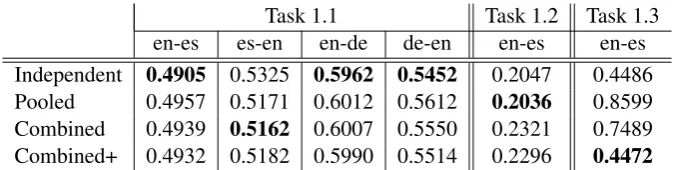
To select an appropriate multi-task setting for our submissions we performed preliminary exper-iments using a 90%/10% split on the correspond-ing traincorrespond-ing set for each task. The resultcorrespond-ing MAE scores are shown in Tables 1 and 2, for standard and sparse GPs, respectively. The boldface fig-ures correspond to the settings we choose for the
2http://www.quest.dcs.shef.ac.uk/
Task 1.1 Task 1.2 Task 1.3 en-es es-en en-de de-en en-es en-es Independent 0.4905 0.5325 0.5962 0.5452 0.2047 0.4486 Pooled 0.4957 0.5171 0.6012 0.5612 0.2036 0.8599 Combined 0.4939 0.5162 0.6007 0.5550 0.2321 0.7489 Combined+ 0.4932 0.5182 0.5990 0.5514 0.2296 0.4472
Table 1: MAE results for preliminary experiments on standard GPs. Post-editing time scores for task 1.3 are shown on log time per word.
Task 1.1 Task 1.2 Task 1.3 en-es es-en en-de de-en en-es en-es Independent 0.5036 0.5274 0.6002 0.5532 0.3432 0.3906
[image:4.595.132.469.192.276.2]Pooled 0.4890 0.5131 0.5927 0.5532 0.1597 0.6410 Combined 0.4872 0.5183 0.5871 0.5451 0.2871 0.6449 Combined+ 0.4935 0.5255 0.5864 0.5458 0.1659 0.4040
Table 2: MAE results for preliminary experiments on sparse GPs. Post-editing time scores for task 1.3 are shown on log time per word.
official submissions, after re-training on the corre-sponding full training sets.
To check the speed-ups obtained from using sparse GPs, we measured wall clock times for training and prediction in Task 1.1 using the “In-dependent” multi-task setting. Table 3 shows the resulting times and the corresponding speed-ups when comparing to the standard GP. For compar-ison, we also trained a model using 200 inducing inputs, although we did not use the results of this model in our submissions.
Time (secs) Speed-up Standard GP 12122 – Sparse GP (m=400) 3376 3.59x Sparse GP (m=200) 978 12.39x Table 3: Wall clock times and speed-ups for GPs training and prediction: full versus sparse GPs.
4 Official Results and Discussion
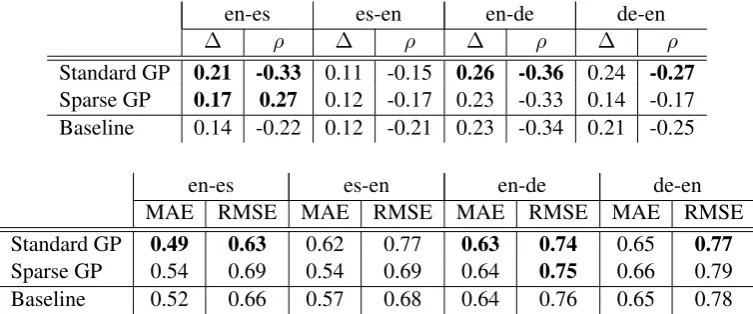
Table 4 shows the results for Task 1.1. Us-ing standard GPs we obtained improved results over the baseline for Spanish and English-German only, with particularly substantial im-provements for English-Spanish, which also hap-pens for sparse GPs. This may be related to the larger size of this dataset when compared to the others. Our results here are mostly inconclusive though and we plan to investigate this setting more in depth in the future. Specifically, due to the
coarse behaviour of the labels, ordinal regression GP models (like the one proposed in (Chu et al., 2005)) could be useful for this task.
Results for Task 1.2 are shown in Table 5. The standard GP model performed unusually poorly when compared to the baseline or the sparse GP model. To investigate this, we inspected the re-sulting model hyperparameters. We found out that the noise σ2
n was optimised to a very low value,
[image:4.595.75.289.489.548.2]close to zero, which characterises overfitting. The same behaviour was not observed with the sparse model, even though it had a much higher number of hyperparameters to optimise, and was therefore more prone to overfitting. We plan to investigate this issue further but a possible cause could be bad starting values for the hyperparameters.
en-es es-en en-de de-en
∆ ρ ∆ ρ ∆ ρ ∆ ρ
Standard GP 0.21 -0.33 0.11 -0.15 0.26 -0.36 0.24 -0.27
Sparse GP 0.17 0.27 0.12 -0.17 0.23 -0.33 0.14 -0.17 Baseline 0.14 -0.22 0.12 -0.21 0.23 -0.34 0.21 -0.25
en-es es-en en-de de-en
MAE RMSE MAE RMSE MAE RMSE MAE RMSE Standard GP 0.49 0.63 0.62 0.77 0.63 0.74 0.65 0.77
Sparse GP 0.54 0.69 0.54 0.69 0.64 0.75 0.66 0.79 Baseline 0.52 0.66 0.57 0.68 0.64 0.76 0.65 0.78
Table 4: Official results for task 1.1. The top table shows results for the ranking subtask (∆: DeltaAvg;
ρ: Spearman’s correlation). The bottom table shows results for the scoring subtask.
Ranking Scoring
∆ ρ MAE RMSE
Standard GP 0.72 0.09 18.15 23.41 Sparse GP 7.69 0.43 15.04 18.38
Baseline 5.08 0.31 15.23 19.48 Table 5: Official results for task 1.2.
Ranking Scoring
∆ ρ MAE RMSE
Standard GP 16.08 0.64 17.13 27.33
Sparse GP 16.33 0.63 17.42 27.35
Baseline 14.71 0.57 21.49 34.28 Table 6: Official results for task 1.3.
5 Conclusions
We proposed a new setting for training QE mod-els based on Multi-task Gaussian Processes. Our settings combined different datasets in a sensible way, by considering each dataset as a different task and learning task covariances. We also pro-posed to speed-up training and prediction times by employing sparse GPs, which becomes crucial in multi-task settings. The results obtained are specially promising in the post-editing time task, where we obtained the same results as with stan-dard GPs and improved over our models from the last evaluation campaign.
In the future, we plan to employ our multi-task models in large-scale settings, like datasets an-notated through crowdsourcing platforms. These datasets are usually labelled by dozens of annota-tors and multi-task GPs have proved an interest-ing framework for learninterest-ing the annotation noise (Cohn and Specia, 2013). However, multiple tasks
can easily make training and prediction times pro-hibitive, and thus another direction if work is to use recent advances in sparse GPs, like the one proposed by Hensman et al. (2013). We believe that the combination of these approaches could further improve the state-of-the-art performance in these tasks.
Acknowledgments
This work was supported by funding from CNPq/Brazil (No. 237999/2012-9, Daniel Beck) and from European Union’s Seventh Framework Programme for research, technological develop-ment and demonstration under grant agreedevelop-ment no. 296347 (QTLaunchPad).
References
Mauricio A. ´Alvarez, Lorenzo Rosasco, and Neil D. Lawrence. 2012. Kernels for Vector-Valued Func-tions: a Review. Foundations and Trends in Ma-chine Learning, pages 1–37.
Daniel Beck, Kashif Shah, Trevor Cohn, and Lucia Specia. 2013. SHEF-Lite : When Less is More for Translation Quality Estimation. InProceedings of WMT13, pages 337–342.
John Blatz, Erin Fitzgerald, and George Foster. 2004. Confidence estimation for machine translation. In
Proceedings of the 20th Conference on Computa-tional Linguistics, pages 315–321.
[image:5.595.110.487.62.219.2] [image:5.595.72.289.271.454.2]Edwin V. Bonilla, Kian Ming A. Chai, and Christopher K. I. Williams. 2008. Multi-task Gaussian Process Prediction. Advances in Neural Information Pro-cessing Systems.
Wei Chu, Zoubin Ghahramani, Francesco Falciani, and David L Wild. 2005. Biomarker discovery in mi-croarray gene expression data with Gaussian pro-cesses. Bioinformatics, 21(16):3385–93, August. Trevor Cohn and Lucia Specia. 2013. Modelling
Annotator Bias with Multi-task Gaussian Processes: An Application to Machine Translation Quality Es-timation. InProceedings of ACL.
James Hensman, Nicol`o Fusi, and Neil D. Lawrence. 2013. Gaussian Processes for Big Data. In Pro-ceedings of UAI.
Carl Edward Rasmussen and Christopher K. I. Williams. 2006. Gaussian processes for machine learning, volume 1. MIT Press Cambridge.
Kashif Shah, Trevor Cohn, and Lucia Specia. 2013. An Investigation on the Effectiveness of Features for Translation Quality Estimation. InProceedings of MT Summit XIV.
Edward Snelson and Zoubin Ghahramani. 2006. Sparse Gaussian Processes using Pseudo-inputs. In
Proceedings of NIPS.
Matthew Snover, Bonnie Dorr, Richard Schwartz, Lin-nea Micciulla, and John Makhoul. 2006. A study of translation edit rate with targeted human annotation. InProceedings of Association for Machine Transla-tion in the Americas.
Lucia Specia, Craig Saunders, Marco Turchi, Zhuoran Wang, and John Shawe-Taylor. 2009. Improving the confidence of machine translation quality esti-mates. InProceedings of MT Summit XII.
Lucia Specia, Kashif Shah, Jos´e G. C. De Souza, and Trevor Cohn. 2013. QuEst - A translation qual-ity estimation framework. In Proceedings of ACL Demo Session.