http://www.scirp.org/journal/ijcns ISSN Online: 1913-3723 ISSN Print: 1913-3715
Performance Analysis of an Adaptive
Incremental Cooperative Relaying
Scheme for Wireless Relay Networks
Shaoqing Wang, Kai Cui, Zhen Huang
The Electronic System Engineering Company of China, Beijing, China
Abstract
In wireless relaying networks, the traditional incremental cooperative relaying scheme (IR) could improve the system throughput enormously over fading channels by exploiting relay nodes to retransmit the source data packet to the destination. In order to enhance the system throughput over time-varying fading channels, this paper proposes an adaptive incremental cooperative re-laying scheme (AIR) based on adaptive modulation and coding, which im-plements adaptive rate transmission for the source and relay nodes according to channel state information. We derive expressions for the AIR system throughput, and then give a gradient-based search algorithm to find the opti-mized adaptive solution for the AIR system by maximizing throughput sub-ject to the constraint of packet error rate at the data link layer. The results in-dicate that throughput of AIR system outperforms that of traditional IR sys-tem greatly for any SNR value.
Keywords
Cooperative Relaying, Adaptive Modulation Coding, Throughput, Packet Error Rate
1. Introduction
In wireless relay networks, an efficient way of combating channel fading is co-operative diversity in which the source node transmits information to the desti-nation not only through a direct-link but also through the use of relays [1] [2]. The basic idea of it results from the broadcasting property of wireless transmis-sion so that other nodes in the same network can overhear the information from the source node and can then forward what is received to the destination. So, cooperative diversity can provide multiple independently-faded channels for the
How to cite this paper: Wang, S.Q., Cui, K. and Huang, Z. (2017) Performance Analy-sis of an Adaptive Incremental Cooperative Relaying Scheme for Wireless Relay Net-works. Int. J. Communications, Network and System Sciences, 10, 48-57.
https://doi.org/10.4236/ijcns.2017.108B006
same information transmission so that the probability that all received signals at the destination suffer deep fading will be significantly reduced. A variety of low-complexity cooperative relaying scheme were proposed firstly in [3], which included fixed relaying (FR), selection relaying (SR) and incremental relaying (IR) schemes. However, both FR and SR schemes lead to a certain loss in spectral efficiency because it requires two time phase periods for half-duplex transmis-sion. IR performs in full-duplex transmission when the direct transmission be-tween the source and destination nodes is successful and in half-duplex trans-mission only when the direct transtrans-mission is not successful, so IR scheme can increase the system spectral efficiency over FR or SR scheme. More cooperative relaying schemes were studied and analyzed for various systems or channel models detailed in [4] [5] [6] [7].
However, all the aforementioned papers only consider fixed rate transmission in cooperative relaying system, which results in a deteriorated throughput per-formance over time-varying fading channels. Adaptive transmission at the transmitter based on adaptive modulation and coding (AMC) has been shown to be effective to enhance the system performance over time-varying fading chan-nels [8]. To exploit the benefits of rate adaptation over the relay channel, recent-ly, several studies have been reported in [9] [10] [11].
It is known that multimedia application not only require wireless relay net-works to support the higher transmission rate, but also need the much better packet-level quality of service (QoS) performance such as packet error rate (PER) at the data link layer. However, both the packet-level QoS requirement in wireless relay networks and the effect of cooperative relaying on the higher layer aren’t considered in [9] [10] [11]. Designing cooperative relaying schemes suita-ble for QoS constrained multimedia applications in wireless relay networks is still an open problem.
Motivated by these researches, in order to enhance the system throughput over time-varying fading channels, we propose an adaptive incremental de-code-and-forward cooperative relaying (AIR) scheme based on AMC for the single-relay transmission system, which implements adaptive rate transmission of the source and relay nodes according to channel state information. The AIR system throughput is defined as the data rate successfully received at the destina-tion node in this paper. We firstly derive expressions for the AIR system throughput, and then give a gradient-based search algorithm to find the opti-mized adaptive solution for the AIR system by maximizing throughput subject to the constraint of packet error rate at the data link layer. In addition, through-put of the traditional IR system is also deduced and compared with that of the AIR system.
re-transmits the packet erroneously received at the destination in order to enhance the system spectral efficiency over the adaptive FR schemes proposed in [9] and [10]. At last, the AIR scheme is easier to implement than the adaptive relaying scheme based on distributed space-time codes proposed in [11], as the later re-quires synchronization between the spatially separated relays performing the distributed space-time code [12] [13].
2. System Model and Adaptive Incremental Relaying Scheme
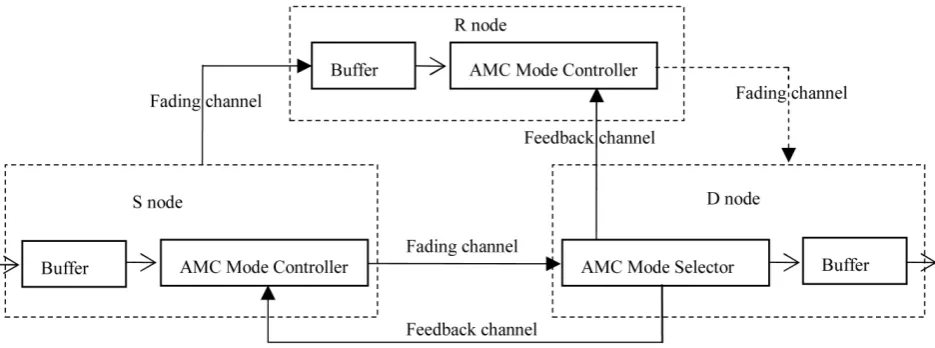
Consider three relevant nodes in a wireless relay network, represented respec-tively by S (source node), R (relay node) and D (destination node), and assume that S wants to sent data to D, as illustrated in Figure 1. At S, packets are stored in a transmit buffer, grouped into frames, and then transmitted over the wireless channel on a frame by frame basis. Assume that the cyclic redundancy check (CRC) bits of each packet facilitate perfect error detection at the receiving nodes. The time is slotted, and the length of a time slot can satisfy the transmission la-tency and spread lala-tency of the data frame. The proposed AIR scheme acts as follows. S node firstly transmits a data frame in the current time slot. For one case, upon successful reception of all packets in this frame at D, it sends back an ACK message, then S transmits a new data frame in the next time slot and the R node just idles. For the other case, if the D receives a packet in error, it broad-casts a NACK message identifying the corrupted packet. If R has received the source packet successfully, it retransmits it to the D and D drops the corrupted packets and only decodes based on the retransmitted packet. If D still fails to re-ceive the retransmitted packet, this packet will be dropped. Moreover, if the R fails to receive the source packet, this packet will be also dropped.
[image:3.595.66.534.543.717.2]Adopting the block fading channel model for the S-D, R-D and S-R links, the channel gains remain constant over a time slot, but vary from one time slot to another. AMC is employed for both the S-D and R-D links in order to imple-ment the adaptive rate transmission. Based on the perfect channel state informa-tion (CSI) acquired at the D node, the AMC selector determines the AMC mode
which is fed back to the S or R node through the feedback channel without error and latency. Then, the AMC controller of the S or R node updates the transmis-sion mode and transmits the new data frame.
Let N denote the total number of transmission mode available and define in-stantaneous SNR of the S-D and R-D links as γ1 and γ2 respectively. The system
partitions the entire SNR range into N + 1 nonoverlapping consecutive intervals with the SNR thresholds denoted as
{ }(
γm n, γm,0=0,γm N, +1= ∞)
(1)where m = 1, 2 refers to the S-D and R-D links respectively and n = 0, 1, ···, N is the mode index.
Specifically, mode n is chosen for the S node when SNR
1 [ 1,n, 1,n1)
γ ∈ γ γ + (2)
Then the S node transmits the data frame in the corresponding rate Rn
bit/symbol.
Similarly, when SNR
2 [ 2,n, 2,n1)
γ ∈γ γ + (3) R node retransmits the corrupted packet to D node in the rate Rn−1bits/sym-
bol.
To avoid deep channel fades, no data frame will be sent when γm< γm,0.
If the symbol rate of the system is constant, Rn can stand for the data rate. We
define throughput of the AIR system as the average data rate successfully re-ceived at the D node, so throughput can be expressed by
[ ]
n(
1 a)
L C
T E R PER
L
−
= − (4)
where E[] stands for expected operation, E[Rn] represents the expected data rate,
L is the length of one packet, C is the length of CRC bits and PERa is the average
packet error rate (PER) of the system. To derive expression of throughput, we need to deduce expressions of the average PER and expected data rate respec-tively in the next section.
3. Performance Analysis
3.1. The Average Packet Error Rate
Let PERSD−a, PERRD−aand PERSR−a denote the average PER of the S-D, R-D and
S-R links respectively, so the average PER of the system can be expressed by
(
1)(
)
a SD a SR a SD a SR a RD a
PER =PER − PER − +PER − −PER − PER − (5)
where the first term corresponds to the event that the source packet is received in error at both the D and R nodes and the second term corresponds to the event that the packet is received in error at the D node but successfully at the R nodes, and the R node’s retransmission to the D node is still in error. The expressions of PERSD−a, PERRD−a and PERSR−a will be deduced in the following.
with variance N0. Assume that the transmit power is constant for all nodes,
de-noted by Pt, d1, d2 and d3 denote the distance of S-D, R-D, and S-R links
respec-tively and path loss exponent is represented by α, so the probability distribution function (PDF) of the received SNR for the S-D and R-D links can be written as respectively
__ __
1
( ) exp
m
m m
pγ γ γ
γ γ = − (6)
where m = 1, 2, 3 refers to the S-D, R-D and S-R links respectively and
( )
__1 P dt 1 /N0
α
γ −
= , __2 P dt
( )
2 /N0α
γ −
= and __3 P dt
( )
3 /N0α
γ −
= stand for the
average received SNR of links.
According to the AMC rule in (2) and (3), each mode n for the S and R nodes will be chosen with probability
(
)
, 1
,
, ( ) 1, 2
m n m m n
m n m
p =
∫
γγ + pγ γ γd m= (7)Noting that the instantaneous PER depends on the received SNR γ, in order to simplify the analysis, we approximate the instantaneous PER for the AMC mode
n as [8]
(
)
1, 0 ( ) exp , pn nn n pn
PER
a g
γ γ γ
γ γ γ
< <
= − >
(8)
where the parameters {an, gn, γpn} are obtained by fitting (8) to the exact PER of
mode n.
Let PERm,n denote the average PER for mode n. Combining (6), (7) and (8),
the average PER of the S-D and R-D links for mode n can be written as
, 1 , , , 1 ( ) ( ) m n m m n
m n n m
m n
PER PER p d
p γ
γ
γ γ γ γ
+
=
∫
(9)where m = 1, 2 refers to the S-D and R-D links respectively. So, the PER of the S-R link for mode n can be expressed by
3
3, 0 3
1,
1
( ) ( )
n n
n
PER PER p d
p γ γ γ γ
∞
=
∫
(10)The average PER of links can be computed as the ratio of the average number of incorrectly received packets over the total average number of transmitted packets. So, we have
1, 1, 1
1, 1 N
n n n
n
SD a N
n n
n
R p PER PER R p = − = =
∑
∑
(11)2, 2,
1
2, 1 N
n n n
n
RD a N
n n
n
R p PER PER R p = − = =
∑
1, 3, 1
1, 1 N
n n n
n
SR a N
n n
n
R p PER PER R p = − = =
∑
∑
(13)Substituting expression (11), (12) and (13) into (5), we can derive expression of the average PER of the system.
3.2. The Expected Data Rate
We define the expected data rate E[Rn] as the average number of accepted
in-formation bits per symbol at the D node. Let R1,n denotes that S node transmits
data packets with data rate Rn and R2,n denotes that R node retransmits the
cor-rupted data packet with data rate Rn, so, the expected data rate can be expressed as
[ ]
(
(
)
)
(
)
1, 1 1 3,
1 3,
1, 2,
1 ( ) ( )
( ) 1
n n n n n
n n
n n
E R E R PER PER PER
L
E PER PER
L L R R γ γ γ = − + + − + (14)
where the first term corresponds to the event that a packet transmitted by the S node with data rate R1,n is received successfully by D or received erroneously by
both the D and R nodes and the second term corresponds to the event that the R node retransmit the corrupted packet with data rate R2,n.
Considering that the total number of AMC modes is N, using (6) and (14), (14) can be rewritten as
[ ]
(
(
)
)
(
)
1, 1
1,
1, 1 2, 1
1 1, 2,
1 2
1, 1 1 3,
1
1, 2,
1 1
1 1 1, 2,
3, 1 2
1 ( ) ( )
( ) ( )
1 ( ) ( )
n n
n n
n n
N
n n n n n
n
N N
n n
n
n n n n
n
E R R PER PER PER
R R
p d PER
R R
PER p p d d
γ γ
γ γ
γ γ γ
γ γ
γ γ
γ γ γ
γ γ γ γ
+ + + = = = = − + + + −
∑∫
∑∑∫ ∫
(15)
3.3. The Optimum of Throughput
Substituting (5) and (15) into (4), we can derive expression of the system throughput. The design objective of the AIR scheme is to maximize the system throughput, while satisfying the packet error rate requirement. So, we need to determine the optimized SNR thresholds {γm,n} for the AMC mode of AIR
sys-tem in order to maximize syssys-tem throughput.
So, the desired optimized problem can be formulated as follows
1, 2,
{max, }
. .
n n
AIR
a t
T
s t PER PER
γ γ
≤ (16)
which means that the average PER of the system is not greater than the threshold of PER (PERt).
Firstly, we formulate the total PER constraint in (16) into two separate PER constraints for the S-D and R-D links as follows
1,n SD t
2,n RD t
PER ≤PER − (18)
where PERSD−t and PERRD−tare the threshold of PER for the S-D and R-D links
respectively.
Combing (5), (16), (17) and (18), we have
(
)(
)
(
1)
SD t SR a SR a RD t t
PER − PER − + −PER − PER − ≤PER (19)
(
1)
t
SR a SD t
RD t
SR a
PER
PER PER
PER
PER − −
−
−
− =
− (20)
Using (8) and (17), we can derive expressions of the SNR threshold of AMC mode for the S-D link as follows
(
)
1,
1
max ln / ,
n n SD t pn
n
a PER
g
γ − γ
=
(21)
Combining (8) and (20), we can derive expressions of the SNR threshold of AMC mode for the R-D link as follows
(
)
2,
1 1
max ln n SR a ,
n pn
t n
SR a SD t
a PER
PER g
PER PER
γ − γ
− −
−
=
−
(22)
Using (16), (21) and (22), the optimized problem in (16) can be rewritten as
max
. . 1
SD t AIR
PER
t SD t
T
s t PER PER
−
−
≤ ≤ (23)
In the following, we give a gradient-based search algorithm to find the opti-mized the SNR threshold of AMC mode. Let PERSD−t = M, T(M) denotes the
corresponding throughput, ƏT(M)/ƏM is the derivative of T(M), Mo represents
the optimum value of M and Tmax denotes the corresponding maximal value of
4. Numerical and Simulation Results
In this section, we provide results to compare the performance of AIR system with that of CRIR system. Without the loss of the generality, we assume that the average SNR of the S-R link is 25 dB and the S-D link and the R-D link have the same average SNR. In addition, transmit power Pt is normalized to unity. In the
[image:8.595.280.468.317.483.2]simulation, we use the AMC mode of HYPERLAN/2 standard with packet length L = 1080 bits and mode 4 is employed by CRIR system.
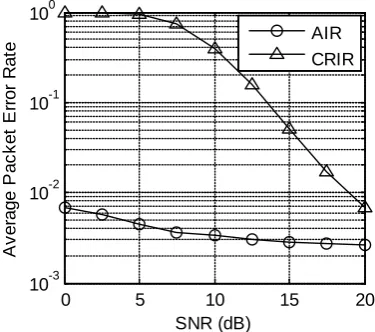
Figure 2 shows the average PER performances of the AIR and CRIR system. From the figure, we can see that AIR system performance outperforms the CRIR system for any SNR value. This is because that AMC is introduced in AIR sys-tem, in which no data frame will be sent in order to avoid deep channel fades. Moreover, the average PER of the AIR system is below the threshold of PER at the data link layer (PERt = 0.01) and the packet-level QoS requirement of the
system is satisfied.
As shown in Figure 3, the AIR system throughput is a concave function of the
Figure 2. The average PER of AIR system vs. the average PER of CRIR system (PERt = 0.01).
Figure 3. Throughput of AIR system vs. the thre-shold PER of S-D link (PERt = 0.01).
0 5 10 15 20
10-3 10-2 10-1 100
SNR (dB)
A
v
er
age P
ac
k
et
E
rr
or
R
at
e AIR
CRIR
0 0.2 0.4 0.6 0.8 1
1.3 1.5 2 2.5 2.6
PER threshold of S-D link(dB)
T
(
b
it/s
/H
z
)
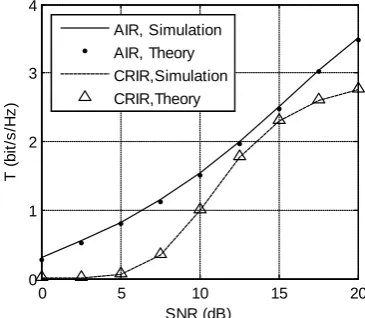
[image:8.595.280.466.536.702.2]Figure 4. Throughput of AIR system vs. through-put of CRIR system (PERt = 0.01).
[image:9.595.281.464.77.236.2]PER threshold of S-D link and there are different optimized throughput values of AIR system for different average SNR of S-D link. The optimized throughput value of AIR system becomes larger and larger as the SNR increases. So, the gra-dient-based search algorithm proposed in Section III. 3 can find the optimized throughput.
Figure 4 compares the throughput of AIR system with that of CRIR system. Due to AMC introduced in AIR scheme, throughput of AIR system exceeds that of CRIR system for any SNR value. The simulation results are very close to the theory results, which verify the theory analysis in Section 3.
5. Conclusions and Future Work
In this paper, we propose an adaptive incremental cooperative relaying (AIR) scheme in order to enhance throughput of the cooperative relaying system. We derive expression for the AIR throughput and give a gradient-based search algo-rithm to find the optimized adaptive solution for AIR system by maximizing throughput subject to the constraint of PER at the data link layer. The numerical and simulation results indicate that throughput of AIR system outperforms that of traditional incremental relaying system greatly for any SNR value. The AIR scheme proposed in the paper establishes the theory foundation for the QoS constrained multimedia applications in wireless relay networks.
We plan to extend our work to the multi-relay selection scenario. If there are multiple relays nodes chosen for the source node, one can select the best relay to retransmit the packet erroneously received by the destination node according to the corresponding relay selection standard such as the best harmonic mean se-lection method [12]. Moreover, the constant transmit power is adopted at all the nodes in this paper. In future, the power control scheme can be integrated into our research.
References
[1] Sendonaris, A., Erkip, E. and Aazhang, B. (2003) User Cooperation Diversity-Part I:
0 5 10 15 20
0 1 2 3 4
SNR (dB)
T
(
b
it/s
/H
z
)
System Description. IEEE Transactions on Communications, 51, 1927-1938.
https://doi.org/10.1109/TCOMM.2003.818096
[2] Sendonaris, A., Erkip, E. and Aazhang, B. (2003) User Cooperation Diversity-Part II: Implementation Aspects and Performance Analysis. IEEE Transactions on Com- munications, 51, 1939-1948. https://doi.org/10.1109/TCOMM.2003.819238
[3] Laneman, J.N., Wornell, G.W. and Tse, D.N.C. (2004) Cooperative Diversity in Wireless Networks: Efficient Protocols and Outage Behavior. IEEE Transactions on Information Theory, 50, 3062-3080. https://doi.org/10.1109/TIT.2004.838089
[4] Bletsas, A., Khisti, A., Reed, D.P. and Lippman, A. (2006) A Simple Cooperative Di-versity Method Based on Network Path Selection. IEEE Journal on Selected Areas in Communications, 24, 659-672. https://doi.org/10.1109/JSAC.2005.862417
[5] Ikki, S. and Ahmed, M.H. (2007) Performance Analysis of Cooperative Diversity Wireless Networks over Nakagami-m Fading Channel. EEE Communications Let-ters, 11, 334-336. https://doi.org/10.1109/LCOM.2007.348292
[6] Cai, J., Alfa, A.S., Ren, P., Shen, X. and Mark, J.W. (2008) Packet Level Performance Analysis in Wireless User-Relaying Networks. IEEE Transactions on Wireless Com- munications, 7, 5336-5345. https://doi.org/10.1109/T-WC.2008.070960
[7] Ikki, S.S. and Ahmed, M.H. (2009) Performance of Cooperative Diversity Using Equal Gain Combining (EGC) over Nakagami-m Fading Channels. IEEE Transac-tions on Wireless CommunicaTransac-tions, 8, 557-562.
https://doi.org/10.1109/TWC.2009.070966
[8] Liu, Q., Zhou, S. and Giannakis, G. (2005) Queuing with Adaptive Modulation and Coding over Wireless Links: Cross-Layer Analysis and Design. IEEE Transactions on Wireless Communications, 4, 1142-1152.
https://doi.org/10.1109/TWC.2005.847005
[9] Ahmed, N. and Aazhang, B. (2007) Throughput Gains Using Rate and Power Con-trol in Cooperative Relay Networks. IEEE Transactions on Communications, 55, 645-656. https://doi.org/10.1109/TCOMM.2007.894121
[10]Dai, L. and Letaief, K.B. (2008) Throughput Maximization of Ad-Hoc Wireless Net- works Using Adaptive Cooperative Diversity and Truncated ARQ. IEEE Transac-tions on CommunicaTransac-tions, 56, 1907-1918.
https://doi.org/10.1109/TCOMM.2008.041164
[11]Nechiporenko, T., Phan, K.T., Tellambura, C. and Nguyen, H.H. (2009) On the Ca-pacity of Rayleigh Fading Cooperative Systems under Adaptive Transmission. IEEE Transactions on Wireless Communications, 8, 1626-1631.
https://doi.org/10.1109/T-WC.2008.071098
[12]Laneman, J.N. and Wornell, G.W. (2003) Distributed Space-Time-Coded Protocols for Exploiting Cooperative Diversity in Wireless Networks. IEEE Transactions on Information Theory, 49, 2415-2425. https://doi.org/10.1109/TIT.2003.817829
Submit or recommend next manuscript to SCIRP and we will provide best service for you:
Accepting pre-submission inquiries through Email, Facebook, LinkedIn, Twitter, etc. A wide selection of journals (inclusive of 9 subjects, more than 200 journals)
Providing 24-hour high-quality service User-friendly online submission system Fair and swift peer-review system
Efficient typesetting and proofreading procedure
Display of the result of downloads and visits, as well as the number of cited articles Maximum dissemination of your research work
Submit your manuscript at: http://papersubmission.scirp.org/