Munich Personal RePEc Archive
Knowledge Flows and Insider Trading
Howden, David
2014
Online at
https://mpra.ub.uni-muenchen.de/79604/
1
This article can be cited as: Howden, David. 2014. “Knowledge Flows and Insider Trading.”
Review of Austrian Economics 27(1): 45-55.
It can be found at: http://link.springer.com/article/10.1007%2Fs11138-013-0209-9
Knowledge Flows and Insider Trading
1David Howden
St. Louis University – Madrid Campus Department of Business and Economics
Avenida del Valle, 34 Madrid, 28003, Spain
Abstract:
Much insider trading literature focuses on the redistribution of monetary rents. This focus has led to ambiguous and conflicting results, unable to identify who the clear winners and losers of insider trading legislation are. Lacking any clearly defined beneficiary, an analysis of the origins and continued support of such legislation is lacking. This paper rectifies this omission by
reassessing the involved agents not in light of their relationship to a company, but from all roles of the knowledge transmission process: creator, distributor and user. Information distributors – large news companies and investment houses – are argued to be sufficiently well organized to lobby for maintained and strengthened legislation to protect rents that would otherwise be greatly diminished.
Keywords: insider information, asymmetric information, redistribution, regulatory environment
JEL Classification: D72, D82, G14, K22
1
2
Knowledge Flows and Insider Trading
1 Introduction
The literature remains mired with ambiguous conclusions as to what parties benefit through
insider trading (IT) legislation. Theories relying on the doctrines of private property, fairness,
ethics or market efficiency have led to conflicting empirical results. The sources of support or
opposition for insider trading legislation remain hotly contested.
Two factors best explain these apparent ambiguities. The first is the use of the
redistribution of monetary rents as the focal point of analysis instead of an approach grounded in
the more fundamental issue: the redistribution of information. Second, current cost-benefit
analyses are based on an analysis of the different users of inside information: insiders versus
outsiders. The continuum of agents that we can consider “insiders” creates a significant grey
area, with little objective criteria distinguishing certain groups. Herein, we provide a more apt
distinction based on the role that agents play in the knowledge creation process. Specific issues
within the broader scope of insider trading can be analyzed through a trichotomy of agents
enacting this process: information creators, distributors, and users.
Despite conflicts and ambiguities in the research to date, one empirical fact remains clear:
insider trading laws do not result in any clearly defined winners or losers. While certain
conditions point to a redistribution of traditional “insider” profits to “outsiders”, the results are
difficult to replicate. The ambiguity between insiders and outsiders creates difficulties when
trying to discern not only which group benefits from such legislation, but also what agents
belong to each group. Lacking a clearly defined group to support insider trading legislation, the
3
We rectify this paradox of support by shifting the cost-benefit analysis away from the distinction
between company insiders and outsiders, and towards the roles of creators, distributors and users
of the information in question.
2 Ambiguous results and conflicting support
Most countries today enforce some degree of IT legislation. In the United States the Securities
Exchange Comission (SEC) enforces this legislation, which falls under section 14(e) of the
Securities Exchange Act of 1934. Formed in the midst of the Great Depression, regulators saw
what appeared to be inefficient financial markets breeding an atmosphere of increased desire for
consumer (i.e., shareholder) protection. The SEC defines “insiders” as officers and directors of a
company, or those owners of more than 10 percent of the company’s equity. The law bans
insiders from trading on material information the public does not yet know about, as well as the
disclosure of this information to unique individuals before the general public.
Unlike other facets of business laws that are largely standardized internationally, insider
trading legislation exists in a myriad of forms. While few countries lack any IT legislation
(Bulgaria, Swaziland and Kuwait are among the few exceptions), most countries fall into a
middle ground. Laws exist which are either less stringent than in America, or are equally
stringent but only loosely enforced (as is the case in Austria, Ireland, New Zealand, and Russia).
Economists generally treat redistribution in monetary terms. Analyses of tax schemes, for
example, have wealth from one set of agents (households) redistributed to another set of agents
(government). The analysis of insider trading commonly follows this pattern, treating the raison
d’être for insider trading legislation as the safeguarding of rents resulting from the information
4
existence of IT legislation, property rights to this inside information must be enforced to
maintain a proper distribution of rents accruing to the company’s shareholders.
Any redistribution analysis must pay heed to both the gains and losses incurred by the
relevant parties. As the gains and losses from insider trading are not so clear, much ambiguous
and conflicting literature results. These ambiguities are also of practical importance. For
example, while legislators impose these laws to protect shareholder profits, evidence points to
insiders continuing to enjoy above-average profits. This tendency exists in even the most strictly
enforced regimes, including both America (Jeng, Metrick and Zeckhauser 1999) and Europe
(Bris 2005).
Manne (1966a; b) argues that there is no clearly defined gain from insider trading; it is
only an added compensation type. If insiders cannot be rewarded via the ability to use inside
information, a strong adverse selection problem exists: salaries increased to compensate for the
inability to partake in insider trading will allow managers who “cheat” by trading to be
overcompensated (Easterbrook 1985: 94). Consequently, to avoid overcompensating dishonest
employees, firms will reduce all salaries accordingly.2
Despite the odds favoring insiders using inside information profitably, evidence also
abounds that market professionals (i.e., outsiders, typically large investment firms) support and
profit from IT legislation at these insiders’ own expense (Haddock and Macey 1987;
Georgakopoulos 1993; Shin 1996; Goshen and Parchomovsky 2000). The leveling of the
informational playing field allows professionals to compete against insiders for the large
potential profits that inside information permits. Whether professionals would profit from this
2
5 information lacking IT legislation is far less certain.
Finally, shareholders are commonly thought to require and support IT legislation in order
to sanction managers who fail to pursue profit-enhancing activities. In contrast, Padilla (2002;
2005) points out that shareholders still decide who is entitled to trade on insider information and
who is not. Even large firms held by widely dispersed shareholders are closely monitored and
management is forced to comply with the will of their shareholders (Alchian and Demsetz 1972;
Shleifer and Vishny 1986). Takeovers provide an example of an effective control mechanism to
ensure that management maximizes shareholder value (Manne 1965: 112). It follows that
shareholders need not be strongly organized to prohibit company insiders from abusing their
power. Sufficiently strong interest groups within the ownership structure can exercise control
over management.
While these explanations for shareholder support of IT legislation seem plausible, there is
opposing evidence. For example, the continued existence of insider trading imposes additional
costs on shareholders who bear the costs of the creation of information while company insiders
continue to enjoy the benefits (Bebchuk and Jolls 1999). If insiders continue to profit from inside
information, shareholders would benefit more by permitting insider trading and compensating
salaries accordingly (à la Manne 1996a) to account for this seized profit potential.
With so much conflicting theory and evidence, it is difficult to identify just who it is that
supports the continued existence of IT legislation. One significant theoretical failing is a
preoccupation with the redistribution of monetary rents at the expense of attention to the
redistribution of the information that permits these rents. Perhaps most troubling is the arbitrary
distinction between insiders and outsiders. Many different levels of insiders can be identified
6
an impending merger. While both parties will be privy to insider information, only management
is directly employed by the firm (and responsible to shareholders) while the lawyers are merely
under contract. The grey area defining groups of relevant actors must be rectified if consistent
and coherent progress is to be made.
3 Insiders v. outsiders reconsidered
Both consumer and producer interests receive due consideration in regulatory decision-making
(Keeler 1984; Primaux et al. 1984; Becker 1986). Rectifying the ambiguous problem of who
insiders are furthers this consumer-producer approach by focusing on information flows. We
define company insiders as any individual who personally creates insider information. Market
professionals employed at investment firms are widely defined as any agent that uses this
information. These professionals are not employed, nor are they owners, of the firm in question
(i.e., they are outsiders). They are users of information with no specific attachment to the
company – usually large stockbrokers or institutional traders.
Haddock and Macey (1987) treat the impetus of IT legislation as the trade-off between
different levels of political bargaining power. In an extension of a Peltzman’s (1976) political
support model, two sets of agents – company insiders and market professionals – compete with
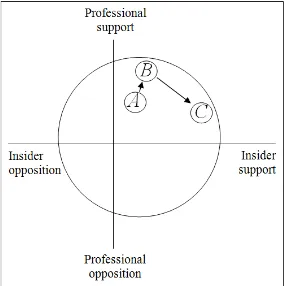
one another in their relative support and opposition to IT legislation. In figure 1 we generalize
7
Figure 1: Insider Trading Political Opportunity Set
Source: Haddock and Macey (1987)
Support and opposition for IT legislation by the relevant parties is given on the x- and y-axes.
The outer boundary provides the legal limit to support for IT legislation, or the extent that it can
be enforced. The judicial system defines and controls this boundary, generally through
precedent.3 Thus, the extent to which IT legislation can be passed into law (and hence enforced)
is set judicially, proximity to the boundary the law’s scope will reach is determined by the
distinct bargaining powers of the interest groups. More expansive and broad-based IT legislation
will only reach its maximum level of codification into law to the extent that the precedents of the
judicial system allow it to – lobbying interests, however strong, are limited in the extent that they
3
8 will see their legislative desires fulfilled.
IT legislation level B dominates A if both professionals and insiders offer more support
for this legislation than the current law allows for. A move from B to C depends on the influence
that each party can wield within the judicial and political system. For example, if market
professionals are more influential than insiders, they may be able to attain their desired level of
regulation despite the wishes of the insiders. The ultimate level of regulation will depend not
only on the demands of each party, but also on their respective bargaining powers.
Although conceptually attractive, the Haddock and Macey model as presented lacks in
two areas. First, it assumes that the parties involved are binary – insiders and professionals. It
excludes different groups from analysis, outsiders in the form of small individual investors, for
example.4 Second, the model does little to explain where the sources of relative bargaining
influence originate. A hierarchy does exist due to organizationally derived bargaining power. The
level of influence and bargaining power generally descends as you move through the list of
agents: management, professionals and investors.
Two factors jointly establish the relative effort that each group will dedicate to lobbying
for their preferred regulatory position.
On the one side is the benefit (both relative and marginal) that each group expects to
obtain. This is negatively related to the number of agents contained within the set. Due to their
sheer numbers, investors each stand to benefit very little at the margin from increased access to
inside information. Management, the smallest group numerically, has the largest marginal benefit
as inside information can be concentrated in the hands of a very limited number of individuals if
not regulated. Market professionals fall somewhere between these two groups.
4
9
The other side of the issue is the relative organization and resultant bargaining power that
generally decreases as membership increases. Investors are poorly organized and wield little
political authority. The masses, despite their potential for high influence due to large numbers,
are unable to organize effectively as the costs of doing so outweigh the benefits each member
expects to receive (Olson 1969). Consequently, a small group favoring an inefficient policy can
still realize their goal if they exert more political influence than a larger competing group
(Becker 1983).
Investors commonly utilize the services of market professionals through investment firms
for their security deals. Implicit in this act is the sacrifice of their political influence in the
regulatory field. Investment firms gain this loss, obtaining greater political influence to set
regulation than was previously available. This effect is magnified as their services will be partly
chosen by the success they have in politically bargaining on behalf of their clients.
We can alter the political opportunity set in figure 1 to reflect the role that each group
serves in the knowledge creation process. Information producers and users loosely align with the
existing dichotomy of insiders and outsiders, but with several important differences. The same
agent or group need not undertake both the creation of information and be the user of its
subsequent knowledge. Consequently, due to the personal and subjective nature of knowledge, it
is unclear with what success someone who is not the creator of its underlying information can
effectively use it. Not only information but also an understanding of what it means is critical for
its successful (i.e., profitable) use (Mayer 2005).5 Regulation redistributes information but the
understanding of what meaning its subsequent knowledge embodies is decidedly more difficult
to transfer. If transmission perverts the meaning of knowledge, actions based upon it might
5
10
likewise be altered.6 Indeed, the accumulation of knowledge is better defined as “an
enhancement of our interpretive powers and our tacit understanding of an unfolding reality rather
than the simple accumulation of data” (Lavoie 1985: 58). The mere accumulation of data is
insufficient to increase our knowledge – we must also gain an understanding of the data’s
implications.
The unhindered transfer of information has several natural checks and balances that
ensure its quality remains high. Information is transferred incrementally in small pieces allowing
for rapid dispersion to the market (Hayek 1976: 116). Not all changes resulting from the
transmission of information need be perfect. The important point is that competitive speculators
continually strive to ensure that information of superior quality displaces that of inferior quality
(Huerta de Soto 2010: chap. 2).
As managers are legislated to provide information to outsiders an important competitive
check that breeds the tendency towards high quality information is removed. The result is that
the information released by a company, or more correctly stated, the understanding thereof, may
be of reduced quality and hence a less faithful representation of its underlying information than
would be the case on the unhampered market.
Information creators consist primarily of insiders. Management creates information
through the daily course of business activities. Normally they would act upon this information
accordingly, if it was beneficial to do so (i.e., if their understanding of it deemed it profitable). IT
legislation denies management these opportunities, forcing the information into the hands of
6
11
market professionals (through their employer investment firms) and individual investors.
Individual investors rely ultimately on investment firms to organize and influence the extent of
IT legislation for them. Despite being potential beneficiaries, individual investors sacrifice their
influence to the better-organized investment firms. This results in two primary subjects in the
political opportunity set consistent with Haddock and Macey (1987) – knowledge producers
(primarily insiders) and users (primarily market professionals through their investment firms).
However, there exists a third group that is highly organized, influential and has clear
benefits from strong IT legislation: information distributors. These distributors – typically large
news groups and investment companies in their role of providing information to their clients –
connect insiders that generate information with the outsiders who are legally allowed to act upon
it. There are relatively few large-scale news outlets capable of disseminating this information.
Their small numbers create a relative ease in politically organizing and lobbying for IT
legislation. Distributors not only have the advantage of being well organized, but they are also in
a position to gain clear rents from these laws. In fact, absent these regulations, their scope of
profit opportunities would lack a whole avenue of business. Without IT legislation, the same
agent that produces information would use it, leaving a reduced and limited need for
intermediary distributors of information. To the extent that IT legislation exists and is enforced,
an increased demand for the services for information intermediaries results.7
With the addition of the information distributors we can update the previous political
opportunity set to include all parties privy to the information dissemination process. Information
producers and users (insiders and market professionals) remain largely unaffected from the
7
12
original rendition. The addition of the third dimension of distributors allows us to analyze an
added element. Many large investment firms not only trade directly upon information but also act
as distributors of it for their clients. Thus, these companies benefit in two ways from their newly
legislated role as primary information distributors.
The gain of information only provides the potential for profits. Even if the meaning
embodied in this information is maintained to provide for these profits, the party with first access
to it will still earn the rents. Meaning, in this case, is the ancillary facts that are instrumental to
understanding the full importance of the newly created information. These additional facts are
increasingly lost the further from the original producers the information recedes.8 Individual
investors will not be the first recipients of this information as it will still be distributed to them
via an intermediary news agency and not directly from company insiders. As the transmission
process perverts, reduces or losses the meaning of this information, individual investors are left
with lower quality information to base their investment decisions on. Indeed, as Prechter (2001:
121) summarizes, the acceptance of information by investors without verifying its quality, “is not
simply fairly common; it is ubiquitous. Most people get virtually all their ideas about financial
markets from other people, through newspapers, television, tipsters, and analysts, without
checking a thing. They think, “Who am I to check? These other people are supposed to be the
experts.”
News corporations gain accordingly from this newfound fountain of information. A new
line of business opens itself to them as a body is necessary to transmit the information that
insiders (knowledge producers) are barred from using to outsiders (information users) who are
8
13
the only ones legislated to act upon it. The largest group to benefit however is the investment
institutions that not only act upon the additional information for their own purposes, but also
release and transfer it to their clients via information updates (i.e., investment tips, newsletters,
etc.). These companies get first use of the information, even before their individual clients gain
access to it. By the time any regulated information reaches an individual client it will most likely
have already been acted upon and its profit opportunities exploited. Investment companies thus
have the appearance of helping their clients via rapid and pertinent information-dissemination,
but the reality is much starker. This dissemination is of little value, the company having already
exploited (at least to some degree) its worth. The information becomes a sales pitch, and gives
small investors the illusion of having better access to information than others have. The illusion
of better access to information is, however, just that: an illusion. While small investors of one
investment firm may have better access to information than investors of a different firm, they
will always be subordinate to the company that disseminates the information to them.
Additionally, information distributors face increasingly certain gains. Their profits do not
depend solely on the newly accessed information used for their own trading purposes. Instead,
they profit through the gains created by other investors acting upon this information. Any gain
from information will be uncertain to an investor trying to estimate its value on the market.
Distributors stand ready to earn a positive return from this information from the fees their clients
incur by acting upon this information by purchasing or selling securities accordingly. Evidence
suggests that the gains from prohibiting insider trading are not randomly distributed among
investors (Macey 1991). Market professionals benefit disproportionately from these regulations
as they are able to devote their careers to seeking and acquiring new information before other
14
Individual investors have little interest in IT regulations. They will be in either case (with
regulations or with an unhindered flow of information) the final recipients of inside-generated
information. The consequent marginal benefit of gaining access to insider information is quite
low to any one investor. Additionally, as there are multitudes of investors, even if the information
could be translated into profit opportunities, the ultimately minor benefit to each individual
would likely prohibit organization to campaign for the regulation. Investors use the services of an
investment house to both trade securities and gain information about them. They will opt for
these intermediaries to campaign for increased information transparency on their behalf.
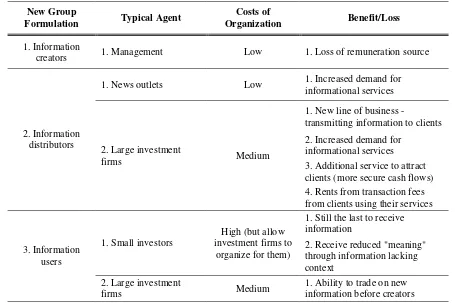
This new trichotomy of agents, their relative costs of organization and the expected costs
or benefits to be sustained through insider trading legislation is summarized in table 1. While
previous literature focuses primarily on the first and last groups – information creators (insiders)
and users (outsiders) – our addition of information distributors allows us to see a potentially
15 New Group
Formulation Typical Agent
Costs of
Organization Benefit/Loss
1. Information
creators 1. Management Low 1. Loss of remuneration source
2. Information distributors
1. News outlets Low 1. Increased demand for
informational services
2. Large investment
firms Medium
1. New line of business -
transmitting information to clients
2. Increased demand for informational services 3. Additional service to attract clients (more secure cash flows) 4. Rents from transaction fees from clients using their services
3. Information users
1. Small investors
High (but allow investment firms to
organize for them)
1. Still the last to receive information
2. Receive reduced "meaning" through information lacking context
2. Large investment
firms Medium
[image:16.612.78.533.71.374.2]1. Ability to trade on new information before creators Table 1: Insider Trading Group Formulation
Despite the implied result that company insiders will have a reduced pool of profit opportunities,
the group may still opt to support these laws. Redistribution may be supported to satisfy social
norms. Hence, some companies may voluntarily partake in such action to increase their
attractiveness to potential investors who view such an action as an attractive selling point.9
Alternatively, altruism could drive the push for a voluntary redistribution of information. Insider
trading laws strive to give everyone an even chance, akin to assigning handicaps in golf (Machan
1996). Companies will be enticed to sacrifice their own use of inside information if the market
(outsiders) sufficiently values such information. Companies failing to follow suit would risk
losing sales to companies that do follow such a rule.
The equilibrium likely to result has investment companies collectively support these rules
9
16
as a type of insurance. As their institutional traders are continually competing against one
another for the access to pertinent information, by advocating these regulations each ensures that
they will gain information at the exact same time as everyone else. Although it may preclude ex
post profits for some, IT legislation guarantees an equal opportunity ex ante. It alters the strategy
from one of competition for early information to one of competition for the proper use and
interpretation of such information.10
4 Conclusion
Insider trading legislation is fundamentally an issue of the redistribution of information. Much
analysis to date has centered on the redistribution of monetary rents. As creators of information
(insiders) are legally barred from acting upon it, others (outsiders) must do so. Lacking the
additional knowledge necessary to discern the full meaning of this information, company
outsiders may misuse inside information, leading to informational inefficiencies. A confusion
between information and its profit-generating use has led to many conflicting and inconclusive
studies concerning the effects of insider trading legislation.
With only ill-defined gains among market participants, the continued support (indeed,
strengthening) of insider trading legislation creates a paradox. Haddock and Macey’s (1987)
political opportunity set provides a good starting point to understanding the origin of these laws.
Separating company insiders from outsiders, relative bargaining positions determine the political
consequences of each party’s desired level of regulation. We have bolstered this analysis by
shifting the focus awayfrom being solely concerned with users of information to a more holistic
approach focusing on the three parties involved with the knowledge transmission process:
10
17 creators, distributors, and users of information.
Large investment houses and media outlets dominate the distributor group. These
distributors, especially investment houses, gain in ways largely unavailable lacking a prohibition
on insider trading. Information distributors garner fresh profits in two ways. First, through the
direct use of this information as large distributors are among the first agents to gain access to it.
Second, through indirect sales commissions and other fees earned on their clients’ transactions
based on this new information. As these firms are few in number and well organized, they
maintain an increased ability to mount a political foray to secure these benefits for themselves.
By viewing interest groups involved with insider trading in light of this trichotomy–
information creators, distributors and users – we gain insight into the true nature and causes
behind the enactment and continued existence of these laws. This paper has not answered to what
extent these agents are incentivized to support insider trading legislation based on this distinction
of roles. It has provided a foundation upon which to identify and analyze where these distinct
incentives originate, based upon these role distinctions.
References
Alchian, A. A. and H. Demsetz. 1972. Production, information costs, and economic organization.
American Economic Review, 62(5), 777-95.
Bebchuk, L. and C. Jolls. 1999. Managerial value diversion and shareholder wealth. Journal of Law, Economics, and Organization, 15(2), 487-502.
Becker, G. S. 1983. A theory of competition among pressure groups for political influence.
Quarterly Journal of Economics, 98(3), 371-400.
Becker, G. S. 1986. The public interest hypothesis revisited: A new test of Peltzman's theory of regulation. Public Choice, 49(3), 223-34.
18
Bettis, J. C., W. A. Ducan and W. K. Harmon. 1998. The effectiveness of insider trading regulations. The Journal of Applied Business Research, 14(4), 53-70.
Bris, Arturo. 2005. Do insider trading laws work? European Financial Management, 11(3), 267-312.
Buchanan, J. M. and G. Tullock. 1962. The calculus of consent. Ann Arbor: University of Michigan Press.
Carlton, D. W. and D. R. Fischel. 1983. The regulation of insider trading. Stanford Law Review, 35(5), 857-95.
Durnev, Art A., and Amrita S. Nain. 2005. The Effectiveness of insider trading regulation around the globe. William Davidson Institute Working paper #695.
Easterbrook, F. H. 1985. “Insider Trading as an Agency Problem.” In Principles and Agents: The Structure of Business, J. W. Pratt and R. Zeckhauser (eds.). Boston: Harvard Business School Press.
Eichenberger, R. and F. Oberholzer-Gee. 1997. Rational moralists: The role of fairness in democratic economic politics. Public Choice, 94(1), 191-210.
Georgakopoulos, N. 1993. Insider trading as a transactional cost: A market microstructure justification and optimization of insider trading regulation. Connecticut Law Review, 26, 1-51.
Goshen, Z. and G. Parchomovsky. 2000. On insider trading markets, and 'negative' property rights in information. Fordham Law and Economics Research Paper No. 06.
Haddock, D. D. and J. R. Macey. 1987. Regulation on demand: A private interest model, with an application to insider trading regulation. Journal of Law and Economics, 30(2), 311-52.
Harris, Larry. 2003. Trading & Exchanges: Market Microstructure for Practitioners. Oxford: Oxford University Press.
Hayek, F. A. 1976. Law, legislation and liberty, volume 2: The mirage of social justice. Chicago, The University of Chicago Press.
Howden, D. 2010. Knowledge shifts and the business cycle: When boom turns to bust. Review of Austrian Economics, 23(2), 165-82.
Huerta de Soto, J. 2010. Socialism, Economic Calculation and Entrepreneurship, (trans.) Melinda Stroup. Cheltenham, UK: Edward Elgar.
19
Keeler, T. E. 1984. Theories of regulation and the deregulation movement. Public Choice, 44(1), 103-45.
Lavoie, D. 1985. National economic planning: What isleft? Washington, DC: CATO Institute.
Macey, J. R. 1991. Insider trading: economics, politics, and policy. Washington, D.C.: The AEI Press.
Machan, T. R. 1996. What is morally right with insider trading. Public Affairs Quarterly, 10(2), 135-42.
Manne, H. G. 1965. Mergers and the market for corporate control. The Journal of Political Economy, 73(2), 110-20.
Manne, H. G. 1966a. Insider trading and the stock market. New York: The Free Press.
Manne, H. G. 1966b. In defense of insider trading. Harvard Business Review, 44(6), 113-22.
Mayer, T. 2005. Information, knowledge, understanding and wisdom. Econ Journal Watch, 2(1), 66-69.
Olson, M. 1969. The logic of collective action. Cambridge, MA: Harvard University Press.
Padilla, A. 2002. Can agency theory justify the regulation of insider trading? The Quarterly Journal of Austrian Economics, 5(1), 3-38.
Padilla, A. 2005. The regulation of insider trading as an agency problem. bepress Legal Series. Working paper 641.
Peltzman, S. 1976. Toward a More General Theory of Regulation. Journal of Law and Economics, 19(2), 211-40.
Prechter, R. R., Jr. 2001. Unconscious herding behavior as the psychological basis of financial market trends and patterns. The Journal of Psychology and Financial Markets, 2(3), 120–25.
Primaux, W. J., J. E. Filer, R. S. Herren, and D. R. Hollas. 1984. Determinants of regulatory policies toward competition in the electric utility industry. Public Choice, 43(2), 173-86.
Shin, J. 1996. The optimal regulation of insider trading. Journal of Financial Intermediation, 5(1), 49-73.
Shleifer, A., and R. W. Vishny. 1986. Large shareholders and corporate control. Journal of Political Economy, 94(3), 461-88.