New Parameterizations and Features for PSCFG-Based Machine
Translation
Andreas Zollmann Stephan Vogel
Language Technologies Institute School of Computer Science
Carnegie Mellon University {zollmann,vogel}@cs.cmu.edu
Abstract
We propose several improvements to the hierarchical phrase-based MT model of Chiang (2005) and its syntax-based exten-sion by Zollmann and Venugopal (2006). We add a source-span variance model that, for each rule utilized in a prob-abilistic synchronous context-free gram-mar (PSCFG) derivation, gives a confi-dence estimate in the rule based on the number of source words spanned by the rule and its substituted child rules, with the distributions of these source span sizes estimated during training time.
We further propose different methods of combining hierarchical and syntax-based PSCFG models, by merging the grammars as well as by interpolating the translation models.
Finally, we compare syntax-augmented MT, which extracts rules based on target-side syntax, to a corresponding variant based on source-side syntax, and experi-ment with a model extension that jointly takes source and target syntax into ac-count.
1 Introduction
The Probabilistic Synchronous Context Free Grammar (PSCFG) formalism suggests an intu-itive approach to model the long-distance and lex-ically sensitive reordering phenomena that often occur across language pairs considered for statis-tical machine translation. As in monolingual pars-ing, nonterminal symbols in translation rules are
used to generalize beyond purely lexical opera-tions. Labels on these nonterminal symbols are often used to enforce syntactic constraints in the generation of bilingual sentences and imply con-ditional independence assumptions in the statis-tical translation model. Several techniques have been recently proposed to automatically iden-tify and estimate parameters for PSCFGs (or re-lated synchronous grammars) from parallel cor-pora (Galley et al., 2004; Chiang, 2005; Zollmann and Venugopal, 2006; Liu et al., 2006; Marcu et al., 2006).
In this work, we propose several improvements to the hierarchical phrase-based MT model of Chiang (2005) and its syntax-based extension by Zollmann and Venugopal (2006). We add a source span variance model that, for each rule utilized in a probabilistic synchronous context-free gram-mar (PSCFG) derivation, gives a confidence es-timate in the rule based on the number of source words spanned by the rule and its substituted child rules, with the distributions of these source span sizes estimated during training (i.e., rule extrac-tion) time.
We further propose different methods of com-bining hierarchical and syntax-based PSCFG models, by merging the grammars as well as by interpolating the translation models.
Finally, we compare syntax-augmented MT, which extracts rules based on target-side syntax, to a corresponding variant based on source-side syntax, and experiment with a model extension based on sourceandtarget syntax.
2 Related work
Chiang et al. (2008) introduce structural dis-tortion features into a hierarchical phrase-based model, aimed at modeling nonterminal reordering given source span length, by estimating for each possible source span length`a Bernoulli
distribu-tion p(R|`) where R takes value one if
reorder-ing takes place and zero otherwise. Maximum-likelihood estimation of the distribution amounts to simply counting the relative frequency of non-terminal reorderings over all extracted rule in-stances that incurred a substitution of span length
`. In a more fine-grained approach they add a
sep-arate binary featurehR, `ifor each combination of
reordering truth valueRand span length`(where
all ` ≥ 10 are merged into a single value), and then tune the feature weights discriminatively on a development set. Our approach differs from Chi-ang et al. (2008) in that we estimate one source span length distribution for each substitution site of each grammar rule, resulting in unique distri-butions for each rule, estimated from all instances of the rule in the training data. This enables our model to condition reordering range on the in-dividual rules used in a derivation, and even al-lows to distinguish between two rules r1 and r2 that both reorder arguments with identical mean span lengths`, but where the span lengths
encoun-tered in extracted instances ofr1are all close to`, whereas span length instances forr2vary widely. Chen and Eisele (2010) propose a hypbrid ap-proach between hierarchical phrase based MT and a rule based MT system, reporting improve-ment over each individual model on an English-to-German translation task. Essentially, the rule based system is converted to a single-nonterminal PSCFG, and hence can be combined with the hierarchical model, another single-nonterminal PSCFG, by taking the union of the rule sets and augmenting the feature vectors, adding zero-values for rules that only exist in one of the two grammars. We face the challenge of combining the single-nonterminal hierarchical grammar with a multi-nonterminal syntax-augmented grammar. Thus one hierarchical rule typically corresponds to many syntax-augmented rules. The SAMT sys-tem used by Zollmann et al. (2008) adds
hierar-chical rules separately to the syntax-augmented grammar, resulting in a backbone grammar of well-estimated hierarchical rules supporting the sparser syntactic rules. They allow the model preference between hierarchical and syntax rules to be learned from development data by adding an indicator feature to all rules, which is one for hierarchical rules and zero for syntax rules. However, no empirical comparison is given be-tween the purely syntax-augmented and the hy-brid grammar. We aim to fill this gap by experi-menting with both models, and further refine the hybrid approach by adding interpolated probabil-ity models to the syntax rules.
Chiang (2010) augments a hierarchical phrase-based MT model with binary syntax features rep-resenting the source and target syntactic con-stituents of a given rule’s instantiations during training, thus taking source and target syntax into account while avoiding the data-sparseness and decoding-complexity problems of multi-nonterminal PSCFG models. In our approach, the source- and target-side syntax directly determines the grammar, resulting in a nonterminal set de-rived from the labels underlying the source- and target-language treebanks.
3 PSCFG-based translation
Given a source language sentence f, statistical
machine translation defines the translation task as selecting the most likely target translationeunder
a modelP(e|f), i.e.:
ˆ
e(f) = arg max
e P(e|f) = arg maxe
m X
i=1
hi(e,f)λi
where the arg max operation denotes a search through a structured space of translation outputs in the target language,hi(e,f) are bilingual fea-tures of e and f and monolingual features of e, and weights λi are typically trained discrim-inatively to maximize translation quality (based on automatic metrics) on held out data, e.g., us-ing minimum-error-rate trainus-ing (MERT) (Och, 2003).
Most large scale systems approximate the search above by simply searching for the most likely derivation of rules, rather than searching for the most likely translated output. There are efficient algorithms to perform this search (Kasami, 1965; Chappelier and Rajman, 1998) that have been ex-tended to efficiently integrate n-gram language
model features (Chiang, 2007; Venugopal et al., 2007; Huang and Chiang, 2007; Zollmann et al., 2008; Petrov et al., 2008).
In this work we experiment with PSCFGs that have been automatically learned from word-aligned parallel corpora. PSCFGs are defined by a source terminal set (source vocabulary)TS, a
tar-get terminal set (tartar-get vocabulary) TT, a shared nonterminal set N and rules of the form: X → hγ, α, wiwhere
• X ∈ N is a labeled nonterminal referred to as the left-hand-side of the rule.
• γ ∈(N ∪ TS)∗is the source side of the rule.
• α∈(N ∪ TT)∗is the target side of the rule.
• w ∈ [0,∞) is a non-negative real-valued weight assigned to the rule; in our model,wis
the exponential function of the inner product of featureshand weightsλ.
3.1 Hierarchical phrase-based MT
Building upon the success of phrase-based meth-ods, Chiang (2005) presents a PSCFG model of translation that uses the bilingual phrase pairs of phrase-based MT as starting point to learn hierarchical rules. For each training sentence pair’s set of extracted phrase pairs, the set of in-duced PSCFG rules can be generated as follows: First, each phrase pair is assigned a generic X
-nonterminal as left-hand-side, making it aninitial rule. We can now recursively generalize each al-ready obtained rule (initial or including nontermi-nals)
N →f1. . . fm/e1. . . en for which there is aninitialrule
M →fi. . . fu/ej. . . ev
where1 ≤ i < u ≤ mand1 ≤ j < v ≤ n, to
obtain a new rule
N →f1i−1Xkfu+1m /ej1−1Xkenv+1
where e.g. f1i−1 is short-hand forf1. . . fi−1, and where k is an index for the nonterminal X that
indicates the one-to-one correspondence between the new X tokens on the two sides (it is not in
the space of word indices likei, j, u, v, m, n). The
recursive form of this generalization operation al-lows the generation of rules with multiple nonter-minal pairs.
Chiang (2005) uses features analogous to the ones used in phrase-based translation: a lan-guage model neg-log probability, a ‘rule given source-side’ neg-log-probability, a ‘rule given target-side’ neg-log-probability, source- and tar-get conditioned ‘lexical’ neg-log-probabilities based on word-to-word co-occurrences (Koehn et al., 2003), as well as rule, target word, and glue operation counters. We follow Venugopal and Zollmann (2009) to further add a rareness penalty,
1/count(r)
where count(r) is the occurrence count of rule
r in the training corpus, allowing the system to
learn penalization of low-frequency rules, as well as three indicator features firing if the rule has one, two unswapped, and two swapped nontermi-nal pairs, respectively.1
3.2 Syntax Augmented MT
Syntax Augmented MT (SAMT) (Zollmann and Venugopal, 2006) extends Chiang (2005) to in-clude nonterminal symbols from target language phrase structure parse trees. Each target sentence in the training corpus is parsed with a stochas-tic parser to produce constituent labels for target spans. Phrase pairs (extracted from a particular sentence pair) are assigned left-hand-side nonter-minal symbols based on the target side parse tree constituent spans.
Phrase pairs whose target side corresponds to a constituent span are assigned that constituent’s label as their left-hand-side nonterminal. If the target side of the phrase pair is not spanned by a single constituent in the corresponding parse tree, we use the labels of subsuming, subsumed, and neighboring parse tree constituents to assign
1Penalization or reward of purely-lexical rules can be
an extended label of the form C1 +C2, C1/C2, or C2\C1 (the latter two being motivated from the operations in combinatory categorial gram-mar (CCG) (Steedman, 2000)), indicating that the phrase pair’s target side spans two adjacent syn-tactic categories (e.g.,she went: NP+VB), a par-tial syntactic categoryC1missing aC2at the right (e.g., the great: NP/NN), or a partial C1 missing aC2at the left (e.g.,great wall: DT\NP), respec-tively. The label assignment is attempted in the or-der just described, i.e., assembling labels based on ‘+’ concatenation of two subsumed constituents is preferred, as smaller constituents tend to be more accurately labeled. If no label is assignable by ei-ther of these three methods, a default label ‘FAIL’ is assigned.
In addition to the features used in hierarchical phrase-based MT, SAMT introduces a relative-frequency estimated probability of the rule given its left-hand-side nonterminal.
4 Modeling Source Span Length of PSCFG Rule Substitution Sites
Extracting a rule with k right-hand-side
nonter-minal pairs, i.e., substitution sites, (from now on called order-k rule) by the method described in
Section 3 involvesk+ 1phrase pairs: one phrase pair used as initial rule andkphrase pairs that are
sub phrase pairs of the first and replaced by non-terminal pairs. Conversely, during translation, ap-plying this rule amounts to combiningk
hypothe-ses fromkdifferent chart cells, each represented
by a source span and a nonterminal, to form a new hypothesis and file it into a chart cell. Intuitively, we want the source span lengths of these k+ 1 chart cells to be close to the source side lengths of thek+1phrase pairs from the training corpus that were involved in extracting the rule. Of course, each rule generally was extracted from multiple training corpus locations, with different involved phrase pairs of different lengths. We therefore modelk+ 1source span length distributions for each order-krule in the grammar.
Ignoring the discreteness of source span length for the sake of easier estimation, we assume the distribution to be log-normal. This is motivated by the fact that source span length is positive and that we expect its deviation between instances of
the same rule to be greater for long phrase pairs than for short ones.
We can now addˆk+ 1features to the transla-tion framework, wherekˆ is the maximum num-ber of PSCFG rule nonterminal pairs, in our case two. Each feature is computed during translation time. Ideally, it should represent the probabil-ity of the hypothesized rule given the respective chart cell span length. However, as each com-peting rule underlies a different distribution, this would require a Bayesian setting, in which priors over distributions are specified. In this prelimi-nary work we take a simpler approach: Based on the rule’s span distribution, we compute the prob-ability that a span length no likelier than the one encountered was generated from the distribution. This probability thus yields a confidence estimate for the rule. More formally, letµbe the mean and σ the standard deviation of the logarithm of the
span length random variableXconcerned, and let xbe the span length encountered during decoding.
Then the computed confidence estimate is given by
P(|ln(X)−µ| ≥ |ln(x)−µ|)
= 2∗Z(−(|ln(x)−µ|)/σ)
whereZ is the cumulative density function of the
normal distribution with mean zero and variance one.
The confidence estimate is one if the encoun-tered span length is equal to the mean of the dis-tribution, and decreases as the encountered span length deviates further from the mean. The sever-ity of that decline is determined by the distribution variance: the higher the variance, the less a devia-tion from the mean is penalized.
5 Merging a Hierarchical and a Syntax-Based Model
While syntax-based grammars allow for more re-fined statistical models and guide the search by constraining substitution possibilitites in a gram-mar derivation, gramgram-mar sizes tend to be much greater than for hierarchical grammars. Therefore the average occurrence count of a syntax rule is much lower than that of a hierarchical rule, and thus estimated probabilitites are less reliable.
We propose to augment the syntax-based “rule given source side” and “rule given target side” dis-tributions by hierarchical counterparts obtained by marginalizing over the left-hand-side and right-hand-side rule nonterminals. For example, the hierarchical equivalent of the “rule given source side” probability is obtained by summing occur-rence counts over all rules that have the same source and target terminals and substitution posi-tions but possibly differ in the left- and/or right-hand side nonterminal labels, divided by the sum of occurrence counts of all rules that have the same source side terminals and source side substi-tution positions. Similarly, an alternative rareness penalty based on the combined frequency of all rules with the same terminals and substitution po-sitions is obtained.
Using these syntax and hierarchical features side by side amounts to interpolation of the re-spective probability models in log-space, with minimum-error-rate training (MERT) determining the optimal interpolation coefficient. We also add respective models interpolated with coefficient .5 in probability-space as additional features to the system.
We further experiment with adding hierarchical rules separately to the syntax-augmented gram-mar, as proposed in Zollmann et al. (2008), with the respective syntax-specific features set to zero. A ‘hierarchical-indicator’ feature is added to all rules, which is one for hierarchical rules and zero for syntax rules, allowing the joint model to trade of hierarchical against syntactic rules. During translation, the hierarchical and syntax worlds are bridged by glue rules, which allow monotonic concatenation of hierarchical and syntactic partial sentence hypotheses. We separate the glue feature
used in hierarchical and syntax-augmented trans-lation into a glue feature that only fires when a hi-erarchical rule is glued, and a distinct glue feature firing when gluing a syntax-augmented rule.
6 Extension of SAMT to a bilingually parsed corpus
Syntax-based MT models have been proposed both based on target-side syntactic annotations (Galley et al., 2004; Zollmann and Venugopal, 2006) as well source-side annotations (Liu et al., 2006). Syntactic annotations for both sourceand target language are available for popular language pairs such as Chinese-English. In this case, our grammar extraction procedure can be easily ex-tended to impose both source and target con-straints on the eligible substitutions simultane-ously.
LetNf be the nonterminal label that would be assigned to a given initial rule when utilizing the source-side parse tree, andNe the assigned label according to the target-side parse. Then our bilin-gual model assigns ‘Nf +Ne’ to the initial rule. The extraction of complex rules proceeds as be-fore. The number of nonterminals in this model, based on a source-model label set of sizesand a
target label set of sizet, is thus given byst.
7 Experiments
We evaluate our approaches by comparing trans-lation quality according to the IBM-BLEU (Pap-ineni et al., 2002) metric on the NIST Chinese-to-English translation task using MT04 as devel-opment set to train the model parameters λ, and
MT05, MT06 and MT08 as test sets.
one source-side terminal symbol.
For parameter tuning, we use the L
0-regularized minimum-error-rate training tool pro-vided by the SAMT toolkit.
The parallel training data comprises of 9.6M sentence pairs (206M Chinese Words, 228M En-glish words). The source and target language parses for the syntax-augmented grammar were generated by the Stanford parser (Klein and Man-ning, 2003).
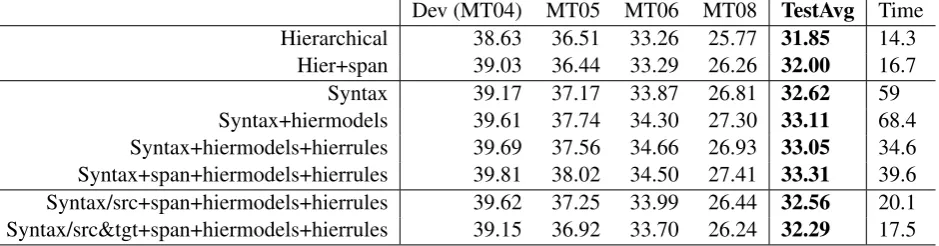
The results are given in Table 1. The source span models (indicated by +span) achieve small test set improvements of 0.15 BLEU points on av-erage for the hierarchical and 0.26 BLEU points for the syntax-augmented system, but these are not statistically significant.
Augmenting a syntax-augmented grammar with hierarchical features (“Syntax+hiermodels”) results in average test set improvements of 0.5 BLEU points. These improvements are not sta-tistically significant either, but persist across all three test sets. This demonstrates the benefit of more reliable feature estimation. Further aug-menting the hierarchical rules to the grammar (“Syntax+hiermodels+hierrules”) does not yield additional improvements.
The use of bilingual syntactic parses (‘Syn-tax/src&tgt’) turns out detrimental to translation quality. We assume this is due to the huge number of nonterminals in these grammars and the great amount of badly-estimated low-occurrence-count rules. Perhaps merging this grammar with a regu-lar syntax-augmented grammar could yield better results.
We also experimented with a source-parse based model (‘Syntax/src’). While not being able to match translation quality of its target-based counterpart, the model still outperforms the hier-archical system on all test sets.
8 Conclusion
We proposed several improvements to the hierar-chical phrase-based MT model of Chiang (2005) and its syntax-based extension by Zollmann and Venugopal (2006). We added a source span length model that, for each rule utilized in a probabilis-tic synchronous context-free grammar (PSCFG) derivation, gives a confidence estimate in the rule
based on the number of source words spanned by the rule and its substituted child rules, resulting in small improvements for hierarchical phrase-based as well as syntax-augmented MT.
We further demonstrated the utility of combin-ing hierarchical and syntax-based PSCFG models and grammars.
Finally, we compared syntax-augmented MT, which extracts rules based on target-side syntax, to a corresponding variant based on source-side syntax, showing that target syntax is more ben-efitial, and unsuccessfully experimented with a model extension that jointly takes source and tar-get syntax into account.
Hierarchical phrase-based MT suffers from spurious ambiguity: A single translation for a given source sentence can usually be accom-plished by many different PSCFG derivations. This problem is exacerbated by syntax-augmented MT with its thousands of nonterminals, and made even worse by its joint source-and-target exten-sion. Future research should apply the work of Blunsom et al. (2008) and Blunsom and Osborne (2008), who marginalize over derivations to find the most probable translation rather than the most probable derivation, to these multi-nonterminal grammars.
All source code underlying this work is avail-able under the GNU Lesser General Public Li-cense as part of the ‘SAMT’ system at:
www.cs.cmu.edu/˜zollmann/samt
Acknowledgements
This work is in part supported by NSF un-der the Cluster Exploratory program (grant NSF 0844507), and in part by the US DARPA GALE program. Any opinions, findings, and conclusions or recommendations expressed in this material are those of the authors and do not necessarily reflect the views of NSF or DARPA.
References
Blunsom, Phil and Miles Osborne. 2008. Probabilistic inference for machine translation. InEMNLP ’08: Proceedings of the Conference on Empirical
Meth-ods in Natural Language Processing, pages 215–
Dev (MT04) MT05 MT06 MT08 TestAvg Time Hierarchical 38.63 36.51 33.26 25.77 31.85 14.3
[image:7.595.75.545.73.196.2]Hier+span 39.03 36.44 33.29 26.26 32.00 16.7 Syntax 39.17 37.17 33.87 26.81 32.62 59 Syntax+hiermodels 39.61 37.74 34.30 27.30 33.11 68.4 Syntax+hiermodels+hierrules 39.69 37.56 34.66 26.93 33.05 34.6 Syntax+span+hiermodels+hierrules 39.81 38.02 34.50 27.41 33.31 39.6 Syntax/src+span+hiermodels+hierrules 39.62 37.25 33.99 26.44 32.56 20.1 Syntax/src&tgt+span+hiermodels+hierrules 39.15 36.92 33.70 26.24 32.29 17.5
Table 1: Translation quality in % case-insensitive IBM-BLEU (i.e., brevity penalty based on closest reference length) for different systems on Chinese-English NIST-large translation tasks. ‘TestAvg’ shows the average score over the three test sets. ‘Time’ is the average decoding time per sentence in seconds on one CPU.
Blunsom, Phil, Trevor Cohn, and Miles Osborne. 2008. A discriminative latent variable model for statistical machine translation. In Proceedings of the Annual Meeting of the Association for Compu-tational Linguistics (ACL).
Brown, Peter F., Vincent J. Della Pietra, Stephen A. Della Pietra, and Robert L. Mercer. 1993. The mathematics of statistical machine translation: parameter estimation. Computational Linguistics, 19(2).
Chappelier, J.C. and M. Rajman. 1998. A general-ized CYK algorithm for parsing stochastic CFG. In
Proceedings of Tabulation in Parsing and Deduction (TAPD), pages 133–137, Paris.
Chen, Yu and Andreas Eisele. 2010. Hierarchical hy-brid translation between english and german. In Hansen, Viggo and Francois Yvon, editors, Pro-ceedings of the 14th Annual Conference of the
Eu-ropean Association for Machine Translation, pages
90–97. EAMT, EAMT, 5.
Chiang, David, Yuval Marton, and Philip Resnik. 2008. Online large-margin training of syntactic and structural translation features. In Proceedings of the 2008 Conference on Empirical Methods in
Nat-ural Language Processing, pages 224–233,
Hon-olulu, Hawaii, October. Association for Computa-tional Linguistics.
Chiang, David. 2005. A hierarchical phrase-based model for statistical machine translation. In Pro-ceedings of the Annual Meeting of the Association for Computational Linguistics (ACL).
Chiang, David. 2007. Hierarchical phrase based trans-lation. Computational Linguistics, 33(2).
Chiang, David. 2010. Learning to translate with source and target syntax. In Proceedings of the 48th Annual Meeting of the Association for
Com-putational Linguistics, pages 1443–1452, Uppsala,
Sweden, July. Association for Computational Lin-guistics.
Galley, Michael, Mark Hopkins, Kevin Knight, and Daniel Marcu. 2004. What’s in a translation rule?
InProceedings of the Human Language Technology
Conference of the North American Chapter of the Association for Computational Linguistics
Confer-ence (HLT/NAACL).
Huang, Liang and David Chiang. 2007. Forest rescor-ing: Faster decoding with integrated language mod-els. In Proceedings of the Annual Meeting of the Association for Computational Linguistics (ACL). Kasami, T. 1965. An efficient recognition
and syntax-analysis algorithm for context-free lan-guages. Technical report, Air Force Cambridge Re-search Lab.
Klein, Dan and Christoper Manning. 2003. Accurate unlexicalized parsing. InProceedings of the Annual Meeting of the Association for Computational Lin-guistics (ACL).
Koehn, Philipp, Franz J. Och, and Daniel Marcu. 2003. Statistical phrase-based translation. In Pro-ceedings of the Human Language Technology Con-ference of the North American Chapter of the As-sociation for Computational Linguistics Conference
(HLT/NAACL).
Liu, Yang, Qun Liu, and Shouxun Lin. 2006. Tree-to-string alignment template for statistical machine translation. InProceedings of the 21st International Conference on Computational Linguistics and the 44th annual meeting of the Association for Compu-tational Linguistics.
Marcu, Daniel, Wei Wang, Abdessamad Echihabi, and Kevin Knight. 2006. SPMT: Statistical ma-chine translation with syntactified target language phrases. InProceedings of the Conference on Em-pirical Methods in Natural Language Processing
Och, Franz J. 2003. Minimum error rate training in statistical machine translation. In Proceedings of the Annual Meeting of the Association for Compu-tational Linguistics (ACL).
Papineni, Kishore, Salim Roukos, Todd Ward, and Wei-Jing Zhu. 2002. BLEU: a method for auto-matic evaluation of machine translation. In Pro-ceedings of the Annual Meeting of the Association for Computational Linguistics (ACL).
Petrov, Slav, Aria Haghighi, and Dan Klein. 2008. Coarse-to-fine syntactic machine translation using language projections. In Proceedings of the Con-ference on Empirical Methods in Natural Language
Processing (EMNLP).
Steedman, Mark. 2000. The Syntactic Process. MIT Press.
Venugopal, Ashish and Andreas Zollmann. 2009. Grammar based statistical MT on Hadoop: An end-to-end toolkit for large scale PSCFG based MT.
The Prague Bulletin of Mathematical Linguistics,
91:67–78.
Venugopal, Ashish, Andreas Zollmann, and Stephan Vogel. 2007. An efficient two-pass approach to synchronous-CFG driven statistical MT. In Pro-ceedings of the Human Language Technology Con-ference of the North American Chapter of the As-sociation for Computational Linguistics Conference
(HLT/NAACL).
Welford, B. P. 1962. Note on a method for calculating corrected sums of squares and products. Techno-metrics, 4(3):419–420.
West, D. H. D. 1979. Updating mean and variance estimates: an improved method. Commun. ACM, 22(9):532–535.
Zollmann, Andreas and Ashish Venugopal. 2006. Syntax augmented machine translation via chart parsing. In Proceedings of the Workshop on
Sta-tistical Machine Translation, HLT/NAACL.
Zollmann, Andreas, Ashish Venugopal, Franz J. Och, and Jay Ponte. 2008. A systematic comparison of phrase-based, hierarchical and syntax-augmented statistical MT. InProceedings of the Conference on