Incremental Parsing in Bounded Memory
William Schuler
Department of Lingustics The Ohio State University
Abstract
This tutorial will describe the use of a fac-tored probabilistic sequence model for parsing speech and text using a bounded store of three to four incomplete constituents over time, in line with recent estimates of human short-term working memory capacity. This formu-lation uses a grammar transform to minimize memory usage during parsing. Incremental operations on incomplete constituents in this transformed representation then define an ex-tended domain of locality similar to those de-fined in mildly context-sensitive grammar for-malisms, which can similarly be used to pro-cess long-distance and crossed-and-nested de-pendencies.
1 Introduction
This paper will describe the derivation of a fac-tored probabilistic sequence model from a proba-bilistic context-free grammar (PCFG). The result-ing sequence model can incrementally parse input sentences approximately as accurately as a bottom-up CKY-styple parser, incrementally estimating the contents of a bounded memory store of intended constituents, consisting of only three to four work-ing memory elements, in line with recent esti-mates of human short-term working memory capac-ity (Cowan, 2001). The detailed derivation of this model is intended to illustrate how probabilistic de-pendencies from an original PCFG (or other types of syntax-derived dependencies) can be preserved in a processing model with human-like working memory constraints.
1.1 Notation
This paper will associate variables for syntactic cate-goriesc, trees or subtreesτ, and string yieldsx¯with constituents in phrase structure trees, identified us-ing subscripts that describe the path from the root of the tree containing this constituent to the constituent itself. These paths may consist of left branches dicated by ‘0’s in the path) and right branches (in-dicated by ‘1’s), concatenated into sequencesη(orι
orκ). Thus, if a pathηidentifies a constituent, that constituent’s left child would be identified by η0, and that constituent’s right child would be identified
byη1. The empty path²will be sued to identify the
root of a tree.
The probabilistic parsers defined here will also use an indicator functionJ⋅Kto denote deterministic probabilities:JφK=1ifφis true,0otherwise.
2 Parsing
For a phrase structure subtree rooted at a constituent of categorycη with yieldx¯η (a sequence of
individ-ual words x), the task of parsing will require the calculation of the inside likelihood probability or Viterbi (best subtree) probabilities. When the do-mainX of wordsx is a subset of the domainC of category labelsc, these can be calculated using rule probabilities in a probabilistic context-free grammar (PCFG) modelθG, notated:
PθG(cη→cη0cη1)=PθG(cη0cη1∣cη) (1)
Any yieldx¯η can be decomposed into prefixx¯η0
and suffixx¯η1yields:
¯
Therefore, inside likelihood probabilities can be de-fined by marginalizing over all such decomposi-tions:
PθIns(G)(x¯η∣cη)=
⎧⎪⎪⎪⎪ ⎪⎨ ⎪⎪⎪⎪⎪ ⎩
if∣x¯η∣=1∶Jx¯η=cηK
otherwise∶ ∑
¯
xη0cη0,x¯η1cη1
PθG(cη →cη0 cη1)
⋅PθIns(G)(x¯η0∣cη0)
⋅PθIns(G)(x¯η1∣cη1)
(3)
and Viterbi scores (the probability of the best tree) can be defined by maximizing over all such decom-positions:
PθVit(G)(x¯η∣cη)=
⎧⎪⎪⎪⎪ ⎪⎨ ⎪⎪⎪⎪⎪ ⎩
if∣x¯η∣=1∶Jx¯η=cηK
otherwise∶ max
¯
xη0cη0,x¯η1cη1PθG(
cη →cη0 cη1)
⋅PθVit(G)(x¯η0∣cη0)
⋅PθVit(G)(x¯η1∣cη1)
(4)
From these, it is possible to obtain the probability of a sentencex¯²:
P(x¯²)=∑ c²
PθIns(G)(x¯²∣c²) ⋅P(c²) (5)
and the most likely tree:
ˆ
τ²=argmax
τ² PθVit(G)(
¯
x²∣cτ²) ⋅P(cτ²) (6)
3 Incremental Parsing using Incomplete Constituents
Note that any prefix of a yield x¯η can be rewritten
as an ‘incomplete yield’ consisting of the complete yield lacking some suffix of that yieldx¯ηι:
¯
xη=(x¯η/x¯ηι)x¯ηι (7)
It is therefore possible to decompose any inside like-lihood or Viterbi probability into two parts: first, an ‘incomplete constituent’ probability of generating this incomplete yieldx¯η/x¯ηι along with anawaited
constituent of category cηι, given an active
con-stituent of categorycη; and second, an ordinary
in-side or Viterbi probability (or ‘complete constituent’ probability) of generatingx¯ηι givencηι:
PθIns(G)(x¯η∣cη)= ∑
ι∈1+,¯x
ηι,cηι
PθIC(G)(x¯η/x¯ηι, cηι∣cη)
⋅PθIns(G)(x¯ηι∣cηι) (8)
This decomposition can be represented graphically as a transformation of the structure of a recurrence from the standard PCFG recurrence above, corre-sponding to PCFG dependencies, to one involv-ing incomplete constituents (in particular, this will transform the end of a right-expanding sequence into the beginning of a left-expanding sequence of in-complete constituents):
cη
¯
xη/x¯ηι cηι
¯
xηι
⇒
cη
cη/cηι
¯
xη/x¯ηι
cηι
¯
xηι
(9)
This decomposition gives incomplete constituent probabilities that can then be decomposed into other incomplete constituent probabilities (this will trans-form the middle of a right-expending sequence into the middle of a left-expanding sequence of incom-plete constituents):
PθIC(G)(x¯η/x¯ηι1, cηι1∣cη)
= ∑
¯
xηι,cηι
PθIC(G)(x¯η/x¯ηι, cηι∣cη)
⋅PθIC(G)(x¯ηι/x¯ηι1, cηι1∣cηι) (10)
= ∑
¯
xηι,cηι
PθIC(G)(x¯η/x¯ηι, cηι∣cη)
⋅ ∑
¯
xηι0,cηι0
PθG(cηι→cηι0cηι1)
⋅PθIns(G)(x¯ηι0∣cηι0) (11)
represented graphically:
cη
¯
xη/x¯ηι cηι
cηι0
¯
xηι0
cηι1
¯
xηι1
⇒
cη
cη/cηι1
cη/cηι
¯
xη/x¯ηι
cηι0
¯
xηι0
¯
xηι1
(12)
or into the product of a grammar rule probability and an inside probability at the end of a sequence of such decompositions (this will transform the beginning of a right-expanding sequence into the end of a left-expanding sequence of incomplete constituents):
PθIC(G)(x¯η/x¯η1, cη1∣cη)=
∑
¯
xη0,cη0
represented graphically:
cη
cη0
¯
xη0
cη1
¯
xη1
⇒
cη
cη/cη1
cη0
¯
xη0
¯
xη1
(14)
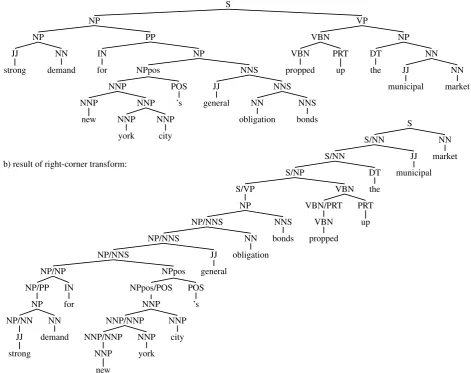
Essentially this transformation turns right-expanding sequences of constituents (with sub-script addresses ending in ‘1’) into left-expanding sequences of incomplete constituents, which can be composed together as they are recognized incre-mentally from left to right. The decompositions of Equations 8–13, taken together, are a model-based right-corner transform (Schuler, 2009).
This transformation can then be defined on depth-specific rules, allowing the sequence model to keep track of a bounded amount of center-embedded phrase structure.
PθIns(G),d(x¯η∣cη)= ∑
ι∈1+,¯xηι,cηι
PθIC(G),d(x¯η/x¯ηι, cηι∣cη)
⋅PθIns(G),d(x¯ηι∣cηι) (15)
PθIC(G),d(x¯η/x¯ηι1, cηι1∣cη)
= ∑
¯
xηι,cηι
PθIC(G),d(x¯η/x¯ηι, cηι∣cη)
⋅PθIC(G),d(x¯ηι/x¯ηι1, cηι1∣cηι) (16)
= ∑
¯
xηι,cηι
PθIC(G),d(x¯η/x¯ηι, cηι∣cη)
⋅ ∑
¯
xηι0,cηι0
PθG-R,d(cηι→cηι0 cηι1)
⋅PθIns(G),d+1(x¯ηι0∣cηι0) (17)
PθIC(G),d(x¯η/x¯η1, cη1∣cη)=
∑
¯
xη0,cη0
PθG-L,d(cη →cη0cη1) ⋅PθIns(G),d(x¯η0∣cη0)
(18)
Estimating probabilities for the beginning and ending of these transformed left-expanding se-quences will require the estimation of expected counts for repeated recursive decompositions of yet-unrecognized incomplete constituents according to Equation 8, marginalizing over values ofx¯. Since left children and right children are decomposed dif-ferently, the expected countsθG-RL∗,dwill use PCFG
probabilities θG-R,d and θG-L,d that are conditioned
on whether the expanding constituent is a right or left child, and on the center-embedding depthdof the expanding constituent. The expected counts
θG-RL∗,dare of constituent categoriescηιanywhere in
the left progeny of a right child of categorycη:
EθG-RL∗,d(cη
0
→cη0...)=∑
cη1
PθG-R,d(cη→cη0cη1)
(19)
EθG-RL∗,d(cη k
→cη0k0...)= ∑ cη0k
EθG-RL∗,d(cη k−1
→ cη0k ...)
⋅ ∑
cη0k1
PθG-L,d(cη0k →cη0k0cη0k1) (20)
EθG-RL∗,d(cη
∗
→cηι...)=
∞
∑
k=0
EθG-RL∗,d(cη k
→cηι ...)
(21)
EθG-RL∗,d(cη
+
→cηι...)=EθG-RL∗,d(cη
∗
→cηι...)
−EθG-RL∗,d(cη
0
→cηι...)
(22)
In practice the infinite sum is estimated to some con-stantKusing value iteration (Bellman, 1957).
These expected counts can then be used to calcu-late left progeny probabilities:
PθG-RL∗,d(cη
∗
→cηι...)=
EθG-RL∗,d(cη
∗
→cηι...)
∑cηιEθG-RL∗,d(cη
∗
→cηι...)
(23) which can be used to calculate forward or Viterbi probabilities for all incomplete constituents in the memory store, along with their yields:
PθFwd((x¯ηd/x¯ηdιd1) D
d=1,(cηd) D
d=1,(cηdιd1) D d=1)=
D
∏
d=1
PθG-RL∗,d(cηd−1ιd−11
∗
→cηd ...)
⋅PθIC(G)(x¯ηd/x¯ηdιd1, cηdιd1∣cηd) (24)
• add a layer of structure below an awaited con-stituent at some depth level (the first case be-low),
• add a layer of structure to the top of an active constituent at some depth level (the second case below), or
• carry forward the probability of an incomplete constituent at a depth at which no transition takes place (the third case below):
PθFwd((x¯ηd/x¯ηdιd1) D
d=1,(cηd) D
d=1,(cηdιd1) D d=1)=
D
∏
d=1
⎧⎪⎪⎪⎪ ⎪⎪⎪⎪⎪ ⎪⎪⎪⎪⎪ ⎪⎪⎪⎪⎪ ⎪⎪⎪⎪⎪ ⎪⎪⎪⎪⎪ ⎪⎪⎪⎪⎪ ⎪⎪⎪⎪⎪ ⎪⎪⎪⎪⎪ ⎪⎪⎪⎪⎪ ⎪⎪⎪⎪⎪ ⎪⎪⎪⎪⎪ ⎪⎪⎪⎪⎪ ⎪⎨ ⎪⎪⎪⎪⎪ ⎪⎪⎪⎪⎪ ⎪⎪⎪⎪⎪ ⎪⎪⎪⎪⎪ ⎪⎪⎪⎪⎪ ⎪⎪⎪⎪⎪ ⎪⎪⎪⎪⎪ ⎪⎪⎪⎪⎪ ⎪⎪⎪⎪⎪ ⎪⎪⎪⎪⎪ ⎪⎪⎪⎪⎪ ⎪⎪⎪⎪⎪ ⎪⎪⎪⎪⎪ ⎩
ifcηd+1 =x¯ηd+1, ιd≠²∶ ∑¯xηdιd,cηdιd
⋅⎛⎝PθG-RL∗,d(cηd−1ιd−11
∗
→cηd...)
⋅PθIC(G),d(x¯ηd/x¯ηdιd, cηdιd∣cηd)
⎞ ⎠ ⋅ ∑x¯ηdιd0,cηdιd0∑κ s.t.x¯ηdιd0κ=cηdιd0κ
⎛
⎝PθG-RL∗,d+1(
cηdιd
∗
→cηdιd0...)
⋅PθIC(G),d+1(x¯ηdιd0/x¯ηdιd0κ, cηdιd0κ∣cηdιd0)
⎞ ⎠
⋅⎡⎢⎢⎢⎢⎢ ⎢⎣
Pθ
G-RL∗,d+1(cηdιd 0
→cηdιd0...)
Pθ
G-RL∗,d+1(cηdιd ∗
→cηdιd0...) ⋅Jx¯ηdιd0κ=cηdιd0κK
⎤⎥ ⎥⎥ ⎥⎥ ⎥⎦
PθG-R,d(cηdιd→cηdιd0cηdιd1)
Eθ
G-RL∗,d+1(cηdιd 0
→cηdιd0...) ifcηd+1 =x¯ηd+1, ιd=²∶
∑x¯ηd0,cηd0∑κ s.t.x¯ηd0κ=cηd0κ
⎛
⎝PθG-RL∗,d(
cηd−1ιd−11
∗
→cηd0...)
⋅PθIC(G),d(x¯ηd0/x¯ηd0κ, cηd0κ∣cηd0)
⎞ ⎠
⋅⎡⎢⎢⎢⎢⎢ ⎢⎣
Pθ
G-RL∗,d(cηd−1ιd−11 + →cηd0...)
Pθ
G-RL∗,d(cηd−1ιd−11 ∗ →cηd0...) ⋅Jx¯ηd0κ=cηd0κK
⎤⎥ ⎥⎥ ⎥⎥ ⎥⎦ ⋅PθG-RL∗,d(cηd−1ιd−11
∗ →cηd...)
Pθ
G-RL∗,d(cηd−1ιd−11 + →cηd0 ...) ⋅PθG-L,d(cηd→cηd0cηd1)
ifcηd+1 ≠x¯ηd+1 ∶ ⎛
⎝PθG-RL∗,d(
cηd−1ιd−11
∗
→cηd ...)
⋅PθIC(G),d(x¯ηd/x¯ηdιd, cηdιd∣cηd)
⎞ ⎠
(25)
Note that the left progeny probabilities above can-cel out over time, leaving only the relevant original PCFG probabilities at the end of each sentence.
4 Parsing in a Factored Sequence Model
Store elements can now be abstracted away from (i.e. marginalized over) individual constituent struc-ture addresses. Store elements are therefore de-fined to contain the only the active and awaited (cAsd t
andcWsd
t) constituent categories necessary to compute
an incomplete constituent probability:
sdtdef=⟨cAsd t, c
W
sdt⟩ (26)
def
=⟨cη
d, cηdιd⟩s.t. ιd∈1
+, η
d∈ηd−1ιd−10+ (27)
Reduction states are defined to contain only the complete constituent categorycrd
t necessary to
com-pute an inside likelihood probability, as well as a flag frdt indicating whether a reduction has taken
place (to end a sequence of incomplete constituents):
rtddef=⟨crd
t, frdt⟩ (28)
def
=⟨cηd,Jx¯ηd=cηdK⟩ (29)
Sinceιd∈1+, it follows that:
x1..t=(x¯ηd/x¯ηdιd) D
d=1 (30)
This allows store elements to be abstracted away from (marginalized over) tree addresses in the cal-culation of forward or Viterbi probabilities:
PθFwd(x1..t, s
1..D t )=
∑
η1..D,ι1..D
PθFwd((x¯ηd/x¯ηdιd1) D
d=1,(cηd) D
d=1,(cηdιd1) D d=1)
(31)
Forward probabilities can then be factored into con-tributions from previous store states (θFwd ats1t−..D1
below, parenthesized in Equation 25), reductions of terminal symbols (θB below, bracketed in
Equa-tion 25), and transiEqua-tion operaEqua-tions (θAbelow, not set
apart in Equation 25):
PθFwd(x1..t, s
1..D t )=
∑
s1t−..D1
PθFwd(x1..t−1, s
1..D
t−1 ) ⋅PθA(s
1..D t ∣s1t−..D1 )
⋅PθB(xt∣s
1..D
t ) (32)
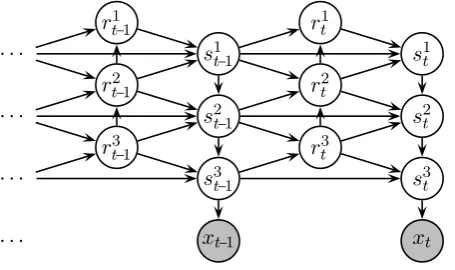
through 22) can be combined in a probabilistic push-down automaton with a bounded pushpush-down store (to simulate the bounded working memory store of a hu-man comprehender). This is essentially an extension of a Hierarchical Hidden Markov Model (HHMM) (Murphy and Paskin, 2001), which obtains a most likely sequence of hidden store statesˆs11..D..T of some lengthT and some maximum depth D, given a se-quence of observations (e.g. words)x1..T:
ˆ
s11..D..Tdef=argmax
s1..D
1..T T
∏
t=1
PθA(s
1..D
t ∣s1t−..D1 )⋅PθB(xt∣s
1..D t )
(33) The model generates each successive store only after considering whether each nested sequence of incom-plete constituents has comincom-pleted and reduced:
PθA(s
1..D t ∣s1t−..D1 )
def
=
∑
r1
t..rDt D
∏
d=1
PθR(r
d
t∣rdt+1sdt−1sdt−−11)
⋅PθS(s
d t∣r
d+1
t r d t s
d
t−1sdt−1) (34)
The model probabilities for these store elements and reduction states can then be defined (from Mur-phy and Paskin 2001) to expand a new incomplete constituent after a reduction has taken place (frdt =
1), transition along a sequence of store elements if no reduction has taken place (frd
t=0):
PθS(s
d
t∣rdt+1rtdsdt−1sdt−1)
def
=
⎧⎪⎪⎪ ⎨⎪⎪⎪ ⎩
iffrd+1
t =1, frdt=1∶PθS-E,d(s d t∣sdt−1)
iffrd+1
t =1, frdt=0∶PθS-T,d(s d
t∣rdt+1rdtsdt−1sdt−1)
iffrd+1
t =0, frdt=0∶Js d t=sdt−1K
(35)
and possibly reduce a store element (terminate a sequence) if the store state below it has reduced (frd+1
t =1):
PθR(r
d t∣r
d+1
t s d t−1sdt−−11)
def
=
{iffrd+1
t =0∶Jr d t =rK
iffrd+1
t =1∶PθR-R,d(r d
t ∣rdt+1sdt−1sdt−−11)
(36)
where s0t = s⊺ and rtD+1 = r⊺ for constantss⊺ (an
incomplete root constituent),r⊺ (a complete lexical
constituent) and r (a null state resulting from the . . .
. . .
. . .
. . .
r3t−1 r2t−1 r1
t−1
s1t−1
s2t−1
s3t−1
xt−1
r3t r2t r1t
s1t
s2t
s3t
[image:5.595.316.544.70.205.2]xt
Figure 1: Graphical representation of the dependency structure in a standard Hierarchic Hidden Markov Model withD=3hidden levels that can be used to parse syntax. Circles denote random variables, and edges denote con-ditional dependencies. Shaded circles denote variables with observed values.
failure of an incomplete constituent to complete). The model is shown graphically in Figure 1.
These pushdown automaton operations are then refined for right-corner parsing (from Schuler 2009), distinguishing active transitions θS-T-A,d (in which
an incomplete constituent is completed, but not re-duced, and then immediately expanded to a new incomplete constituent in the same store element) from awaited transitionsθS-T-W,d (which involve no
completion):
PθS-T,d(s d
t∣rdt+1rdtsdt−1sdt−1)
def
=
{ifrtd=r∶PθS-T-A,d(s d
t∣sdt−1rdt+1)
ifrtd≠r∶Pθ
S-T-W,d(s d
t∣sdt−1rtd)
(37)
PθR-R,d(r d
t∣rtd+1sdt−1sdt−−11) def
=
{ifcrd+1
t =xt∶PθR-R,d(r d
t∣sdt−1sdt−−11)
ifcrd+1
t ≠xt∶Jr d
t=rK (38)
These right-corner parsing operations then con-struct a full inside probability decompositions, us-ing Equations 8 through 13 and Equations 19 through 22, marginalizing out all constituents that are not required in each term:
• for expansions:
PθS-E,d(⟨cηι, c
′
ηι⟩ ∣ ⟨−, cη⟩)def=
EθG-RL∗,d(cη
∗
a) binarized phrase structure tree:
S
NP
NP
JJ
strong
NN
demand
PP
IN
for
NP
NPpos
NNP
NNP
new
NNP
NNP
york
NNP
city POS
’s
NNS
JJ
general
NNS
NN
obligation
NNS
bonds
VP
VBN
VBN
propped
PRT
up
NP
DT
the
NN
JJ
municipal
NN
market
b) result of right-corner transform:
S
S/NN
S/NN
S/NP
S/VP
NP
NP/NNS
NP/NNS
NP/NNS
NP/NP
NP/PP
NP
NP/NN
JJ
strong NN
demand IN
for
NPpos
NPpos/POS
NNP
NNP/NNP
NNP/NNP
NNP
new
NNP
york NNP
city POS
’s JJ
general NN
obligation NNS
bonds
VBN
VBN/PRT
VBN
propped
PRT
up DT
the
JJ
municipal NN
market
Figure 2: (a) Sample binarized phrase structure tree for the sentenceStrong demand for New York City’s general obligations bonds propped up the municipal market,and (b) a right-corner transform of this binarized tree.
• for awaited transitions, from Equation 11:
PθS-T-W,d(⟨cη, cηι1⟩ ∣ ⟨c
′
η, cηι⟩cηι0)def=
Jcη=c′ηK⋅
PθG-R,d(cηι→cηι0cηι1)
EθG-RL∗,d(cηι
0
→cηι0...)
(40)
• for active transitions, from Equations 8 and 13:
PθS-T-A,d(⟨cηι, cηι1⟩ ∣ ⟨−, cη⟩cηι0)
def
=
EθG-RL∗,d(cη
∗
→cηι...) ⋅PθG-L,d(cηι→cηι0cηι1)
EθG-RL∗,d(cη
+
→cηι0...)
(41)
• for cross-element reductions:
PθR-R,d(cηι,1∣ ⟨−, cη⟩ ⟨c
′
ηι,−⟩)
def
=
Jcηι=c′ηιK⋅
EθG-RL∗,d(cη
0
→cηι...)
EθG-RL∗,d(cη
∗
→cηι...)
(42)
• for in-element reductions:
PθR-R,d(cηι,0∣ ⟨−, cη⟩ ⟨c
′
ηι,−⟩)
def
=
Jcηι=c′ηιK⋅
EθG-RL∗,d(cη
+
→cηι...)
EθG-RL∗,d(cη
∗
→cηι...)
(43)
[image:6.595.52.524.86.459.2]d=1
d=2
d=3
word
t=1 t=2 t=3 t=4 t=5 t=6 t=7 t=8 t=9 t=10 t=11 t=12 t=13 t=14 t=15
str ong deman
d
for new york city ’s gene ral
oblig atio
ns bo
nds proppe d
up th e
m unic
ip al
m ar
ket
− − − − − − − − − − − − − − −
− − − −
N N
P /N
N P
N N
P /N
N P
N P
po s/P
O S
− − − −
V B
N /P
R T
− − −
−
N P/N
N N
P/P P
N P/N
P N
P/N P
N P/N
P N
P/N P
N P/N
N S
N P/N
N S
N P/N
N S
S/V P
S/V P
S/N P
S/N N
[image:7.595.83.524.74.201.2]S/N N
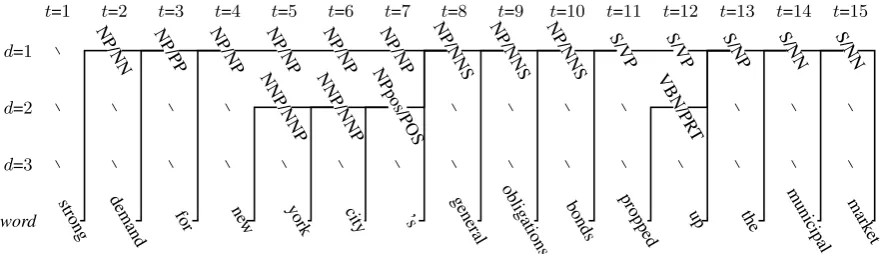
Figure 3: Sample tree from Figure 2 mapped tosd
t variable positions of an HHMM at each depth leveld(vertical) and time stept(horizontal). This tree uses at most only two memory store elements. Values for reduction statesrd
t are not shown.
and as a sequence of store states in Figure 3, cor-responding to the output of Viterbi most likely se-quence estimator. This estimation runs in linear time on the length of the input, so the parser can be run continuously on unsegmented or unpunctuated in-put. An ordinary phrase structure tree can be ob-tained by applying the transforms from Section 3, in reverse, to the right-corner recursive phrase structure tree represented in the sequence of store states.
5 Discussion
This paper has presented a derivation of a fac-tored probabilistic sequence model from a proba-bilistic context-free grammar, using a right-corner transform to minimize memory usage in incremen-tal processing. This sequence model characteriza-tion is attractive as a cognitive model because it does not posit any internal representation of com-plex phrasal structure beyond the pair of categories in each incomplete constituent resulting from the application of a right-corner transform; and be-cause these incomplete constituents represent con-tiguous connected chunks of phrase structure, in line with characterizations of chunking in working mem-ory (Miller, 1956). Experiments on large phrase-structure annotated corpora (Marcus et al., 1993) show this model could process the vast majority of sentences in a typical newspaper using only three or four store elements (Schuler et al., 2008; Schuler et al., 2010), in line with recent estimates of hu-man short-term working memory capacity (Cowan, 2001).
This derivation can be applied to efficiently
in-crementalize any PCFG model, preserving the prob-abilistic dependencies in the original model. But, since the model is ultimately defined through transi-tions on entire working memory stores, it is also pos-sible to relax the independence assumptions from the original PCFG model, and introduce additional dependencies across store elements that do not cor-respond to context-free dependencies. These ad-ditional dependencies might be used approximate dependencies of mildly context-sensitive grammar formalisms like tree adjoining grammars (Joshi, 1985), e.g. to model long-distance dependencies in filler-gap constructions (Kroch and Joshi, 1986), or crossed and nested dependencies in languages like Dutch (Shieber, 1985).
d=1
d=2
d=3
word
t=1 t=2 t=3 t=4 t=5 t=6 t=7 t=8 t=9
th
e bike you said your friend got for ch
ristm as
− − − − −
N P/N
N − − −
− − −
SxN P/V
PxN P
SxN P/S
xN P
SxN P/S
xN P
SxN P/V
PxN P
SxN P/P
P SxN
P/N P
−
N P/N
N N
P/G C
npS N
P/G C
npS N
P/G C
npS N
P/G C
npS N
P/G C
npS N
P/G C
npS N
P/G C
[image:8.595.119.464.74.197.2]npS
Figure 4: Sample store sequence containing long-distance dependency in a filler-gap construction.
d=1
d=2
d=3
word
t=1 t=2 t=3 t=4 t=5 t=6
Jan Pie t
M
arie zag laten zw
em m
en
− − − S/V
P S/VP S/VP
− − S/V
P S/VP S/VP S/S
− S/V
[image:8.595.82.254.243.354.2]P S/VP S/VP S/S S/S
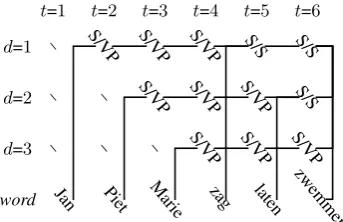
Figure 5: Sample store sequence containing crossed and nested dependencies.
satisfy claims that the model constructs chunks only for contiguous dependency structures (which is not true of propagated ‘slash’ features.
Figure 5 shows a sample store sequence corre-sponding to a parse of a Dutch sentence containing crossed and nested dependencies, featuring reduc-tions across non-adjacent depth levels. This requires a more severe relaxation of PCFG independence as-sumptions, and is beyond the capacity of the HHMM as defined above, but this does preserve the notion of incomplete constituents and general composition established above, and is not beyond the capacity of factored sequence models with human-like memory bounds in general (note that the example sentence can still be parsed with only three store elements). This suggests a promising avenue of generalizing this model to learn parsing transitions that may be broader than those of a strict pushdown automaton.
References
Richard Bellman. 1957. Dynamic Programming. Princeton University Press, Princeton, NJ.
Nelson Cowan. 2001. The magical number 4 in short-term memory: A reconsideration of mental storage ca-pacity. Behavioral and Brain Sciences, 24:87–185. Aravind K. Joshi. 1985. How much context
sensitiv-ity is necessary for characterizing structural descrip-tions: Tree adjoining grammars. In L. Karttunen D. Dowty and A. Zwicky, editors, Natural language parsing: Psychological, computational and theoreti-cal perspectives, pages 206–250. Cambridge Univer-sity Press, Cambridge, U.K.
Anthony S. Kroch and Aravind K. Joshi. 1986. The lin-guistic relevance of tree adjoining grammars. Linguis-tics and Philosophy.
Mitchell P. Marcus, Beatrice Santorini, and Mary Ann Marcinkiewicz. 1993. Building a large annotated cor-pus of English: the Penn Treebank. Computational Linguistics, 19(2):313–330.
George A. Miller. 1956. The magical number seven, plus or minus two: Some limits on our capacity for process-ing information. Psychological Review, 63:81–97. Kevin P. Murphy and Mark A. Paskin. 2001. Linear time
inference in hierarchical HMMs. InProc. NIPS, pages 833–840, Vancouver, BC, Canada.
Carl Pollard and Ivan Sag. 1994. Head-driven Phrase Structure Grammar. University of Chicago Press, Chicago.
William Schuler, Samir AbdelRahman, Tim Miller, and Lane Schwartz. 2008. Toward a psycholinguistically-motivated model of language. InProceedings of COL-ING, pages 785–792, Manchester, UK, August. William Schuler, Samir AbdelRahman, Tim Miller, and
Lane Schwartz. 2010. Broad-coverage incremental parsing using human-like memory constraints. Com-putational Linguistics, 36(1).
William Schuler. 2009. Parsing with a bounded stack us-ing a model-based right-corner transform. In Proceed-ings of NAACL, pages 344–352, Boulder, Colorado. Stuart Shieber. 1985. Evidence against the